Introduction
Gender inequality is a growing concern in the professional video gaming industry. Esports and professional gaming channels are growing more rapidly than ever as a form of globally reaching entertainment. Twitch, the most popular video game channel streaming platform, is presently ranked as the 32nd most traffic-heavy site in the world, ranking ahead of Twitter.com with millions of daily viewers and subscribers. Undoubtedly the market for professional gaming has grown to include a larger and more diverse following than ever. Still, male professional gamers continue to outnumber females by far in their field. According to the 2019 ESA annual report, female gamers represent roughly 46% of all video game players, yet only represent about 5% of the tactical shooter genre that is most commonplace amongst Esports competitions and professional competitive play. For this reason, sites like Twitch that broadcast professional gameplay videos are dominated by male-to-male dialogue between members of all-male gaming teams. These videos offer a unique window into the linguistic patterns of a highly gendered industry that is only growing in popularity and size.
Various studies have been conducted locating the meaning of compliments relative to gender and hierarchy in professional environments. Few however have analyzed male-male utilization of compliments and insults in a professional setting and none have used professional gaming as the sample for researching the operation of evaluative speech acts. Deborah Tannen and Janet Holmes are the loudest voices in academia when it comes to the gendered nature of complimenting. Both have proposed that women tend to perceive complimenting as an expression of positive affect or solidarity while men tend to view compliments referentially or with more emphasis on their objective informational content (Holmes, 2008, p. 11). In You Just Don’t Understand: Women and Men in Conversation, Tannen (1990) argues that for men, complimenting is primarily about asserting one’s authority over the other through evaluation. Even when evaluating someone positively, a person who gives a compliment is asserting that they have the authority to pass judgement on someone else. In return this causes men to occasionally perceive compliments as a face threatening act. Insults, another form of evaluation, are face threatening acts by nature. In an insult, the speaker gives a negative evaluation of some trait, possession, or behavior of their addressee, thereby attacking their positive face (Eckert & McConnell-Ginet, 2013, p. 187). This, coupled with knowledge that even positive evaluations can be used to assert dominance over an addressee, helps to explain why in interaction research, insults are viewed as a way to establish hierarchy and power. Perhaps surprisingly, however, many scholars have also theorized about how insults can be used to strengthen community bonds and establish solidarity. In The Hidden Life of Girls: Games of Stance, Status, and Exclusion, Goodwin (2006) describes both boys and girls trading mock insults as a way to practice verbal skills through play. Kochman (1972) has observed similar mock ritual insult exchanges between boys and theorizes that, while ritual insult can be used as a way to build bonds between addressors and addressees, even if an insult is intended as play, it may be taken seriously and seen as a face-threatening act. This risk is especially high when the insult just exaggerates an actual characteristic of the addressee. This research seeks to determine whether evaluative speech acts are used to build solidarity or enforce power differentials in an all-male professional game setting. Taking into account that there already exist observable power asymmetries between the owners of video game streaming channels and the other players they invite to play with them on their channel, research methods were designed to answer the following question. How are complimenting and insulting behaviors affected by the dominance status? Who pays more compliments and insults? Who is the typical addressee? Based on the prevailing theory that men typically use evaluation to assert their own authority to judge others, I hypothesized that both compliments and insults would flow down the power differential more freely than they flowed up it, and that ownership of a channel would contribute to the hierarchical power distribution.
Methods
Target Population
Research for this study was conducted by recording and analyzing gameplay dialogue between professional male gamers and their male teammates in multiplayer, first-person shooter games. Twitch is a live video streaming website specializing in E-sports broadcasting and personal streams of individual players known as “streamers”. The website operates on a channel and subscriber model in which a streamer runs a channel and amasses followers through streaming content and participating in tournaments. A streamer is able to monetize their channel through endorsing sponsors as well as being gifted small money contributions from subscribers. A typical stream session consists of broadcasted live game footage either solo or with teammates invited to play in a game broadcasted onto the channel. The video game that was chosen for this study was a first person shooter (FPS), battle royale style game titled Call of Duty: Warzone. Gameplay in Warzone is multiplayer, consisting typically of four teams fighting against each other to be the last one standing. Teammates communicate verbally through audio chat to strategize, but the audio communication is often used for socializing in less strategy demanding situations of gameplay. In the context of the gaming platform, the owner of the channel is superordinate to the guest players, and streamers with large followings hold particular status. As of June 16, 2020 TimTheTatman was the 8th most followed Twitch channel, boasting roughly 4.9 million followers and making him one of the most successful professional streamers. In this professional gaming environment, TimTheTatman’s role was analogous to a boss to his guests, some of which were professional streamers themselves but with smaller followings. Guest players were privileged to be on TimTheTatman’s stream and have exposure to his fanbase with no guarantee that they would be invited back again. In this context, the channel owner was the dominant player, and his guests were subordinates, or occupying a position of lower status.
Data Collection & Linguistic Units
This study analyzed six hours worth of gameplay dialogue between TimTheTatman and his channel guests. To collect data, instances of compliments and insults were recorded and tallied noting the speaker and the addressee. Addressors were broken into two categories: the dominant player (TimTheTatman) and non-dominant players (Tim’s three teammates). Addresses were broken into three categories: the dominant player, the non-dominant teammates, and the opponents (players on other teams that were encountered during the game). For this research a compliment was defined as a speech act that attributed credit from a speaker to an addressee, be it explicitly or implicitly, for some trait, action or possession valued positively by both interlocutors (Holmes, 1986, p. 485). An insult, on the other hand, was defined as “a negative appraisal and attack on the addressee’s positive face through implicit blame for what is being criticized” (Eckert & McConnell-Ginet, 2013, p. 187). Once the data was collected, certain calculations were required to accurately compare the data. The number of compliments/insult speech acts made collectively by all three guest players were subsequently divided by three to arrive at the mean number of compliments/insults made per guest player. Guests were not counted individually because there was no conclusive way to distinguish the voices of the three guest players on the audio chat. For that reason, the average number of compliments and insults per guest was calculated instead. The total number of speech acts by each type of speaker was also tallied, as well as the ratio of compliments to insults given by each type of player.
Results
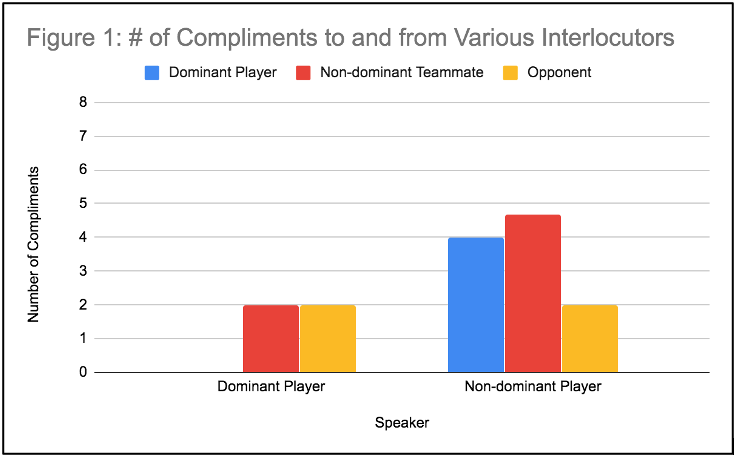
Overall, the data from this study indicated that while the non-dominant player complimented others with more frequency than the dominant player did, the dominant player insulted his teammates more than non-dominant players did. Both dominant and non-dominant players complimented and insulted their opponents at roughly the same rate. As indicated in Figure 1, there was a significant difference in the frequency of compliments given out by the dominant player versus non-dominant players. On average, non-dominant players complimented their teammates and the dominant player twice as often (4 times) as he complimented them (twice). Interestingly, both dominant and non-dominant players complimented their opponents at exactly the same rate (twice). There was no difference between the rate at which the dominant player complimented his teammates and his opponents. However, non-dominant players averaged slightly more than twice as many compliments for their teammates as for their opponents.
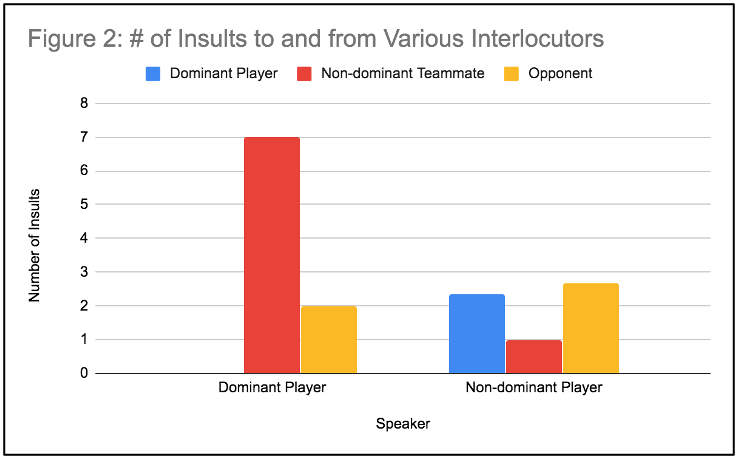
By contrast, Figure 2 shows that the dominant player insulted his teammates at a much higher rate (7 times) than the average non-dominant player insulted him (2.3 times) or other non-dominant teammates. Both the dominant player and the non-dominant players insulted their opponents at roughly the same rate (2 and 2.6 times respectively), and interestingly, this was similar to the rate at which both speakers complimented their opponents. The dominant player insulted his teammates at more than three times the rate that he insulted his opponents. The average non-dominant player insulted the dominant player slightly less than he insulted his opponent, and insulted other non-dominant players even less than that.
In total, dominant and non-dominant players engaged in a similar number of evaluative speech acts. As is visible in Figure 3, the dominant player engaged in a total of 13 evaluative speech acts, and the average non-dominant player engaged in an average of 16.7 evaluative speech acts over the course of six hours of gameplay. The preferred type of evaluation differed by addressor, however.
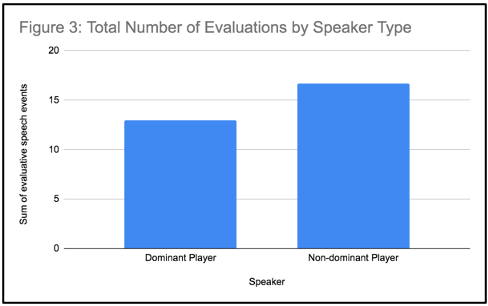
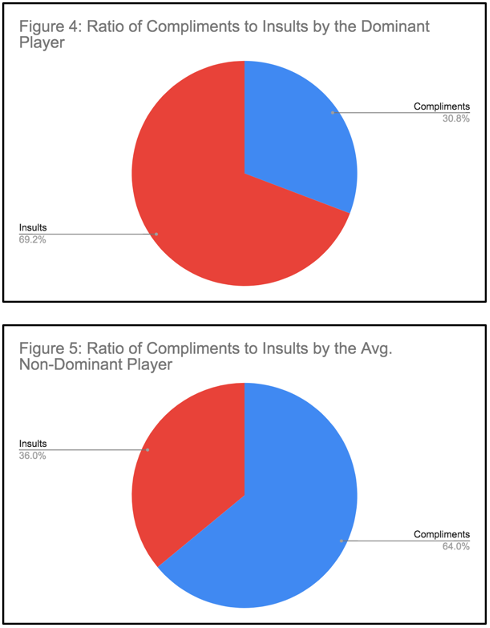
Figure 4 shows that 69.2%, or slightly more than two thirds, of the dominant player’s evaluative comments were insults and only 30.8% were compliments. Conversely, only 36%, or slightly more than a third, of the average non-dominant player’s evaluative comments were insults, while 64% were compliments.
Discussion
In setting out to conduct this research, I hypothesized that evaluative speech acts would be used in all-male gaming settings to assert power and reinforce hierarchy. I expected that the dominant player would engage in more evaluative speech acts than non-dominant players did. The data suggests, however, that the overall frequency of evaluative speech acts does not reflect the hierarchy within this setting as much as the types of evaluations and whom they were directed to do. Both the dominant and non-dominant players had similar numbers of evaluative comments, and, in fact, the non-dominant players made ever so slightly more evaluative comments. The fact that dominant and non-dominant players both complimented and insulted their opponents at a similar rate suggests that evaluating individuals outside of a group is a low-risk way for all players, regardless of hierarchical status, to build solidarity amongst individuals within the group. Goodwin (2006, p. 232) reinforces how insults can function to unite those laughing with the insulter while othering the target. Contrary to my hypothesis, the data showed that while the dominant player had a higher tendency to insult teammates, the average non-dominant player had a higher tendency to compliment. One explanation is that, “implicit in any evaluation is a claim on the part of the evaluator that he or she is in a position to judge the evaluatee. And taking an evaluation seriously attributes this position to the evaluator.” (Eckert & Sally McConnell-Ginet, 2013, p. 180). In other words, the dominant player’s frequent use of insult seems to support the interpretation of evaluations as speech acts used to assert power.
However, the frequency of compliments from the non-dominant player directed toward the dominant player raises questions about this interpretation. One potential explanation is that non-dominant players used compliments to facilitate interaction and create solidarity within the gameplay. This type of compliment use has been frequently observed within groups of women, as well as in co-ed groups where women take on the role of the ‘interactional shitworker’, instigating and facilitating communication between the parties present (Fishman, 1978, p. 398). Given the inferior status of non-dominant players within the Twitch power hierarchy, it seems likely that these players use of compliments in this setting is evidence that they were attempting to deliver positive affect compliments, which have been typically gendered as a more feminine use of complimenting, (Holmes, 2003, p. 143). The difference between the use of compliments as a solidarity building linguistic act as opposed to an evaluative linguistic act is illustrated in the excerpt below.
Excerpt 1

3:59:43-4:00:10

TIM=TimTheTatman        PL1=guest player 1
PL2=guest player 2      PL3=guest player 3

01  PL1:     Tim the Tatman’s~cookin ~now~uh-

02           ((Tim’s character dies))

03  TIM:     I got sniped at the same fucking time I just want to

                                                      fuck myself

04           baby, YEAH:::=

05  PL1:     =(h):::m (h)m (h)m?

            ((laughter followed by 6x slow claps))

06  TIM:     Put it right in my f(h)ucking a:::ss.

07  PL2:     Alright calm down for two seconds I’m coming.=

08  PL3:     =I’m stayin here cause they’re hunting me

09  PL1:     hhhhu hhh (1) hhhhhe:: ((laughter))

10           ((Tim gets revived by PL2))

11  TIM:     Hey thank you Matt you’re a good friend.
Excerpt 1 opens with a compliment from Player 1, a non-dominant player, about Tim, the dominant player. Player 1 observes that Tim is “cookin,” a metaphor implying that Tim is playing well. Although the compliment is about the dominant player, it is not addressed directly to him. Rather, it is addressed to the group and names Tim in the third person. This, coupled with the fact that the compliment evaluates Tim’s playing generally without describing any specific feature of his gameplay, suggests that Player 1 is using flattery to create solidarity with Tim rather than to evaluate him objectively. “Giving praise is inherently asymmetrical,” and compliments given from a high hierarchical position to someone lower are called “praise” while a compliment from a lower position upwards is called “flattery”, (Tannen, 1990, p. 69). Immediately after Player 1 flatters Tim, Tim makes a mistake and his avatar dies. Tim acknowledges the mistake and then adds “I want to FUCK myself baby,” followed by “put it right in my fucking ass”. Often, men use sports metaphors to describe sex, but in this example the inverse is true (Eckert & McConnell-Ginet, 2013, p. 250). Sex, specifically the act of being penetrated, is a metaphor for losing, or dying, in the game. Tim uses misogyny to liken himself to a woman or other passive participant in sex. His use of profanity and hyperbole detracts from the sincerity of the admission that he made a mistake, and therefore diverts blame away from himself. Ironically, by linguistically equating himself with a powerless participant in a graphic sexual act, he is able to save face by avoiding a sincere apology or acknowledgement of his mistake. This outburst spurs Player 2 to put his own avatar at risk to revive Tim’s player, after which Tim says, “Hey thank you Matt, you’re a good friend.” In contrast to Player 1’s compliment, this statement is directed at its subject and directly acknowledges a specific helpful behavior from Player 2. This is a rare instance of compliment from the dominant player, and is in keeping with the observation that when compliments are less frequent, they are more likely to be referentially oriented or genuine expressions of admiration (Herbert, 1990). This compliment garnered no response from the addressee or the other players, which is typical of most compliments in this setting apart from the occasional expression of gratitude. This evaluation allows Tim to assert his authority to evaluate Player 2. Perhaps he does this in part to recover his face after having lost agency in the course of gameplay.
Excerpt 2 illustrates the ways that insults are used to assert power and establish solidarity. It is an outlier situation in which we get to see both dominant and non-dominant players insult each other.
Excerpt 2

4:19:55-4:20:21

TIM=TimTheTatman     PL1=guestplayer 1

01  PL1:     Tim you’re always nowhere near us [fighting people

02  TIM:                                       [ºsh:::: I got this

                                                          shit bro

03  PL1:     ((sarcastic)) Oh here we go

04           ((tim kills opponent))

05  TIM:     wha what did you say Matt,

06  TIM:     ((mocking)) Oh here we go. Yeah look at that shit bro

07  PL1:     Tim I gotta be honest with you man

08           like know your truth. You die a lot=

09  TIM:     =No I do not.

10  PL1:     Tim there’s another guy there’s another guy below

11           you. I mean you are deaf as a fucking.

12  TIM:     under me::?

13           (3)

14  Tim:     ºI’m so confused bro
This excerpt begins with a non-dominant player implying that Tim is too far away from his teammates, to which Tim tries to reassure Player 1 that he “got this shit,” and is therefore in control, not a liability. Player 1 responds in an exasperated tone, implying that he doesn’t trust Tim not to mess up. His use of sarcastic tone suggests this is an instance of an off-record request using irony (Brown and Levinson, 2014). The implied request is that Tim not enter into combat by himself. Rather than accepting the request, Tim quickly questions and repeats Player 1, in effect insulting and mocking him. Even though non-dominant players rarely insult Tim, overtly or implicitly, in this instance, Tim responds to Player 1’s suggestion as if it were an insult. This is a reasonable reaction considering Eckert & McConnell-Ginet posit that “comments can be taken as serious insults even if not so intended” (Eckert & McConnell-Ginet, 2013, p.188) . He sees it as a face threatening request and he questions player 1’s right to challenge Tim. He then mocks Player 1’s indirect, less confrontational, and more stereotypically feminine speech style by repeating the phrase “Oh here we go,” in a mocking tone. This indirect insult reaffirms Player 1’s subordinate status. What follows in lines 6 to 11 is an escalated series of insults from Player 1 and more deflections from Tim. Given the tone of the insults, this seems to be an example of “mock ritual insult” (Kochman, 1972, p. 314). The teammates seem to be verbally jousting more than they are giving serious insults. Tim holds his face throughout the whole altercation. He didn’t give legitimacy to any of the insults by evaluating them as false. In this way he was able to maintain face by resisting imposition (Brown and Levinson, 1987).
Conclusion
The total amount of evaluative speech acts had no bearing on enforcing power differentials in an all-male professional game setting. Insults flowed down the power differential more frequently as expected, but contrary to my hypothesis, compliments flowed up it more frequently. This was ultimately attributed to non-dominant players’ assumption of a more typically feminine speech style that utilized compliments effectively to boost solidarity. This exposes how gendered hierarchies are present in language between men, even when no women are present.
One limitation of this study was difficulty distinguishing the voices of guest players. In a future study a stream in which the voices of players could be distinguished via timbre and pitch would be preferable. This study also only analyzed one small slice of the gaming world. Future studies could benefit from analyzing a wider spectrum of games and streamers that might reflect different power hierarchies. In addition there are more nuanced speech acts such as declaratives which were far more frequently occurring than compliments and insults. I would encourage subsequent studies to analyze other evaluative speech acts in male-male gameplay and how they operate to assert a hierarchy. This research unsurprisingly shows that language between males in professional gaming ascribes to strict patriarchal tendencies. This is important to understand in the growing field of professional gaming, and this language must be challenged if women are to have a more representative presence in the profession. Certain Twitch streamers such as KittyPlays are paving the way for the next generation of female pro gamers by challenging sexist language as it is encountered real time during her stream. Nonetheless, given that hidden biases are likely to perpetuate in this domain through language even if there are more professional female players, more studies should look into gender hierarchy’s implications on the gaming world given its influence over language in popular culture.
See also:
HALO 3: Negative comments by gender
SEXISM IN VIDEO GAMING: Online harassers are literally losers?
Bibliography
Berger, P. L. and T. Luckmann (1966). The Social Construction of Reality: A Treatise in the Sociology of Knowledge. Garden City, NY: Anchor Books.
Brown, P. & Levinson, S. C. (1987). Politeness: Some universals in language usage. Cambridge: Cambridge University Press.
Eckert, P. & McConnell-Ginet, S. (2013). Language and Gender. Cambridge: Cambridge University Press.
Fishman, P. (1978). Interaction: The Work Women Do. Sociolinguistics by N. Coupland and A. Jaworski. London: Palgrave.
Goodwin, M. H. (2006). The Hidden Life of Girls: Games of Stance, Status, and Exclusion. Oxford: Blackwell.
Herbert, R. K. (1990). Sex-based Differences in Compliment Behavior. Language in Society, vol. 19. Cambridge: Cambridge University Press.
Holmes, J. (2003). Complimenting: A positive politeness strategy. Sociolinguistics: The essential readings. ed. by Christina Bratt Paulston and G. Richard Tucker. Malden, MA: Wiley-Blackwell.
Holmes, J. (2008). An introduction to Sociolinguistics. London: Pearson Education Limited.
Kochman, T. (1972). Rappin’ and Stylin’ Out: Communication in Urban Black America. Chicago: University of Illinois Press.
Tannen, D. (1990). You just don’t understand: Women and men in conversation. New York: William Morrow.
twitch.tv Competitive Analysis, Marketing Mix and Traffic – Alexa”. www.alexa.com. Retrieved June 16, 2020.