bilingualism

Native English Speakers and Bilingual Speakers with English as L2, Difference Between their Syntactic Knowledge Acquisition

Viktoria Hovhannisyan, Alisara Koomthong, Tomoe Murata, Kota Tsukamoto

Syntactic knowledge is the understanding of the connection between the words in a sentence. This skill develops over time in children when being exposed to a language from their environment. Previous research demonstrated that bilinguals show different structured outcomes for language and cognitive performance, in terms of being at disadvantage. This study argues that bilinguals with English as a second language speakers who grew up acquiring English tend to develop syntactic awareness more effectively and, as a result, perform better on grammatical tasks as opposed to native English speakers. We collected data from 20 undergraduate students and asked them to complete grammar tasks along with answering questions that would reveal the level of their syntactic knowledge. We found that native English speakers are more knowledgeable in syntactic structures based on their scores than international bilingual English speakers.

[expander_maker id=”1″ more=”Read more” less=”Read less”]

Intro & Background:

This study is designed to test two populations, native English speakers and non-native English speakers in the adult population. The research is aiming to observe metalingual awareness, more specifically syntactic awareness in adult monolingual and bilingual populations. To narrow down our focus of the study, we will not be assessing any other aspects of language, such as phonological awareness, vocabulary size, or accent.

Over the years, various studies have suggested that bilingual speakers have disadvantages in language and cognitive performance.  For example, one study has demonstrated that bilingual children develop vocabulary more gradually in each language and perform poorly on language proficiency tasks than monolingual speakers of the same language (Bialystok and Feng, 2011 & Oller and Eilers, 2002). Additionally, another study has shown that adult bilinguals have limited vocabulary size (Portocarrero, Burright, & Donovick, 2007). They also produce fewer words in verbal fluency tasks (Rapp, 2005). This topic has been very well researched, and the results of several studies have actually shown that there is a disadvantage to bilingualism.

However, the study that was conducted on the children population found that bilingual children sometimes perform better than their monolingual peers on grammaticality judgment task which is a form of assessing metalinguistic awareness (Foursha-Stevenson & Nicoladis, 2011). They argue that some of these differences can be accredited to the fact that bilinguals have to learn to control attention to language choice. Based on the results where the children undergo those differences, we believe that the same concept applies to the adult bilingual population. Furthermore, a study that tested the effects of monolingualism-bilingualism on a foreign language learning using a grammatical judgment task showed that bilinguals performed significantly better than monolinguals after adolescence, although there was no difference in performance before adolescence (Yeganeh 2013). The author also points out that being bilingual is effective for foreign language acquisition after adolescence and they achieve higher results in the learning process. In short, two different studies suggest that bilinguals perform better than monolinguals on grammaticality judgment tasks during childhood and after adolescence. Moreover, we believe that native English speakers do not typically spend as much time learning grammar rules as the bilingual population, since they acquire language naturally (i.e., family, friends, schools, home, community). Whereas the non-native speakers who grew up in a foreign language environment generally square language in the school setting where they get formal lessons on topics such as syntactic rules. Considering this difference in both populations in addition to the bilingual advantage in grammar judgment tasks, we predict that non-native English speakers would perform better on grammatical assessment than native English speakers.

Methods:

To test our hypothesis, we collected 20 responses from undergraduate college students, 8 male and 11 female and 1 other, who are either native monolingual English speakers or bilingual English speakers. We assumed that the ideal bilingual candidate should have learned English at around elementary school or after. As for an ideal native English speaker, they should not have been exposed to any second language input from the time of birth to about 7 years old. This reasoning was based on the critical period hypothesis, which argues that there is an ideal time window to acquire language in a linguistically rich environment and after that period it is much harder to acquire language (Bailey, Bruer, Symons, & Lichtman, 2001).

The study consists of two parts which was aimed to generate data about an individual’s English language skills and beliefs. The first part of the survey asked a series of bibliographical questions relating to their personal background and their history with language acquisition. Some of the questions were the following: “Is your first language English?”, “Do you speak a language other than English natively?”, “At what age were you first exposed to the English language?” etc.  The second part of the survey asked all participants to take the “Michigan ECPE” grammar test which consisted of about 10-15 sentences that were designed to test an individual’s English grammar level. We used the highest level of the test since we were testing both native and non-natives college students who most likely already reached proficiency in the English language. Here is one of the examples of the grammar assessment.
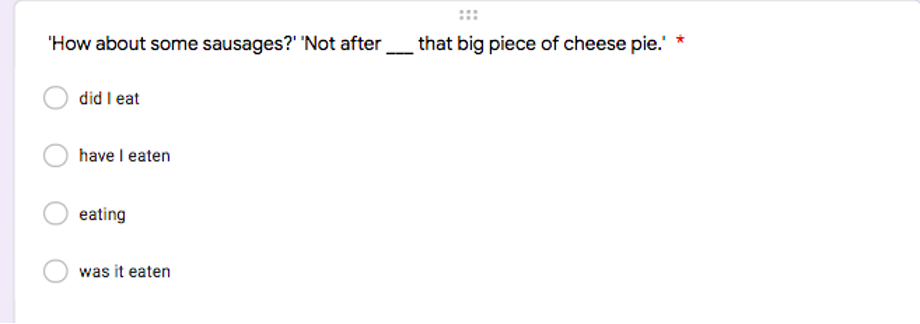
To test the metalinguistic awareness of grammar of the individuals, we will modify the “Michigan ECPE ” grammar test and add a section after each sentence where participants will be asked to explain as to why they believe the answer they chose is grammatically correct. To analyze and evaluate the feedback of an open-ended response, we will categorize the response based on some key components of the response. First, we will be looking for key terminology used in the response. If the participant explains their answer giving the exact grammatical rule they applied, we would count that the participant has meta-knowledge about the syntactic rules and we will assign full credit for their response. When the participant does not define their answer using terminology but explains the gist of the rule then a full credit would be given for their response. If the participant does not use terminology nor explain the rule’s gist but rather gives a logical answer that explains their reasoning, we would assign a half-credit for their answer. Lastly if the participants give a very generic explanation such as “it sounds just right” or “I feel like it matches with the sentence” then we would not assign any credit to their explanation since it is lacking the source of their meta-knowledge. 

To test the link between participants’ confidence level and proficiency, we will ask the participants to rate their confidence level after each question. Additionally, at the end of the questionnaire we asked participants if they have ever received formal lessons on English grammar during the schooling years. This step is crucial to determine the exposure of language input through the development of the participants.

Results & Analysis:

Based on the results, there was not a definite or clear trend that can confirm or annul our hypothesis. Our first group of participants, native English speakers, the majority of them scored much higher and are more confident than our bilingual speakers with English as L2 participants, which goes against our hypothesis.
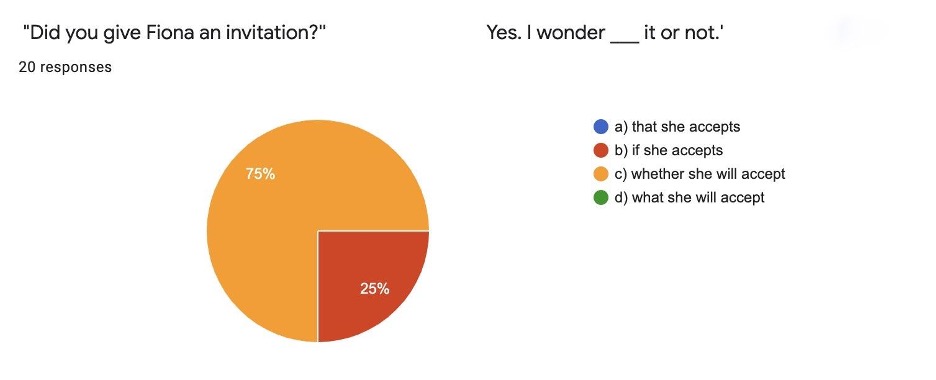
Figure 1

Figure 1 presents one of our questions that we’ve given to our participants. We believe that this question gives an accurate representation of our overall results. 75% of the participants scored correctly and within that percentile, 73% are native English speakers. The other 25% that answered incorrectly, most of them were internationals (80%). However, we also decided to look further into Question 10 where our participants struggled the most.
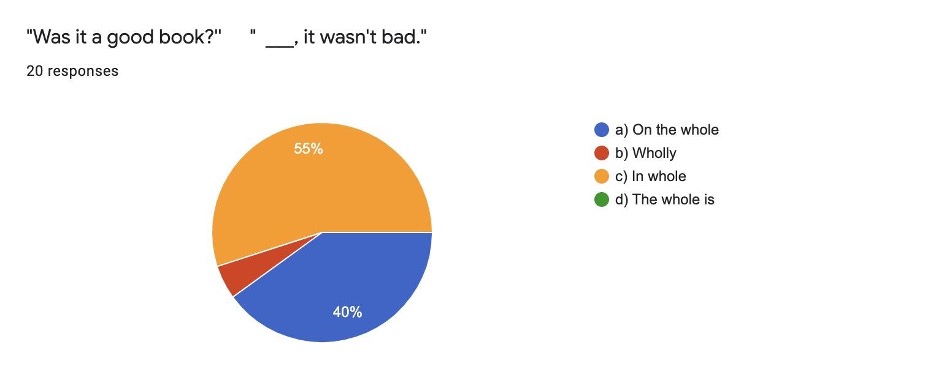
Figure 2

As shown in Figure 2, 60% of the participants chose “In whole” which was incorrect. Within that percentile, 33% were international bilingual speakers and 67% were native English speakers. This resulted in a large portion of the participants that answered incorrectly were native English speakers. As for the ones that answered correctly, 50% were bilinguals and 50% were native. From this, we concluded that the question might have been too complicated which gave us mixed results.

Even though most of the participants that scored highly were English speakers, there were some bilingual speakers that scored very highly. Looking at each participant, we noticed a pattern occurring in international bilinguals that did well: all were exposed to the English language at a young age.
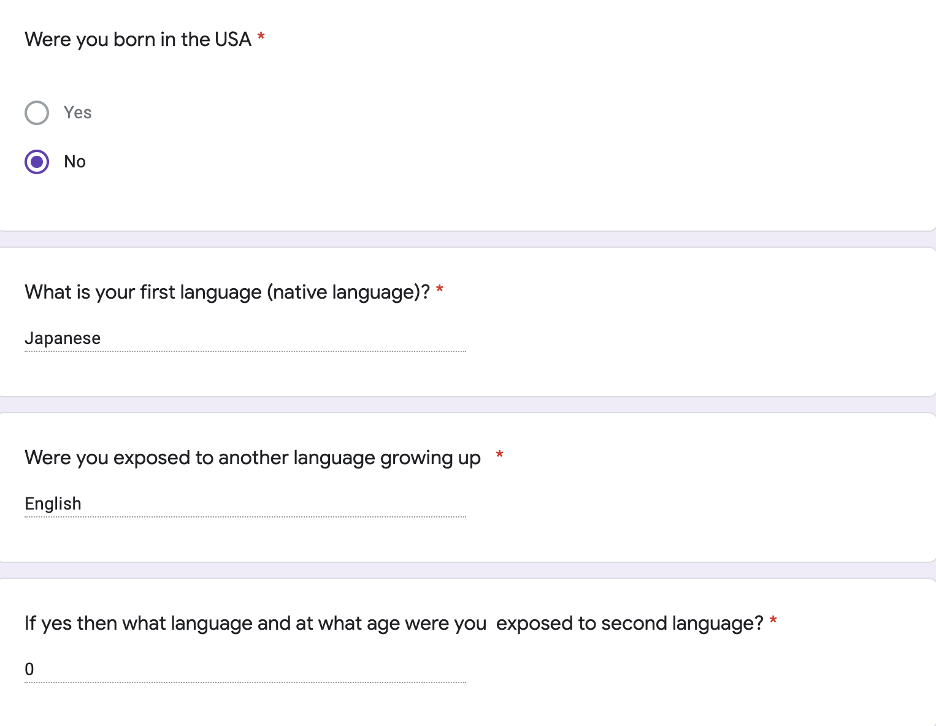
Figure 3

Figure 3 above is our ninth participant that scored 11/11. She was one of our two participants that got a perfect score with the other one being a native English speaker. As shown in Figure 3, she has been exposed to the English language at a very young age, even though she grew up in a foreign environment. Due to this observation, we analyzed the international bilingual speakers that did poorly on the assessment and noticed that they were not exposed to English until either in high school or college.

In terms of confidence level, most of the participants scored average or high after they finished the test. Only two participants scored low, ranging from 3 to 5 out of 10, on their confidence spectrum. Overall, native English speakers placed their confidence level higher than international bilingual speakers as shown in Figure 4 below.
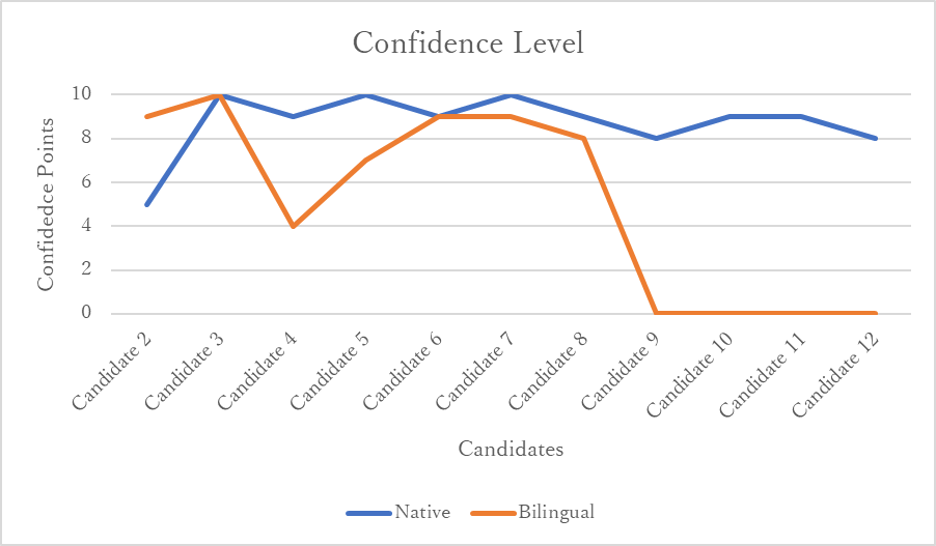
Figure 4 (Bilingual candidates 9 to 12 are 0 because there are no candidates).

Discussion & Conclusion:

Based on our findings, it did not align with our hypothesis. In page 3, “Methods” section, sentences from line 3 explains in detail that since we expected the international bilinguals with English as L2 to have more proficiency in syntactic knowledge, the result turned out to be quite the opposite. The points that we mentioned are probably the amount of time people have spent learning English. For the candidates, we only divided them into native English speakers and non-native English speakers. It could have been more detailed since international bilinguals do not always have proficiency in two languages. Additionally, we have not gathered their morphological knowledge, such as speaking and listening, so it is difficult to consider whether a candidate is proficient enough in the language. According to the article “Retaining an accent,” by Francois Grosjean, not every person growing up in the same country does have the same language level, and it will depend on their living environment (see paragraph 9 and 10 on Retaining an Accent). The project allowed us to gather a lot of information about them. Still, at the same time, we found a few points that we needed to adjust or add to proceed with a more detailed project.

For future reference, we believe this experiment is just the beginning of analyzing the bilingual’s and native speakers’ knowledge of English. To make the research more precise, we could separate the bilingual candidates in detail, such as bilinguals who grew up with English as their L1 and bilinguals who grew up with English as their L2. Both candidates have the categorization of bilinguals, but their level of proficiency will turn out different by their background in learning the language. It will indeed affect their knowledge when they are exposed to speaking English as their L1 and L2. Focusing on their ages will also make the project more solid. We gathered their ages but did not reference our analysis. Therefore, if we were to continue working on this project, we would want to focus more on the relationship between age and language. According to Inna Figotina, an educator, the age of a person starting to learn a language will affect their engagement with the language (listen after 21:00 on The Future is Bilingual). On the methodology, we could have set the questions more simply (see page 4, paragraph 3, “Methods”). We will change the difficulty of each quiz by putting Q1 as very easy and Q10 as most difficult. For our research, this method will allow us to figure out the English level, and we can create more analysis on each candidate group; native English speakers did not score perfectly but many got the difficult questions correctly, and many international bilingual candidates got high points but none of them got difficult questions correct. By changing these methods and the target participants, we could gather the information for a deeper analysis of the relationship between bilingualism and English.

In conclusion, research on bilingual speakers and native English speakers allowed us to recap the behavior and the attitude toward the language. Many of the previous experiments and the research supported our hypothesis. However, the result was not the one that we expected. We still believe in our hypothesis that native speakers will not take much effort into learning their own language (English) compared to non-native or international bilingual speakers. However, it can be interesting to figure out how learning will always relate to how they will master one language. Overall, the research brought us to a new idea of bilingualism and the behavior toward their language, and we will continue to focus on that point.


References:

Bailey, Bruer, Symons, & Lichtman (2001) in Bailey D.B., Bruer J.T., Symons F.J., Lichtman J.W. (Eds.). (2001). Critical thinking about critical periods. Baltimore: Paul Brookes.View Full Reference List)

Bialystok, E., & Feng, X. (2009). Language proficiency and executive control in proactive interference: evidence from monolingual and bilingual children and adults. Brain and language, 109(2-3), 93–100. https://doi.org/10.1016/j.bandl.2008.09.001

Cummin, J. (2004). D. Kimbrough Oller & Rebecca E. Eilers (eds), Language and literacy in bilingual children. Clevedon, England: Multilingual Matters, 2002. Pp. vii 310. Journal of Child Language, 31(2), 424-429. doi:10.1017/S0305000904226290

Foursha-Stevenson, C., & Nicoladis, E. (2011). Early emergence of syntactic awareness and cross-linguistic influence in bilingual children’s judgments. International Journal of Bilingualism, 15(4), 521–534. https://doi.org/10.1177/1367006911425818

Grosjean, François. (2013). Having an accent in a language. Psychology Today,  https://www.psychologytoday.com/us/blog/life-bilingual/201301/retaining-accent

Portocarrero, J. S., Burright, R. G., & Donovick, P. J. (2007). Vocabulary and verbal fluency of bilingual and monolingual college students. Archives of clinical neuropsychology : the official journal of the National Academy of Neuropsychologists, 22(3), 415–422. https://doi.org/10.1016/j.acn.2007.01.015

Rapp, B. (2015). Handbook of Cognitive Neuropsychology: What Deficits Reveal about the Human Mind. Psychology Press. Philadelphia 2001, pp. 321-345.

Google. (n.d.). The future is bilingual – 1 year as a published author – interview with inna. (2021) Google. Retrieved May 20, 2022, from https://podcasts.google.com/feed/aHR0cHM6Ly9hbmNob3IuZm0vcy8yNmVlZTNkNC9wb2RjYXN0L3Jzcw?sa=X&ved=0CAkQlvsGahcKEwjQ_s2E29r3AhUAAAAAHQAAAAAQAQ

Yeganeh, M. T. (2013). Age constraint on foreign language learning in monolingual versus bilingual learners. Procedia – Social and Behavioral Sciences, 70, 1794–1799. https://doi.org/10.1016/j.sbspro.2013.01.255

[/expander_maker]
, , ,

Does accent hold-over depend on the conversational context? A comparison of conversations between two bilinguals and a bilingual-monolingual pair

Theo Chen, Joan Kim, Yoori Kwak, Sumeyye Nabieva

In our study, we explored code-switching and accent hold-overs for Korean-English bilinguals. Accent hold-overs are theorized to happen when a person is code-switching from one language to another, and refers to a lag in the switching of phonological inventories. While a similar effect has been found in processing, there isn’t a consensus on such a phenomenon in production. This has both psycholinguistic and sociolinguistic implications, as it explores both actual language production as well as sociocultural factors that might influence bilingual speech.

We ran a small experiment in which Korean-English bilinguals read off a script to either another Korean-English bilingual or to an English monolingual. Our script included both borrowings and code-switching. We expected that we would see more of an accent hold-over during code-switching when Korean-English bilinguals spoke to each other. However, we found no evidence of an accent hold-over than expected. This is supported by some additional studies on the topic but could also be a result of our methodology and process, as opposed to an actual reflection of bilingualism.

[expander_maker id=”1″ more=”Read more” less=”Read less”]

Introduction and Background

Code-switching is a linguistic phenomenon where speakers who are fluent in more than one language quickly change from one language to another while they’re speaking. It’s very common and is often tied to sociocultural factors. For example, a person might code-switch when they need to use a specific word that is cultural and doesn’t have a good translation in another language. They might also code-switch to show others that they are fluent in multiple languages and to connect themselves to a certain identity or heritage (Myers-Scotton, 1993).

We define accent hold-over as the transmission of the phonological system of one language to speech in another language, tied to code-switching. For example, imagine that a person who speaks both Korean and English is talking to a parent in Korean. They might briefly code-switch to English to say a short word or phrase, such as a person’s name or a culturally-related phrase, before switching back to Korean. We would potentially see an accent hold-over as they are switching between the two languages. Because the phonological systems, or the sounds present in the language, are very different between Korean and English, a person’s speech might be more accented than their normal speech for a short period of time.

Grosjean (1988) studied this phenomenon, which he called the “base-language effect,” and found that it exists in language processing. When two bilingual people are speaking and one person code-switches to another language, the person listening to them experiences a small lag in processing what they’re hearing. Their brain expects to hear sounds from the previous language, and needs a brief period of time to adjust and switch to the other language. A later study by Grosjean & Miller (1994) didn’t find this in language production, but research has been mixed. Some, such as Olsen (2013), have found this hold-over effect in production, while others, such as Šimáčková & Podlipský (2018), have not. Overall, there hasn’t been much research in this area, and past research has not focused on the impact of a speaker’s linguistic background.

In our study, we will look at how Korean-English bilinguals interact with each other, compared to how a Korean-English bilingual interacts with an English monolingual speaker. Our goal is to investigate how vowel and consonant sounds change (or remain the same) as a person switches between Korean and English mid-sentence. We chose these two languages partially out of convenience, because there are many Korean-English bilinguals in this area, and two of our group members are also Korean-English bilinguals. But we also considered the phonological inventories of the two languages: Korean and English have very different sounds, which could amplify these effects. Going into this experiment, we hypothesized that Korean-English bilinguals would code-switch and show more of an accent holdover effect when talking to a Korean-English bilingual compared to a monolingual English speaker.

Similar to the hold-over effect, Maye et al. (2008) showed that when listeners heard a segment of Wizard of Oz where the vowels were shifted down in the vowel space, listeners were easily adapted to the accent change. The listeners were then able to find a plausible implementation of the shifted accent in other real words. Based on this case study, we can argue that bilingual speakers who hear the hold-over accent in other speakers may be able to use it in their own speech as well, once they are accustomed to the sound changes. However, because our speakers will be reading a prewritten script that is written in both English and Korean, it is possible that the orthography of the script may elicit some accent adaptation (Norris et al., 2003).

More generally, we are also looking at Korean phonetic code-switching when reading Korean words in English sentences. Additionally, other factors that could affect code-switching in this instance include prosodic flow, language dominance, community norms (Myers-Scotton, 1993), and the bilingual’s personal language practices and fluency (Poplack et al. 2020). Poplack et al. (2020), when looking at the phonology of English borrowings spoken by French-English bilinguals, also found that there was a large amount of variation between different groups of consonants, so we will be investigating both consonants and vowels in this experiment.

Methodology

To explore our research question, we ran a small experiment: we gave pairs of participants a script to read off of, and recorded and analyzed their speech. We ended up with two pairs of participants. One pair had two Korean-English bilinguals, both of whom have lived in Korea and the United States and considered themselves fluent in both languages. The other pair had one Korean-English bilingual, who had also lived in both Korea and the United States, and a monolingual English speaker who wasn’t fluent in any other language and had little to no exposure to Korean. We accepted the language background that our participants told us, but a more extensive study should include a language test to formally assess this.

Our script was written by two Korean-English bilinguals, Joan and Yoori. The script had two speakers. Speaker one’s part was entirely in English but had Korean food borrowings: Korean words referring to cultural foods, transliterated into English text because English equivalents don’t exist. For example, we included the words ‘kimbap’ and ‘hangook hotdog.’ Speaker one was designed so any English speaker, regardless of their knowledge of Korean, would be able to read it. On the other hand, speaker two spoke mainly in English but code-switched to Korean. This code-switching was indicated in the script using Hangul, the Korean alphabet, unlike the food borrowings for speaker one that were in the English alphabet. By writing the words in Hangul, we indicated that speaker two should be entirely switching from English to Korean. Then, we could see how these mid-sentence code-switches changed the speaker’s English phonology and pronunciation.

Analysis ended up being a little difficult for us. We originally wanted to look at the sounds in Praat, but that ended up being unrealistic given the nature and scope of our experiment. Our main method of analysis was listening to our recordings by ear, because we had both English speakers who didn’t have exposure to Korean and Korean-English bilinguals. We looked at the phonological inventories for both languages to make sure we had accurate intuitions and picked out notable segments.

Results and Analysis

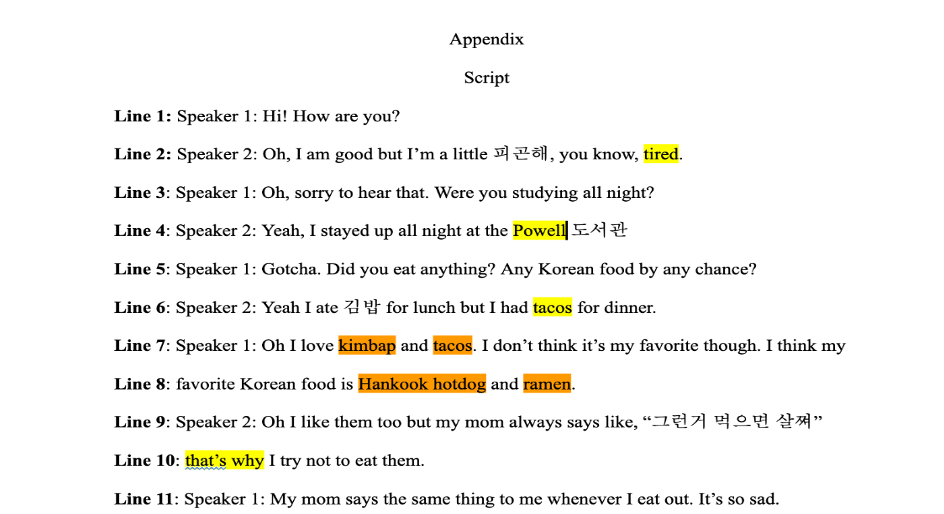
After recording the participants, we listened to the speech by ear. We expected words before and after a Korean word to have an accent holdover. Interestingly, there were no accent holdovers in the words we expected them to be. For example, in line 2 (see Figure 1), the word tired is pronounced [ˈtaɪəɹd] instead of [ˈtaɪjəd]. We also predicted that proper names would contain accent holdovers, such as in line 4 when the participant is asked to read Powell Library, but with the word library in Korean. Instead of pronouncing it as [pa:ul], the word Powell was instead pronounced as [ˈpaʊəl] by both bilingual speakers reading speaker 2 lines. Our script also gave opportunities to pronounce Korean food names, as well as a different nationality’s dish to see if food in a different culture and language would also be pronounced with a Korean accent holdover. We provide this in lines 6 and 7. While both bilingual speakers reading speaker 2 lines pronounced the Korean word kimbap in the proper Korean pronunciation, the word tacos in the same sentence was pronounced in a standard American accent as [ˈtɑkoʊz] instead of [ˈtakoz] as predicted. Interestingly, when the bilingual speaker was reading the speaker 1 script in line 7, the word kimbap and tacos was spoken in an American accent, rather than in the Korean pronunciation. However, an explanation for this would be that in line 7, the word kimbap was written in English instead of in the Korean orthography, possibly causing the bilingual speaker reading that line to have chosen to not read it in Korean.

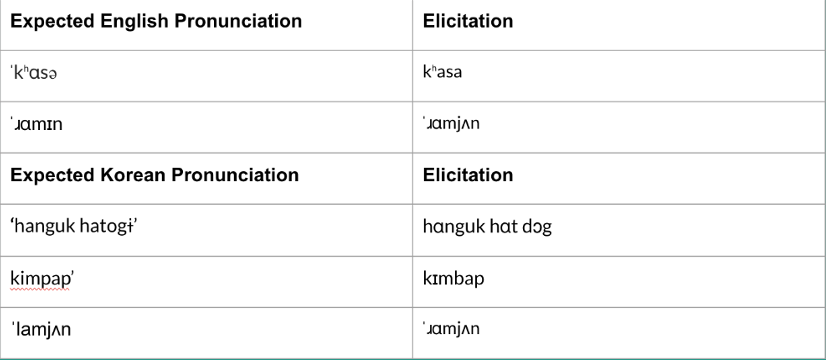
Figure 1. A portion of the script read by the participants. Words and phrases where accent holdover was expected are labeled in yellow. Borrowed words related to food, interpreted as opportunities for code-switching, are labeled in orange.

One thing to note is that when the Korean-English bilingual speaker was reading speaker 1’s line in the script, all Korean food names were read in the standard American accent. For instance, in lines 7 and 8, the words kimbap, hangook hotdog, and ramen were expected to read as [kimpap’], [‘hanguk hatogɨ’], and [ˈlamjʌn] respectively. Instead, the words were elicited as [kɪmbap], [hɑnguk hɑt dɔg], and [ˈɹɑmjʌn]. [ˈɹɑmjʌn] particularly stood to us during our analysis because it appeared to be a combination of a standard American accent and the Korean accent. More specifically, the first syllable is pronounced with the [ɹ] that is not found in the Korean phonemic inventory, but the second syllable is pronounced [mjʌn] as a Korean speaker would.

Another accent incident we noticed was that both bilingual speakers reading speaker 1’s line produced a club’s name in a Korean accent. The club, KASA, or Korean American Student Association, was expected to be pronounced as [ˈkʰɑsə], but was instead produced as [kʰasa] by both speakers.

Figure 2. A chart of words that were pronounced differently than what we expected. Ramen is written twice because both English and Korean say the same word distinctively.

Discussion

Overall, we did not find any evidence of an accent holdover when bilinguals switched between Korean and English. In every instance of code switching, we observed that the accent being produced changed immediately along with the language in which the corresponding word was meant to be read. The previously mentioned cases that we found (e.g., the case of “KASA”) seem to be instances of code-switching, as opposed to accent holdover. This would indicate that there is no phonological accent holdover effect for bilinguals, reflecting the findings of Grosjean & Miller (1994) and Šimáčková & Podlipský (2018). This suggests a high level of flexibility in language systems and instantaneous or near-instantaneous shifts between languages, as past research has also indicated.

We did, however, have other particularly interesting findings almost entirely unrelated to accent hold-overs.  For instance, the words “KASA” and “ramen”, while formed or written in the script in English, were pronounced at least in part with a Korean phonemic inventory. This might suggest that there is a code switch for words that relate to Korean culture or identity, even if they are not formed in the Korean language in the script or in general.

When it comes to accent holdovers themselves, because of a number of limitations, we are not confident that our results definitively demonstrate that accent holdovers do not exist. The small sample size of participants was one, as we only tested one pair of speakers per context (bilinguals speaking to each other vs. a bilingual and a monolingual speaking). The sample size is especially notable due to high variation among bilingual individuals, which means that we may be required to recruit a larger sample size to account for this variability and to be able to construct a meaningful average.

Perhaps our most significant limitation is the fact that the context in which participants had to elicit words was largely unnatural, as it was based entirely off of a prepared script. While it was difficult to find an efficient way to elicit the data we needed for analysis, the scripted nature of elicitation could have affected results in unforeseen ways. Chief among these is the fact that Korean and English have radically different orthographies, which, over the course of this study, often forced us to choose how to spell certain target words such as “ramen”. Therefore, the scripted nature of the experiment might also yield an alternative explanation as to why the word “ramen” was pronounced the way it was: a word originally formed in Korean, it was spelled in its English borrowed version in the script, yielding a potential confusion within the bilingual speaker as to how he ought to pronounce the word he was reading (and therefore an odd code-mix). There is also a possibility that the speakers were conscious of their pronunciation after they noticed that their voice was going to be recorded. This might have made them more focused on pronouncing English words in the English inventory and Korean words in the Korean inventory so that neither their English nor their Korean would sound “butchered” or their transition would seem “incomplete” to the recording and listening experimenters. Considering all of the above-mentioned limitations, our results become difficult to interpret.

Conclusion

Despite suggestions of differences in language processing when it comes to perception of accent change in bilingual speech and code-switching, accent holdovers have not yet been observed in speech of bilinguals to one another, or in speech of a bilingual that is directed to a monolingual. There are several ways the limitations of this particular study could be addressed, but ultimately it appears that code-switching is instantaneous and happens not just on a general word level, but on the phonemic level as well: the inventories switch as much as does the vocabulary. This may illustrate a broader trend in that the multiple languages are placed in the bilingual speaker’s mind as different systems that, even when somewhat mixed (like in code-switching), remain firmly separated.


References

Grosjean, F. (1988). Exploring the recognition of guest words in bilingual speech. Language and Cognitive Processes. 3, 233–274.

Grosjean, F., & Miller, J. L. (1994). Going in and out of languages: An example of bilingual flexibility. Psychological Science, 5(4), 201–206.

Myers-Scotton, C. (1993). Social Motivations for Code-Switching: Evidence from Africa. Oxford: Clarendon Press.

Poplack, S., Robillard, S., Dion, N., & Paolillo, J. C. (2020). Revisiting phonetic integration in bilingual borrowing. Linguistic Society of America, 96(1), 126–159.

Maye J., Aslin R. N., Tanenhaus M. K. (2008). The weckud wetch of the wast: lexical adaptation to a novel accent. Cogn. Sci., 32, 543–562.

Norris D., McQueen J. M., Cutler A. (2003). Perceptual learning in speech. Cogn. Psychol., 47, 204–238.

Olson, D. J. (2013). Bilingual language switching and selection at the phonetic level: Asymmetrical transfer in VOT production. Journal of Phonetics, 41, 407–420.

Šimáčková, Š., & Podlipský, V. (2018). Patterns of short-term phonetic interference in bilingual speech. Languages, 3(3), 34. MDPI AG.


[/expander_maker]
Ukraine in Transition: The Process of Reducing Russian Language Usage

Iscelle Abad, Zhuoen Li, Ira Throne, Ryan Tsai, Max Yudowitz

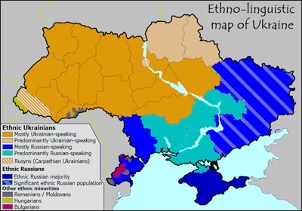
With the ongoing invasion of Ukraine, language in the country is changing. In response to the war, many natives have expressed a desire to switch their primary language in daily life from Russian to Ukrainian. Although it’s been a while since it was conducted, the 2001 All-Ukrainian population census estimated that roughly 29.6% of the Ukrainian Population spoke Russian as a native language, equalling roughly 14.3 million people. Since there has been no new census conducted in over 10 years, it’s hard to approximate the exact number of Russian and Ukrainian speakers today. However, a recent 2022 national poll conducted by the independent sociological research group RATING (Рейтинг) showed that, among respondents, in the last 10 years the number of native Ukrainian speakers has steadily grown from 57% in 2012 to 76% in 2022 with the percent of native Russian speakers at around 20%.

Figure 1: Map showing the distribution of languages and ethnicities in Ukraine.

Given that a fair number of the population are not completely fluent in Ukrainian, the attempt to switch over has not been easy for everyone. The adjustment of switching primary language within a community is usually a long-term process spanning generations, but given the unique circumstances, many Ukrainians are going through it at an accelerated pace within just a few months.

Since this is a turning point for Ukraine linguistically, some crucial questions are necessary. How are people going through this process? What aspects of the transition come easier to people, and what struggles are they dealing with during this transition? Are there some sort of unique transitional stages that Ukrainians are going through in the same way?

[expander_maker id=”1″ more=”Read more” less=”Read less”]

These are the questions that prompted our research. An unprecedented level of media availability allows insight into how some speakers are utilizing code-switching (changing between different languages when speaking) in their daily lives today, almost in real-time. Some anecdotes that can give insight into how some Ukrainians are experiencing this change can be read in interviews in this article: Enemy tongue: eastern Ukrainians reject their Russian birth language | Ukraine | The Guardian. Another example is the subjects of our study, Ukrainian vloggers, who have made a noticeable shift from primarily speaking in Russian to primarily speaking in Ukrainian. Initially, before conducting this study, we anticipated that the subjects at first would most frequently code-switch from Russian to Ukrainian when they are telling jokes or just by inserting common words into their conversation.

The subjects of our study are three YouTube bloggers from a channel called “Lions on a Jeep” who spoke almost exclusively in Russian until after the full-fledged invasion of Ukraine started. They’re men in their late 20s – early 30s and were familiar with Ukrainian before, although they didn’t seem to actively use it on a daily basis. Starting March 3, 2022, they began to record live streams in their effort to collect donations for the Ukrainian military. Their first 2 streams were almost completely in Russian, but during the 3rd stream they started switching to Ukrainian at different rates. As of right now, they are still recording their streams and have transitioned to speaking Ukrainian for the most part. We collected over 70 speech samples from several live streams of theirs. The frequency, amount of videos in a short period of time, and the unedited and casual format of the conversation helped to consistently and closely analyze the transition.

Before gathering data, we divided the transition into 3 predicted stages: At the first stage they speak mostly Russian with some high frequency insertion of words/phrases from Ukrainian. At the second stage, they use more Ukrainian and there is continued high frequency insertion Ukrainian in addition to full switching between Russian and Ukrainian. Finally, at the third stage, they use mostly Ukrainian, occasionally borrowing words/phrases from Russian. We looked at the those stages individually for each speaker and then noted the code-switches that they had. We categorized each switch as a word, phrase, sentence, or clause, and counted the number of each type as they occurred. We then noted the context of each switch for further analysis so that we could more easily discover any code-switching patterns present later on.

When observing code switching, we used the categories of phrases, sentences, words, and clauses to organize cases. Phrases refer to switches from one language to the other halfway through a sentence, sentences refer to complete thoughts in one language, words to certain isolated switches, and clauses to small sentences embedded within larger ones. The main categories of contexts for code-switches in our data that we found were common Ukrainian word insertion, when showing national pride, humor, a slip, incorrectly using a Russian word believing it’s Ukrainian, and switching when not knowing the translation.

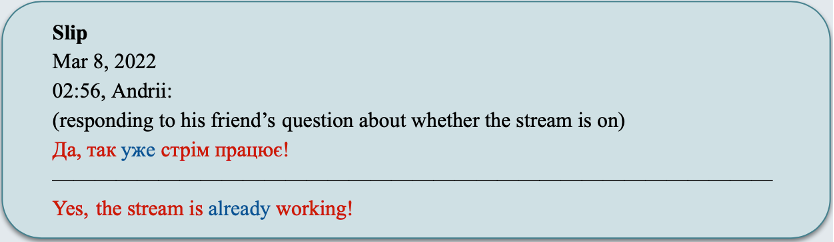
It’s clear to see these different kinds of contexts when looking at short examples such as in Figure 2. Here we can see that the speaker is inserting a Russian word into a Ukrainian sentence. Russian “уже” is a high-frequency word that closely resembles Ukrainian “вже”, so this is most likely a slip.

Figure 2: An example of a slip.  Red=Ukrainian and Blue=Russian.

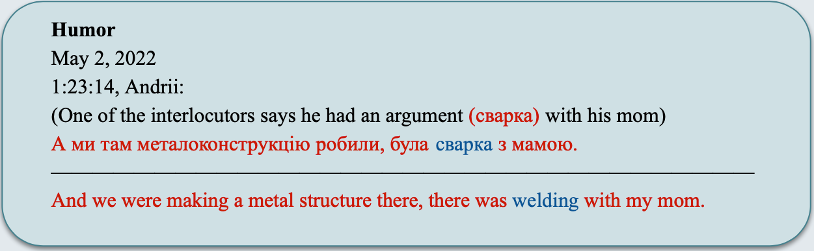
In the second example in Figure 3, we can see how wordplay is utilized. The word “сварка” means argument in Ukrainian and in Russian it means welding. One of the subjects said in Ukrainian that he had an argument (“сварка”) with his mom, and the speaker joked that they were making a metal structure with his mom, and thus there was “сварка”, meaning welding. Here we can see how the speaker used a word that exists in both languages but used it with Russian meaning for a comic effect.

Figure 3: An example of switching humorously. Red=Ukrainian and Blue=Russian.

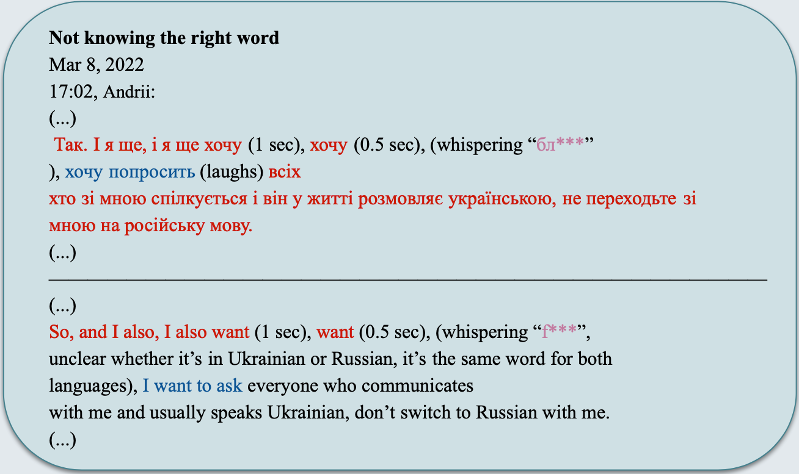
In Figure 4, the speaker was clearly struggling to recall the right word, so he inserted the phrase in Russian into a Ukrainian sentence.

Figure 4: An example of switching when not sure of the right word. Red=Ukrainian, Blue=Russian, and Pink=A mix of Ukrainian and Russian.

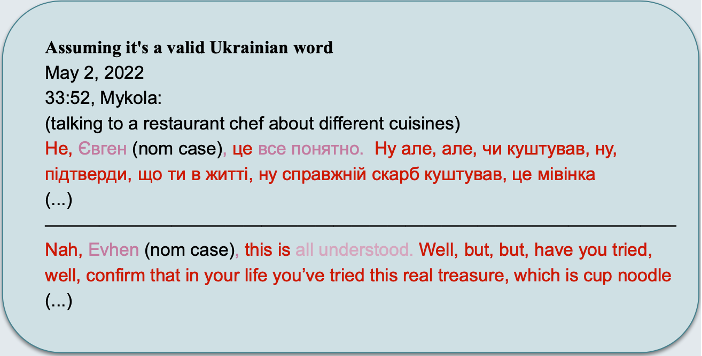
A clear example of the speakers assuming what they are saying is a correct word in Ukrainian can be seen in Figure 5.

Figure 5: Incorrect assumption of a word as Ukrainian. Red=Ukrainian, Blue=Russian, and Pink=A mix of Ukrainian and Russian.

The name of one of the speakers (Євген) is used in the nominative case, as it would be in Russian, whereas in Ukrainian, the vocative case (Євгене) should be used. “Bсе” is pronounced with a Ukrainian accent and is a hybrid of the Russian “всё” and the Ukrainian “усе”. The Russian word “понятно” is pronounced with a Ukrainian accent, and the speaker most likely assumes it to be a valid Ukrainian word. This seems to be a common pattern because we’ve seen several instances of it.

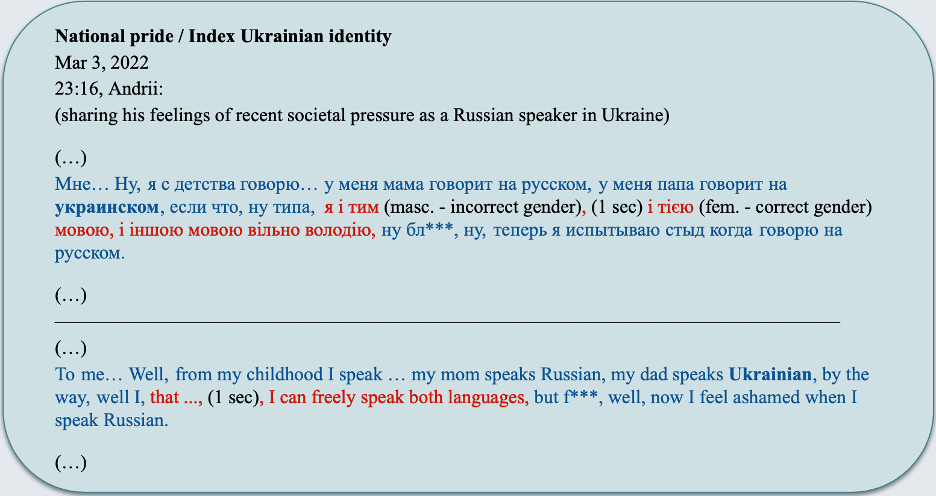
The speaker first uses masculine gender in Figure 6, because the Russian word for language “язык” is masculine, but then corrects himself and uses feminine gender, which is correct for the Ukrainian word “мова.” Also, you can see that he is inserting a clause in Ukrainian to prove that he has some proficiency in the language and show his Ukrainian identity.

Figure 6: Example of switch to show national pride. Red=Ukrainian and Blue=Russian.

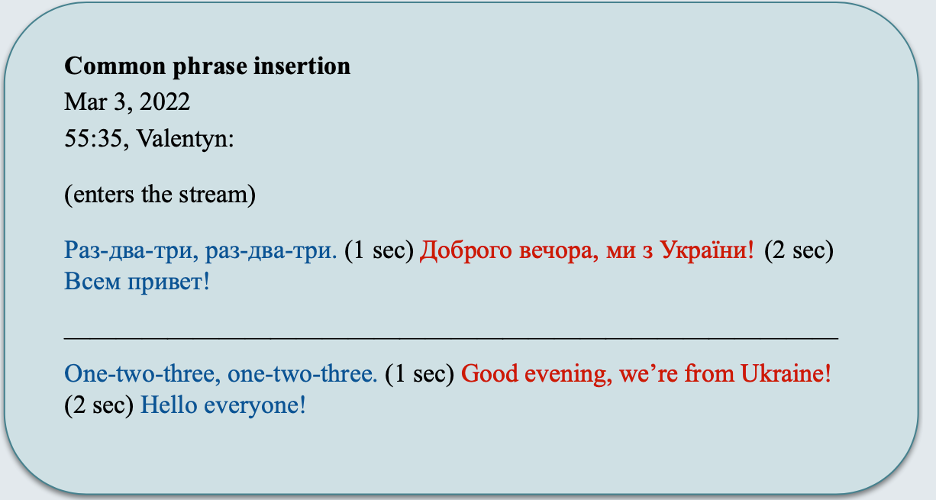
Lastly, in Figure 7, the speaker is saying a common Ukrainian phrase that has been used extensively and is embedded by 2 sentences in Russian.

Figure 7: Example of switch when inserting a common phrase. Red=Ukrainian and Blue=Russian.

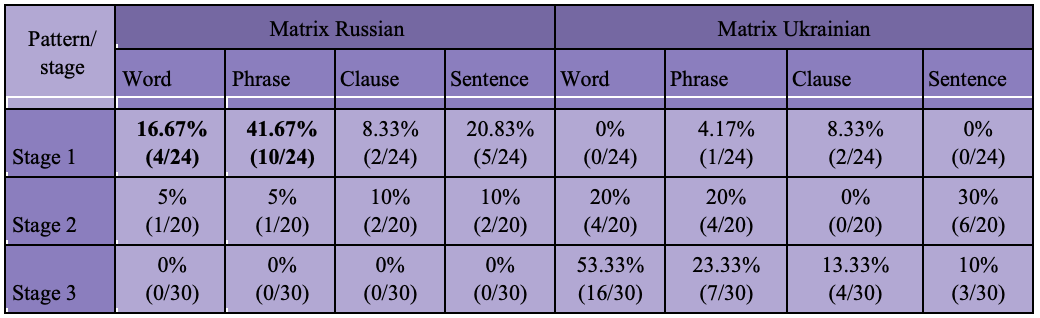
In cases of Ukrainian word insertion, speakers would add in phrases or words that are used regularly, such as greetings or slogans. Because of its fairly clear division amongst the stages in Table 1, we believe that the speakers first used phrases they were familiar and confident with as they began to transition as a way to clearly and immediately signal their solidarity and intent to distance themselves from Russian.

Table 1: The frequency of each pattern in Russian and Ukrainian at each stage as a percentage.

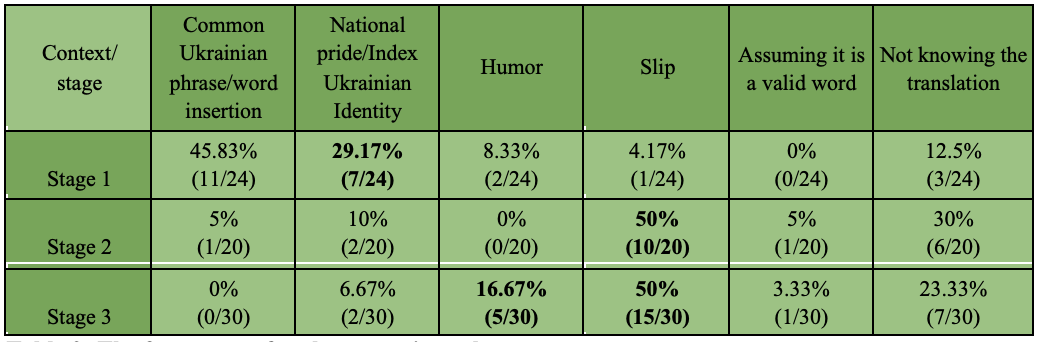
The speakers also used Ukrainian phrases and words to express national identity and pride. Similarly, to the case of common words and phrases, this behavior, as seen in Table 2, was utilized more in stage one than stages two and three to quickly and easily express their Ukrainian identity.

Table 2: The frequency of each context in each stage as a percentage.

The use of this context eventually decreased, just like common words and phrases did, as the speakers grew more confident in Ukrainian and did not need to quickly express their pride, since speaking the language fluently accomplished the task. This use to express national identity was higher than we originally thought it would be, and it was somewhat surprising to see it happen so often.

Another pattern we observed was the use of code-switching in a humorous or comedic manner. This kind of code-switching is intentional and utilizes parts of both languages such as intonation and meaning to create a joke or a wordplay. However, the frequency of humor, shown in Table 2, was surprising, as we anticipated it to be far higher than it actually was in stage one. The use of humorous code-switching was present scarcely in stage one, not at all in stage two, and was most prominent in stage three.

Slips in our data involved a speaker starting a sentence in Ukrainian but accidentally reverting to Russian before they finished expressing their thought. In some cases, the speakers would realize they had slipped and correct themselves, but in others the speakers would continue, finishing the thought in Russian. Table 2 also shows that slips accounted for the majority of code-switches from stages two and three. This is likely due to the speakers using primarily Ukrainian for the second and third stages, so slips in the first stage are less common given that little Ukrainian is actually being used.

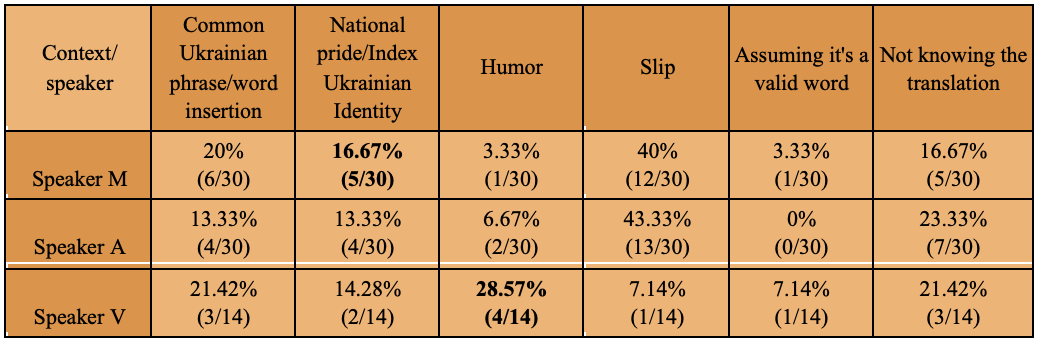
We were able to find recurring contexts related to speakers as well. As we previously mentioned, speakers would often code-switch at the start in order to index themselves as Ukrainians. The speakers did so relatively the same amount, but Speaker M did this slightly more than the other speakers, as shown in Table 3.

Table 3: The frequency of each context for each speaker as a percentage.

The use of humor however showed a greater disparity. Speaker V humorously code-switched to a far greater percentage than his counterparts. A better mastery and confidence of the language would likely allow the speakers to make more jokes and use differences between the two languages more effectively. We found that Speaker V seems to have the greatest ability of the three to speak Ukrainian. He demonstrated this by completely skipping stage two and barely needing any time to transition, so we believe that he was able to use the language more effectively to make jokes through his knowledge of both languages and their differences.

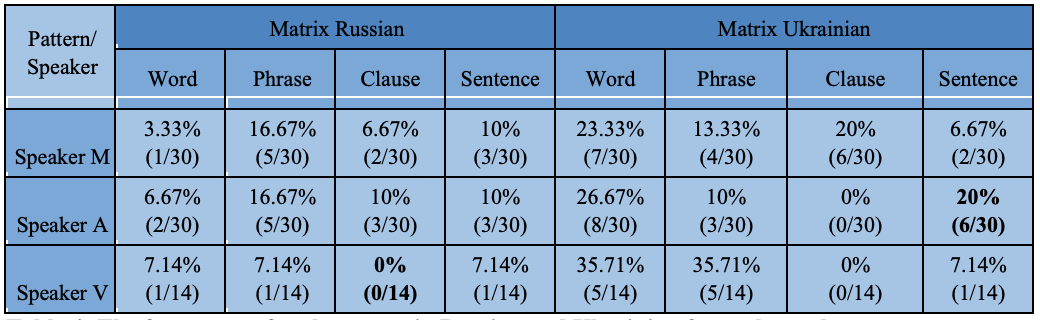
Since Speaker V displayed different code-switching patterns when compared with his counterparts and did less code-switching in general, he did not at any point use clause insertion when code-switching, as in Table 4, which showed more evidence as to his strength in the language. For Speaker A, we noticed that he code-switched more sentences than Speakers V and M, especially when switching from Ukrainian to Russian.

Table 4: The frequency of each pattern in Russian and Ukrainian for each speaker as a percentage.

Looking further than these 3 subjects and this specific context, the data from our study may be a useful reference when looking at rapid language transition in other countries or perhaps what people tend to struggle with versus what they find easy when changing their primary language both in Ukraine and in other places. As this kind of research continues, we might be able to gain insight into how this rapid language transition could result in, or perhaps already has resulted in, new linguistic features such as an emerging accent or dialect and the creation of new words or slang from primarily Russian speakers becoming primarily Ukrainian speakers. If you are looking for additional information about the languages’ history and how they are being used in the ongoing war today, the following blog post, Ukrainian vs Russian: How Do These Languages Differ, is very useful.


References

Azhniuk, B. (2017). Ukrainian Language Legislation and the National Crisis. Harvard Ukrainian Studies, 35(1/4), pp. 311–329. http://www.jstor.org/stable/44983546

Gardner-Chloros, P. (2009). Code-switching. Cambridge, England: Cambridge University Press.

Krishnan, S., Noor, N., and Rasmani, K. (2011). Analysis on Stages of Code-switching by Bilingual Educators: A Case Study. International Conference on Applied Sciences, Mathematics and Humanities 2011, pp.  475-481. https://www.researchgate.net/publication/338357063_ANALYSIS_ON_STAGES_OF_CODE-SWITCHING_BY_BILINGUAL_EDUCATORS_A_CASE_STUDY

Mahootian, S. (2020). Bilingualism (Routledge Guides to Linguistics). London and New York: Routledge Taylor & Francis Group.

Myers-Scotton, C. (1993). Common and Uncommon Ground: Social and Structural Factors in Codeswitching. Language in Society, 22(4), pp. 475–503. http://www.jstor.org/stable/4168471

Rating Group. (2022, March 19). The Sixth National Poll: the Language Issue in Ukraine. Retrieved May 13, 2022, from https://ratinggroup.ua/en/research/ukraine/language_issue_in_ukraine_march_19th_2022.html

San, H. K. (2009). Chinese-English Code-switching in Blogs by Macao Young People (Publication No. 9877103) [Master’s thesis, The University of Edinburgh]. Edinburgh Research Archive.

State Statistics Committee of Ukraine. (2003-2004). All-Ukrainian population census 2001. Retrieved May 13, 2022, from http://2001.ukrcensus.gov.ua/eng/

[/expander_maker]
On Language Attitudes, Heritage Language Maintenance, and Biracial Identity Formation

Karin Antablian, Leslie Cheng, Tabitha Haskins, Kaoru Kaburagi, anonymous author.

This study is an investigation of the relationship between biracial individuals and their association or dissociation with their cultural heritage. Using monoracial individuals as a control, we utilize survey methods and metalinguistic interviews to expand upon Cheng and Lee’s (2009) model, focusing particularly on how language attitudes and heritage language maintenance influence biracial identity indexation. In doing so, our purpose is twofold. First, we aim to establish what connections exist between attitudes towards heritage language learning and language maintenance. Second, we aim to better understand how language maintenance affects biracial identity. We found that while monoracial and biracial individuals both have positive perceptions of heritage language learning, these attitudes tend to be stronger among monoracial individuals. Additionally, we found that cultural identity was more turbulent among biracial individuals, but that they were more likely to perceive heritage language maintenance as a way to assert and connect with their multicultural heritage.

[expander_maker id=”1″ more=”Read more” less=”Read less”]

Introduction and Background

The United States is becoming an increasingly multiracial, multilingual nation. While still constituting a relatively small portion of the population, people of mixed race make up the fastest growing demographic in America – in the past decade alone, the multiracial population within the United States has increased by 276 percent, from 9 million people in 2010 to 33.8 million people in 2020. Furthermore, since 1980, the number of people who speak a language other than English at home has more than doubled (US Census Bureau, 2020). In light of these changing demographics, research surrounding biracial identity and attitudes towards bilingualism is becoming particularly paramount.

In crossing over cultural boundaries and racial lines, biracial individuals exist at the crossroads of disparate backgrounds that at times may be at odds with one another. Existing within this liminal space “in between,” so to speak, can contribute to the formation of a “marginal” identity, feelings of conflict when negotiating identity (Poston, 1990), or distance from their cultural heritage (Bracey, Bámaca, & Umaña-Taylor, 2004). 

However, it is understood that when an individual perceives facets of their identity to be compatible, the individual’s sense of self becomes more unified, a process known as identity integration (Syed & McLean, 2016). Models of identity integration have been applied to examine the process of biracial identity negotiation in various domains. One framework of particular interest comes from Cheng and Lee (2009), who present four methods of identity indexation among those of biracial descent. These classifications represent how the individual navigates their cultural identity in society, and also serve as an indicator for the degree of conflict or turbulence that the individual has over their own identity. The classifications are as follows:

  • Intersections: Identification with individuals of related groups
  • Dominance: Identification with individuals of one primary group
  • Compartmentalization: Identification with a group is situationally dependent
  • Merger: Simultaneous, cross-group identifications

The present study applies Cheng and Lee’s framework to investigate the relationship between biracial individuals and their association or dissociation with their cultural identity. More specifically, we look at the role of heritage language maintenance in informing the stances and alignments of biracial individuals. Following the conclusions of Lee (2002), which suggests strong correlations between an individual’s heritage language proficiency and their cultural identity, there exists the question of whether dual language use within the home generates a hyper-salient cultural identity — or an aversion towards particular cultural indexations.

Using monoracial students as a point of reference, we hypothesized that biracial students may exhibit more conflicted, turbulent attitudes or be more ambivalent towards bilingualism due to parents of differing cultural backgrounds, which would be reflected in how they culturally identify themselves. We also hypothesized that monoracial students may be more inclined to learn the heritage language, as both parents are likely to show a unified attitude towards bilingualism and thus exhibit less cultural conflict.

Methods

We utilized survey methods and metalinguistic interviews to collect data. In total, we surveyed 32 college students and interviewed 9 college students. Out of those that we surveyed, 27 participants were of monoracial descent and 5 participants were biracial descent. 5 interviewees were of monoracial descent and 4 interviewees were of biracial descent. While participants came from a variety of cultural and linguistic backgrounds, the majority came from Asian backgrounds (n=26). All biracial participants were half white.

Our survey contained two sections. In the first section, we asked participants questions about their language demographic background information (e.g., What is your primary language? If you speak another language at home please list them.) We also asked whether they belong to a cultural community and/or they grew up in one. In the second section, participants ranked their agreements on a scale of 1-5 with a series of statements. Statements concerned both parents’ attitudes towards bilingualism (e.g., My parent thinks it’s important I learn another language.) as well as their personal attitudes (e.g., If I ever have kids, I would want them to know a second language.)

After surveying participants, we conducted interviews to further investigate their experiences and possible differences in attitudes towards bilingualism between parental units, especially if the student is of biracial descent. During the interviews, we focused more on how biracial students indexed themselves and looked at possible connections to their linguistic backgrounds (e.g., “What were your caregivers’ attitudes towards your heritage language(s)? Were they supportive, against learning it? Did their attitudes change as you got older?”)

Results

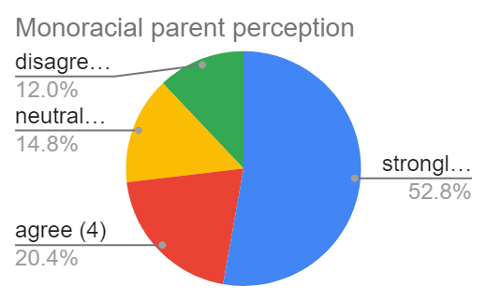
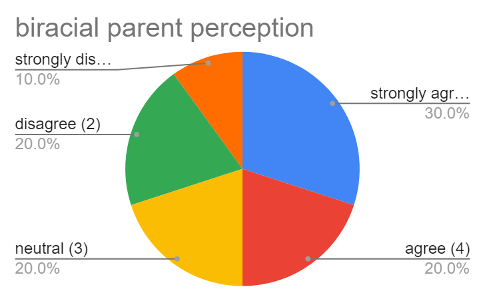
Unsurprisingly, both biracial and monoracial students had positive perceptions of bilingualism, and thought their parents had positive perceptions of bilingualism as well. However, these groups differed in how strong these positive perceptions were. Since the survey asked participants to rank how strongly they agreed with a series of positive and negative statements about bilingualism from a scale of 1 (strongly disagree) to 5 (strongly agree), we were able to observe the distribution of their responses. Figure 1 below shows the distribution of responses of monoracial students and Figure 2 shows the distribution of responses for biracial students regarding how much the participants agreed that their parents have positive attitudes towards bilingualism.

Figure 1. Monoracial students’ level of agreement on their parents having positive attitudes towards bilingualism


Figure 2. Biracial students’ level of agreement on their parents having positive attitudes towards bilingualism


Although both monoracial and biracial students thought their parents had generally positive views towards bilingualism, the monoracial students agreed more strongly than the biracial students. The monoracial students picked “strongly” agree over 50% of the time, whereas the biracial students only picked that 30% of the time. Monoracial students also agreed (ranking either 4 or 5) with the positive statements over 70% of the time whereas the biracial students only ranked the statements 4 or 5 50% of the time. Although this is merely a correlation, it is an interesting observation to note that could lead to more studies in the future.

For the interviews, there was variation across both monoracial and biracial students in how strongly their parents advocated for their learning in the heritage language. This is unsurprising given how each household is different and the variety of factors that shape parents’ decisions to teach the heritage language or not. Time may be an important factor, and the parents’ own fluency in the language may hinder or encourage this passing on of language to their children.

However, we did notice specifically that for biracial students who later chose to learn the heritage language on their own, they emphasized a want to connect to their heritage, especially since it gives a sort of “validity” to their cultural identities. Elaine, a half-Peruvian half-White student stated, “Once I started learning Spanish I had… more validity to my identity as a Peruvian because it’s like even though I didn’t look like it, well…I can speak in this language.” Biracial students appeared more questioning of their identities compared to monoracial students since they were not necessarily as exposed to their heritage culture and may feel more “outside” the culture due to their mixed appearance. They appeared to be more questioning of their own identities especially if they couldn’t speak the heritage language well, as language is often seen as a pillar of cultural identity.

On the other hand, the monoracial students we interviewed appeared to comfortably identify with the X-American label, for example Asian-American or Mexican-American. When asked about cultural identity, one student whose parents are first-generation Korean immigrants stated that she identifies as “just Korean-American” and “never really questioned it because [she] grew up in [a predominantly Asian area with a lot of other Koreans”. Presumably, she grew up in a household that was unified in culture and language, and people would not question her “Koreanness” based on her appearance. It is interesting to note that so-called “hyphenated” Americans have earned a spot in the mainstream social discourse of American society, yet biracial students have not necessarily done so due to the diversity in their parents’ heritages. A biracial identity is not easily constructed across all groups because there is such a mix of cultures.

Discussion

Overall, there were not drastic differences between the attitudes of the parents of monoracial individuals versus biracial individuals. There was a large degree of uniformity in the belief that being multilingual is a beneficial skill to have, albeit varying degrees of implementation. There were significant differences in the participants themselves, however. Among our monoracial survey population, we see that the majority of them informally acquired their heritage language and that the heritage language is the dominant language of the home. Among our biracial survey population, English is the predominant language at home, with only half of our participants having acquired their heritage language. With the exception of a single participant, the heritage language was formally acquired.

The most interesting difference between these two groups was that those of the biracial population exhibited a demonstrated awareness of their language indexation that monoracial individuals did not. One participant, Yukari, shares of how her Japanese mother passed down the Japanese language to her:

“When I was living in Japan, I honestly felt I was pretty privileged since the people around me were also half Japanese, but a lot of them didn’t know how to speak Japanese and so I had the sense of pride that ‘Oh, I can speak Japanese’ and I thought it was a good thing because I consider Japan my home, so being able to communicate with not only my family, but the community was a really important thing to me… If I wasn’t able to speak Japanese, I feel like I would’ve connected more to my American side of the family. I would’ve considered myself more as white instead of Japanese.”

Yukari’s experience, building off of the information presented by Elaine previously, allows us to draw parallels between these two participant’s experiences. Each biracial individual indicated a high level of indexation through their heritage language. Both Elaine and Yukari used their heritage language to make a claim to their non-white identity. Not only was this consciously done, but each of them used their heritage language to navigate social circumstances and interactions. Considering the point made by Cheng and Lee (2009) (see quote below), it is evident that in the increasingly multicultural, multilingual United States, more and more biracial individuals are operationalizing their heritage language to make claim to a multifaceted and multicultural identity.

“People change their identification strategies depending on individual constraints such as attention and cognitive resources, and contextual factors such as situational cues that make a particular social identity more or less salient.” (Cheng & Lee, 2009).

One limitation to our study was that the survey responses we collected were not evenly distributed between monoracial (n=27) and biracial students (n=5). Furthermore, we tried to keep our survey as simple and concise as possible, so we were limited in the number of questions we could ask. There’s only so much a survey can cover in terms of nuances in attitudes towards bilingualism. Lastly, even with our interviews, the participants tended to only talk about topics adjacent to our questions, so this was only the tip of the iceberg as well. We hope that despite these limitations, our study serves as a foundation to more discourse and research about biracial students, language use, and cultural identity in the future.

In conclusion, there was little to no significant variation between parents of monoracial and biracial individuals in perceptions of bilingualism. The greatest factor for heritage language acquisition was its presence, or lack thereof, in the home. Our research did provide evidence for cognizant identity indexation through heritage language acquisition on the part of the biracial individuals. This was in direct contrast to the motivations for heritage language use in monoracial individuals. Moving forwards, it would be beneficial to investigate ways that language is encouraged through the maternal line, as our data gave some implications for this. Our sample size, however, does not provide enough variation or control to determine the validity of this statement.


Additional Resources 

This Ted Talk is given by two high school sophomores who talk about the experience of being biracial as well as some common misconceptions about biracial individuals. It’s a personal account of being biracial that also emphasizes the ways language can exclude people or deny their identities.

Check out this related Languaged Life blog post from a previous class to find out more about social factors that inform language maintenance within multilingual families!


References

Bracey, J.R., Bámaca, M.Y. & Umaña-Taylor, A.J (2004). Examining ethnic identity and self-Esteem among biracial and monoracial adolescents. Journal of Youth and Adolescence 33, 123–132. https://doi.org/10.1023/B:JOYO.0000013424.93635.68

Cheng, C., & Lee, F. (2009). Multiracial identity integration: Perceptions of conflict and distance among multiracial individuals. Journal of Social Issues, 65(1), 51-68. DOI: 10.1111/j.1540-4560.2008.01587.x

Foster-Frau, S., Mellnik, T., Blanco, A. (2021, October 8). ‘We’re talking about a big, powerful phenomenon’: Multiracial Americans drive change. The Washington Post. https://www.washingtonpost.com/nation/2021/10/08/mixed-race-americans-increase-census/

Lee, J. (2002). The Korean language in America: The role of cultural identity in heritage language learning, language, culture and curriculum, 15(2), 117-133, DOI: 10.1080/07908310208666638

Poston, W. S. (1990). The biracial identity development model: A needed addition. Journal of Counseling & Development, 69(2), 152–155. https://doi.org/10.1002/j.1556-6676.1990.tb01477.x

Syed, M., McLean, K.C. (2015). Understanding identity integration: Theoretical, methodological, and applied Issues. Journal of Adolescence, 47, 109-118. https://doi.org/10.1016/j.adolescence.2015.09.005.

United States Census Bureau. (2022, March 25). 2020 Census illuminates racial and ethnic composition of the country. https://www.census.gov/library/stories/2021/08/improved-race-ethnicity-measures-reveal-united-states-population-much-more-multiracial.html

United States Census Bureau. (2020). Populations and people. https://data.census.gov/cedsci/profile?g=0400000US06

[/expander_maker]
Understanding Contrastive Conjunctions as Discourse Markers in Bilingual Discourse

Baltazar Sanchez III

In multilingual settings, speakers use several languages at the same time; this type of discourse is known as code-switching, where speakers may make switches at any point in their conversation between different codes, or languages. Many studies focus on the rules— or constraints, depending on the author’s approach— involved in this type of discourse while some describe the functions of such multilingual language use, in particular the pragmatic and/or conversational effects. The focus of this paper is insertional code-switching, which is a type of code-switching in which single words are inserted as opposed to entire phrases, as a type of discourse marker in conversations between bilingual individuals, in particular with the English word “but” and its Spanish equivalent pero. The inspiration for this comes from Gardner-Chloros, Charles & Cheshire’s (2000) discussion of code-switching in discourse as a further dimension to what may be classified as monolingual discourse marker. More specifically, this paper focuses on managing the conversational floor through contrastive conjunctions— English “but” and Spanish pero. After analyzing cases and data compiled from an online corpus, it becomes clear that contrastive conjunctions have multiple functions, which is a feature that is highlighted once these discourse markers are considered in the environment of code-switches in bilingual discourse. The findings contribute to the current understanding on discourse markers specifically and code-switching more generally, both of which intersect in establishing common ground between speakers.


You can read the entire paper HERE


What social patterns contribute to lack of maintenance of a heritage language within a multilingual family?

Hebbah Elokour, Rowan Towle, Jason Panelli, Frances Vano, Sana Shrikant

This study examines the various factors involved in the maintenance of heritage languages among multilingual immigrant families in the United States. Previous research shows that maintenance of heritage language is a complex and nuanced problem and that most families in the United States fail to pass on their home languages. We sought to compare all factors, and beyond any single particular immigrant family or case. We utilized a survey and several short interviews on which to do analysis. We found that all respondents had a positive outlook on heritage language maintenance and that in 100% of cases those who had advanced language skills had formal language exposure. Furthermore, we found that all respondents had some language skills and continually used them in socially significant ways.

[expander_maker id=”1″ more=”Read more” less=”Read less”]

Introduction & Background

Our goal was to study multilingualism in families and the social patterns that are common in failure of heritage language maintenance. We found a significant amount of research on the rates of heritage language retention among immigrant populations around the world. However, the majority of this has been structured around maintenance of Spanish speaking immigrant families in the United States. Also, much of these studies further focus on particular populations such as Cubans in Florida (Lambert, 1996). This is a gap that we wanted to address, as our research contains data points from many different language groups. These studies did give us a good amount of information as to the cause behind heritage language loss, some of which include socio-economic class (Pearson, 2007), education level of family (Bill,  Hernandez-Chavez & Hudson, 2000), and perceived social status of heritage culture/language by local society (Kloss, 1966). However, some of these studies have varying results, which makes it difficult to take away one consistent conclusion. Additionally, none have compared all these factors across different immigrant populations of various status and locations to find the commonalities that might exist among the specific low heritage language maintenance group. We took this information as a starting point, and decided to aggregate all of our data points to make a full comparison. With the increase in positive attitudes toward ethnic diversity in the United States (Budiman, 2020), there seems to be a shift underway that could impact the maintenance of heritage languages and culture in both multigenerational immigrant families in the country and families who may immigrate in the future. Our study aims to observe these factors in low heritage language maintenance families and understand commonalities in this group.  We hypothesize that younger people will have a more positive outlook towards heritage language acquisition,  but we also hypothesize that this will contribute less to language maintenance than factors such as formal education and language use outside of the household. Additionally, we hypothesize that code switching does not occur in these families but that they may pass on small bits of language, like vocabulary that allows them to communicate things in particular social situations, such as when they want to talk about something they want to keep private while not at home.

Methods

A short survey was the primary method of data gathering. These surveys were sent to friends and classmates who are bilingual or multilingual adults and come from bilingual or multilingual homes. The surveys will attempt to understand the heritage level of heritage language mastery, methods of learning in the family, knowledge of English among older members of the family, living conditions, and other questions to assess attitudes towards heritage language maintenance and enthusiasm towards the heritage culture and ethnic identity. There were five yes or no questions and six short answer questions for individually specific information such as language(s) and exposure type. Following this, a short interview was conducted with three survey participants and one of their parents each. This was to get a more in-depth description of particular social and family factors that impact motivation and need to acquire the heritage language. After we collected the data, we measured the level of heritage language competence and in what ways, types of informal and formal exposure, and level of necessity of the language in the family environment. We then analyzed the data to identify common social and speech patterns in groups with low language maintenance.

Key Words

Active Language Skills: This term refers to skills with a given language that amount to some amount of active conversational ability or working proficiency.

Passive Language Skills: This term refers to abilities with a given language that amount to some understanding and ability to use the language in socially specific circumstances.

Heritage Language: This term refers to a language that is spoken by an immigrant family that is not the dominant language in the society in which they now live.

Formal Language Exposure: This term refers to exposure to a language that is purposeful and deliberate such as classes, school, guided reading, and/or cultural events focused on language.

Informal Language Exposure: This term refers to exposure to a language that is random and without specific purpose such as family speaking at home, presence in a larger speaking community such as a neighborhood, and/or random exposure to music and media of the language.

Findings

Our data included 18 respondents to our questionnaire and 3 interviewees. There may be some bias toward specifically individuals exposed to Tagalog as a significant portion of our respondents (7 out of 18) and interviewees (2 out of 3) described Tagalog in their responses. One interview was conducted in person, one interview via zoom call, and one interview through email. These data points are the basis of our findings, and while a more diverse data set and more speaking interviews would have been preferred, this is what was accessible to us due to the pandemic and time zone constraints.

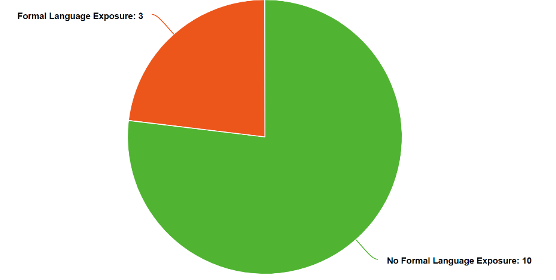
There are two significant correlations uncovered in the questionnaire that may reveal important social factors regarding language acquisition. Firstly, every single respondent with active language skills also had formal language exposure. Conversely, of the thirteen respondents to not have active language skills, only 3 of them had exposure to the language in a formal setting.

Figure 1: Respondents to the questionnaire who had no active language skills: a significant portion of this group had no formal language exposure.

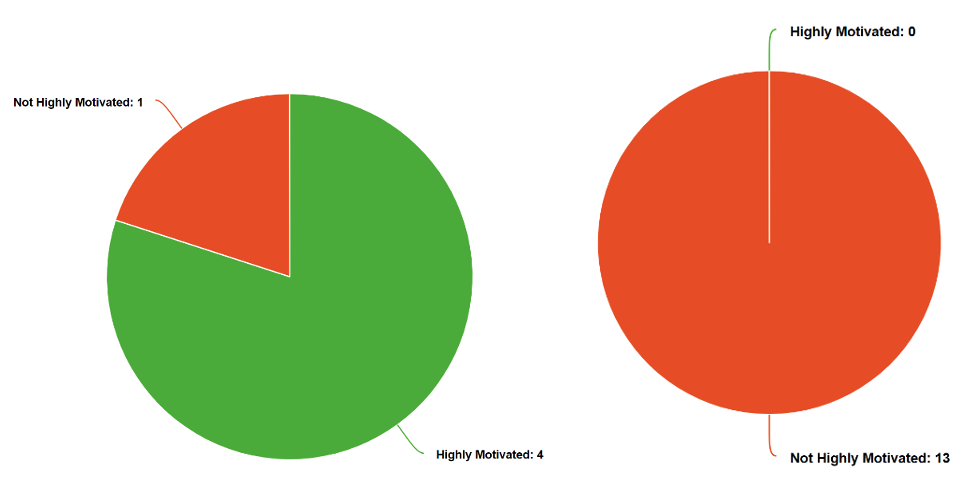
The other highly correlated response to the questionnaire was the descriptions of motivation for the respondents to learn the language. All 13 respondents with only passive language skills either described their family as not motivating language acquisition or presented some roadblock to motivation. This included situations where only one parent spoke the language and thus hindered the overall family motivation for the children to also learn the language. On the other hand, 4 out of 5 of respondents with active language skills presented some necessity in understanding and using the language. In many of these cases, respondents described family members who did not speak English such as their grandparents, and a need to speak and understand the language to communicate with these family members.

Figure 2: The left pie chart shows a high percentage of respondents with active language skills had families that were highly motivated to pass on the language; the right pie chart shows a complete lack of highly motivated data points in the group without active language skills.

The last piece of data from the questionnaire revealed an overarching positive opinion of bilingualism and multilingualism. Every respondent except for 1 thought of bilingualism or multilingualism as a positive thing. The one respondent who did not have positive views of bilingualism or multilingualism described their viewpoint as “Neither positive nor negative”. Additionally, every respondent said they would want to pass on the language to their children if they could. This indicates that sentiment about heritage language learning was positive, even in cases where the respondents had only passive language skills or limited vocabulary and gives little prediction into whether a child will acquire the language with active skills.

The interview allowed us to observe how the interviews used their limited language skills in their everyday life. All 3 interviewees described their language skills as “limited vocabulary only” but still made significant use of the language. Namely, all interviewees were able to immediately recognize the language when hearing people speak it. They all had limited vocabulary as they described and some of the terms and phrases common amongst all of the interviewees included food items and common greetings. More significantly, however, is that all interviewees actually used the language in certain social situations with their family members. The first interviewee’s younger brother refers to her as “ate” or “older sister” in Tagalog, and despite not speaking Tagalog she is uncomfortable with him referring to her by her name. The second interviewee described using the language “strategically” in disguising some sensitive vocabulary in public. This included describing items as “cheap” or “expensive” while shopping to not offend the clerks or describing the physical appearance of someone. The last interviewee described their family using Spanish to ask for favors from each other. The family viewed Spanish as more formal and a more polite and effective way to ask something of each other.

Combining these findings, we learn that the strongest correlations are found in active language skills being present with highly motivated families whose children were exposed to language in formal settings. Conversely, members of the group without active language skills only had very low formal language exposure and did not have families that highly motivated language acquisition. The passive-only language skills group all seemed to acquire some level of the language and all interviewees still used the pieces they knew in socially significant manners. From these findings, we can predict that the informal language exposure in the passive-only groups still had social meaning to this group and even low levels of language acquisition are often used in socially specific tasks. In other words, informal language exposure in families with low motivation to pass on their language still resulted in the language being a part of the way they speak and interact with other members of the family. Particularly, the language is often leveraged for specific social tasks and part of the speech patterns of the family even when the dominant language is not the heritage language.

Conclusion

Based on our results, we conclude that a child’s educational environment plays the most significant role in failing to pass down languages. Even when parents wanted to pass down their native language, the primary language spoken in the host nation’s environment interfered with that goal. Unless some form of formal language education was pursued by the family. Additionally, children who grew up in bilingual households retained culturally significant words more than they did with other general words. These types of words include food and words related to etiquette in the culture. Lastly, the people we surveyed generally had a positive outlook on multilingualism and would want to pass down their heritage language if they could.

To expand our study, we suggest studying heritage learners who grew up not just in multilingual households but multilingual communities. In our research, almost everyone we surveyed grew up in predominantly English-speaking communities. We are interested to see whether or not we’d be able to see different social patterns that contribute to the lack of maintaining a heritage language had the children grew up in multilingual communities. We also suggest finding people who learned a second language in only formal settings and comparing their retention rate to that of a person exposed only in informal settings. Furthermore, a more comprehensive study in the United States tracking social and educational factors across all immigrant communities might further shed light on the strongest factors affecting heritage language maintenance. Our study aimed to answer some of the many questions posed to understand the social implications of multilingualism.


References

Bill, G., Hernandez-Chavez, E., & Hudson, A. (2000). Spanish home language use and English proficiency as differential measures of language maintenance and shift. Southwest Journal of Linguistics, 19, 11–27.

Budiman, A. (2021, April 28). Americans are more positive about the long-term rise in U.S. racial and ethnic diversity than in 2016. Pew Research Center. https://www.pewresearch.org/fact-tank/2020/10/01/americans-are-more-positive-about-the-long-term-rise-in-u-s-racial-and-ethnic-diversity-than-in-2016/.

Kloss, H. (1966). German-American language maintenance efforts. In J. A. Fishman (Ed.), Language loyalty in the United States: The maintenance and perpetuation of non-English mother tongues by American ethnic and religious groups (pp. 206–252). The Hague: Mouton.

Lambert, W. E., & Taylor D. M. (1996). Language in the lives of ethnic minorities: Cuban American families in Miami. Applied Linguistics, 17(4), 477–500.

Pearson, B. Z. (2007). Social factors in childhood bilingualism in the United States. Applied Psycholinguistics, 28, 399–410.

[/expander_maker]
Testing the Matrix Language Frame (MLF) Hypothesis with Modern East Asian language-English Bilingual Speakers of Code Switching – Insertion & Alternation

Hyung Joon (Joe) Kim, Mocha Ito, Irene Han, Sena Ji, Luis Flores

Our study tests the validity of the Myers-Scotton’s (1993) Matrix Language Frame (MLF) hypothesis in light of modern Japanese-English and Korean-English bilingual speakers’ code-switching data (Myers-Scotton & Jake, 2009). Code-switching (CS) is the umbrella term for the use of more than one code, such as languages, dialects, sub-dialects, and accent, within or across conversations. Our focus is on two sub-elements of intra-sentential CS: alternation and insertion. We test the hypothesis by looking at whether the Morpheme Order Principle and the System Morpheme Principle hold true in our transcribed data of a total of 5 bilingual participants’ conversations in two separate groups. Our analysis reveals three new insights, which show that the two principles of the MLF hypothesis can be overriden under certain linguistic restrictions and in specific psycho-social context, as well as the fact that the frequency of alternation is positively correlated with the bilingual speaker’s proficiency in his or her first language.

[expander_maker id=”1″ more=”Read more” less=”Read less”]

Introduction/ Background

The study of bilingual code switching began in the 1900s. However, the way how East-Asian descent Americans code switch in their conversations with another bilingual interlocutor is an area that has not been addressed as much by modern linguistic scholars, despite the consistent increase in the population of East Asian-American bilingual speakers in the last few decades. It is estimated that approximately 14.1 million Asians have immigrated to the US since the 1850s (Migration Information Source, 2020). The obtaining of a second language by the 1.5 or 2nd generation immigrants in America has led to a number of intra-racial cultural issues. For example, the rapid code-switching that 1.5 or 2nd generation bilingual children often use has led to intra-cultural division between the 1st generation immigrant parents and their children. This is because the parents are often more used to conversing in their mother tongue Asian language, whereas the 1.5 and 2nd generation children are used to mixing more than two languages in their speech.

In fact, there is a sizable void in the existing literature in the field of Asian-American bilingual code-switching. Linguists have undertaken studies on code switching with rarer and more exotic pairs of languages, such as Lingala-Swahili (Bokamba, 1988) and Turkish-Dutch (Backus, 1992), but not as extensively on East Asian language-English pairs. Our study aims to fill the void in the study of bilingualism by focusing on how bilingual speakers of East Asian language and English converse with their bilingual family members. We focus our analysis on insertion and Alternation. Insertion is using one primary language that forms the main grammatical frame, but inserting words from the second language into the sentence. Alternation is the back-and-forth switching between one language and another, involving a full switch to a different languages’ grammatical frame. We hope that our empirical research assists in bridging the generational disparity between the 1st generation and 1.5/2nd generation Asian American immigrants.

Our study tests the validity of the MLF Hypothesis. The hypothesis proposes two principles: The Morpheme Order Principle and the System Morpheme Principle. These principles are distinguished by Myers-Scotton’s terminology, known as the content morphemes and system morphemes. Content morphemes are words like nouns, verbs, adjectives that express semantic meanings and assign or receive thematic roles (they are structured into grammar by system morphemes). Their counterpart, system morphemes are functional words (words that have little meaning but express grammatical relations. i.e. propositions, articles, conjunctions, etc) that express the relation between content morphemes and do not assign or receive thematic roles (i.e. roles of noun phrases).

The Morpheme Order Principle states that in a sentence with mixed constituents from the Matrix Language (first language) and Embedded Language (second language), the surface morpheme order must not violate that of the Matrix Language (ML).

The System Morpheme Principle states that in a sentence with mixed constituents from the ML and EL, all system morphemes which have grammatical relations external to their head constituent must come from the ML.

In short, we propose the three following hypotheses:

First, EL system morphemes can have grammatical relations external to their heads. This overrides the System Morpheme Principle. We provide support by showcasing an example of EL system morphemes in our Japanese-English data.

Second, in a bilingual speaker’s speech with mixed constituents from ML + EL, the surface morpheme order constructed by the ML can be violated. The second finding overrides the Morpheme Order Principle. We show that there can be a disruption of an ML surface morpheme order in a sentence with ML + EL constituents in our Korean-English data.

Third, bilingual speakers that are more proficient in their first language engage in higher average frequency and longer total duration of alternation.

Methods

Table 1 shows the background information about the five bilingual speakers that took part in our research. Two were Korean-English bilingual speakers and three were Japanese-English bilingual speakers. All three Japanese-English bilingual speakers were fluent in both languages. The two Japanese parents’ first language was Japanese and their second language was English. Mocha’s first language was English, and her second language was Japanese. For the Korean-English bilingual speakers, both interlocutors were native speakers of Korean. Their first language (ML) was Korean, and their second language (EL) was English. The two Korean participants spent the majority of their lives (20 years and 15 years respectively) living in Korea than outside of Korea.

Table 1. Interlocutor background

The Japanese student (Mocha) recorded 20 minutes of conversation with two of her parents and the Korean student (Joe) recorded 18 minutes of conversation with his older brother. Both students listened to the recording and transcribed the conversations with their family member(s). The sections spoken in a non-English language were translated into English.

After transcribing, we broke down our insertion data in order to examine the first two following aspects: the possibility of EL system morphemes that have grammatical relations external to their heads, and the violation of ML surface morpheme order of a sentence with ML+EL constituents. These findings would invalidate the System Morpheme Principle, and the Morpheme Order Principle, respectively. Third, we examined the total duration of alternation (in seconds), as well as the average frequency of alternation (per second), to assess the correlation between the tendency to engage in alternation and the proficiency in the speaker’s first language or second language.

Results/Analysis

First, we counted the total number of times alternation and insertion appeared in each language pair.

Table 2. The total number of insertion and alternation in Japanese-English and Korean-English bilingual conversations.

After counting, we categorized the inserted words into content and system morphemes. We observed if content and system morphemes are present in both ML and EL for the Japanese-English and Korean-English conversations.

Table 3. Insertion of content and system morphemes in ML and EL for Korean-English conversations.


Table 4. Insertion of content and system morphemes in ML and EL for Japanese-English conversations.

In Table 3, morphemes like nouns, negation, adjectives, and fillers appeared the most In the Korean-English data. In Table 4, nouns, particles and conjunctions appeared the most in the Japanese-English data. A bar chart in Figure 1 is based on Tables 3 and 4 summarizes morpheme insertion by interlocutor. 

Table 1. Morpheme insertion by interlocutor.

With this visual representation of the distribution of morpheme insertions, we were ready to test the System Morpheme Principle, which states that in a sentence with mixed elements of ML + EL, all system morphemes with grammatical relations external to their heads have to come from ML. Clearly, we could see that Mocha and Joe’s brother inserted system morpheme in EL. To invalidate this principle, we first had to confirm that the system morphemes in our data have grammatical relations external to their heads; then, prove that those system morphemes are from the EL, thereby negating the logic that all system morphemes must come from ML.

Excerpt 1. Example of EL system morpheme in Japanese-English data.

M: Mocha
Y: Mocha’s mother

Mocha’s EL system morphemes: no (の), kara (から)

M: Linguisticsのrequisiteほとんど終わってるから。
   Linguistics no requisite hotondo owatteru kara.

M: たぶんだけどESLだと思うよ
   for most [of]  finished  already. 

M: Tabun ESL dato omou yo
   Probably that [I] think

(I already finished most of the prerequisites for linguistics. I think it’s probably ESL)

Y:良かったね。でもMastersわどうするの?

(That’s good for you. But what are you going to do about Masters?)

In the excerpt above, Mocha, whose EL is Japanese, is inserting Japanese system morphemes, no and kara into the sentence. Words like no の is a system morpheme, because it is a functional word with little content meaning similar to a preposition. But no (の) bears grammatical relations with the latter EL system morphemes, owatteru kara (終わってるから). This a grammatical relationship external to the head of no (の), which is ‘Linguistics’.

Therefore, Mocha’s conversation with her mother clearly indicates the possibility of an EL system morpheme that bears an external relationship to its head, overriding the System Morpheme Principle.

Next, we went on to test the Morpheme Order Principle.

Excerpt 2. A sentence with ML+EL constituents with violated ML surface morpheme order.

J: Joe

D: Joe’s Brother

J: 그래도, 이제, 좀, free 하게 다니거나 그럴 수가 없지

   Geraedo,eejae,jom,   ha-gae daniguna geurul sooga up-jee

(But, now, a little, we can’t roam around freely)

D: New York  이미, it’s poppin’

           eun ee-mi,

(New York is already, it’s poppin’)

In Excerpt 2, Joe’s brother uses the English NP “New York” to begin the sentence, which is followed by a Korean particle eun (은) and adverb ee-mi (이미), which means ‘already’. According to the Korean surface morpheme order, the morpheme that must always follow a Korean adverb has to be either a verb or an adjective attached to a past-tense inflection suffix, such as neut-eut-uh (늦었어), which is an adjective + past tense inflection suffix, such as:

neut-da (늦다) + –eut-uh (-었어)

Adjective stem + past tense inflection suffix

However, in our raw data, we see that the adverb ee-mi (이미), is followed by the English possessive determiner, “it’s”, which violates the ML (Korean) surface morpheme order of a sentence with ML+EL mixed constituents. Therefore, the example in our Korean-English bilingual conversation invalidates Myers-Scotton’s Surface Morpheme Order Principle.

Lastly, we analyzed our alternation data by calculating the total duration (s) of alternation between ML and EL.

Table 2. The total duration of alternation (s) between ML and EL.

In Table 2, duration is the total length of alternated sentences (in seconds), including from the beginning of a sentence in language A to the end of the sentence in language B after the end of alternation. For example,

D: 호원 예술대, 재즈 피아노. Supposedly it’s one of the top three

     Howon-Yesooldae, Jazz Piano

(Ho Won Music School, B.S. in Jazz Piano)

The entire sentence above was counted as one case of alternation, lasting between 5~10 seconds. Among Japanese-English interlocutors, Mocha’s speech showed the longest duration of alternation, resulting in more than 80 seconds in alternated sentences. For the Korean-English data, Joe’s brother spent more than 70 seconds in alternated sentences.

Table 3. The average frequency of alternation (/s).

Similarly, in Table 3, Mocha and Joe’s brother exhibited the highest average frequency of alternation (in their respective bilingual group). The frequency was calculated by dividing the number of total times each interlocutor used alternation in his or her speech, by the total duration of each conversation.

Based on our findings, we predict that those with more years of experience speaking in their first language tend to engage in alternation more. In our data set, Mocha and Joe’s brother have had more years of speaking & learning their first language at their home country (Mocha, 21 years; Joe’s Brother, 20 years), in contrast to their family members (Mocha’s parents, 19 and 3 years; Joe, 12 years at home). We hypothesize that a bilingual speaker with a stronger foundation in their first language may feel more comfortable alternating to a foreign language, although other factors not addressed in this study such as the speech content, psycho-social relationship with the interlocutor, and environmental factors may equally play a role.

Conclusions

The formal theorization of Myers-Scotton’s Matrix Language Framework hypothesis (1993, 2009) formed the groundwork for the study of bilingual CS since the 1990’s. Our empirical quantitative study focused on a syntactical analysis of how 1.5 and 2nd generation Japanese-English and Korean-English bilingual speakers CS today, offering evidence against the two basic principles of the MLF Hypothesis. We also demonstrate a positive correlation between the engagement in alternation and the proficiency in the bilingual speaker’s first language.

Our findings aim to advance the study of modern bilingual CS by pointing out that scholars must continue to understand the syntactic inner-mechanism of the more sizable bilingual population’s CS, in particular, the East Asian language-English pair. This is because of the greater socio-linguistic implications these studies can have, such as the reduction in the generational gap between millions of Asian immigrant parents and millennial children, and the broader academic recognition of the quickly-changing nature of multilingual culture in Asia in this global age.

We invite scholars to continue to look into areas not addressed in this study, such as the role of psycho-social elements, level of intimacy between interlocutors, and other greater socio-linguistic and anthropological factors that may affect how future bilingual speakers may engage in CS.

Lastly, our findings stress the importance of being well-versed in one’s first language, as our study shows that a bilingual speaker who has spent more years speaking in his or her first language finds it easier to fully switch to a different language than those who have had less years of experience learning their mother tongue language at their home country.


References

Backus, A. (1992). Patterns of language mixing: a study in Turkish-Dutch bilingualism.

Bokamba, E. G. (1988). Code-mixing, language variation, and linguistic theory: Evidence from Bantu languages. Lingua76(1), 21-62.

Code-switching (G4) – Language Contact. Language Contact. (2011, October 8). https://sites.google.com/site/hongkonglinguistics/Downhome/Topic1/part1knowledgerepresentationinprolog20. Last accessed 10/08/2021.

Indian immigrants in the Unites States (2020) Migration Information Source. https://www.migrationpolicy.org/article/indian-immigrants-united-states-2019. Last accessed 10/08/2021.

Myers-Scotton, C. (1993). Common and uncommon ground: social and structural factors in codeswitching. Language and Society, 22 (pp. 475-503).

Myers-Scotton, C., & Jake, J. (2009). A universal model of code-switching and bilingual language processing and production. In B. E. Bullock & A. J. Toribio (Eds.), The Cambridge handbook of linguistic code-switching (pp. 336–357). Cambridge University Press.

Code-switching (G4) – Language Contact. Language Contact. (2011, October 8).

https://sites.google.com/site/hongkonglinguistics/Downhome/Topic1/part1knowledgerepresentationinprolog20.

Shim, Ji Young. 2021. OV and VO variation in code-switching (Current Issues in Bilingualism 1). Berlin: Language Science Press.

[/expander_maker]
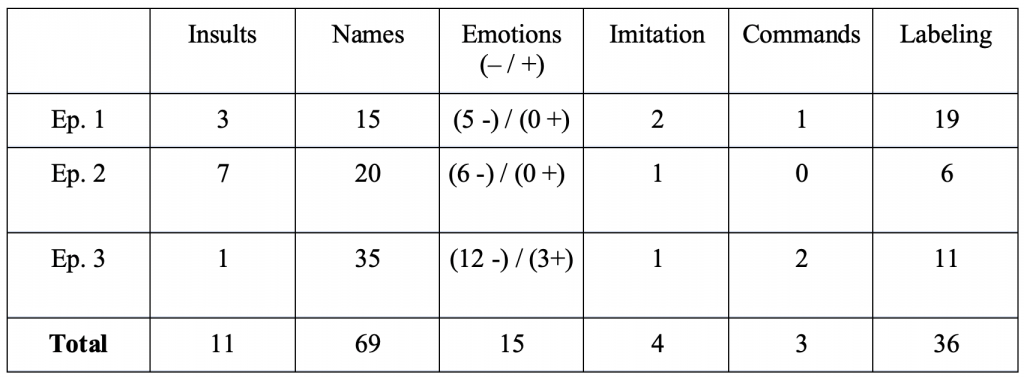
, , , , ,

Love Language: A Sociolinguistic Study on Bilingual Couples Talk

Yiran Li, Ekeme Ekanem, Mary Youngblood, and Nguyenova Dieu Anh – Shelly

Code-switching, where more than one language is integrated into speech, is extremely common amongst bilingual and multilingual speakers. Unfortunately, code-switching is often viewed by society as lazy or unintelligent, creating a negative stigma around speakers of non-standard language, which are often minority groups. This research analyzes the functions and contexts in which bilingual couples code-switch, focusing on the effects, if any, of their language backgrounds. To study this, we gathered data from 90-Day Fiance, a reality show centered around long-distance relationships. We looked at confrontational discussions to find instances of code-switching, comparing couples with same and different language backgrounds. Our results demonstrate the functionality of code-switching as well as its place within couples speech and confrontation, as couples may use code-switching to express certain feelings or to establish a connection. This study helps not only to end the stigma around code-switching but may also provide insight into communication for couples as a tool to strengthen relationships.

Carolina finds another woman’s underwear in Fernando’s closet. She asks him in Spanish, “Whose are these?” and starts the next sentence in English, “Panties girl”, meaning some other woman’s underwear.

[expander_maker id=”1″ more=”Read more” less=”Read less”]

Introduction

Code-switching is a linguistic phenomenon when a speaker switches from one language to another during a conversation. Specifically, we will focus on bilingual conversation. We will analyze two groups of bilingual couples: those who have similar language backgrounds, and those who have different language backgrounds communicating primarily in English as the dominant and common language between them.

The proposed outcome is that bilingual couples, with similar language backgrounds and English as their second language, are more likely to employ code-switching to convey a mood or perspective, while those with different language backgrounds are more likely to use code-switching as a communication strategy to build common understanding, such as borrowing (Van, 2012; Pietikainen, 2014).

Background

Code-switching has been proposed as a way to establish an identity (Piller, 2002). For example, De Fina (2007) looked at groups of Italian American men to reveal their code-switching patterns. De Fina found that the linguistic behaviors of an individual often influence those around them, so it may be that one partner may be influenced by the code-switching patterns of their partner. This theory was supported by Code switching in Mixed Couples that Code-switching has a specific reason for it. One of the reasons of code according to the findings was politeness. One of the partners would often accommodate to the other by switching the language. Some Code switching happens because of solidarity to establish a closer relationship. Lastly code-switching also shows confirmation (Dumaning 2015). Pietikainen also mentioned that lexical gap might be the reason for code switching. When a partner cannot successfully recall or produce the English word, they will sometimes use their partner’s first language (L1) instead of their L1 to ensure their partner understands (Pietikainen 2014).

Yodanis et al. (2007) studied the effects of bilingualism on couples’ relationships and found that having different native languages did not create more communication problems in couples with the same native languages. This suggests that these couples work harder and more effectively on their communication. The article ELF Couples and Automatic Code-Switching focuses on ELF couples and how code-switching influence their communication. The more common languages the couples shared the more they code-switched during their communication. Pietikainen found out that code-switching is automatic and unconscious and concluded that code-switching is the result of ELF couples’ relaxed atmosphere in their lives (Pietikainen 2014).

Methods

The methods used in this experiment were transcription analysis taken from clips of the popular show, 90-Day Fiancé. 90-Day Fiancé is a reality show that features Americans and their partners through their journey through the K-1 visa process (fiancé visa). 90-Day Fiancé follows couples during their first 90 days living together before they will be required to either get married or head back to their home country. We examined several bilingual couples from the show within two groups: different language background and the same language background Carolina and Fernando, Chantel and Pedro, and Devan and Jihoon. Carolina is a L1 Spanish speaker and acquiring English as her L2; her fiancé, Fernando, is a heritage Spanish speaker and also has native proficiency in English. Chantel is an American L1 English speaker and is Spanish as an L2; her partner, Pedro, is a Dominican L1 Spanish speaker, and acquiring English as his L2. Both Chantel and Pedro are acquiring their L2 to be able to communicate with each other, however, their language backgrounds are different, as they were not exposed to learning their L2 until after their relationship began. Devan is an American L1 English speaker and Jihoon is a Korean L1 English speaker who speaks very little English.

The clips analyzed were taken from moments of conflict and confrontation between the couples. For example, we use a clip from featuring Carolina confronting Fernando about a pair of women’s underwear she found in Fernando’s closet. Once a clip was selected, the dialogue was recorded, and the code-switching was marked and translated. Once properly transcribed, the code-switching events were categorized and compared with the results from the other couples (Piller 2002).

Results

We found that Carolina and Fernando were more likely to use code-switching as a way to convey their mood or perspective as well as stylistic purposes (such as comedy), when faced with confrontation. Their similar language backgrounds allow them to navigate communication in both languages while code-switching. Contrastingly, Devan and Jihoon used code-switching sparingly.

Devan:     Ok, get out.

Jihoon:    Yeah, sorry.

Jihoon:    피곤한다 피곤해

           Pigonhanda  pigonhae

           Frustrated  (very) frustrated.

In this exchange between Devan and Jihoon, the code-switching event happens after a long pause (about 2 seconds) after his initial phrase. Devan does not understand this utterance as she does not speak Korean and Jihoon knows this as he says it. It is not a continuation of the conversation he was having with Devan, but more of a mumbled expression to himself.

In Carolina and Fernando’s case, Carolina uses Spanish and English within the same phrases, as shown below.

Carolina: Fernando!

Carolina: What is this?

Fernando: uh?

Carolina: Sube. 

          Come up (the stairs)

Carolina: De quién son esos? Panties girl. De quién son?

          Whose are these?                Whose are (these)?

Fernando: Did you find ‘em in my closet?

Carolina: In your closet.

Fernando: I- That has nothing- That’s nothing from recent. That’s 

old, old. I’m serious.


[/expander_maker]
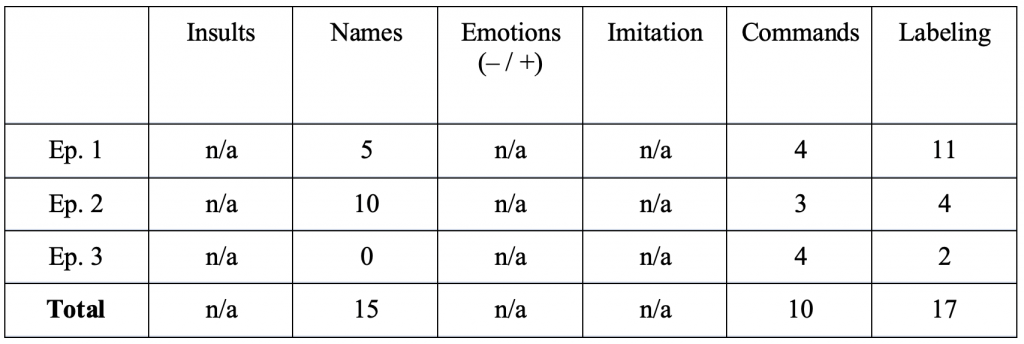
Bilingualism in TV: When and why does code-switching happen?

Zoe Willoughby, Anton Nogin, Isaiah Sandoval, Maria Becerra

As bilingualism becomes increasingly prevalent in a wider variety of television shows, sociolinguistic analysis of what code-switching entails and why it is used becomes even more important to look at. We delve into an analysis of the shows Dora the Explorer and One Day at a Time to explore what types of code-switching are used for audiences of different ages. We hypothesized each show would differ in its most frequent type of code-switching – metaphorical or situational – because of the different language complexity levels depending on each intended age group. However, we realized these labels may not be as clear as expected. As we analyzed the data, some instances could fit under both of those categories or did not fit under either. Since the language use was more complex in One Day at a Time, so was the categorization of the reasons why code-switching was used. We ultimately determined cut-and-dry labels such as “situational” and “metaphorical” are not sufficient enough to classify why people code-switch. In order to recognize code-switching as a tool used to demonstrate language mastery and not convenience, our analysis of the results looks to offer possible solutions to further classify these instances of code-switching in TV shows.

[expander_maker id=”1″ more=”Read more” less=”Read less”]

What’s this all about?

Along with the growing bilingual population in the United States, there has been a shift in the way bilingualism is represented in the media, especially in television shows (Grosjean 2018). In this study, we wanted to look at the layers of language complexity of bilingual speakers through bilingual shows. Given bilinguals might have another layer to add to the technicality of their speech – code-switching – it is important to see how the media portrays that. Code-switching itself has layers of complexity when it comes to explaining why a speaker might do so.

Bilingual shows are becoming more mainstream for viewers of a wider age range, producing shows such as Dora the Explorer (DE) and One Day at a Time (ODT), the two shows we focus on in this study. We used these two shows as a lens through which we viewed the reasoning behind why bilinguals might use code-switching and the context in which these switches occur. By distinguishing between the two intended age groups for each show, we decided to focus on the different types of code-switching that may be more specific to each age group: metaphorical (using code-switching as a resource to enhance meaning) and situational (using code-switching depending on topic or other speaker) (Van Herk 2018, pgs. 151-152).

We hypothesized situational code-switching would be more frequent in DE, the show for younger audiences, and metaphorical code-switching would be more frequent in ODT, the show for older audiences. After analysis, we proved this true but found that classifying reasons for code-switching would require more categories to encompass its complexity.

What’s the context?

Our research focuses on bilingual television shows, specifically ones whose characters code-switch (CS) between Spanish and English. Despite incorrect assumptions that bilingualism always means total proficiency in two languages, this neglects to acknowledge the complexity of language use for those who are multilingual (Grosjean 1994). This definition is unclear, but CS helps to show bilingualism and is indicative of a speaker’s command over the language they are speaking (Bullock & Toribio 2009).

The types of code-switching used in these shows are our central linguistic variables. Metaphorical CS is a resource used to supplement the meaning of a certain word or phrase by tapping into the associations with a certain language (Woolard 2004). Situational CS occurs when a speaker uses a different language for a certain conversation topic or with a certain speaker (Gumperz 1977). Situational CS tends to occur intersentential (within a sentence) and metaphorical CS tends to occur intrasentential (over multiple sentences), and since intrasentential CS is linked with a better mastery of a language, metaphorical CS is implied to be a sign of that as well (Bullock & Toribio 2009).

How did we go about it?          

In the first three episodes of each show’s first season, we recorded each instance in which the speakers switched from English, the main language of each show, to Spanish, the secondary language. Each show has a different age recommendation, and Common Sense Media, an advocacy group that reviews the appropriateness of media for families and children, stated that Dora the Explorer (DE) is intended for audiences ages three and up, and One Day at a Time (ODT) is intended for audiences ages 12 and up (Herman 2004, Slaton 2016).

Our first step in collecting the data was to keep a running list of each instance of code-switching that occurred in each show. Along with the timestamp of the occurrence, we also included a brief description of the context in which we found the example. Once each instance was recorded from all of the episodes, we created six categories that grouped the different contexts in which CS happened. These contexts included insults, names (character called by relationship name), emotions, imitation (copying what someone else said in a different manner), commands, and labeling (calling certain things with their corresponding names in one language).

Originally, we planned to use these contexts to help us divide the CS occurrences into situational and metaphorical explanations, but this proved much more complex than expected. In order to compensate for the lack of coverage the explanations of situational and metaphorical CS gave, we created additional categorizations, which included lexical gaps (when speakers use words in one language that cannot be directly translated with the same weight), overlaps (combine multiple explanations), and exceptions (where CS did not serve as significant of a sociolinguistic purpose).

What did we find?

As we had predicted, there were more instances of situational CS in DE than there were in ODT, and there were more instances of metaphorical CS in ODT than there were in DE. For example, in ODT episode two (18:05 – 18:20), Penelope (in bold) is talking to her coworkers and boss in the office (none speak Spanish):

But maybe you didn’t hear because you were on your phone like now  
Uh, what?  

Yo voy a matar a este hombre    [I am going to kill this man]

Huh, what does that mean?

I am just thinking about lunch.

In this example, Penelope is angry at the situation at her work and chooses to switch to Spanish to express her anger. This is a metaphorical instance because Penelope is trying to create distance between her and her coworkers.

On the other hand, DE provides clear instances of situational CS. For example, in episode two, when Dora met with Baby Blue Bird (who is monolingual), she has to switch over to Spanish to be able to communicate with him (Dora in bold):

Where do you live baby bird?

¿Que?              [What?]

Oh, Baby Bluebird speaks Spanish         (at the audience)  

¿Donde vives?      [Where do you live?]

This example is situational CS because one of the speakers is only able to understand Spanish. Therefore, the situation calls for Dora to switch over to Spanish to be able to communicate.

Our hypothesis was based on the fact that DE would have less complex language usage and that ODT would have more complex language usage because of their respective intended audiences. This observation was confirmed when collecting data. We have summarized the contexts of CS for each of the shows per episode in Table 1.1 and Table 1.2 below.

Table 1.1 Contexts of CS in ODT
Table 1.2 Contexts of CS in DE

From observing the contexts of CS for both shows, it is noticeable that ODT has more complexity in CS than DE. Because of the lower level of language complexity, DE has no instances of insults, emotions or imitations, meaning that classifying the reasons for CS for ODT was not as clear as for DE. In some cases, a given instance of CS did not fall neatly into metaphorical or into situational. This is when we resorted to our additional categories of why a speaker might code-switch: lexical gap, an overlap, or not clear enough for any category (exception). For example, in ODT episode one, the grandma says:

You need to do something about this little sinvergüenza

[You need to do something about this little ___________]

In this case, the word “sinvergüenza,” refers to a person who is not ashamed of doing something that is seen as shameful. However, there is no direct translation in English that has the same meaning, and therefore we have labeled it as a lexical gap.

Another example of the categories we have created is in ODT episode three when the grandma says:

She thinks she’s tan fancy because her four grandsons are altar boys. Guataca.

[She thinks she’s so fancy because her four grandsons are altar boys. _______]

Here, the grandma is using an insult in Spanish. This word has no direct translation to English so we have labeled it as a lexical gap. However, it is also an instance where the speaker (the grandma) is trying to create distance between her and the person she is insulting, therefore it is metaphorical CS. Since this CS instance has aspects of both lexical gaps and metaphorical CS, we labeled it an overlap.

Sometimes we couldn’t fit the CS instances into any of the categories because there seemed to be no significant sociolinguistic purpose. An example of this is when Dora repeats a word in Spanish and English a few times to teach a new word, which we labeled as repetition. Another instance is mixing, which is done often by the grandma in ODT. To clarify, we defined mixing to be when a word is used in a different language (usually intrasentential) but can be directly translated into English; CS might have happened just out of convenience. For example, in one episode, the grandma says “café con leche” which translates directly to “coffee with milk.” Also, when calling someone by their relationship name in Spanish, such as “mami” or “abuelita,” there is little to no sociolinguistic meaning behind it (we labeled this naming). Imagine this: If CS did not happen in any of these examples, would it make a sociolinguistic difference? In these cases, the speakers chose to CS for a reason that can’t be explained by sociolinguistics. In other words, the sociolinguistic difference was not enough to warrant another category.

What does this all mean?

If we only look at the scope of our hypothesis, then we proved the main points: There is more metaphorical CS in ODT, and more situational CS in DE, both suitable for each show’s recommended age group. However, the hypothesis itself did not allow us to take into account the other types of language use related to CS that came up in data collection and analysis. In every instance, whether it be a simple word or phrase repetition in DE, or more dynamic instances of CS in ODT, the words or phrases from Spanish utilized in English (or vice versa) were grammatically sound, even if they had no direct equivalent in the other language. This phenomenon shows that bilingual individuals who utilize CS are, at the very least, capable in both languages. Characters in both shows were able to switch seamlessly from one language to the other, maintaining grammaticality and conversation flow at the same time. What this means is that depending on a speaker’s frequency of CS usage, CS itself could act as a marker of high proficiency in, or even mastery of two languages.

Our hypothesis and initial conclusion stemmed from the narrow definitions of CS provided in our class textbook. The textbook provided context and examples for how metaphorical or situational CS each functioned in an interaction. However, it presumes these categories are limited by where in the phrase or sentence the CS instance occurs. The book defines situational CS as only occurring from one sentence to the other, and metaphorical CS as occurring within a single sentence (Van Herk 2018, pg. 151-152). Although the book connects language proficiency and emotional states to CS usage, it uses narrow descriptions for the phenomenon itself.

The textbook also assumes metaphorical and situational CS are the only two categories of CS worth noting. While the textbook works to dispel language myths by defining the sociolinguistic reasons for CS, it could confuse readers that there might only be two main reasons, just like it did for us. To that end, the exceptions and overlaps from our data are defined as such because we couldn’t place them in either category. It’s up to readers like you to go back and define these instances however you see fit.

What’s next?

Since there is a wide variety of other bilingual media out there (reality TV, movies, podcasts, etc.), more data could be collected to find different examples of diverse bilingual speech patterns. We could even compare media across time periods to measure frequencies of CS across several years or decades. This all ties back into one observation – that bilingual individuals are being engaged with in mass media and are being positively validated.


References

Bullock, B., & Toribio, A. (2009). Themes in the study of code-switching. In B. Bullock & A. Toribio (Eds.), The Cambridge Handbook of Linguistic Code-switching (Cambridge Handbooks in Language and Linguistics, pp. 1-18). Cambridge: Cambridge University Press. doi:10.1017/CBO9780511576331.002.

Grosjean F. (2018). Psychology Today, The Amazing Rise of Bilingualism in the United States. https://www.psychologytoday.com/us/blog/life-bilingual/201809/the-amazing-rise-bilingualism-in-the-united-states.

Grosjean, F. (1994). Individual bilingualism. The encyclopedia of language and linguistics, 3, 1656-1660. http://www.signwriting.org/forums/swlist/archive2/message/6760/Indiv%20bilm.rtf.

Gumperz, J. J. (1977). The Sociolinguistic Significance of Conversational Code-Switching. RELC Journal, 8(2), 1–34. https://doi.org/10.1177/003368827700800201.

Herman, J. (2004, December 14). Dora the Explorer – TV Review. Retrieved from https://www.commonsensemedia.org/tv-reviews/dora-the-explorer.

Slaton, J. (2016, December 19). One Day at a Time – TV Review. Retrieved from https://www.commonsensemedia.org/tv-reviews/one-day-at-a-time-0.

Van Herk, G. (2018). Multilingualism. In Gerard Van Herk (Ed.): What is sociolinguistics? (2nd edition: pp. 146 – 157). Hoboken, NJ: John Wiley & Sons, Inc.

Van Herk, G. (2018). Glossary. In Gerard Van Herk (Ed.): What is sociolinguistics? (2nd edition: pp. 220 – 237). Hoboken, NJ: John Wiley & Sons, Inc.

Woolard, K.A. (2004). Codeswitching. In A. Duranti (Eds). A Companion to Linguistic Anthropology (pp.73-94). Oxford, Blackwell. https://onlinelibrary.wiley.com/doi/pdf/10.1002/9780470996522#page=92.

[/expander_maker]
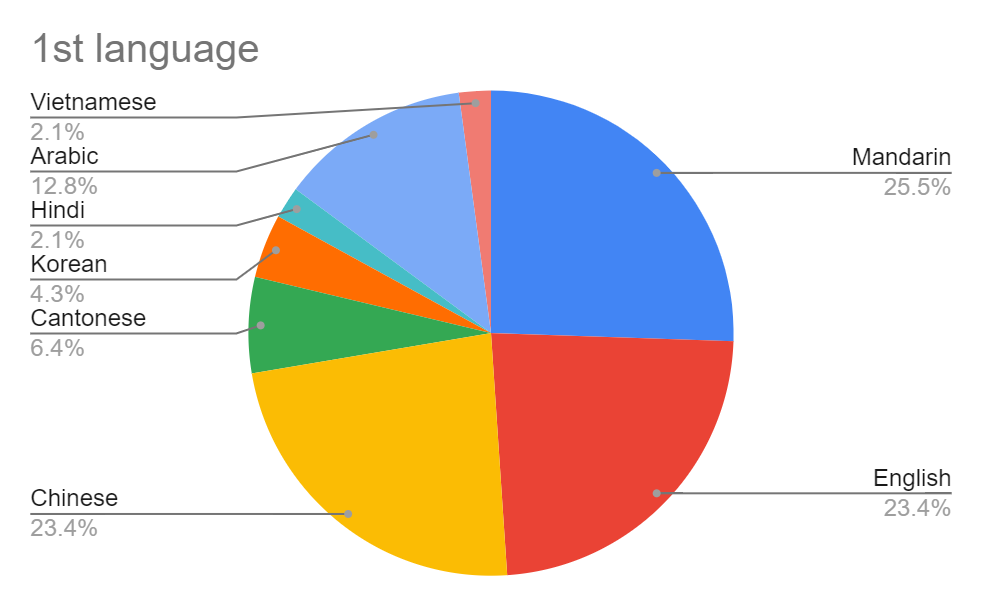
“Language 1, Language 2, and The Ol’ Switch-A-Roo” Mix & Match: Bilingual Edition

Language preferences and code-mixing among UCLA bilinguals in different social settings

Shiqi Liang, Leen Aljefri, Yingxue Du and Tianyi Shao

Here at UCLA, we have a diverse student body coming from many different backgrounds, which means we do have a sizable bilingual population on campus. Bilinguals and multilinguals often find themselves navigating through different social settings that require them to speak different languages. As bilingual speakers, switching between languages is quite common for us that it almost becomes a daily routine. However, when we really carefully think about that daily routine, there are so many questions we want to ask. Do we have a preference of one language compares to the other? Do our preferences vary? How do they vary? Do we mix languages? If so, how and why do we mix languages? Do bilinguals here at UCLA have a specific language preference when it comes to discussing fluid dynamics or gossiping about the latest juicy drama? Based on our study of 47 questionnaire responses collected from UCLA bilinguals and multilinguals, we arrive at the conclusion that among them, English is predominantly preferred in academic and professional related settings as well as social settings. At the same time, non-English languages are preferred in family settings and are present in social settings as well. We observed that code-mixing, the practice of mixing different languages together, is generally avoided, except when it is used as a tool for clarification.

[expander_maker id=”1″ more=”Read more” less=”Read less”]

Bilinguals experience potential conflicts between the two cultures behind the languages they speak. Language preference among bilinguals is related to the process of acculturation and socialization. Previous studies have identified the relationship between language preference and socialization, and literature addressing the relation can provide us with insights into the subject of interest. Song (2017) addresses the relationship between second language acquisition and socialization in “Second Language Learning as Mode-Switching” through the following idea: if social relations/context changes, then people employ a different linguistic and pragmatic mode to adapt to the new social expectation. Song adds that learning a second language requires the understanding of different speaking norms, linguistic values, and the rules of grammar. Language preference among bilinguals, therefore, can indicate the preference of one social norm to another to some extent. On the other hand, the fact that language preference among bilinguals is related to socialization is further addressed through a study conducted on infants and 9-month-old children (Valji & Poka, 2014), in which the infants show no preference for one language over the other and the 9-month-old children show preference in their native languages over the non-native language. As the social situations get more complicated when the bilinguals enter adulthood, the factors that might influence them to choose one language over the other are increasingly complicated and it is reasonable to articulate a relationship between social circumstances of a specific conversation and the language preference in that specific setting.

Observing the way multilinguals communicate with individuals in predominantly monolingual community is different than observing multilinguals in their own communities. Social and linguistic characteristics of multilinguals can be more noticeable when directly contrasted to monolinguals in the same community. As a first step to understanding what it means to be multilingual in a monolingual community, it is useful to look at a small bilingual population in such a community. The main focus of this project is to study the change in language preference according to situations and the frequency of code-mixing (practice of mixing different languages in one interaction) in bilinguals. In an effort to determine if a trend exists among the bilingual population here at UCLA when it comes to linguistic behavior, we conducted a case study and surveyed a group of 47 bilinguals at UCLA.

To better illustrate exchanges and preference in the use of language among bilinguals, here is an exchange between two English-Mandarin bilingual speakers talking about. The excerpts from this conversation is to present an example of how bilingual speakers interact with each other and how code-mixing happened during the conversation. The two bilingual speakers have conversations in their native language, and case study is to record and transcribe their conversation, and analyze the part that code mix happened. Throughout the whole conversation, code-mixing happened four times when participant B’s spoke. The four code-mixing can roughly be divided into two categories based on their cause, for clarification purposes and habit of word using.

A: 不是,我是说现在就你一个人在这个...... 空间啊?

   No, I mean right now are you just alone in that...... space?

B: 现在?Right now?

   Right now? Right now?

This is where code-mixing first happened during the conversation, and the purpose of it is to clarify the meaning of the word “现(xian)在(zai)”, which means present time. However, the meaning is not clear enough, because that word can represent different length of present time, and that can make the whole sentence a different meaning. Here, the phrase “right now” appeared as a clarification, which is similar to the purpose of the next exchange.

A:我听说过,但我不清楚是治愈(Zhi Yu)的还是致郁(Zhi Yu)的?

  I’ve heard about that, but I am not quite sure if it’s a healing story or a gloomy story.

Bhealing的那种,...... 结果两个人无意间卷进了road trip, 然后慢慢变好。

   It’s the healing type, .... The two people happened to be on a road trip, and things are getting better.

In this exchange, individual B needs to use another language to clarify her sentence since the Mandarin for “healing” and “gloomy” has the same pronunciation, “zhi yu”. In the second case she chose to say “road trip” in English mostly because she want to evoke a special cultural reference not widely available in Chinese culture.

The main methodology of this research is centered around analyzing data gathered through an online questionnaire designed to generate simple yet precise responses from participants. Before answering the survey, participants would read a text that ask them to evaluate themselves and only proceed to answer the questions if they match all the requirements of what we consider to be bilingual/multilingual. There are 10 mandatory questions and 6 additional questions if the participant speaks more than 2 languages. Participants would first self-report the languages they speak (free response) then choose scenarios in which they would prefer to speak a certain language and the reasons behind that. In order to avoid half-completed questionnaires and encourage complete responses, questions that involves picking scenarios and reasons would be in forms of multiple choice instead of free response. However, if none of the options provided are satisfying, participants are free to enter their own response through the “other” option. The questionnaire itself was distributed among the researchers’ group of bilingual friends and an incentive (free boba) was provided to further encourage participation. You can find the full questionnaire here.

In the end 47 responses were gathered and subsequently analyzed. You can find our raw data and analysis here. Out of all those responses, all 47 of them indicated English as a language they speak, with the Chinese language family (Mandarin, Cantonese and Taiwanese) ranking the second most self-reported spoken language with 34 responses. But yet surprisingly, only 23.4% of participants consider English as their first language.

Chart 1.1 and 1.2: self-identified “first language” and “second language”
Chart 2: total counts of languages participants reported speaking
Chart 3: self-report race and ethnicity among participants. “/” means decline to answer.

Unfortunately, as the sample size is relatively small and might not be an accurate representation of the entire student population at UCLA, the sample selection might be biased and the conclusions derived from the questionnaires might not be a representation of the entire multilingual student population. English, Mandarin and Arabic were selected because they have the most speakers and thus could relatively better represent themselves.

Chart 4.1, 4.2 and 4.3: language preferences in different scenarios. Red-schemed bars represent social/emotional/casual settings and blue-schemed bars represent academic/professional settings.

We could see that English is predominantly used in academic and professional setting (discussing academic work, discussing homework questions with friends, etc) and often used in social settings (talking to friends), yet less often used in family settings (talking to parents). Chinese and Arabic are less often used in academic and professional settings, but more prominent in social and family settings. This is rather predictable since UCLA is mostly a monolingual community and using a non-English language to discuss academic work is regarded as a social taboo. The prominence of non-English languages in family settings could be best explained by language preference in immigrant households in general. Children would mostly speak their parents’ native language in their own household due to new immigrants’ limited English proficiency.

Surprisingly, a lot of students also choose to discuss emotional issues in English. We predicted that since English is often associated with professional and academic settings, students might prefer a language that isn’t heavily associated with cold and rigid setting to discuss emotional issues. Our best explanation for this observed pattern is that some non-English languages, such as Mandarin and Arabic, are often associated with a more reserved culture. Thus, students may feel more comfortable speaking in English.

In terms of code-switching, most students answered “depends”. Only a few answered “almost in every sentence”. Data suggest that most students don’t prefer not to mix languages too often in their daily conversations. As for reasons for mixing language, almost everyone answered “in order to avoid misunderstanding or meanings lost in translation” or some variety of the same reason.

Chart 5.1 and 5.2: code-mixing among UCLA individuals. The first chart talks about the frequency of code-switching and the second one deals with reasons behind code-switching or lack of code-switching.

The complete reasons found in Chart 5.2 are listed below, from lowest to highest frequency:

    • I don’t know how to say a word in Spanish
    • I don’t know how to say a word in Chinese so I switch to English
    • I don’t know how to say a word in Chinese so I switch to English
    • I think it’s very hip and cool to do so.
    • I don’t
    • I want to highlight a part of my identity
    • Some words lose their meanings when translated to another language, so to avoid misunderstanding I would mix the language together

As predicted, the majority of the responses confirmed the hypothesis that English would be the favored language in academic settings. Conversely, the other language by majority is likely to be spoken in more personal conversations such as speaking to family and friends.

While, UCLA is home to a large multilingual community, the general language of instruction is English. In a way, the level of English knowledge is controlled by the admission requirements. Consequently, that may play a role in justifying the preference for speaking English in academic settings. It is the university’s expectation of its affiliates, and so it is upheld by the student population regardless of multilingualism within the community itself.


References:

Song, S. (2017). Second Language Learning as Mode-Switching. Second Language Acquisition as a Mode-Switching Process, 75–100. doi: 10.1057/978-1-137-52436-2_5

Valji, A., & Polka, L. (2004). Language preference in monolingual and bilingual infants. The Journal of the Acoustical Society of America, 115(5), 2505–2505. doi: 10.1121/1.4783066


About the Authors

Shiqi (Susan) is a second-year statistics major at UCLA. She enjoys studying human geography and drawing in her free time.

Leen is a first-year engineering student from Saudi Arabia.

Christie is a senior majoring in theatre and has working experience of teaching bilingual children before. She enjoys listening to music and observing sunset glow and sunrise glow.

Tianyi is a senior majoring in Mathematics/economics at UCLA. She enjoys video games, music, and photography and she loves making observations about her life.

[/expander_maker]
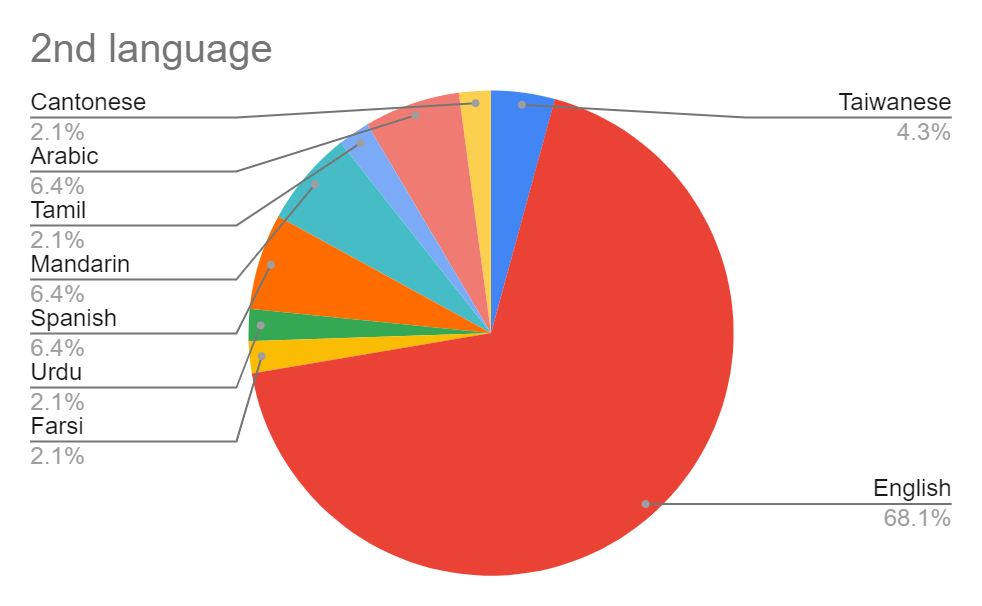
Scroll to Top