bilingualism

Code-Switching Habits of BTS

Sylvia Le, Lien Joy Campbell, Jose Orozco, Noah SS

Do you know BTS? – If you answered no, where have you been? In the past five years Korean pop music (K-pop) has undergone a global explosion. Built into the successful business model of K-pop is the central idea of English as a Lingua Franca. While several studies throughout the years have focused on code combinations in lyrics, our study addresses specifically code-switching in a less structured environment: interviews. We elected to focus on the “biggest boy band in the world” and, arguably, the most well-known and culturally recognizable act in the international K-pop industry, BTS. The central question driving us was: does code-switching correlate to the success of BTS? In this study, we focused on interviews from three parts of BTS’s career and analyzed them for the structure, type, and cause of code-switching, while also comparing the frequency to their album sales and streams. We found that while language as a tool for international growth may be tangible, it is perhaps not as productively used as we assumed.

[expander_maker id=”1″ more=”Read more” less=”Read less”]

Background

Oftentimes, musicians and artists have found language to be a barrier between them and larger, global audiences. As artists, they are responsible for their audience connecting with their work, as well as their audience connecting with them as artists – and the way we use language in conversation has a huge impact on other people’s perception of us. So, the language in which an artist communicates can play a huge role in the reception of their work and the way they connect with fans and audiences. Recently, this has been a distinct element of modern music, where global streaming and social media connection is at an all-time high. In particular, K-Pop groups have found an increasingly English-speaking audience.

Recognizing this, we chose to investigate more deeply whether K-Pop groups have relied more on code-switching when interacting with their audience. Specifically, we wanted to analyze how K-Pop groups have used English, incorporating it into their interviews, music, and public persona, to garner a wider audience, as according to Ahn (2021), English is one of the main factors associated with the success of K-pop on the world stage.

Code-switching, for our purposes, may be defined as the practice of alternating between two or more languages or varieties of language in conversation.

While plenty of K-Pop groups have, over the years, made serious international inroads, it is arguable that none have achieved as much success as the boy band Bangtan Sonyeondan, BTS. They debuted in 2013 producing and performing hardcore hip-hop music and enjoyed their first breakthrough and commercial success in 2015, after the release of HYYH, a Youth series demonstrating their evolving musical style. Alongside the shift in music, they began using “more elaborate storylines” and “multi-layered narratives” to create the BTS Universe. HYYH was aimed at the Chinese market, but after the Chinese government closed its market to K-pop in 2016 due to the THAAD crisis, BTS was one of the first K-pop bands to actively aim at the US market, the largest and most influential in the world. Now, BTS is widely regarded as the biggest boy band in the world (Parc & Kim, 2020).

Given the established desirability of the US market from Shin and Kim (2013) and an understanding of the growing power of English as lingua franca in Asia from Kirkpatrick (2010), we chose to study instances specifically of BTS’ English/Korean code-switching.

Methodology

Several studies have focused on the use of code-switching in the actual performance and songs of K-Pop. We believed that studying English in interviews would be more casual and supplement previous lyric research. We were inspired by a study conducted by Octaviani and Yamin (2020) on the triggers of code-switching in the TV show, The Immigration, and a thesis conducted by Luthfiyani (2014) based on code-switching in the TV show, The After School Club.

Our data took the form of BTS’ interviews given to English-speaking international press/media. The selection of these was based on the popularity of the interviews as well as their chronological position in BTS’s career. Exempting their hiatus years, we split BTS’ career into three parts. We analyzed the two most viewed international interviews, via YouTube, from the beginning (2013-2015), the middle (2016-2018), and the most recent part of their career (2019-2021).

As BTS present themselves as a group and to account for variance in Korean/English proficiency, we elected to analyze them as a group rather than on an individual basis. Instances of single word assent, echoing, and “noise” were not counted as instances of switching, as they generally contributed to the sound texture of the interviews rather than content.

We then analyzed BTS’s rate of codeswitching and compared this to their album sales and song streams. We also categorized the switching as intrasentential, intersentential, and extrasentential as originally introduced by Poplack (1980). We additionally analyzed the type of code-switching in relation to Blom and Gumperz (1972) and Yohena’s (2003) categorizations: situational and metaphorical code-switching. Situational code-switching is based in situations where the speakers find that they speak one language in one situation and another in a different situation with no topic change. Metaphorical code-switching happens when there is a topic change (formal to informal, official to personal, serious to humorous, and politeness to solidarity). Finally, we analyzed the contextual motivations for code-switching using the frame of functions laid out by Holmes (2013).

We predicted that the frequency of code-switching would increase in reflection of their international career growth, and that their code-switching would grow in contextual complexity in relation to growing exposure to international environments. We further predicted that the contexts of code-switching would display more metaphorical use, too, as an indicator of their growing international group identity.

Results and Analysis

Before presenting our results, there are some confounders and limitations from our study that must be addressed. One limitation was our small sample size. This was a case study done for only one band and due to time limitations, we analyzed a small number of interviews. The conductors of this research are not native Korean speakers, so some of the code-switching analysis was aided by outlet provided subtitles, which could lead to mistakes due to cultural differences in the language and phrases that are used during Korean code-switching. Finally, band-wide analysis lacks granular specificity. It is difficult to draw causational lines in band-data, there being many extraneous variables, so although our study deduces a correlation, we cannot conclude causation.

We began our analysis by looking at the structures in which code-switching occurred. We found that there was an overwhelming preference for intersentential code-switching, see Figure 1.
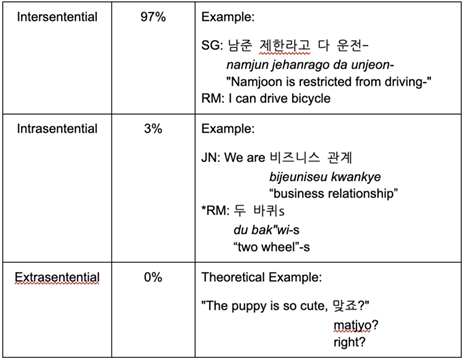
Figure 1: Table illustrating structural types of code-switching and the rate at which they appear in the data. Also included are example sentences from the data, exempting the theoretical example. Additionally of note is the singular instance of a word level/morpheme mix with the Korean NP and English plural morpheme -s

Interestingly, most intersentential examples were the result of turn-taking by the speaker. This points to the conclusion that most code-switching occurred independently and did not involve grammatical combinatorial structures. Typically, code-switching preferentially occurs intrasententially, as Koban (2013) confirmed with English/Turkish bilinguals. However, in this case, perhaps the semi-structured nature of interviews produces a preference for providing “complete” answers resulting in standalone sentence switches. Additionally, intersentential switching may be more accessible as they could have time to prep and foresight into normal interview questions.

In terms of the total lack of extrasentential switching observed, there are two primary possible causes. The first is that this form of switching – most often found in the form of tag questions – likely is more common in contact situations, as well as in situations where the languages occur in a more balanced distribution and particularly productive phrases remain active across both languages, which, due to the language imbalance observed in BTS, is less likely. The second possible cause is the interview format, which is not conducive to the use of tag questions.

We next compared the rate of code-switching that BTS engaged in throughout their career in relation to their album sales and streams. Firstly, we found that BTS’ popularity grew exponentially over the years we studied. We compared their sales over time and the amount of their streams of Spotify over time and both showed a clear increase, as shown in Figure 2.
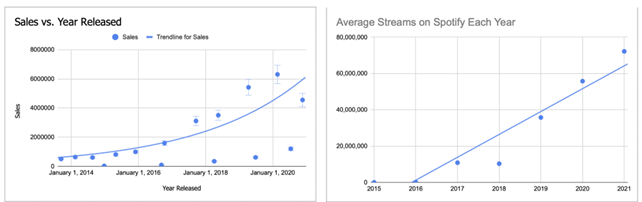
Figure 2: BTS’ record sales over per release as well as their average streams on Spotify per year

This was directly proportional to another criteria we considered that calculated the amount of English utterances the group produced per minute. There was a similar exponential increase with 1.13/min. in their Early era, 1.40/min. in their Mid era, and 2.06/min. in their Recent era, shown in Figure 3. This increase was directly proportional with the impact of their music and, therefore, their brand, strongly suggesting that their use of code-switching is related to their popularity and global exposure.
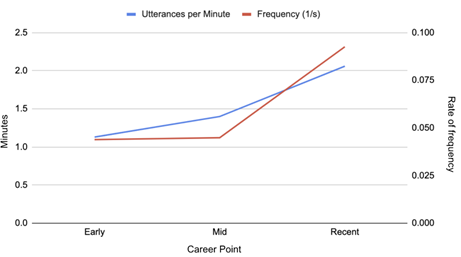
Figure 3: English utterances per minute across the three time periods as well as the frequency 1/s of the code switches across the time periods

Additionally, we looked at the styles of code-switching that the band engaged in utilizing the framework of situational and metaphoric switching. The data samples found in Figures 4 and 5 are examples of these switches.
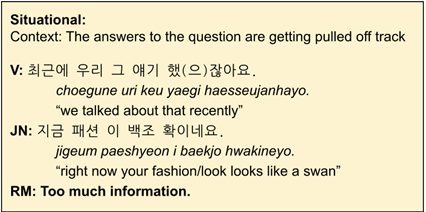
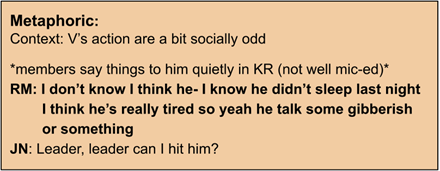
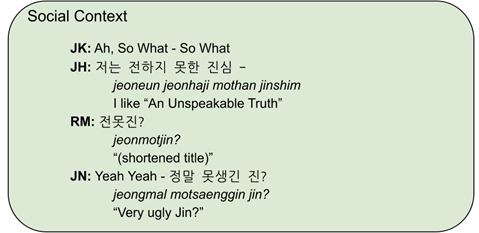
Figure 4: An example of situational code-switching note that RM uses a switch to English to recenter the interview’s social context on the interview and transition to the next question [BTS Answer the Web’s Most Searched Questions: 2:50 – 2:54]
Figure 5: An example of metaphoric code-switching. Note that RM transitions more strongly than in figure (4) in social position from fellow to leader and on-screen translator to repair the socially awkward/non-answer by V, and to create distance between himself and V’s display [BTS Chats to Andy Trieu at SBS PopAsia HQ: 2:52 – 3:08]
Interestingly, the two examples are relatively similar. The defining feature between these two are the stances conveyed. In the situational switch, RM is stopping the Korean conversation to transition the conversation to a new topic and it is directed at the members to refocus them. In comparison, the metaphoric switch conveys both emotional distance from V, as well as a shift in his attention and language goal from being a team-member to the leader, so there is a social position change conveyed as well. Additionally, Jin acknowledges RM’s switch, displaying solidarity by making a joke also in English, targeting V’s “weird behavior.”

In our comparison of situational vs. metaphoric switching over their career, we found that there was a strong preference for situational code-switching, as seen in Figure 6.
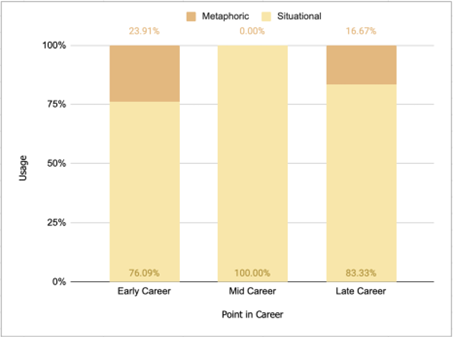
Figure 6: The percentage of use for both metaphoric and situational code-switching in relation to BTS’ early career, mid career, and late career. Interestingly there was no metaphoric switching found in their mid career

Our data shows a general preference for situational switching overall and unexpectedly very little change in metaphoric switching. Metaphoric switching remained consistently low, even dipping to 0% in their mid-career. However, this may be due to the interviews that were analyzed for this period. This was unexpected, however, metaphoric switching is more indicative of a speaker’s internal world, or how they situate themselves in a social interaction, which lends itself to more advanced multilingual speech – this may require a higher English proficiency to be used strategically than many BTS members currently possess. This can be corroborated by the fact that many of the metaphoric switches observed were performed by RM, who is fluent in English, and the most balanced and practiced bilingual of the group.

The final aspect of code-switching that we analyzed was Holmes’ influencing factors, which can be defined as

  1. Participant: motivated by a change in the participants or goal receiver of utterance
  2. Solidarity: signaling shared group membership
  3. Social Context: motivated by a change in the social dimension of conversation
  4. Topic: motivated when a specific topic is more accessible in one language

The data samples found in Figure 7-Figure 10 provide examples of these different influencing factors.
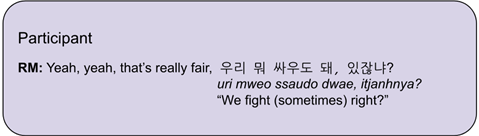
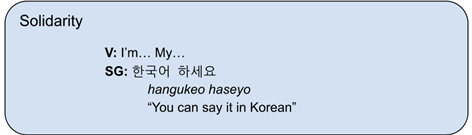
Figure 7: An example in which RM code-switches as the goal receiver of the sentences changes from James Corden to the rest of his members. [BTS Carpool Karaoke: 8:01 – 8:05]
Figure 8: Suga, recognizing V’s struggles, switches to Korean to show solidarity with V as a fellow Korean speaker and member. [BTS Reveal Their Hidden Talents, Impersonate Each Other, and Reveal Their Celebrity Crushes to Andy Trieu: 2:14 – 2:20]
Figure 9: J-Hope switches to Korean to say his favorite song on the album, after joking with the puppies about the title track; it is a reaction to the socially more formal question. Interestingly this triggers the other members to switch to Korean and continue joking. (Jin’s comment is a play on words that sounds like the shortened version of the title RM uses to confirm with J-Hope) [BTS Plays With Puppies While Answering Fan Questions: 1:49 – 1:57]
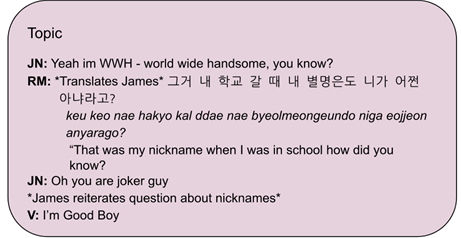
Figure 10: Unlike the last example in Figure 7, where RM’s translation and subliminal signal that a switch to Korean is fine, the conversation continues in English, as some members have specific nicknames. This is a topic that they are more comfortable discussing in English [BTS Carpool Karaoke: 5:15 – 5:36]
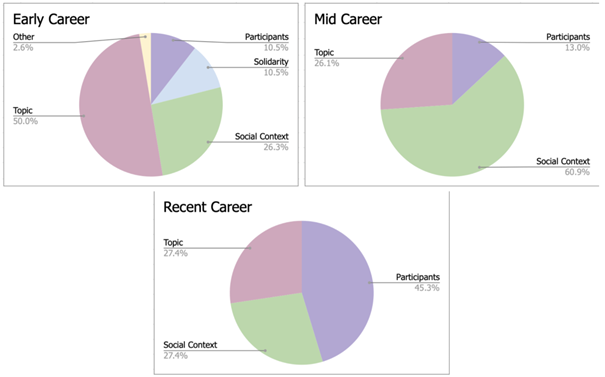
In our analysis of our data, we found that complexity actually decreased somewhat from their early career to their mid/recent career as seen in Figure 11.

Figure 11: Comparisons in the different influencing factors that affected BTS’ code-switching throughout their career

Moreover, the complexity of code-switching exhibited in their mid and recent careers did not show the same distribution of influencing factors – with notable shifts in the prominence of Social Context and Participants. This could be due to the style of interviews, as well as growing sensitivity to interacting with English-speaking interviewers/hosts. However, the decrease in overall complexity from their early career points to a relatively consistent pattern of code-switching in terms of broad contextual influence.

Discussions and Conclusions

In recent years K-Pop has undergone a surge in popularity and groups like BTS have begun to code-switch more to relate with fans. With English being a lingua franca, we analyzed the code-switching between Korean to English from BTS. Some unexpected findings were that metaphorical switching did not increase as they began to grow. Originally, we thought that metaphorical switching would increase, but this was not the case. BTS displayed a preference for situational switching and there was little change in their metaphorical usage. We also believed that their code-switching would grow in complexity as they gained greater exposure to international environments, but this was not the case as per our research. This data is significant because it provided a greater insight into code-switching and how L2 language learners switch more in a certain style than others. It may also demonstrate that outside pressure to use an L2 language – in this case English – may not have as much effect on the actual surfacing of this language in use.

We found that most intersentential examples were member-by-member, which suggested that code-switching in this case was a standalone feature in the languages. We typically have seen new language learners start from intrasentential code-switching. This could be true for some learners, but perhaps intersentential sentences are sometimes simpler in structure and less complex. They are used in isolation, so it is easier to remember, and these types of sentences are used in everyday conversations so they are easier to pick up. So, complex mixing may be less frequent amongst BTS due to this reason, as more complicated structures require more advanced knowledge of the language. Such limited access to L2 can shape a language learner’s usage of metaphoric language as well, since it requires more proficiency in the language. Learners may struggle to use and understand metaphorics efficiently as they cannot comprehend the nuances such as with cultural references or ties. Since BTS is a Korean group, the cultural aspects of code-switching also bring in further struggles when attempting to switch to English, predominantly American English.

In conclusion, the code-switching for BTS was mainly intersentential, as the data demonstrated. There were clear preferences for intersentential code-switching over other types. We believe that this was due to the fact that the group is not very proficient in English. Based on the data that we collected, BTS code-switching has stayed relatively constant throughout the years, further illustrating the fact that they had a preference for the type of switching they use. Generally speaking, groups code-switch with friends and family when they are most comfortable. These groups may also code-switch to impress others or to send a different perception of themselves to a larger audience. Having the group code switch amongst themselves could have helped gain further attraction among fans. Meanwhile, code-switching would have also been used to convey their English skills, as it is an important language to learn in the fields of business and music.

There was an increase in overall code-switching as the group grew in international popularity. This makes sense, as they have to spread to keep up with demand. Due to this, corporations tend to gravitate to these markets where they can capitalize the most. From this standpoint, it makes sense as to why groups like BTS code switch to English rather than another language, or why their prevalence is so large among English-speaking nations and across the world. However, with the rising popularity of K-pop and Korean culture internationally, too, there has been a spike in Korean language and culture studies, so perhaps there will be a lessening of overt pressure to perform multilingualism in the future. Overall, it appears that the usage of English has aided BTS’ popularity; however, it may not be as definitively related to their success in the international music industry as we assumed.

While there were certain limitations to our study, as mentioned previously, in the larger phenomena of linguistics and bilingualism with its relation to code-switching, the data and analysis we had created could be important for future work. Future research could focus on the effects of code-switching on BTS’ audience and their reactions to it rather than how often they code-switch and why, encompassing whether or not the perception of code-switching amongst fans enhances or detracts from their appreciation of the music. On a similar note, we could also analyze the cultural implications of code-switching and how it impacts Korean culture on a global scale. This data can help future researchers better understand code-switching and its impacts on an audience relating to global sales, popularity, and positive outlook.

References

Ahn, H. (2021). English and K-pop: The case of BTS 1. English in East and South Asia, 212-225.

Blom, Jan-Petter, and John Gumperz. (1972). “Social Meaning in Linguistic Structures: Code Switching in Northern Norway.” In: John Gumperz and Del Hymes (eds.): Directions in Sociolinguistics:Sociolinguistics: The Ethnography Communication, 407-434.

Holmes, J. (2013). An Introduction to Sociolinguistics (4th ed.). Routledge. https://doi.org/10.4324/9781315833057

Kirkpatrick, A. (2011). English as an Asian lingua franca and the multilingual model of ELT. Language Teaching, 44(2), 212-224. DOI:10.1017/S0261444810000145

Koban, D. (2013). Intra-sentential and Inter-sentential Code-switching in Turkish-English Bilinguals in New York City, U.S. Procedia – Social and Behavioral Sciences, 70, 1174–1179. doi:10.1016/j.sbspro.2013.01.173

Luthfiyani, F. (2014). Code-switching and Code Mixing on Korean Television Music Show After School Club (thesis). UIN Syarif Hidayatullah Jakarta: Fakultas Adab dan Humaniora, Jakarta.

Nilep, C. (2006). “Code-switching” in Sociocultural Linguistics. Colorado Research in Linguistics, 19. https://doi.org/10.25810/hnq4-jv62

Octaviani, Andita Dyah & Yamin, Haruki Manik Ayu. (2020, July 30). The Rise of English Among K- Pop Idols: Language Varieties in The Immigration. Proceedings of the International University Symposium on Humanities and Arts (INUSHARTS 2019), 117-121. DOI: 10.2991/assehr.k.200729.023

Parc, J., & Kim, Y. (2020). Analyzing the reasons for the global popularity of BTS: A new approach from a business perspective. Journal of International Business and Economy, 21(1), 15-36.

Poplack, S. (1980). Sometimes I’ll start a sentence in Spanish y termino en Español: Toward a typology of CS. Linguistics 18, 581-618.

Shin, S.I. & Kim, L. (2013). Organizing K-Pop: Emergence and Market Making of Large Korean Entertainment Houses, 1980–2010. East Asia 30, 255–272. DOI: 10.1007/s12140-013-9200-0

Yohena, S. O. (2003). Metaphorical code-switching revisited. (Vol. 38, pp. 138–158). essay, Ferris University.

[/expander_maker]

, , ,

Language Proficiency and Cultural Identity of Korean Heritage Speakers

Griffin Gamble, Erin Kwak, Joanna Kwasek, and Hannah Shin

A heritage language is defined as a minority language spoken at home that is not part of a dominant language in society. This study looked specifically into Korean heritage speakers living in the United States and investigated whether language proficiency in Korean will align with the degree of Korean cultural identity. In order to study this relationship, we utilized two separate data collection methods: an elicitation task to assess language proficiency and a self-reported questionnaire to record cultural identity. As expected, we found that the more grammatical errors the participants made, the less they identified with their Korean culture. This finding suggests a positive relationship between Korean language proficiency and Korean self-identity, which contradicts previous findings that higher proficiency in a heritage language predicts a more balanced bicultural identity that is not dominated by one culture.

[expander_maker id=”1″ more=”Read more” less=”Read less”]

Introduction and Background

With the U.S. being known as a melting pot of cultures, numerous languages are constantly being spoken and intermingled in public and private. Following this observation, we were interested in understanding how heritage speakers–more specifically, Korean heritage speakers–juggle multiple cultural identities.

Previous findings suggest that one’s cultural identity and language proficiency are correlated. Lee (2002) studied the relationship between heritage language proficiency and cultural identity of Korean heritage speakers. They were able to observe that Korean heritage speakers who were proficient in Korean largely reported having a bicultural identity, or one that is equally American and Korean (Lee, 2002). Furthermore, Adaobi (2014) studied the link between a minority language, Etulo, and the majority language, Tiv, to understand if bilingualism affects self-identity. Similarly to Lee (2002), Adaobi found that Eluto speakers identified with both cultures, but did experience a sense of identity conflict, or dual identity, from time to time (Adaobi, 2014). Such findings indicate that proficiency in both the dominant and minority languages facilitate a unique bicultural identity.

One of the biggest limitations that we observed in the studies above was the use of self-assessments as a measure of language proficiency. Self-reports can be unreliable in producing standardized data, as it does not involve an objective assessment of language proficiency; it is susceptible to biases about how well one believes they can speak a language. Therefore, in our study, we have decided to implement a widely used method in the study of bilingualism: the elicitation task (Bialystok and Frohlich, 1980; Dechert, 1983). As grammatical competence is often a strong predictor of overall oral proficiency (Magnan, 1988), it is plausible to assume that grammatical errors will decrease as the proficiency level increases. With such assumptions, the current study conducted a grammaticality judgment of participant speech to determine language proficiency (Cornips & Poletto, 2005), in hopes of enhancing both the validity and reliability of the research addressing heritage language proficiency and cultural identity.

We hypothesized that there will be a positive relationship between Korean language proficiency and Korean cultural identity. In other words, Korean heritage speakers who 1) exhibit higher grammatical accuracy in Korean and 2) are able to utilize more cultural references will identify with the Korean identity to a larger degree.

Methods

We studied twelve Korean heritage speakers currently living in Southern California, between the ages of 15 and 23. Eight of the participants identified as female, three as male, and one as other. They had differing levels of exposure to formal Korean language education but all of them used Korean at home with their family (aligning with our definition of a heritage speaker).

Table 1: Participant Demographics

The study utilized two separate data collection methods. The first was an elicitation task, which involved a slideshow that depicted the Korean fairytale titled The Heavenly Maiden. We began by telling the story to the participants in English, accompanied by the corresponding image for each scene (See Figure 1).

Figure 1: Example of a slide from the elicitation task

The participants were then asked to retell the story in Korean as we flipped through the images in the slideshow. Their speech was recorded and transcribed for further analysis. The second data collection method was a questionnaire that was distributed to participants after the elicitation task. By doing so, the questions regarding ethnicity, culture, and comfortability in speaking Korean did not influence their performance in the storytelling task. The survey also included questions about the participants’ general background information, such as their age, the circumstances in which they learned Korean, in what situations and how frequently they use Korean today, etc.

The recording was reviewed for two main variables: instances of any grammatical errors (such as subject, verb, and object word order errors) and the usage of culturally-relevant vocabulary within the story. Regarding the culturally-relevant vocabulary, there are a few terms, such as 선녀 (“heavenly maiden”) and 두레박 (“bucket”), that are important aspects of the fairytale. We expected to find that participants who are more in touch with Korean culture would be able to better identify and use those cultural references.

Results and Analysis

Out of the twelve participants, only ten participants fully participated in our study as two people opted out of the elicitation task as they felt that the task would be too difficult with their language abilities. However, we still decided to give them the option of completing the questionnaire so that we could note any potential patterns.

When analyzing the data, we noticed two main patterns amongst the participants: irregular formality and sentence structure. These were interesting to us because the Korean language is highly sensitive to different degrees of formality–that is, a speaker should not be suddenly switching between multiple formality levels unless the recipient has changed. An instance of irregular formality can be seen in this excerpt of participant 1’s transcript: “사슴이 남자에게 도움을 요청했습니다. 사냥꾼이 사슴을 사냥하고 있었다.” The first sentence ends with –습니다, which is formal and respectful. However, the next sentence ends with –다, which is less formal and more direct. Additionally, Korean sentences typically follow a subject-object-verb order, but the participants seemed to use different word order structures purposefully. Korean-American speakers were repeatedly and deliberately utilizing an alternative word order structure as a stylistic choice, not as a momentary mistake. An example of irregular sentence structure can be observed in this excerpt of participant 4’s transcript: “사슴이 살려달라고 그래서 나무속에 숨겨놨는데 사냥꾼이 와서 찾았어요 사슴을.” This sentence notably ends with an object (“사슴을”), which is not common in Korean speech, and more resembles English’s subject-verb-object order.

Surprisingly, participants were generally lacking in the use of cultural references with two people using none, seven people using one, and one person using two. Patterns regarding the usage of cultural referents were thus not evident, which made it difficult to answer the relevant aspect of our hypothesis.

Regarding the self-reported cultural identity of our participants, a majority of our participants considered themselves Korean-American, but more Korean or equally Korean and American. None of our participants considered themselves fully American with no Korean identity. Interestingly, the participant with the least amount of errors and highest self-perception of being Korean (i.e., they viewed themself as fully Korean, rated themself 5 in Korean proficiency, and 5 for how comfortable they are in speaking Korean), only utilized one cultural referent throughout the whole speech. She instead opted for a more casual and simple nuance, using Korean versions of an English word, such as “샤워” ([ɕʰawʌ] ‘shower’) and 버켓 ([bʌket̚] ‘bucket’). We also noticed that the two people who opted out of the task but filled out the questionnaire were the only ones who marked “very uncomfortable” for the question asking how comfortable they are in speaking Korean and “strongly agree” for the statement “I celebrate most American holidays.”

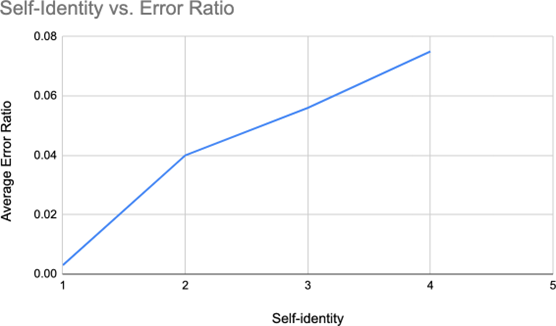
In comparing the self-identity question to their overall error ratio in speech, we found that the average error ratio increased as the participants identified as more American (See Figure 2). Although we were not able to run a formal statistical analysis due to our limited sample size, we expect this trend to transfer onto a bigger sample size as well due to its concreteness.

Figure 2: Self-Identity and Error Ratio

Another interesting observation we made was that those who marked that they took Korean in school for foreign language credit (which were participants 9, 10, A, and B) had either: the highest ratios of errors or completely opted out of the elicitation task due to low proficiency.

Discussion and Conclusion

The results suggest that language proficiency and cultural identity seem to have a positive correlation, as the participant who rated herself as fully Korean had the least errors in speech, and the average error ratio of participants increased along with American identity. In addition, we also observed a common linguistic pattern among our Korean-American participants. Those who rated themselves a score of 2 or 3, and therefore did not fully identify as Korean, were using a word order structure similar to English subject-verb-object (SVO). This word order is not technically ungrammatical in Korean, but it’s usually only used if the second clause is an afterthought therefore it can come off as awkward especially if used repetitively. However, the Korean-American participants appeared to be using it as a stylistic choice, and not by mistake. This finding opens up a new area of research for bilingualism: emerging linguistic patterns in heritage speakers that were not previously observed in native speakers. By studying how this linguistic trend is preserved or even replaced within generations, we would also be able to study how multiple languages reform as they come in contact with a different language. In the case of our participants, it was mainly the fusing of English and Korean that prompted the rise of English’s SVO-like word order structure in Korean.

One of the biggest limitations was our small sample size. A larger sample size would help identify stronger, statistically significant correlations between our variables, and in turn, promote the external validity of our findings. Furthermore, we could better target the elements within our hypothesis by improving the elicitation task. As we were unable to observe a consistent use of cultural references among the participants, we could better assess the role of cultural proficiency or cultural awareness by utilizing or creating a story that prompts the use of more cultural references. The analysis method of our study would also have been more standardized if the grammaticality judgment was not done by the researchers themselves. Although we were limited in our time and resources, recruiting a panel of native Korean speakers to rate the grammaticality of each participant’s speech would lead to a more concrete assessment of language proficiency.

So why do these findings matter in our day-to-day lives? First of all, the observations we made throughout our study support the idea of a bidirectional relationship between language and identity. Even though our main research question dealt with the positive connection between language proficiency and the corresponding cultural identity, this relationship encompasses so many other factors such as our attitude towards our culture, the amount of language use per day, the quality of language use, the context of language use, and much more. Each of the aforementioned variables could equally serve as a byproduct of or the driving elements behind one’s language proficiency. For instance, one could be using their heritage language only with their parents because they lack proficiency, or lack proficiency because they only use it with their parents and no one else. If you factor in the role of cultural identity, it further raises the question of “which came first?” as it could be the depth of cultural identity that motivates language use or vice versa. Knowing this, it brings us to the second reason why the findings of this study are important: we could potentially promote language proficiency and cultural identity by elevating one another! To provide an example, enhancing one’s cultural identity could serve as a big motivator behind learning a heritage language. The positive attitude allocated to a specific culture could definitely act as an incentive for learning a language while enhancing the learning process itself. Similarly, one might wish to identify with their heritage culture on a deeper level. The findings in this study suggest that increasing one’s proficiency in their heritage language could in turn intensify one’s respective cultural identity.

References

Adaobi, N. O. (2014). Bilingualism and identity in etulo. OGIRISI: A New Journal of African Studies, 10(1), 23. https://doi.org/10.4314/og.v10i1.2

Bialystok, E., & Fröhlich, M. (1980). Oral Communication Strategies for Lexical Difficulties.

Interlanguage Studies Bulletin, 5(1), 3–30. http://www.jstor.org/stable/43135243 Cornips, L., & Poletto, C. (2005). On standardizing syntactic elicitation techniques (part 1).

Lingua, 115(7), 939–957. https://doi.org/10.1016/j.lingua.2003.11.004

Dechert, H. W. (1983). How a story is done in a second language. In C. Faerch, & G. Kasper, (Eds.), Strategies in Interlanguage Communication, 175-196. New York: Longman.

Jee, M. J. (2016). Exploring Korean heritage language learners’ anxiety: ‘We are not afraid of Korean!’ Journal of Multilingual and Multicultural Development, 37(1), 56–74. https://doi.org/10.1080/01434632.2015.1029933

Lee, J. S. (2002). The Korean language in America: The role of cultural identity in heritage language learning. Language, Culture and Curriculum, 15(2), 117–133. https://doi.org/10.1080/07908310208666638

Magnan, S.S. (1988). Grammar and the ACTFL Oral Proficiency Interview: Discussion and Data. The Modern Language Journal, 72, 266-276.

Montrul, S. (2013). How “Native” Are Heritage Speakers?, Heritage Language Journal, 10(2), 153-177. doi: https://doi.org/10.46538/hlj.10.2.2 

Rothman, J. (2009). Understanding the nature and outcomes of early bilingualism: Romance languages as heritage languages. International Journal of Bilingualism, 13(2), 155–163. https://doi.org/10.1177/1367006909339814

[/expander_maker]

, , , , ,

너 Halloween costume으로 뭐 할 꺼야?(What are you going to do for your Halloween Costume?): Code-Switching Patterns in Korean-English Bilingual speakers

Sarah Bassiry (Sky), Michelle Chan, Seohyung Hong (Alena), Christina Jang, and Jasmine Miranda

Through media platforms and conversations bilingual speakers engage in, we unconsciously and frequently code-switch across languages. Yet, the lingering interpretation of how style-shifting is done in Korean-English speakers continues to be scrutinized. In this study, researchers investigated observable linguistic patterns across three contrastive Korean-English populations and examined their code-switching temperaments within both languages. Six participants engaged in casual conversations with a researcher and were audio recorded in order to gather sufficient evidence. The participants were then asked to complete a background survey and had a follow-up interview post experiment. Detailed analysis from this study revealed that there were distinct results amongst all participants with cultural topic types and amount of code-switching occurrences. These preliminary results show that some participants had more occurrences of intrasentential code-switching in discussions that were culturally/contextually related to the embedded language. The study highlights how code-switching can influence and is more affected by the speaker’s linguistic identity than the topic of conversation.

[expander_maker id=”1″ more=”Read more” less=”Read less”]

Introduction and Background

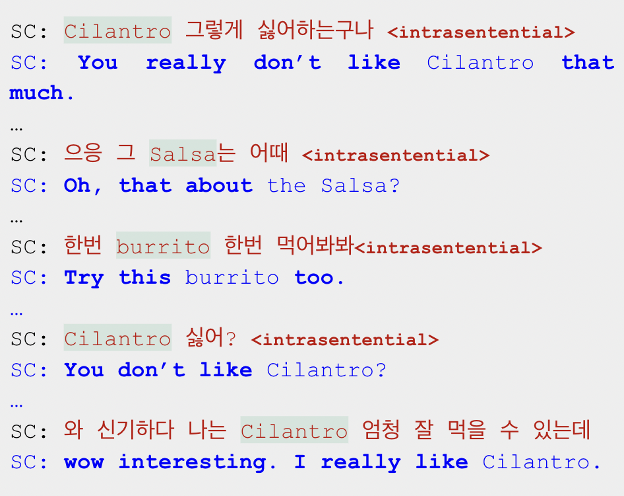
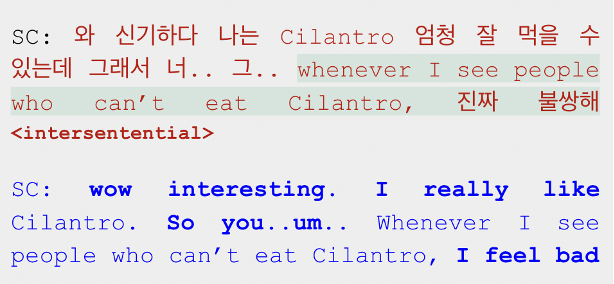
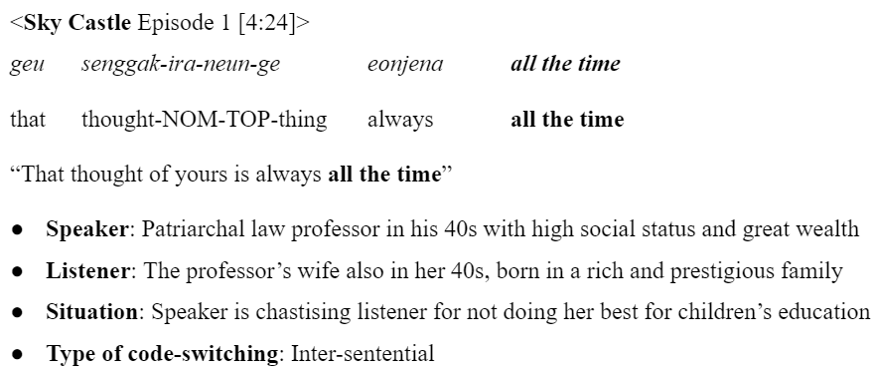
This study strives to investigate sociolinguistic patterns found in the code-switching of Korean-English bilingual college students, focusing on the frequency and cultural context of the code-switching as well as the type of code-switching utilized. Code-switching is defined as the capacity of multilingual to fluidly switch between several languages (Bullock & Toribio, 2009). The categories of code-switching types were interjections, intrasentential code-switching, and intersentential code-switching as defined by prior research in the field. Inter-sentential switching takes place in two different sentences with one sentence spoken in the primary language and the other one uttered in a second language; meanwhile, intra-sentential switching occurs within a sentence with a word specifically alternated to a second language (Mohamad Khalil & Mohd Shahril Firda, 2018). (1) and (2) below show examples of intrasentential and intersentential code-switching from the data recorded for this study.

  1. Intrasentential CS- example from Participant A (1:38~1:50)
Image 1: Example of intrasentential CS. Matrix Language: Korean; embedded Language: English

2. Intersentential CS- example from Participant A (1:51~1:58)


Image 2: Example of intersentential CS

The researchers followed the basis of the Matrix Language Frame Model (MLF) which holds the idea that code-switching has a matrix language and is the more dominant language that provides the morphosyntactic frame. Whereas, an embedded language is known as the language from which smaller elements are inserted (Myers-Scotton, 1933). Koban (2013) provides a detailed account of code-switching amongst Turkish-English bilinguals and has documented greater higher frequencies of intra-sentential code-switching as opposed to inter-sentential code-switching. This finding supports what the researchers hypothesize in this current study. Another implication the researchers examined was whether the participant’s language background and cultural background had any noticeable effect on their code-switching behavior. 

Methodology

A total of 6 undergraduate students (mean age 22.16 years) studying at the University of California, Los Angeles, participated in the experiment. The population targets three different Korean-English bilingual college students  (1st gen. Korean-Americans[A, B], 1.5 gen. Immigrant Korean/Korean-American [C, D], & Korean international students studying abroad in the U.S.[E, F]). The experiment was conducted through spontaneous casual-style speech in a one-on-one format with the researchers and was audio recorded. Upon completion of the experiment, relevant background information was collected from the participants through a background survey (age, country of birth, age of exposure to both languages, comfort language) and a follow-up interview with questions facilitated by the researchers. Researchers transcribed and translated applicable segments of the recorded material and then analyzed linguistic patterns in code-switching occurrences as well as findings tailored to sociolinguistic occurrences. The experiment per participant lasted an average of 30 minutes.

Results and Analysis

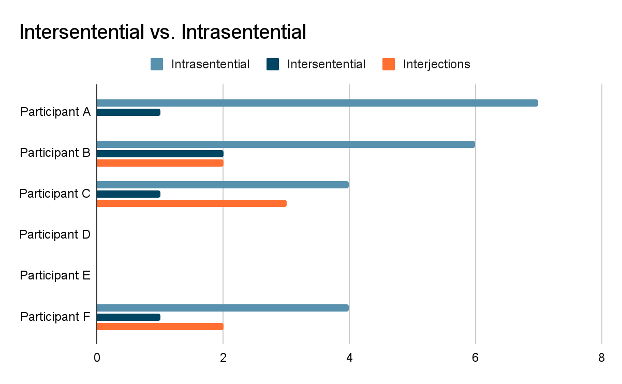
Figure 1: Intersentential vs. Intrasentential

We found a two-way effect with intra vs. intersentential and the number of CS occurrences. This effect revealed that participants showed higher frequencies of intrasentential code-switching as opposed to intersentential which holistically supports what the researchers expected (see Figure 1). Participants A, B, C & F used this intrasentential shift in the middle of their sentences and without hesitation. This denotes a shift between Korean and English and shows that these participants are almost if not always unaware of the shift in this language (see Figure 2).

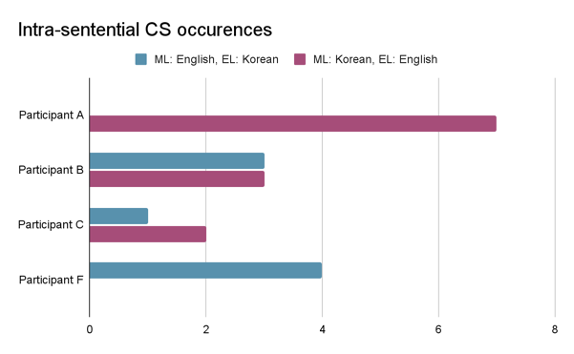
Figure 2: Intra-sentential CS occurrences

The most eye-catching result from Figure 2 reveals that Participant A showed no occurrences of code-switching as the matrix language being English, even though this same participant notated that his dominant language was English in the survey.

Figure 3: Interjections
Figure 4: No interjections

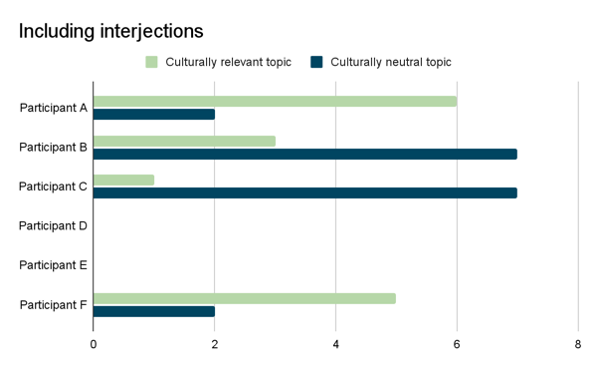
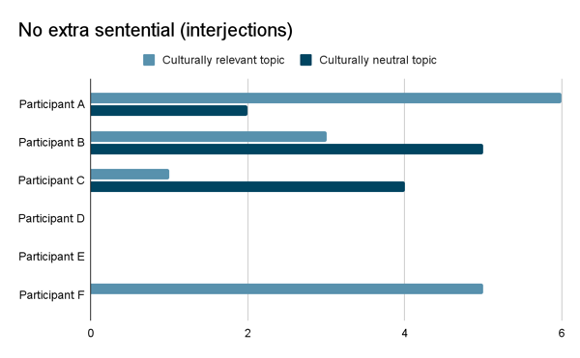
Figure 3 compares the CS occurrences according to the cultural relevance of the topic including intrasentential, intersentential, and extra-sentential occurrences. We can see from Figure 3 that participants B and C, showed more CS occurrences for culturally neutral topics which went against our hypothesis that people with code-switch more in topics culturally relevant to the embedded language. Even when excluding interjections, which we thought would less be influenced by the cultural relevance, we can still see such a result remains the same in Figure 4.

So for participants B and C, we underwent an additional in-depth analysis to see how their linguistic background influenced their CS behavior.

A comparison of participants A and B’s observed code-switching as well as their self-reported views of code-switching provides insight into the conscious and subconscious factors affecting their code-switching behavior and choices regarding their language use. Both where born and raised mostly in the USA and also expressed being most comfortable code-switching when speaking with other Korean-American friends.  Prior research suggests that among bilinguals with social profiles including the identities related to both languages, code-switching may become the unmarked choice (Myers-Scotton, 1993), which seemed to be the case for some of the data examples we found in A and B.

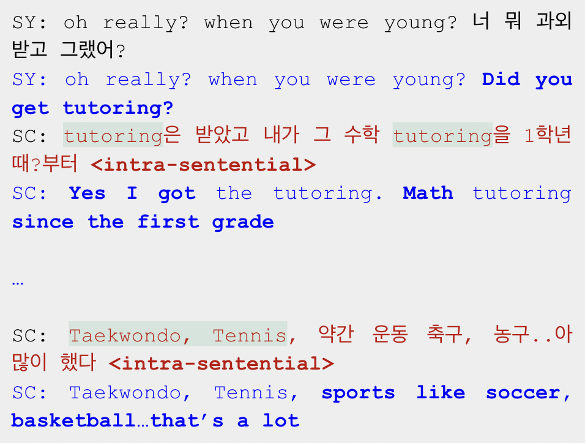
Image 3: Participant A’s Unmarked CS Behavior (28:55~29:46)

Looking at the data example in image 3, participant A uses the English word “tutoring” for his first utterance even though the question was phrased in Korean. This could be attributed to him being less familiar with the Korean word “과외” but at the same time, it could also be because he uses CS as an unmarked linguistic choice. Also for his second utterance, it is notable that he lists two of the sports name in English but the latter two in Korean; obviously it isn’t that he doesn’t know the word “Soccer” and “Basketball” in English, rather he seems to be code-switching this time more unconsciously. The in-person interview revealed that he himself thinks he code-switches so often that it is almost second nature to him. So the CS occurrence in this excerpt is an example of CS being an unmarked choice.

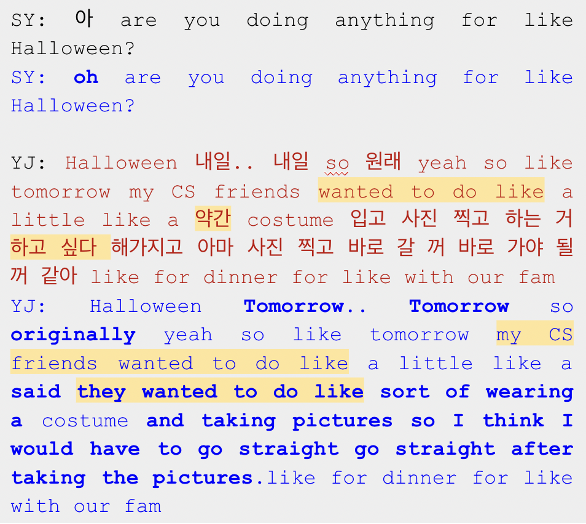
Image 4: Participant B’s Unmarked CS Behavior (14:20~14:40)

In participant B’s data example in image 4, it is worth noting that the part “wanted to do like” is repeated both in English and Korean in the intersentential CS with a change in the matrix language. This could potentially be a piece of evidence that for participant B, CS is such an unmarked choice that he would unconsciously switch the matrix language to Korean even though Halloween, being a culture-specific event, would be more easily expressed in English.

However, at the same time, the in-person interview revealed that participant A and B showed a difference when it came to the need to intentionally use more Korean.  Participant A mentioned that “a Korean should be able to speak at least a decent level of the Korean language” (translated from Korean), which accounts for his intrasentential CS occurring mainly as Korean as the Matrix language. This also relates to the larger concept of a diaspora factor which adds an additional layer to bilingualism as “diaspora identities combine multiple points of identification, thus embodying and asserting how diversity and difference are lived and experienced as a process of entanglement” (McKittrick, 2009). Mills (2005) also discussed how in their 2001, 2004, and 2005 studies they found that in their target population of British-Pakistani bilingual diaspora that “the heritage language represents the community as being a crucial identifier and bond to the immediate and wider diasporic group (and that) their languages where crucial for maintaining their sense of identity as being both British and Pakistani” (Mills, 2005). While there are of course differences between each diaspora community, this theme of diaspora navigating their identity between cultures and the close connection to identity and community that languages tend to have for members of this type of community has shown up in many past studies on diaspora populations. The 1st generation Korean-American bilinguals (A and B) where the only subgroup in our study where both participants of that background showed frequent occurrences of code switching.  Given the nature of diaspora populations and the results found in our study, our findings seem to support a conclusion that for Korean-Americans, code-switching is generally the unmarked choice and often used to index their Korean heritage as well as an in-group identity of being between two cultures as part of the Korean diaspora in America. Though Participants A and B had similar frequencies of code-switching overall, Participant A’s follow-up interview responses expressed a more conscious intention to index his Korean heritage as well as an in-group identity of being between two cultures as part of the Korean diaspora in America. Participant B on the other hand stated in the follow-up interview that he does not really feel the need to intentionally speak more Korean possibly attributing to his higher level of fluency and a longer period of studying the Korean language. Interestingly, Participant B actually had the highest rates of overall code switching, further showing how code -switching tends to be the unmarked choice within bilinguals whose identity is linked to both of their languages, such as bilinguals who are part of a diaspora population.

For participant C, she used English as the dominant language in the culturally relevant topic, Halloween, as opposed to the culturally neutral topic, buying tickets for a game, which shows that the American-culture-oriented topic did affect her linguistic behavior. However, at the same time, she showed fewer CS occurrences for the culturally relevant topic, which can be explained by her motivation for CS being a lack of proficiency in English for certain words which would occur regardless of the topic.

Another result noticeable in Figure 1 was that participant D and E did not show any occurrences of CS at all. In the interview, participant D said that even if the person they were speaking with was a Korean-English bilingual, he would consciously not code-switch if the topic was serious because there would be the need to convey his intentions in a more clear-cut manner through his native language, which seemed to be the case for the 40-minute conversation recorded.

On the other hand, the participant’s usual frequent use of CS with the interviewer and his response that he feels the need to consciously speak more English in the States to improve his English-speaking skills implies that CS is a marked linguistic choice for him to index his identity as a more fluent English-speaking international student in a community where the majority of the people speak English as their mother tongue. This relates to the social status of English in Korean society. In Korea where western countries, mainly the United States, are viewed as “superpowers” due to political and historical reasons (Cho, 2021). English has been shown to be greatly publicized and commonized especially in educational institutions (Choi & Kim, 2021). In other words, speaking English fluently symbolizes higher social status thus it developed an advanced elite image. It has been observed that bilingual immigrant families in the US are experiencing linguistic discrimination in that they have accents when speaking English which is labeled as broken and unintelligent (Tedx Talks, 2018, 2:30). It may explain the motivation of participant D trying to intentionally speak more English as he can to purposely present an international bilingual elite image.

Participant E responded that she would avoid code-switching to English when talking with native Korean speakers even if they were fluent in English. It has been observed that code-switching can be regarded as showing off when the interlocutors have unequal language proficiency (Fangzhe, 2019). In order to prevent being interpreted as bragging about her language ability, participant E intentionally avoids code-switching. Thus to her, CS was shown to be the marked linguistic choice and the markedness entailed a more negative connotation as a person who feels the need to “show off” their English or seem more “American”. And through this linguistic behavior, she may be able to feel a sense of belonging with her immigrant friends whose dominant language is Korean.

Thus both participants showed that the agency of the speaker to index (or not to index) a certain identity intervenes in the choice of an absence of CS, which aligned with our analysis for participant A, B, and C.

Additionally, the 1st generation immigrants tended to show more CS occurrences compared to international students which relate to how in previous studies it has been proven that language was affected by people’s aspirations, stances, and attitudes (Tedx Talks, 2014, 11:05). In other words, the linguistic behaviors of the participants would be affected not only by their current community of practice but also by the in-group they expected themselves to be placed in the future. So for the former group, because they aspired to stay in the States for the rest of their lives, they would be frequently exposed to a  linguistic environment in which CS would be the unmarked choice such as with  their college Korean American friends or with their family. For the international students, they would only be staying in the States for less than a year, after which they would return to South Korea where CS would generally be accepted as a marked choice even sometimes with negative connotations.

Conclusion

This experiment provided an opportunity for us to closely examine code-switching patterns in bilingual Korean-English speakers. The researchers pondered on observable linguistic patterns in three contrastive Korean-English populations in relation to code-switching behaviors. Thorough analysis of the findings indicates different relationships between linguistic behaviors and sociolinguistic identities. The overall analysis from this study reveals that code-switching is in fact more affected by the speaker’s linguistic identity rather than what topic is being conversed. The findings provide sufficient evidence that people index code-switching as part of the in-group identity and thus accepting code-switching as an unmarked choice would produce more code-switching occurrences comparatively to those who code-switched to index a marked linguistic pattern.                   


References

Bullock, B., & Toribio, A. (2009). Themes in the study of code-switching. In B. Bullock & A. Toribio (Eds.), The Cambridge Handbook of Linguistic Code-switching (pp. 1-18). Cambridge University Press. https://doi.org/10.1017/CBO9780511576331.002

Cho, J. (2021). English fever and American dreams: The impact of Orientalism on the evolution of English in Korean society. English Today, 37(3), 142–147. https://doi.org/10.1017/S026607841900052X

Choi, Tatar, B., & Kim, J. (2021). Bilingual signs at an “English only” Korean university: place-making and “global” space in higher education. International Journal of Bilingual Education and Bilingualism, 24(9), 1431–1444. https://doi.org/10.1080/13670050.2019.1610353

Fangzhe. (2019, May 7). Code-switching: showing off? Educational Sociolinguistics. https://bild-lida.ca/educationalsociolinguistics/uncategorized/code-switching-showing-off/#:~:text=In%20this%20case%2C%20code%2Dswitching,that%20you%20are%20showing%20off.

Koban, D. (2013). Intra-sentential and inter-sentential code-switching in Turkish-English bilinguals in New York City, U.S. Procedia – Social and Behavioral Sciences, 70, 1174–1179. https://doi.org/10.1016/j.sbspro.2013.01.173

McKittrick, K. (2009). Diaspora. International Encyclopedia of Human Geography, 156–161. https://doi.org/10.1016/b978-008044910-4.00938-x

Mills, J. (2005). Connecting communities: Identity, language and diaspora. International Journal of Bilingual Education and Bilingualism, 8(4), 253–274. https://doi.org/10.1080/13670050508668610

Mohamad Khalil, S., & Mohd Shahril Firda, M. S. Z. (2018). Inter-sentential and intra-sentential code switching in parliamentary debate. International Journal of Modern Languages And Applied Linguistics, 2(4), 29–31. https://doi.org/10.24191/ijmal.v2i4.7691

Myers-Scotton, C. (1993). Common and uncommon ground: Social and structural factors in codeswitching. Language in Society, 22(4), 475–503. https://doi.org/10.1017/s0047404500017449

Tedx Talks. (2014, Nov. 21). TEDxDublin – Vera Regan – What your speaking style, like, says about you [Video]. YouTube. https://www.youtube.com/watch?v=jAGgKE82034&t=593s

Tedx Talks. (2018, July 25). TEDxWWU – Karen Leung – Embracing multilingualism and eradicating linguistic bias [Video]. YouTube. https://www.youtube.com/watch?v=S8QrGsxeEq8

[/expander_maker]

, , ,

A Study on Randall Park: Linguistic Marks of Second-generation Asian-Americans

Joon Chang, Mabel Gong, Yanqi Qing, Esther Li, Yoori Kwak

Abstract

The term “Asian American” was coined by the late Japanese historian Yuji Ichioka in the late 1960s, in the midst of the burgeoning affirmative action movement advocated by African-Americans and other minorities. His original intention in introducing this ethno-racial identity was to deny the disparaging term “oriental” that Westerners had imposed on Asian Americans (Zhou, 2013). Over time, the Asian American identity became more widely accepted by Americans and Asians, and ethnicity grew to be an increasingly important point of discussion in today’s society. Second-generation Asian Americans who grew up in this environment, under the fusion of heritage and mainstream American cultures may reflect a hybrid self-identity. This hybrid self-identity can also be observed and expressed through the form of language.

Acknowledgement

First and foremost, we would like to thank Dr. Daria Bahtina and Ms. Mercedes Douglas who provided us with valuable advice from the beginning of the topic selection process and helped us tremendously when we encountered difficulties in the construction of the projects. In addition, we would like to thank each and every group member for their hard work and dedication to this project, it was the efforts of each of us that brought the project to life.

[expander_maker id=”1″ more=”Read more” less=”Read less”]

Introduction and Background

Asian-Americans are part of a wave of immigrants who began arriving in the United States decades ago seeking more socioeconomic flexibility. They are now one of the fastest growing minority populations and have become a vital group to American society and culture. As such, it is worth noting that second-generation Asian-Americans, who grew up at the intersection of their heritage culture and mainstream American culture, have a unique self-identification. These Asian-Americans tend to integrate their heritage language characteristics into English, in a manner that reflects their definition of self and ethno-cultural orientation as an expression of their hybrid identity.

To better understand the unique linguistic characteristics of second-generation Asian-Americans, we conducted a case study focused on California native Asian-American Randall Park. Through transcript analysis and observation of prosodic features during his interviews and stand-up comedy shows, we attempt to answer the following questions: Does Park have unique prosodic features or linguistic shifts that identify him as uniquely Asian-American? Does Park code-switch for his social identity? What stylistic shifts are observable in his performances that support these phonetic and prosodic shifts?

Korean Americans are the fifth most popular Asian-American group in the U.S. with an estimated population of 1.6 million (Ryu et al., 2013). According to the 2020 national census, 17% of California’s population consisted of Asian-Americans, a stark increase from 2010’s 13% (U.S. Census Bureau, 2020).

Figure 1: Randall Park

Randall Park is an American actor, comedian, and writer. Park was born on March 23, 1974, in Los Angeles to Korean immigrants and grew up in Castle Heights, CA (Empire, 2022). A graduate of Hamilton High School’s Humanities Magnet Program, Park began attending UCLA in 1993. He later co-founded “Lapu, the Coyote that Cares”, the largest and longest running Asian-American theater company on campus and received his M.A. in Asian-American Studies in 1999.

We selected Park as the research subject because his media is easily accessible, he is well-connected with his Asian-American identity, and he is a good representation of individuals thriving at the intersection of East and West cultures.

Method

Much of the research performed on Asian-American speech has focused on cultural and linguistic borrowing from other American ethnicities to create an Asian-American speech community. Angela Reyes has several studies displaying Asian-American culture and speech as borrowing from African American dialect (Reyes 2005). However, our study will look into a different aspect of borrowing and look into the influence first generation immigrants have on their second generation children’s speech. Although second generation Asian-Americans are born and raised in the United States, they still produce observable prosodic features that are not fully native American English. To find these features, we will perform a case study on Park.

To narrow the focus of this study, we chose to examine only one Asian-American male celebrity. Park is proficient in both English and Korean. It is worth noting that all of the acting roles that Park saw success with tapped into his Asian-American background for comedic effect. This makes him an optimal subject for our study, as he has navigated Asian-American English with an acute awareness of utilizing variants relevant to different entertainment contexts — both naturally in interview and live speech settings, and more exaggerated in acting roles. 

Several studies have identified phonological characteristics common among Asian-American English speakers. A survey conducted by the UC Berkeley Phonetics and Phonology Lab in 2016 regarding the “unique English Vowel Spaces of Asian-American Californians,” found one such feature where “Korean and South Asian speakers of Californian English had a more fronted foot vowel than the White speakers” (Cheng). A study by Lauren Hall-Lew and Rebecca Starr, who studied Chinese Americans in the San Francisco Bay Area, found additional vowel production differences where boat was pronounced beh-oat and the cot/caught vowels were merged to produce the same sound (Hall-Lew). Using these studies as a reference, we will analyze speech samples from Park, develop phonetic transcripts, and confirm whether the conclusions of the study corroborate with Park’s speech.

We hypothesized that second-generation Asian-Americans integrate their heritage language characteristics into English, which reflects their definition of self and ethno-cultural orientation as an expression of their hybrid identity. To verify our hypothesis, we examined 96 minutes of Park’s interviews and stand-up clips, during which we observed his unique production of the /u/ (i.e. boot), /ɛ/ (i.e. bet), /ɑ/ (i.e. father), and /aʊ/ (i.e. how) vowels. We selected 29 words samples from these video clips in which he produced these vowels and analyzed the spectrograms of each vowel using PRAAT. Of the 29 samples, 14 samples were discarded due to low sound quality, short phoneme duration, and unreadable spectrograms.

The 15 words we analyzed on PRAAT were:

/u/: movie, restroom, shoots

/ɛ/: friends, parents, restroom

/ɑ/: audience, body, job, mom, palms, trauma

/aʊ/: around, down, how

To use as comparison for Park’s pronunciation of these vowels, we had a male native Korean speaker and a male Korean American pronounce these 15 words. The native Korean was a 24-year-old monolingual born in South Korea who began his English education in the third grade. Due to the characteristics of English education in Korea, his English pronunciation is heavily accented. The Korean American was a 22-year-old bilingual, fluent in both English and Korean, who lived his entire life in Southern California. The Korean American had no noticeable accent when speaking English.

Using PRAAT, the section of sound containing the vowel was then isolated for further analysis. These vowel sections for each of the three individuals – Park, Native Korean, and Korean American – were compared with each other when spectrogram readability was possible to observe differences or similarities. A control sample from existing data on an American male speaker’s vowels was used to compare with the three Korean individuals (Figure 2).

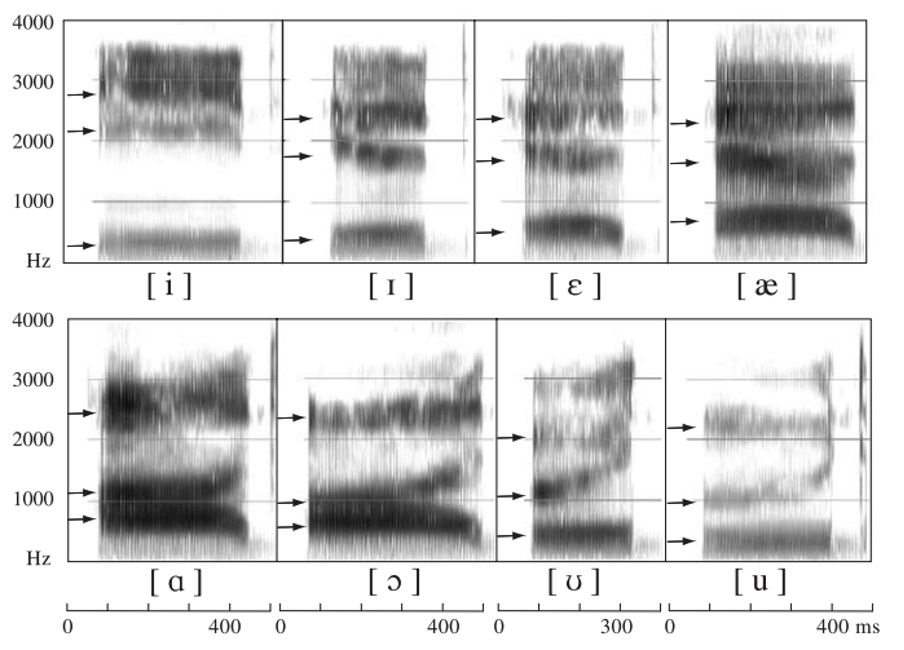
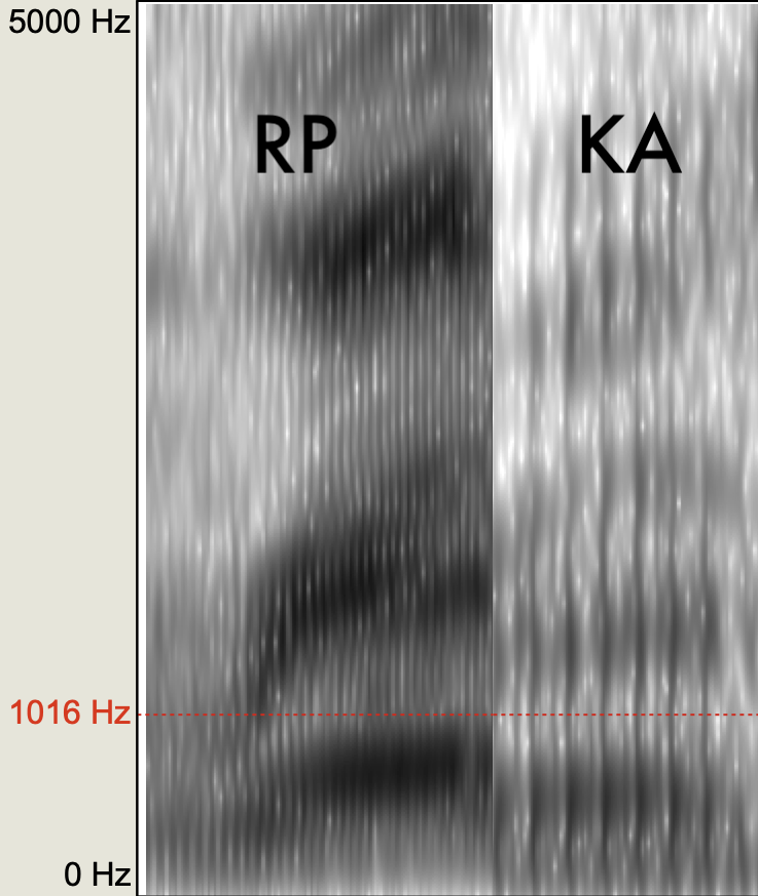
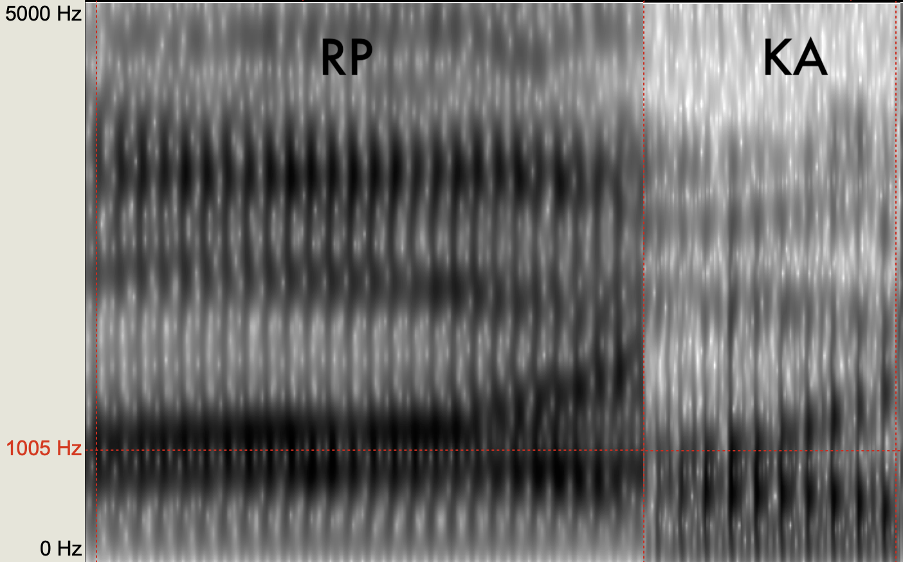
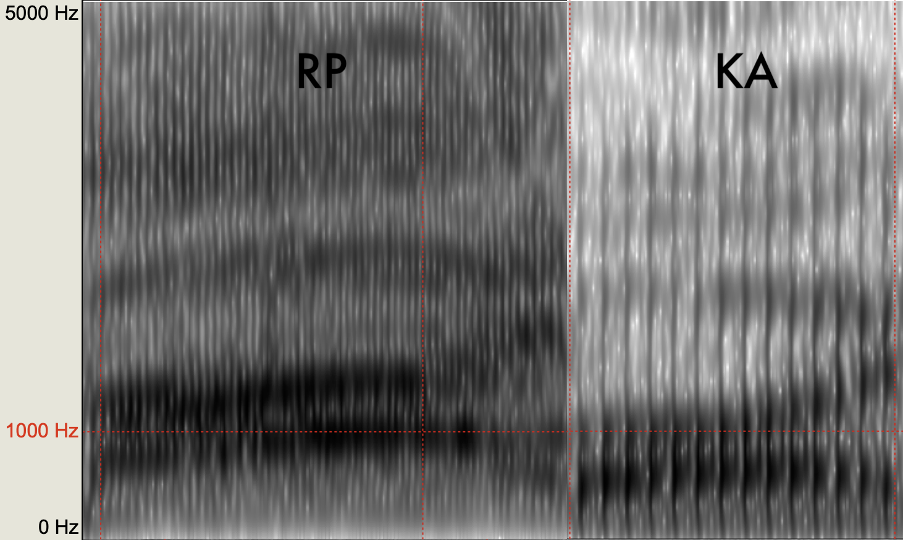
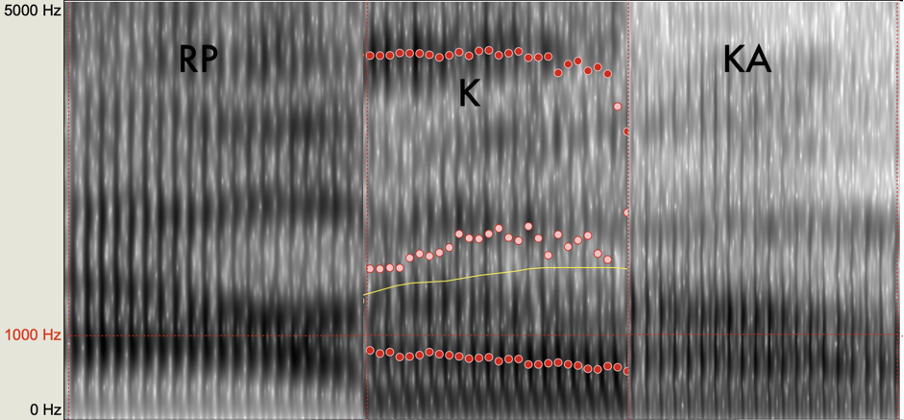
Within the spectrograms of the vowels for the individuals, the F1 and F2 formants were observed in particular. Formants are concentrated areas of acoustic energy around a particular frequency in speech waves. The first formant (F1) is inversely related to vowel height, indicating the height of the tongue during vowel production. The second formant (F2) is related to the degree of backness of a vowel, indicating the front or back position of the tongue during vowel production.

Figure 2: American Male Vowel Spectrogram (Ladefoged, 2006)

Results and Analysis

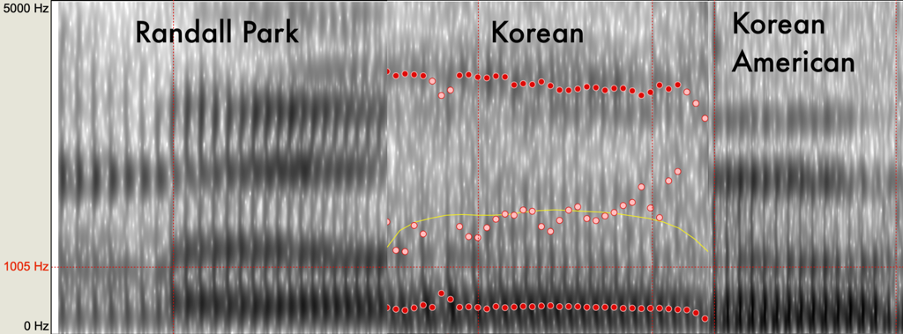
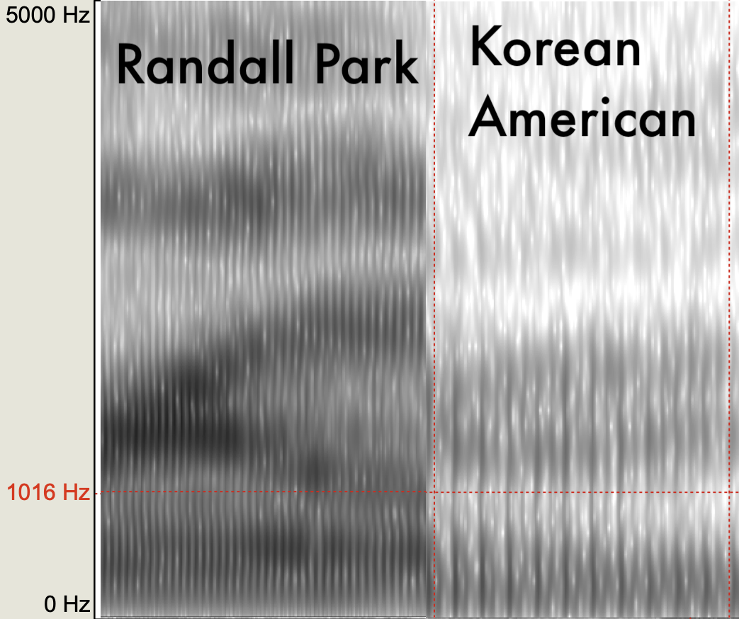
Two examples of the /u/ vowel as in the word “boot” were the words “movie”  and “restroom”. In the spectrograms of these two words (Figures 3 and 4), all three Koreans had higher F1 and F2 values than the American speaker (Figure 2). Also, Park’s F1 and F2 values were higher than the Korean American speakers. This shows that all three Koreans had a higher and more front tongue position than the American speaker in the pronunciation of this vowel, with Park’s being higher than the other speakers. This higher and more front pronunciation of the “oo” vowel can be heard in Park’s pronunciation as he says the high, central /ʉ/ vowel compared to the high, back /u/.

Figure 3: Spectrogram of /u/ from “Movie” (https://youtube.com/clip/UgkxrGNwV57voWS1HsCG_0hTomRVcL96ifno)
Figure 4: Spectrogram of /u/ from “Restroom” (https://youtube.com/clip/UgkxVWnYPx4R-M-ASxdZSp8qByJx1kjzLtnG)

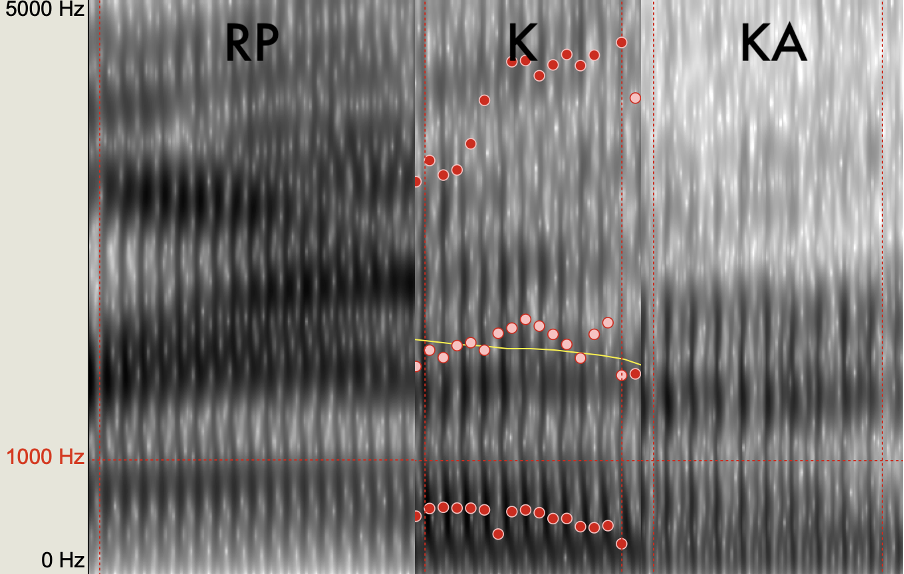
Two examples for the /ɛ/ vowel such as in “bet” are the words “friends” and “restroom”. Looking at the spectrograms for this vowel (Figures 5 and 6), we can see that all three Koreans had slightly higher F1 and F2 values than the American speaker (Figure 2), with Park’s being the highest. Similar to the findings of the /u/ vowel, we can see that the three Koreans had higher and more front tongue positions during the /ɛ/ vowel production with Park’s being greater than the Native Korean and Korean American. In Park’s pronunciation of the /ɛ/ vowel, the higher and more front /e/ vowel used in Spanish can be heard compared to the /ɛ/ vowel used in English.

Figure 5: Spectrogram of /ɛ/ from “Friends” (https://youtube.com/clip/Ugkxpl0-5yD2NO7_j3shYwZrLGxf2tLSg6L6)
Figure 6: Spectrogram of /ɛ/ from “Restroom” (https://youtube.com/clip/UgkxVWnYPx4R-M-ASxdZSp8qByJx1kjzLtnG)

Examples of the /ɑ/ vowel such as in “father” were “body” and “audience”. In this vowel, Park had higher F1 and F2 values than all other speakers including the American male (Figures 2, 7 and 8). There were no significant differences between the American male’s and the Korean American’s F1 and F2 values. Park had a slightly higher F2 value than the American speaker, indicating a more front pronunciation than the other speakers.

Figure 7: Spectrogram of /ɑ/ from “Audience” (https://youtube.com/clip/UgkxoGfTm6TTUg12GWM4SCM6lNqVWPAj3Fp_)
Figure 8: Spectrogram of /ɑ/ from “Body” (https://youtube.com/clip/Ugkx3yTNOhVKaSNX305q2daASzLa_BiGlOiz)

A vowel that Park had a unique pronunciation of that is not available from the American male is the diphthong /aʊ/ such as in “town.” A diphthong is a sound formed by the combination of two vowels in a single syllable. An example of this sound from Park was in the word “how”. In this sound, Park and the Korean American had nearly identical F2 values (Figure 9). However, Park had a slightly higher F1 value than both the Korean and Korean American, showing he had a slightly higher tongue position in this production.

Figure 9: Spectrogram of /aʊ/ from “How” (https://youtube.com/clip/UgkxzucRmH9iypLVR5X24STFmGqpSeY22xbn)

These productions of vowels had little variation among different shows and interviews of Park. Although his pronunciation of the /u/,  /ɛ/, /ɑ/, and /aʊ/ vowels remained relatively the same, several linguistic characteristics not part of his normal speech appeared during style shifts when taking on different stances.

In his stand-up comedy show on Comedy Central, several linguistic features that accompany his style shifts can be observed. The first linguistic style shift occurred at the sentence “bunch a kids just pointing at me and laughing at me”. At this moment, by raising the volume and tone of his own voice, g-dropping, and using “a” instead of “of,” Park implied that the behavior of bullying which was enacted by non-Asian children was a bad thing by putting those linguistic styles that are not his normal speaking style. Next, his second style shift happened with the words “I am confident now”. At the moment, he spoke in a higher tone with an authoritative voice, shifting his style to show that he has overcome his past trauma of being bullied and is now embracing his Asian heritage in a positive way. And lastly, he showed his style shift with the sentence “and I feel so good”. At this point, he spoke in a breathy and calm voice, with a lower tone. These linguistic styles all represented the peace he found after releasing his bad memories of bullying. These prosodic features or linguistic style shifts support his Asian-American identity. This could be supported by the characteristics of the Asian-American Identity Development Model of Kim (1981). The first shift mentioned above shows he went through Ethnic Awareness and White identification as an Asian-American when he was in middle school. After going through those bullies, he realized he is marked as a distinct ethnicity which is non-American, and also as one who suffers racial prejudice from the White. The second style shift shows that he still acknowledges that he is different from unmarked Americans as he did as a child, however, now accepts his ethnic heritage rather than tries to escape from it. This also supports that he does code-switch for his ethnic identity as a Korean American.

Discussion and Conclusion

This case study and research provided an opportunity for us to closely examine some socio-linguistic factors and impacts of the growing Asian-American diaspora. Additionally, we gained a better understanding of how second-generation Asian-Americans integrate into society through a linguistic lens. We hope that some of the findings of this study may be helpful in supporting English learners from similar backgrounds as our subject, potentially used as supplemental material in curriculum design. In the field of socio-linguistics, the existing studies focused on Asian-Americans are not as extensive as other ethno-racial groups. Thus, this project may serve as a good starting point for future research and development and we hope to inspire more studies to be conducted in this area.

Potential subjects we considered for our case study will serve as excellent focuses for future development. Asian-American comedian and actress Ali Wong was one example, where a closer examination of second-generation Asian-American females and a comparative study with Park be conducted. Additionally, case studies on Asian-Americans in different social contexts outside of entertainment can be valuable, in which case politician Andrew Yang can serve as a good jumping-off point. Since our study narrowed in on a native California, a deeper analysis of how U.S. regional differences can contribute to second-generation Asian-American English would be insightful.


References

Cheng, Andrew. A Survey of English Vowel Spaces of Asian-American Californians. UC Berkeley PhonLab Annual Report, 22 Aug. 2018, https://escholarship.org/uc/item/4w84m8k4.

Chin, G. J. (2008, April 18). The Civil Rights Revolution comes to immigration law: A new  look at the immigration and nationality act of 1965. SSRN. Retrieved May 12, 2022, from https://papers.ssrn.com/sol3/papers.cfm?abstract_id=1121504

Comedy Central. ( 2016, July 26). Randall Park – Bullies & Diarrhea – This Is Not Happening – Uncensored. YouTube, uploaded by https://www.youtube.com/watch?v=zLGnli1JFpw&ab_channel=ComedyCentral.

Chung, S. (2015). History of Korean immigration to America, from 1903 to present. History of Korean Immigration to America, from 1903 to Present | Boston Korean Diaspora Project. Retrieved May 13, 2022, from https://sites.bu.edu/koreandiaspora/issues/history-of-korean-immigration-to-america-from-1903-to-present/

David B. Hanna. (1997). Do I Sound “Asian” to You?: Linguistic Markers of Asian-American Identity. University of Pennsylvania Working Papers in Linguistics: Vol. 4:Iss.2, Article 10. https://repository.upenn.edu/cgi/viewcontent.cgi?article=1791&context=pwpl

Elaine W. Chun, Ironic Blackness as Masculine Cool: Asian-American Language and Authenticity on YouTube, Applied Linguistics, Volume 34, Issue 5, December 2013, Pages 592–612. https://doi.org/10.1093/applin/amt023

Empire. (2022). Randall Park. Empire. Retrieved May 13, 2022, from https://www.empireonline.com/people/randall-park/

Hall-Lew, & Starr, R. L. (2010). Beyond the 2nd generation: English use among Chinese Americans in the San Francisco Bay Area. English Today, 26(3), 12–19. https://doi.org/10.1017/S0266078410000155

Homeland Security. (2013). Message from secretary Alejandro N. Mayorkas on National Police week 2022. Home | Homeland Security. https://www.dhs.gov/

Jimmy Kimmel Live. (2015, Feb 12). Randall Park on Becoming an Actor. YouTube, uploaded by https://www.youtube.com/watch?v=1xwB9pIAWVU&ab_channel=JimmyKimmelLive

Jung, E. Alex (2019, May 29). Randall Park’s small-town L.A. Vulture. Retrieved May 13, 2022, from https://www.vulture.com/2019/05/randall-park-always-be-my-maybe.html

Kim, Jean. (1981). “Processes of Asian-American identity development : a study of Japanese American women’s perceptions of their struggle to achieve positive identities as Americans of Asian ancestry.” Doctoral Dissertations 1896 – February 2014. 3685. https://scholarworks.umass.edu/dissertations_1/3685

Ladefoged, P. (2006). A course in phonetics. Thomson Wadsworth.

Larry King. (2017, May 11). If You Only Knew: Randall Park. Youtube, uploaded by https://www.youtube.com/watch?v=OgRWv16jfNA&ab_channel=LarryKing

Muzaffar Chishti, F. H. M. C. (2017, March 2). Fifty Years On, the 1965 Immigration and Nationality Act continues to reshape the United States. migrationpolicy.org. Retrieved May 13, 2022, from                                           https://www.migrationpolicy.org/article/fifty-years-1965-immigration-and-nationality-act-continues-reshape-united-states

Newman, & Wu, A. (2011). “DO YOU SOUND ASIAN WHEN YOU SPEAK English?” RACIAL IDENTIFICATION AND VOICE IN CHINESE AND KOREAN Americans’ ENGLISH. American Speech, 86(2), 152–178. https://doi.org/10.1215/00031283-1336992

Reyes, A. (2002). “Are you losing your culture?”: poetics, indexicality and Asian-American identity. Discourse Studies, 4(2), 183–199. https://doi.org/10.1177/14614456020040020401

Reyes, A. (2005). Appropriation of African American slang by Asian-American youth. Journal of Sociolinguistics, 9(4), 509–532. https://doi.org/10.1111/j.1360-6441.2005.00304.x

Reyes, A. and Lo, A., 2009. Beyond yellow English: toward a linguistic anthropology of Asian Pacific America. Oxford: Oxford University Press. https://oxford.universitypressscholarship.com/view/10.1093/acprof:oso/9780195327359.001.0001/acprof-9780195327359

Reyes, A. (2017, September 1). Language, Identity, and Stereotype among Southeast Asian-American Youth The Other Asian: The Other Asian (1st ed.). Routledge. https://doi.org/10.4324/9781315092027

Ryu, S. Y., Crespi, C. M., & Maxwell, A. E. (2013, December). A bi-national comparative      study of health behaviors of Koreans in South Korea and Korean Americans in California. Journal of immigrant and minority health. Retrieved May 13, 2022, from https://www.ncbi.nlm.nih.gov/pmc/articles/PMC3530654/

Shankar, S. (2011). Asian-American Youth Language Use: Perspectives Across Schools and Communities. Review of Research in Education, 35(1), 1–28. https://doi.org/10.3102/0091732X10383213

Team Coco. (2021, Mar 2). Randall Park Shrieked During his ‘Wanda Vision’ Fight Scene. YouTube, uploaded by https://www.youtube.com/watch?v=Py6zbMO0XvE&ab_channel=TeamCoco

The Daily Show with Trevor Noah. (2019, Jun 12). Randall Park – Taking Cues from Fans and Real Life for “Always Be My Maybe. Youtube, uploaded by https://www.youtube.com/watch?v=nbY34h54av0&ab_channel=TheDailyShowwithTrevorNoah

The Late Show with Stephen Colbert. (2016, Oct 18). Randall Park Feared He’d Be Kidnapped After His Role In ‘The Interview’. YouTube. uploaded by https://www.youtube.com/watch?v=nbfsEmeA9n4&ab_channel=TheLateShowwithStephenColbert

U.S. Census. (2020). United States. https://www.census.gov/quickfacts/US.

Zhou, Min. (2013). “Asian”, “Yellow”, and “Honorary White”? -Social positioning and identity of Asian communities in the American racial stratification system. PKU Department of Sociology, Beijing. http://www.shehui.pku.edu.cn/upload/editor/file/20180829/20180829114227_4964.pdf

[/expander_maker]

“Oh My God!” Who uses code-switching in K-dramas?

Gianelli Liguidliguid, Kyoo Sang Han, Victor Sohn

Korean dramas, otherwise known as “K-dramas,” have become easier to watch than ever before. With shows previously only being televised on South Korean TV stations, many people can now watch K-dramas on popular streaming platforms like Netflix and Hulu. Because of this, the popularity of K-dramas has spread everywhere, including in the U.S. With this rise in popularity, there has also been an increase in the amount of Konglish (Korean-English) being spoken in K-dramas. This study explores the number of code-switching instances from Korean to English in K-dramas targeted toward a specific age demographic and looks into code-switching characters. Our research focuses on eight K-dramas, four aired in the morning for older audiences, and four aired in the evening for younger audiences. We hypothesize that Korean-English code-switching will be more frequent in K-dramas targeted at a younger audience and that higher socioeconomic status will play a role in regarding who code-switches. Our data highlights which age demographic tends to code-switch more, focusing on inter-sentential and intra-sentential code-switches, and provides an overview of the types of characters that speak in both Korean and English.

[expander_maker id=”1″ more=”Read more” less=”Read less”]

Introduction & Background:

Korean culture has steadily been rising in popularity, and K-dramas are part of this universal fame, thanks to their easy accessibility through streaming services. Along with the recent success of Squid Game, many have watched K-dramas and might have noticed that English is frequently used in the Korean language. The bountiful use of English can be explained by the vast influence English has in modern Korea. For example, students are required to learn English starting from the age of 10, and it is also part of the official Korean SAT. The reputation of English in the current Korean society is untouchable, and Barratta (2014) describes that English is associated with modernity and power, creating a more modern identity for Koreans.

In this study, we wanted to analyze the frequency of code-switching in K-dramas and how it is affected by age and socioeconomic status. How would these factors affect how and when characters code-switch with each other? Since English is a sign of luxury and youth in Korea, this could affect the production of K-dramas. We hypothesized that Korean to English code-switching would be more frequent in K-dramas targeted at a younger audience. After evaluating our results, we concluded this is true but also noticed that more data might be needed for further detailed analysis.

Before diving any further, it is essential to explain what exactly code-switching is and how it differs from lexical borrowing. Lexical borrowing is a phenomenon whereby a loanword, at some point during the history of a language, entered its lexicon as a result of borrowing, transfer, and copying (Haspelmath, 2009). These words are part of the Korean language and are primarily loanwords that originate from English. On the other hand, code-switching is the alternating use of several languages by bilingual speakers (Muysken & Milroy, 1995). It is the practice of switching between two languages and is more frequent in conversation than in writing. Code-switching is used among speakers to convey meaning above and beyond the referential. There are three types of code-switching classified by linguists, but we decided to focus only on two: inter-sentential and intra-sentential. The first one happens at sentence boundaries, while the second one happens in the middle of a sentence.

Dramas are divided into two groups in Korea: morning and evening shows. Morning shows air sometime between 7:50 AM to 9:30 AM and is meant for an older audience, such as housewives or the elderly who have the time to watch TV early in the morning. It is rare for students or business people to watch morning shows since they are either studying or working. On the other hand, evening K-dramas air between 10:00 PM to 11:50 PM, usually after the daily news. These shows are targeted at a younger audience, such as students or other people who only have time to watch TV in the evening.

Our data was collected from a total of eight K-dramas. Four dramas targeting the younger audience were: Business Proposal, Sky Castle, Vincenzo, and You’re Beautiful. The other four targeting the older audience were: Always Springtime, Cheongdam-dong Scandal, Lady of the Storm, and Pink Lipstick. All of these shows were set in a contemporary setting (Modern day Seoul, Korea) and aired between 2010 and 2020.

Methods:

As our data collection method, we investigated code-switching occurrences in Korean dramas in an effort to find relations between the frequency of code-switching and the factors that influence code-switching. To conduct our research efficiently, we only analyzed the first episode of each drama that are equal in length (1 hour approximately, for a total of 480 minutes of data analyzed). Furthermore, we limited our subjects to only characters that are native Korean speakers that opted to code-switch to English and excluded any native English speakers or foreigners that had to code-switch out of necessity.

To collect our qualitative data, we analyzed the conversations where code-switching occurred and considered different factors that stimulated code-switching in context. As mentioned above, we hypothesized that socioeconomic status and age would influence our subjects hugely. We counted characters under 35 as younger speakers and over 35 as older speakers. To determine our subjects’ socioeconomic status and age, we searched their characters’ names on the “AsianWiki” site. There, it led us to find more about each character’s background. Another procedure we adopted was to analyze the instances of code-switching by applying the Leipzig Glossing Rules to dissect our data more precisely. This step assured us of avoiding any misinterpretation of any sort from switching from Korean to English and reinforced the clarity of our findings.

As our quantitative data collection method, we recorded every code-switching instance. We sorted out any cases that showed resemblance to code-switching but did not entirely satisfy the requirements such as lexical borrowing, copying, and transfer. This data was collected in order to see if any specific patterns of code-switching exist in these eight K-dramas, such as intrasentential code-switches vs. intersentential code switches. Any instance of code-switching was noted down, along with the character’s background, the situation they are in, the listener, and the type of code-switching. An example of how we collected data is seen in Figure 1 below.

Figure 1: An example of code-switching found in Vincenzo

Results & Analysis:

As we initially predicted, there were more instances of code-switching in K-dramas meant for a younger audience. Figure 2 below depicts the number of times code-switching was used in K-dramas comparing the shows intended for older and younger audiences.

Figure 2: Number of times Code-switching was used in K-dramas

As the figure reveals, code-switching was three times more frequent in K-dramas meant for a younger audience. Age is an important factor in code-switching, and K-dramas seem to imply more English-speaking characters if the show is meant for a more trendy and youthful audience.

Only two types of code-switching were found in the K-dramas we analyzed: intra-sentential and inter-sentential switching. Figure 3 below shows the number of each code-switching moment found in the K-dramas we analyzed.

Figure 3: intra-sentential and inter-sentential code-switching in K-dramas

The data presents how both instances of code-switching were often used, but intra-sentential switching was 1.5 times more frequent than the other. It seems Korean speakers are fonder and more capable of code-switching in between sentences.

Also, characters of higher social status used code-switching more often than those of lower social status. Figure 4 below exhibits the number of code-switching instances based on age and socioeconomic status.

Figure 4: Number of code-switching moments used among younger and older speakers of different class

As the figure shows, younger speakers were more likely to use code-switching. Also, speakers of higher class would use code-switching more often than those of lower class. This data relates to how socioeconomic status is an essential factor influencing the frequency of code-switching found in K-dramas.

Figures 5 & 6 below show the code-switching moments found in K-dramas meant for younger and older audiences, respectively. It also divided which type of code-switching was used for each Korean TV show.

Figure 5: Number of Code-switching moments found in K-dramas (Young)
Figure 6: Number of Code-switching moments found in K-dramas (Old)

As shown in Figure 5, there was a relatively even number of inter-sentential and intra-sentential code switches in two of the four K-dramas targeted at a younger audience. However, in Sky Castle and Vincenzo, there was a larger amount of intra-sentential code switches than inter-sentential. Similarly, in Figure 6, there was a fairly even number of inter-sentential and intra-sentential code switches in two of the four K-dramas targeted at an older audience. However, in Pink Lipstick, there were zero inter-sentential code switches but three intra-sentential code switches. In Cheongdam-dong Scandal, there were no instances of intra-sentential code switches, but there was one instance of an inter-sentential code switch.

Considering the differences in word order between Korean Subject-Object-Verb (SOV) and English Subject-Verb-Object (SVO), the instances of code-switching between the two languages found in the data oftentimes served as emphases and iterations of the main points rather than facilitating communication. In many cases, the characters who used code-switching had the word order jumbled between Korean and English and formed redundant and garbled phrases. This phenomenon can also be attributed to the absence of articles in many Korean phrases. Unlike English, the Korean language does not require articles in every sentence structure. When the speakers switched from Korean to English, English articles were omitted in many cases.

Figure 7: An example of code-switching found in Sky Castle

As shown in Figure 7, the speaker used “always” in Korean and “all the time” in English to emphasize his point. Both “always” and “all the time” can be used interchangeably and mutually mean the same in this context to express his frustration. Hence, the instance of code-switching in Figure 7 can be considered redundant and impractical. Many other instances of code-switching occurrences were reiterations of the same phrase or expression said in Korean before or after within the sentence boundaries. Additionally, in K-dramas for an older audience, it was all younger speakers that used code-switching, except for one instance. This unique example was found in Always Springtime, where an older speaker repeats the word “family” twice, once in Korean and once in English, to emphasize his point comically.

Jo Yoo Jung Scenes (Part 02) || A Business Proposal

Lastly, we analyzed many different characters and found that the most frequently used code-switching phrase was “Oh My God,” which was found in a total of four K-dramas: Always Springtime, Business Proposal, Pink Lipstick, and Vincenzo. This phrase was usually said to add comedic effect to the conversation. One example can be seen here in one of the K-dramas, Business Proposal, with the character Jo Yoo Jung. She is seen as a high-status individual as she is the director of Marine Beauty, a (fictional) famous company in South Korea. At the beginning of this scene, she can be seen walking in and saying hello to the people who work for her. She starts speaking in Konglish, directing everyone to “go have some coffee” in English. The people she is talking to do not respond back in English. When Jo Yoo Jung turns around and notices that she is wearing a very similar outfit to another main character in Business Proposal, Jin Young-Seo, she yells, “Oh my god!” in fright.

In this particular scene, Jo Yoo Jung attempts to boast and advertise her English knowledge to characters of lower status than her. She is a high-class younger character who uses code-switching to raise her status and add authority to a message. This moment relates to how English is used to mark dominance and emphasize modernity. She is also aware that the people around her are of a lower class, so she might be attempting to make them feel excluded and point out their lack of English education. Jo Yoo Jung continues to code-switch after encountering another high-class speaker, knowing that she is capable of understanding her English phrases.

Discussion and conclusions:

We can see that higher class speakers were prone to code-switching, regardless of their age. When lower class speakers code-switch, it was primarily used for comedic relief, exaggeration, or imitation of a higher-class speaker. Also, when code-switching happened, it often occurred between the same age group: young & young or old & old. It rarely happens between different age groups. Additionally, the use of code-switching would often portray the character’s personality. For example, in the K-drama You’re Beautiful, an older speaker would use code-switching to express his quirky and upbeat personality to the audience.

We also noticed that higher class speakers use English to establish authority and dominance over the listener. On the other hand, lower class speakers would use code-switching because they want to fit in and raise their social status by using English. Younger speakers code-switched with each other to mark their group identity of youth and trendiness. Overall, it seems that English acts as a symbol of youth, modernity, and authority in the current Korean society.

However, our study also had some limitations. First, only a small number of K-dramas were analyzed, so the data is quite limited. Only the first episodes were evaluated, so we are missing several code-switching moments throughout the whole series. Also, it was difficult finding K-dramas meant for an older audience. K-dramas for a younger audience could easily be found on streaming platforms, but this was not the case for the other K-dramas. They would only be available in Korea and were hard to find on the internet. The difficulty of finding K-dramas for an older audience might have affected the small size of our data. Additionally, more accurate and neutral results might have been possible if the genres of the selected K-dramas were unified. Instead of having four to five different genres, having just one genre (ex: slice-of-life) could have led to more proper outcomes.

To further expand our research, we could look into code-switching moments happening in other Korean media sources. For example, more speech patterns could be analyzed in different forms of media such as movies, reality shows, etc. Also, we could analyze code-switching frequency in different time periods to observe how English was used in the Korean language several decades ago. For example, a K-drama from the 1980s might have less English usage and not have any code-switching instances at all. However, even with different analyses, we can observe that English has become a symbol and gained dominance in Korean society, influencing the language itself.


References:

Baratta, A. (2014). The use of English in Korean TV drama to signal a modern identity: Switches from Korean to English within Korean TV dramas signal an identity of modernity and power. English Today, 30(3), 54-60. doi:10.1017/S0266078414000297

Eversteijn, N. (2011). All at once: Language choice and codeswitching by Turkish- Dutch teenagers. PhD thesis. Tilburg, the Netherlands: Tilburg University.

David, M. Tien, W. Meng, Y. & Hui, G. (2009) Language choice and code switching of the elderly and the youth. International Journal of the Sociology of Language. DOI:10.1515/IJSL.2009.044

Fauziyah, Wulidatil. “An Analysis of Code Switching Used by Captain Yoo in Korean Drama Descendant of the Sun.” Etheses of Maulana Malik Ibrahim State Islamic University, 15 Dec. 2017, http://etheses.uin-malang.ac.id/11890/.

Jamie Shinhee Lee. (2014). English on Korean television. World Englishes, 33(1), 33–49. https://doi.org/10.1111/weng.12052

Jamie Shinhee Lee. (2006). Linguistic Constructions of Modernity: English Mixing in Korean Television Commercials. Language in Society, 35(1), 59–91. http://www.jstor.org/stable/ 4169478

Mahootian, Shahrzad (2020). Bilingualism. Routledge, Taylor & Francis Group, London & New York.

Willoughby, Zoe, et al. “Bilingualism in TV: When and Why Does Code-Switching Happen?” Languaged Life, 20 Dec. 2019, http://languagedlife.ucla.edu/sociolinguistics/ bilingualism-in-tv-when-and-why-does-code-switching-happen/.

[/expander_maker]
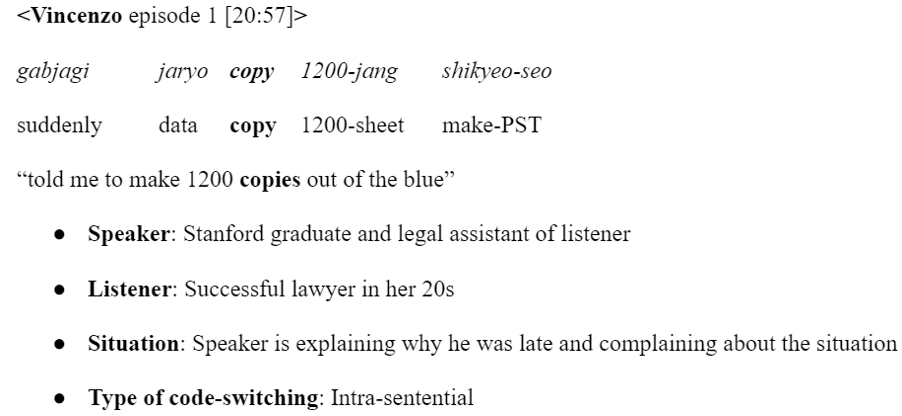


“El niño hits la pelota”: Syntactic Language Transfer in Spanish-English Bilinguals

Leslie Cheng, Madeline Netto, Grace Yao

This study explores the extent of which language transfer affects Spanish L2 learners, Spanish heritage speakers, as well as Spanish-dominant speakers. Previous research shows that Spanish L2 learners differed in their reliance on English when interpreting Spanish depending on their fluency, showing various levels of syntactic transfer. We wanted to expand this to Spanish heritage speakers and Spanish-dominant speakers as well. We found that SVO was the most commonly produced sentence structure, as well as the only produced transitive sentence word order, across all three groups, and that VSO and VOS were not preferred across all three groups. Our results suggest that the canonical SVO word order is the most natural and unmarked for all Spanish speakers, while syntactic transfer or language contact may have affected the acceptability of non-SVO sentences.

[expander_maker id=”1″ more=”Read more” less=”Read less”]

Introduction and Background

English and Spanish are both typologically SVO languages, but they use different syntactic strategies to mark the subject and object relationship within a sentence. English predominantly uses word order to mark the subject and object relationship, so the SVO word order of transitive sentences is relatively fixed (Morett, 2013). For instance, in English, it is acceptable to say “John wrote the book,” (SVO) but “The book wrote John” (OVS) is nonsensical and ungrammatical.

On the other hand, Spanish uses verb conjugation and subject-verb agreement, alongside other cues and strategies such as animacy and differential object marking, to mark subject and object. These properties allow Spanish sentences to have a more flexible word order: both “Juan escribió el libro” (John wrote the book; SVO) and “El libro lo escribió Juan” (The book, wrote Juan; OVS) are common, grammatical constructions. In fact, Spanish allows for all six basic word orders: SOV, VOS, VSO, OSV, and OVS, are all grammatical in addition to the canonical SVO order, which is more flexible than English and other Romance languages, such as French and Italian (Lahousse & Lamiroy, 2012).

Language transfer is the application from one of a bilingual’s languages onto another language. Because English and Spanish have these differences in syntax and word order, we are able to study how word order from English transfers onto the Spanish of bilinguals. A previous study investigated how English syntactic structures transferred onto the Spanish of L2 Spanish learners. They found that at first, learners relied heavily on English interpretation of syntax when interpreting Spanish sentences. As the learners became more advanced, however, they were able to use more cues unique to Spanish. We expanded on this research by testing more types of Spanish speakers than just L2 learners. We broke down our participants by language background, as either L2 learners, heritage Spanish speakers, or Spanish dominant (ES-dominant) speakers. Making these groups allows us to investigate if linguistic background plays a role in language transfer (Morett & MacWhinney 2013).

In comparing Spanish L2 learners, heritage speakers, as well as ES-dominant speakers, we wanted to determine the extent that language transfer affects each group. We hypothesized that Spanish L2 learners will experience the highest level of language transfer and rely on their knowledge of English grammar, since they are not yet fluent in Spanish. We expected the ES-dominant speakers to experience the lowest level of language transfer because of their fluency in Spanish, while heritage speakers would fall somewhere between these two groups since their Spanish fluency level also falls somewhere in between.

Study Design

We utilized a Google form with two tasks: elicitation and judgment, followed by a demographics section at the end that collected data about each participant’s fluency and usage with Spanish and English, how they learned each language, and other background information. The elicitation section asked participants to write a series of short transitive sentences consisting of 3-8 words in Spanish based on simple pictures, such as a cat chasing a mouse or a teacher reading to students. There were six pictures in total. Refer to the Appendix for sample pictures, as well as instructions from the tasks. The goal of this task was to elicit transitive sentences, observing the frequency of certain word orders within each subject group.

The judgment section presented participants with a series of short Spanish transitive sentences in various word orders and asked them to judge whether the sentence was grammatical or not. If they judged it grammatical, they were asked to identify the subject of the sentence. This task contained eight transitive sentences in varying word orders: SVO, VSO, OVS, and VOS are example constructions. Table 1 below show sample sentences used in our Google form:

Table 1. Examples of word orders used in judgment section

Results

 These tasks measure syntactic language transfer. Groups that were less accepting of non-SVO word orders show the most language transfer. The elicitation test was designed with the idea that groups with less language transfer would use more varying word order. On the judgment task, more language transfer would mean accepting more of the sentences as correct. We expected differences in the amount of language transfer between the groups with ES-dominant speakers demonstrating the least language speakers, meaning that we expected they would use and accept more non-SVO word orders. Based on the previous research, we also believed that L2 learners would show the most language transfer by relying on English syntactic cues to have narrower use and acceptance of word order. Heritage speakers were expected to fall in the middle.

When forming the groups, we determined L2 learners to be respondents who began learning Spanish in middle school or later. Heritage speakers were ones who learned Spanish before preschool but are more comfortable using English, and ES-dominant bilinguals are those who learned Spanish as a first language, and continue to be most comfortable speaking Spanish.

In our elicitation task, we observed four main sentence construction types: transitive, intransitive, prodrop, and copula, as shown in Table 2. These example sentences are actual responses to our elicitation task, but they were taken from respondents of all three groups, so they are not representative of any one group.

Table 2. Sentence construction types observed in elicitation task

Transitive sentences are ones that contain a subject, object, and a verb, and as such we were able to categorize them by word order: for example, SVO. Spanish grammar also allows for sentential subjects to be optionally dropped, giving a sentence with just a verb and an object, where the subject is only implied. These sentences were labeled as prodrop to reflect this. Intransitive sentences contained only a subject and a verb that does not take an object, labeled as INTR in our data. Lastly, copular sentences are ones that include the verb “to be” and a subject predicate, labeled as COP.

As a note, our analysis of the elicitation task data only included responses that gave full sentences. We had several responses that were simple noun phrases, for example “el chico.” These were particularly common in the L2 data, most likely due to a lack of proficiency with Spanish. We excluded these phrasal responses because our goal was to observe transitive sentence word order.

Figure 1. Proportions of sentence types observed in the elicitation task results of each group. Printed percentage label indicates the percentage of SVO responses within each group

Looking at the quantitative data from the elicitation task presented in Figure 1, the most notable observation is that SVO is the only observed transitive sentence pattern for all three groups. SVO sentences accounted for about 90% of all responses from heritage speakers and ES-dominant bilinguals. Full transitive sentences were less common for L2 learners, accounting for just over 42% of responses; instead, there was a tendency to use simpler constructions such as prodrop or intransitive sentences that did not include all three of subject, object, and verb. Like with the excluded phrasal responses, this was likely due to a lack of proficiency in Spanish.

Figure 2. Example flow of a judgment task question. If the answer to question 1 was “Yes, grammatical,” the participant would be asked to identify the subject

In our judgment task, we gave several grammatical sentences of varying word orders to our respondents and asked them to make two judgments about each sentence: first, is the sentence grammatical? If the response was yes, we then asked them to name the subject of the sentence. This format is shown in Figure 2. We analyzed this data in two parts, consolidating responses for word order types in each group: first, the results of the grammaticality judgment task, and second, the results of the subject identification task.

Figure 3. Grammaticality judgment task results, shown as percentage of respondents who said the sentence is grammatical, grouped by word order and language background.

There was a clear difference between ES-Dominant bilinguals and the other two groups in the grammaticality judgment task, since ES-Dominant speakers accepted our SVO and OVS sentences far more than the other respondents (Figure 3). Performing a chi-square test of independence on each word order category showed statistically significant differences in grammaticality judgment among the three groups for SVO and OVS sentences (p < 0.05), but no significant differences for VSO and VOS sentences (p > 0.40), which were the least accepted word orders overall. While we did not expect the verb-initial sentences to be so unfavorable for all groups, the ES-Dominant bilinguals displayed the most flexibility with regard to word order, which aligns with our hypothesis.

Figure 4. Subject identification task results, shown as percentage of respondents who answered with the correct sentential subject. Only responses consisting of a single noun were included, as some answered with the verb or both nouns.

As demonstrated in Figure 4, there was a high rate of correct responses for all groups in SVO and VSO sentences, which have the subject as the first noun. The correct identification rate drops sharply in OVS and VOS sentences, where the subject is the second noun, demonstrating a tendency across all three groups to just choose the first noun as the subject.

Notably, the L2 Learners had a much lower correct identification rate than the other groups for second noun subjects, with no correct responses when identifying subjects for OVS sentences. However, when we performed a chi-square test on this data, we did not observe any statistically significant differences in the groups for any word order (p > 0.30). This is most likely because of our very small sample size, since we only asked the respondents to identify the subject if they said the sentence was grammatical.

Discussion and Conclusions

This study allowed us to explore differences in English-Spanish syntactic transfer between L2 learners, heritage speakers, and ES-dominant bilinguals. The most notable result we found was that SVO was the only observed transitive word order in our elicitation task. This overwhelming prevalence of SVO sentences suggests that it is the unmarked, preferred word order for all groups of Spanish speakers. Conversely, non-SVO word order in Spanish is likely marked in some way, for example as a form of focalization for the fronted word (Campos & Zampini, 1990).

Thus, a possible extension of this research could involve the elicitation of sentences from a question instead of from a picture, as was done in this study. Questions that take a verb or object as an answer, for example “What is the man doing?” or “What is the girl eating?” could be used to elicit non-SVO sentences through focalization, with the goal being to compare the frequency of non-SVO word orders produced by each group.

Overall, L2 learners and heritage speakers had similar grammaticality judgments for each word order, while ES-dominant bilinguals were far more accepting of SVO and OVS word orders than the other two groups. However, all three groups found the VSO and VOS sentences to be disagreeable, which may indicate an inherent dislike for movement of the verb. We interpreted these differences in grammaticality judgments as possible evidence of language transfer, with ES-dominant bilinguals exhibiting the least syntactic transfer from English, but other factors such as dialectical differences in lexicon and grammar may also have contributed to these results. Language contact with English may be another possible reason for the unacceptability of VSO and VOS sentences, even for the ES-dominant group.

L2 learners chose the first noun as the subject more so than any other group. Although both heritage speakers and Spanish-dominant speakers showed a slight tendency to also pick the first noun, it was not to the extent that L2 learners did. A possible explanation for why this occurred is that the participants may not have known what a grammatical or syntactic subject refers to. Even native speakers of a language may not necessarily have explicit grammatical instruction that would allow them to identify what a grammatical subject is.

Some other limitations of this study include the fact that the number of responses to our survey was a bit unbalanced between the groups. We received 5 L2 learner responses, 13 heritage speaker responses, and 10 Spanish-dominant speaker responses. It would have been ideal to have balanced groups as well as more participants overall. Furthermore, we tried to pick obvious pictures that would produce a limited range of sentences, yet we still received a variety of creative answers which were more difficult to codify. Lastly, as the survey could not be too long in order to keep participants’ attention, we were limited in the number of questions we could ask. More questions would have been ideal to observe more consistent results and be more certain of our results.

Despite these limitations, we hope this study will serve as a foundation for more language transfer studies in the future. Although we focused on certain specific aspects of language transfer in Spanish-English bilinguals, we believe that having this metalinguistic knowledge about the existence of language transfer would be especially useful for L2 learners when they are first acquiring Spanish, or any other foreign language. Many L2 learners struggle with overcoming the biases of their first language, but learning about the ways in which their native language can transfer over to the language they are trying to acquire is useful knowledge that will assist in their foreign language learning journey. As our world becomes more interconnected than ever, foreign language learning will surely become even more prevalent, and knowing about language transfer is a cornerstone to that.

Additional materials

https://www.languagetransfer.org/

As the name suggests, a website of free language learning materials that utilizes the ideas of language transfer to approach foreign language learning in a different way. This includes audio courses on French and Spanish.


https://www.youtube.com/watch?v=zByu8ilyxPg

A short video explanation of flexible word order in Spanish and possible different meanings that varying word orders can create.


References:

Campos, H. & Zampini, M. (1990). Focalization Strategies in Spanish. Probus, 2 (1), 47-64. https://doi.org/10.1515/prbs.1990.2.1.47

Erdocia, K., & Laka, I. (2018). Negative transfer effects on L2 word order processing. Frontiers in Psychology, 9. https://doi.org/10.3389/fpsyg.2018.00337

Lahousse, K. & Lamiroy, B. (2012) “Word order in French, Spanish and Italian:A grammaticalization account” Folia Linguistica, 46 (2), 387-416. https://doi.org/10.1515/flin.2012.014

​​Morett, L. M. & MacWhinney, B. (2013). Syntactic Transfer in English-speaking Spanish Learners. Bilingualism: Language and Cognition, 16 (1). DOI: 10.1017/S1366728912000107

Rodrigo, L., Tanaka, M. & Koizumi, M. (2020). The role of word order in bilingual speakers’ representation of their two languages: the case of Spanish–Kaqchikel bilinguals. J Cult Cogn Sci, 4, 275–291. https://doi.org/10.1007/s41809-019-00034-4

Vaughan-Evans, A., Kuipers, J. R., Thierry, G., &amp; Jones, M. W. (2014). Anomalous transfer of syntax between languages. Journal of Neuroscience, 34 (24), 8333–8335. https://doi.org/10.1523/jneurosci.0665-14.2014


Appendices:

Example of Task 1, composition, which aims to elicit sentences from participants based on simple pictures:

Instructions: In this section, you will be presented with a series of images. Please write a short sentence in Spanish (3-8 words) describing the action in each image. You are free to look up words in a dictionary, replace single words with English, or skip the question if any terms are unfamiliar, but do not use a translator for full sentences.


Example of Task 2, multiple choice, testing various word orders in Spanish and whether the participants will judge them grammatical or not.

Instructions: In this section, you will be presented with a series of sentences. There are two parts. First, indicate whether the sentence is grammatical or not. Please note that “yes” indicates “this sentence is technically OK,” not “I would say it like this.” If “yes,” please indicate the subject of the sentence.

[/expander_maker]
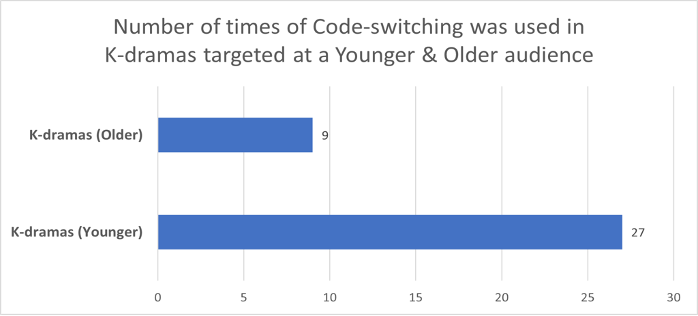
What Comes First, the Noun or the Adjective? An Analysis of Adjective Order Among Spanish Heritage Speakers

Fernando Beltran, Yvette Gamez, Flor Ramirez, Chenyi Wang

This study explores the cross linguistic influence of adjective ordering among Spanish heritage speakers. Recently, a multitude of research has been developed to understand the tendencies of heritage speakers regarding adjective ordering in their less dominant language, which oftentimes is Spanish. The purpose of this study is to untangle the various options of ordering adjectives in Spanish. Participants were presented with two tasks: a judgment task and a production task. Results for the judgment task suggest that heritage speakers of Spanish at UCLA prefer the conventional adjective ordering in Spanish – that is, a single adjective in a post-nominal position. Findings from the production task demonstrate that heritage speakers elicit a single adjective postnominally and rarely produce multiple adjectives for a single noun. Further analysis uncovers that code-switched adjectival phrases are not seen as grammatical or native-like by heritage speakers. Overall, the findings reveal that there is little to no crosslinguistic influence from English to Spanish in regard to adjective ordering.

[expander_maker id=”1″ more=”Read more” less=”Read less”]

Introduction and Background

Spanish, which is one of the most popular Romance languages, often presents adjectives after the noun; this is known as a post-nominal adjectival position (Sanchez & Camacho, 2021). For example, “las palabras inapropiadas” follows this post-nominal order. However, in Spanish, it is acceptable to place adjectives before nouns or in what is known as a pre-nominal adjectival position, e.g., “las inapropiadas palabras.” The variation in adjective placement in the Spanish language reflects the flexibility of a looser grammatical rule. Even so, in Spanish and other Romance languages, pre-nominal adjectives are more constrained than post-nominal ones (Pérez-Leroux et al., 2020). Moreover, only a single adjective can appear in the pre-nominal position for adjective-noun-adjective (ANA) phrases. An example of this is ¨las hermosas nubes azules¨, in which one adjective is pre-nominal and one is post-nominal, but not both pre-nominal. Despite this, Spanish adjectives are relatively flexible as both post-nominal and pre-nominal constructions are generally appropriate (Camacho 2018).

English, on the contrary, has a strict noun-adjective order, with adjectives almost always preceding nouns; that is, the conventional adjective position in English is pre-nominal, so much so that there is a near categorical use of this adjectival position. While there is no technical arrangement of Spanish adjectives within a noun phrase, in English, “a small, round ball” would appear much more appropriate than “a round, small ball”. This is known as a strict hierarchical order for adjectives: Size > Color > Nationality > Noun – one example is “The big brown English dog.” (Pérez-Leroux et al., 2020). This specific order must be followed in English; otherwise, the sentence will sound unnatural with the adjectives repositioned.

The study we will discuss in this blog article seeks to dissect such distinctive adjective-noun and adjective-adjective placements in Spanish and English. It also attempts to analyze if heritage speakers transfer the stricter grammar of English into Spanish. The target population of this study is intended to be adult Spanish heritage speakers at different levels of proficiency in the language. Heritage speakers are individuals who learn their native language from an early age at home and later acquire a new language, often at school, that becomes their dominant language used in social, educational, and professional settings. The language that is used less often then becomes the heritage language (Montrul, 2012), and because the speaker uses it less frequently, they become less proficient in this language. However, a heritage speaker’s abilities in their heritage language can vary depending on the input and frequency in which they continue to speak and/or write it. For example, a Spanish heritage speaker could speak native Spanish (heritage language) at home with family members and some friends, while using English (dominant language) at school and/or work. There is a wide diversity in the competence of heritage speakers: some are proficient in their native language, while other speakers may demonstrate characteristics similar to second language (L2) learners.

Given the known differences in the order of adjectives and nouns between Spanish and English, we hypothesize that some aspects of these rules may transfer across languages (i.e., English to Spanish), resulting in a phenomenon in which less proficient heritage speakers of Spanish will have a preference for stricter adjective order than more proficient Spanish heritage speakers. More proficient Spanish heritage speakers, on the other hand, will have a looser interpretation of noun-adjective order than less proficient Spanish heritage speakers.

Methods

The intended target population in this study consists of Spanish heritage speakers at different levels of Spanish proficiency from the University of California, Los Angeles (UCLA). To control for the variation in Spanish dialects and influences, these participants are chosen to be of Mexican-American descent only. Participants of linguistics majors are also excluded. For participants who do not meet our criteria, their data is excluded from the study. Based on the participants’ self-reported confidence and self-assessment of Spanish skills, they are grouped into either the more proficient or the less proficient group in which the more proficient heritage speakers may resemble native speakers and the less proficient heritage speakers may resemble L2 learners. After conducting the main study tasks, as discussed below, the participants are asked to fill out a Bilingual Language Profile (BLP) questionnaire (Birdsong 2012), which determines their linguistic abilities in each language: English and Spanish.

The main study consists of two portions: a judgment test in which participants judge the correctness/soundness of Spanish, English, and Spanish-English codeswitched phrases based on their noun-adjective order, and a naming test in which participants are prompted to produce Spanish adjective phrases after being presented with two descriptive images. The first part of the study involves sentences that participants have to rate on a scale of 1-5 (1 being not correct at all and 5 being 100% correct). We also ask participants for their reasoning behind their ratings of the provided sentences in order to exclude any irrelevant biases. To ensure the quality of the given sentences, a balanced bilingual – one who is proficient in both English and Spanish – is invited to first judge the same sentences later sent to the participants. In the second part of the study, participants are presented with two pictures that should elicit Spanish noun-adjective phrases using multiple adjectives. For example, images of a small, red house and a big, green house are shown, to which participants are asked to provide a verbal description in Spanish.

For the judgment test, responses were recorded according to speakers’ perception of correctness of the adjective order in Spanish and English. We compared the averages for the ratings the participants give to the sentences in this task. For the naming task, we first record the participants’ ordering of the nouns and adjectives in their sentences and later analyze how closely (if any) the noun-adjective order in the spoken sentences adheres to the rules in English. For both tasks, we predict less proficient Spanish heritage speakers will perform in such a way that they adhere to the adjective ordering of the English language more so than the more proficient Spanish heritage speakers.

Results/Analysis

As mentioned in the methods section, in order to determine the proficiency level of the participants in our study, we had them fill out a demographics survey. Unfortunately for the purposes of our study, none of our participants answered the questionnaire in a way that would qualify them as a lower proficiency Spanish speaker. In this case, we cannot address our hypothesis directly. Instead, a general analysis is provided on our results and data.

Table 1 below shows the average ratings of each sentence in the judgment test across all participants as well as the number of responses for each rating on the 1-to-5 scale for each sentence.

Looking at the average ratings from the participants for the judgment task, in which they judged sentences on a scale of 1 to 5 with a score of 1 being not appropriate sounding, and 5 being very appropriate, participants reported a score higher than 4 for sentences with a single adjective in the post-nominal position. This result is expected, since these sentences follow the typical Spanish noun-adjective order. Examples include: “El carro lujoso” (Table 2), “Las acciones indebidas”, and “Me gusta la jovén bonita”. For Spanish sentences that violate this typical grammatical construction, participants assigned average scores lower than 2. An example is “Las inapropiadas palabras.”

Table 2. A bar graph that shows participants’ ratings of the Spanish phrase, “El carro lujoso”. The green bar represents the number of participants who rated this phrase a 4 and the orange bar represents the number of participants who rated this phrase a 5.

For English and Spanish-only sentences that contain more than one adjective, the participants’ scores appear to be on the lower side, but one sentence is also rated as more neutral (approximately a score of 3) in judgment. In the case of “I want to sit on the stone, white chair”, the average rating is 2.06, and this may be explained by the order of English adjectives, in which color adjectives are usually placed before material ones, such as “I want to sit on the white, stone chair” (Table 3). In the case of “Me gusta la jovén mujer bonita”, the average reported score is 2.13 (Table 4). This may be due to the fact that the sentence incorporates a less common adjective structure by locating one adjective pre-nominally and another post-nominally seen in Spanish. English-only grammar would adopt one or the other. Therefore, given that the sentence is in Spanish, participants may prefer to have both adjectives in the post-nominal position as it is seen by the participant as more native-like. A more neutral rating (approximately 3) is given to “ La motocicleta verde italiana”. Unlike the adjective-noun-adjective (ANA sequence) case above, both adjectives are placed post-nominally in this sentence, and since Spanish does not limit adjective hierarchy in the post-nominal position, some participants may prefer “verde italiana” while other prefer “italiana verde”, resulting in the more neutral distribution in score.

Table 3. A bar graph that shows participants’ ratings of the English sentence, “I want to sit on the stone, white chair.” The blue bar represents the number of participants who rated this sentence a 1. The red bar represents the number of participants who rated this sentence a 2. The yellow bar represents the number of participants who rated this sentence a 3. The green bar represents the number of participants who rated this phrase a 4.
Table 4. A bar graph that shows participants’ ratings of the Spanish sentence, “Me gusta la jovén mujer bonita.” The blue bar represents the number of participants who rated this sentence a 1. The red bar represents the number of participants who rated this sentence a 2. The yellow bar represents the number of participants who rated this sentence a 3. The green bar represents the number of participants who rated this phrase a 4. The orange bar represents the number of participants who rated this phrase a 5.

Lastly, the average ratings for most code-switched sentences are lower than 3, which indicates that the participants do not judge these phrases as appropriate sounding. See the following examples:

1. Comí un blue candy japonés. 2.19 (Table 5)

2. The house azul. 2.06

3. The big cuadro peruano. 2.5

4. I want to sit on the small, silla roja. 2.94

Table 5. A bar graph that shows participants’ ratings of the code-switched sentence, “Comí un blue candy japonés.” The blue bar represents the number of participants who rated this sentence a 1. The red bar represents the number of participants who rated this sentence a 2. The yellow bar represents the number of participants who rated this sentence a 3. The green bar represents the number of participants who rated this phrase a 4.

In Spanish grammar, an adjective-noun-adjective order is possible, but in the data shown above, most participants do not agree and do not accept this structure. One explanation may be the occurrence of transfer from English grammar. If this is the case, then the participants may subconsciously have an English-dominant syntactic structure in mind while processing these code-switched sentences, resulting in this lower rating. The following sentence further supports this explanation and shows a more neutral response from the participants:

5. The big Peruvian cuadro. 3.56

In this sentence, both adjectives – one English and one Spanish – appear before the noun, and on average, the participants think this sentence is more acceptable than the cases above. This suggests that participants deem an adj-adj-noun order more suitable than the cases above (including ANA sequences), which is the grammatical order seen in English but not Spanish sentences. Given that most participants self-reported to have had more formal instructions in English, have spent most of their life in an English-speaking region, talk to themselves mostly in English, and on average are more proficient in English skills than Spanish ones, this hypothesized explanation is possible. However, only one such sentence is reported in this study, and a rating of 3.56 is relatively neutral and not strong enough to indicate any determining conclusion on the possible transfer of English syntactic rules to Spanish.

Discussion

We originally hypothesized that heritage speakers of Spanish with lower proficiency in the language would adhere more closely to the English norms regarding noun-adjective order. Therefore, we predicted that less proficient Spanish heritage speakers would have a stricter understanding of noun-adjective order. However, since none of the participants rated themselves as low in proficiency in Spanish, we, again, conducted only a general analysis using all data.

As addressed above, our results do not show any solid evidence for cross-linguistic transfer of English adjective ordering rules to Spanish. In addition to the individual sentences mentioned above, an overall analysis dissects all data to suggest little to no transfer from English to Spanish: 1) most ratings are low for adj-N order in Spanish 2) use of mostly N-adj phrases in production 3) lower ratings of ANA sequences in Spanish. The first two observations would indicate no transfer from English. The third case may suggest possible transfer from English since English does not allow for ANA sequences. However, this may also be due to the infrequency of ANA sequences in general. According to the post in FluentU by Whitney Grace, the most common adjective sequence is to have only one adjective before the noun or after.

Furthermore, when later asked, the participants reported that a lower score is given to the code-switched sentences simply because they did not like having two languages mixed in a single sentence. They would prefer having either just Spanish or English in one phrase, or if code-switching does occur, it would be more natural-sounding to them when this switch occurs in sentences that are much longer instead of a short sentence as presented in our judgment task.

Our study also has multiple limitations. For one, our small sample size (16 people) restricts the generalizability of our study. Moreover, we were not able to ask all our participants about their reasoning regarding their judgments because unfortunately, we did not build this into the task. As a result, only the handful of participants who completed the naming task clarified why they answered the way they did on the judgment task. This is a major limitation, especially for the judgments made on the codeswitched sentences, since many of them could have rated them as unnatural only for the reason that they were codeswitched, not because they did not follow the rules of English or Spanish. Thus, our finding that participants experienced transfer from English is not clear as Spanish heritage speakers obey the adjective ordering that is most commonly used and may not be fully aware of the less frequent syntactic rules in Spanish, which then limits a holistic and evidential insight as to whether transfer from English has occurred.

Conclusion

From this study, it is shown that Spanish heritage speakers prefer the Spanish adjective order of noun-adjective in most Spanish-only cases and prefer the strict English order of adjective-noun in English-only sentences. On code-switched phrases, heritage speakers rated the constructions as non-native and would have preferred only one language per sentence. In terms of practical implications, our findings could contribute to improving Spanish classes specifically designed for heritage speakers. Although our results do not match with our initial hypothesis that syntactic transfer from English to Spanish may occur, the study nonetheless highlights some preferences and thoughts of processing languages from Spanish heritage speakers. In the future, it would be great to analyze heritage speakers of different proficiency levels in Spanish (as we originally intended) as well as heritage speakers growing up in different environments. This type of study can further be applied to heritage speakers of other languages to examine not only the linguistic differences across languages used by heritage speakers but also their cognitive processes and their intuition when presented with varying combinations of the distinct language systems.  

References

Birdsong, D., Gertken, L.M., & Amengual, M. Bilingual Language Profile: An Easy-to-Use Instrument to Assess Bilingualism. COERLL, University of Texas at Austin. Web. 20 Jan. 2012. <https://sites.la.utexas.edu/bilingual/>.

Camacho, José. “The Interpretation of Adjective-N Sequences in Spanish Heritage.” Languages 3.4 (2018): 46–. Web.

Montrul, S. A. (2012, August 8). Is the heritage language like a second language? University of Illinois Urbana-Champaign.

Pérez-Leroux, Ana et al. “Restrictions on Ordering of Adjectives in Spanish.” Borealis (Tromsø) 9.1 (2020): 181–208. Web.

Sánchez, Liliana & José Camacho. 2021. Adjectives in Heritage Spanish. Isogloss. Open Journal of Romance Linguistics 7, 3:1-20.

Whitney Grace. “The Guide to Spanish Adjective Placement: Quit Misplacing Those Descriptives!” FluentU Spanish, 18 Jan. 2022, https://www.fluentu.com/blog/spanish/spanish-adjective-placement/.

[/expander_maker]
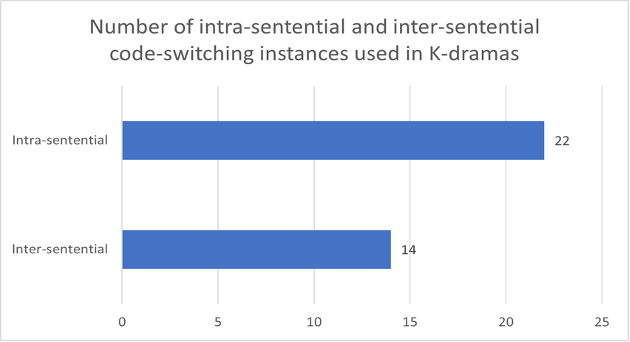
Speaking to My Partner Only in Korean for 24 Hours!: How bilingual couples mitigate communication issues

Talar Anoushian, Kimberly Gaona, Kimberly Maynard, Ann Mayor, and Guoran Zhang

Communication within couples can be difficult at times, but is it different when they’re bilingual? This study aims to clarify any breakdowns in communication within bilingual couples when it comes to speaking to their less proficient language for a long period of time. The data used for this study was collected from YouTube challenge videos titled “Speaking to My Partner Only in Korean for 24 Hours”. The challenge goes as follows: the most proficient partner would speak in the challenged language, Korean, and the other partner would try to understand and respond to the conversation as much as possible. The two bilingual couples that were used for this study vary in Korean proficiency — one couple being intermediate and the other beginner. During the study, we found some patterns linking certain strategies for repairing communication to the varying levels of proficiency, meaning some strategies are more likely to be employed during bilingual communication when one of the speakers is less fluent. We also found some examples of how the nature of these couples’ relationship influenced how they approached certain communication breakdowns and their partner’s differing proficiency level.

[expander_maker id=”1″ more=”Read more” less=”Read less”]

Introduction & Background

Many of us have seen the popular videos where a bilingual speaker chooses to speak only their native language for 24 hours, much to the confusion of those around them who may not be as fluent. This challenge became especially popular amongst bilingual couples with different language backgrounds. Not only do these videos provide an entertaining viewing experience, but they also allow us insight into how bilingual couples communicate in their various languages and what they do when communication breaks down. We decided to use these videos to see how the strategies used to mend miscommunications differ between a couple where both speakers are fluent in the language being spoken and a couple where only one speaker is fluent in the spoken language. We are especially interested to see how they will choose to mend these misunderstandings when the option to switch into their shared language (the language they both speak most commonly) is taken away from them.

We decided to study Korean-English bilingual couples — more specifically, couples in which one partner is a native Korean speaker and the other varies in Korean proficiency. Recent studies have shown that the number of bilingual individuals has progressively increased in the past years, and this is especially true for South Koreans. For South Koreans, having ​​the flexibility to use their native Korean language proficiency as well as advanced English language proficiency gives these bilingual speakers an advantageous position in society (Choi, 2018). While their communication skills may seem advanced, bilingual speakers still run into errors and misunderstandings in their communication, and they use different methods to solve these. These methods used to resolve miscommunication are known as “repair strategies.” We developed a list of these strategies from various other studies and grouped them into two categories: self-initiated and other-initiated. The full list of the strategies along with their definitions (and the definitions of self-initiated and other-initiated) can be found in Table 5 in the Appendix. The way these strategies can come into play during conversation is illustrated in the image below:

Image 1: A flow chart showing the cycle of communication.

As shown in Image 1, the cycle of communication is as follows: two interlocutors are talking and a message is being communicated, then at some point, the addressee doesn’t understand what is expressed. Thus, the speaker uses a repair strategy in hopes of getting their intended message across. Sometimes, even after a repair strategy is used, the addressee still doesn’t understand what is being expressed, then the pattern repeats until the partner does understand the message. Once the message is successfully communicated, fluid communication continues.

To build our subject pool, we focused on the following popular Korean-English bilingual couples: Gohan and Cerose who share a YouTube channel named Jin & Juice, and Jin and Hattie Green who share an eponymously-named Youtube channel. Gohan and Jin are South Korean native men speakers, but their partners are non-native Korean speakers. Cerose of Jin & Juice is an American woman who learned Korean as she lived in South Korea, and she gradually acquired a native-like command of the language. Hattie is a British woman who lives with her partner in South Korea as well, and as a result she learned some basic Korean but speaks at a beginner level proficiency. Since each of these couples have a less fluent partner with varying levels of proficiency in Korean, we expected different strategies to be employed by each couple throughout the challenge. Since some strategies don’t involve an advanced level of Korean — like abort-and-abandon and avoidance — we expected the couple with only one fluent speaker to use these simpler repair strategies. On the other hand, other repair strategies like expansion and meta-repair require better understanding of Korean, so we expected the couple with two fluent speakers to use these and similar self-initiated strategies. However, we can’t definitively say which couple will code-switch from Korean to English, but we do anticipate that code-switching will be used mostly by the couple where only one speaker is fluent, because there would be no way to simplify what is said so that their partner can understand while still speaking Korean.

Methods

First, we collected data from the channels mentioned above performing the “Speaking to My Partner in Only Korean for 24 Hours” challenge. Below are the links to their respective channels:

Figure 2: Jin and Juice (890K subscribers)
Figure 3: Jin and Hattie (1.6M subscribers)
Figure 4: Farina Jo (1.28M subscribers)

Although we originally intended to study 3 different bilingual couples — Gohan and Cerose from the YouTube channel Jin & Juice, Dong-In and Farina from the YouTube channel Farina Jo, and JinWoo and Hattie from the channel Jin and Hattie — we realized that, as we began to collect data, Dong-In and Farina did not fit the specifications we had set forth for our subject pool. Dong-In and Farina are less of a Korean-English couple and more like a Korean-German couple since they use German more frequently in their everyday lives. Because of this, they were no longer good candidates for this study so we decided to remove them from our subject pool.

For our research, we used a similar method to Belgrimet’s (2020) study of bilingual students and their use of repair strategies in communication breakdowns. We looked specifically for moments where the communication breaks down to see what strategies are employed when code-switching is supposed to be avoided. We also looked for moments where a couple failed the challenge by using code-switching as a repair strategy. These repair strategies will be categorized using a defined list from various sources, and it can be found in the Appendix. To study Gohan and Cerose, we decided to watch their video “Speaking Korean to my girlfriend for 24 hours.” To study Jin and Hattie, we decided to watch their video “[AMWF] Speaking Korean To My Girlfriend for 24 hours ver.2 * she has no idea * | Calling Noona!?.

The different strategies used from each Korean-English couple will be compared to see any noticeable differences in their rate of usage. In order to perform this comparison, once all the strategies used by each couple have been counted, the data was inputted into a table to allow for easier side-by-side comparison. We also noted the function of the various strategies in an attempt to explain the reasons behind why certain strategies are more likely to be used in one context than another. In addition, we looked at intentional code-switching moments separately and, using our knowledge of code-switching and other repair strategies, drew some conclusions to explain why the speaker felt a need to code-switch instead of using a different strategy to repair the miscommunication. Below are examples of spreadsheets we created to tabulate our data and notes:

Image 5: An example of a spreadsheet that contains the repair strategies used by Gohan and Cerose.


Image 6: An example of a spreadsheet that compares the repair strategies used by our subject pool.

Results and Data Analysis

For the first couple, Jin and Juice (aka Gohan and Cerose) which contained two fluent speakers, we looked at their video “Speaking Korean to my girlfriend for 24 hours.” They used some of the strategies we discussed before, as seen in the table below.

For them, the most commonly used self-initiated strategy was hesitation. Most instances of hesitation were seen when Cerose was speaking Korean. For example, we have this instance from when she was applying lotion on Gohan’s face and explaining how she has been doing his skin-care for him:

Speaking Korean to my girlfriend for 24 hours (Timestamp: 5:03)

Cer: 요즘 명진이 피부가 너무. . .

      Lately Gohan’s skin is very. . .

Goh:  쓰래기라?

      Trash?

Cer: 응 너무 안 좋아서. . . 피부 관리. . 시키는거야
     
     Yeah it’s not very good so... I’m doing... 
     his skin care for him

Each “. . .” is a moment where she pauses or hesitates. The first one we actually classified as an example of “word search,” since Gohan fills in the next part of the sentence for her, but the next two are moments we labeled as “hesitation.” In this case, the hesitation seems to not only be due to her having to think of what to say in Korean, but also the fact that she is multitasking and applying lotion on Gohan’s face at the same time.

We also saw quite a few instances of unintentional code-switching in this couple. A couple of examples from Gohan include:

Speaking Korean to my girlfriend for 24 hours (Timestamp: 2:35)

Goh: 내가 요즘 유튜브에서 요리 tutorial 듣고 있는데... *gasp* 개물어

      I've been watching a lot of youtube cooking tutorials 
      lately… *gasp* bite me
Speaking Korean to my girlfriend for 24 hours (Timestamp: 5:16)

Goh: 여기 여기 *crevices*에도 해줘.

     Here, here get the crevices too.

We had expected that as the more fluent couple, they would be less likely to fail the challenge and code-switch since they would struggle less to communicate in Korean. Instead, we saw multiple instances of code-switching, but they were all unintentional like the ones above: not being used to resolve a misunderstanding but rather naturally coming out as they spoke.

When it came to the other-initiated strategies, there was no clear outlier in the data and they were all used pretty evenly. The strategy that was used the most was clarification, but not all instances of clarification were used to resolve miscommunication caused by the language gap. Sometimes it would be used simply to keep the flow of a conversation or just confirm information, similar to what we would see in monolingual conversations. For example:

Speaking Korean to my girlfriend for 24 hours (Timestamp: 2:32)

Cer: 배고파.

     I'm hungry

Goh: 배고픔?

     You're hungry?

Cer: 응

     Yeah

The next couple, Jin and Hattie, is the couple that has one Korean native speaker, Jin, and one beginner-level speaker, Hattie. Overall, this couple had far more communication breakdowns as Hattie could not understand most of what was said by Jin, which in turn led to a more frequent use of repair strategies. The numbers can be seen in the following table.

In this couple’s interactions we see a large amount of “ignore” happening. There were many moments in which Hattie could not understand what Jin was saying when he spoke Korean so rather than attempt to fix the situation she would simply act as if she had not heard what he said. Below is one instance in the video where we see a lot of ignoring on Hattie’s side as well as a lot of repetition on Jin’s side:

[AMWF] Speaking Korean To My Girlfriend for 24 hours ver.2 
* she has no idea * | Calling Noona!? (Timestamp: 1:31)

Jin: 아니 장미 맞아

     No you're right this is a rose

Hat: That's a really big rose. That can't be a rose.

Jin: 이거 장미 맞아

     This is a rose.

Hat:I should take a picture for my step mum. 
    She would love these.

Jin: 응.. 아니 이거 장미 맞다고

     Yeah.. But I said you're right this is a rose.

Hat: What?

Jin: 장미 맞다고 이거

     I said this is a rose

Hat: It's quite hot and sunny

Jin: 아니 너 왜 자꾸 다른 말 해? 내가 한국말 하는데

     Why do you keep changing the subject? I'm speaking Korean…

The first two times Jin tries to tell her she is right about it being a rose she doesn’t even look at him and continues talking to herself about whether or not it is a rose and how she should take pictures for her mother, giving us two instances of “ignore.” The third time, she does acknowledge that he is speaking to her and asks “What?” an example of “explicit-minimal query,” but after he repeats himself for the third time she goes back to ignoring him and changes the topic to the weather.

We noticed that in both couples there were instances of the native speakers using purposeful word-choice to make things easier for their partner to understand. For example, in Jin and Hattie’s video, there is one case where Jin uses a “Konglish” word, or a Korean word borrowed from English, as well as a time where he references a line from a drama that Hattie would be familiar with:

Konglish example:

[AMWF] Speaking Korean To My Girlfriend for 24 hours ver.2 
* she has no idea * | Calling Noona!?  (Timestamp: 4:31)

Jin: 나 이거 스킴해볼까?

     Should I try skimming this?

Hat: You're skimming rocks? We did skim rocks
Drama Reference Example:

[AMWF] Speaking Korean To My Girlfriend for 24 hours ver.2 
* she has no idea * | Calling Noona!?  (Timestamp: 1:51)

Jin: 나는!!

     I am!!! [reference from drama Itaewon Class]

Hat: 나는 박새로이 [unintelligible]. . . 감사합니다

     I am Park Seroi [unintelligible]. . . Thank you

For Gohan and Cerose, we found one possible instance of this type of “simplification” of the language to make it easier for the partner to understand:

Speaking Korean to my girlfriend for 24 hours (Timestamp: 2:20)

Cer: 몇시야?

     What time is it?

Goh: 지금?? 6시 32분 오후.. 밤 6시다

     Right now?? 6:32pm.. 6 o'clock at night

It isn’t entirely clear if this is just Gohan simply rewording how he says the utterance without any regard for her skill level, but we believe it’s possible that he purposely chose to switch from using 오후 “pm” to 밤 “night” which is a more straightforward and commonly-known word for Korean learners.

There are also times where they seemed to be trying to increase their partner’s confidence in Korean. For instance, in Jin and Hattie we see an example of Hattie gaining confidence as she understands something Jin says, and even though she clearly misunderstands what he says after he chooses not to mention this and instead acts as if she is doing well to let her maintain her confidence:

[AMWF] Speaking Korean To My Girlfriend for 24 hours ver.2 
* she has no idea * | Calling Noona!?  (Timestamp: 6:59)

Jin: 여기 연어가 진짜 맛있어

     The salmon here is really delicious

Hat: It's really delicious

Jin: 어떻게 알았어?

     How did you know?

Hat: I know! I know what you're saying! It's really 
     annoying cause I can actually understand you this time.

Jin: 그럼 말해

     Then say something

Hat: Yes

Jin: 한국어로 말해

     Say something in Korean

Hat: I can understand Korean. My Korean's getting better.

Jin: 오호호.. [unintelligible]

     Ohoho [unintelligible]

Hat: I can't say anything but I can understand it.

Jin: Boom

We can see that when he asks her to say something in Korean, she clearly misunderstands and responds as if he is saying something else. However rather than bringing this up and making her realize that she misunderstood, he reacts with supportive responses and lets her continue to believe that she understood.

As for Jin and Juice, Gohan attempts to increase Cerose’s confidence with direct compliments such as below:

Speaking Korean to my girlfriend for 24 hours (Timestamp: 7:50)

Cer: 한국말 못해

     I can’t speak Korean

Goh: 한국말 엄청 잘하는 거야

     Your Korean is really good

All in all, when looking at repair strategies, as we expected the less fluent couple had to use more strategies overall and did use some of the strategies we had predicted such as other-initiated repetition and ignore. We also expected that the fluent couple would use more self-initiated strategies, which was supported by our data. Both couples used a similar amount of self-initiated strategies total, but when we compare this amount relative to the amount of other-initiated strategies used, we see that Jin and Juice used self-initiated strategies far more than other-initiated strategies.

Chart 1: A comparison of Self-to-Other Repair Strategies used by both couples.

The one aspect of our data that contradicted what we were expecting was the data on code-switching. Unexpectedly, the more fluent couple, Gohan and Cerose, code-switched more than Jin and Hattie. However, we expected code-switching to be employed purposely to resolve non-understandings, which would be intentional code-switching. Since all instances we saw were unintentional code-switching, this could explain why the fluent couple was more likely to code-switch. Due to the fact that they both have good command over both Korean and English, it is likely that they code-switch more often than Jin and Hattie in their day-to-day life, thus the instances of unintentional code-switching could be explained as a result of habit.

Discussion and Conclusions

Based on the collected data, we came to the conclusion that lower fluency equals more breakdowns in communication because of the lack of understanding. Gohan and Cerose’s conversations were a little smoother due to their higher proficiency in Korean. Compared to Jin and Hattie, where Hattie was the less proficient partner, there were more breakdowns in communication. We also did find certain strategies were employed far more by the less fluent couple, indicating a link between repair strategies used and proficiency level.

In conclusion, bilingual couples can struggle in communication due to the many languages involved and their level of proficiency in each language. This study can help us understand bilingual couples and the ways they fix miscommunications while dealing with varying language proficiency. Ultimately, we can see how being bilingual does not mean that you are linguistically handicapped, and it’s rather advantageous to have access to other languages and ways to express yourself. 


References

Belgrimet, S. (2020). A conversation analysis of repair strategies in communication breakdowns: A case study of algerian bilingual students. International Journal of English Literature and Social Sciences, 5(2), 459–467. https://doi.org/10.22161/ijels.52.21

Choi, L. J. (2018). Legitimate bilingual competence in the making: Bilingual performance and investment of Korean-English bilinguals. International Journal of Bilingualism, 23(6), 1394–1409. https://doi.org/10.1177/1367006918791266

Cogo, A., & Pitzl, M.-L. (2016). Pre-empting and signalling non-understanding in Elf: ELT Journal, 70(3), 339–345. https://doi.org/10.1093/elt/ccw015

Firth, A. (1996). The discursive accomplishment of normality: On ‘lingua franca’ english and conversation analysis. Journal of Pragmatics, 26(2), 237–259. https://doi.org/10.1016/0378-2166(96)00014-8

Gullberg, M., & McCafferty, S. G. (2008). Introduction to gesture and SLA: Toward an integrated approach. Studies in Second Language Acquisition, 30(02).
https://doi.org/10.1017/s0272263108080285

Stępkowska, A. (2021). Language choices between partners in bilingual relationships. GEMA Online® Journal of Language Studies, 21(4), 110–124.
https://doi.org/10.17576/gema-2021-2104-06

West, T. (2018). A Conversation Analysis of Repair Strategies in Multilingual English Discussion Classes. New Directions in Teaching and Learning
English Discussion
, 6.

[/expander_maker]
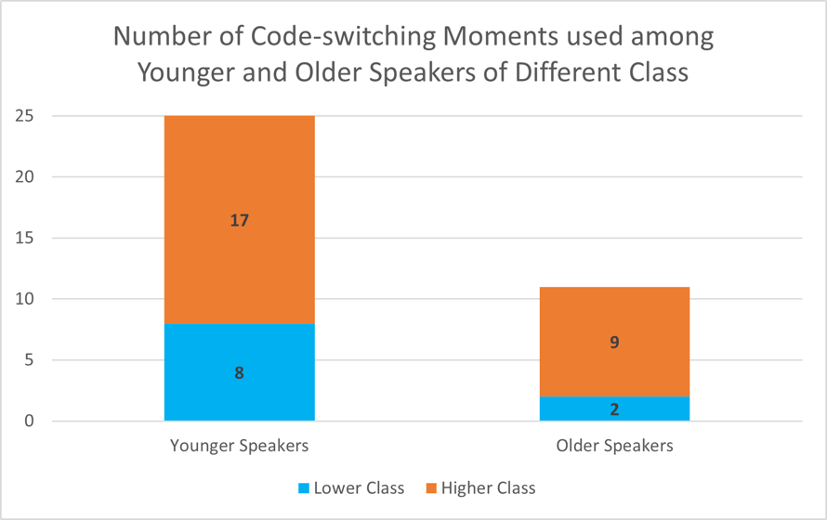
Using Google Translate? Ask a Bilingual Instead!

Gustavo Gutierrez, Abby Minervini, Ryley Park, Ana Rios, and Santiago Valdez

One of the many myths in the field of bilingualism is that bilinguals are “born translators” due to their ability to switch and communicate in more than one language. Nonetheless, if you have ever witnessed a professional interpreter in action whether at a hospital, courtroom, or school, you may have noticed that interpreting and translating are no easy tasks. While we know that being bilingual does not automatically turn you into a professional interpreter/translator, it appears that language brokering, the task of translating and interpreting that many bilingual children take on to aid their parents or relatives, seems to benefit bilinguals’ ability to interpret and translate in settings where it is critical that communication is as accurate and smooth as possible, such as in the medical setting. The following study explores the relationship between language acquisition background and interpretation and translation abilities by examining the performance of two groups of bilinguals, namely Early Childhood Bilinguals and Second Language Learners, when asked to facilitate communication by translating and interpreting within a medical context. Keep on reading to find out the differing translation abilities and tendencies of these two groups of bilinguals!

[expander_maker id=”1″ more=”Read more” less=”Read less”]

In this research project we sought to compare the translation abilities of Spanish-English and Korean-English early childhood bilinguals (ECB) to second language learners (L2 learners) of Spanish and Korean. Early childhood bilinguals are those who acquire and develop their second language (L2) during early childhood (birth to 8 years old). Second language learners are those who learn their L2 at a more mature age, after already acquiring their first language (L1). We chose Spanish-English and Korean-English bilinguals due to the high population of Korean and Spanish speakers in Los Angeles, where this project was conducted (Data USA, 2019). For the purpose of this study we centered the context of translation/interpretation on a medical setting, due to the high-risk environment and necessity for accurate translations. Our participants included 7 ECBs of Spanish-English, 7 L2 learners of Spanish, 7 ECBs of Korean-English, and 3 L2 learners of Korean all of whom were 19-23 years old.

That being said, we attempted to answer the following questions:

  • Do early childhood bilinguals have an advantage over second language learners when it comes to maintaining meaning when translating/interpreting?
  • How does each group’s linguistic background affect their interpretation/translation skills?

Background

Previous research in Second Language Acquisition has often categorized L2 Learners as being more aware of their L2’s structure and linguistic properties, mainly due to their formal instruction and relatively late learning onset (McLaughlin, 1981). While this type of linguistic awareness might prove useful in certain situations, it does not necessarily equate to a greater ability to express meaning and communicate effectively (Colina, 2002). Because of this and the fact that L2 Learners are likely to have less exposure to their L2 than ECBs, we imagine that L2 Learners are less skilled at accurately expressing meaning in translations and interpretations, because they might be more focused on correctly translating the structure of the language.

Similarly, literature on the area of Language Brokering differentiates child L2 Learners and adult L2 Learners by their priorities when producing in the L2. For example, one study found that children prioritize accurate meaning when producing in the L2, whereas adults are more likely to prioritize grammatical correctness and structural form (Fathman, 1975 as cited in McLaughlin, 1981). In another study, it was found that children with prior language brokering experience had higher levels of metalinguistic abilities and enhanced problem-solving skills (Lopez et al., 2019). Given these findings, we decided to have our study focus on bilinguals with differing language acquisition backgrounds to better understand their priorities and tendencies when translating and interpreting.

When analyzing translations, it is important to understand what must occur in order to produce an accurate translation. Schwieter and Ferreira (2018) define translation and interpretation as processes that involve the comprehension of the input in the source language, its deverbalization or mental decomposition, and, lastly, its re-expression as output into the target language. Because preserving meaning while attempting to construct a message with a sound structure is difficult, we believe that our study can contribute to the body of knowledge in the area and potentially lead to new approaches for interpretation and translation training. Ultimately, it is crucial that all patients, regardless of whether they can speak English, have access to professional interpreters and translators as something as important as their health and well-being is at stake (Tonkin, 2017).

Method

We had participants reply to a 3-part questionnaire that included sociodemographic questions, a translation task and an interpretation task. The translation task asked participants to translate three medical terms from English to Spanish/Korean and three medical terms from Spanish/Korean to English. The interpretation task asked participants to interpret 4 sets of dialogue between a doctor and patient. The first two asked them to interpret the doctor’s English lines and the last two asked them to interpret the patient’s Spanish/Korean lines. This was to emulate an appropriate context for using interpretive skills. For the translation task, we looked at the percentage of participants that had correct translations, and for the interpretation task we identified patterns and tendencies for each group’s translations.

Results

For our Spanish speakers, we found that the ECBs performed better on five of the six single-word translations that are displayed in Figures 1 and 2. The ECBs were more likely to come up with the correct translation, except for the Spanish term “infección por estreptococos.”

We cannot fully understand why this happened, but we predict that the L2 Learners were better at making educated guesses for this term because they often used context clues when they did not know the exact translations. For example, when translating dolor de garganta into English, many of them said throat pain or pain of throat. However, this term actually means sore throat in Spanish. As individual words, dolor means pain and garganta means throat. Therefore, we predict that they made educated guesses based on their knowledge of these terms, but overall did not know the target translation. This distinction is important because throat pain and sore throats are very different medical ailments, which proves why specific medical translations are essential.

Figure 1. Terms from the Translation Task that participants had to translate from English to Spanish.
Figure 2. Terms from the Translation Task that participants had to translate from Spanish into English.

For our interpretation task, we knew that there would be more variability in responses, so we decided to analyze them by seeing if there were any patterns in how each group decided to translate. The responses from each group are displayed in Figures 3 and 4. When translating Is it difficult to breathe? we noticed that all of the L2 Learners had identical responses: Es difícil respirar?

Figure 3. Responses from ECBs on Interpretation Task for “Is it difficult to breathe?”  
Figure 4. Responses from L2 Learners on Interpretation Task for “Is it difficult to breathe?”


They provided a very literal translation that coincides word-for-word with the English sentence. In contrast, the ECBs had more variety in their responses, using a broader vocabulary and more complex sentence structure. In general, the ECBs produced more complex interpretations that took the concept from English and conveyed it in a natural way in Spanish. Overall, the L2 Learners tended to maintain word choice and sentence structure across translation, while the ECBs demonstrated more flexibility in their responses.

Next, we noticed another difference in translation patterns for this sentence: Please point to the exact spot where it hurts. The ECBs provided very precise translations, whereas the L2 Learners were vaguer. As shown in Figure 3, five of the seven ECBs selected the Spanish verb apuntar as the translation equivalent of point. In contrast, none of the L2 Learners selected this word. In fact, all of them had unique responses. As shown in Figure 4, the L2 Learners use phrases like digame (‘tell me’), usar tu mano (‘use your hand’), señale con el dedo (‘point with your finger’) and toca el lugar (‘touch the place’) that have the intention of communicating pointing. It seems that they don’t know how to exactly express point, so they use these roundabout phrases instead. This is likely because the L2 Learners have weaker vocabularies.

Figure 5. Responses from ECBs on Interpretation Task for “Please point to the exact spot where it hurts.” 
Figure 6. Responses from L2 Learners on Interpretation Task for “Please point to the exact spot where it hurts.”


Overall, the ECBs are mostly able to come up with a singular word to mean point, but the L2 Learners all used different phrases to try and communicate the same meaning.

While we noticed these differences when translating from English to Spanish, we did not identify many interesting patterns when the groups translated in the opposite direction. It seems like translating from Spanish to English was easier for both groups, because we had many more responses. Also, there was less variation in translations among groups and between groups, which led to very similar data.

For the Korean results, the ECBs also performed better on five of the six single-word translations. However, we significantly lacked data from the L2 Learners with only three participants. Most ECBs successfully translated the terms from English to Korean, whereas L2 learners appeared to struggle, averaging a 33% success rate.

Figure 7. Terms from the Translation Task that participants had to translate from English to Korean.

When translating from Korean to English, we noticed that there were some over-translations among the ECBs. For example, our target word was 패혈성 인두염 (‘strep throat’), but they answered septic pharyngitis which is a more scientific term for strep throat.

Another term that was over-translated is 인후염 (sore throat) where we received the term laryngopharyngitis. In this case, sore throat should be pharyngitis rather than laryngopharyngitis which means a sore throat and an inflamed voice box. Since these terms are actually different, it is important to note since they may require different medical treatments.

Figure 9. Responses from ECBs on Interpretation Task for “Please point to the exact spot where it hurts.”
Figure 10. Responses from L2 Learners on Interpretation Task for “Please point to the exact spot where it hurts.”


In the interpretation portion for the Korean data, the participants translated, “Please point to the exact spot where it hurts.” from English to Korean. In the Korean language, there is no exact equivalent for the term, point, so this term is usually related to the phrase 가르켜주세요, which is directly translated to teach me. The closest direct translation for point is 짚어주세요. For this task, we saw that all of the ECBs answered using either 가르켜주세요 (teach me) and 짚어주세요 (point) when they interpreted for point. On the other hand the L2 Learners did not have correct answers as they completely neglected the term point since it is a more difficult term to translate and instead answered with 어디가 아파요? (Where does it hurt?) making their answers more concise and even changing the statement into a question.

Figure 11. Responses from ECBs on Interpretation Task for “배 위에 난방 패드를 붙이면 기분이 좋아져요.” 
Figure 12. Responses from L2 Learners on Interpretation Task for “배 위에 난방 패드를 붙이면 기분이 좋아져요.”


For the next interpretation task we analyzed 배 위에 난방 패드를 붙이면 기분이 좋아져요 (I feel better when I put a heating pad on my stomach). While all of the ECBs mentioned the phrase, feel better (기분이 좋아져요), the L2 learners simplified the phrase by saying helps instead and restructuring the sentence from the target answer. Overall, the answers provided by the ECBs were much more detailed and accurate whereas L2 learners provided more concise answers or none at all. While the ECB answers varied, they used words with the same meaning consistently throughout all the tasks.

Discussion

An important finding in the translation task was that ECBs were better at translating medical terminology because they performed better in five out of six translation questions. This finding supports our hypothesis that the linguistic background of ECBs is advantageous to their translation abilities. For example, ECBs were more likely to give the actual translation for dolor de garganta (‘sore throat’), whereas L2 learners tended to make educated guesses based on their knowledge of what dolor (‘pain’) and garganta (‘throat’) mean, showing that they did not know the actual translation. This same finding was also true for Korean-English participants.

One important finding in the interpretation task was that ECBs had better lexicons and understanding of the language because they used specific Spanish words like apuntar (‘to point at’), whereas L2 learners had to find different ways to convey the English word point with words that they know such as, usar (‘use’), señale (‘show’), and toque (‘touch’). In addition to the frequency of ECBs acting as language brokers, our questionnaires also show that they acquired Spanish at the age of five or younger, and had more frequent exposure to the language compared to L2 speakers, which likely leads to improved vocabularies and understanding of the language. This same finding was also true for Korean-English participants.

The last finding in the interpretation task was that ECBs were more likely to be flexible and advanced in translating by using different structures. For example, they used Spanish phrases such as tiene dificultad para respirar? (‘Have difficulty breathing?’), se le hace difícil respirar? (‘Is it difficult for you to breathe?’), and others. From our questionnaire data, we saw that ECBs have more translation experience than the L2 learners, which likely prepared them to focus on translating meaning rather than the exact structure, because they know how a concept might be conveyed differently in each language. In contrast, L2 learners were likely to mimic the same structure of the first language, such as their word-for-word translation, es difícil respirar? (‘Is it difficult to breathe?’). This same finding was also true for Korean-English participants.

Based on the results of our study, we confirmed that ECBs were more likely to prioritize meaning, whereas L2 learners prioritized speech form and structure as expected from the studies we drew upon. Therefore, this further supports the notion that the L2 Learners’ awareness of language properties does not equate to the ability to accurately express meaning.

Our research can be particularly useful for the medical and healthcare industry, where professional translators and interpreters are needed to facilitate communication with patients. The findings of our study suggest that companies might prefer to hire ECBs because they are likely to have more experience with translating and interpreting than L2 learners. However, the slight variations in which ECBs expressed meaning also indicate that being bilingual does not necessarily mean you will be a perfect translator or interpreter, which is why it is important to have professionally trained experts. Our findings do show that there are benefits of learning a second language at an early age. Therefore, encouraging parents to consider bilingual education for their children at an early age can help develop their translating and interpreting skills, expand their lexicon, and allow them to comfortably use both languages, which could be seen with some of our participants.

Conclusion

Researchers should consider replicating this study on a much larger scale to ensure that there is enough data from each group. This study could also be improved upon by having pre-tests, such as cloze tests, that can accurately measure the fluency levels of the participants to compare the translation abilities of those that have similar proficiency levels. We didn’t measure the proficiency levels of participants other than by asking them to rate their own abilities in Korean and Spanish.

While the ECBs seemed to perform better than the L2 learners on a few different measures, ECBs still experienced their own struggles when translating certain medical terminology. This demonstrates that bilinguals are not born translators and being bilingual is not necessarily a sufficient requirement for professional translators and interpreters, especially in a medical setting.


References

Colina, S. (2002) Second Language Acquisition, Language Teaching and Translation Studies. The Translator, 8:1, 1-24, DOI: 10.1080/13556509.2002.10799114

Data USA. (2019) “Non-English Speakers in Los Angeles, CA.” Data USA, https://datausa.io/profile/geo/los-angeles-ca/demographics/languages.

López, B. G., Lezama, E., & Dagoberto Heredia, Jr. (2019). Language Brokering Experience Affects Feelings Toward Bilingualism, Language Knowledge, Use, and Practices: A Qualitative Approach. Hispanic Journal of Behavioral Sciences, 41(4), 481–503. https://doi.org/10.1177/0739986319879641

McLaughlin, B. (1981). Differences and similarities between first- and second-language learning. Annals of the New York Academy of Sciences, 379, 23–32. https://doi.org/10.1111/j.1749-6632.1981.tb41994.x

Schwieter, J., & Ferreira, A. (2018). Bilingualism, translation, and interpreting (pp. 251–266).

Tonkin, E. (2017). The importance of medical interpreters. American Journal of Psychiatry Residents’ Journal, 12(8), 13–13. https://doi.org/10.1176/appi.ajp-rj.2017.120806

[/expander_maker]
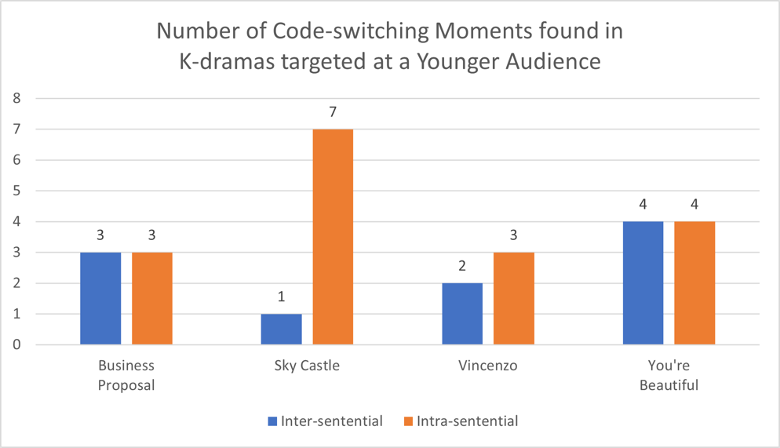
Attrition amongst Spanish Bilingual Young Adults in Los Angeles

Elie Barbar, Said B., Bel Jacob

It is well-known that one’s language fluency decreases the less one utilizes it. In particular, heritage speakers are a unique case in which their first language is spoken often within a familial context, yet in all other cases, it is not used. This study sets out to examine Spanish heritage speakers in the Los Angeles area to determine whether growing up solely in Los Angeles has affected their level of attrition in the Spanish language. The main hypothesis was that because Spanish is only spoken in a familial context, the speakers would have an average or below-average grasp of the language. The methods utilized to study this included a mix of surveys, tests, and interviews conducted to determine attrition rates amongst the participants. After using these methods, we found that Spanish Heritage Bilingual Young Adults in L.A. had an above-average fluency within the language, exceeding our original expectation of the participants having average or below-average levels of fluency. The main assessment from the data as to why these speakers have retained their heritage language so well is due to the environment they grow up in. Within Los Angeles, Spanish is widely spoken so not only do the participants have a chance to speak it with their family but with the outside world as well.

[expander_maker id=”1″ more=”Read more” less=”Read less”]

Introduction

Attrition and incomplete acquisition have been one of the most intriguing concepts in language development–many children grow up learning multiple languages at once, especially in densely populated areas of bilinguals, including Los Angeles. Our study goal was to discover the degree of attrition in reading and writing amongst young adults in Los Angeles. We wanted to investigate the relationship between attrition of L1 and formal education in L2. In Los Angeles, 42% of the population speaks Spanish vernacular due to it being their heritage language while being formally educated in English, which could either lead to attrition in the future or incomplete acquisition of the Spanish Language. Attrition is the loss of language over time despite fully acquiring it during youth due to multiple factors such as “emigration, extensive use of L2 in daily life” (Schmid & Köpke, 2007), while incomplete acquisition is when children deviate from the norm and were never able to fully acquire a language (Köpke, 2018). In addition, Keijzer (2008) discusses Roman Johnson’s hypothesis, stating that “forgetting a language is the reversal process of learning the same language,” which was taken into account here because we believe this depends on age – a child may acquire a language in a few years but take many more as an adult for attrition to occur.

Linguists have hypothesized in the past through the interdependent development hypothesis that learning a second language could be accelerated if one or the other is morphologically rich, which Spanish is morphologically rich. In other words, the evidence points toward children being able to acquire both English and Spanish properly (Liew, 1996). In addition, since the parents’ L1 is Spanish, it would allow the child to be exposed to Spanish properly for the first few years of life, before heavily integrating into the American society to acquire English as well. While we cannot be certain whether attrition or incomplete acquisition, previous evidence and patterns of communication of parents tend to suggest the complete acquisition of both languages, meaning that attrition is more appropriate to test here. However, there has been evidence to support that if there is somewhat of a lack of language input for the child, then incomplete acquisition may occur – in a study about bilingual English-Spanish speakers, mothers were strongly working toward maintaining their children’s Spanish abilities: “the experience of these Spanish-speaking mothers reveal that while they perceived bilingualism as important for work and family communication, they often struggled to sustain their children’s Spanish development using various home language policies and discourse strategies…several mothers reported that their child was starting to prefer English, not only with siblings and peers but also with Spanish-speaking adult caregivers” (Surrain, 2018, p. 20). This evidence suggests that formal education, as young as preschool, can play a role in L1 language attainment if parents are not providing enough input of the heritage language to the children. This could translate to attrition in college students due to the potential lack of constant input of their L1. This is why we hypothesize that due to the lack of writing and reading and strictly using L1 orally, heritage speakers will greatly suffer in competency scores since their formal education is focused on English, the dominant language. Our prediction is that test scores will be middle to low.

Methods

Participants included 13 Spanish bilingual young adults from ages 18-21. All of them were recruited in the Los Angeles area and speak LA vernacular Spanish. First, the participants filled out a survey, investigating their perceived proficiencies in speaking, listening, reading, and writing in Spanish, as well as frequencies and demographics in which they would use LA vernacular Spanish. Then, they were given a college-level written test from CLEP (College Level Examination Program). Lastly, they were offered an optional interview to explore discrepancies between their perceived proficiency and the actual test results. We analyzed their degrees of attrition and deficiency in competency in their L1, mostly in morphosyntactic structures by observing what areas of morphosyntax they tend to struggle with the most.

Results

Survey Results:

Figure 1 (a, b, c): Perceived proficiency before the test.


Figure 2: Frequency in which the 13 participants use the given areas of language asked.


Figure 3: Preference of Spanish versus English in certain given social environments.


Test Results:

Figure 4: The collective test scores of the reading/writing test consisting of 15 questions.


Figure 5: Example of the most missed question among the participants.


Interview Results:

(Linguistic Landscape)

“Living in LA I read Spanish in a lot of different places, like billboards and fliers. It’s not everywhere in LA but I see it.”

“My parents and I try to keep up on our Spanish. We agree that we will exclusively speak it at home. And when we go to the market and places like that, we see it all over the place.”

“I never really took a Spanish class, but I see it when I am out in town or when I go to Mexican grocery stores. It’s not complicated stuff but I see it written and I read it.”


( Attrition / Dominant L2)

“I took some Spanish in high school because it was required, but I don’t read it often and I don’t write it ever. It’s mostly just speaking it at home.”

“I only really speak it at home with my parents, but other than that I don’t use it often.”


(Dialect and Prescriptivism)

“This kind of Spanish isn’t exactly the type of Spanish I use, it seems like this is more like Spain Spanish.”


Analysis

When observing the figures in the proficiency portion of the survey, our participants were fairly confident in their abilities as well-rounded bilinguals. There is a common consensus that the more someone speaks a language, the more comfortable they will become speaking the language. The average proficiencies were well above our predicted levels, as we predicted a steeper drop in the confidence in reading and writing. This goes against our hypothesis that predicted that formal education would have a significant effect on proficiency levels in reading and writing. There was a significant drop in confidence in relation to the participant’s confidence in their writing ability which does go in the direction of what we expected, just not by the amounts that were projected. One should keep in mind that the group is a mix of heritage speakers with and without formal Spanish education. This may have an impact on the data.

In the aspect of frequency of use, the frequency of speech portion is relatively high but our expectation was for a middling average. The frequency is similar to the perceived confidence in language use which is interesting. The frequency numbers drop in a similar way to the proficiency. The lower confidence level in reading and writing seems to have a correlation to the frequency of use, thus it can be stated that frequency of use possibly bolsters confidence in an area of speech. One note is that the frequency of writing in Spanish is even lower than the confidence level of writing in Spanish.

When asked about the social environments in which our speakers use Spanish, the results are extremely stacked in one direction. The language of choice in most instances was overwhelmingly in favor of English. The only instance of the prominent use of Spanish is with older family members. This in a way is logical since the parents’ L1 is Spanish and they would feel more comfortable communicating in the Spanish vernacular of their heritage language rather than English. Even with younger family members, the numbers polled much stronger toward English, but a decent number still spoke to them in Spanish. This information tracks with our hypothesis of attrition, in that English, has the dominant use in their day-to-day language usage. However, this was the only portion of our data to support our claim.

The Spanish reading and writing test proved to predominantly correspond with the perceived proficiency stated in the survey. Eleven of the participants scored ten or higher on a fifteen-question test. The most common score was twelve out of fifteen for four participants. Scores thirteen and fourteen account for another four participants.

One strange observation is the two outlier scores of eight correct answers. Upon viewing these tests individually, some seemingly simple mistakes were made, and for some, the commonality was a bit of struggle on the correct past form to use. One explanation could be a rushed test taker not completely reading the question upon answering, but this is not confirmed. The case of the incorrect past forms is a small commonality of about two questions incorrect on it. Here the participants had a hard time distinguishing between the preterit or the imperfect forms. The reason we believe that the test was rushed is that the clues to use imperfect are usually with the text, and if the text is not fully read, then the reader may not be alerted to use the imperfect. These two participants also missed some easy questions that a beginner Spanish learner would get correct, let alone a heritage speaker. There is no real way to truly claim that a rushed test is the reason for these outliers, but from the evidence presented, this may be the likely case. This also calls to question our methods, as they may be too long for participants to where they may rush through the test and skew our results.

Ultimately though, our participants exceeded our expectations in terms of testing. The test results produced were higher than expected with only our two outliers being in the middle. Even the questions that were wrong could be argued to be fully grammatical depending on the variety of Spanish used as this is a prescriptivist Spanish test. They did however struggle with a particular question pertaining to the present progressive, and whether or not to add a preposition. This phrasing is more typical of formal written language, rather than spoken language. There is a lack of a present progressive trigger word like “estar”, making this even more marked.

The final portion of the test was an optional interview portion asking about participants’ scores, many of whom responded with comments about living in the Los Angeles area and seeing Spanish in their environment. Linguistic landscape has played a large role in the test results according to our participants. Many of them are subjected to many forms of written Spanish stimuli in their surroundings due to the large Spanish-speaking community in Los Angeles. This was not taken into account when planning our experiment but gives us a good idea as to why our data concluded the way it did.


Discussion

Foremost, our biggest flaw was not taking the linguistic landscape into account for our project as a whole. Our early results were strange when first testing, we could not predict just how well our participants projected and performed. Our interview portion really shed light on our shortcoming of neglecting such an influence on heritage speakers in this area. That being said, if we were to do another experiment and frame a comparison against heritage speakers in a less optimal linguistic landscape where English is dominant. We believe that the results would be a staggering comparison as to how much the linguistic landscape plays a role in the limiting of attrition.

We believe that our method format was extremely solid in terms of the quality of data produced, however, the length of a survey, a test, and an interview severely limited the amount of people willing to participate. To some degree, we believe that it even affected our test results. The outliers in our test data suggest that two of our participants may have been speeding through our test without fully reading the questions. Even leaving the interview portion optional, the sequence of google form after google form has given us some unintended consequences.

But to the credit of the long format, the interview portion was eye-opening and put our entire experiment into a better perspective. Three comments describing aspects of the linguistic landscape were pivotal in understanding the prior results. However, the interview also highlighted the flaw of overly prescriptivist language use in our test. The comment that our test was too “Spain Spanish” was something that we knew would come up, however, there is no known formal test that we know of which would test for specific dialects. I believe that we do not have enough credibility as linguists to create this, but for other linguists moving forward, dialect-specific tests may be a useful tool.

Another issue that we observed was the inconsistency of heritage speakers with prior formal education in Spanish. In hindsight, we should have included several questions in the survey asking specific questions about their formal training. As for finding exclusively non formally trained heritage speakers, it’s hard to control for, especially since most schools and colleges require a foreign language. Many heritage speakers opt for taking Spanish as their foreign language in school leaving a small number of young adult heritage speakers to pick from to keep the data consistent.


Conclusion

In the survey, our test group projected that their proficiency was fairly high for reading and writing in Spanish, and their reading and writing test results confirmed this. The only evidence in our favor was that English was their preferred language of choice in most social scenarios, but this did not translate into the test data. Ultimately our hypothesis was proven false, as our group exceeded our expectation of proficiency and did not exhibit distinct signs of attrition in their Spanish reading and writing. This also demonstrated that formal education does not have as much of a tremendous role in proficiency in the heritage language as we expected. Thus, it can be concluded that for our group of Los Angeles Spanish heritage speakers, attrition was not present and that our bilinguals have attained high proficiencies in their L1s and their L2s.   


References

Elizabeth M. Liew (1996) Developmental Interdependence Hypothesis Revisited in the Brunei Classroom, Journal of Multilingual and Multicultural Development, 17:2-4, 195-204, DOI: 10.1080/01434639608666271

Goral M, Libben G, Obler LK, Jarema G, Ohayon K. Lexical attrition in younger and older bilingual adults. Clin Linguist Phon. 2008 Jul;22(7):509-522. doi: 10.1080/02699200801912237. PMID: 18568793; PMCID: PMC3128922.

Keijzer, M. (2004). First language attrition: A cross-linguistic investigation of Jakobson’s regression hypothesis. International Journal of Bilingualism, 8(3), 389–393. https://doi.org/10.1177/13670069040080030201

Keijzer, M. (2010). The regression hypothesis as a framework for first language attrition. Bilingualism: Language and Cognition, 13(1), 9-18. doi:10.1017/S1366728909990356

Köpke, B. and Genevska-Hanke, D. (2018) First Language Attrition and Dominance: Same Same or Different?. Frontiers in psychology9, 1963. https://doi.org/10.3389/fpsyg.2018.01963

Montrul, S. (2002). Incomplete acquisition and attrition of Spanish tense/aspect distinctions in adult bilinguals. Bilingualism: Language and Cognition, 5(1), 39-68. doi:10.1017/S1366728902000135.

Schmid, M. S., & Köpke, B. (2007). Bilingualism and attrition. Language attrition: Theoretical perspectives, 33, 1-7.

Surrain, S. (2018). ‘Spanish at home, English at school’: How Perception of Bilingualism shape Family Language Policies among Spanish-speaking Parents of Preschoolers. International Journal of Bilingual Education and Bilingualism. 1-15.


[/expander_maker]
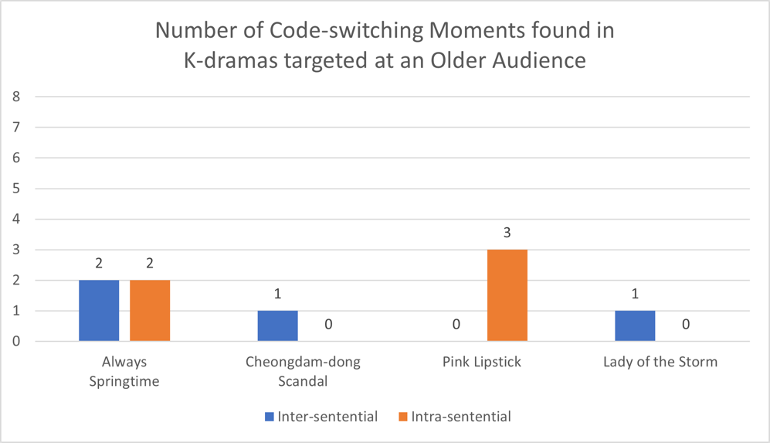
Scroll to Top