Meera Chavan, Seungyeon Chi, Kaya Kumar, Anna Shin
If a stranger asks you how your day was, would you rather say that you aced your final or fell down Bruin Walk? Now, what if you were asked that same exact question by your close friend? Would you still answer the same? Stemming from our original motivation of wanting to observe intraspeaker variation through a peer to peer conversation, this study investigates how perceived familiarity influences linguistic variations among female university students. Ultimately demonstrating that speakers do, in fact, systematically shift registers and semantic tendencies when addressing friends versus strangers in order to negotiate a more intimate relationship, social identity, and to create ‘distance’. The key research question that guided our study was ‘how do different aspects of everyday conversation affect familiarity dynamics between individuals?’. Whether they be among friends, family members, or peers, everyday conversations play a central role in constructing intimacy, hierarchy, and belonging, yet they are often overlooked because we don’t usually think or reflect when we speak.
Keywords: familiarity, university, variation, selective communication
[expander_maker id=”1″ more=”Read more” less=”Read less”]
Crash Course on Intraspeaker Variation
The Big Picture
Language use is a social choice where individuals can negotiate their social relationships and identities. The foundation of this negotiation is intraspeaker variation which specifically focuses on how people change the way they talk on a situational basis (Grieser, “Locating Style”). We wanted to explore how gen Z girls utilize this variation to navigate friendship and new relationships through university as it can be a period of high stress and unfamiliar circumstances.
What We Do and Don’t Know
We conducted all interviews online through a singular platform as it has been proven that the medium of communication also causes intraspeaker variation (Bleaman, I. L., Cugno, K., & Helms, A.). Existing sociolinguistic research records establish that “socialness” of vocabulary is a fundamental principle of language. On a more pragmatic and phonological level, Savitsky et al. discusses “closeness-communication bias” among friends, along with the use of vocal fry as a linguistic register among young women. However, much of the existing research pertains to broader social categories leading to a gap in understanding of exactly how interpersonal familiarity alone acts as a primary factor in linguistic shifts, specifically among female university students.
What did We Want to Learn?
Our project contributes to the field of linguistic anthropology by focusing on the variable of familiarity in observing language use among female GenZ students. Ultimately, our research argues that perceived interpersonal familiarity does dynamically affect the linguistic choices of female university students. Demonstrating that speakers systematically shift pragmatic, phonological, and semantic features when addressing friends versus strangers.
Who?
The target participant population for this study were female undergraduate students at the University of California, Los Angeles. Participants were recruited through personal networks within the group. Each participant took part in two separate interviews: one conducted by a researcher they were already familiar with (her friend) and the other conducted by a researcher they had not previously met (a stranger).
How?
Both interviews (with a friend and a stranger) were conducted on the virtual video conferencing platform, Zoom, with both the camera and microphone active to observe not only vocal and conversational differences but also body language. This was to mitigate potential effects of communication medium on linguistic behavior. Interviewers maintained a neutral tone while asking the questions to avoid influencing participants’ level of comfort or speaking style. However, natural and conversational interaction was allowed during responses so that the interviews resembled everyday communication rather than a strictly controlled survey format. During the interview, participants were asked a standardized set of six questions that were related to their academic experiences, careers, and their personal lives. Ranging from baseline questions (yellow) to more personal, feelings based questions (purple).
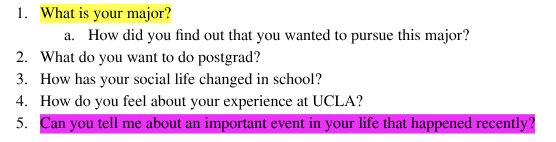
Baseline questions helped us note phonological and contextual differences in participant’s answers while the later questions allowed observation of the ways in which participant familiarity with the interviewer would affect what personal information they would share.
What Actually Happened?
There are several distinct findings within the course of the conducted interviews: we found that participants used constant vocal features (vocal fry, dropped endings, and vowel elongation) with both friends and strangers albeit with differing frequency, conversely we found differences in information shared and eye contact maintained throughout. With friends, participants were likely to use high frequencies of dropped endings, vocal fry, and filler words, the most commonly noted of which was ‘like’. With strangers, participants used the same language features just with far less frequency, however the concentration of where in the interview these features occurred stayed consistent. The figure below demonstrates this phenomena as it was observed, also illustrating that the ‘more personal’ questions (Q4 + Q5) elicited the use of significantly more filler words.

We also observed participants were much more likely to provide scaffolding information to strangers than their friends. Several varied examples of this appeared throughout the interviews, one of the most clear instances of this in each interview was the context behind what a major entailed.

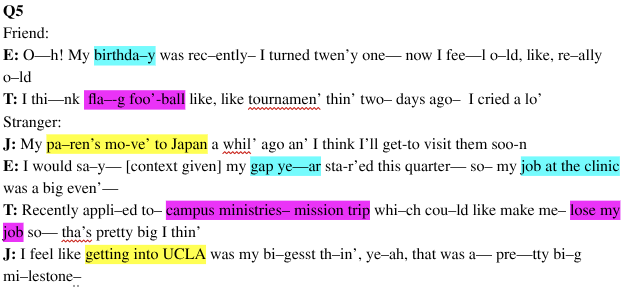
Interestingly, we noted that eye contact was more likely to be avoided with friends throughout the interview, with the exception of the ‘most personal’ question that asked the participant to recount a recent important event in their life where eye contact was avoided altogether. Furthermore, when answering this question, participants had a higher likelihood of revealing information about their personal lives to their friends whereas they were more likely to convey academic or professional success with strangers as demonstrated in the figure below.
So what? Why does this Matter?
Contrasting our initial hypothesis, our findings show a much higher degree of nuance in undergraduate communication between girls. While we initially expected a stark difference between the interviews in not only topics of conversation but also manner of speaking, the participants demonstrated that female college-aged students tend to exhibit similar behavioral characteristics with friends and strangers in order to establish some level of positive rapport with unfamiliar people. Though they don’t know the interviewer, they use behaviors that demonstrate ‘familiarity’ and ‘friendliness’ to simulate a level of closeness in order to mitigate the feelings of awkwardness that can manifest when discussing yourself with strangers. The implications of our findings suggest that in the context of our target demographic casual speech in an unfamiliar setting illustrates attempts to build connections and acquaintances. Further, it is apparent that rather than being a conscious choice to please a stranger, this ‘warmth’ may be a way for college aged girls to make themselves more comfortable in potentially uncomfortable situations. Consistent with this, the hesitancy our participants showed to reveal personal details shows that despite displaying a front of openness and friendship, most participants had clear boundaries of their own comfort. Altogether, these results suggest that female university students employ linguistic and conversational variability in a very clear manner to craft situations of potential discomfort into conversations where they create their own comfort while maintaining clear and distinct lines between what they feel appropriate to share or not.
References
Bleaman, I. L., Cugno, K., & Helms, A. (2023). Medium-shifting and intraspeaker variation in conversational interviews. Language Variation and Change, 1–25. https://doi.org/10.1017/s0954394522000151
Grieser, J. (2013). Locating Style: Style-shifting to Characterize Community at the Border of Washington, D.C. University of Pennsylvania, Working Papers in Linguistics, 19(2).
Savitsky, K., Keysar, B., Epley, N., Carter, T., & Swanson, A. (2011). The closeness-communication bias: Increased egocentrism among friends versus strangers. Journal of Experimental Social Psychology, 47(1), 269–273. https://doi.org/10.1016/j.jesp.2010.09.005
[/expander_maker]