Chai Das, Ella Liang, Mila Matos, Abigail Shih
“Reading”, or delivering witty, crafted insults, is a speech act that may have been popularized by the reality television show RuPaul’s Drag Race, but it actually has roots much deeper. Drag “reading” can be traced back to African American and Latino LGBTQ+ ballroom culture. However, as drag culture has been brought into mainstream media, it has faced pressure to appeal to broader audience expectations. This study analyzed if the same manifestation of pressure can be seen specifically in the reads from RuPaul’s Drag Race, specifically if there are a greater proportion of impolite reads in later seasons compared to earlier seasons. Categorization of polite and impolite was determined by four key aspects: semantic fields, register, specificity and address terms. We analyzed these aspects in Seasons 2 through 5 in RuPaul’s Drag Race, a period of huge growth in viewership, to answer the research question: is there a difference in the proportion of polite reads in different seasons? Using Brown and Levinson’s politeness theory, we determined there was a shift from polite reads in earlier seasons to more impolite reads in later seasons. This change seems to reflect a broader “sanitization” of drag culture norms to achieve mainstream legibility.
Keywords: drag culture, politeness, RuPaul’s Drag Race, mainstreaming
[expander_maker id=”1″ more=”Read more” less=”Read less”]
Introduction and Background
Ballroom culture in itself houses predominantly African American and Latino LGBTQ+ demographics and revolves around chosen kinship structures, therefore absorbing members expelled from biological families. Drag performances staged as balls treat topics of race, class, and gender as live material rather than simple background conditions due to the aggressive attempts of erasure from general society. Ball culture in essence fuses African American English with elements of queer subcultural inventions to establish as an infrastructure for solidarity and as a protective barrier against hostile antagonizers (Barrett, 1998). For example, drag has originally used “camp” as a tool to make political statements and influence change (Hellmuth, 2024). “Camp” is a performance style that is very exaggerated and incorporates so much irony and humor that it’s considered absurd. Historically, drag has utilized “camp” throughout drag performances and many of them are used to combat gender norms. However, this absurd aspect of the culture has been extremely controversial with some people criticizing drag performances as a “threat to children”. Therefore, many more mainstream drag performances have been “sanitized” to avoid pushback by staying away from certain highly politicized topics or not being as “radical” as they have historically been (Hellmuth, 2024). Some recent performers might choose less controversial themes or less confrontational comments.
Reading, one aspect of drag culture, originates in the ballroom tradition that values indirection and the wittiness; a successful read in its original form does not state the insult directly but rather it implies and embeds the attack in presupposition, implication or wordplay that rewards insiders capable of decoding it. Within Brown, it is classified as an off-record-face-threatening act, which means the insult is delivered without being technically stated, leaving the speaker with plausible deniability and allowing audience members to perform some investigative work (Brown, 1987). The craft lives within that gap between what is said and what is meant.
Direct reads, however, state the insult in explicit terms. They are immediately accessible to any demographic regardless of community knowledge; this is more favorable to mainstream television viewers but comes at the cost of appearing as low-hanging fruit within the originating drag culture tradition. The directness variable essentially operates both as a linguistic measure and a social one. It indexes whether the speaker is performing for an insider community or a general audience.
While scholars have studied the structural commercialization of drag aesthetics, they haven’t studied how this mainstreaming process changes micro-level linguistic practices, such as reading in drag. This study seeks to understand the relationship, if any, between viewership of RuPaul’s Drag Race and proportion of direct reads. As the viewership of RPDR expanded, we assert that direct reads became increasingly rewarded because they performed for an audience no longer exclusive to drag culture insiders.
Methods
To answer whether drag reading changed as RuPaul’s Drag Race went mainstream, we needed a way to get inside the language itself. It was not just whether a read was funny; it was more about what linguistic work the queen was actually doing to construct it. To get a better understanding we built a four criterion composite scoring scale, with each criterion grounded in linguistic literature. The scale was from 0-5, with 0 to 1 being community impolite, 2-3 being ambiguous, and 4-5 being community polite. Each targeted one specific dimension of what separates a skilled community read from a generic insult. We found it was more effective to back our judgement of politeness of reads through linguistic analysis than a simple binary determiner of if it was polite or impolite.
The first criterion is the semantic field, which was worth two points. Lehrer (1974) claimed that vocabulary clusters into meaning domains, or simply put, a group of words that belong together based on what they refer to. So essentially a read that borrows from one domain to create an attack through another, requires audiences to hold both and connect them to recover the insult. Cross domain reads follow ballroom culture because this feature is really dependent on subcultural knowledge to decode the read. On the other hand, single domain reads that stay in the same category as the target does not require as much work. This portion is the most complex and the most community specific, so we thought it was justified to weigh it more heavily at 2 points.
The second criterion was the register, which was worth one point. According to Halliday (1978), moving between formal and colloquial vocabulary within a single utterance is a skilled social performance and it signals the speaker can control multiple speech varieties all together and use them strategically. Any detected movement is considered crafty, and reads that just maintain constant colloquial vocabulary throughout show no fluency between registers and scores zero.
The third criterion is specificity, one point. The main source Brown and Levinson (1987) states that off-record-face-threatening acts which are insults delivered through implication rather than a direct statement, needs a specific target to function. In this case, a generic flaw is not something that you can build an inference around. A read that targets something unique to a queen or individual like her specific presentation, her identity, her documented history on the show would score a point. In contrast, a read that can be copy pasted on anyone in the lineup is a zero.
The last criterion were address terms, which is worth one point. Barrett (1998) documented that terms like honey, girl, mama, miss, etc signal community membership, and as indexicals in drag speech specifically. The existence of those terms in a read shows that the speaker is performing for an insider room, and this would be one point. If there is absence of it, then it signals more mainstream audience orientation, so this would be zero.
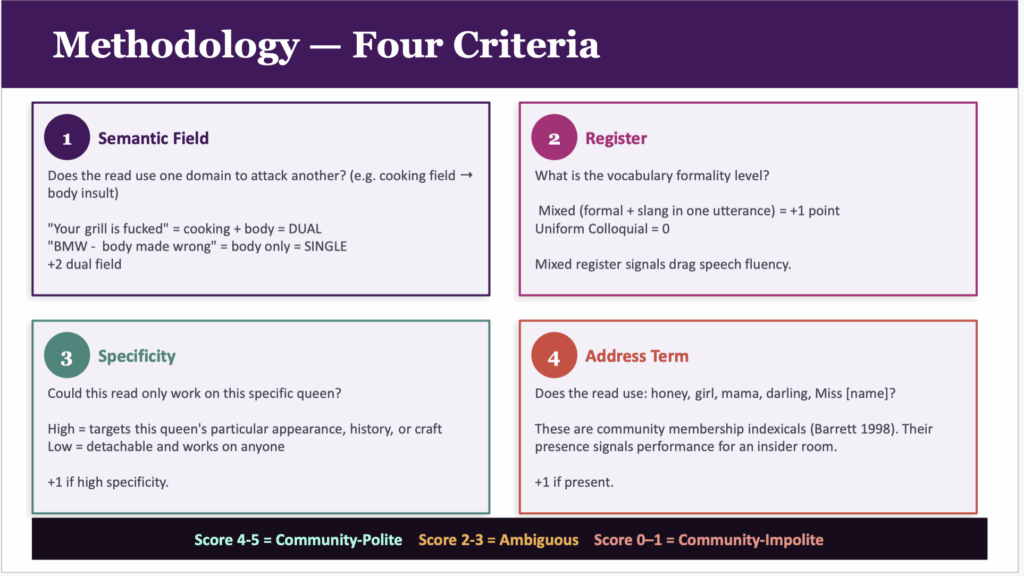
Figure 1: Summary of Methodology Criteria (Semantic Field, Register, Specificity, Address Term)
Results and Analysis
To illustrate how we applied our methodology to our sample, the following section will analyze two reads in detail, then display the data as a whole.
In Season 2, one of the reads said “And miss Tatianna, miss honey you think you’re so soft, not by the hairs of your chinny chin chin.” Contestant Jujubee delivered this read, combining the Three Little Pigs fairy tale with a directed jab at Tatianna’s demeanor. We categorized the semantic field of this read as “multiple” as it draws from the fairy tale reference and the drag specific context of the word “soft” to target Tatianna’s demeanor. This gives the read 2 points. Next, as explained above, we gave this read another point for mixed register, as it uses both elevated language and colloquial language. Third, the use of Tatianna, the target’s, name in the read makes the statement high in specificity, earning the read another point. The use of the address words “honey” and “miss” give this read a final point, totaling the maximum 5 points on our scale.
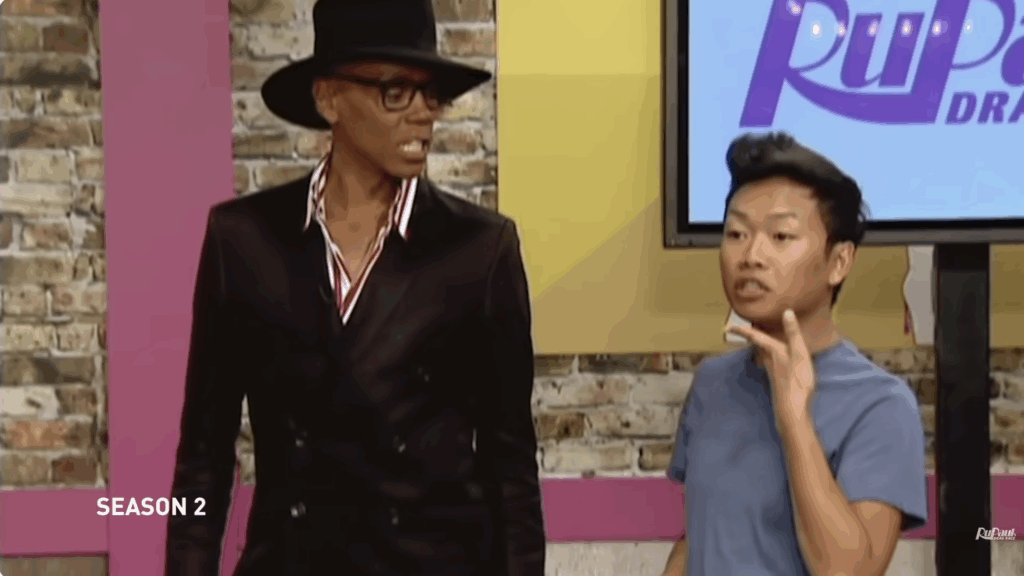
Figure 2: Jujubee directing a read to Tatianna in RuPaul’s Drag Race Season 2
In Season 3, one read from Shangela to Raja was the following, “Raja, I know you call yourself top model, but I think Tyra Banks and I would agree you’re just fashion roadkill.” We gave this read two points for multiple semantic fields as it references the show “America’s Next Top Model” to address the target’s appearance. The read also utilizes mixed register by moving between the language of the fashion industry (“top model” and the reference to Tyra Banks) and the highly colloquial insult fashion roadkill, resulting in a third point. Directing the read to Raja specifically and what she allegedly calls herself results in a point for specificity. Finally, as there is no address marker, this read would total 4 points.
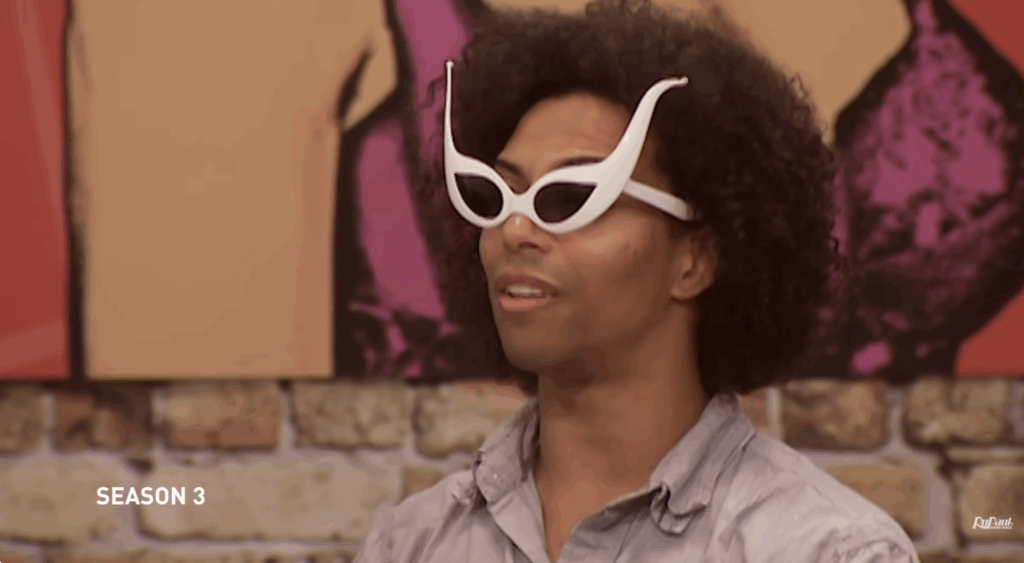
Figure 3: Shangela giving a read on RuPaul’s Drag Race Season 3
After we assigned a point value to all the reads, we examined the proportions of reads categorized as impolite, polite, or ambiguous across the different seasons. This analysis revealed notable variation between seasons. Season 2 contained the highest proportion of polite reads, with approximately 80% of all reads being classified as polite. In contrast, Season 5 showed no reads that were categorized as polite. Instead, 70% of the reads in Season 5 were classified as ambiguous, while the remaining 30% were categorized as impolite. These findings suggest a shift in the nature of the reads over time, with later seasons displaying fewer clearly polite instances. By using the point values outlined in the methodology, we displayed our categorizations in the following bar graph.
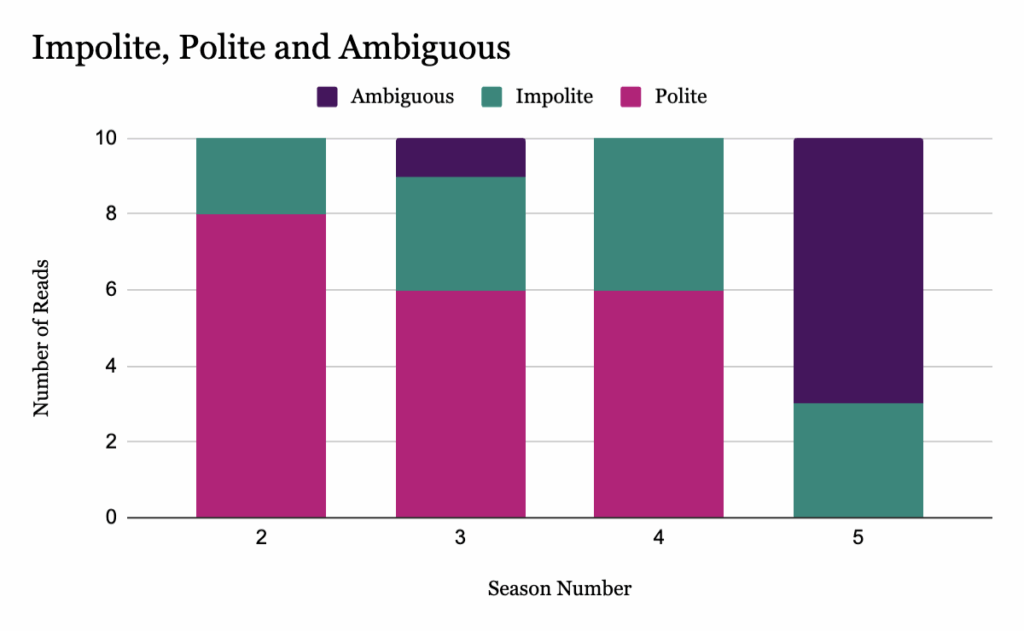
Figure 4: Bar graph measuring number of ambiguous, impolite and polite reads by season number, with season number on the x-axis and number of reads on the y-axis.
We also looked at the data separately from the final categorical labels to examine the seasons in relation to one another. To do this, we analyzed the politeness score based on the linguistic features we focused on. As a reminder, higher politeness scores indicate greater use of semantic fields associated with politeness, a more formal register, increased use of addresses, and greater specificity. Again, the scale was from 0-5, with 0 to 1 being community impolite, 2-3 being ambiguous, and 4-5 being community polite. The bar graph displays the average politeness score for each season. The results show a clear downward trend across the series: as the seasons progress, the average politeness score steadily decreases. This suggests that the linguistic features associated with politeness become less prominent over time, supporting the pattern observed in the categorical analysis and indicating an overall decline in politeness markers in later seasons.
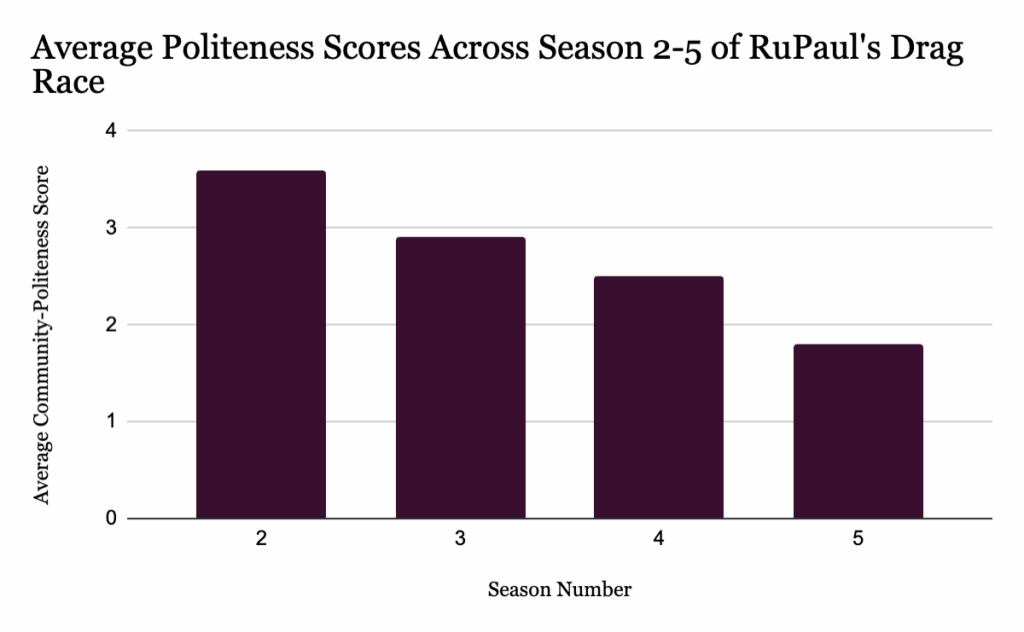
Figure 5: Bar graph measuring average community-politeness score by season number, with season number on the x-axis and score on the y-axis
Discussion & Conclusions
While we cannot claim any causal relationships, our data is conclusive in depicting a general trend of a shift towards community impoliteness over time. This pattern demonstrates a broader notion that RuPaul’s Drag Race has become the largest source of drag art globally, replacing other popular sources such as ballroom. But what will become of ballroom language? Will Drag Race’s fame make ballroom culture vulnerable to mainstream judgment? One argument holds that the commodification of drag is negative in that it utilizes stereotypes to create images for consumption (Cranon 2024). Once drag is seen as a popular “product”, there is a risk of cultural and linguistic appropriation. However, on the other hand, there is a positive effect of sharing stories of marginalized communities in mainstream media. The popularity of the show has increased awareness around drag performance, and its audience has grown. Groups of all backgrounds report to feel positive effects on mental health and lowered feelings of anxiety and depression since attending drag events (Leer 2021). Historically, groups that benefited from drag art were LGBTQ+, but now with a more diverse audience, straight women share this comfort. So while our data shows trends of linguistic change in the Drag Race reading challenge, this is generally a positive signal of acceptance and diversification.
Bibliography
Barrett, R. (1998) ‘Markedness and Styleswitching in Performances by African American Drag Queens’, in Carol Myers-Scotton (ed.), Stylistic Choices in Spoken English, in Carol Myers-Scotton (ed.), Codes and Consequences: Choosing Linguistic Varieties, https://doi.org/10.1093/oso/9780195115222.003.0008
Brown, P., & Levinson, S. C. (1987). Politeness: Some universals in language usage. Cambridge University Press.
https://archive.org/details/politenesssomeun00brow
Calder, J. (2019), From Sissy to Sickening: The Indexical Landscape of /s/ in SoMa, San Francisco. J Linguist Anthropol, 29: 332-358. https://doi.org/10.1111/jola.12218
Cranon, Ryn. “The Real Realness: Commodifying Culture from the Ballroom to Rupaul’s Drag Race.” Saint Lunita Magazine, 16 May 2024 https://saintlunita.com/2024/05/10/the-real-realness-commodifying-culture-from-the-ballroom-to-rupauls-drag-race/
Halliday, M. A. K. (1978). Language as social semiotic. 31-35, 142-145 https://archive.org/details/languageassocial0000hall
Hellmuth, L. (2024). The Politics of Camp: Drag between Cultural Mainstream and Reactionary Politics. Amerikastudien / American Studies, 69(4), 425–444. https://www.jstor.org/stable/48846923
Holmes, A. (2025, May 14). The Underground Art of the Insult. The New York Times. https://www.nytimes.com/2015/05/17/magazine/the-underground-art-of-the-insult.html
Lehrer, A. (1974). Semantic fields and lexical structure. North-Holland. pp. 1-45 https://books.google.com/books/about/Semantic_Fields_and_Lexical_Structure.html?id=L8BrAAAAIAAJ
Leer, Clair. (2021) “Research Shows Drag Life Is Good for You: UON.” University of Northampton, www.northampton.ac.uk/news/research-shows-drag-life-is-good-for-you/.
Mann, S. L. (2011). Drag Queens’ Use of Language and the Performance of Blurred Gendered and Racial Identities. Journal of Homosexuality, 58(6–7), 793–811. https://doi.org/10.1080/00918369.2011.581923
Moore, Ramey (2013), “Everything Else Is Drag: Linguistic Drag and Gender Parody on Rupaul’s Drag Race,” Journal of Research in Gender Studies 3(2): 15–26
[RuPaul’s Drag Race]. (2018, December 15). Every Reading Challenge (Compilation Part 1) | The Library is Open | RuPaul’s Drag Race [Video]. Youtube. https://www.youtube.com/watch?v=PFn_AzQuJWQ&t=277s
[RuPaul’s Drag Race]. (2018, December 16). Every Reading Challenge (Compilation Part 2) | The Library is Open | RuPaul’s Drag Race [Video]. Youtube. https://www.youtube.com/watch?v=PFn_AzQuJWQ&t=277s
Taylor, V., & Rupp, L. J. (2004). Drag Queens and Kings. In M. Stein (Ed.), Encyclopedia of Lesbian, Gay, Bisexual and Transgender History in America (Vol. 1, pp. 316-320). Charles Scribner’s Sons. https://link.gale.com/apps/doc/CX3403600152/GVRL?u=uclosangeles&sid=bookmark-GVRL&xid=90ae12f8
[/expander_maker]