Diana Cordova, Priscilla Hernandez, Sarai Ordonez Orquidea
Spanish-English bilingual celebrities frequently shift across languages in public interviews, but these shifts are not random. In this blog, we examine how three Latino/a celebrities with different dominance backgrounds manage language choice and display proficiency in English-dominant and Spanish-dominant media contexts. We analyze interview data from Jennifer Lopez, Bad Bunny, and Shakira to explore how patterns in language distribution, discourse stability, grammatical control, and lexical range position speakers along a bilingual fluency spectrum. Using CEFR descriptors as a comparative framework, we show that fluency consistently aligns with language dominance rather than balanced bilingualism. We also consider how these patterns may shape audience perceptions of bilingual legitimacy, even though audience reactions are not directly measured in this study. By focusing on observable fluency in real-time speech, this project highlights how bilingual performance operates in public media spaces and why perceptions of credibility continue to matter in discussions of Latino/a bilingualism.
Keywords: bilingualism, language dominance, fluency spectrum, Latino/a celebrities, CEFR
[expander_maker id=”1″ more=”Read more” less=”Read less”]
Introduction and Background
Spanish-English bilingual celebrities frequently alternate between languages in public interviews and media appearances. However, these shifts are not random, nor are they uniform across contexts. In both English-dominant and Spanish-dominant media settings, patterns of language use reflect underlying differences in language dominance and proficiency, raising broader questions about how bilingual ability is expressed in public speech. While bilingualism is often treated as a stable or balanced skill, actual language performance may vary significantly depending on context, topic, and the speaker’s dominant language. Research in bilingualism has consistently shown that language competence is rarely balanced across languages and is instead shaped by dominance. Prior work has also demonstrated that observable features of speech production, such as fluency, grammatical control, and lexical range, provide measurable indicators of proficiency. In addition, sociolinguistic research has shown that listeners often evaluate bilingual speakers based on these same features, with pronunciation, code-switching, and grammatical accuracy influencing how speech is interpreted (Mata, 2023). Frameworks such as the Common European Framework of Reference for Languages (CEFR) provide a standardized way to assess these features of oral proficiency, including discourse stability, grammatical control, and lexical range across different levels of fluency. However, despite this body of research, there remains limited work that systematically examines how these measurable indicators of fluency manifest in real-time speech across media contexts, especially among public figures whose language use is highly visible and widely circulated. To address this gap, this study examines how three Spanish-English bilingual Latino/a celebrities manage language choice and display proficiency across both English-dominant and Spanish-dominant interview settings. Specifically, we ask how differences in fluency position speakers along a bilingual proficiency spectrum. We hypothesize that speakers with distinct dominance backgrounds will exhibit measurable variation in language distribution, discourse stability, and grammatical control, with fluency aligning more closely with dominance than with balanced bilingualism. By analyzing interview data from Jennifer Lopez, Bad Bunny, and Shakira and applying CEFR-based descriptors of oral proficiency, this study demonstrates that bilingual performance reflects structured variation in proficiency, revealing a continuum of fluency rather than a binary distinction between languages.
Methods
Data Selection
This study analyzed publicly available interview data from three Spanish–English bilingual Latino/a celebrities representing distinct bilingual acquisition and dominance backgrounds: Jennifer Lopez, Bad Bunny, and Shakira. These speakers were selected because they represent different bilingual trajectories commonly discussed in bilingualism research. Jennifer Lopez was born and raised in the United States to Puerto Rican parents and represents a heritage Spanish speaker who developed primarily in an English-dominant educational environment. Bad Bunny was born and raised in Puerto Rico, where Spanish is the dominant language, and therefore represents a Spanish-dominant bilingual speaker. Shakira was born and raised in Colombia and acquired English after establishing Spanish as her first and dominant language, representing a late bilingual who learned English in adulthood. To ensure comparability across speakers, the study selected one interview conducted in an English-dominant and one in a Spanish-dominant U.S. media context. Four-minute segments of speech were extracted and transcribed from each interview, producing a dataset of 12 minutes of analyzed discourse. Segments were selected from portions of the interviews in which the celebrity spoke continuously rather than responding with short answers, allowing for analysis of extended discourse and fluency patterns.
Fluency Coding Framework
Interview segments were transcribed using digital transcription tools and then manually reviewed for accuracy. Each transcript was coded for language distribution, defined as the percentage of English and Spanish words produced within each sample. Words were counted and categorized by language to determine how frequently speakers used Spanish versus English within English-dominant interview settings. Transcripts were coded for key indicators of oral fluency, including grammatical control, lexical range, fluency and hesitation patterns, sustained discourse, and code-switching use.
Table 1. CEFR-based rubric for evaluating oral fluency in interview discourse
Feature
| Feature | B1/B2 (Intermediate) | C1/C2 (Advanced) |
| Grammatical Control | Occasional errors in agreement, tense, or sentence structure Inconsistencies in complex constructions | Consistent grammatical accuracy stable control across complex structures |
| Lexical Range | Adequate vocabulary for communication but limited flexibility Occasional word retrieval difficulty | Wide and flexible vocabulary Precise word choice with minimal retrieval difficulty |
| Fluency & Hesitation | Noticeable pauses, fillers, or reformulations that interrupt flow | Minimal hesitation Smooth, continuous speech with natural pacing |
| Sustained Discourse | Difficulty maintaining extended speech without breakdown or switching | Able to sustain multi-sentence discourse with coherence and stability |
| Code-switching Use | May reflect lexical gaps or retrieval difficulty | Used strategically or minimally without disrupting discourse |
CEFR-Based Proficiency Evaluation Framework
To provide a systematic method for comparing speakers, the analysis applied descriptors from the Common European Framework of Reference for Languages (CEFR). The CEFR organizes language proficiency into six levels (A1–C2), which are grouped into three broader categories: Basic User (A1–A2), Independent User (B1–B2), and Proficient User (C1–C2). These levels are defined through “can-do” descriptors that capture what speakers are able to accomplish in real communicative contexts (Council of Europe, 2001). At the higher end of the scale, C-level speakers can sustain extended, coherent discourse with strong grammatical control, minimal hesitation, and a wide lexical range. In contrast, B-level speakers demonstrate effective communication but may show noticeable pauses, lexical retrieval difficulty, and occasional grammatical inconsistencies, particularly in more complex or extended speech. In this study, these descriptors were used to operationalize fluency by focusing on discourse stability, grammatical accuracy, and the ability to maintain continuous speech without breakdown. Although the CEFR is typically used in formal assessment contexts, it provides a consistent and transferable framework for evaluating observable features of speech across speakers with different dominance backgrounds. By applying CEFR descriptors to interview data, this study approximates relative proficiency levels based on real-time language production rather than self-reported ability. Each segment was evaluated according to these CEFR descriptors for spoken production, with particular attention to how long each speaker could sustain discourse in Spanish or English without prolonged hesitation, as well as whether grammatical stability was maintained throughout the segment. These descriptors allowed the study to approximate relative proficiency levels across speakers without relying solely on subjective judgments.
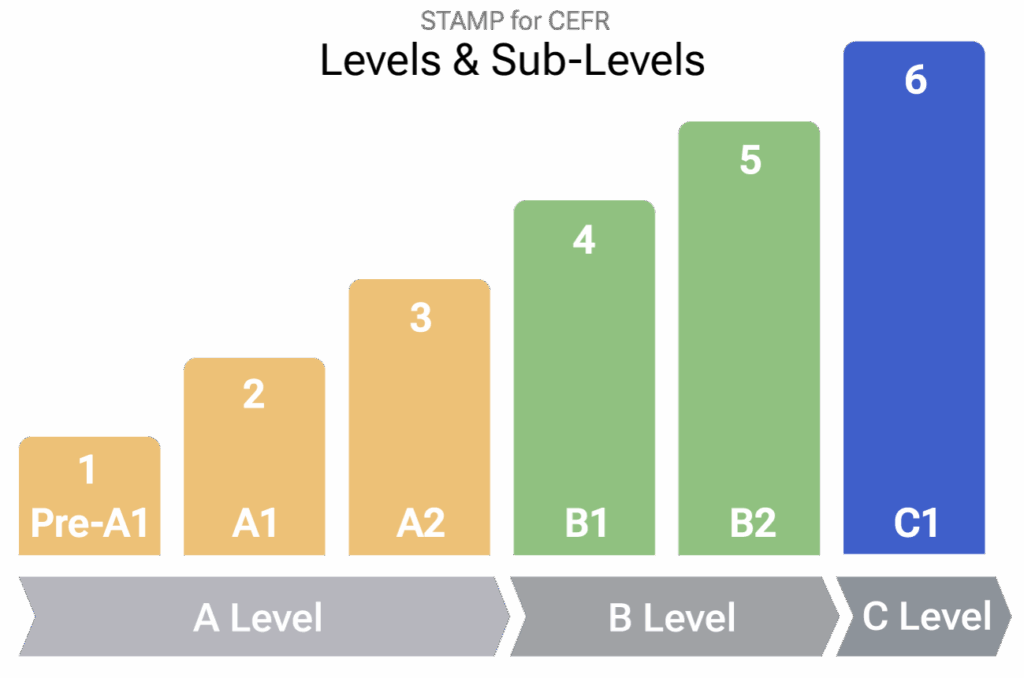
Figure 1: CEFR proficiency levels and sub-levels used as a framework to evaluate speakers’ oral fluency.
Analytical Approach
The study used a comparative discourse analytic approach to examine patterns across speakers. After coding language distribution and fluency indicators, results were compared across the three speakers to determine whether language dominance background predicted differences in sustain discourse and grammatical control. By combining quantitative measures with qualitative observations of fluency markers, the analysis aimed to identify systematic differences in bilingual performance during real time interview speech. This methodological approach allowed the study to examine how bilingual celebrities display fluency in public media contexts and how these observable patterns position speakers along a broader bilingual proficiency spectrum.
Results
Table 2 provides an overview of language distribution and fluency patterns across speakers and interview contexts. Percentages reflect language use within each interview.
| Speaker | Context | % Spanish | % English | Fluency | Fluency Notes | CEFR |
| JLo | Spanish- dominant interview | ~85% | ~15% | Intermediate | Sustains discourse, intrasentential code-switching, minor grammatical inconsistencies, occasional hesitation/reformulation | B2 |
| JLo | English- dominant interview | ~5% | ~95% | High | Fully fluent and grammatically stable, emotional pauses | C2 |
| Bad Bunny | Spanish-dominant interview | ~98% | ~2% | High | Sustained discourse, Spanish accent influence | C2 |
| Bad Bunny | English-dominant interview | ~1% | ~99% | Intermediate | Minor hesitations, minor inflectional morphology errors | B2 |
| Shakira | Spanish-dominant interview | ~94% | ~6% | High | Sustains rapid discourse, strong grammatical control | C2 |
| Shakira | English-dominant interview | ~10% | ~90% | High | Minor pauses, stable structure, slight accent influence | C2 |
Table 2. Language distribution and CEFR-based fluency across speakers and contexts.
For Jennifer Lopez, we examined her Despierta América interview where she speaks primarily in Spanish, about 85–90% of the segment. However, she frequently inserts English words such as “microbudget” and “my partner.” These switches are mostly intrasentential, meaning they occur within a sentence rather than between sentences. While she sustains extended discourse in Spanish, there are occasional grammatical inconsistencies, such as gender agreement errors like “un película” instead of “una película”. She also shows moments of hesitation and reformulation. Overall, she demonstrates strong Spanish fluency, but her speech reflects influence from English dominance.
In contrast, during her American Music Awards acceptance speech, Lopez speaks almost entirely in English, about 95%. Her English is fully fluent and grammatically stable, with only emotional pauses typical of award speeches. She includes the Spanish phrase, “Mi gente Latino,” which contains a grammatical mismatch, attracting public scrutiny. In this context, Spanish is used symbolically rather than as sustained discourse. Spanish becomes a resource for identity and solidarity, while English remains the dominant language for extended, stable discourse.
When analyzing Bad Bunny’s Vogue interview, conducted in Spanish, the language distribution was approximately 98% Spanish. His Spanish shows no hesitations and strong grammatical stability. There are three cases of intra-sentential switches: “un jacket,” “un outfit,” and “5 o 6 horas o whatever.” In one sentence, he also started his statement with, “Bro”. His pronunciation is shaped by the vowels and consonants that Spanish speakers typically use, which are not present in English. For example, when he says “bro,” he uses the “rolling r.” These switches appear natural part of his own mental dictionary and were placed in his sentences due to convenience, he remained stable and consistent. These patterns show that Spanish, being his dominant language, is the one he is most comfortable with, yet his English can still be used effectively and has even become part of his speech in Spanish-contexts.
In his recent Grammy acceptance speech, conducted in English and addressed a predominantly English-speaking audience. He delivered this speech with approximately 99% English, with only one case of language switch when he stated, “Sometime we get…contaminados.” The word contaminados sounds similar to the English word contaminated, making it relatively transparent for audiences to infer his intended meaning despite a language shift. While he sustained an extended English discourse, he briefly switched to Spanish after being unable to retrieve the English word he was attempting to use. This moment of initial hesitation led to his resorting to his dominant language, which reflects a moment of lexical retrieval difficulty that comes with navigating two grammatical systems simultaneously. There are also errors in his English production, such as verbs not matching the subject correctly and inconsistencies with verb tenses, indicative of a B2- level proficiency. Despite this, he articulated an engaging speech with effective communication to his audiences.
In the Spanish-dominant interview, Shakira speaks 94% Spanish with only minimal code-switching into English. She sustains extended discourse with little hesitation, demonstrating strong grammatical control and a wide lexical range. She maintains a consistent pace and is able to elaborate on responses without breakdown. For example, in the Por el Mundo interview, she produces long, multi-clause responses while narrating experiences, maintaining coherence across extended turns without loss of structure. Even when engaging in more spontaneous moments, such as repetition (“es igual es igual”) or the use of discourse markers (“osea”), these features function as natural elements of spoken discourse rather than signs of hesitation. Occasional English insertions, such as references to titles like Charlie and the Chocolate Factory (12:26), do not disrupt discourse flow. It reflects natural lexical access tied to culturally specific terms. Additionally, her production shows strong agreement patterns and syntactic control, with no noticeable errors that interrupt comprehension. Even when shifting topics, she maintains coherence and continuity across sentences, further supporting her ability to sustain extended discourse. Her Spanish production remains stable, rapid, and highly controlled, based on the rubric in Table 2, these features align with C2-level proficiency.
In English-dominant interview, Shakira speaks 90% English with only minimal code-switching into Spanish. She is able to sustain extended discourse with strong grammatical control and only minor processing pauses. For example, brief hesitation before retrieving target words suggests momentary lexical search rather than breakdown in proficiency. Her speech maintains overall stability, with only slight accent influence and occasional phonological transfer. One notable example is the pronunciation of “puntería” using English phonological patterns. This phonological shift reflects cross-linguistic influence, where English sound patterns become more activated in an English-dominant context. This transfer suggests that both language systems remain active and interact during real-time production. In this case, the use of English phonology for a Spanish word highlights how language dominance can shape lexical choice and pronunciation patterns. Despite these features, her discourse remains coherent, fluent, and structurally stable throughout the segment. Based on the same rubric, this level of performance is consistent with C2-level proficiency, as she sustains discourse across contexts without significant grammatical instability. Together, these findings position Shakira at the highest end of the bilingual proficiency spectrum in this study, demonstrating consistent control across both Spanish- and English-dominant settings while reflecting subtle effects of language dominance.
Discussion and Conclusion
The findings from this study reinforce the idea that bilingual proficiency operates along a continuum shaped by language dominance rather than balanced ability across languages. Across all three speakers, patterns in language distribution, grammatical control, and discourse stability consistently aligned with their dominant language, supporting our original hypothesis. At the same time, these results highlight how observable features, such as hesitation, accent influence, and code-switching, may shape how bilingual speakers are perceived in public contexts. For example, Jennifer Lopez’s “Mi gente Latino” moment and Bad Bunny’s Spanish-influenced English pronunciation illustrate how natural features of bilingual speech can be interpreted as errors or deviations. Similarly, Shakira’s phonological transfer in “puntería” shows that even highly proficient speakers exhibit cross-linguistic interaction in real-time production. Together, these patterns suggest that perceptions of fluency are often based on surface-level performance rather than underlying competence.
Overall, this study demonstrates that bilingual fluency is a dynamic process influenced by language dominance and communicative context. By applying CEFR-based descriptors to real-time interview data, we show that even highly proficient bilingual speakers display variation in fluency across languages, reflecting the interaction between their linguistic systems. While this study focused on observable production, future research could expand this work by examining less structured speech contexts, such as spontaneous interviews or informal media interactions, as well as incorporating audience perception data to better understand how bilingual speakers are evaluated. By situating bilingual performance within both linguistic and social frameworks, this study contributes to a more nuanced understanding of fluency as something that is not only produced but also interpreted.
Cross-Referencing Bilingual Language Learning in Public Figures
While our analysis focuses on observable fluency in interview contexts, broader discussions of language learning can help contextualize why fluency varies across speakers. For example, Chris Lonsdale’s TED talk argues that language acquisition is driven by meaningful interaction, sustained exposure, and real-time communication rather than formal instruction. Lonsdale emphasizes that learners develop fluency by focusing on relevant content, prioritizing meaning over form, and engaging in continuous listening and interaction. This perspective aligns closely with our findings. Speakers who regularly use a language in high-stakes communicative contexts are more likely to demonstrate stable discourse, stronger grammatical control, and fewer breakdowns in fluency. In particular, Lonsdale highlights that understanding meaning before mastering form and tolerating ambiguity are key to developing fluency. These principles help explain why bilingual speakers may appear more fluent in their dominant language, where they have greater experience sustaining extended discourse without hesitation. A similar perspective is reflected in discussions of multilingual celebrities and language learning practices, which emphasize that language proficiency is often developed through immersion, repetition, and continuous use in real-world settings rather than through formal instruction alone. Media accounts of multilingual celebrities highlight the importance of active communication, frequent exposure, and performance-based practice in building fluency (Inlingua Malta, n.d.). This type of sustained engagement allows speakers to develop greater automaticity, making it easier to sustain extended discourse with fewer breakdowns. This aligns with our findings, as speakers who more frequently operate in a given language context demonstrate greater discourse stability, stronger grammatical control, and a wider lexical range. Thus, fluency appears to be shaped by patterns of use and dominance, reinforcing the idea that bilingual ability exists along a continuum.
References
BBC News Mundo. (2025, July 5). Shakira en entrevista con la BBC: Ser inmigrante en EE.UU. “significa vivir con miedo constante.” [Video]. YouTube. https://www.youtube.com/watch?v=FUPk1a4ln0U
Carr, J. R. C. (2014). One margarita, please! Language attitudes regarding pronunciation in the language of origin. Voices, 2(1). https://escholarship.org/uc/item/3jk6z6tt
Casielles-Suárez, E. (2017). Spanglish: The hybrid voice of latinos in the united states. Atlantis: Journal of the Spanish Association for Anglo-American Studies, 39(02), 147–168. https://doi.org/10.28914/Atlantis-2017-39.2.08
Ciappara, D. (2024, July 8). How hollywood celebrities learned english in record time. Inlingua Malta. https://www.inlinguamalta.com/blog/how-hollywood-celebrities-learned-english-in-record-time/
Jhos. (2015, January 13). Jennifer Lopez en Despierta America 2015 [Video]. YouTube. https://www.youtube.com/watch?v=MbDa046KyHg
JLoGreece2. (2012, February 8). Jennifer Lopez Won AMA for Favorite Latin Music Artist of 2011 (HD) [Video]. YouTube. https://www.youtube.com/watch?v=MbDa046KyHg
Loureiro-Rodríguez, V., & Moyna, M. I. (2025). “Me aviento el English y el Spanish”: Spanish-English code-switching in Texas conjunto artist Nick Villarreal. International Journal of Bilingualism, 29(4), 984–1007. https://doi.org/10.1177/13670069241261305
Mata, R. (2023). Bilingualism is good but codeswitching is bad: Attitudes about Spanish in contact with English in the Tijuana – San Diego border area. Critical Inquiry in Language Studies, 20(4), 386–407. https://doi.org/10.1080/15427587.2022.2136672
Montgomery, G., & Zhang, Y. B. (2018). Intergroup anxiety and willingness to accommodate: Exploring the effects of accent stereotyping and social attraction. Journal of Language and Social Psychology, 37(3), 330–349. https://doi.org/10.1177/0261927X17728361
Raichlin, R., Walters, J., & Altman, C. (2019). Some wheres and whys in bilingual codeswitching: Directionality, motivation and locus of codeswitching in Russian-Hebrew bilingual children. International Journal of Bilingualism, 23(2), 629–650. https://doi.org/10.1177/1367006918763135
Recording Academy/ GRAMMYs. (2026, February 1). BAD BUNNY Wins BEST MUSICA URBANA ALBUM | 2026 GRAMMYs [Video]. YouTube. https://www.youtube.com/watch?v=hhvdOTvdpjs
Shenk, E. (2017). ‘So yo creo que es un proceso evolutivo’: Language ideologies among Puerto Ricans in southeastern Pennsylvania. Multilingua, 36(6). https://doi.org/10.1515/multi-2015-0123
Tedx Talks. (2013, November 20). How to learn any language in six months [Video]. YouTube. https://www.youtube.com/watch?v=d0yGdNEWdn0
Telefe. (2025, November 30). Las mil vidas de Shakira: “Transforme el dolor en arte y mucha gente sano conmigo” [Video]. YouTube. https://www.youtube.com/watch?v=t71lLIQ6wis
The Tonight Show Starring Jimmy Fallon. (2024, March 25). Shakira on Reclaiming Her Resilience in New Album After Ex-Husband, Cardi B Collab and NYC Surprise [Video]. YouTube. https://www.youtube.com/watch?v=GPmnZdaa1bk
Vogue. (2025, April 28). 12 Hours With Bad Bunny In Puerto Rico [Video]. YouTube. https://www.youtube.com/watch?v=l9dCHZdcEKo
60 Minutes. (2020, January 5). Superstar singer Shakira once teased by school classmates for singing “like a goat” [Video]. YouTube. https://www.youtube.com/watch?v=nIJEuifB9MQ
[/expander_maker]