Beyond the Binary: Analyzing Vocal Pitch of Non-Binary Celebrities

Megan Fu, Rowan Konstanzer, Erin Kwak, and Kimberly Gaona

Examining the speech of nonbinary individuals allows a better understanding of how different speech acoustic features such as vocal pitch, quality, and tempo are used to help construct gender identity. By investigating the speech acoustic features of non-binary celebrities, this study investigates whether coming out would cause their vocal pitch, tempo, and quality to be more divergent from cis-female and cis-male speakers. This was done by analyzing the celebrities’ pitches in their neutral interviews both before and after they publicly came out. It was hypothesized that the nonbinary individuals’ pitches would fall between the cis-female and cis-male pitches based on prior studies and research. Though this was supported by the data, a concrete conclusion was unable to be found as the differences were minor. However, an important takeaway was that a person’s pitch did not necessarily correlate with their gender identity and that there can and should be more research that includes the nonbinary community.

[expander_maker id=”1″ more=”Read more” less=”Read less”]

Key Words:

  • Non-binary (or genderqueer): an umbrella term for gender identities that are neither male nor female‍, and identities that are outside the gender binary which fall under the LGBTQ+ community.
  • Cisgender: a person whose gender identity is the same as their sex assigned at birth.
  • Vocal Pitch: the low and high frequencies of a sound. Vocal pitch is determined by the degree of tension in the vocal folds of the larynx, which itself is influenced by complex and nonlinear interactions among the laryngeal muscles.

Introduction + Background:

Where there is a plethora of research regarding the vocal pitch ranges of cis-women and cis-men, there is inadequate research on the vocal pitch of non-binary individuals. We noticed this lack of information and decided to attempt to fill it. It is important to note that there are some studies that have delved into the concept of vocal pitch differences in non-binary individuals, but none that we could find that was exclusively devoted to the fact.

Using the findings from similar studies, most notably Bradley and Schmid’s 2019 study on non-binary vocal pitch and speech patterning, we were able to piece together what we thought we could expect from the results of our study. As was found in Bradley and Schmid’s study, “the non-binary group of participants had an average F0 in between the cis-men and cis-women and had intonation not patterning like the cis-women nor the cis-men—instead patterning with a mixture of both feminine and masculine traits” (Bradley & Schmid, 2019, p. 2688). While this study also looked into the vocal frequencies of cis-men, cis-women, and non-binary peoples, it focused more on the speech patterning of those individuals.

From this study and others, we were able to derive that we should expect a similar result from our research. Based on this, we hypothesized that the vocal pitch of non-binary individuals will fall somewhere in between the average F0 of women and the average F0 of men. More specifically, in the individuals that we chose to examine, the assigned female at birth (afab) individuals’ vocal pitches will deepen/lower after coming out and the assigned male at birth (amab) individuals’ vocal pitches will rise after coming out.

Methods:

In order to test our hypothesis, we chose to examine six individuals who identify as non-binary. The individuals we chose to look at where the following celebrities: Sam Smith (AMAB), Nico Tortorella (AMAB), Jonathan Van Ness (AMAB), Amandla Stenberg (AFAB), Brigette Lundy-Paine (AFAB), and Demi Lovato (AFAB). We chose to examine these celebrities because there is heavy documentation before and after they have come out, making a more thorough analysis possible. However, it is important to note that all of the chosen individuals identify as queer and that Sam Smith is British. This could have had an effect on the results and was kept in mind while conducting our research. Other confounding variables included anxiety level, heightened emotion (based on topic sensitivity), sexuality, interview setting, and level of professionalism. Thus, interviews about neutral topics were chosen, such as albums, hair, skincare routine, and TV shows. Examples of non-neutral topics that were avoided as much as possible were those about them coming out, trauma, and politics.

Two interviews before coming out and two interviews afterward were chosen for each celebrity and analyzed. After cutting the videos to exclude other speakers, audience reactions, and sound effects, the interviews were uploaded to Praat to observe the average, minimum, and maximum pitches. The minimum and maximum pitches were checked to ensure that they were from the actual subjects and not the host, audience, background music, or any other disturbances. Because there were two interviews each, the averages of the findings were utilized to compare the pitch data before and after coming out with each individual and with each other. This information was also compared to the average pitches of cisgender individuals from outside research.

Results/Analysis:

The following table and graph showcase a summary of our main findings.

Figure 1 illustrates the vocal pitches (in Hertz) of the six celebrities before and after coming out as non-binary in comparison to the female and male cisgender averages (Pépiot, 2014, p. 305). **Note that the cisgender averages do not exhibit any change before versus after.
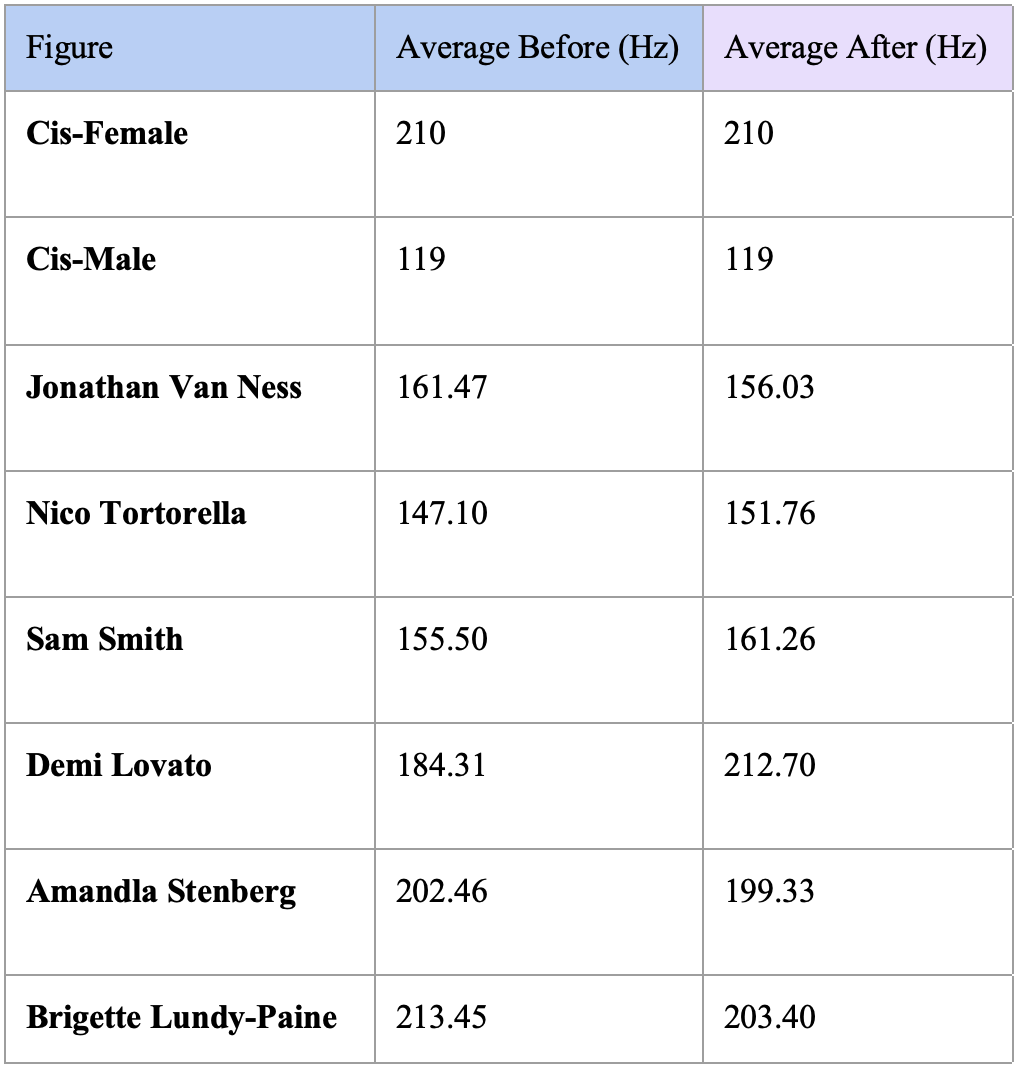
Figure 1: Average Vocal pitches (Hz) of celebrities before and after coming out.

Figure 2 depicts the same data as Figure 1 but in the form of a scatter plot so one can better visualize the change in pitch of each celebrity and see them compared against one another plus the cisgender controls. The horizontal or x-axis shows the name of the celebrities. The y-axis or the vertical axis shows the frequencies in Hertz.
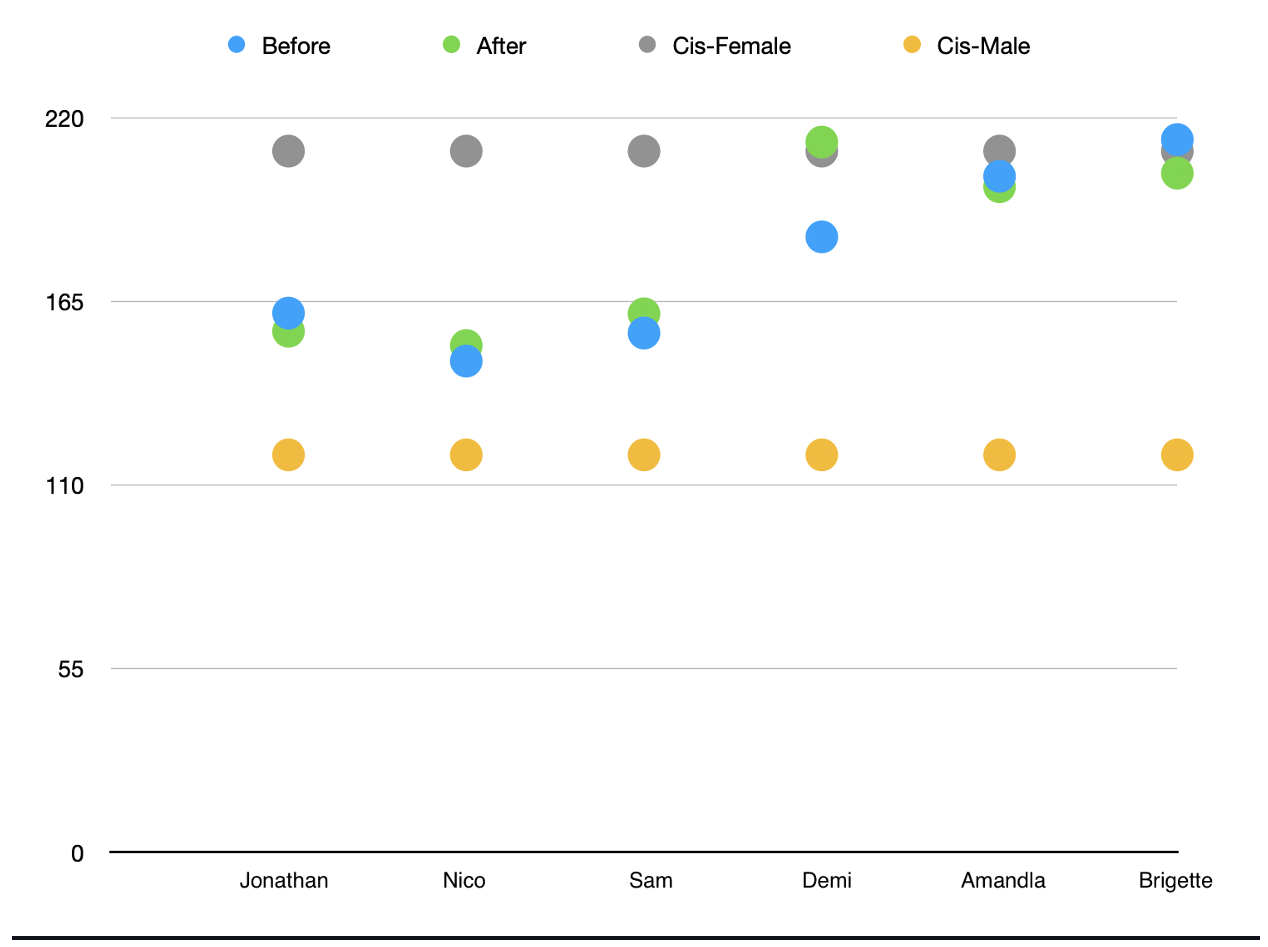
Figure 2: Scatter plot, vocal pitches of celebrities.

Although all the celebrities exhibited some degree of change in vocal pitch, the difference was insignificant across all six individuals (the dots for most of them are overlapping). To summarize, two out of the three assigned-male-at-birth celebrities had a (slightly) higher pitch after coming out, and two out of the three assigned-female-at-birth celebrities had a (slightly) lower pitch after coming out. Even though these findings support our original hypothesis. However, the difference for each person was only a matter of <10 Hertz. For reference, with each jump in octave, the Hertz doubles. Therefore, a difference of 5 Hertz is negligible and would be indistinguishable to the human ear. Because of this minute difference in the celebrities’ vocal pitch before versus after coming out, we would say our findings were ultimately inconclusive.

We can attribute this to many different confounding variables. First, non-binary is an umbrella term so all the individuals we analyzed could fall very differently on the broad spectrum of gender identity. Because non-binary people vary in how they express their gender (or lack thereof), this could account for why the celebrities did not exhibit much change in vocal pitch after coming out. Moreover, we only analyzed six celebrities and took a small sampling of their speech patterns which limits the scope of our conclusions. Therefore, due to the small data set and population, it would be unwise to make any generalizations about the community as a whole based on these six individuals alone. Although we opted to look at celebrities’ interviews in order to get their natural speech patterns rather than elicited ones, being in a formal interview setting could have altered their pitches alone. Even though we aimed to keep the subject matter of the interviews neutral, we could not account for the individual’s mood or emotions that particular day which also could have altered their pitch. The passage of time between each set of interviews could have also had an effect on their pitch—especially considering these celebrities are on the younger side (Gen-Z and millennials), their voices could have simply matured in the time between each interview. Lastly, it is also important to note that all of the celebrities we analyzed identify as queer. Therefore, their sexual orientations could have also been a contributing factor to any deviations from the cisgender averages.

Discussions and Conclusions:

Even though we could not fully confirm our hypothesis or make any concrete conclusions there are still some worthwhile takeaways from our findings. Most importantly, one cannot make assumptions about vocal pitch based on someone’s gender expression alone. Just because someone has a higher vocal pitch does not mean they need to present more feminine or align themselves with a female identity. The same goes for a lower pitch not necessitating a masculine identity. In summary, our findings matter as they support the idea that vocal pitch is not an accurate marker of gender identity. In addition, these results combat preconceived stereotypes about the connection between vocal pitch and gender identity.

Due to the limited scope of our research, some possible future directions we thought of include doing a long-term study following non-binary individuals on their coming out journey and closely documenting any changes in pitch. Another version of this study could entail analyzing a larger population or data pool such as college students and collecting data firsthand so the environment can be more controlled since there were external factors we could not control such as background noise and interference in the celebrity interviews.

By looking at the speech acoustic features of non-binary celebrities in their interviews before versus after coming out, we were able to see analyze how their vocal pitches diverged from cis-female and cis-male speakers. Notably, researching vocal pitch differences plays a role in understanding human interaction and expression. The voice serves as a mode of personal expression for one’s identity: “the voice is a form of communication in which people form relationships with one another, show vulnerability, and show geographical linguistic features” (Mills et al., 2017, pg. 13). With this in mind, creating a study analyzing the non-binary community helps create a better understanding of the LGBTQ+ community’s expression of identity through speech acoustic features.

Through our findings, we hope to provide greater insight into the non-binary community and serve as a starting point in seeing how gender norms also play an important role in pitch production rather than assuming biology is the sole reason. Overall, we believe our research still has a purpose in opening the floor to more linguistic research into the non-binary community which often gets overlooked or glossed over.

Further Reading and Watching:

 Vocal Branding: How Your Voice Shapes Your Communication Image — The voice is one of the most important factors for creating a social group, an image of oneself, and your perception of others. The different aspects of vocal pitch such as intensity, inflection, rate, frequency, and quality can say a lot about a person’s current emotional state such as being angry, sad, embarrassed, anxious, confident, happy, and so on. This is called a voice brand and helps describe a person’s personality or overall persona.

Queer Speech: Real or Not? – Languaged Life — In this blog post, you can read more about language as an identifier for sexuality. In this blog post, Dao et. al explore if there’s a difference between queer and straight women’s speech or if it is just a stereotype.

From Uptalk to Vocal Fry, Women Are Prolific Language Innovators — In this podcast, the hosts of Spectacular Vernacular engage with recent vocal trends for English speakers and how women are driving this change. Listen to find out more about the connection between communication, perception, and identity.

Watch Do I Sound Gay? | Prime Video — This 2014 documentary directed and starring David Thorpe explores the link between vocal quality and perceived sexual orientation. While entertaining, the film also explores the existence and accuracy of stereotypes about the speech patterns of homosexual men.


References:

Bucholtz, M., & Hall, K. (2005). Identity and interaction: A sociocultural linguistic approach. Discourse Studies 7: 585–614.

Butler, J. (1988). Performative acts and gender constitution: An essay in phenomenology and feminist theory. Feminist Theory Reader, 519–531. https://doi.org/10.4324/9781315680675-71

Erwan, P.  (2014). Male and female speech: a study of mean f0, f0 range, phonation type and speech rate in Parisian French and American English speakers. Speech Prosody 7, 305-309.

Gratton, C. (2016). “Resisting the Gender Binary: The Use of (ING) in the Construction of Non-binary Transgender Identities,” University of Pennsylvania Working Papers in Linguistics: 22(2) , Article 7.

Gratton, C. (2015). “Recreating gender”: The linguistic construction of Non-binary Gender Identities. Poster presented at the LSA Institute 2015: University of Chicago. Work in progress.

Mills, M., & Stoneham, G. (2017). The Voice Book for Trans and Non-Binary People: A Practical Guide to Creating and Sustaining Authentic Voice and Communication. https://books.google.com/books?id=N9rADQAAQBAJ

Schmid, M., & Bradley, E. (2019). Vocal pitch and intonation characteristics of those who are gender non-binary. 2019 International Congress of Phonetic Sciences. https://doi.org/10.13140/RG.2.2.17233.68961

[/expander_maker]

, , ,

Understanding Contrastive Conjunctions as Discourse Markers in Bilingual Discourse

Baltazar Sanchez III

In multilingual settings, speakers use several languages at the same time; this type of discourse is known as code-switching, where speakers may make switches at any point in their conversation between different codes, or languages. Many studies focus on the rules— or constraints, depending on the author’s approach— involved in this type of discourse while some describe the functions of such multilingual language use, in particular the pragmatic and/or conversational effects. The focus of this paper is insertional code-switching, which is a type of code-switching in which single words are inserted as opposed to entire phrases, as a type of discourse marker in conversations between bilingual individuals, in particular with the English word “but” and its Spanish equivalent pero. The inspiration for this comes from Gardner-Chloros, Charles & Cheshire’s (2000) discussion of code-switching in discourse as a further dimension to what may be classified as monolingual discourse marker. More specifically, this paper focuses on managing the conversational floor through contrastive conjunctions— English “but” and Spanish pero. After analyzing cases and data compiled from an online corpus, it becomes clear that contrastive conjunctions have multiple functions, which is a feature that is highlighted once these discourse markers are considered in the environment of code-switches in bilingual discourse. The findings contribute to the current understanding on discourse markers specifically and code-switching more generally, both of which intersect in establishing common ground between speakers.


You can read the entire paper HERE


Pattern Differences Between Voices Across Sina Weibo and Their Indications on Speakers’ Sociolinguistic Ideologies

Wenqian Guo

This study investigates how and why a specific speaker’s linguistic behavioral patterns may differ across channels on the same social media platform. Specifically, this research addresses important components in conversations, such as grammaticality and illocutionary indications, as well as the emoji feature that is exclusive to online media, the Chinese social media platform Sina Weibo in this case. Through comparing speakers’ comments between posts on the state-controlled People’s Daily Weibo channel and the “super-topic” free discussion forum on social, cultural, and political events, it is clear that the topics being addressed and the functions that different channels serve in each case, respectively, contribute to the speakers’ different perceptions of these channels. Additionally, from individual speakers’ responses in interviews during the study, the special censorship nature of social media in China and the exclusively superior accessibility of state-controlled media also complicate speakers’ linguistic choices, emphasizing their consideration of locating “safety” and practical usefulness on social media. As there remains limited previous research focusing on this specific area, this research hopes to offer new insights on exploring sociolinguistic ideologies embedded in Mandarin online communication.

[expander_maker id=”1″ more=”Read more” less=”Read less”]

Examples

1. Discussions of Social Events

Event: The China Tax Administration declares its serious attitudes towards the actress Zheng Shuang’s tax fraud and evasion event

Fig. 1 Screenshot of the Zheng Shuang Event Under the People’s Daily Channel
Fig. 2 Screenshot of the Zheng Shuang Event Under the Free Discussion Forum
  • Comments under People’s Daily: mostly well-formed sentences, with either full SVO structures or simplified VO structures with implicit subjects in place, regarding one’s attitude toward the unfair privilege associated with Zheng, along with active and academic-like usage of vocabularies that urge for the government’s investigation. Emojis are more used in illustrative, direct manners.
  • Comments under the free discussion forum: fragmented, short phrases popping up randomly; the presence of “four-letter words” associated with negative emotions; pure complaints about unfairness that the general public is subjected to when compared with privileged individuals like Zheng. Emojis are more used in metaphoric and illocutionary manners.

2. Discussions of Cultural Events

Event: Around this year’s Spring Festival, the capital city of the Tang Dynasty, Luoyang, reconstructed the palace city of Tang and held light festivals that also reflected on the glorious past days.

Fig. 3 Screenshot of the Luoyang light festival Under the People’s Daily Channel
Fig. 4 Screenshot of the Luoyang light festival Under the Free Discussion Forum

Informal expressions and phrases that lack complete sentence structures appear frequently. As for contents, while comments under both platforms contain recurrent praise for the beauty of the reconstructed ancient city, specifically, among comments under the People’s Daily, there are some noticeable distinctions. For example, there are comments that urge the national government to propagate the replication of such efforts in other cities, as well as comments of local people of Luoyang that take the commenting channel as a place to advertise their cities to potential visitors who come from other cities. This clearly marks the distinctive characteristic that only the state-controlled People’s Daily channel could be entitled to, as being the representation of the government’s voices, the public may consider it as a direct and effective channel to communicate with the government, as well as its easy accessibility and widely accepted popularity makes it appropriate for propagation. On the other hand, the free discussion forum could not similarly reach the government, as well as it may not be entitled to that high level of popularity and accessibility, given that many people would not visit the forum if not necessary or not interested.

[/expander_maker]
 

,

Where are you from? I don’t know but did you ask the question in English? ¿o en Español?

Sarah Arjona, Yeeun Heo, Erika Yagi, Minyoung Yoon, Bryan Zhao

Have you ever imagined growing up next to the pyramids or the Eiffel tower? Some Third Culture Kids (TCKs) do so without being Egyptian or French, because they live abroad with their parents. Although extensive research has been done on code-switching, not a lot of this research has focused on code-switching in TCKs. This study explores the code-switching of Spanish English multilingual TCKs in formal and informal settings. To test our hypothesis that TCKs code-switch more often in informal settings among their peers, we conducted one-on-one interviews and a group activity with three tween and teen Spanish English multilingual TCKs over Zoom. We analyzed the frequency of their code-switching as well as the length of their code-switching. Our findings suggest that TCKs do code switch more often in the informal setting but it may not only be influenced by setting type but also by age and attitude.

[expander_maker id=”1″ more=”Read more” less=”Read less”]

Introduction and Background

If your parents are from Spain, but you grew up everywhere else like Zimbabwe and Vietnam, you would be considered a Third Culture Kid (TCK). TCKs are those regarded as growing up outside of their parents’ home countries as in the example above, and they are often known to be multilingual due to their diverse backgrounds (Barker & Moore, 2012; Bonebright, 2010; Pollock et al., 2017). There are currently over 230 million expatriates in this world, and many are accompanied by their children who would be considered TCKs (United Nations, 2019). TCKs can impart other important skills, such as adapting effortlessly to environmental changes, relating easily to other cultures, having strong communication skills, and being open-minded.


Although many of the TCK studies are conducted around English speakers, this research looks at Spanish speaking families, as Spanish is the language with second most native speakers in the world, surpassing English (Ahearn, 2021). However, while there are over 8000 English speaking international schools around the world, Spanish based schools outside of Spanish-speaking countries are not as accessible (Sharma, 2016). So how would they go about using their language skills, especially code-switching?

Code-switching is defined as interchanging among different languages in a speech (Ahearn 2021), or using one’s mental lexicon to a fuller extent. Code-switching occurs in both formal and informal settings (Jacobson 2002). Informal settings can be with friends, family and peers, and formal settings with strangers in structured settings (Jacobson 2002). Code-switching is often motivated by social factors such as the topic or the speaker’s attitude toward the topic, identity creation and solidarity (Myers Scotton, 1993; Van Herk, 2017).

Since TCKs are extremely adaptable, they may show some code-switching in both settings. Our hypothesis is that they are more likely to code-switch in an informal setting and more frequently so when surrounded by peers who share one or more languages.

Methods

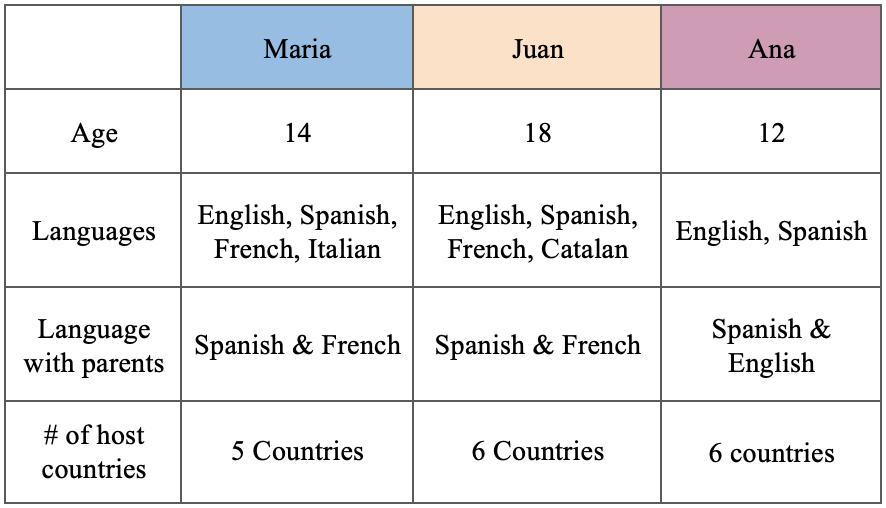
Three TCKs, Maria, Juan, and Ana were recruited for this research. All three of them are multinational, but have at least one Spanish parent whom they speak Spanish with. Maria and Juan also speak French at home, whereas Ana speaks only English and Spanish. All three have attended English-speaking schools and are thus multilingual in at least English and Spanish. They are all TCKs as they have lived abroad for the most part of their lives, including in countries such as Ethiopia, Haiti, and Sierra Leone.

Figure 1: Information about participants

These three TCKs participated in two meetings, one formal and one informal setting. We used Jacobson’s definition of these settings, where the formal setting is defined to be with strangers in a structured, official environment, and the informal setting with friends and family (2002).

Formal Activity: One-on-one zoom interview (15 minutes)

TCKs were interviewed about themselves by a Spanish and English-speaking interviewer in both languages. The language in which the questions were posed alternated between English and Spanish and the TCKs were encouraged to answer in both languages. The purpose of this interview was to induce the TCKs to use proper nouns and speak of familiar experiences, providing them a situation to code-switch.

Informal Activity: Group Game Night (30minutes)

All three TCKs participated in a game night together, hosted by the same interviewer from the prior meeting. The game consisted of building two stories; one in English and one in Spanish as the matrix language. The task was to continue a single storyline by taking turns to say a part for 15 minutes in English and 15 minutes in Spanish. Students were given no further instruction about whether they could code-switch or not. This task allowed the participants to feel comfortable and enjoy the meeting, which we hypothesized initially would lead to more frequent use of code-switching.

Results/Analysis

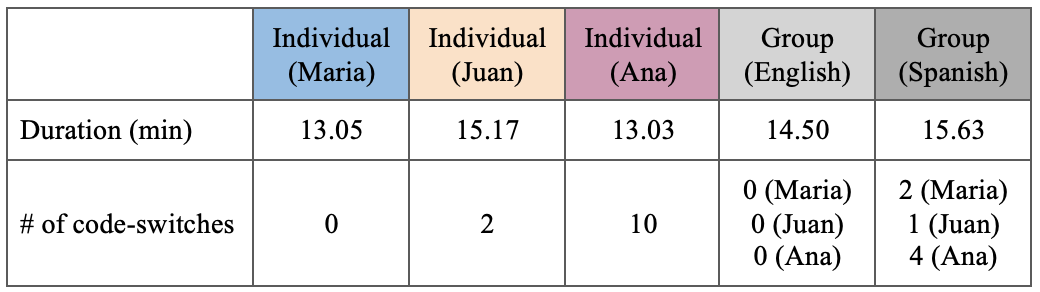
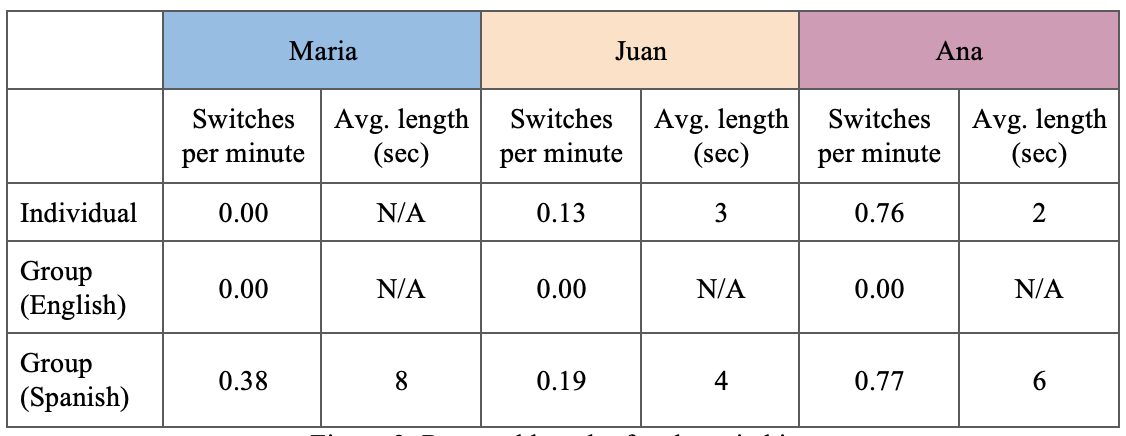
To capture our results, we counted the number of code-switches in each interview and took note of the duration of each segment. This data is recorded in Figure 2 below. We also cataloged each instance of code-switching by noting its timestamp, duration, and verbal content.

Figure 2: Interview duration and code-switch count

We first analyzed our data by calculating the rate of code-switching per minute for each participant in each setting by dividing the number of code-switches by the length of time the participant spoke in the segment. Note that in the group interviews, each participant spoke for approximately the same amount of time. We also calculated the average length of each code switch, with the same segmentation. Figure 3 displays these findings below.

Figure 3: Rate and length of code-switching

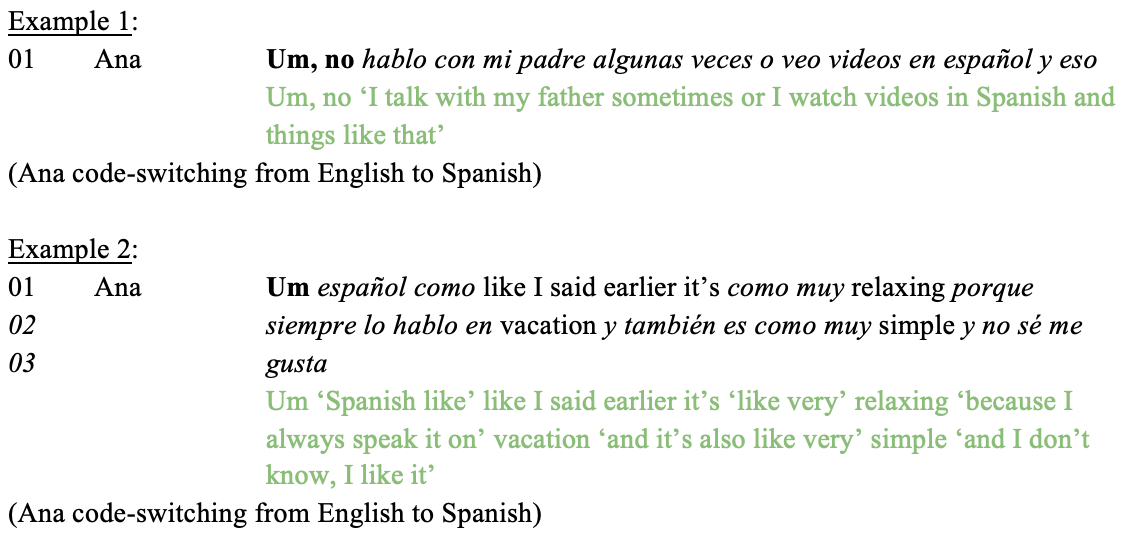
During the individual interviews, Ana code-switched the most frequently out of the three participants, at a rate of 0.76 times per minute and an average length of 2 seconds per code-switch. Ana’s number of code-switches from English to Spanish and Spanish to English were about the same. However, her English to Spanish code-switchings consisted of almost exclusively filler words and discourse markers. For example, Ana would often say “Um..” in an English accent before continuing to answer her question that was asked in Spanish as in the examples below during her individual interview recording.

Moreover, she used English starter words such as “Probably…” and “Like…” before answering in Spanish. On the other hand, her Spanish to English code-switching included more meaningful utterances and lasted for a longer period each time. The Spanish to English code-switchings include words and even whole phrases to enhance her answer. Juan had two instances of code-switching during his individual interview, which were also filler words. Lastly, our third participant, Maria, did not code-switch at all during her individual interview.

None of the participants code-switched during the English group activity. The direct correlation for having more code-switching during the Spanish activity isn’t clear, but there are a few factors that can be discussed. The strongest factor might be that students are more comfortable with English in general. They also confirmed that English is their strongest language during the interview. Another may be because the interviewer herself did little to no code-switching throughout the whole study, at least not at a word level. Finally, the interviewer’s Spanish variety is different from the interviewees (which will be further elaborated under limitation), which may have an impact on the participants’ use of Spanish.

However, for each participant, both the rate of code-switching and the average length of a code-switch were greatest during the Spanish group interview. Ana, who code-switched the most compared to her peers during her individual interview, did so even slightly more often during the Spanish group interview at a rate of 0.77 times per minute. The length of her code-switching was also significantly longer during the latter interview, at 6 seconds on average compared to 2 in the former. Juan, who code-switched a few times during his individual interview, also raised his rate of switching during the Spanish group interview to 0.19 switches per minute, and the average length to 4 seconds per switch. Finally, even Maria, who demonstrated no code-switching during the other interviews, did have a number of switches during the Spanish group interview, at a rate of 0.38 times per minute. Interestingly, Maria also displayed the highest average length of a code-switch, at 8 seconds per switch.

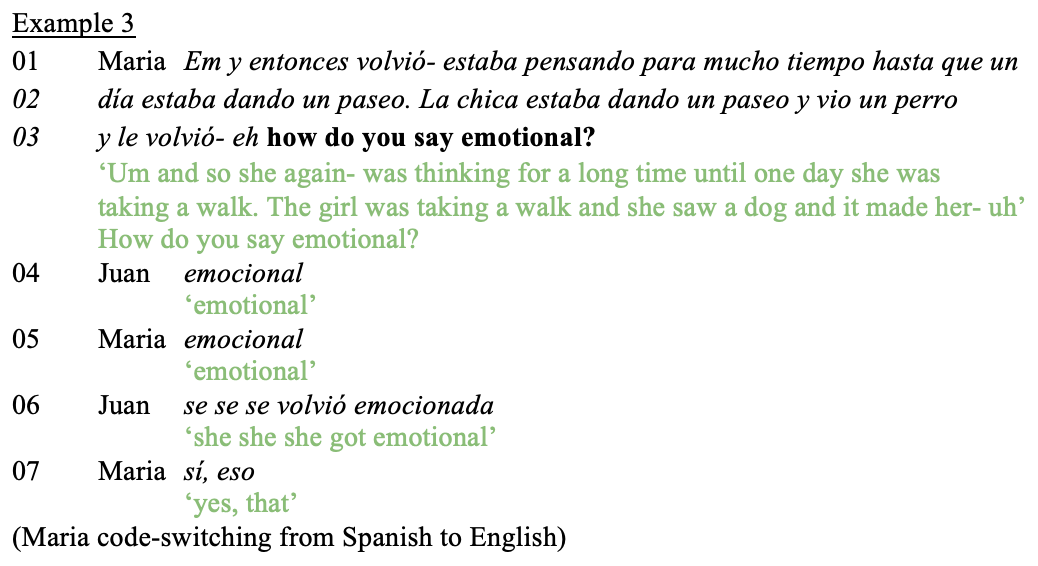
Our hypothesis suggests that the individual interviews invoked less code-switching because they were more formal and were also the first time for the participants and the interviewer to meet and have a real conversation. The individual interviews consisted entirely of questions and answers, which limited free interactions with the interviewer and the interviewees. On the other hand, the group activity was more in the format of a fun conversation where participants spoke relatively freely and even interrupted each other to add and comment on things. Some of the reasons why they may not have code-switched as often during the individual interviews could be explained by other factors as well. Age may have played a role because our youngest participant, Ana, was the one to code-switch most often in both the formal and the informal meetings. Moreover, Juan, the oldest of the participants, acted as a facilitator throughout the group meeting to correct the other participant’s Spanish utterances. There was an instance where Maria struggled to find the Spanish word for ‘emotional’ and Juan stepped in to help and encourage Maria to say the corrected phrase.

Another instance was when Ana said “el cure” – using the masculine form for ‘the’ and then the English word “cure” – and Juan corrects her by saying “la cura” with the correct feminine form of “the,” correcting both her improper form of the article and her use of the English “cure.” Participant’s intentions and plans may also have affected the frequency of code-switching, as in the Ted Talk with Vera Regan (2014). Juan, who code-switched the least out of all three participants, plans to go to Spain in the future for college. His plans on moving to Spain may have had an impact on his view of the Spanish language, leading him to have a more practical take on the concept of language.

Discussion and Conclusions

By looking at TCKs in formal and informal settings, we observe their code-switching patterns, which is significant because it contributes to our understanding of TCKs as extremely adaptable and open-minded. The data supports our hypothesis that TCKs code-switch more in informal settings among their peers because participants code-switched more often in the group activity than in the one-on-one interviews. Additionally, there were correlations with age in that the oldest participants, Juan and Maria, code-switched the least and more at the phrase and sentence levels. The youngest participant Ana, on the other hand, code-switched the most and more at the word level. We also saw a correlation between less code-switching and attitude in the oldest participant, Juan, as he tended to code-switch the least. Juan made efforts to speak only either Spanish or English at a time and he guided the other two participants by providing the appropriate Spanish word when the other participants code-switched to English from Spanish at the word level. These behaviors may be attributed to Juan’s assumption of a facilitator role during the group activity, his practical view on language, and his future plan to live in Spain.

Future Directions

In order to further explore age as a significant factor in code-switching, the study can be replicated with different age groups. The focus would be on whether there are patterns between older participants and less code-switching as well as on the level of code-switching. Another direction the study can take is to compare code-switching across groups with different attitudes. For example, we could compare code-switching between a group of participants that have future plans to live in a Spanish-speaking country and a group that doesn’t have such plans. Lastly, the study can be expanded to compare across different varieties of Spanish, matching participants with interviewers that speak their variety of Spanish. This study focuses on speakers of a variety of Spanish from Spain. Future studies may expand into different varieties of Latin American Spanish as well as varieties of U.S. Spanish and more.

Limitations

 It is worth mentioning that although the interviewers and participants both spoke English and Spanish, they spoke different varieties of Spanish. While the participants spoke Spain Spanish, the interviewer spoke Los Angeles/Southern California Spanish heavily influenced by Mexican Spanish and Guatemalan Spanish varieties.

Additionally, most of the questions asked during the one-on-one interviews were yes/no questions. Another thing to consider is that the interviewer did not code-switch. All these factors may have affected the creation of a setting that allowed for a more spontaneous elicitation of code-switching.


References

Ahearn, Laura. 2021. Living Language: An Introduction to Linguistic Anthropology. Hoboken, NJ: John Wiley & Sons.

Barker, G. G., & Moore, A. M. (2012). Confused or multicultural: Third culture individuals’ cultural identity. International Journal of Intercultural Relations, 36(4), 553–562. https://doi.org/10.1016/j.ijintrel.2011.11.002

Bonebright, D. A. (2010). Adult third culture kids: HRD challenges and opportunities. Human Resource Development International, 13(3), 351–359. https://doi.org/10.1080/13678861003746822

Herk, V. G. (2018). What is Sociolinguistics? (2nd ed.). John Wiley & Sons, Inc.

Jacobson, R. (2002). Broadening Language Use Options in Formal Discourse: The Malaysian Experience. Retrieved July, 13, 2014.

Jess. (2018, February 6). Employee benefits & third culture kids: What do global citizens want most from employers? Pacific Prime’s Blog. https://www.pacificprime.com/blog/third-culture-kids.html

Myers-Scotton, C. (1993). Common and uncommon ground: Social and structural factors in codeswitching. Language in society, 475-503.

Pollock, D. C., Van Reken, R. E., & Pollock, M. V. (2017). Third Culture Kids: Growing up among worlds (3rd ed.). Boston, MA: Nicholas Brealey Publishing.

Regan, V. (2014, November 21). What your speaking style, like, says about you. Tedx Talks. https://www.youtube.com/watch?v=jAGgKE82034&t=593s&ab_channel=TEDxTalks.

Sharma, Y. (2016, February 24). Asia drives demand for international schools. BBC News. https://www.bbc.com/news/business-35533953

United Nations. (2019). International Migrant Stock 2019. United Nations Population Division | Department of Economic and Social Affairs. https://www.un.org/en/development/desa/population/migration/data/estimates2/estimates19.asp

[/expander_maker]
, , ,

“Pussy!”: Gendered Insults While Video Gaming

Nisha Porchezhiyan

The present article is a research study about the use of gendered insults while playing Super Smash Bros and Mario Kart. This study consisted of three players, one female and two male playing both of the games and analyzing their conversations to see which gender used “pussy” as an insult more often and what types of triggers each gender had for the word. This paper argues that men use the word “pussy” as an insult more than women while playing video games, typically as either retaliation for when their character gets hit in the game or as a generic insult that is not caused by any action in the game. On the contrary, women typically use “pussy” as an insult only when another player calls them that insult. The results of the study support the thesis and the results align with the conclusions of previous researchers. The data collected implies that the high male frequency of “pussy” might reinforce gender stereotypes where women are seen as weaker than men, because they use female genitalia as an insult for being weaker.

[expander_maker id=”1″ more=”Read more” less=”Read less”]

Video Gaming and Swearing

Video gaming is a culture that uses excessive swearing among the players, acting as a means of communication where the use of gendered insults is common. Gendered insults are derogatory words about females or female genitalia, such as “pussy,” “whore,” “sissy,” etc. This study will focus on the use of the word “pussy” while playing the video games Super Smash Bros and Mario Kart. Super Smash Bros is a fighting game where players’ characters battle on a stage, known as the map. Mario Kart is a racing game where players’ characters race each other around the map, or the racetrack. I used a sample of Arizona State college students and transcribed their conversations while playing these games; this type of research will help me explore the distribution of the word “pussy” based on the gender identities of the speakers and the different triggers each gender has when they use “pussy” as an insult. While both genders use “pussy” as an insult, men use it more often than women while playing the Mario Kart and Super Smash Bros and with different triggers for the word: women use it only when they get called a “pussy” by another player, while men use it when their character gets hit/falls off the map, or as a general insult without anything happening in the game.


What research was done before?

Beginning with gendered insults, feminist social constructionist theory argues that using gendered insults and sexual language about females shows male sexual power over women because of the objectification of women (Murnen, 2006). The author argues that men use gendered insults more than women, while women use them less often. What Murnen argued was similar to the results I found in my research with college student gamers, a group that reinforces social stereotypes with the high frequency of swear words, known as “flaming” other players. “Flaming” is insulting a friend as a joke or a tease, with no ill intent behind the insult. This is why most insults said during video games are not meant to be personal insults, but just friendly commentary among friends (Elliot, 2013). The insults used during video games act as a means of communication among the players; video game players use excessive swearing which reinforces stereotypes because players often do not think before speaking while playing video games (Finnegan, 2019).

Specifically, on gendered insults while video gaming, the use of excessive swearing can contribute to gender norm regulation, leading to the frequent use of gendered insults in regular societal discourse (Felmlee, 2019). While this is a broad statement and the findings of this research cannot be extrapolated that extremely, my research does build on the basis of Felmlee’s work.

How was this study designed?

This research project focused on the use of the word “pussy” while playing Mario Kart and Super Smash Bros on the Nintendo Switch. Because I only had three controllers, the sample size was three people: one African American/Portuguese male, one white female, and one white male. The participants knew their conversations during the game would be recorded, but they did not know what I was specifically looking for. For the Mario Kart video game, the participants played Bell Cup, which all three of them decided to be the hardest cup (set of four races). This was chosen because harder games would aggravate the players more, leading to a higher frequency of gendered insults used. For the Super Smash Bros video game, the participants played three rounds (one battle) and the participants were given the flexibility of choosing their own character. All of the games the participants played were recorded from which I pulled excerpts and transcribed to be used as data.

What were the results?

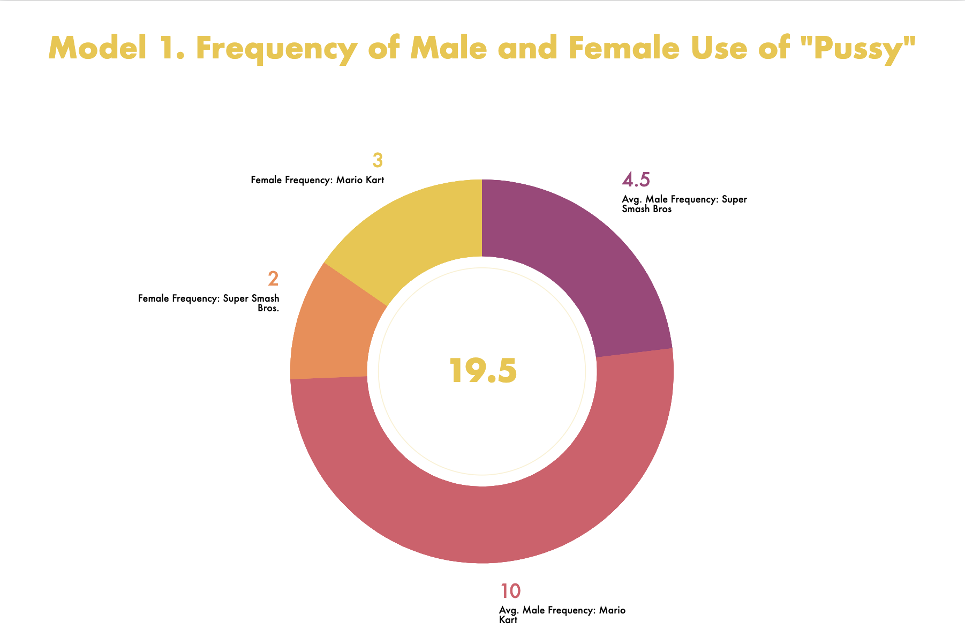
By tallying the frequency of the word “pussy” as an insult, I was able to create a pie chart to visualize the frequency of the male use of “pussy” and the female use. Because there were two males and one female in my study, I averaged the male frequency. As seen in Model 1, the total average male frequency was 14.5 uses of “pussy” and the total female frequency was 5 uses of “pussy.”

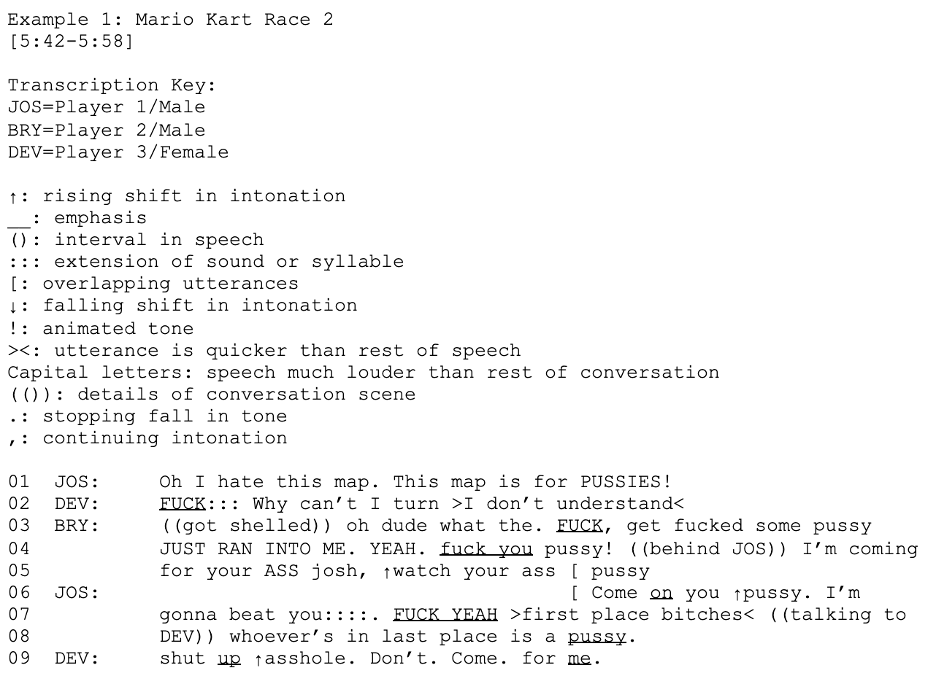
Example 1 is an excerpt from the second race in Mario Kart where “pussy” was used six times. In lines 4,5 BRY (male) gets hit by JOS (male) and calls him a “pussy,” but the other four occurrences of the word were used even though no action occurred in the game (lines 1,3,6,8). This data supports the thesis that for males there are two triggers of “pussy,” either when a character gets hit or when nothing happens in the game. In line 8, JOS calls DEV (female) a “pussy” but she responds by calling him an “asshole” instead.

What do the results mean?

Looking at the pie chart from Model 1, male players used “pussy” at a higher frequency than the female player, supporting my thesis than men are more likely to use the word “pussy” as an insult compared to women. This supports the findings of Murnen’s research and might imply that male use of the word “pussy” is higher because of their positioning in society with more power due to gender stereotypes (Murnen, 2006).

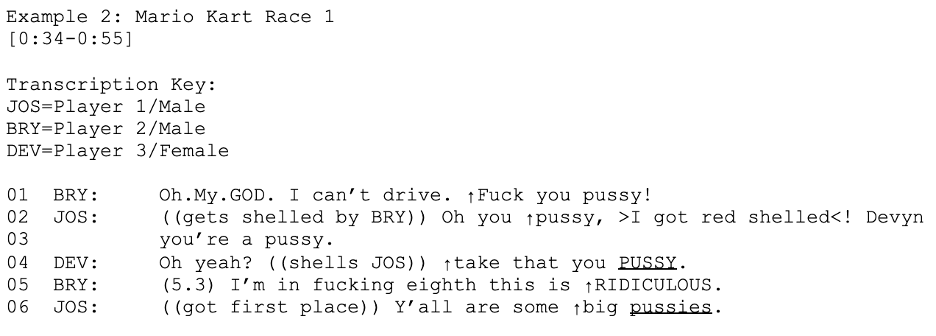
The transcripts from Examples 1 and 2 support my thesis that male use of the word “pussy” has two different triggers, either when their character gets hit or without any action occurring in the game. Moreover, as seen in Example 2, the female player (DEV) only used the word “pussy” after another player called her a “pussy,” but throughout the entire set of games, she never used the word first. This could be because she did not want to use gendered insults due to their sexist nature but might have wanted to fit in with the group which consisted mostly of men. This is supported by Example 1 where DEV opted to use the gender-neutral insult “asshole” instead of “pussy” which might imply that women are inclined to swearing, but do not want to reinforce gender norms and the objectification of females and female genitalia. This contradicts the findings of Ashwell’s research who argues that gendered insults are so problematic because they lack a gender-neutral alternative (Ashwell, 2016).

Ultimately, the research supported my thesis that men use “pussy” as an insult while video gaming at a higher frequency than women, and how women only use “pussy” after they are called the insult.

Some limitations of this study is that the sample size used was very small and cannot be generalizable for the entire population of college-level video gamers. Moreover, there were more males than females in the study, but ideally there should have been an equal amount. The study should also have focused on other types of gendered insults to be able to provide a conclusion on gendered insults as a whole.

Based on these results, for future research, I recommend looking into socio-political beliefs of the participants and whether there is a correlation between their political views and their use of gendered insults.


References

Ashwell, L. (2016). Gendered Slurs. Social Theory and Practice, 42(2), 228-239. Retrieved February 8, 2021, from http://www.jstor.org/stable/24871341

Elliot, T. P. (2012). Flaming and gaming – computer-mediated-communication and toxic disinhibition. University of Twente (student thesis).

Felmlee, D., Inara Rodis, P., & Zhang, A. (2019). Sexist Slurs: Reinforcing Feminine Stereotypes Online. Sex Roles. doi:https://doi.org/10.1007/s11199-019-01095-z

Finnegan, J. (2019). Bad language and Bro-up Cooperation in Co-sit gaming. Approaches to Videogame Discourse Lexis, Interaction, Textuality.

Francesca, Thaliakr, Rachel, Robert, Youredoingamazing, Jc, Rose, K. (2018, April 12). Everyday misogyny: 122 subtly sexist words about women (and what to do about them). Retrieved March 18, 2021, from http://sacraparental.com/2016/05/14/everyday-misogyny-122-subtly-sexist-words-women/

Murnen, S. K. (2006). Gender and the use of sexually degrading language. Psychology of Women Quarterly. doi:https://doi.org/10.1111/j.1471-6402.2000.tb00214.x

[/expander_maker]
, , ,

Reading is Fundamental: The Role of Ritual Insults in Ru Paul’s Drag Race

Olivia Heiner

Insults are sometimes regarded as negative or impolite; however, they can also be a playful ritual among various communities.  Consider, for example, the exaggerated “Yo Mama” jokes told between young school children.  Such insults are entertaining, performative, and unlikely to cause much harm.

This article explores the practice of mock ritual insults in the drag queen community, where such insults are referred to as “reads”.  In particular, this study looks at conversations from episodes of Ru Paul’s Drag Race—a reality television show where drag queens compete against each other—in order to analyze the content and linguistic aspects of reads.  Like other communities who practice ritual insults, queens display wit and humor in their reads.  Unlike insults in other male communities, however, reads use drag language and focus on content that is particularly relevant to the gendered performance of drag; this includes high pitched voice, feminine pronouns and addresses, as well as insults focused on fashion, makeup, and physical characteristics.  Despite the fact that reads usually involve insults against real traits in the addressee, surrounding queens and addressees usually respond to reads in a positive manner. This demonstrates how reading is a playful practice that not only entertains queens, but also helps them build a “thicker skin” against the real, non-playful criticism that they experience as a marginalized group.

[expander_maker id=”1″ more=”Read more” less=”Read less”]

Background on Ritual Insults in the Drag Community

The drag queen community is comprised of people (mostly gay men or other members of the LGBTQ+ community) who portray an exaggerated feminine gender performance, usually on a stage.  Ritual insults are common in the drag community, so much so that they have their own name: reading.  An explanation of reading is given by Dorian Corey in a documentary film about the 1980’s drag scene, Paris is Burning (1990).  Corey describes reading as “the real art form of insult”, which often involves finding a flaw in someone and exaggerating it in a way that makes people laugh. 

The witty and clever nature of reads in the drag community is similar to ritual insult practices in other communities, such as games of “the dozens” in black communities or “Yo Mama” jokes told amongst school children (Abrahams, 1962; Eckert & McConnel-Ginnet, 2013).  The differences, however, are what give us insights into the distinctive characteristics of drag culture.  One difference is the truthful nature of reads in drag, which contrasts ritual insults in other communities that are usually not grounded in facts.  The truthfulness of reads is important, because it functions as a way to build thicker skin against non-playful verbal attacks from the straight community (McKinnon, 2017).  In terms of linguistic delivery, drag queen language often involves a blend of African American language, female language, gay men’s English, and Southern U.S. English (Bruun 2018).  This distinguishes reads from insults in other male communities, which typically involve hetero-masculine language and content.  This article provides a discussion of how these distinctive elements of drag insults are used in Ru Paul’s Drag Race.

Methods

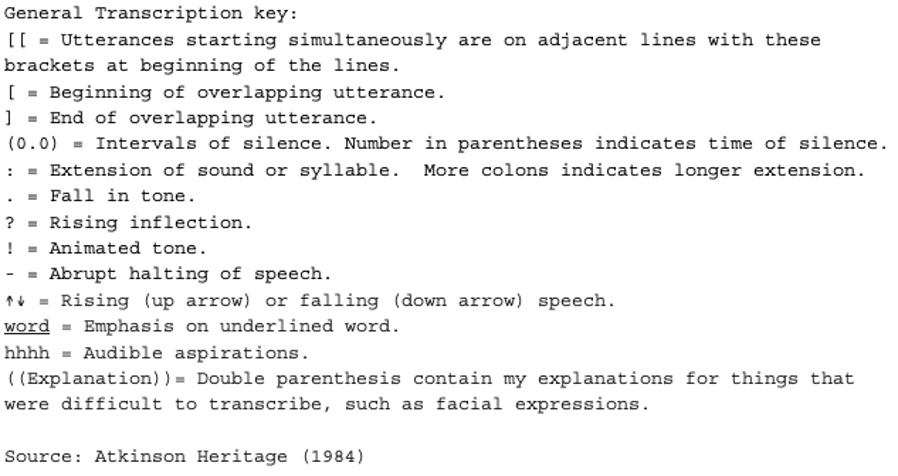
While studying reads in Ru Paul’s Drag Race, I gathered data from various settings in the show, such as challenges, runway events, and conversations in the work room.  The biggest source of reads in the show was in the Reading Challenge, where each queen is given the floor (one at a time) to read the other queens.  The queen with the “best” reads wins the challenge (usually the queen whose reads receives the most laughter).  While watching the reading challenge, I took note of the subject of each read, such as fashion or physical traits, and any relevant linguistic content, such as wordplay and gendered pronouns.  I also categorized each read as unsuccessful or successful, where a successful read was one that elicited a positive response, such as audible laughter, from a majority of the present queens;  unsuccessful reads were those that are met with negative or quiet responses. The transcript notation used for data collection is given at the end of the article.

Results and Analysis

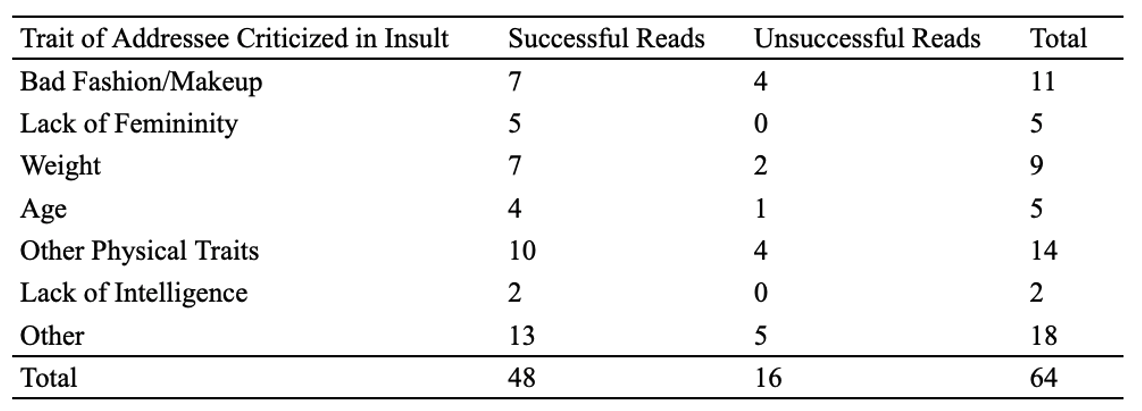
The content of reads varied, but they mostly revolved around performative aspects of femininity.  Table 1 tallies the number of reads in various categories, as well as the number of successful/unsuccessful reads in each category.

Table 1: Number of Successful and Unsuccessful Reads by Category of Insult. “Other Physical Traits” refers to physical traits not included in the first four listed categories. The last category labelled “Other” refers to insults that were either uninterpretable or that required contextual knowledge the author was unaware of.

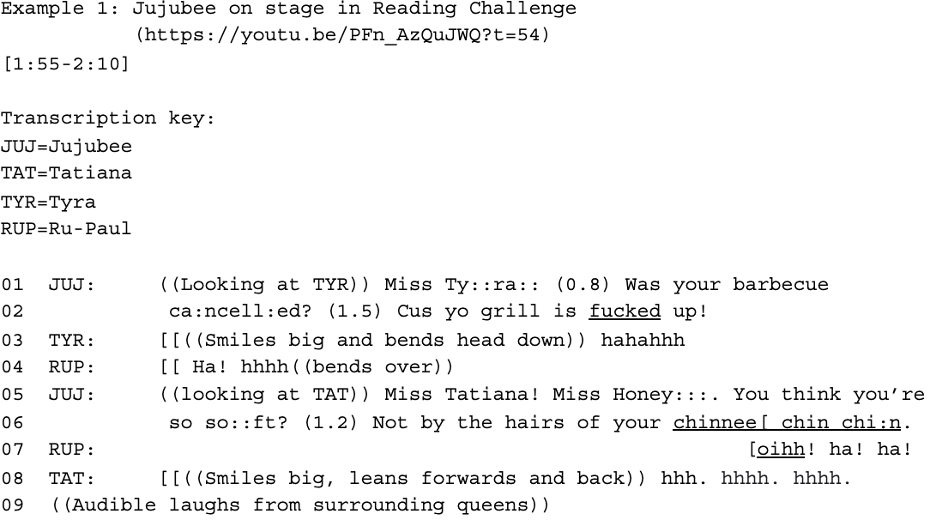
A representative example of a successful reading is Jujubee’s reads of Tyra and Tatiana in one of the Reading Challenges:

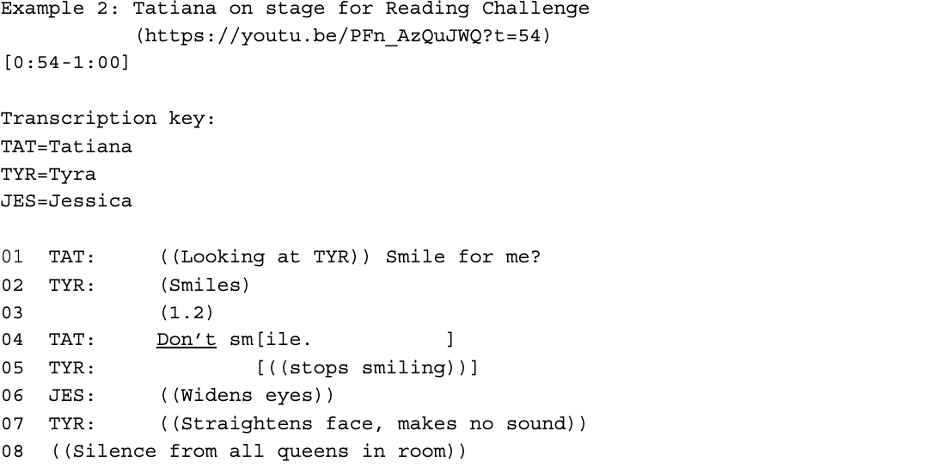
The laughs and smiles from the other queens in response to Jujubee’s reads indicate how successful her reads were.  They involved cleverness, feminine addresses (Miss Honey), and attacked physical traits and lack of femininity in the addressees.  The topic of reads, however, isn’t always enough to make a successful read.  Consider Tatiana’s read of Tyra’s teeth:

In this example, the topic of Tatiana’s read is the same as Jujubee’s read of Tyra; they both criticize Tyra’s teeth.  However, Tatiana’s read fell flat and was categorized as unsuccessful.  Why was it unsuccessful? While Jujubee’s read was performative, exaggerated, and clever, Tatiana’s read was short, involved no wordplay, and lacked the “drag language” that was present in Jujubee’s insults.  Thus, the linguistic delivery of reads is just as important as the subject of reads in determining a read’s success.

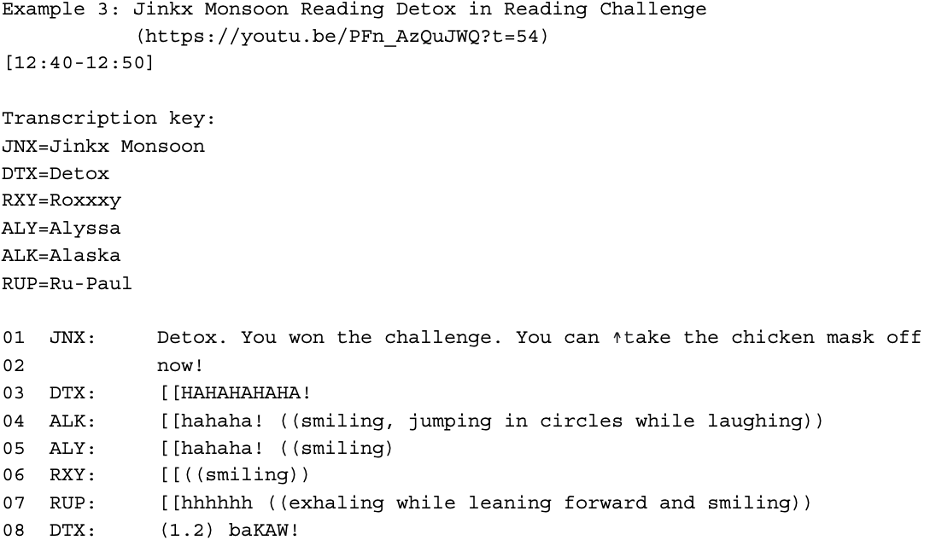
While Tatiana and Jujubee’s examples show the two extremes of unsuccessful and successful reads, it should be noted that a majority of reads were successful.  Most successful reads involved laughter not just from surrounding queens, but also from the queen being insulted.  This held true even when reads contained personal insults that the most people might be self-conscious of, such as being overweight or having unattractive facial features.  One example of this is Detox’s response when being read by Jinkx Monsoon:

In this example, Jinkx was insulting Detox’s real face, comparing it to a chicken.  Instead of showing offense from Jinkx’s comment, however, Detox laughed loudly with the other queens and even joined in on the joke by responding with a chicken sound (line 08).  This highlights the playful nature of reading, even when it involves personal insults directed at real traits in the addressee.

Discussion and Conclusion

From this collected data, it is clear that ritual mock insults have a distinctive form in the drag community.  The reliance on humor and wit is similar to other communities who practice ritual insults; the other linguistic aspects and topics of reads, however, reflect ways in which the drag community is unique from other primarily male communities.  What counts as a valid insult in any community reveals what is relevant to that community, and the reads in this article showed how portraying stereotypically feminine traits and minimizing masculine presentation is important to drag queens.  Reads revealed femininity through the subjects they focused on (fashion, makeup, physical traits) and through an exaggerated use of feminine language (high pitch voice, feminine pronouns).  In terms of how reads are perceived, most received positive responses from surrounding queens and from the addressee being insulted, even when they focused on actual flaws in the addressee.  Reads are a playful part of drag, and being able to both successfully deliver and gracefully accept insults in the form of reading is vital to thriving as a drag queen.


Further Reading and Watching

If you are interested in learning about or watching ritual insults in other communities and in drag, the following resources are useful:

Dozens is Oral Legacy Rooted in Survival

Drag Race Reading Challenge Compilation

Dorian Corey Explains Reading in Paris is Burning

Ru Paul’s Drag Race: Guide to Giving Shade


Transcript Notation


References

Abrahams, R. (1962). Playing the dozens. ​The Journal of American Folklore,​ ​75(​ 297), 209-220. doi:10.2307/537723.

Atkinson, & Heritage. (1984). Transcription  Notation.

Bruun, M. (2018). “As We’ve Seen in This Season, Anything Can Happen, So Don’t Fuck It Up” – Impoliteness in Rupaul’s Drag Race Season 9. ​University of Eastern Finland Philosophical Faculty, School of Humanities, Foreign Languages and Translation Studies.​

Drag Race: All Stars. Season 2​ [Television series]. (2016). LOGO.

Eckert, P., & McConnell-Ginet, S. (2003). ​Language and gender​. Cambridge: Cambridge University Press.

Every Reading Challenge (Compilation Part 1) The Library is Open RuPaul’s Drag Race.​ (2018, December 15). [Video]. YouTube. https://www.youtube.com/watch?v=PFn_AzQuJWQ

Labov, William. (2009). Rules for ritual insults. doi:10.1007/978-1-349-92299-4_42.

Livingston, J. (1990). Paris Is Burning. Off White Productions Inc.

McKinnon, S. (2017). Building a thick skin for each other. Journal of Language and Sexuality 6:1, 90–127. doi:10.1075/jls.6.1.04mck.

Simmons, N. (2014). Speaking Like a Queen in RuPaul’s Drag Race: Towards a Speech Code of American Drag Queens. Sexuality & Culture, 18(3), 630–648. https://doi.org/10.1007/s12119-013-9213-2

Taylor, V., & Rupp, L. (2004). Chicks with Dicks, Men in Dresses. Journal of Homosexuality, 46:3-4, 113-133. doi: 10.1300/J082v46n03_07


[/expander_maker]
, , ,

¡Échale ganas, mija!: How Latina Immigrant Mothers Use Word Choice to Assert Their Expectations

Catherine Guzman, Joan Kim, Kiara Mares, Yadira Marquez, Flor Ramirez

College enrollment and graduation rate from Latinos has increased during the last decade. Latinas[1] went from being 17% of graduates in 2000 to 30% in 2017. Latina mothers have played an important role in the success of Latinas by either providing motivation or pressuring them. Latina daughters may also face more pressure to understand the role that family dynamics and cultural roles play in their education and professional life, and it is our goal to show what factors influence the expectations of immigrant Latina mothers as well as how they communicate this to their children. We analyze word choice such as pauses and filler words, positive and negative word connotation, achievement remarks and associations, and levels of details to understand what factors influence what is expected of Latina daughters. Through the analysis of interviews of two Latina mothers with their older and younger daughters, we expect to find a positive correlation between the different levels of educational expectations based on birth order and expect the older daughter to have more responsibility and expectations of success.

Figure 1: Educated Latina Art Print from oayon1313

[1] Latina: a woman or girl of Latin American origin or descent

[expander_maker id=”1″ more=”Read more” less=”Read less”]

In its everyday use, language is constantly changing. It adapts to best fit the current needs of a society and reflect what is culturally relevant. When analyzed correctly, language is a record of a culture – relating norms, cultural roles, dynamics, etc.

Take a look at the following quote:

“The father, what he wanted was that his daughter leave the house dressed in white and that was his goal” (Perez, excerpt 8).

Without further context, this excerpt allows for some insight as to what gender roles and familial expectations characterized this speaker’s community. Here, there is an emphasis on community and culture, because the speaker’s expectations have been determined by the interactions within their own community, which in turn, is reflected in their use of language.

This is not a new take on language and can be tied back to symbolic interactionism. This theory posits that meaning is constructed through everyday interactions and conversations (“Symbolic Interactionism Theory”, 2014). In other words, much of what we come to value, identify with, expect, draw meaning from, etc., was learned through our interactions with others within our community.

This is the framework that formed the basis of the present study. With a focus on word choice, our interest was with Latina immigrant mothers, women who grew up within Latin American norms and expectations, then found themselves having to immerse themselves into a new culture and unfamiliar social contexts (often resulting in conflicting interactions).

According to prior research, Latina immigrant mothers’ perceptions of education are impacted by interactions in both American and Latin America social contexts. To illustrate, in Mexican culture, women are often expected to prioritize familial obligations over their education (Perez, 2009). In addition, women in Mexico are expected to be most involved in their children’s lives, while in the U.S., it is common for both mother and father to work (resulting in comparatively less involvement) (Perez, 2009). Overall, prior findings support the assertion that immigrant women often form judgements from experiences and meaning created during early-life interactions (Perez, 2009).

With the intention of seeing how these findings manifested within an immigrant mother’s direct interactions with their children, we were looking to explore the following: What factors influence the expectations of immigrant Latina mothers? How do they communicate this to their children?

The study’s analysis was collected via informal interviews with two Latina immigrant mothers. Mother 1 is from Jalisco, Mexico. She immigrated to the U.S. 41 years ago, at age 8. Her two daughters are 19 and 16 years old. Mother 2 is from Oaxaca, Mexico. She immigrated to the U.S. 30 years ago, at age 16. She has two daughters, ages 19 and 23.

We hypothesized that Latina immigrant mothers have higher expectations for their older daughters. These expectations take the form of expecting the daughters to attain a higher education. We further hypothesized that Latina immigrant mothers would demonstrate these ideals through word choice, specifically, through the use of more positively correlated words and less fillers when being interviewed about their daughters’ educational goals.

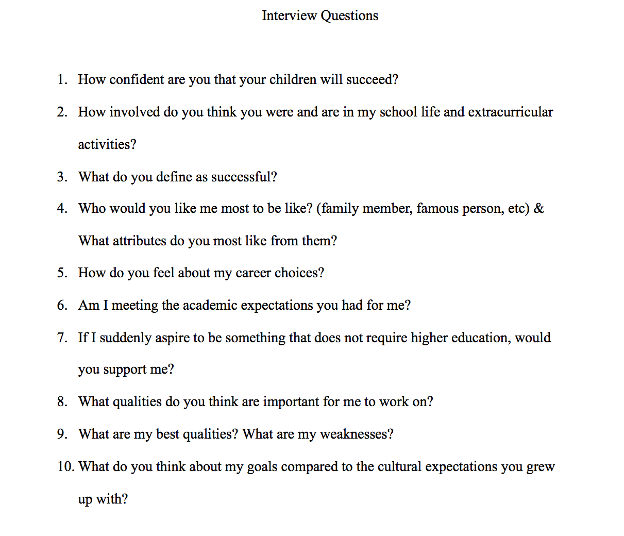
In order to investigate our hypothesis, we had each daughter interview their respective mothers- mother 1 was interviewed by her oldest and youngest daughter and mother 2 was interviewed by her oldest and youngest daughter. The younger and older daughters each asked their mother the same series of ten questions (see the list of questions below), but they interviewed their mothers on different days and asked the questions in different orders. Each of the younger daughters asked the interview questions on the first day, and, then, a few days later the older daughters interviewed their mothers.

Figure 2: Interview Questions

We recorded these interviews in order to be able to transcribe them so that we could make note of the following nuances in the mothers’ speech patterns: pauses, filler words, connotative word choice, levels of detail and any phrases that may allude back to gendered expectations. For the purpose of our research, we took pauses longer than two seconds into consideration; we did not analyze one second or less than one second pauses because we interpreted them as the mothers taking a moment to formulate their thoughts. We analyzed pauses longer than two seconds as an indicator of hesitancy on the mothers’ behalf about how they should respond to the question that was posed to them. We counted all the instances of filler words such as “Ah,” “Ahm,” “Uh,” “Uhm,” “Eh,” “Ehm,” and “Mmm ”as markers of hesitancy when preceded or followed by a pause as well.

We also used the context of the mothers speech to determine what pauses or fillers the mothers used to give themselves time to think and what pauses or fillers the mothers used when hesitant about how to deliver their responses. In addition to that, we also focused on words such as “orgullosa,” meaning proud,” or “gusta,” meaning “like,” as samples of connotative word choice in order to quantify how approving or disapproving the mother was in her response. We noted the amount of detail mothers went into in their responses for each question from the interview with their youngest daughter and cross referenced it with the length of their response from the interview with their oldest daughter. We made note of this, in order to determine if going into more or less detail with one daughter or the other had any implications in regards to their expectations for each daughter. While doing all of that, we also analyzed the data for any instances of references to gendered expectations the mothers brought up to draw conclusions about how well the educational expectations the mothers held for their daughters aligned with gendered expectations that are typical of Latinx culture.

Before we discuss our results, click this link: Latina Mothers in order to hear the audio.

The word choices in the recorded interactions were meant to indicate hesitancy or show intention in the responses, with a special focus on the answers from the mother. Filler words and phrases were tallied specifically with consideration that it might mean there was more difficulty finding a word, alluding that mothers felt the need to be more intentional with their responses. While there was a very large contrast between the amount of them the mothers used, the results indicated that amongst them both, they used more filler words with their older daughters. Specifically Mother 2 used 17 filler words with her youngest daughter and 23 with her oldest daughter. Similarly, Mother 1 used 2 filler words with her youngest daughter and 4 with her older daughter. This observation was especially interesting, given that in both cases the older daughters interviewed their mothers after the younger ones had so despite having already been primed 2 days prior, there was still more use of filler words with older daughters.

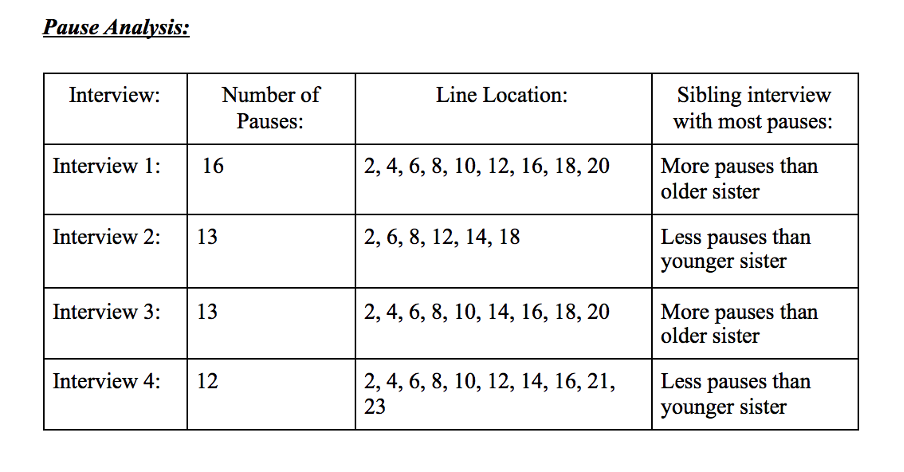
Pauses had the opposite results. When tallying we counted pauses above two seconds, and found that both mothers used more pauses when communicating with their younger daughters. In this case the mothers used a similar amount of pauses despite the location varying. Mother 2 used 16 pauses with the younger daughter, compared to just 13 pauses with the older one. Mother 1 used 13 pauses with the younger daughter and 12 pauses with the older daughter. Analyzing pauses was done with the intention of considering their hesitation when answering questions in a certain way. Overall this analysis indicated that when speaking with their younger daughters, the mothers used more pauses for their younger daughters. This could signify that the word choice required more thought and was more selective. However, it is also important to recognize that this length in pauses could be attributed to the younger daughters interviewing their mother first.

Table 1: Interview’s Pause Analysis

The next part of the analysis consisted of finding words that held strong positive or negative connotations. We immediately noticed that there were not any explicit words that had negative meaning or were used to allude to something in a negative light. On the other hand, we were pleasantly surprised with the amount of words with positive meaning. Although they were used in varying contexts, both mothers expressed about the same amount of positive words. Most of these words overlapped in all conversations, with some of the most recurrent being orgullosa” meaning ‘proud’, “exitosa” meaning ‘successful’, and “gusta” meaning ‘liking/liked’. Each word was interpreted as approval of their accomplishments or what they’re doing academically. These positive words were evenly spread among all interviews and didn’t indicate any biases for stricter expectations with one or the other daughters. One interaction that exemplified the role of maternal figures in setting expectations, was Mother 1’s response to the question “What do you think about my goals compared to the cultural expectations you grew up with?”. She responded with, “Esta buena pregunta para tus abuelas”, ‘this is a good question for your grandmothers’ possibly implying that expectations for women are set by the women that raised them.

Finally, our study analyzed the level of detail provided in the responses. The purpose of taking detail into consideration was to see if the mother was involved more with one daughter than the other or if the mother felt the need to explain her responses because of a more demanding expectation to either of her daughters. While the answers varied in length, there was an increased length in the responses for the older daughters from both mothers. This again could indicate that mothers feel the need to reinforce specific goals and expectations more thoroughly to their older daughters.

However, in studying this we observed other responses that supported our hypothesis that Latina immigrant mothers held higher expectations for their elder daughters in comparison to their younger daughters. The first question being “How do you feel about my career choices?” where Mother 1 explains to both daughters that she is content in their choices. However, she then goes on to note that her older daughter’s aspirations are rather competitive and she wants to see them all the way through. This was in contrast with her response to her younger daughter where she suggested a career in Broadway, which is much more difficult to land a secure spot in. This response perhaps shows that the mother wants her older daughter to be more secure in her career choice, followed by the expectations of being in a stable job — expectations not found in the interview with her younger daughter.

In summary, our study found that with the cases given, we were able to find some indications of older daughters being held to a higher career standard. Such instances were found in word choices analyses regarding careers and education. Specifically, we were able to find patterns of correlating pauses and filler words, and were even able to find patterns of expressing more detailed answers to older daughters. However, due to certain limitations (to be specified in subsequent paragraphs), it is clear that these findings are not substantial enough for a definitive conclusion. 

Our research would benefit from further research to argue for a more solid conclusion. Additional exploration and analysis on our test subjects and methods could provide more substantial evidence for whether or not Latina immigrant mothers have higher expectations for their first eldest daughters compared to the youngest.

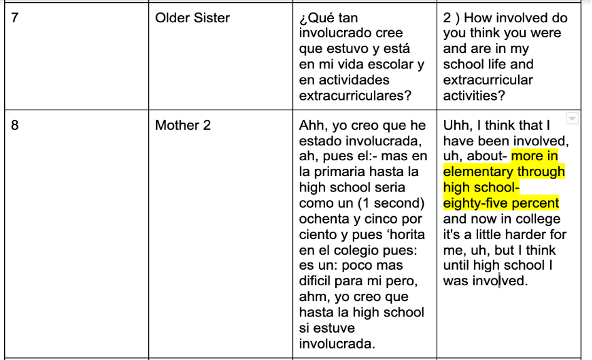
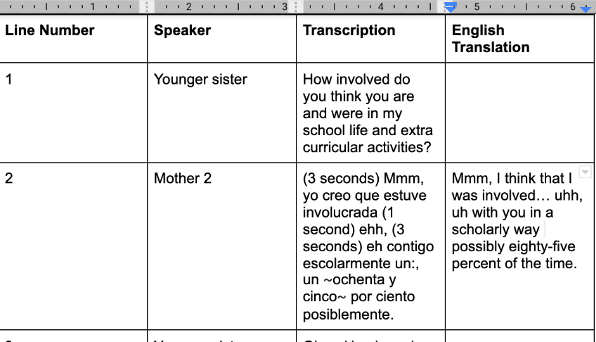
Our research limitations consisted of a few things. First, out of the interest of time, our interviewees were only allowed ten questions to ask their mothers. These questions did not include follow up questions, which would have greatly expanded on certain ideas. For example, one instance that could have benefitted from more explanations from both responses is to the question “How involved do you think you were and are in my school life and extra curricular activities?”.

Table 2: Older Sister Conversation (highlighted part shows the level of detail given by the mother when answering the question)


Table 3: Younger Sister Conversation (the mother’s response is shorter compared to her response to the older daughter)

To expand, one mother replied with “..un ~ochenta y cinco~ por ciento posiblemente” ‘possibly 85 percent’  for both daughters. This mother only expands briefly when talking to her older daughter, ranging her involvement between elementary school and high school. However, one way to have gained more qualitative data would have been to ask specifically in what ways this mother came to the conclusion of 80 percent.

The other mother responded with “I am very involved in the activities and studies of my daughters”  for the younger daughter and “Very, very much in school” for the older daughter. Similar to the previous mother, a follow up question of asking “How so?” or “In what ways?” could have provided more data to compare to with the first mother, in regards to what these two mothers did to stay involved.

Moreover, our study only used two mothers, therefore, our work should be considered as a case study rather than extensive research. It is only a small representation of the Latina motherhood community. On a similar note, with only two mothers, it was difficult to compare and draw conclusive statements. However, if there were more resources, subjects, and time allowed, these limitations could be reduced.

These findings may contribute to a larger phenomenon on who maintains such expectations in a Latina community, as well as connecting to as far as how this affects a woman’s social identity in her aspirations. 


References

Aviles, G. (2019, November 20). More Latinas have college degrees, but they’re still making less than white males. NBCNews.com. https://www.nbcnews.com/news/latino/more-latinas-have-college-degrees-they-re-still-making-three-n1087101

Clark, H. H., & Fox Tree, J. E. (2002, February 27). Using uh and um in spontaneous speaking. Retrieved from http://www.columbia.edu/~rmk7/HC/HC_Readings/Clark_Fox.pdf

Crosnoe, R., Ansari, A., Purtell, K. M., & Wu, N. (2016). Latin American Immigration, Maternal Education, and Approaches to Managing Children’s Schooling in the United States. Journal of marriage and the family, 78(1), 60–74. https://doi.org/10.1111/jomf.12250

Field research. (n.d.). Retrieved May 11, 2021, from https://www.researchconnections.org/childcare/datamethods/fieldresearch.jsp

Mendoza-Denton, N. (2008) “THAT’S THE WHOLE THING [tɪŋ]!”: DISCOURSE MARKERS AND TEENAGE SPEECH. In J. McIntosh (Ed.), Homegirls (pp. 265-291). Wiley.

Perez, A. (2009). Understanding Attitudes about Education within two Cultural Contexts: Comparing the Perceptions and Expectations of Mexican Mothers in the Greater Los Angeles Area to their Cohort in Mexico. Graduate Studies At California Lutheran  University.

Symbolic Interactionism Theory. Communication Theory. (2014). Retrieved May 2021, from https://www.communicationtheory.org/symbolic-interactionism-theory/.


[/expander_maker]
What social patterns contribute to lack of maintenance of a heritage language within a multilingual family?

Hebbah Elokour, Rowan Towle, Jason Panelli, Frances Vano, Sana Shrikant

This study examines the various factors involved in the maintenance of heritage languages among multilingual immigrant families in the United States. Previous research shows that maintenance of heritage language is a complex and nuanced problem and that most families in the United States fail to pass on their home languages. We sought to compare all factors, and beyond any single particular immigrant family or case. We utilized a survey and several short interviews on which to do analysis. We found that all respondents had a positive outlook on heritage language maintenance and that in 100% of cases those who had advanced language skills had formal language exposure. Furthermore, we found that all respondents had some language skills and continually used them in socially significant ways.

[expander_maker id=”1″ more=”Read more” less=”Read less”]

Introduction & Background

Our goal was to study multilingualism in families and the social patterns that are common in failure of heritage language maintenance. We found a significant amount of research on the rates of heritage language retention among immigrant populations around the world. However, the majority of this has been structured around maintenance of Spanish speaking immigrant families in the United States. Also, much of these studies further focus on particular populations such as Cubans in Florida (Lambert, 1996). This is a gap that we wanted to address, as our research contains data points from many different language groups. These studies did give us a good amount of information as to the cause behind heritage language loss, some of which include socio-economic class (Pearson, 2007), education level of family (Bill,  Hernandez-Chavez & Hudson, 2000), and perceived social status of heritage culture/language by local society (Kloss, 1966). However, some of these studies have varying results, which makes it difficult to take away one consistent conclusion. Additionally, none have compared all these factors across different immigrant populations of various status and locations to find the commonalities that might exist among the specific low heritage language maintenance group. We took this information as a starting point, and decided to aggregate all of our data points to make a full comparison. With the increase in positive attitudes toward ethnic diversity in the United States (Budiman, 2020), there seems to be a shift underway that could impact the maintenance of heritage languages and culture in both multigenerational immigrant families in the country and families who may immigrate in the future. Our study aims to observe these factors in low heritage language maintenance families and understand commonalities in this group.  We hypothesize that younger people will have a more positive outlook towards heritage language acquisition,  but we also hypothesize that this will contribute less to language maintenance than factors such as formal education and language use outside of the household. Additionally, we hypothesize that code switching does not occur in these families but that they may pass on small bits of language, like vocabulary that allows them to communicate things in particular social situations, such as when they want to talk about something they want to keep private while not at home.

Methods

A short survey was the primary method of data gathering. These surveys were sent to friends and classmates who are bilingual or multilingual adults and come from bilingual or multilingual homes. The surveys will attempt to understand the heritage level of heritage language mastery, methods of learning in the family, knowledge of English among older members of the family, living conditions, and other questions to assess attitudes towards heritage language maintenance and enthusiasm towards the heritage culture and ethnic identity. There were five yes or no questions and six short answer questions for individually specific information such as language(s) and exposure type. Following this, a short interview was conducted with three survey participants and one of their parents each. This was to get a more in-depth description of particular social and family factors that impact motivation and need to acquire the heritage language. After we collected the data, we measured the level of heritage language competence and in what ways, types of informal and formal exposure, and level of necessity of the language in the family environment. We then analyzed the data to identify common social and speech patterns in groups with low language maintenance.

Key Words

Active Language Skills: This term refers to skills with a given language that amount to some amount of active conversational ability or working proficiency.

Passive Language Skills: This term refers to abilities with a given language that amount to some understanding and ability to use the language in socially specific circumstances.

Heritage Language: This term refers to a language that is spoken by an immigrant family that is not the dominant language in the society in which they now live.

Formal Language Exposure: This term refers to exposure to a language that is purposeful and deliberate such as classes, school, guided reading, and/or cultural events focused on language.

Informal Language Exposure: This term refers to exposure to a language that is random and without specific purpose such as family speaking at home, presence in a larger speaking community such as a neighborhood, and/or random exposure to music and media of the language.

Findings

Our data included 18 respondents to our questionnaire and 3 interviewees. There may be some bias toward specifically individuals exposed to Tagalog as a significant portion of our respondents (7 out of 18) and interviewees (2 out of 3) described Tagalog in their responses. One interview was conducted in person, one interview via zoom call, and one interview through email. These data points are the basis of our findings, and while a more diverse data set and more speaking interviews would have been preferred, this is what was accessible to us due to the pandemic and time zone constraints.

There are two significant correlations uncovered in the questionnaire that may reveal important social factors regarding language acquisition. Firstly, every single respondent with active language skills also had formal language exposure. Conversely, of the thirteen respondents to not have active language skills, only 3 of them had exposure to the language in a formal setting.

Figure 1: Respondents to the questionnaire who had no active language skills: a significant portion of this group had no formal language exposure.

The other highly correlated response to the questionnaire was the descriptions of motivation for the respondents to learn the language. All 13 respondents with only passive language skills either described their family as not motivating language acquisition or presented some roadblock to motivation. This included situations where only one parent spoke the language and thus hindered the overall family motivation for the children to also learn the language. On the other hand, 4 out of 5 of respondents with active language skills presented some necessity in understanding and using the language. In many of these cases, respondents described family members who did not speak English such as their grandparents, and a need to speak and understand the language to communicate with these family members.

Figure 2: The left pie chart shows a high percentage of respondents with active language skills had families that were highly motivated to pass on the language; the right pie chart shows a complete lack of highly motivated data points in the group without active language skills.

The last piece of data from the questionnaire revealed an overarching positive opinion of bilingualism and multilingualism. Every respondent except for 1 thought of bilingualism or multilingualism as a positive thing. The one respondent who did not have positive views of bilingualism or multilingualism described their viewpoint as “Neither positive nor negative”. Additionally, every respondent said they would want to pass on the language to their children if they could. This indicates that sentiment about heritage language learning was positive, even in cases where the respondents had only passive language skills or limited vocabulary and gives little prediction into whether a child will acquire the language with active skills.

The interview allowed us to observe how the interviews used their limited language skills in their everyday life. All 3 interviewees described their language skills as “limited vocabulary only” but still made significant use of the language. Namely, all interviewees were able to immediately recognize the language when hearing people speak it. They all had limited vocabulary as they described and some of the terms and phrases common amongst all of the interviewees included food items and common greetings. More significantly, however, is that all interviewees actually used the language in certain social situations with their family members. The first interviewee’s younger brother refers to her as “ate” or “older sister” in Tagalog, and despite not speaking Tagalog she is uncomfortable with him referring to her by her name. The second interviewee described using the language “strategically” in disguising some sensitive vocabulary in public. This included describing items as “cheap” or “expensive” while shopping to not offend the clerks or describing the physical appearance of someone. The last interviewee described their family using Spanish to ask for favors from each other. The family viewed Spanish as more formal and a more polite and effective way to ask something of each other.

Combining these findings, we learn that the strongest correlations are found in active language skills being present with highly motivated families whose children were exposed to language in formal settings. Conversely, members of the group without active language skills only had very low formal language exposure and did not have families that highly motivated language acquisition. The passive-only language skills group all seemed to acquire some level of the language and all interviewees still used the pieces they knew in socially significant manners. From these findings, we can predict that the informal language exposure in the passive-only groups still had social meaning to this group and even low levels of language acquisition are often used in socially specific tasks. In other words, informal language exposure in families with low motivation to pass on their language still resulted in the language being a part of the way they speak and interact with other members of the family. Particularly, the language is often leveraged for specific social tasks and part of the speech patterns of the family even when the dominant language is not the heritage language.

Conclusion

Based on our results, we conclude that a child’s educational environment plays the most significant role in failing to pass down languages. Even when parents wanted to pass down their native language, the primary language spoken in the host nation’s environment interfered with that goal. Unless some form of formal language education was pursued by the family. Additionally, children who grew up in bilingual households retained culturally significant words more than they did with other general words. These types of words include food and words related to etiquette in the culture. Lastly, the people we surveyed generally had a positive outlook on multilingualism and would want to pass down their heritage language if they could.

To expand our study, we suggest studying heritage learners who grew up not just in multilingual households but multilingual communities. In our research, almost everyone we surveyed grew up in predominantly English-speaking communities. We are interested to see whether or not we’d be able to see different social patterns that contribute to the lack of maintaining a heritage language had the children grew up in multilingual communities. We also suggest finding people who learned a second language in only formal settings and comparing their retention rate to that of a person exposed only in informal settings. Furthermore, a more comprehensive study in the United States tracking social and educational factors across all immigrant communities might further shed light on the strongest factors affecting heritage language maintenance. Our study aimed to answer some of the many questions posed to understand the social implications of multilingualism.


References

Bill, G., Hernandez-Chavez, E., & Hudson, A. (2000). Spanish home language use and English proficiency as differential measures of language maintenance and shift. Southwest Journal of Linguistics, 19, 11–27.

Budiman, A. (2021, April 28). Americans are more positive about the long-term rise in U.S. racial and ethnic diversity than in 2016. Pew Research Center. https://www.pewresearch.org/fact-tank/2020/10/01/americans-are-more-positive-about-the-long-term-rise-in-u-s-racial-and-ethnic-diversity-than-in-2016/.

Kloss, H. (1966). German-American language maintenance efforts. In J. A. Fishman (Ed.), Language loyalty in the United States: The maintenance and perpetuation of non-English mother tongues by American ethnic and religious groups (pp. 206–252). The Hague: Mouton.

Lambert, W. E., & Taylor D. M. (1996). Language in the lives of ethnic minorities: Cuban American families in Miami. Applied Linguistics, 17(4), 477–500.

Pearson, B. Z. (2007). Social factors in childhood bilingualism in the United States. Applied Psycholinguistics, 28, 399–410.

[/expander_maker]
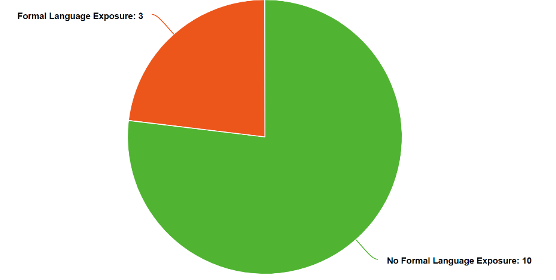
To: Perceived Female Recipient
Subject: Examining Nonbinary Identities in Email

Cc: Kyna Horten, Phoebe Morales, Lukas Weinbach

What if I told you that the way you write your emails is a dead giveaway of your gender identity? What if I told you there is a way to make this less obvious? If you want to learn more about Gendered Language, keep reading! What we know so far: Research parses variations in speech into ‘powerful’ language and ‘powerless’ language, or ‘men’s language’ and ‘women’s language. ‘What research has not considered yet: For centuries, men and women have had gender roles to perform which influence their speech behaviors; however, there is no social gender for people outside of the binary to perform, perhaps as a result of the idea that biological sex runs on a binary (which it doesn’t). In recent years, the options for social gender are changing from a binary to include those outside the traditional man/woman dynamic. Bathrooms, passports, and titles (mrs./ms., mr., mx.) are beginning to accommodate genders outside of the binary. Still, there are no set stereotypes, roles, or expectations for genderless people. We wanted to investigate how individuals identifying as agender perform language when writing emails.

[expander_maker id=”1″ more=”Read more” less=”Read less”]

For our study, we chose a convenience sample of three participants. The target demographic were nonbinary English-speakers in the Millennial/Gen Z age-range. One participant was assigned-female-at-birth and part of the cisgender control group. The other two participants were agender, and this group was a mix of assigned-female-at-birth and assigned-male-at-birth. Each participant provided at least six formal email threads for analysis. At least three of these were addressed to male recipients while the other half were addressed to female recipients. All recipients held a position of power over the participants. Before examining the emails, we produced a codebook full of key words and markers which signify powerless language. Here are a few examples of markers we coded:

Code Description of code
HEDGING (HD) [sort of, kind of, I guess, it seems]
ITALICS (IT) [so, very, totally, quite, really, !] Emphasis.
QUESTION INTONATION (QI) question intonation in declarative context

[I was wondering if… ?]

THANK (TY) [thanks, thank you] expressing gratitude
PLEASE (PLS) [please]
APOLOGY (SRY) [sorry]
EMBEDDING (EB) [hope, wanted, wondering]
EMOTES (EMO) emojis, emoticons [haha, lol]
ACCOUNTABILITY (ACC) taking responsibility for a certain outcome, admitting fault
APPEASING (APP)


[hope you’re well] making social small talk to prepare for request; elevating recipient or denigrating oneself to appease them.

We tallied these codes to calculate the average frequency of powerless markers for every X amount of words in each message.

Gerard Van Herk’s What is Sociolinguistics? (2017) provides concepts of gender identity, performance, and practice. Herk asserts that “in cross-gender interactions we can expect to see the greatest gender effect,” therefore, we analyzed cross-gender interactions to help gauge the effect of perceived gender.

All data were coded twice, once by each of the researchers who did not compose said text. After coding was completed, we compared our findings in order to determine percent agreement of coding and in order to confirm that our coding system is well-defined and useful. Below are some example emails which we coded and analyzed as part of our data pool. The first is written by our assigned-female cisgender participant addressed to a female recipient, and the second is written by our assigned-male agender participant addressed to a male recipient. All names and sensitive information have been anonymized.

Figure 1. An email by assigned-female cisgender participant addressed to a female recipient.
Figure 2. An email by assigned-male agender participant addressed to a male recipient.

We found in our results that there is a notable increase in powerless markers in cross-gender interactions, according to assigned gender at birth. Below is a table summarizing the average frequency of powerless language towards female and male recipients for each participant:

ANONYMIZED NAMES AMANDA

(AGENDER, AFAB)

DAPHNE

(CIS, AFAB)

ERIK

(AGENDER, AMAB)

FEMALE RECIPIENT 31.7 14.1 10.4
MALE RECIPIENT 11.8 11.2 13.4

We can see that gender identity had little, if any, effect on speech in emails. Regardless of identity, cross-gender interactions according to assigned gender at birth still produced more exaggerated use of powerless language, just as Van Herk predicted. As researchers, we expected that our agender participants, Amanda and Erik, would not conform to binary patterns. We predicted that their average frequency of powerless markers per message would be roughly the same across differently gendered recipients. Instead, our actual results imply that binary socialization, upbringing, and external perception impact the way that nonbinary people navigate the world. These results have many practical applications for the LGBTQ+ community. Some nonbinary people may be okay with presenting in a way that aligns with their assigned gender at birth; however, others may desire to present a different image. Perhaps agender and other nonbinary individuals can use this research to consciously move towards less gendered speech, if they so desire. Furthermore, individuals wishing to present as more masculine or more feminine may also use this research to alter their speech so that it better aligns with their identity.

However, it is also important to note that these cross-gender disparities are potentially social constructs. Powerless language is not inherently feminine or masculine, but we associate these qualities with gender performativity.

If a person is in a position of less power, they are inclined to use more polite language. This is not necessarily powerless language in itself. In fact, it can be powerful language in its own right, as the speaker or writer implements manipulative tactics in request-making. For those in a lower position, polite language is more likely to produce results.

There are several interesting topics for further research. As mentioned above, upbringing may have a significant impact on cross-gender language. Patriarchal, matriarchal, and neutral households may produce differing attitudes towards the power dynamic of men and women. So, depending on a person’s upbringing, they may use either more or less powerless language when speaking to different genders.

The sociolinguistic study of gendered language is said to have started with Lakoff’s early studies and eventually his book “Language and Woman’s Place” (1975). Since then, the study of language and gender has developed greatly. Lakoff’s Research has been referenced and expanded upon many times, but generally focuses on a binary view of gender, and non-binary topics are under researched fields of study. Although both gender identities and social genders outside of the binary have always existed, the term ‘agender,’ “denoting or relating to a person who does not identify themselves [sic] as having a particular gender” (Google Definitions), was first coined on the internet in the year 2000 (Them). Our own research is extremely limited, examining a small pool of data from a convenience sample of three participants, only two of which are agender. We did not study other nonbinary identities outside of agender, nor did we study binary transgender people. Further research may reveal more patterns or nuances which escaped our own research.


References

Brown, P., & Levinson, S. C. (2007). Politeness: Some universals in language usage. In Politeness: Some universals in language usage (pp. 61-83). Cambridge: Cambridge Univ. Press.

Cameron, D. (2010). Performing Gender Identity Young Men’s Talk and the Construction of Heterosexual Masculinity. In 1367818629 1000231388 D. Kulick (Author), Language and sexuality. Cambridge: Cambridge University Press. http://dx.doi.org/10.1017/CBO9780511791178

Herk, V. G. (2018). What is sociolinguistics? In What is sociolinguistics? (pp. 86-100). Hoboken, NJ: John Wiley &amp; Sons.

Myers, Kristen. (2012). Cowboy Up!. ResearchGate. www.researchgate.net/publication/276215982_Cowboy_Up.

O’Barr, William M., and Bowman K. Atkins. ‘Women’s Language’ or ‘Powerless Language’? Women and Language in Literature and Society, by Sally McConnel-Ginet (1980). New York: Praeger, pp. 93–110.

Silverstein, M. (1976). Shifters, Linguistic Categories, and Cultural Description. In 1367858396 1000257581 K. H. Basso &amp; 1367858397 1000257581 H. A. Selby (Authors), Meaning in anthropology (pp. 11-55).

Them. (2018). What Does It Mean to Be Agender? Them., Them. www.them.us/story/inqueery-agender.

[/expander_maker]
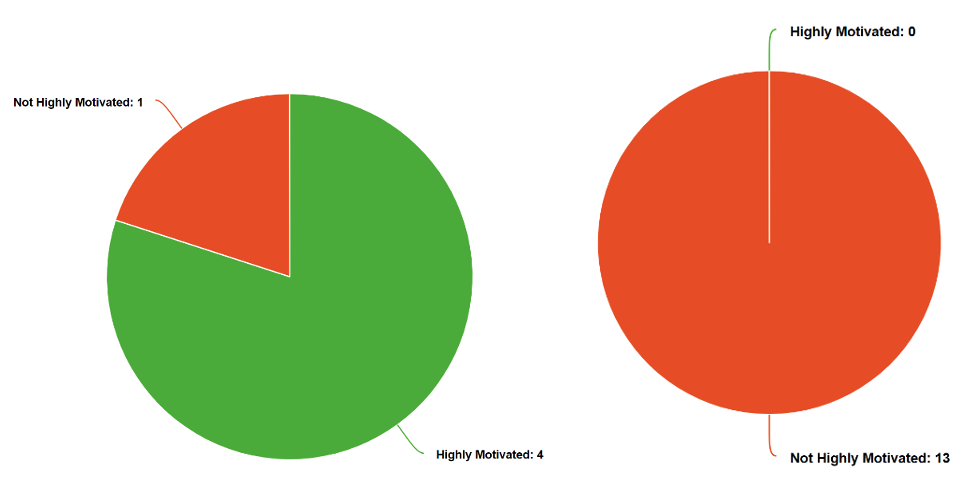
Testing the Matrix Language Frame (MLF) Hypothesis with Modern East Asian language-English Bilingual Speakers of Code Switching – Insertion & Alternation

Hyung Joon (Joe) Kim, Mocha Ito, Irene Han, Sena Ji, Luis Flores

Our study tests the validity of the Myers-Scotton’s (1993) Matrix Language Frame (MLF) hypothesis in light of modern Japanese-English and Korean-English bilingual speakers’ code-switching data (Myers-Scotton & Jake, 2009). Code-switching (CS) is the umbrella term for the use of more than one code, such as languages, dialects, sub-dialects, and accent, within or across conversations. Our focus is on two sub-elements of intra-sentential CS: alternation and insertion. We test the hypothesis by looking at whether the Morpheme Order Principle and the System Morpheme Principle hold true in our transcribed data of a total of 5 bilingual participants’ conversations in two separate groups. Our analysis reveals three new insights, which show that the two principles of the MLF hypothesis can be overriden under certain linguistic restrictions and in specific psycho-social context, as well as the fact that the frequency of alternation is positively correlated with the bilingual speaker’s proficiency in his or her first language.

[expander_maker id=”1″ more=”Read more” less=”Read less”]

Introduction/ Background

The study of bilingual code switching began in the 1900s. However, the way how East-Asian descent Americans code switch in their conversations with another bilingual interlocutor is an area that has not been addressed as much by modern linguistic scholars, despite the consistent increase in the population of East Asian-American bilingual speakers in the last few decades. It is estimated that approximately 14.1 million Asians have immigrated to the US since the 1850s (Migration Information Source, 2020). The obtaining of a second language by the 1.5 or 2nd generation immigrants in America has led to a number of intra-racial cultural issues. For example, the rapid code-switching that 1.5 or 2nd generation bilingual children often use has led to intra-cultural division between the 1st generation immigrant parents and their children. This is because the parents are often more used to conversing in their mother tongue Asian language, whereas the 1.5 and 2nd generation children are used to mixing more than two languages in their speech.

In fact, there is a sizable void in the existing literature in the field of Asian-American bilingual code-switching. Linguists have undertaken studies on code switching with rarer and more exotic pairs of languages, such as Lingala-Swahili (Bokamba, 1988) and Turkish-Dutch (Backus, 1992), but not as extensively on East Asian language-English pairs. Our study aims to fill the void in the study of bilingualism by focusing on how bilingual speakers of East Asian language and English converse with their bilingual family members. We focus our analysis on insertion and Alternation. Insertion is using one primary language that forms the main grammatical frame, but inserting words from the second language into the sentence. Alternation is the back-and-forth switching between one language and another, involving a full switch to a different languages’ grammatical frame. We hope that our empirical research assists in bridging the generational disparity between the 1st generation and 1.5/2nd generation Asian American immigrants.

Our study tests the validity of the MLF Hypothesis. The hypothesis proposes two principles: The Morpheme Order Principle and the System Morpheme Principle. These principles are distinguished by Myers-Scotton’s terminology, known as the content morphemes and system morphemes. Content morphemes are words like nouns, verbs, adjectives that express semantic meanings and assign or receive thematic roles (they are structured into grammar by system morphemes). Their counterpart, system morphemes are functional words (words that have little meaning but express grammatical relations. i.e. propositions, articles, conjunctions, etc) that express the relation between content morphemes and do not assign or receive thematic roles (i.e. roles of noun phrases).

The Morpheme Order Principle states that in a sentence with mixed constituents from the Matrix Language (first language) and Embedded Language (second language), the surface morpheme order must not violate that of the Matrix Language (ML).

The System Morpheme Principle states that in a sentence with mixed constituents from the ML and EL, all system morphemes which have grammatical relations external to their head constituent must come from the ML.

In short, we propose the three following hypotheses:

First, EL system morphemes can have grammatical relations external to their heads. This overrides the System Morpheme Principle. We provide support by showcasing an example of EL system morphemes in our Japanese-English data.

Second, in a bilingual speaker’s speech with mixed constituents from ML + EL, the surface morpheme order constructed by the ML can be violated. The second finding overrides the Morpheme Order Principle. We show that there can be a disruption of an ML surface morpheme order in a sentence with ML + EL constituents in our Korean-English data.

Third, bilingual speakers that are more proficient in their first language engage in higher average frequency and longer total duration of alternation.

Methods

Table 1 shows the background information about the five bilingual speakers that took part in our research. Two were Korean-English bilingual speakers and three were Japanese-English bilingual speakers. All three Japanese-English bilingual speakers were fluent in both languages. The two Japanese parents’ first language was Japanese and their second language was English. Mocha’s first language was English, and her second language was Japanese. For the Korean-English bilingual speakers, both interlocutors were native speakers of Korean. Their first language (ML) was Korean, and their second language (EL) was English. The two Korean participants spent the majority of their lives (20 years and 15 years respectively) living in Korea than outside of Korea.

Table 1. Interlocutor background

The Japanese student (Mocha) recorded 20 minutes of conversation with two of her parents and the Korean student (Joe) recorded 18 minutes of conversation with his older brother. Both students listened to the recording and transcribed the conversations with their family member(s). The sections spoken in a non-English language were translated into English.

After transcribing, we broke down our insertion data in order to examine the first two following aspects: the possibility of EL system morphemes that have grammatical relations external to their heads, and the violation of ML surface morpheme order of a sentence with ML+EL constituents. These findings would invalidate the System Morpheme Principle, and the Morpheme Order Principle, respectively. Third, we examined the total duration of alternation (in seconds), as well as the average frequency of alternation (per second), to assess the correlation between the tendency to engage in alternation and the proficiency in the speaker’s first language or second language.

Results/Analysis

First, we counted the total number of times alternation and insertion appeared in each language pair.

Table 2. The total number of insertion and alternation in Japanese-English and Korean-English bilingual conversations.

After counting, we categorized the inserted words into content and system morphemes. We observed if content and system morphemes are present in both ML and EL for the Japanese-English and Korean-English conversations.

Table 3. Insertion of content and system morphemes in ML and EL for Korean-English conversations.


Table 4. Insertion of content and system morphemes in ML and EL for Japanese-English conversations.

In Table 3, morphemes like nouns, negation, adjectives, and fillers appeared the most In the Korean-English data. In Table 4, nouns, particles and conjunctions appeared the most in the Japanese-English data. A bar chart in Figure 1 is based on Tables 3 and 4 summarizes morpheme insertion by interlocutor. 

Table 1. Morpheme insertion by interlocutor.

With this visual representation of the distribution of morpheme insertions, we were ready to test the System Morpheme Principle, which states that in a sentence with mixed elements of ML + EL, all system morphemes with grammatical relations external to their heads have to come from ML. Clearly, we could see that Mocha and Joe’s brother inserted system morpheme in EL. To invalidate this principle, we first had to confirm that the system morphemes in our data have grammatical relations external to their heads; then, prove that those system morphemes are from the EL, thereby negating the logic that all system morphemes must come from ML.

Excerpt 1. Example of EL system morpheme in Japanese-English data.

M: Mocha
Y: Mocha’s mother

Mocha’s EL system morphemes: no (の), kara (から)

M: Linguisticsのrequisiteほとんど終わってるから。
   Linguistics no requisite hotondo owatteru kara.

M: たぶんだけどESLだと思うよ
   for most [of]  finished  already. 

M: Tabun ESL dato omou yo
   Probably that [I] think

(I already finished most of the prerequisites for linguistics. I think it’s probably ESL)

Y:良かったね。でもMastersわどうするの?

(That’s good for you. But what are you going to do about Masters?)

In the excerpt above, Mocha, whose EL is Japanese, is inserting Japanese system morphemes, no and kara into the sentence. Words like no の is a system morpheme, because it is a functional word with little content meaning similar to a preposition. But no (の) bears grammatical relations with the latter EL system morphemes, owatteru kara (終わってるから). This a grammatical relationship external to the head of no (の), which is ‘Linguistics’.

Therefore, Mocha’s conversation with her mother clearly indicates the possibility of an EL system morpheme that bears an external relationship to its head, overriding the System Morpheme Principle.

Next, we went on to test the Morpheme Order Principle.

Excerpt 2. A sentence with ML+EL constituents with violated ML surface morpheme order.

J: Joe

D: Joe’s Brother

J: 그래도, 이제, 좀, free 하게 다니거나 그럴 수가 없지

   Geraedo,eejae,jom,   ha-gae daniguna geurul sooga up-jee

(But, now, a little, we can’t roam around freely)

D: New York  이미, it’s poppin’

           eun ee-mi,

(New York is already, it’s poppin’)

In Excerpt 2, Joe’s brother uses the English NP “New York” to begin the sentence, which is followed by a Korean particle eun (은) and adverb ee-mi (이미), which means ‘already’. According to the Korean surface morpheme order, the morpheme that must always follow a Korean adverb has to be either a verb or an adjective attached to a past-tense inflection suffix, such as neut-eut-uh (늦었어), which is an adjective + past tense inflection suffix, such as:

neut-da (늦다) + –eut-uh (-었어)

Adjective stem + past tense inflection suffix

However, in our raw data, we see that the adverb ee-mi (이미), is followed by the English possessive determiner, “it’s”, which violates the ML (Korean) surface morpheme order of a sentence with ML+EL mixed constituents. Therefore, the example in our Korean-English bilingual conversation invalidates Myers-Scotton’s Surface Morpheme Order Principle.

Lastly, we analyzed our alternation data by calculating the total duration (s) of alternation between ML and EL.

Table 2. The total duration of alternation (s) between ML and EL.

In Table 2, duration is the total length of alternated sentences (in seconds), including from the beginning of a sentence in language A to the end of the sentence in language B after the end of alternation. For example,

D: 호원 예술대, 재즈 피아노. Supposedly it’s one of the top three

     Howon-Yesooldae, Jazz Piano

(Ho Won Music School, B.S. in Jazz Piano)

The entire sentence above was counted as one case of alternation, lasting between 5~10 seconds. Among Japanese-English interlocutors, Mocha’s speech showed the longest duration of alternation, resulting in more than 80 seconds in alternated sentences. For the Korean-English data, Joe’s brother spent more than 70 seconds in alternated sentences.

Table 3. The average frequency of alternation (/s).

Similarly, in Table 3, Mocha and Joe’s brother exhibited the highest average frequency of alternation (in their respective bilingual group). The frequency was calculated by dividing the number of total times each interlocutor used alternation in his or her speech, by the total duration of each conversation.

Based on our findings, we predict that those with more years of experience speaking in their first language tend to engage in alternation more. In our data set, Mocha and Joe’s brother have had more years of speaking & learning their first language at their home country (Mocha, 21 years; Joe’s Brother, 20 years), in contrast to their family members (Mocha’s parents, 19 and 3 years; Joe, 12 years at home). We hypothesize that a bilingual speaker with a stronger foundation in their first language may feel more comfortable alternating to a foreign language, although other factors not addressed in this study such as the speech content, psycho-social relationship with the interlocutor, and environmental factors may equally play a role.

Conclusions

The formal theorization of Myers-Scotton’s Matrix Language Framework hypothesis (1993, 2009) formed the groundwork for the study of bilingual CS since the 1990’s. Our empirical quantitative study focused on a syntactical analysis of how 1.5 and 2nd generation Japanese-English and Korean-English bilingual speakers CS today, offering evidence against the two basic principles of the MLF Hypothesis. We also demonstrate a positive correlation between the engagement in alternation and the proficiency in the bilingual speaker’s first language.

Our findings aim to advance the study of modern bilingual CS by pointing out that scholars must continue to understand the syntactic inner-mechanism of the more sizable bilingual population’s CS, in particular, the East Asian language-English pair. This is because of the greater socio-linguistic implications these studies can have, such as the reduction in the generational gap between millions of Asian immigrant parents and millennial children, and the broader academic recognition of the quickly-changing nature of multilingual culture in Asia in this global age.

We invite scholars to continue to look into areas not addressed in this study, such as the role of psycho-social elements, level of intimacy between interlocutors, and other greater socio-linguistic and anthropological factors that may affect how future bilingual speakers may engage in CS.

Lastly, our findings stress the importance of being well-versed in one’s first language, as our study shows that a bilingual speaker who has spent more years speaking in his or her first language finds it easier to fully switch to a different language than those who have had less years of experience learning their mother tongue language at their home country.


References

Backus, A. (1992). Patterns of language mixing: a study in Turkish-Dutch bilingualism.

Bokamba, E. G. (1988). Code-mixing, language variation, and linguistic theory: Evidence from Bantu languages. Lingua76(1), 21-62.

Code-switching (G4) – Language Contact. Language Contact. (2011, October 8). https://sites.google.com/site/hongkonglinguistics/Downhome/Topic1/part1knowledgerepresentationinprolog20. Last accessed 10/08/2021.

Indian immigrants in the Unites States (2020) Migration Information Source. https://www.migrationpolicy.org/article/indian-immigrants-united-states-2019. Last accessed 10/08/2021.

Myers-Scotton, C. (1993). Common and uncommon ground: social and structural factors in codeswitching. Language and Society, 22 (pp. 475-503).

Myers-Scotton, C., & Jake, J. (2009). A universal model of code-switching and bilingual language processing and production. In B. E. Bullock & A. J. Toribio (Eds.), The Cambridge handbook of linguistic code-switching (pp. 336–357). Cambridge University Press.

Code-switching (G4) – Language Contact. Language Contact. (2011, October 8).

https://sites.google.com/site/hongkonglinguistics/Downhome/Topic1/part1knowledgerepresentationinprolog20.

Shim, Ji Young. 2021. OV and VO variation in code-switching (Current Issues in Bilingualism 1). Berlin: Language Science Press.

[/expander_maker]
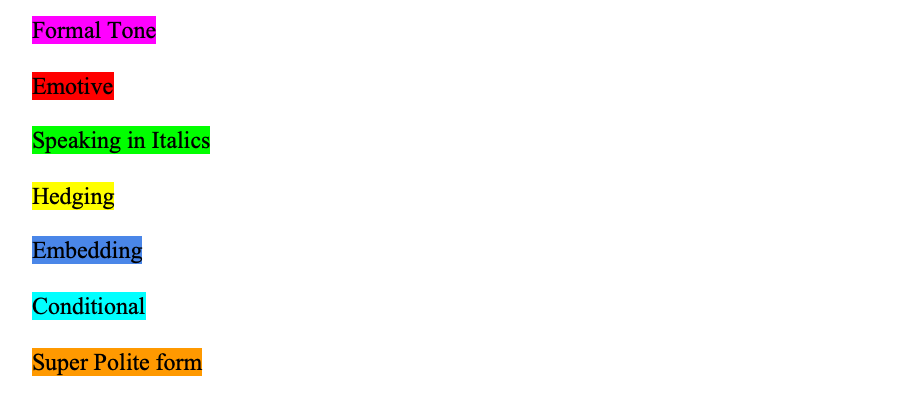
, , , , ,
Scroll to Top