“El niño hits la pelota”: Syntactic Language Transfer in Spanish-English Bilinguals

Leslie Cheng, Madeline Netto, Grace Yao

This study explores the extent of which language transfer affects Spanish L2 learners, Spanish heritage speakers, as well as Spanish-dominant speakers. Previous research shows that Spanish L2 learners differed in their reliance on English when interpreting Spanish depending on their fluency, showing various levels of syntactic transfer. We wanted to expand this to Spanish heritage speakers and Spanish-dominant speakers as well. We found that SVO was the most commonly produced sentence structure, as well as the only produced transitive sentence word order, across all three groups, and that VSO and VOS were not preferred across all three groups. Our results suggest that the canonical SVO word order is the most natural and unmarked for all Spanish speakers, while syntactic transfer or language contact may have affected the acceptability of non-SVO sentences.

[expander_maker id=”1″ more=”Read more” less=”Read less”]

Introduction and Background

English and Spanish are both typologically SVO languages, but they use different syntactic strategies to mark the subject and object relationship within a sentence. English predominantly uses word order to mark the subject and object relationship, so the SVO word order of transitive sentences is relatively fixed (Morett, 2013). For instance, in English, it is acceptable to say “John wrote the book,” (SVO) but “The book wrote John” (OVS) is nonsensical and ungrammatical.

On the other hand, Spanish uses verb conjugation and subject-verb agreement, alongside other cues and strategies such as animacy and differential object marking, to mark subject and object. These properties allow Spanish sentences to have a more flexible word order: both “Juan escribió el libro” (John wrote the book; SVO) and “El libro lo escribió Juan” (The book, wrote Juan; OVS) are common, grammatical constructions. In fact, Spanish allows for all six basic word orders: SOV, VOS, VSO, OSV, and OVS, are all grammatical in addition to the canonical SVO order, which is more flexible than English and other Romance languages, such as French and Italian (Lahousse & Lamiroy, 2012).

Language transfer is the application from one of a bilingual’s languages onto another language. Because English and Spanish have these differences in syntax and word order, we are able to study how word order from English transfers onto the Spanish of bilinguals. A previous study investigated how English syntactic structures transferred onto the Spanish of L2 Spanish learners. They found that at first, learners relied heavily on English interpretation of syntax when interpreting Spanish sentences. As the learners became more advanced, however, they were able to use more cues unique to Spanish. We expanded on this research by testing more types of Spanish speakers than just L2 learners. We broke down our participants by language background, as either L2 learners, heritage Spanish speakers, or Spanish dominant (ES-dominant) speakers. Making these groups allows us to investigate if linguistic background plays a role in language transfer (Morett & MacWhinney 2013).

In comparing Spanish L2 learners, heritage speakers, as well as ES-dominant speakers, we wanted to determine the extent that language transfer affects each group. We hypothesized that Spanish L2 learners will experience the highest level of language transfer and rely on their knowledge of English grammar, since they are not yet fluent in Spanish. We expected the ES-dominant speakers to experience the lowest level of language transfer because of their fluency in Spanish, while heritage speakers would fall somewhere between these two groups since their Spanish fluency level also falls somewhere in between.

Study Design

We utilized a Google form with two tasks: elicitation and judgment, followed by a demographics section at the end that collected data about each participant’s fluency and usage with Spanish and English, how they learned each language, and other background information. The elicitation section asked participants to write a series of short transitive sentences consisting of 3-8 words in Spanish based on simple pictures, such as a cat chasing a mouse or a teacher reading to students. There were six pictures in total. Refer to the Appendix for sample pictures, as well as instructions from the tasks. The goal of this task was to elicit transitive sentences, observing the frequency of certain word orders within each subject group.

The judgment section presented participants with a series of short Spanish transitive sentences in various word orders and asked them to judge whether the sentence was grammatical or not. If they judged it grammatical, they were asked to identify the subject of the sentence. This task contained eight transitive sentences in varying word orders: SVO, VSO, OVS, and VOS are example constructions. Table 1 below show sample sentences used in our Google form:
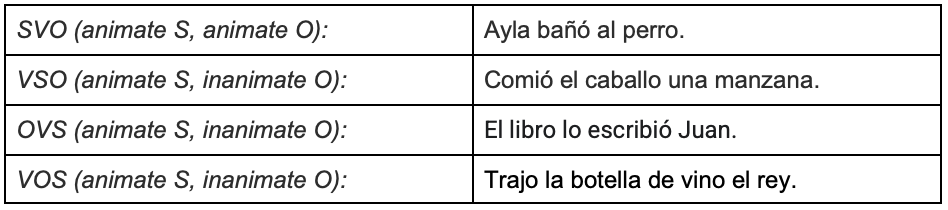
Table 1. Examples of word orders used in judgment section

Results

 These tasks measure syntactic language transfer. Groups that were less accepting of non-SVO word orders show the most language transfer. The elicitation test was designed with the idea that groups with less language transfer would use more varying word order. On the judgment task, more language transfer would mean accepting more of the sentences as correct. We expected differences in the amount of language transfer between the groups with ES-dominant speakers demonstrating the least language speakers, meaning that we expected they would use and accept more non-SVO word orders. Based on the previous research, we also believed that L2 learners would show the most language transfer by relying on English syntactic cues to have narrower use and acceptance of word order. Heritage speakers were expected to fall in the middle.

When forming the groups, we determined L2 learners to be respondents who began learning Spanish in middle school or later. Heritage speakers were ones who learned Spanish before preschool but are more comfortable using English, and ES-dominant bilinguals are those who learned Spanish as a first language, and continue to be most comfortable speaking Spanish.

In our elicitation task, we observed four main sentence construction types: transitive, intransitive, prodrop, and copula, as shown in Table 2. These example sentences are actual responses to our elicitation task, but they were taken from respondents of all three groups, so they are not representative of any one group.
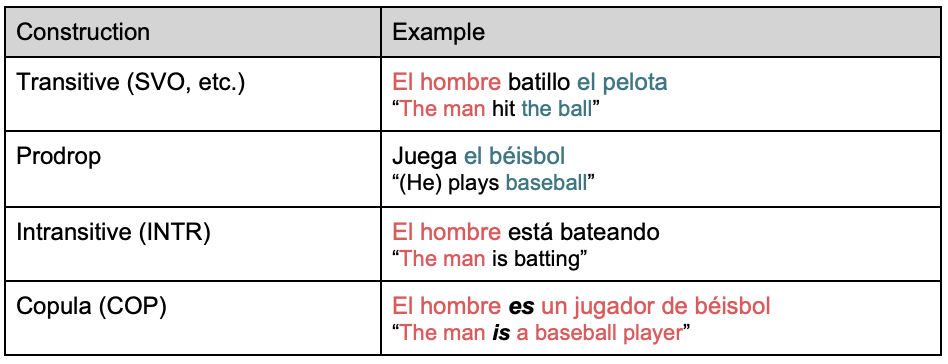
Table 2. Sentence construction types observed in elicitation task

Transitive sentences are ones that contain a subject, object, and a verb, and as such we were able to categorize them by word order: for example, SVO. Spanish grammar also allows for sentential subjects to be optionally dropped, giving a sentence with just a verb and an object, where the subject is only implied. These sentences were labeled as prodrop to reflect this. Intransitive sentences contained only a subject and a verb that does not take an object, labeled as INTR in our data. Lastly, copular sentences are ones that include the verb “to be” and a subject predicate, labeled as COP.

As a note, our analysis of the elicitation task data only included responses that gave full sentences. We had several responses that were simple noun phrases, for example “el chico.” These were particularly common in the L2 data, most likely due to a lack of proficiency with Spanish. We excluded these phrasal responses because our goal was to observe transitive sentence word order.
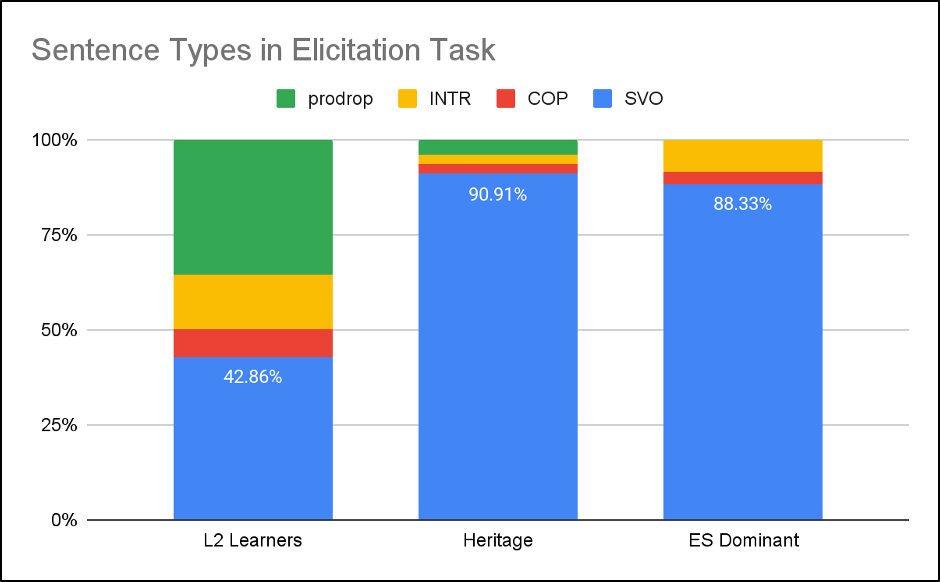
Figure 1. Proportions of sentence types observed in the elicitation task results of each group. Printed percentage label indicates the percentage of SVO responses within each group

Looking at the quantitative data from the elicitation task presented in Figure 1, the most notable observation is that SVO is the only observed transitive sentence pattern for all three groups. SVO sentences accounted for about 90% of all responses from heritage speakers and ES-dominant bilinguals. Full transitive sentences were less common for L2 learners, accounting for just over 42% of responses; instead, there was a tendency to use simpler constructions such as prodrop or intransitive sentences that did not include all three of subject, object, and verb. Like with the excluded phrasal responses, this was likely due to a lack of proficiency in Spanish.
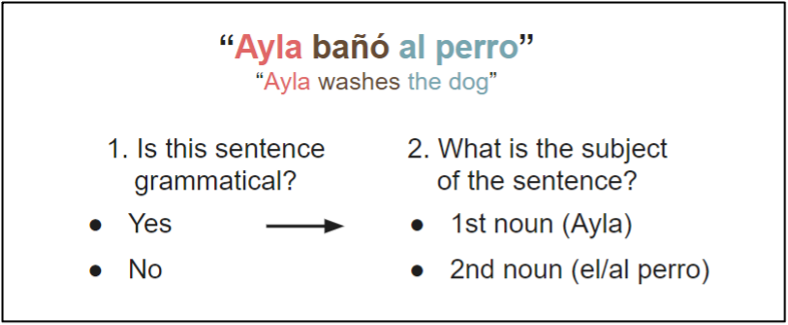
Figure 2. Example flow of a judgment task question. If the answer to question 1 was “Yes, grammatical,” the participant would be asked to identify the subject

In our judgment task, we gave several grammatical sentences of varying word orders to our respondents and asked them to make two judgments about each sentence: first, is the sentence grammatical? If the response was yes, we then asked them to name the subject of the sentence. This format is shown in Figure 2. We analyzed this data in two parts, consolidating responses for word order types in each group: first, the results of the grammaticality judgment task, and second, the results of the subject identification task.
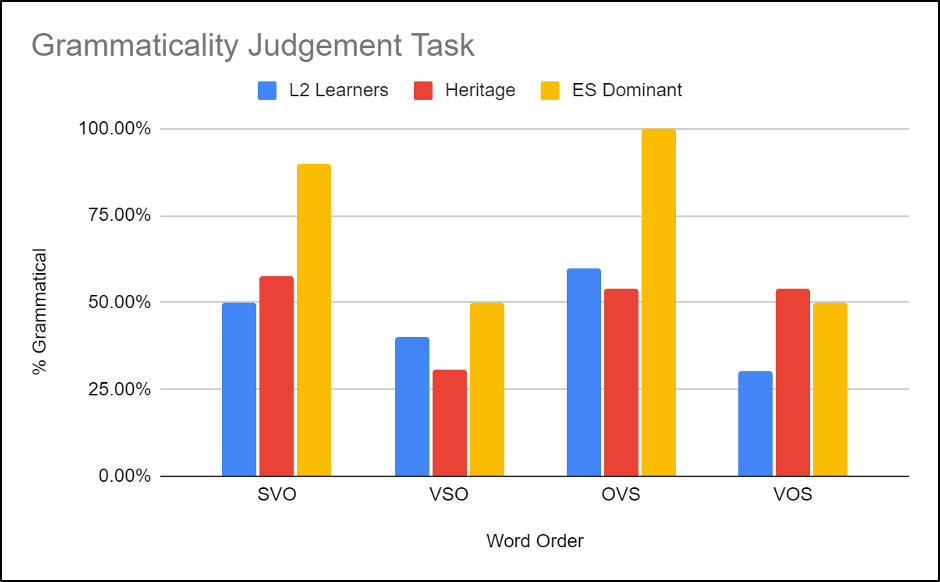
Figure 3. Grammaticality judgment task results, shown as percentage of respondents who said the sentence is grammatical, grouped by word order and language background.

There was a clear difference between ES-Dominant bilinguals and the other two groups in the grammaticality judgment task, since ES-Dominant speakers accepted our SVO and OVS sentences far more than the other respondents (Figure 3). Performing a chi-square test of independence on each word order category showed statistically significant differences in grammaticality judgment among the three groups for SVO and OVS sentences (p < 0.05), but no significant differences for VSO and VOS sentences (p > 0.40), which were the least accepted word orders overall. While we did not expect the verb-initial sentences to be so unfavorable for all groups, the ES-Dominant bilinguals displayed the most flexibility with regard to word order, which aligns with our hypothesis.
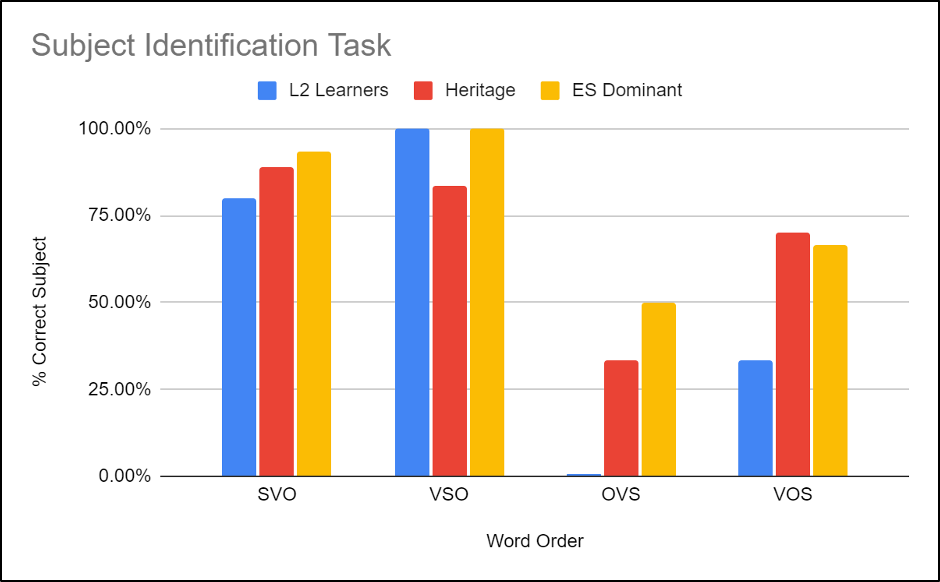
Figure 4. Subject identification task results, shown as percentage of respondents who answered with the correct sentential subject. Only responses consisting of a single noun were included, as some answered with the verb or both nouns.

As demonstrated in Figure 4, there was a high rate of correct responses for all groups in SVO and VSO sentences, which have the subject as the first noun. The correct identification rate drops sharply in OVS and VOS sentences, where the subject is the second noun, demonstrating a tendency across all three groups to just choose the first noun as the subject.

Notably, the L2 Learners had a much lower correct identification rate than the other groups for second noun subjects, with no correct responses when identifying subjects for OVS sentences. However, when we performed a chi-square test on this data, we did not observe any statistically significant differences in the groups for any word order (p > 0.30). This is most likely because of our very small sample size, since we only asked the respondents to identify the subject if they said the sentence was grammatical.

Discussion and Conclusions

This study allowed us to explore differences in English-Spanish syntactic transfer between L2 learners, heritage speakers, and ES-dominant bilinguals. The most notable result we found was that SVO was the only observed transitive word order in our elicitation task. This overwhelming prevalence of SVO sentences suggests that it is the unmarked, preferred word order for all groups of Spanish speakers. Conversely, non-SVO word order in Spanish is likely marked in some way, for example as a form of focalization for the fronted word (Campos & Zampini, 1990).

Thus, a possible extension of this research could involve the elicitation of sentences from a question instead of from a picture, as was done in this study. Questions that take a verb or object as an answer, for example “What is the man doing?” or “What is the girl eating?” could be used to elicit non-SVO sentences through focalization, with the goal being to compare the frequency of non-SVO word orders produced by each group.

Overall, L2 learners and heritage speakers had similar grammaticality judgments for each word order, while ES-dominant bilinguals were far more accepting of SVO and OVS word orders than the other two groups. However, all three groups found the VSO and VOS sentences to be disagreeable, which may indicate an inherent dislike for movement of the verb. We interpreted these differences in grammaticality judgments as possible evidence of language transfer, with ES-dominant bilinguals exhibiting the least syntactic transfer from English, but other factors such as dialectical differences in lexicon and grammar may also have contributed to these results. Language contact with English may be another possible reason for the unacceptability of VSO and VOS sentences, even for the ES-dominant group.

L2 learners chose the first noun as the subject more so than any other group. Although both heritage speakers and Spanish-dominant speakers showed a slight tendency to also pick the first noun, it was not to the extent that L2 learners did. A possible explanation for why this occurred is that the participants may not have known what a grammatical or syntactic subject refers to. Even native speakers of a language may not necessarily have explicit grammatical instruction that would allow them to identify what a grammatical subject is.

Some other limitations of this study include the fact that the number of responses to our survey was a bit unbalanced between the groups. We received 5 L2 learner responses, 13 heritage speaker responses, and 10 Spanish-dominant speaker responses. It would have been ideal to have balanced groups as well as more participants overall. Furthermore, we tried to pick obvious pictures that would produce a limited range of sentences, yet we still received a variety of creative answers which were more difficult to codify. Lastly, as the survey could not be too long in order to keep participants’ attention, we were limited in the number of questions we could ask. More questions would have been ideal to observe more consistent results and be more certain of our results.

Despite these limitations, we hope this study will serve as a foundation for more language transfer studies in the future. Although we focused on certain specific aspects of language transfer in Spanish-English bilinguals, we believe that having this metalinguistic knowledge about the existence of language transfer would be especially useful for L2 learners when they are first acquiring Spanish, or any other foreign language. Many L2 learners struggle with overcoming the biases of their first language, but learning about the ways in which their native language can transfer over to the language they are trying to acquire is useful knowledge that will assist in their foreign language learning journey. As our world becomes more interconnected than ever, foreign language learning will surely become even more prevalent, and knowing about language transfer is a cornerstone to that.

Additional materials

https://www.languagetransfer.org/

As the name suggests, a website of free language learning materials that utilizes the ideas of language transfer to approach foreign language learning in a different way. This includes audio courses on French and Spanish.


https://www.youtube.com/watch?v=zByu8ilyxPg

A short video explanation of flexible word order in Spanish and possible different meanings that varying word orders can create.


References:

Campos, H. & Zampini, M. (1990). Focalization Strategies in Spanish. Probus, 2 (1), 47-64. https://doi.org/10.1515/prbs.1990.2.1.47

Erdocia, K., & Laka, I. (2018). Negative transfer effects on L2 word order processing. Frontiers in Psychology, 9. https://doi.org/10.3389/fpsyg.2018.00337

Lahousse, K. & Lamiroy, B. (2012) “Word order in French, Spanish and Italian:A grammaticalization account” Folia Linguistica, 46 (2), 387-416. https://doi.org/10.1515/flin.2012.014

​​Morett, L. M. & MacWhinney, B. (2013). Syntactic Transfer in English-speaking Spanish Learners. Bilingualism: Language and Cognition, 16 (1). DOI: 10.1017/S1366728912000107

Rodrigo, L., Tanaka, M. & Koizumi, M. (2020). The role of word order in bilingual speakers’ representation of their two languages: the case of Spanish–Kaqchikel bilinguals. J Cult Cogn Sci, 4, 275–291. https://doi.org/10.1007/s41809-019-00034-4

Vaughan-Evans, A., Kuipers, J. R., Thierry, G., &amp; Jones, M. W. (2014). Anomalous transfer of syntax between languages. Journal of Neuroscience, 34 (24), 8333–8335. https://doi.org/10.1523/jneurosci.0665-14.2014


Appendices:

Example of Task 1, composition, which aims to elicit sentences from participants based on simple pictures:

Instructions: In this section, you will be presented with a series of images. Please write a short sentence in Spanish (3-8 words) describing the action in each image. You are free to look up words in a dictionary, replace single words with English, or skip the question if any terms are unfamiliar, but do not use a translator for full sentences.

 

Example of Task 2, multiple choice, testing various word orders in Spanish and whether the participants will judge them grammatical or not.

Instructions: In this section, you will be presented with a series of sentences. There are two parts. First, indicate whether the sentence is grammatical or not. Please note that “yes” indicates “this sentence is technically OK,” not “I would say it like this.” If “yes,” please indicate the subject of the sentence.

[/expander_maker]
What Comes First, the Noun or the Adjective? An Analysis of Adjective Order Among Spanish Heritage Speakers

Fernando Beltran, Yvette Gamez, Flor Ramirez, Chenyi Wang

This study explores the cross linguistic influence of adjective ordering among Spanish heritage speakers. Recently, a multitude of research has been developed to understand the tendencies of heritage speakers regarding adjective ordering in their less dominant language, which oftentimes is Spanish. The purpose of this study is to untangle the various options of ordering adjectives in Spanish. Participants were presented with two tasks: a judgment task and a production task. Results for the judgment task suggest that heritage speakers of Spanish at UCLA prefer the conventional adjective ordering in Spanish – that is, a single adjective in a post-nominal position. Findings from the production task demonstrate that heritage speakers elicit a single adjective postnominally and rarely produce multiple adjectives for a single noun. Further analysis uncovers that code-switched adjectival phrases are not seen as grammatical or native-like by heritage speakers. Overall, the findings reveal that there is little to no crosslinguistic influence from English to Spanish in regard to adjective ordering.

[expander_maker id=”1″ more=”Read more” less=”Read less”]

Introduction and Background

Spanish, which is one of the most popular Romance languages, often presents adjectives after the noun; this is known as a post-nominal adjectival position (Sanchez & Camacho, 2021). For example, “las palabras inapropiadas” follows this post-nominal order. However, in Spanish, it is acceptable to place adjectives before nouns or in what is known as a pre-nominal adjectival position, e.g., “las inapropiadas palabras.” The variation in adjective placement in the Spanish language reflects the flexibility of a looser grammatical rule. Even so, in Spanish and other Romance languages, pre-nominal adjectives are more constrained than post-nominal ones (Pérez-Leroux et al., 2020). Moreover, only a single adjective can appear in the pre-nominal position for adjective-noun-adjective (ANA) phrases. An example of this is ¨las hermosas nubes azules¨, in which one adjective is pre-nominal and one is post-nominal, but not both pre-nominal. Despite this, Spanish adjectives are relatively flexible as both post-nominal and pre-nominal constructions are generally appropriate (Camacho 2018).

English, on the contrary, has a strict noun-adjective order, with adjectives almost always preceding nouns; that is, the conventional adjective position in English is pre-nominal, so much so that there is a near categorical use of this adjectival position. While there is no technical arrangement of Spanish adjectives within a noun phrase, in English, “a small, round ball” would appear much more appropriate than “a round, small ball”. This is known as a strict hierarchical order for adjectives: Size > Color > Nationality > Noun – one example is “The big brown English dog.” (Pérez-Leroux et al., 2020). This specific order must be followed in English; otherwise, the sentence will sound unnatural with the adjectives repositioned.

The study we will discuss in this blog article seeks to dissect such distinctive adjective-noun and adjective-adjective placements in Spanish and English. It also attempts to analyze if heritage speakers transfer the stricter grammar of English into Spanish. The target population of this study is intended to be adult Spanish heritage speakers at different levels of proficiency in the language. Heritage speakers are individuals who learn their native language from an early age at home and later acquire a new language, often at school, that becomes their dominant language used in social, educational, and professional settings. The language that is used less often then becomes the heritage language (Montrul, 2012), and because the speaker uses it less frequently, they become less proficient in this language. However, a heritage speaker’s abilities in their heritage language can vary depending on the input and frequency in which they continue to speak and/or write it. For example, a Spanish heritage speaker could speak native Spanish (heritage language) at home with family members and some friends, while using English (dominant language) at school and/or work. There is a wide diversity in the competence of heritage speakers: some are proficient in their native language, while other speakers may demonstrate characteristics similar to second language (L2) learners.

Given the known differences in the order of adjectives and nouns between Spanish and English, we hypothesize that some aspects of these rules may transfer across languages (i.e., English to Spanish), resulting in a phenomenon in which less proficient heritage speakers of Spanish will have a preference for stricter adjective order than more proficient Spanish heritage speakers. More proficient Spanish heritage speakers, on the other hand, will have a looser interpretation of noun-adjective order than less proficient Spanish heritage speakers.

Methods

The intended target population in this study consists of Spanish heritage speakers at different levels of Spanish proficiency from the University of California, Los Angeles (UCLA). To control for the variation in Spanish dialects and influences, these participants are chosen to be of Mexican-American descent only. Participants of linguistics majors are also excluded. For participants who do not meet our criteria, their data is excluded from the study. Based on the participants’ self-reported confidence and self-assessment of Spanish skills, they are grouped into either the more proficient or the less proficient group in which the more proficient heritage speakers may resemble native speakers and the less proficient heritage speakers may resemble L2 learners. After conducting the main study tasks, as discussed below, the participants are asked to fill out a Bilingual Language Profile (BLP) questionnaire (Birdsong 2012), which determines their linguistic abilities in each language: English and Spanish.

The main study consists of two portions: a judgment test in which participants judge the correctness/soundness of Spanish, English, and Spanish-English codeswitched phrases based on their noun-adjective order, and a naming test in which participants are prompted to produce Spanish adjective phrases after being presented with two descriptive images. The first part of the study involves sentences that participants have to rate on a scale of 1-5 (1 being not correct at all and 5 being 100% correct). We also ask participants for their reasoning behind their ratings of the provided sentences in order to exclude any irrelevant biases. To ensure the quality of the given sentences, a balanced bilingual – one who is proficient in both English and Spanish – is invited to first judge the same sentences later sent to the participants. In the second part of the study, participants are presented with two pictures that should elicit Spanish noun-adjective phrases using multiple adjectives. For example, images of a small, red house and a big, green house are shown, to which participants are asked to provide a verbal description in Spanish.

For the judgment test, responses were recorded according to speakers’ perception of correctness of the adjective order in Spanish and English. We compared the averages for the ratings the participants give to the sentences in this task. For the naming task, we first record the participants’ ordering of the nouns and adjectives in their sentences and later analyze how closely (if any) the noun-adjective order in the spoken sentences adheres to the rules in English. For both tasks, we predict less proficient Spanish heritage speakers will perform in such a way that they adhere to the adjective ordering of the English language more so than the more proficient Spanish heritage speakers.

Results/Analysis

As mentioned in the methods section, in order to determine the proficiency level of the participants in our study, we had them fill out a demographics survey. Unfortunately for the purposes of our study, none of our participants answered the questionnaire in a way that would qualify them as a lower proficiency Spanish speaker. In this case, we cannot address our hypothesis directly. Instead, a general analysis is provided on our results and data.

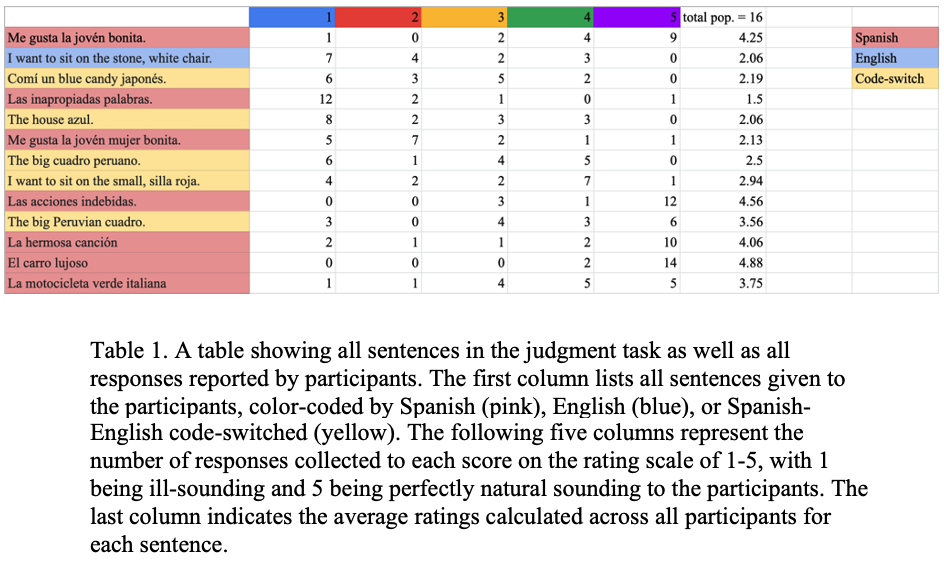
Table 1 below shows the average ratings of each sentence in the judgment test across all participants as well as the number of responses for each rating on the 1-to-5 scale for each sentence.

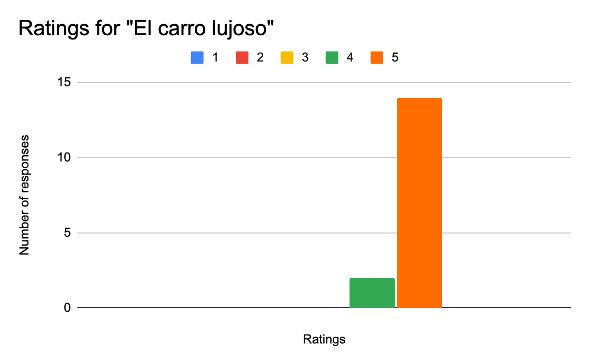
Looking at the average ratings from the participants for the judgment task, in which they judged sentences on a scale of 1 to 5 with a score of 1 being not appropriate sounding, and 5 being very appropriate, participants reported a score higher than 4 for sentences with a single adjective in the post-nominal position. This result is expected, since these sentences follow the typical Spanish noun-adjective order. Examples include: “El carro lujoso” (Table 2), “Las acciones indebidas”, and “Me gusta la jovén bonita”. For Spanish sentences that violate this typical grammatical construction, participants assigned average scores lower than 2. An example is “Las inapropiadas palabras.”

Table 2. A bar graph that shows participants’ ratings of the Spanish phrase, “El carro lujoso”. The green bar represents the number of participants who rated this phrase a 4 and the orange bar represents the number of participants who rated this phrase a 5.

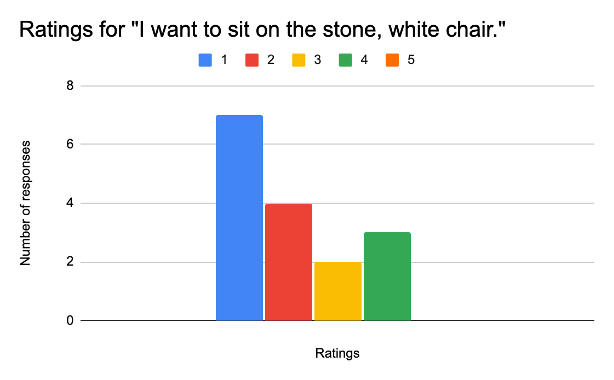
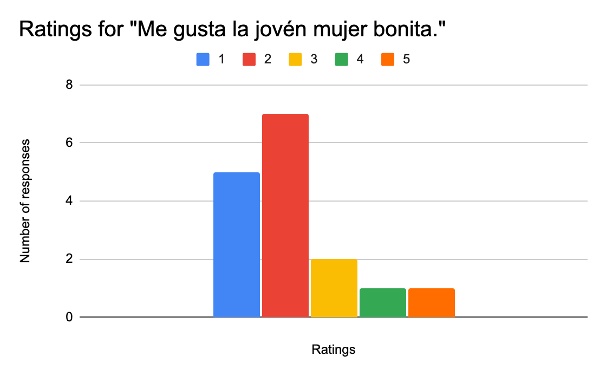
For English and Spanish-only sentences that contain more than one adjective, the participants’ scores appear to be on the lower side, but one sentence is also rated as more neutral (approximately a score of 3) in judgment. In the case of “I want to sit on the stone, white chair”, the average rating is 2.06, and this may be explained by the order of English adjectives, in which color adjectives are usually placed before material ones, such as “I want to sit on the white, stone chair” (Table 3). In the case of “Me gusta la jovén mujer bonita”, the average reported score is 2.13 (Table 4). This may be due to the fact that the sentence incorporates a less common adjective structure by locating one adjective pre-nominally and another post-nominally seen in Spanish. English-only grammar would adopt one or the other. Therefore, given that the sentence is in Spanish, participants may prefer to have both adjectives in the post-nominal position as it is seen by the participant as more native-like. A more neutral rating (approximately 3) is given to “ La motocicleta verde italiana”. Unlike the adjective-noun-adjective (ANA sequence) case above, both adjectives are placed post-nominally in this sentence, and since Spanish does not limit adjective hierarchy in the post-nominal position, some participants may prefer “verde italiana” while other prefer “italiana verde”, resulting in the more neutral distribution in score.

Table 3. A bar graph that shows participants’ ratings of the English sentence, “I want to sit on the stone, white chair.” The blue bar represents the number of participants who rated this sentence a 1. The red bar represents the number of participants who rated this sentence a 2. The yellow bar represents the number of participants who rated this sentence a 3. The green bar represents the number of participants who rated this phrase a 4.
Table 4. A bar graph that shows participants’ ratings of the Spanish sentence, “Me gusta la jovén mujer bonita.” The blue bar represents the number of participants who rated this sentence a 1. The red bar represents the number of participants who rated this sentence a 2. The yellow bar represents the number of participants who rated this sentence a 3. The green bar represents the number of participants who rated this phrase a 4. The orange bar represents the number of participants who rated this phrase a 5.

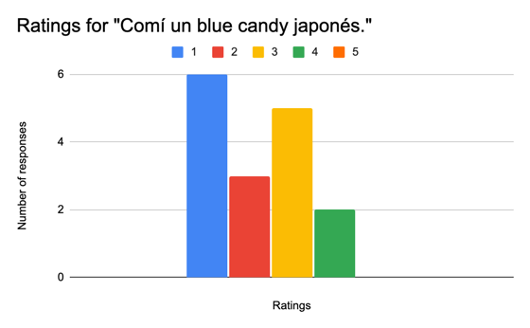
Lastly, the average ratings for most code-switched sentences are lower than 3, which indicates that the participants do not judge these phrases as appropriate sounding. See the following examples:

1. Comí un blue candy japonés. 2.19 (Table 5)

2. The house azul. 2.06

3. The big cuadro peruano. 2.5

4. I want to sit on the small, silla roja. 2.94

Table 5. A bar graph that shows participants’ ratings of the code-switched sentence, “Comí un blue candy japonés.” The blue bar represents the number of participants who rated this sentence a 1. The red bar represents the number of participants who rated this sentence a 2. The yellow bar represents the number of participants who rated this sentence a 3. The green bar represents the number of participants who rated this phrase a 4.

In Spanish grammar, an adjective-noun-adjective order is possible, but in the data shown above, most participants do not agree and do not accept this structure. One explanation may be the occurrence of transfer from English grammar. If this is the case, then the participants may subconsciously have an English-dominant syntactic structure in mind while processing these code-switched sentences, resulting in this lower rating. The following sentence further supports this explanation and shows a more neutral response from the participants:

5. The big Peruvian cuadro. 3.56

In this sentence, both adjectives – one English and one Spanish – appear before the noun, and on average, the participants think this sentence is more acceptable than the cases above. This suggests that participants deem an adj-adj-noun order more suitable than the cases above (including ANA sequences), which is the grammatical order seen in English but not Spanish sentences. Given that most participants self-reported to have had more formal instructions in English, have spent most of their life in an English-speaking region, talk to themselves mostly in English, and on average are more proficient in English skills than Spanish ones, this hypothesized explanation is possible. However, only one such sentence is reported in this study, and a rating of 3.56 is relatively neutral and not strong enough to indicate any determining conclusion on the possible transfer of English syntactic rules to Spanish.

Discussion

We originally hypothesized that heritage speakers of Spanish with lower proficiency in the language would adhere more closely to the English norms regarding noun-adjective order. Therefore, we predicted that less proficient Spanish heritage speakers would have a stricter understanding of noun-adjective order. However, since none of the participants rated themselves as low in proficiency in Spanish, we, again, conducted only a general analysis using all data.

As addressed above, our results do not show any solid evidence for cross-linguistic transfer of English adjective ordering rules to Spanish. In addition to the individual sentences mentioned above, an overall analysis dissects all data to suggest little to no transfer from English to Spanish: 1) most ratings are low for adj-N order in Spanish 2) use of mostly N-adj phrases in production 3) lower ratings of ANA sequences in Spanish. The first two observations would indicate no transfer from English. The third case may suggest possible transfer from English since English does not allow for ANA sequences. However, this may also be due to the infrequency of ANA sequences in general. According to the post in FluentU by Whitney Grace, the most common adjective sequence is to have only one adjective before the noun or after.

Furthermore, when later asked, the participants reported that a lower score is given to the code-switched sentences simply because they did not like having two languages mixed in a single sentence. They would prefer having either just Spanish or English in one phrase, or if code-switching does occur, it would be more natural-sounding to them when this switch occurs in sentences that are much longer instead of a short sentence as presented in our judgment task.

Our study also has multiple limitations. For one, our small sample size (16 people) restricts the generalizability of our study. Moreover, we were not able to ask all our participants about their reasoning regarding their judgments because unfortunately, we did not build this into the task. As a result, only the handful of participants who completed the naming task clarified why they answered the way they did on the judgment task. This is a major limitation, especially for the judgments made on the codeswitched sentences, since many of them could have rated them as unnatural only for the reason that they were codeswitched, not because they did not follow the rules of English or Spanish. Thus, our finding that participants experienced transfer from English is not clear as Spanish heritage speakers obey the adjective ordering that is most commonly used and may not be fully aware of the less frequent syntactic rules in Spanish, which then limits a holistic and evidential insight as to whether transfer from English has occurred.

Conclusion

From this study, it is shown that Spanish heritage speakers prefer the Spanish adjective order of noun-adjective in most Spanish-only cases and prefer the strict English order of adjective-noun in English-only sentences. On code-switched phrases, heritage speakers rated the constructions as non-native and would have preferred only one language per sentence. In terms of practical implications, our findings could contribute to improving Spanish classes specifically designed for heritage speakers. Although our results do not match with our initial hypothesis that syntactic transfer from English to Spanish may occur, the study nonetheless highlights some preferences and thoughts of processing languages from Spanish heritage speakers. In the future, it would be great to analyze heritage speakers of different proficiency levels in Spanish (as we originally intended) as well as heritage speakers growing up in different environments. This type of study can further be applied to heritage speakers of other languages to examine not only the linguistic differences across languages used by heritage speakers but also their cognitive processes and their intuition when presented with varying combinations of the distinct language systems.  

References

Birdsong, D., Gertken, L.M., & Amengual, M. Bilingual Language Profile: An Easy-to-Use Instrument to Assess Bilingualism. COERLL, University of Texas at Austin. Web. 20 Jan. 2012. <https://sites.la.utexas.edu/bilingual/>.

Camacho, José. “The Interpretation of Adjective-N Sequences in Spanish Heritage.” Languages 3.4 (2018): 46–. Web.

Montrul, S. A. (2012, August 8). Is the heritage language like a second language? University of Illinois Urbana-Champaign.

Pérez-Leroux, Ana et al. “Restrictions on Ordering of Adjectives in Spanish.” Borealis (Tromsø) 9.1 (2020): 181–208. Web.

Sánchez, Liliana & José Camacho. 2021. Adjectives in Heritage Spanish. Isogloss. Open Journal of Romance Linguistics 7, 3:1-20.

Whitney Grace. “The Guide to Spanish Adjective Placement: Quit Misplacing Those Descriptives!” FluentU Spanish, 18 Jan. 2022, https://www.fluentu.com/blog/spanish/spanish-adjective-placement/.

[/expander_maker]
Speaking to My Partner Only in Korean for 24 Hours!: How bilingual couples mitigate communication issues

Talar Anoushian, Kimberly Gaona, Kimberly Maynard, Ann Mayor, and Guoran Zhang

Communication within couples can be difficult at times, but is it different when they’re bilingual? This study aims to clarify any breakdowns in communication within bilingual couples when it comes to speaking to their less proficient language for a long period of time. The data used for this study was collected from YouTube challenge videos titled “Speaking to My Partner Only in Korean for 24 Hours”. The challenge goes as follows: the most proficient partner would speak in the challenged language, Korean, and the other partner would try to understand and respond to the conversation as much as possible. The two bilingual couples that were used for this study vary in Korean proficiency — one couple being intermediate and the other beginner. During the study, we found some patterns linking certain strategies for repairing communication to the varying levels of proficiency, meaning some strategies are more likely to be employed during bilingual communication when one of the speakers is less fluent. We also found some examples of how the nature of these couples’ relationship influenced how they approached certain communication breakdowns and their partner’s differing proficiency level.

[expander_maker id=”1″ more=”Read more” less=”Read less”]

Introduction & Background

Many of us have seen the popular videos where a bilingual speaker chooses to speak only their native language for 24 hours, much to the confusion of those around them who may not be as fluent. This challenge became especially popular amongst bilingual couples with different language backgrounds. Not only do these videos provide an entertaining viewing experience, but they also allow us insight into how bilingual couples communicate in their various languages and what they do when communication breaks down. We decided to use these videos to see how the strategies used to mend miscommunications differ between a couple where both speakers are fluent in the language being spoken and a couple where only one speaker is fluent in the spoken language. We are especially interested to see how they will choose to mend these misunderstandings when the option to switch into their shared language (the language they both speak most commonly) is taken away from them.

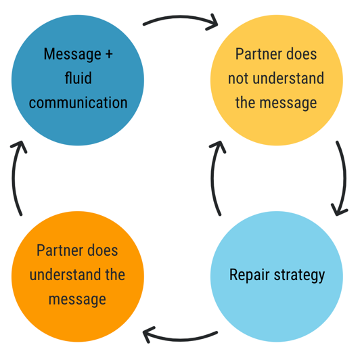
We decided to study Korean-English bilingual couples — more specifically, couples in which one partner is a native Korean speaker and the other varies in Korean proficiency. Recent studies have shown that the number of bilingual individuals has progressively increased in the past years, and this is especially true for South Koreans. For South Koreans, having ​​the flexibility to use their native Korean language proficiency as well as advanced English language proficiency gives these bilingual speakers an advantageous position in society (Choi, 2018). While their communication skills may seem advanced, bilingual speakers still run into errors and misunderstandings in their communication, and they use different methods to solve these. These methods used to resolve miscommunication are known as “repair strategies.” We developed a list of these strategies from various other studies and grouped them into two categories: self-initiated and other-initiated. The full list of the strategies along with their definitions (and the definitions of self-initiated and other-initiated) can be found in Table 5 in the Appendix. The way these strategies can come into play during conversation is illustrated in the image below:

Image 1: A flow chart showing the cycle of communication.

As shown in Image 1, the cycle of communication is as follows: two interlocutors are talking and a message is being communicated, then at some point, the addressee doesn’t understand what is expressed. Thus, the speaker uses a repair strategy in hopes of getting their intended message across. Sometimes, even after a repair strategy is used, the addressee still doesn’t understand what is being expressed, then the pattern repeats until the partner does understand the message. Once the message is successfully communicated, fluid communication continues.

To build our subject pool, we focused on the following popular Korean-English bilingual couples: Gohan and Cerose who share a YouTube channel named Jin & Juice, and Jin and Hattie Green who share an eponymously-named Youtube channel. Gohan and Jin are South Korean native men speakers, but their partners are non-native Korean speakers. Cerose of Jin & Juice is an American woman who learned Korean as she lived in South Korea, and she gradually acquired a native-like command of the language. Hattie is a British woman who lives with her partner in South Korea as well, and as a result she learned some basic Korean but speaks at a beginner level proficiency. Since each of these couples have a less fluent partner with varying levels of proficiency in Korean, we expected different strategies to be employed by each couple throughout the challenge. Since some strategies don’t involve an advanced level of Korean — like abort-and-abandon and avoidance — we expected the couple with only one fluent speaker to use these simpler repair strategies. On the other hand, other repair strategies like expansion and meta-repair require better understanding of Korean, so we expected the couple with two fluent speakers to use these and similar self-initiated strategies. However, we can’t definitively say which couple will code-switch from Korean to English, but we do anticipate that code-switching will be used mostly by the couple where only one speaker is fluent, because there would be no way to simplify what is said so that their partner can understand while still speaking Korean.

Methods

First, we collected data from the channels mentioned above performing the “Speaking to My Partner in Only Korean for 24 Hours” challenge. Below are the links to their respective channels:

Figure 2: Jin and Juice (890K subscribers)
Figure 3: Jin and Hattie (1.6M subscribers)
Figure 4: Farina Jo (1.28M subscribers)

Although we originally intended to study 3 different bilingual couples — Gohan and Cerose from the YouTube channel Jin & Juice, Dong-In and Farina from the YouTube channel Farina Jo, and JinWoo and Hattie from the channel Jin and Hattie — we realized that, as we began to collect data, Dong-In and Farina did not fit the specifications we had set forth for our subject pool. Dong-In and Farina are less of a Korean-English couple and more like a Korean-German couple since they use German more frequently in their everyday lives. Because of this, they were no longer good candidates for this study so we decided to remove them from our subject pool.

For our research, we used a similar method to Belgrimet’s (2020) study of bilingual students and their use of repair strategies in communication breakdowns. We looked specifically for moments where the communication breaks down to see what strategies are employed when code-switching is supposed to be avoided. We also looked for moments where a couple failed the challenge by using code-switching as a repair strategy. These repair strategies will be categorized using a defined list from various sources, and it can be found in the Appendix. To study Gohan and Cerose, we decided to watch their video “Speaking Korean to my girlfriend for 24 hours.” To study Jin and Hattie, we decided to watch their video “[AMWF] Speaking Korean To My Girlfriend for 24 hours ver.2 * she has no idea * | Calling Noona!?.

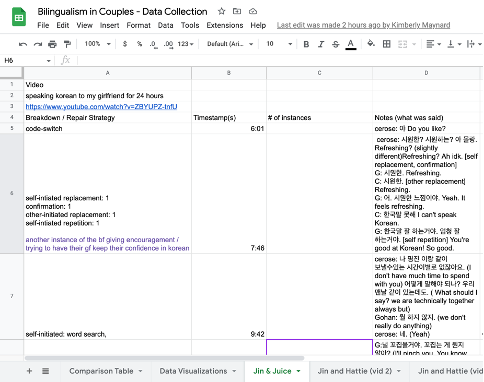
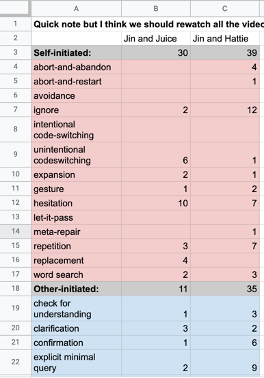
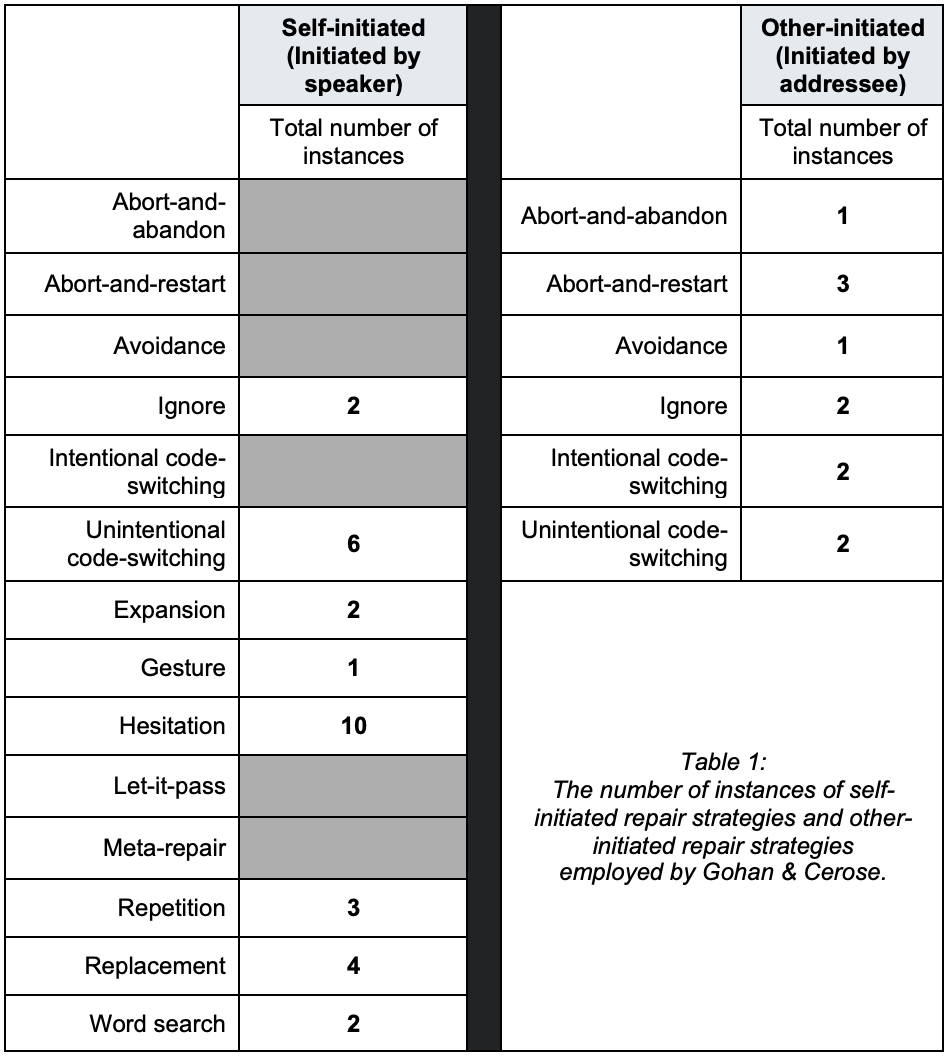
The different strategies used from each Korean-English couple will be compared to see any noticeable differences in their rate of usage. In order to perform this comparison, once all the strategies used by each couple have been counted, the data was inputted into a table to allow for easier side-by-side comparison. We also noted the function of the various strategies in an attempt to explain the reasons behind why certain strategies are more likely to be used in one context than another. In addition, we looked at intentional code-switching moments separately and, using our knowledge of code-switching and other repair strategies, drew some conclusions to explain why the speaker felt a need to code-switch instead of using a different strategy to repair the miscommunication. Below are examples of spreadsheets we created to tabulate our data and notes:

Image 5: An example of a spreadsheet that contains the repair strategies used by Gohan and Cerose.


Image 6: An example of a spreadsheet that compares the repair strategies used by our subject pool.

Results and Data Analysis

For the first couple, Jin and Juice (aka Gohan and Cerose) which contained two fluent speakers, we looked at their video “Speaking Korean to my girlfriend for 24 hours.” They used some of the strategies we discussed before, as seen in the table below.

For them, the most commonly used self-initiated strategy was hesitation. Most instances of hesitation were seen when Cerose was speaking Korean. For example, we have this instance from when she was applying lotion on Gohan’s face and explaining how she has been doing his skin-care for him:

Speaking Korean to my girlfriend for 24 hours (Timestamp: 5:03)

Cer: 요즘 명진이 피부가 너무. . .

      Lately Gohan’s skin is very. . .

Goh:  쓰래기라?

      Trash?

Cer: 응 너무 안 좋아서. . . 피부 관리. . 시키는거야
     
     Yeah it’s not very good so... I’m doing... 
     his skin care for him

Each “. . .” is a moment where she pauses or hesitates. The first one we actually classified as an example of “word search,” since Gohan fills in the next part of the sentence for her, but the next two are moments we labeled as “hesitation.” In this case, the hesitation seems to not only be due to her having to think of what to say in Korean, but also the fact that she is multitasking and applying lotion on Gohan’s face at the same time.

We also saw quite a few instances of unintentional code-switching in this couple. A couple of examples from Gohan include:

Speaking Korean to my girlfriend for 24 hours (Timestamp: 2:35)

Goh: 내가 요즘 유튜브에서 요리 tutorial 듣고 있는데... *gasp* 개물어

      I've been watching a lot of youtube cooking tutorials 
      lately… *gasp* bite me
Speaking Korean to my girlfriend for 24 hours (Timestamp: 5:16)

Goh: 여기 여기 *crevices*에도 해줘.

     Here, here get the crevices too.

We had expected that as the more fluent couple, they would be less likely to fail the challenge and code-switch since they would struggle less to communicate in Korean. Instead, we saw multiple instances of code-switching, but they were all unintentional like the ones above: not being used to resolve a misunderstanding but rather naturally coming out as they spoke.

When it came to the other-initiated strategies, there was no clear outlier in the data and they were all used pretty evenly. The strategy that was used the most was clarification, but not all instances of clarification were used to resolve miscommunication caused by the language gap. Sometimes it would be used simply to keep the flow of a conversation or just confirm information, similar to what we would see in monolingual conversations. For example:

Speaking Korean to my girlfriend for 24 hours (Timestamp: 2:32)

Cer: 배고파.

     I'm hungry

Goh: 배고픔?

     You're hungry?

Cer: 응

     Yeah

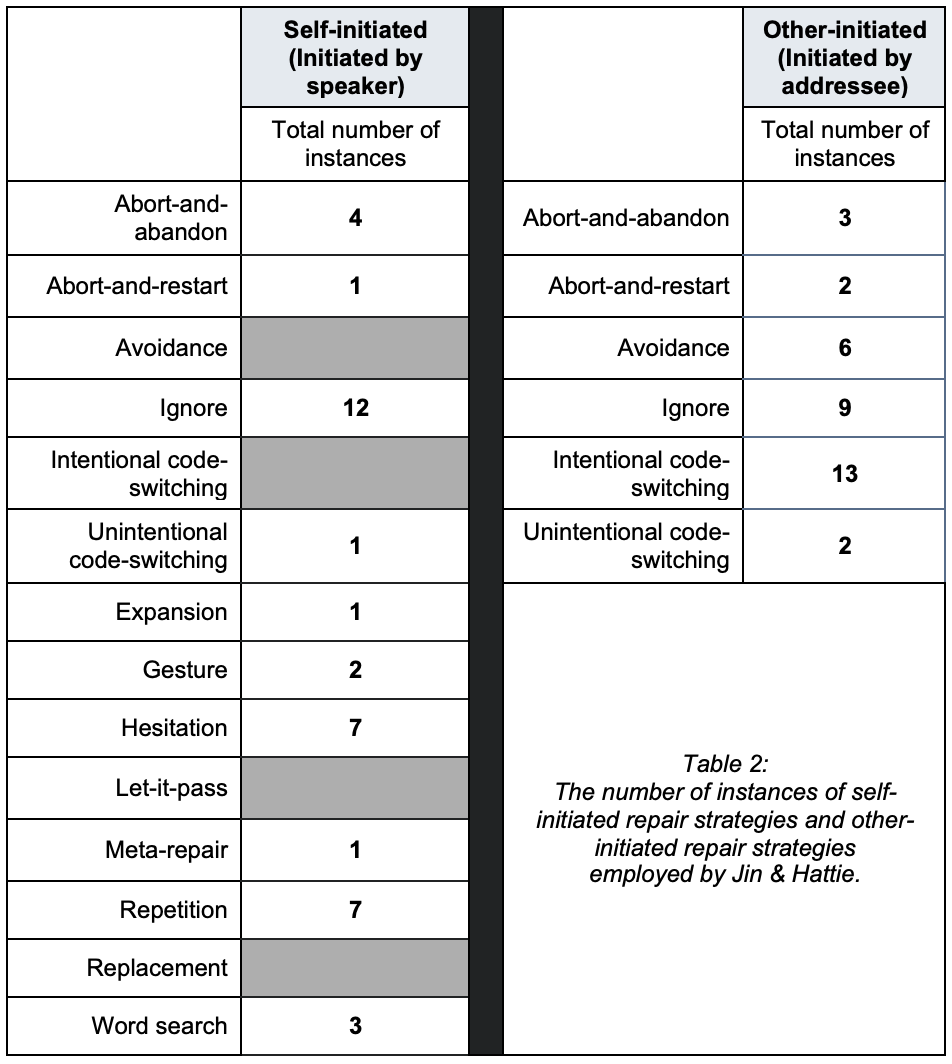
The next couple, Jin and Hattie, is the couple that has one Korean native speaker, Jin, and one beginner-level speaker, Hattie. Overall, this couple had far more communication breakdowns as Hattie could not understand most of what was said by Jin, which in turn led to a more frequent use of repair strategies. The numbers can be seen in the following table.

In this couple’s interactions we see a large amount of “ignore” happening. There were many moments in which Hattie could not understand what Jin was saying when he spoke Korean so rather than attempt to fix the situation she would simply act as if she had not heard what he said. Below is one instance in the video where we see a lot of ignoring on Hattie’s side as well as a lot of repetition on Jin’s side:

[AMWF] Speaking Korean To My Girlfriend for 24 hours ver.2 
* she has no idea * | Calling Noona!? (Timestamp: 1:31)

Jin: 아니 장미 맞아

     No you're right this is a rose

Hat: That's a really big rose. That can't be a rose.

Jin: 이거 장미 맞아

     This is a rose.

Hat:I should take a picture for my step mum. 
    She would love these.

Jin: 응.. 아니 이거 장미 맞다고

     Yeah.. But I said you're right this is a rose.

Hat: What?

Jin: 장미 맞다고 이거

     I said this is a rose

Hat: It's quite hot and sunny

Jin: 아니 너 왜 자꾸 다른 말 해? 내가 한국말 하는데

     Why do you keep changing the subject? I'm speaking Korean…

The first two times Jin tries to tell her she is right about it being a rose she doesn’t even look at him and continues talking to herself about whether or not it is a rose and how she should take pictures for her mother, giving us two instances of “ignore.” The third time, she does acknowledge that he is speaking to her and asks “What?” an example of “explicit-minimal query,” but after he repeats himself for the third time she goes back to ignoring him and changes the topic to the weather.

We noticed that in both couples there were instances of the native speakers using purposeful word-choice to make things easier for their partner to understand. For example, in Jin and Hattie’s video, there is one case where Jin uses a “Konglish” word, or a Korean word borrowed from English, as well as a time where he references a line from a drama that Hattie would be familiar with:

Konglish example:

[AMWF] Speaking Korean To My Girlfriend for 24 hours ver.2 
* she has no idea * | Calling Noona!?  (Timestamp: 4:31)

Jin: 나 이거 스킴해볼까?

     Should I try skimming this?

Hat: You're skimming rocks? We did skim rocks
Drama Reference Example:

[AMWF] Speaking Korean To My Girlfriend for 24 hours ver.2 
* she has no idea * | Calling Noona!?  (Timestamp: 1:51)

Jin: 나는!!

     I am!!! [reference from drama Itaewon Class]

Hat: 나는 박새로이 [unintelligible]. . . 감사합니다

     I am Park Seroi [unintelligible]. . . Thank you

For Gohan and Cerose, we found one possible instance of this type of “simplification” of the language to make it easier for the partner to understand:

Speaking Korean to my girlfriend for 24 hours (Timestamp: 2:20)

Cer: 몇시야?

     What time is it?

Goh: 지금?? 6시 32분 오후.. 밤 6시다

     Right now?? 6:32pm.. 6 o'clock at night

It isn’t entirely clear if this is just Gohan simply rewording how he says the utterance without any regard for her skill level, but we believe it’s possible that he purposely chose to switch from using 오후 “pm” to 밤 “night” which is a more straightforward and commonly-known word for Korean learners.

There are also times where they seemed to be trying to increase their partner’s confidence in Korean. For instance, in Jin and Hattie we see an example of Hattie gaining confidence as she understands something Jin says, and even though she clearly misunderstands what he says after he chooses not to mention this and instead acts as if she is doing well to let her maintain her confidence:

[AMWF] Speaking Korean To My Girlfriend for 24 hours ver.2 
* she has no idea * | Calling Noona!?  (Timestamp: 6:59)

Jin: 여기 연어가 진짜 맛있어

     The salmon here is really delicious

Hat: It's really delicious

Jin: 어떻게 알았어?

     How did you know?

Hat: I know! I know what you're saying! It's really 
     annoying cause I can actually understand you this time.

Jin: 그럼 말해

     Then say something

Hat: Yes

Jin: 한국어로 말해

     Say something in Korean

Hat: I can understand Korean. My Korean's getting better.

Jin: 오호호.. [unintelligible]

     Ohoho [unintelligible]

Hat: I can't say anything but I can understand it.

Jin: Boom

We can see that when he asks her to say something in Korean, she clearly misunderstands and responds as if he is saying something else. However rather than bringing this up and making her realize that she misunderstood, he reacts with supportive responses and lets her continue to believe that she understood.

As for Jin and Juice, Gohan attempts to increase Cerose’s confidence with direct compliments such as below:

Speaking Korean to my girlfriend for 24 hours (Timestamp: 7:50)

Cer: 한국말 못해

     I can’t speak Korean

Goh: 한국말 엄청 잘하는 거야

     Your Korean is really good

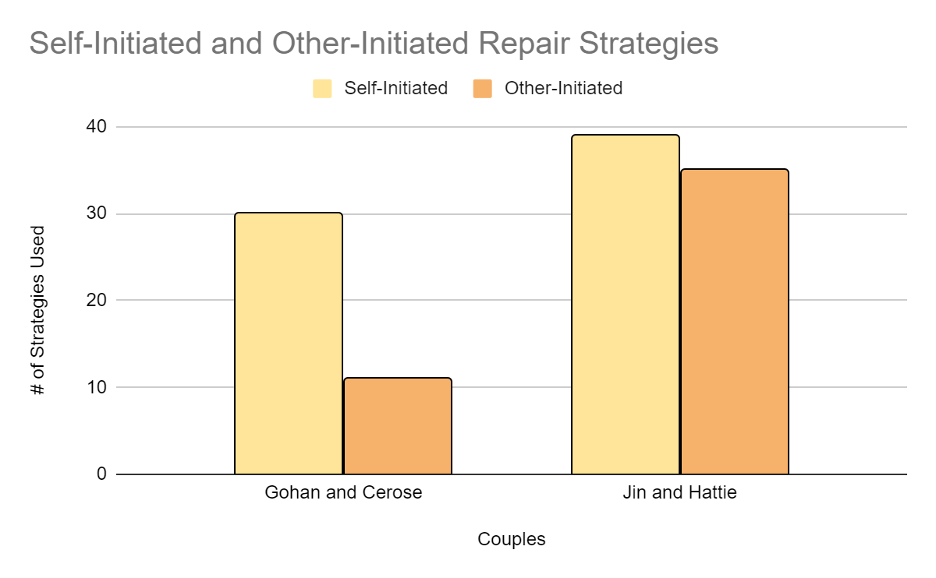
All in all, when looking at repair strategies, as we expected the less fluent couple had to use more strategies overall and did use some of the strategies we had predicted such as other-initiated repetition and ignore. We also expected that the fluent couple would use more self-initiated strategies, which was supported by our data. Both couples used a similar amount of self-initiated strategies total, but when we compare this amount relative to the amount of other-initiated strategies used, we see that Jin and Juice used self-initiated strategies far more than other-initiated strategies.

Chart 1: A comparison of Self-to-Other Repair Strategies used by both couples.

The one aspect of our data that contradicted what we were expecting was the data on code-switching. Unexpectedly, the more fluent couple, Gohan and Cerose, code-switched more than Jin and Hattie. However, we expected code-switching to be employed purposely to resolve non-understandings, which would be intentional code-switching. Since all instances we saw were unintentional code-switching, this could explain why the fluent couple was more likely to code-switch. Due to the fact that they both have good command over both Korean and English, it is likely that they code-switch more often than Jin and Hattie in their day-to-day life, thus the instances of unintentional code-switching could be explained as a result of habit.

Discussion and Conclusions

Based on the collected data, we came to the conclusion that lower fluency equals more breakdowns in communication because of the lack of understanding. Gohan and Cerose’s conversations were a little smoother due to their higher proficiency in Korean. Compared to Jin and Hattie, where Hattie was the less proficient partner, there were more breakdowns in communication. We also did find certain strategies were employed far more by the less fluent couple, indicating a link between repair strategies used and proficiency level.

In conclusion, bilingual couples can struggle in communication due to the many languages involved and their level of proficiency in each language. This study can help us understand bilingual couples and the ways they fix miscommunications while dealing with varying language proficiency. Ultimately, we can see how being bilingual does not mean that you are linguistically handicapped, and it’s rather advantageous to have access to other languages and ways to express yourself. 


References

Belgrimet, S. (2020). A conversation analysis of repair strategies in communication breakdowns: A case study of algerian bilingual students. International Journal of English Literature and Social Sciences, 5(2), 459–467. https://doi.org/10.22161/ijels.52.21

Choi, L. J. (2018). Legitimate bilingual competence in the making: Bilingual performance and investment of Korean-English bilinguals. International Journal of Bilingualism, 23(6), 1394–1409. https://doi.org/10.1177/1367006918791266

Cogo, A., & Pitzl, M.-L. (2016). Pre-empting and signalling non-understanding in Elf: ELT Journal, 70(3), 339–345. https://doi.org/10.1093/elt/ccw015

Firth, A. (1996). The discursive accomplishment of normality: On ‘lingua franca’ english and conversation analysis. Journal of Pragmatics, 26(2), 237–259. https://doi.org/10.1016/0378-2166(96)00014-8

Gullberg, M., & McCafferty, S. G. (2008). Introduction to gesture and SLA: Toward an integrated approach. Studies in Second Language Acquisition, 30(02).
https://doi.org/10.1017/s0272263108080285

Stępkowska, A. (2021). Language choices between partners in bilingual relationships. GEMA Online® Journal of Language Studies, 21(4), 110–124.
https://doi.org/10.17576/gema-2021-2104-06

West, T. (2018). A Conversation Analysis of Repair Strategies in Multilingual English Discussion Classes. New Directions in Teaching and Learning
English Discussion
, 6.

[/expander_maker]
Using Google Translate? Ask a Bilingual Instead!

Gustavo Gutierrez, Abby Minervini, Ryley Park, Ana Rios, and Santiago Valdez

One of the many myths in the field of bilingualism is that bilinguals are “born translators” due to their ability to switch and communicate in more than one language. Nonetheless, if you have ever witnessed a professional interpreter in action whether at a hospital, courtroom, or school, you may have noticed that interpreting and translating are no easy tasks. While we know that being bilingual does not automatically turn you into a professional interpreter/translator, it appears that language brokering, the task of translating and interpreting that many bilingual children take on to aid their parents or relatives, seems to benefit bilinguals’ ability to interpret and translate in settings where it is critical that communication is as accurate and smooth as possible, such as in the medical setting. The following study explores the relationship between language acquisition background and interpretation and translation abilities by examining the performance of two groups of bilinguals, namely Early Childhood Bilinguals and Second Language Learners, when asked to facilitate communication by translating and interpreting within a medical context. Keep on reading to find out the differing translation abilities and tendencies of these two groups of bilinguals!

[expander_maker id=”1″ more=”Read more” less=”Read less”]

In this research project we sought to compare the translation abilities of Spanish-English and Korean-English early childhood bilinguals (ECB) to second language learners (L2 learners) of Spanish and Korean. Early childhood bilinguals are those who acquire and develop their second language (L2) during early childhood (birth to 8 years old). Second language learners are those who learn their L2 at a more mature age, after already acquiring their first language (L1). We chose Spanish-English and Korean-English bilinguals due to the high population of Korean and Spanish speakers in Los Angeles, where this project was conducted (Data USA, 2019). For the purpose of this study we centered the context of translation/interpretation on a medical setting, due to the high-risk environment and necessity for accurate translations. Our participants included 7 ECBs of Spanish-English, 7 L2 learners of Spanish, 7 ECBs of Korean-English, and 3 L2 learners of Korean all of whom were 19-23 years old.

That being said, we attempted to answer the following questions:

  • Do early childhood bilinguals have an advantage over second language learners when it comes to maintaining meaning when translating/interpreting?
  • How does each group’s linguistic background affect their interpretation/translation skills?

Background

Previous research in Second Language Acquisition has often categorized L2 Learners as being more aware of their L2’s structure and linguistic properties, mainly due to their formal instruction and relatively late learning onset (McLaughlin, 1981). While this type of linguistic awareness might prove useful in certain situations, it does not necessarily equate to a greater ability to express meaning and communicate effectively (Colina, 2002). Because of this and the fact that L2 Learners are likely to have less exposure to their L2 than ECBs, we imagine that L2 Learners are less skilled at accurately expressing meaning in translations and interpretations, because they might be more focused on correctly translating the structure of the language.

Similarly, literature on the area of Language Brokering differentiates child L2 Learners and adult L2 Learners by their priorities when producing in the L2. For example, one study found that children prioritize accurate meaning when producing in the L2, whereas adults are more likely to prioritize grammatical correctness and structural form (Fathman, 1975 as cited in McLaughlin, 1981). In another study, it was found that children with prior language brokering experience had higher levels of metalinguistic abilities and enhanced problem-solving skills (Lopez et al., 2019). Given these findings, we decided to have our study focus on bilinguals with differing language acquisition backgrounds to better understand their priorities and tendencies when translating and interpreting.

When analyzing translations, it is important to understand what must occur in order to produce an accurate translation. Schwieter and Ferreira (2018) define translation and interpretation as processes that involve the comprehension of the input in the source language, its deverbalization or mental decomposition, and, lastly, its re-expression as output into the target language. Because preserving meaning while attempting to construct a message with a sound structure is difficult, we believe that our study can contribute to the body of knowledge in the area and potentially lead to new approaches for interpretation and translation training. Ultimately, it is crucial that all patients, regardless of whether they can speak English, have access to professional interpreters and translators as something as important as their health and well-being is at stake (Tonkin, 2017).

Method

We had participants reply to a 3-part questionnaire that included sociodemographic questions, a translation task and an interpretation task. The translation task asked participants to translate three medical terms from English to Spanish/Korean and three medical terms from Spanish/Korean to English. The interpretation task asked participants to interpret 4 sets of dialogue between a doctor and patient. The first two asked them to interpret the doctor’s English lines and the last two asked them to interpret the patient’s Spanish/Korean lines. This was to emulate an appropriate context for using interpretive skills. For the translation task, we looked at the percentage of participants that had correct translations, and for the interpretation task we identified patterns and tendencies for each group’s translations.

Results

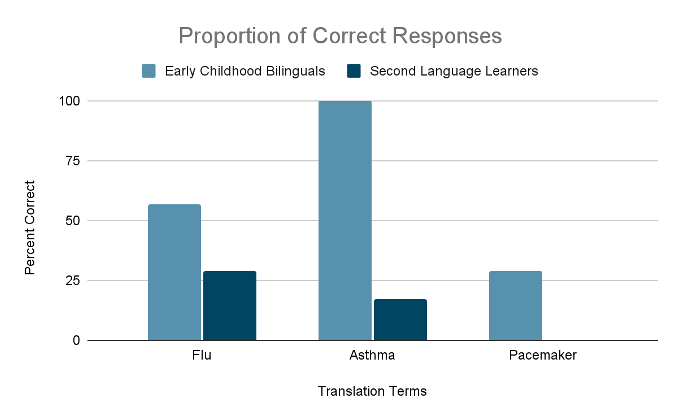
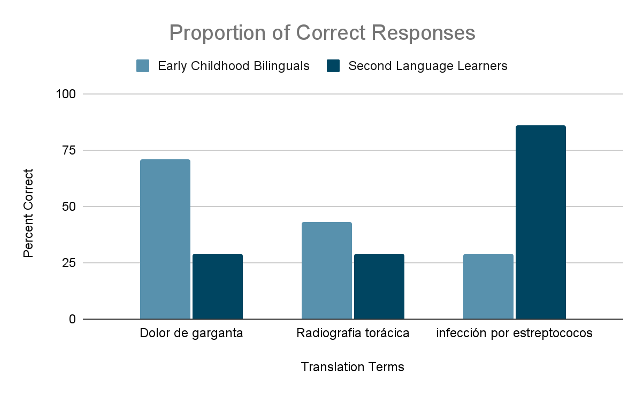
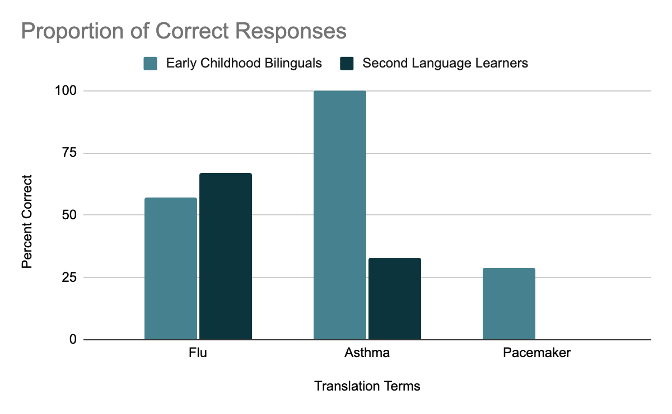
For our Spanish speakers, we found that the ECBs performed better on five of the six single-word translations that are displayed in Figures 1 and 2. The ECBs were more likely to come up with the correct translation, except for the Spanish term “infección por estreptococos.”

We cannot fully understand why this happened, but we predict that the L2 Learners were better at making educated guesses for this term because they often used context clues when they did not know the exact translations. For example, when translating dolor de garganta into English, many of them said throat pain or pain of throat. However, this term actually means sore throat in Spanish. As individual words, dolor means pain and garganta means throat. Therefore, we predict that they made educated guesses based on their knowledge of these terms, but overall did not know the target translation. This distinction is important because throat pain and sore throats are very different medical ailments, which proves why specific medical translations are essential.

Figure 1. Terms from the Translation Task that participants had to translate from English to Spanish.
Figure 2. Terms from the Translation Task that participants had to translate from Spanish into English.

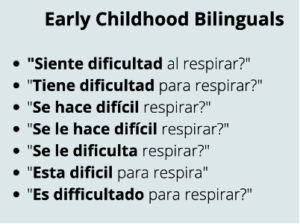
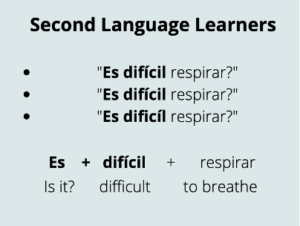
For our interpretation task, we knew that there would be more variability in responses, so we decided to analyze them by seeing if there were any patterns in how each group decided to translate. The responses from each group are displayed in Figures 3 and 4. When translating Is it difficult to breathe? we noticed that all of the L2 Learners had identical responses: Es difícil respirar?

Figure 3. Responses from ECBs on Interpretation Task for “Is it difficult to breathe?”  
Figure 4. Responses from L2 Learners on Interpretation Task for “Is it difficult to breathe?”


They provided a very literal translation that coincides word-for-word with the English sentence. In contrast, the ECBs had more variety in their responses, using a broader vocabulary and more complex sentence structure. In general, the ECBs produced more complex interpretations that took the concept from English and conveyed it in a natural way in Spanish. Overall, the L2 Learners tended to maintain word choice and sentence structure across translation, while the ECBs demonstrated more flexibility in their responses.

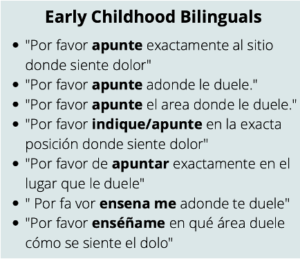
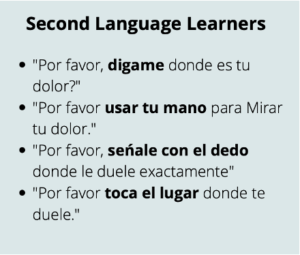
Next, we noticed another difference in translation patterns for this sentence: Please point to the exact spot where it hurts. The ECBs provided very precise translations, whereas the L2 Learners were vaguer. As shown in Figure 3, five of the seven ECBs selected the Spanish verb apuntar as the translation equivalent of point. In contrast, none of the L2 Learners selected this word. In fact, all of them had unique responses. As shown in Figure 4, the L2 Learners use phrases like digame (‘tell me’), usar tu mano (‘use your hand’), señale con el dedo (‘point with your finger’) and toca el lugar (‘touch the place’) that have the intention of communicating pointing. It seems that they don’t know how to exactly express point, so they use these roundabout phrases instead. This is likely because the L2 Learners have weaker vocabularies.

Figure 5. Responses from ECBs on Interpretation Task for “Please point to the exact spot where it hurts.” 
Figure 6. Responses from L2 Learners on Interpretation Task for “Please point to the exact spot where it hurts.”


Overall, the ECBs are mostly able to come up with a singular word to mean point, but the L2 Learners all used different phrases to try and communicate the same meaning.

While we noticed these differences when translating from English to Spanish, we did not identify many interesting patterns when the groups translated in the opposite direction. It seems like translating from Spanish to English was easier for both groups, because we had many more responses. Also, there was less variation in translations among groups and between groups, which led to very similar data.

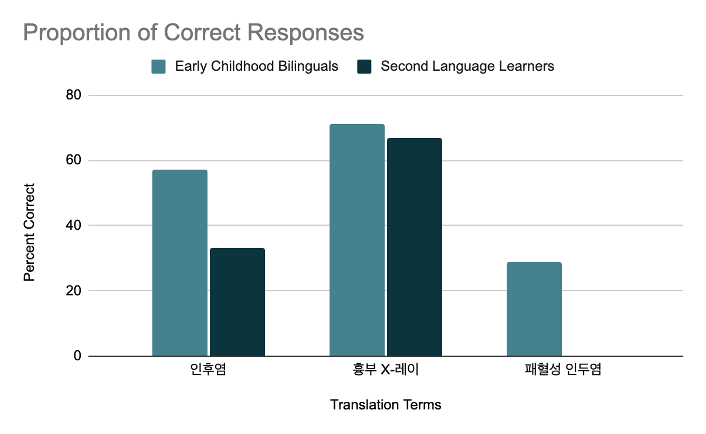
For the Korean results, the ECBs also performed better on five of the six single-word translations. However, we significantly lacked data from the L2 Learners with only three participants. Most ECBs successfully translated the terms from English to Korean, whereas L2 learners appeared to struggle, averaging a 33% success rate.

Figure 7. Terms from the Translation Task that participants had to translate from English to Korean.

When translating from Korean to English, we noticed that there were some over-translations among the ECBs. For example, our target word was 패혈성 인두염 (‘strep throat’), but they answered septic pharyngitis which is a more scientific term for strep throat.

Another term that was over-translated is 인후염 (sore throat) where we received the term laryngopharyngitis. In this case, sore throat should be pharyngitis rather than laryngopharyngitis which means a sore throat and an inflamed voice box. Since these terms are actually different, it is important to note since they may require different medical treatments.

Figure 9. Responses from ECBs on Interpretation Task for “Please point to the exact spot where it hurts.”
Figure 10. Responses from L2 Learners on Interpretation Task for “Please point to the exact spot where it hurts.”


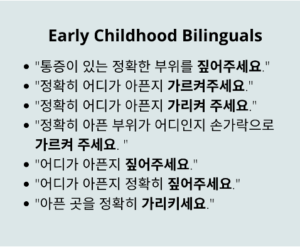
In the interpretation portion for the Korean data, the participants translated, “Please point to the exact spot where it hurts.” from English to Korean. In the Korean language, there is no exact equivalent for the term, point, so this term is usually related to the phrase 가르켜주세요, which is directly translated to teach me. The closest direct translation for point is 짚어주세요. For this task, we saw that all of the ECBs answered using either 가르켜주세요 (teach me) and 짚어주세요 (point) when they interpreted for point. On the other hand the L2 Learners did not have correct answers as they completely neglected the term point since it is a more difficult term to translate and instead answered with 어디가 아파요? (Where does it hurt?) making their answers more concise and even changing the statement into a question.

Figure 11. Responses from ECBs on Interpretation Task for “배 위에 난방 패드를 붙이면 기분이 좋아져요.” 
Figure 12. Responses from L2 Learners on Interpretation Task for “배 위에 난방 패드를 붙이면 기분이 좋아져요.”


For the next interpretation task we analyzed 배 위에 난방 패드를 붙이면 기분이 좋아져요 (I feel better when I put a heating pad on my stomach). While all of the ECBs mentioned the phrase, feel better (기분이 좋아져요), the L2 learners simplified the phrase by saying helps instead and restructuring the sentence from the target answer. Overall, the answers provided by the ECBs were much more detailed and accurate whereas L2 learners provided more concise answers or none at all. While the ECB answers varied, they used words with the same meaning consistently throughout all the tasks.

Discussion

An important finding in the translation task was that ECBs were better at translating medical terminology because they performed better in five out of six translation questions. This finding supports our hypothesis that the linguistic background of ECBs is advantageous to their translation abilities. For example, ECBs were more likely to give the actual translation for dolor de garganta (‘sore throat’), whereas L2 learners tended to make educated guesses based on their knowledge of what dolor (‘pain’) and garganta (‘throat’) mean, showing that they did not know the actual translation. This same finding was also true for Korean-English participants.

One important finding in the interpretation task was that ECBs had better lexicons and understanding of the language because they used specific Spanish words like apuntar (‘to point at’), whereas L2 learners had to find different ways to convey the English word point with words that they know such as, usar (‘use’), señale (‘show’), and toque (‘touch’). In addition to the frequency of ECBs acting as language brokers, our questionnaires also show that they acquired Spanish at the age of five or younger, and had more frequent exposure to the language compared to L2 speakers, which likely leads to improved vocabularies and understanding of the language. This same finding was also true for Korean-English participants.

The last finding in the interpretation task was that ECBs were more likely to be flexible and advanced in translating by using different structures. For example, they used Spanish phrases such as tiene dificultad para respirar? (‘Have difficulty breathing?’), se le hace difícil respirar? (‘Is it difficult for you to breathe?’), and others. From our questionnaire data, we saw that ECBs have more translation experience than the L2 learners, which likely prepared them to focus on translating meaning rather than the exact structure, because they know how a concept might be conveyed differently in each language. In contrast, L2 learners were likely to mimic the same structure of the first language, such as their word-for-word translation, es difícil respirar? (‘Is it difficult to breathe?’). This same finding was also true for Korean-English participants.

Based on the results of our study, we confirmed that ECBs were more likely to prioritize meaning, whereas L2 learners prioritized speech form and structure as expected from the studies we drew upon. Therefore, this further supports the notion that the L2 Learners’ awareness of language properties does not equate to the ability to accurately express meaning.

Our research can be particularly useful for the medical and healthcare industry, where professional translators and interpreters are needed to facilitate communication with patients. The findings of our study suggest that companies might prefer to hire ECBs because they are likely to have more experience with translating and interpreting than L2 learners. However, the slight variations in which ECBs expressed meaning also indicate that being bilingual does not necessarily mean you will be a perfect translator or interpreter, which is why it is important to have professionally trained experts. Our findings do show that there are benefits of learning a second language at an early age. Therefore, encouraging parents to consider bilingual education for their children at an early age can help develop their translating and interpreting skills, expand their lexicon, and allow them to comfortably use both languages, which could be seen with some of our participants.

Conclusion

Researchers should consider replicating this study on a much larger scale to ensure that there is enough data from each group. This study could also be improved upon by having pre-tests, such as cloze tests, that can accurately measure the fluency levels of the participants to compare the translation abilities of those that have similar proficiency levels. We didn’t measure the proficiency levels of participants other than by asking them to rate their own abilities in Korean and Spanish.

While the ECBs seemed to perform better than the L2 learners on a few different measures, ECBs still experienced their own struggles when translating certain medical terminology. This demonstrates that bilinguals are not born translators and being bilingual is not necessarily a sufficient requirement for professional translators and interpreters, especially in a medical setting.


References

Colina, S. (2002) Second Language Acquisition, Language Teaching and Translation Studies. The Translator, 8:1, 1-24, DOI: 10.1080/13556509.2002.10799114

Data USA. (2019) “Non-English Speakers in Los Angeles, CA.” Data USA, https://datausa.io/profile/geo/los-angeles-ca/demographics/languages.

López, B. G., Lezama, E., & Dagoberto Heredia, Jr. (2019). Language Brokering Experience Affects Feelings Toward Bilingualism, Language Knowledge, Use, and Practices: A Qualitative Approach. Hispanic Journal of Behavioral Sciences, 41(4), 481–503. https://doi.org/10.1177/0739986319879641

McLaughlin, B. (1981). Differences and similarities between first- and second-language learning. Annals of the New York Academy of Sciences, 379, 23–32. https://doi.org/10.1111/j.1749-6632.1981.tb41994.x

Schwieter, J., & Ferreira, A. (2018). Bilingualism, translation, and interpreting (pp. 251–266).

Tonkin, E. (2017). The importance of medical interpreters. American Journal of Psychiatry Residents’ Journal, 12(8), 13–13. https://doi.org/10.1176/appi.ajp-rj.2017.120806

[/expander_maker]
Attrition amongst Spanish Bilingual Young Adults in Los Angeles

Elie Barbar, Said B., Bel Jacob

It is well-known that one’s language fluency decreases the less one utilizes it. In particular, heritage speakers are a unique case in which their first language is spoken often within a familial context, yet in all other cases, it is not used. This study sets out to examine Spanish heritage speakers in the Los Angeles area to determine whether growing up solely in Los Angeles has affected their level of attrition in the Spanish language. The main hypothesis was that because Spanish is only spoken in a familial context, the speakers would have an average or below-average grasp of the language. The methods utilized to study this included a mix of surveys, tests, and interviews conducted to determine attrition rates amongst the participants. After using these methods, we found that Spanish Heritage Bilingual Young Adults in L.A. had an above-average fluency within the language, exceeding our original expectation of the participants having average or below-average levels of fluency. The main assessment from the data as to why these speakers have retained their heritage language so well is due to the environment they grow up in. Within Los Angeles, Spanish is widely spoken so not only do the participants have a chance to speak it with their family but with the outside world as well.

[expander_maker id=”1″ more=”Read more” less=”Read less”]

Introduction

Attrition and incomplete acquisition have been one of the most intriguing concepts in language development–many children grow up learning multiple languages at once, especially in densely populated areas of bilinguals, including Los Angeles. Our study goal was to discover the degree of attrition in reading and writing amongst young adults in Los Angeles. We wanted to investigate the relationship between attrition of L1 and formal education in L2. In Los Angeles, 42% of the population speaks Spanish vernacular due to it being their heritage language while being formally educated in English, which could either lead to attrition in the future or incomplete acquisition of the Spanish Language. Attrition is the loss of language over time despite fully acquiring it during youth due to multiple factors such as “emigration, extensive use of L2 in daily life” (Schmid & Köpke, 2007), while incomplete acquisition is when children deviate from the norm and were never able to fully acquire a language (Köpke, 2018). In addition, Keijzer (2008) discusses Roman Johnson’s hypothesis, stating that “forgetting a language is the reversal process of learning the same language,” which was taken into account here because we believe this depends on age – a child may acquire a language in a few years but take many more as an adult for attrition to occur.

Linguists have hypothesized in the past through the interdependent development hypothesis that learning a second language could be accelerated if one or the other is morphologically rich, which Spanish is morphologically rich. In other words, the evidence points toward children being able to acquire both English and Spanish properly (Liew, 1996). In addition, since the parents’ L1 is Spanish, it would allow the child to be exposed to Spanish properly for the first few years of life, before heavily integrating into the American society to acquire English as well. While we cannot be certain whether attrition or incomplete acquisition, previous evidence and patterns of communication of parents tend to suggest the complete acquisition of both languages, meaning that attrition is more appropriate to test here. However, there has been evidence to support that if there is somewhat of a lack of language input for the child, then incomplete acquisition may occur – in a study about bilingual English-Spanish speakers, mothers were strongly working toward maintaining their children’s Spanish abilities: “the experience of these Spanish-speaking mothers reveal that while they perceived bilingualism as important for work and family communication, they often struggled to sustain their children’s Spanish development using various home language policies and discourse strategies…several mothers reported that their child was starting to prefer English, not only with siblings and peers but also with Spanish-speaking adult caregivers” (Surrain, 2018, p. 20). This evidence suggests that formal education, as young as preschool, can play a role in L1 language attainment if parents are not providing enough input of the heritage language to the children. This could translate to attrition in college students due to the potential lack of constant input of their L1. This is why we hypothesize that due to the lack of writing and reading and strictly using L1 orally, heritage speakers will greatly suffer in competency scores since their formal education is focused on English, the dominant language. Our prediction is that test scores will be middle to low.

Methods

Participants included 13 Spanish bilingual young adults from ages 18-21. All of them were recruited in the Los Angeles area and speak LA vernacular Spanish. First, the participants filled out a survey, investigating their perceived proficiencies in speaking, listening, reading, and writing in Spanish, as well as frequencies and demographics in which they would use LA vernacular Spanish. Then, they were given a college-level written test from CLEP (College Level Examination Program). Lastly, they were offered an optional interview to explore discrepancies between their perceived proficiency and the actual test results. We analyzed their degrees of attrition and deficiency in competency in their L1, mostly in morphosyntactic structures by observing what areas of morphosyntax they tend to struggle with the most.

Results

Survey Results:

Figure 1 (a, b, c): Perceived proficiency before the test.


Figure 2: Frequency in which the 13 participants use the given areas of language asked.


Figure 3: Preference of Spanish versus English in certain given social environments.


Test Results:

Figure 4: The collective test scores of the reading/writing test consisting of 15 questions.


Figure 5: Example of the most missed question among the participants.


Interview Results:

(Linguistic Landscape)

“Living in LA I read Spanish in a lot of different places, like billboards and fliers. It’s not everywhere in LA but I see it.”

“My parents and I try to keep up on our Spanish. We agree that we will exclusively speak it at home. And when we go to the market and places like that, we see it all over the place.”

“I never really took a Spanish class, but I see it when I am out in town or when I go to Mexican grocery stores. It’s not complicated stuff but I see it written and I read it.”


( Attrition / Dominant L2)

“I took some Spanish in high school because it was required, but I don’t read it often and I don’t write it ever. It’s mostly just speaking it at home.”

“I only really speak it at home with my parents, but other than that I don’t use it often.”


(Dialect and Prescriptivism)

“This kind of Spanish isn’t exactly the type of Spanish I use, it seems like this is more like Spain Spanish.”


Analysis

When observing the figures in the proficiency portion of the survey, our participants were fairly confident in their abilities as well-rounded bilinguals. There is a common consensus that the more someone speaks a language, the more comfortable they will become speaking the language. The average proficiencies were well above our predicted levels, as we predicted a steeper drop in the confidence in reading and writing. This goes against our hypothesis that predicted that formal education would have a significant effect on proficiency levels in reading and writing. There was a significant drop in confidence in relation to the participant’s confidence in their writing ability which does go in the direction of what we expected, just not by the amounts that were projected. One should keep in mind that the group is a mix of heritage speakers with and without formal Spanish education. This may have an impact on the data.

In the aspect of frequency of use, the frequency of speech portion is relatively high but our expectation was for a middling average. The frequency is similar to the perceived confidence in language use which is interesting. The frequency numbers drop in a similar way to the proficiency. The lower confidence level in reading and writing seems to have a correlation to the frequency of use, thus it can be stated that frequency of use possibly bolsters confidence in an area of speech. One note is that the frequency of writing in Spanish is even lower than the confidence level of writing in Spanish.

When asked about the social environments in which our speakers use Spanish, the results are extremely stacked in one direction. The language of choice in most instances was overwhelmingly in favor of English. The only instance of the prominent use of Spanish is with older family members. This in a way is logical since the parents’ L1 is Spanish and they would feel more comfortable communicating in the Spanish vernacular of their heritage language rather than English. Even with younger family members, the numbers polled much stronger toward English, but a decent number still spoke to them in Spanish. This information tracks with our hypothesis of attrition, in that English, has the dominant use in their day-to-day language usage. However, this was the only portion of our data to support our claim.

The Spanish reading and writing test proved to predominantly correspond with the perceived proficiency stated in the survey. Eleven of the participants scored ten or higher on a fifteen-question test. The most common score was twelve out of fifteen for four participants. Scores thirteen and fourteen account for another four participants.

One strange observation is the two outlier scores of eight correct answers. Upon viewing these tests individually, some seemingly simple mistakes were made, and for some, the commonality was a bit of struggle on the correct past form to use. One explanation could be a rushed test taker not completely reading the question upon answering, but this is not confirmed. The case of the incorrect past forms is a small commonality of about two questions incorrect on it. Here the participants had a hard time distinguishing between the preterit or the imperfect forms. The reason we believe that the test was rushed is that the clues to use imperfect are usually with the text, and if the text is not fully read, then the reader may not be alerted to use the imperfect. These two participants also missed some easy questions that a beginner Spanish learner would get correct, let alone a heritage speaker. There is no real way to truly claim that a rushed test is the reason for these outliers, but from the evidence presented, this may be the likely case. This also calls to question our methods, as they may be too long for participants to where they may rush through the test and skew our results.

Ultimately though, our participants exceeded our expectations in terms of testing. The test results produced were higher than expected with only our two outliers being in the middle. Even the questions that were wrong could be argued to be fully grammatical depending on the variety of Spanish used as this is a prescriptivist Spanish test. They did however struggle with a particular question pertaining to the present progressive, and whether or not to add a preposition. This phrasing is more typical of formal written language, rather than spoken language. There is a lack of a present progressive trigger word like “estar”, making this even more marked.

The final portion of the test was an optional interview portion asking about participants’ scores, many of whom responded with comments about living in the Los Angeles area and seeing Spanish in their environment. Linguistic landscape has played a large role in the test results according to our participants. Many of them are subjected to many forms of written Spanish stimuli in their surroundings due to the large Spanish-speaking community in Los Angeles. This was not taken into account when planning our experiment but gives us a good idea as to why our data concluded the way it did.


Discussion

Foremost, our biggest flaw was not taking the linguistic landscape into account for our project as a whole. Our early results were strange when first testing, we could not predict just how well our participants projected and performed. Our interview portion really shed light on our shortcoming of neglecting such an influence on heritage speakers in this area. That being said, if we were to do another experiment and frame a comparison against heritage speakers in a less optimal linguistic landscape where English is dominant. We believe that the results would be a staggering comparison as to how much the linguistic landscape plays a role in the limiting of attrition.

We believe that our method format was extremely solid in terms of the quality of data produced, however, the length of a survey, a test, and an interview severely limited the amount of people willing to participate. To some degree, we believe that it even affected our test results. The outliers in our test data suggest that two of our participants may have been speeding through our test without fully reading the questions. Even leaving the interview portion optional, the sequence of google form after google form has given us some unintended consequences.

But to the credit of the long format, the interview portion was eye-opening and put our entire experiment into a better perspective. Three comments describing aspects of the linguistic landscape were pivotal in understanding the prior results. However, the interview also highlighted the flaw of overly prescriptivist language use in our test. The comment that our test was too “Spain Spanish” was something that we knew would come up, however, there is no known formal test that we know of which would test for specific dialects. I believe that we do not have enough credibility as linguists to create this, but for other linguists moving forward, dialect-specific tests may be a useful tool.

Another issue that we observed was the inconsistency of heritage speakers with prior formal education in Spanish. In hindsight, we should have included several questions in the survey asking specific questions about their formal training. As for finding exclusively non formally trained heritage speakers, it’s hard to control for, especially since most schools and colleges require a foreign language. Many heritage speakers opt for taking Spanish as their foreign language in school leaving a small number of young adult heritage speakers to pick from to keep the data consistent.


Conclusion

In the survey, our test group projected that their proficiency was fairly high for reading and writing in Spanish, and their reading and writing test results confirmed this. The only evidence in our favor was that English was their preferred language of choice in most social scenarios, but this did not translate into the test data. Ultimately our hypothesis was proven false, as our group exceeded our expectation of proficiency and did not exhibit distinct signs of attrition in their Spanish reading and writing. This also demonstrated that formal education does not have as much of a tremendous role in proficiency in the heritage language as we expected. Thus, it can be concluded that for our group of Los Angeles Spanish heritage speakers, attrition was not present and that our bilinguals have attained high proficiencies in their L1s and their L2s.   


References

Elizabeth M. Liew (1996) Developmental Interdependence Hypothesis Revisited in the Brunei Classroom, Journal of Multilingual and Multicultural Development, 17:2-4, 195-204, DOI: 10.1080/01434639608666271

Goral M, Libben G, Obler LK, Jarema G, Ohayon K. Lexical attrition in younger and older bilingual adults. Clin Linguist Phon. 2008 Jul;22(7):509-522. doi: 10.1080/02699200801912237. PMID: 18568793; PMCID: PMC3128922.

Keijzer, M. (2004). First language attrition: A cross-linguistic investigation of Jakobson’s regression hypothesis. International Journal of Bilingualism, 8(3), 389–393. https://doi.org/10.1177/13670069040080030201

Keijzer, M. (2010). The regression hypothesis as a framework for first language attrition. Bilingualism: Language and Cognition, 13(1), 9-18. doi:10.1017/S1366728909990356

Köpke, B. and Genevska-Hanke, D. (2018) First Language Attrition and Dominance: Same Same or Different?. Frontiers in psychology9, 1963. https://doi.org/10.3389/fpsyg.2018.01963

Montrul, S. (2002). Incomplete acquisition and attrition of Spanish tense/aspect distinctions in adult bilinguals. Bilingualism: Language and Cognition, 5(1), 39-68. doi:10.1017/S1366728902000135.

Schmid, M. S., & Köpke, B. (2007). Bilingualism and attrition. Language attrition: Theoretical perspectives, 33, 1-7.

Surrain, S. (2018). ‘Spanish at home, English at school’: How Perception of Bilingualism shape Family Language Policies among Spanish-speaking Parents of Preschoolers. International Journal of Bilingual Education and Bilingualism. 1-15.


[/expander_maker]
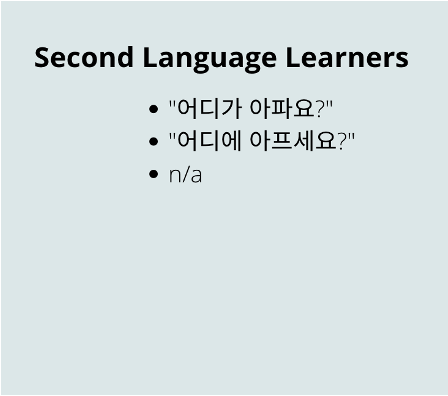
Native English Speakers and Bilingual Speakers with English as L2, Difference Between their Syntactic Knowledge Acquisition

Viktoria Hovhannisyan, Alisara Koomthong, Tomoe Murata, Kota Tsukamoto

Syntactic knowledge is the understanding of the connection between the words in a sentence. This skill develops over time in children when being exposed to a language from their environment. Previous research demonstrated that bilinguals show different structured outcomes for language and cognitive performance, in terms of being at disadvantage. This study argues that bilinguals with English as a second language speakers who grew up acquiring English tend to develop syntactic awareness more effectively and, as a result, perform better on grammatical tasks as opposed to native English speakers. We collected data from 20 undergraduate students and asked them to complete grammar tasks along with answering questions that would reveal the level of their syntactic knowledge. We found that native English speakers are more knowledgeable in syntactic structures based on their scores than international bilingual English speakers.

[expander_maker id=”1″ more=”Read more” less=”Read less”]

Intro & Background:

This study is designed to test two populations, native English speakers and non-native English speakers in the adult population. The research is aiming to observe metalingual awareness, more specifically syntactic awareness in adult monolingual and bilingual populations. To narrow down our focus of the study, we will not be assessing any other aspects of language, such as phonological awareness, vocabulary size, or accent.

Over the years, various studies have suggested that bilingual speakers have disadvantages in language and cognitive performance.  For example, one study has demonstrated that bilingual children develop vocabulary more gradually in each language and perform poorly on language proficiency tasks than monolingual speakers of the same language (Bialystok and Feng, 2011 & Oller and Eilers, 2002). Additionally, another study has shown that adult bilinguals have limited vocabulary size (Portocarrero, Burright, & Donovick, 2007). They also produce fewer words in verbal fluency tasks (Rapp, 2005). This topic has been very well researched, and the results of several studies have actually shown that there is a disadvantage to bilingualism.

However, the study that was conducted on the children population found that bilingual children sometimes perform better than their monolingual peers on grammaticality judgment task which is a form of assessing metalinguistic awareness (Foursha-Stevenson & Nicoladis, 2011). They argue that some of these differences can be accredited to the fact that bilinguals have to learn to control attention to language choice. Based on the results where the children undergo those differences, we believe that the same concept applies to the adult bilingual population. Furthermore, a study that tested the effects of monolingualism-bilingualism on a foreign language learning using a grammatical judgment task showed that bilinguals performed significantly better than monolinguals after adolescence, although there was no difference in performance before adolescence (Yeganeh 2013). The author also points out that being bilingual is effective for foreign language acquisition after adolescence and they achieve higher results in the learning process. In short, two different studies suggest that bilinguals perform better than monolinguals on grammaticality judgment tasks during childhood and after adolescence. Moreover, we believe that native English speakers do not typically spend as much time learning grammar rules as the bilingual population, since they acquire language naturally (i.e., family, friends, schools, home, community). Whereas the non-native speakers who grew up in a foreign language environment generally square language in the school setting where they get formal lessons on topics such as syntactic rules. Considering this difference in both populations in addition to the bilingual advantage in grammar judgment tasks, we predict that non-native English speakers would perform better on grammatical assessment than native English speakers.

Methods:

To test our hypothesis, we collected 20 responses from undergraduate college students, 8 male and 11 female and 1 other, who are either native monolingual English speakers or bilingual English speakers. We assumed that the ideal bilingual candidate should have learned English at around elementary school or after. As for an ideal native English speaker, they should not have been exposed to any second language input from the time of birth to about 7 years old. This reasoning was based on the critical period hypothesis, which argues that there is an ideal time window to acquire language in a linguistically rich environment and after that period it is much harder to acquire language (Bailey, Bruer, Symons, & Lichtman, 2001).

The study consists of two parts which was aimed to generate data about an individual’s English language skills and beliefs. The first part of the survey asked a series of bibliographical questions relating to their personal background and their history with language acquisition. Some of the questions were the following: “Is your first language English?”, “Do you speak a language other than English natively?”, “At what age were you first exposed to the English language?” etc.  The second part of the survey asked all participants to take the “Michigan ECPE” grammar test which consisted of about 10-15 sentences that were designed to test an individual’s English grammar level. We used the highest level of the test since we were testing both native and non-natives college students who most likely already reached proficiency in the English language. Here is one of the examples of the grammar assessment.

To test the metalinguistic awareness of grammar of the individuals, we will modify the “Michigan ECPE ” grammar test and add a section after each sentence where participants will be asked to explain as to why they believe the answer they chose is grammatically correct. To analyze and evaluate the feedback of an open-ended response, we will categorize the response based on some key components of the response. First, we will be looking for key terminology used in the response. If the participant explains their answer giving the exact grammatical rule they applied, we would count that the participant has meta-knowledge about the syntactic rules and we will assign full credit for their response. When the participant does not define their answer using terminology but explains the gist of the rule then a full credit would be given for their response. If the participant does not use terminology nor explain the rule’s gist but rather gives a logical answer that explains their reasoning, we would assign a half-credit for their answer. Lastly if the participants give a very generic explanation such as “it sounds just right” or “I feel like it matches with the sentence” then we would not assign any credit to their explanation since it is lacking the source of their meta-knowledge. 

To test the link between participants’ confidence level and proficiency, we will ask the participants to rate their confidence level after each question. Additionally, at the end of the questionnaire we asked participants if they have ever received formal lessons on English grammar during the schooling years. This step is crucial to determine the exposure of language input through the development of the participants.

Results & Analysis:

Based on the results, there was not a definite or clear trend that can confirm or annul our hypothesis. Our first group of participants, native English speakers, the majority of them scored much higher and are more confident than our bilingual speakers with English as L2 participants, which goes against our hypothesis.

Figure 1

Figure 1 presents one of our questions that we’ve given to our participants. We believe that this question gives an accurate representation of our overall results. 75% of the participants scored correctly and within that percentile, 73% are native English speakers. The other 25% that answered incorrectly, most of them were internationals (80%). However, we also decided to look further into Question 10 where our participants struggled the most.

Figure 2

As shown in Figure 2, 60% of the participants chose “In whole” which was incorrect. Within that percentile, 33% were international bilingual speakers and 67% were native English speakers. This resulted in a large portion of the participants that answered incorrectly were native English speakers. As for the ones that answered correctly, 50% were bilinguals and 50% were native. From this, we concluded that the question might have been too complicated which gave us mixed results.

Even though most of the participants that scored highly were English speakers, there were some bilingual speakers that scored very highly. Looking at each participant, we noticed a pattern occurring in international bilinguals that did well: all were exposed to the English language at a young age.

Figure 3

Figure 3 above is our ninth participant that scored 11/11. She was one of our two participants that got a perfect score with the other one being a native English speaker. As shown in Figure 3, she has been exposed to the English language at a very young age, even though she grew up in a foreign environment. Due to this observation, we analyzed the international bilingual speakers that did poorly on the assessment and noticed that they were not exposed to English until either in high school or college.

In terms of confidence level, most of the participants scored average or high after they finished the test. Only two participants scored low, ranging from 3 to 5 out of 10, on their confidence spectrum. Overall, native English speakers placed their confidence level higher than international bilingual speakers as shown in Figure 4 below.

Figure 4 (Bilingual candidates 9 to 12 are 0 because there are no candidates).

Discussion & Conclusion:

Based on our findings, it did not align with our hypothesis. In page 3, “Methods” section, sentences from line 3 explains in detail that since we expected the international bilinguals with English as L2 to have more proficiency in syntactic knowledge, the result turned out to be quite the opposite. The points that we mentioned are probably the amount of time people have spent learning English. For the candidates, we only divided them into native English speakers and non-native English speakers. It could have been more detailed since international bilinguals do not always have proficiency in two languages. Additionally, we have not gathered their morphological knowledge, such as speaking and listening, so it is difficult to consider whether a candidate is proficient enough in the language. According to the article “Retaining an accent,” by Francois Grosjean, not every person growing up in the same country does have the same language level, and it will depend on their living environment (see paragraph 9 and 10 on Retaining an Accent). The project allowed us to gather a lot of information about them. Still, at the same time, we found a few points that we needed to adjust or add to proceed with a more detailed project.

For future reference, we believe this experiment is just the beginning of analyzing the bilingual’s and native speakers’ knowledge of English. To make the research more precise, we could separate the bilingual candidates in detail, such as bilinguals who grew up with English as their L1 and bilinguals who grew up with English as their L2. Both candidates have the categorization of bilinguals, but their level of proficiency will turn out different by their background in learning the language. It will indeed affect their knowledge when they are exposed to speaking English as their L1 and L2. Focusing on their ages will also make the project more solid. We gathered their ages but did not reference our analysis. Therefore, if we were to continue working on this project, we would want to focus more on the relationship between age and language. According to Inna Figotina, an educator, the age of a person starting to learn a language will affect their engagement with the language (listen after 21:00 on The Future is Bilingual). On the methodology, we could have set the questions more simply (see page 4, paragraph 3, “Methods”). We will change the difficulty of each quiz by putting Q1 as very easy and Q10 as most difficult. For our research, this method will allow us to figure out the English level, and we can create more analysis on each candidate group; native English speakers did not score perfectly but many got the difficult questions correctly, and many international bilingual candidates got high points but none of them got difficult questions correct. By changing these methods and the target participants, we could gather the information for a deeper analysis of the relationship between bilingualism and English.

In conclusion, research on bilingual speakers and native English speakers allowed us to recap the behavior and the attitude toward the language. Many of the previous experiments and the research supported our hypothesis. However, the result was not the one that we expected. We still believe in our hypothesis that native speakers will not take much effort into learning their own language (English) compared to non-native or international bilingual speakers. However, it can be interesting to figure out how learning will always relate to how they will master one language. Overall, the research brought us to a new idea of bilingualism and the behavior toward their language, and we will continue to focus on that point.


References:

Bailey, Bruer, Symons, & Lichtman (2001) in Bailey D.B., Bruer J.T., Symons F.J., Lichtman J.W. (Eds.). (2001). Critical thinking about critical periods. Baltimore: Paul Brookes.View Full Reference List)

Bialystok, E., & Feng, X. (2009). Language proficiency and executive control in proactive interference: evidence from monolingual and bilingual children and adults. Brain and language, 109(2-3), 93–100. https://doi.org/10.1016/j.bandl.2008.09.001

Cummin, J. (2004). D. Kimbrough Oller & Rebecca E. Eilers (eds), Language and literacy in bilingual children. Clevedon, England: Multilingual Matters, 2002. Pp. vii 310. Journal of Child Language, 31(2), 424-429. doi:10.1017/S0305000904226290

Foursha-Stevenson, C., & Nicoladis, E. (2011). Early emergence of syntactic awareness and cross-linguistic influence in bilingual children’s judgments. International Journal of Bilingualism, 15(4), 521–534. https://doi.org/10.1177/1367006911425818

Grosjean, François. (2013). Having an accent in a language. Psychology Today,  https://www.psychologytoday.com/us/blog/life-bilingual/201301/retaining-accent

Portocarrero, J. S., Burright, R. G., & Donovick, P. J. (2007). Vocabulary and verbal fluency of bilingual and monolingual college students. Archives of clinical neuropsychology : the official journal of the National Academy of Neuropsychologists, 22(3), 415–422. https://doi.org/10.1016/j.acn.2007.01.015

Rapp, B. (2015). Handbook of Cognitive Neuropsychology: What Deficits Reveal about the Human Mind. Psychology Press. Philadelphia 2001, pp. 321-345.

Google. (n.d.). The future is bilingual – 1 year as a published author – interview with inna. (2021) Google. Retrieved May 20, 2022, from https://podcasts.google.com/feed/aHR0cHM6Ly9hbmNob3IuZm0vcy8yNmVlZTNkNC9wb2RjYXN0L3Jzcw?sa=X&ved=0CAkQlvsGahcKEwjQ_s2E29r3AhUAAAAAHQAAAAAQAQ

Yeganeh, M. T. (2013). Age constraint on foreign language learning in monolingual versus bilingual learners. Procedia – Social and Behavioral Sciences, 70, 1794–1799. https://doi.org/10.1016/j.sbspro.2013.01.255

[/expander_maker]
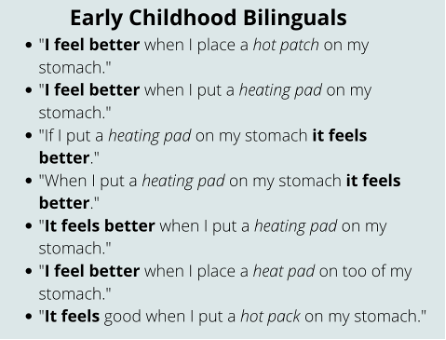
, , ,

Does accent hold-over depend on the conversational context? A comparison of conversations between two bilinguals and a bilingual-monolingual pair

Theo Chen, Joan Kim, Yoori Kwak, Sumeyye Nabieva

In our study, we explored code-switching and accent hold-overs for Korean-English bilinguals. Accent hold-overs are theorized to happen when a person is code-switching from one language to another, and refers to a lag in the switching of phonological inventories. While a similar effect has been found in processing, there isn’t a consensus on such a phenomenon in production. This has both psycholinguistic and sociolinguistic implications, as it explores both actual language production as well as sociocultural factors that might influence bilingual speech.

We ran a small experiment in which Korean-English bilinguals read off a script to either another Korean-English bilingual or to an English monolingual. Our script included both borrowings and code-switching. We expected that we would see more of an accent hold-over during code-switching when Korean-English bilinguals spoke to each other. However, we found no evidence of an accent hold-over than expected. This is supported by some additional studies on the topic but could also be a result of our methodology and process, as opposed to an actual reflection of bilingualism.

[expander_maker id=”1″ more=”Read more” less=”Read less”]

Introduction and Background

Code-switching is a linguistic phenomenon where speakers who are fluent in more than one language quickly change from one language to another while they’re speaking. It’s very common and is often tied to sociocultural factors. For example, a person might code-switch when they need to use a specific word that is cultural and doesn’t have a good translation in another language. They might also code-switch to show others that they are fluent in multiple languages and to connect themselves to a certain identity or heritage (Myers-Scotton, 1993).

We define accent hold-over as the transmission of the phonological system of one language to speech in another language, tied to code-switching. For example, imagine that a person who speaks both Korean and English is talking to a parent in Korean. They might briefly code-switch to English to say a short word or phrase, such as a person’s name or a culturally-related phrase, before switching back to Korean. We would potentially see an accent hold-over as they are switching between the two languages. Because the phonological systems, or the sounds present in the language, are very different between Korean and English, a person’s speech might be more accented than their normal speech for a short period of time.

Grosjean (1988) studied this phenomenon, which he called the “base-language effect,” and found that it exists in language processing. When two bilingual people are speaking and one person code-switches to another language, the person listening to them experiences a small lag in processing what they’re hearing. Their brain expects to hear sounds from the previous language, and needs a brief period of time to adjust and switch to the other language. A later study by Grosjean & Miller (1994) didn’t find this in language production, but research has been mixed. Some, such as Olsen (2013), have found this hold-over effect in production, while others, such as Šimáčková & Podlipský (2018), have not. Overall, there hasn’t been much research in this area, and past research has not focused on the impact of a speaker’s linguistic background.

In our study, we will look at how Korean-English bilinguals interact with each other, compared to how a Korean-English bilingual interacts with an English monolingual speaker. Our goal is to investigate how vowel and consonant sounds change (or remain the same) as a person switches between Korean and English mid-sentence. We chose these two languages partially out of convenience, because there are many Korean-English bilinguals in this area, and two of our group members are also Korean-English bilinguals. But we also considered the phonological inventories of the two languages: Korean and English have very different sounds, which could amplify these effects. Going into this experiment, we hypothesized that Korean-English bilinguals would code-switch and show more of an accent holdover effect when talking to a Korean-English bilingual compared to a monolingual English speaker.

Similar to the hold-over effect, Maye et al. (2008) showed that when listeners heard a segment of Wizard of Oz where the vowels were shifted down in the vowel space, listeners were easily adapted to the accent change. The listeners were then able to find a plausible implementation of the shifted accent in other real words. Based on this case study, we can argue that bilingual speakers who hear the hold-over accent in other speakers may be able to use it in their own speech as well, once they are accustomed to the sound changes. However, because our speakers will be reading a prewritten script that is written in both English and Korean, it is possible that the orthography of the script may elicit some accent adaptation (Norris et al., 2003).

More generally, we are also looking at Korean phonetic code-switching when reading Korean words in English sentences. Additionally, other factors that could affect code-switching in this instance include prosodic flow, language dominance, community norms (Myers-Scotton, 1993), and the bilingual’s personal language practices and fluency (Poplack et al. 2020). Poplack et al. (2020), when looking at the phonology of English borrowings spoken by French-English bilinguals, also found that there was a large amount of variation between different groups of consonants, so we will be investigating both consonants and vowels in this experiment.

Methodology

To explore our research question, we ran a small experiment: we gave pairs of participants a script to read off of, and recorded and analyzed their speech. We ended up with two pairs of participants. One pair had two Korean-English bilinguals, both of whom have lived in Korea and the United States and considered themselves fluent in both languages. The other pair had one Korean-English bilingual, who had also lived in both Korea and the United States, and a monolingual English speaker who wasn’t fluent in any other language and had little to no exposure to Korean. We accepted the language background that our participants told us, but a more extensive study should include a language test to formally assess this.

Our script was written by two Korean-English bilinguals, Joan and Yoori. The script had two speakers. Speaker one’s part was entirely in English but had Korean food borrowings: Korean words referring to cultural foods, transliterated into English text because English equivalents don’t exist. For example, we included the words ‘kimbap’ and ‘hangook hotdog.’ Speaker one was designed so any English speaker, regardless of their knowledge of Korean, would be able to read it. On the other hand, speaker two spoke mainly in English but code-switched to Korean. This code-switching was indicated in the script using Hangul, the Korean alphabet, unlike the food borrowings for speaker one that were in the English alphabet. By writing the words in Hangul, we indicated that speaker two should be entirely switching from English to Korean. Then, we could see how these mid-sentence code-switches changed the speaker’s English phonology and pronunciation.

Analysis ended up being a little difficult for us. We originally wanted to look at the sounds in Praat, but that ended up being unrealistic given the nature and scope of our experiment. Our main method of analysis was listening to our recordings by ear, because we had both English speakers who didn’t have exposure to Korean and Korean-English bilinguals. We looked at the phonological inventories for both languages to make sure we had accurate intuitions and picked out notable segments.

Results and Analysis

After recording the participants, we listened to the speech by ear. We expected words before and after a Korean word to have an accent holdover. Interestingly, there were no accent holdovers in the words we expected them to be. For example, in line 2 (see Figure 1), the word tired is pronounced [ˈtaɪəɹd] instead of [ˈtaɪjəd]. We also predicted that proper names would contain accent holdovers, such as in line 4 when the participant is asked to read Powell Library, but with the word library in Korean. Instead of pronouncing it as [pa:ul], the word Powell was instead pronounced as [ˈpaʊəl] by both bilingual speakers reading speaker 2 lines. Our script also gave opportunities to pronounce Korean food names, as well as a different nationality’s dish to see if food in a different culture and language would also be pronounced with a Korean accent holdover. We provide this in lines 6 and 7. While both bilingual speakers reading speaker 2 lines pronounced the Korean word kimbap in the proper Korean pronunciation, the word tacos in the same sentence was pronounced in a standard American accent as [ˈtɑkoʊz] instead of [ˈtakoz] as predicted. Interestingly, when the bilingual speaker was reading the speaker 1 script in line 7, the word kimbap and tacos was spoken in an American accent, rather than in the Korean pronunciation. However, an explanation for this would be that in line 7, the word kimbap was written in English instead of in the Korean orthography, possibly causing the bilingual speaker reading that line to have chosen to not read it in Korean.

Figure 1. A portion of the script read by the participants. Words and phrases where accent holdover was expected are labeled in yellow. Borrowed words related to food, interpreted as opportunities for code-switching, are labeled in orange.

One thing to note is that when the Korean-English bilingual speaker was reading speaker 1’s line in the script, all Korean food names were read in the standard American accent. For instance, in lines 7 and 8, the words kimbap, hangook hotdog, and ramen were expected to read as [kimpap’], [‘hanguk hatogɨ’], and [ˈlamjʌn] respectively. Instead, the words were elicited as [kɪmbap], [hɑnguk hɑt dɔg], and [ˈɹɑmjʌn]. [ˈɹɑmjʌn] particularly stood to us during our analysis because it appeared to be a combination of a standard American accent and the Korean accent. More specifically, the first syllable is pronounced with the [ɹ] that is not found in the Korean phonemic inventory, but the second syllable is pronounced [mjʌn] as a Korean speaker would.

Another accent incident we noticed was that both bilingual speakers reading speaker 1’s line produced a club’s name in a Korean accent. The club, KASA, or Korean American Student Association, was expected to be pronounced as [ˈkʰɑsə], but was instead produced as [kʰasa] by both speakers.

Figure 2. A chart of words that were pronounced differently than what we expected. Ramen is written twice because both English and Korean say the same word distinctively.

Discussion

Overall, we did not find any evidence of an accent holdover when bilinguals switched between Korean and English. In every instance of code switching, we observed that the accent being produced changed immediately along with the language in which the corresponding word was meant to be read. The previously mentioned cases that we found (e.g., the case of “KASA”) seem to be instances of code-switching, as opposed to accent holdover. This would indicate that there is no phonological accent holdover effect for bilinguals, reflecting the findings of Grosjean & Miller (1994) and Šimáčková & Podlipský (2018). This suggests a high level of flexibility in language systems and instantaneous or near-instantaneous shifts between languages, as past research has also indicated.

We did, however, have other particularly interesting findings almost entirely unrelated to accent hold-overs.  For instance, the words “KASA” and “ramen”, while formed or written in the script in English, were pronounced at least in part with a Korean phonemic inventory. This might suggest that there is a code switch for words that relate to Korean culture or identity, even if they are not formed in the Korean language in the script or in general.

When it comes to accent holdovers themselves, because of a number of limitations, we are not confident that our results definitively demonstrate that accent holdovers do not exist. The small sample size of participants was one, as we only tested one pair of speakers per context (bilinguals speaking to each other vs. a bilingual and a monolingual speaking). The sample size is especially notable due to high variation among bilingual individuals, which means that we may be required to recruit a larger sample size to account for this variability and to be able to construct a meaningful average.

Perhaps our most significant limitation is the fact that the context in which participants had to elicit words was largely unnatural, as it was based entirely off of a prepared script. While it was difficult to find an efficient way to elicit the data we needed for analysis, the scripted nature of elicitation could have affected results in unforeseen ways. Chief among these is the fact that Korean and English have radically different orthographies, which, over the course of this study, often forced us to choose how to spell certain target words such as “ramen”. Therefore, the scripted nature of the experiment might also yield an alternative explanation as to why the word “ramen” was pronounced the way it was: a word originally formed in Korean, it was spelled in its English borrowed version in the script, yielding a potential confusion within the bilingual speaker as to how he ought to pronounce the word he was reading (and therefore an odd code-mix). There is also a possibility that the speakers were conscious of their pronunciation after they noticed that their voice was going to be recorded. This might have made them more focused on pronouncing English words in the English inventory and Korean words in the Korean inventory so that neither their English nor their Korean would sound “butchered” or their transition would seem “incomplete” to the recording and listening experimenters. Considering all of the above-mentioned limitations, our results become difficult to interpret.

Conclusion

Despite suggestions of differences in language processing when it comes to perception of accent change in bilingual speech and code-switching, accent holdovers have not yet been observed in speech of bilinguals to one another, or in speech of a bilingual that is directed to a monolingual. There are several ways the limitations of this particular study could be addressed, but ultimately it appears that code-switching is instantaneous and happens not just on a general word level, but on the phonemic level as well: the inventories switch as much as does the vocabulary. This may illustrate a broader trend in that the multiple languages are placed in the bilingual speaker’s mind as different systems that, even when somewhat mixed (like in code-switching), remain firmly separated.


References

Grosjean, F. (1988). Exploring the recognition of guest words in bilingual speech. Language and Cognitive Processes. 3, 233–274.

Grosjean, F., & Miller, J. L. (1994). Going in and out of languages: An example of bilingual flexibility. Psychological Science, 5(4), 201–206.

Myers-Scotton, C. (1993). Social Motivations for Code-Switching: Evidence from Africa. Oxford: Clarendon Press.

Poplack, S., Robillard, S., Dion, N., & Paolillo, J. C. (2020). Revisiting phonetic integration in bilingual borrowing. Linguistic Society of America, 96(1), 126–159.

Maye J., Aslin R. N., Tanenhaus M. K. (2008). The weckud wetch of the wast: lexical adaptation to a novel accent. Cogn. Sci., 32, 543–562.

Norris D., McQueen J. M., Cutler A. (2003). Perceptual learning in speech. Cogn. Psychol., 47, 204–238.

Olson, D. J. (2013). Bilingual language switching and selection at the phonetic level: Asymmetrical transfer in VOT production. Journal of Phonetics, 41, 407–420.

Šimáčková, Š., & Podlipský, V. (2018). Patterns of short-term phonetic interference in bilingual speech. Languages, 3(3), 34. MDPI AG.


[/expander_maker]
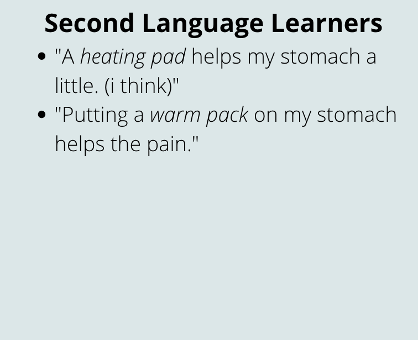
Love at First Voice

Jasmine Beroukhim, Nicole Palleja, Marydith Macabale, and Jaee Shin

Netflix’s hit dating show, Love is Blind has captured the attention of millions of viewers for its original take and format. In the show the contestants are separated by gender, and converse with one another through pods where a wall separates them from seeing each other. The show reimagines dating by erasing material aspects of a contestant’s identity right down to the sound of their voice. Throughout the show noticeable shifts in voice were apparent, and while it is well documented that humans have an innate capacity to shift styles through their voices, little research has been completed on how vocal changes are expressed in the discourse of reality dating shows.  Our study focused on the implications of vocal modulations in the context of reality television to investigate how an individual’s voice can contribute to the shaping of identity. In discussing this topic, we are interested in how the human voice can be used to influence perception and how women’s voices may reflect their perceived gender roles. We believe it is crucial to better understand the power of the human voice in leveraging perceptions and the societal and cultural reasons why a woman’s voice may change when speaking to a potential partner.

[expander_maker id=”1″ more=”Read more” less=”Read less”]

Introduction and Background

Our research focused on the first episode from Love is Blind which featured Jessica Batton, a 34-year-old white woman from Chicago, who works as a Regional Manager.  The public coined her iconic voice as a “sexy baby voice,” but the “sexy baby voice” was only apparent when she spoke to potential matches and disappeared when she relayed her experience in camera confessional interviews. “Sexy baby voice” according to linguists is achieved by raising your pitch and engaging in upspeak where the phrase ends with a rising pitch. Through our analysis we labeled Jessica’s two voices as “sexy baby voice” and her “professional voice.” In order to concretely measure the changes of her vocal modulation our study utilized the linguistic tool, PRAAT by inputting voice recordings from the show and comparing Jessica’s “sexy baby voice” used in the pods versus her “professional voice” utilized in the individual camera confessionals. Furthermore, we used conversational analysis to juxtapose her dual voices and to deepen our understanding of Jessica and determine if her pitch use fluctuated in accordance to the subject of her discussion. By creating a transcript between Jessica and her potential partner, we were able to illustrate the nuanced changes described through PRAAT and what the speaker was indexing through her vocal modulation.

Hypothesis
We expect Jessica to employ a higher vocal pitch when she is interacting with a male suitor, in the pods versus utilizing lower vocal pitch, consistent with a professional speaking voice, during her individual, camera confessionals. We expected our research findings to be consistent with our hypothesis in accordance with Jessica’s fluctuating voice pitch depending on her contextual setting and how such use of varying vocal pitches are reflective of her attempt to index two different identities in her personal and professional life.

Methodology/Project Design

We chose to limit our primary data collection to Season 1, Episode 1, entitled Is Love Blind as Jessica garnered the most screen time compared to other episodes later in the season, as she navigated the complexities of finding true love between two potential partners: Barnett and Mark. This case study was particularly notable to use because her modulating voice samples, according to professional or personal context, would provide us with substantial material to analyze throughout the episode. In our research, we collected a total of four samples and chose samples where a dramatic change in voice was evident Another reason for choosing these four samples was their back-to-back nature. Jessica used her professional voice when giving an interview and then used her “sexy baby voice” moments later when entering the pod. We then put the four samples into PRATT, which allowed us to draw conclusions about formant values, pitch, and intensity, when speaking to future relationship prospects versus one-on-one camera confessional. We then created a transcript of each of the 4 samples and used conversational analysis methodologies. We then collected 12 additional samples that we ran through PRATT with the purpose of observing her pitch formants. The subject content of the vocal samples was not analyzed. We watched the relevant episode, recorded Jessica’s speech, transcribed her voice samples into PRATT, created a transcript, and subsequently analyzed her pitch patterns in relation to what she was saying. By carefully analyzing the linguistic features of Jessica’s voice, we were able to deepen our understanding of Jessica as a social being as she indexed construction of her identity when speaking to relationship prospects versus addressing the camera directly in individual confessionals. 

Literature Review: Woman’s Vocal modulation in Dating Context

Helen Sautason, an English and Linguistic Professor at York St. John University in London offers insight into why a woman’s voice may change when speaking to a potential partner. In Sautason’s words, “the speaker will put themselves in a position where they sound less powerful because they have a belief that men find that attractive, and they don’t want (men) to feel threatened. There’s always been a value placed on girlish femininity” (Dazed, 2020, p. 2). Additionally, in a study entitled, “Voice Pitch Modulation in Human Mate Choice,” thirty adult men and women were observed in real time speed-dating events; their vocal patterns were analyzed for pitch changes. What was concluded from this study was that “women spoke in a higher-pitched and less monotone voice on speed dates with men they chose as potential mates.” The authors of the research observed that “the trade-off implied by this dichotomy suggests that women may volitionally raise their voice pitch to signal youth and femininity but lower their pitch in contexts where they wish to be taken seriously, or to indicate intimacy to a listener” (Pisanski et al., 2018, p. 2). As we examine our focus episode, we see that this observation is evident.  

Data Analysis: Pitch Formants

The differences in frequencies translate directly to pitch differentiation. A lower frequency indicates a lower pitch, while a higher frequency indicates a higher pitch. Figure 1 is a visual representation of Jessica’s first on-screen confessional where she introduces herself as a contestant on the show for the first time. Here she used her professional voice which produced a low F1 frequency of 606Hz. 

Figure 1: Professional Voice

Figure 2 is a visual representation of Jessica’s first time in the pods where she meets Barnett.  Here she used her sexy which produced a high F1 frequency of 1069Hz. 

Figure 2: Sexy-Baby Voice (Barnett)

Her use of two different voices and varying pitches is a direct attempt to index two different identities. There is a juxtaposition of two “first moments” that are happening within the context of Jessica’s introduction as an on-screen character to the world. Excerpt 1 provides a direct transcription of what Jessica says in her camera confessional, where her F1 produced a frequency of 606Hz (line 1).

Excerpt 1: Jessica’s First Confessional Interview “Professional Voice” 

[6:38- 7:00]

1 Jess: My name is Jessica Batton I'm from Rock Falls Illinois

2       <I’ve had> a rigid set of: standards I would only date a

3       guy between 1 to 5 years older I would only date (0.1)

4       athletes because I’m really athletic

Here, the audience is led to believe that Jessica is an established and serious woman looking for a mature relationship, to fit the bill of her desired qualities of a man, which is consistent with her use of a lower pitch voice register. The second introduction of Jessica portrays a different picture of her identity to Barnett, which contrasts sharply with her introduction to the world; a direct transcription of what Jessica says in the pods can be found in Excerpt 2 where her F1 produced a frequency of 1069Hz (line 8). 

Excerpt 2: Jessica’s Initial Pod Meeting “Sexy Baby Voice”

[6:38- 7:00]

1 Jess: But  I’m 34 years old and I may not find someone based

2       on:: the criteria that I’ve::: put in place for myself

3       I’m ready to start a family and::  I want to have:::

4       the most perfect marriage

5 Mark: What’s your name,

6 Jess: I’m Jessica_

7 Mark: Jessica_  Nice to meet you Jessica  I’m Mark 

8 Jess: Nice to meet you  Mark ?

Suddenly, she is bubbly, girlish, and demure, consistent with her use of the high pitch, feminine, sexy-baby voice register. It is implied that Jessica’s use of the sexy baby voice serves her the purpose of portraying herself as a likable woman that should be seen as desirable to the male gaze, or in this case, the male ear. Shortly after Jessica’s sexy baby voice driven interaction with Barnett, it appears that her high-pitched voice had captivated the attention of Barnett who comments on how nice her voice sounds. 

Similarly, the initial meeting between Jessica and Mark, her second potential romantic partner on the show, merited our attention and examination as it was another unique instance of Jessica’s voice modulation. Before meeting Mark Jessica gave a camera confessional discussing her past dating. When analyzing the F1 formant frequencies of her “professional voice,” in her camera confessional her F1 frequency produced a value of: 607Hz. The visual representation of her formants can be found in Figure 3. 

Figure 3: Professional Voice

Minutes after Jessica’s camera confessional Jessica enters the pods where Jessica leverages her “sexy-baby” voice. In the pods, her pitch had increased and produced a value of 810Hz, a drastic difference in pitch from her interview frequency of 607Hz. The visual representation of her formants can be seen in Figure 4.

Figure 4: Sexy-Baby Voice (Mark)

Excerpt 3 provides a transcription of Jessica’s use of her professional voice, which produced a low F1 of 607Hz (lines 1-4). 

Excerpt 3: Jessica’s Confessional Interview “Professional Voice” 

[30:23-30:30]

1 Jess:  There’s never been a time in my life (.) when I’ve been

2        able to really (0.1) focus solely on finding love_

3        here in the experiment (0.1) you spend every second  

4        of every minute searching for your soul mate

Jessica’s statement pushes the perception of Jessica’s social identity as a professional “working woman”’ who does not have time to spare to be dating. In the study, “Voice Pitch Modulation In Human Mate Choice”, the authors explain the common perception of women who have a lower-pitched voice as “consistently judged as more dominant, competent and mature, and as better leaders than women with a higher voice pitch” (Pisanski et al., 2018, p. 2). It is therefore not a coincidence that Jessica uses her “professional voice” emulating a pitch drop when speaking about her personal life and lack of time to engage in dating.

Excerpt 4  provides a direct transcription of Jessica’s conversations with Mark, where her sexy baby voice was used frequently, and produced a high F1 frequency of 810Hz.

Excerpt 4: Jessica’s Pod Meeting “Sexy Baby Voice”

[31:26- 32:11]

1 Mark:  holy shit we’re the same fucking person (.) and it's 

2        like (.) I want to raise my kids with religion

3        Christianity you know because that’s how I was raised 

4 Jess:  yeah

5 Mark:  and you know (.) I have a tattoo on my ribs (.) like  

6        it’s a cross with my parents initials on the top and

7        bottom (.) my sister and brother on an empty plaque

8 Jess:  wow 

9 Mark:  so when I have kids I can initial their names on it  

10       (.) and Psalm 19:14 going across it

11 Jess:  °I love that (.) that makes me so happy 

12 Mark:  (( laughs)) 

13        (0.2)

14 Mark:  how many kids do you want?

15 Jess:  three

16 Mark:  three (,) ? I'm down

17 Jess:  ok

18 Mark:  I want two boys and a girl

19 Jess:  I like that ,

20 Mark:  my face hurts

21 Jess:  why ?

22 Mark:  I’m smiling a lot

23 Jess:  you are?

24 Mark:  maybe

25 Jess:  that makes me so happy

Throughout the conversation, her replies were short and affirmative of Mark’s feelings and sentiments about religion and the number of children they desire. A study titled “New Zealand Women Are Good to Talk to: An Analysis of Politeness Strategies In Interaction” explains that American women are supportive and cooperative conversationalists; they act as an ideal and responsive audience – usually to men.” (Holmes, 1993, p. 92) The idea that women often act as “an ideal and responsive audience” to men, might explain the use of Jessica’s “sexy baby voice” in this interaction with Mark and the need to protect his ego.  There exists a contrast between Jessica’s dual identities because with her professional voice, we interpret her as a head strong working woman, versus with her sexy baby voice we tend to perceive her as flirty, and submissive “dumb blonde” archetype (refer to Figure 5 for an image of Jessica). 

Figure 5: Jessica Batton

For the purposes of confirming our hypothesis, we collected further data reinforcing Jessica’s consistent use of vocal modulations in response to alternating scenarios. The data presented in Figure 6 is a series of F1 frequencies that reaffirm Jessica’s use of higher pitch in her romantic interactions and lower pitch in her on-screen camera confessionals while reflecting on her life experiences.

Figure 6: Jessica’s pitch variation in two contexts throughout one show episode


Conclusions

There have been numerous studies conducted on voice modulation in various settings and even dating simulations, however, the objective of our study is to fill the gap in the body of research in the context of reality dating television, analyzing how individuals use their voices as a means of connecting with a potential partner who cannot physically see them.

In Love is Blind, we found that Jessica Batton deliberately altered her voice in order to make her sound more attractive to potential suitors, and that her sexy baby voice contrasted sharply with the pitch frequency she used when speaking directly to the camera. Therefore, based on Jessica’s varying voice modulation patterns in response to differentiated social contexts, we reaffirm the notion that voice can be used as a tool to construct and index an identity in specific social environments.  When completing our case study, we were cognizant of the limitations, more so, that a reality television show can easily manipulate an image of a woman through the editing of the production team  Our research was also limited as we only conducted a case study and did not analyze if this applied to others on the show, and did not analyze other episodes to mark if there was a change. In light of this, although our study does not definitively establish that women change their voice in the situational context of all reality dating television, it is one glaring instance of the degree to which shifting vocal modulation can affect the external perception of a person’s identity. 


References

Dazed. (2020, March 9).  Investigating the ‘sexy baby voice’ phenomenon. Dazed.
https://www.dazeddigital.com/life-culture/article/48255/1/investigating-the-sexy-baby-voice-phenomenon-love-isblind#:~:text=The%20’sexy%20baby%20voice’%20typically,s
mall%20body%20size%20(sigh).

Guardian News and Media. (2020, February 26).  What is ‘sexy baby voice’? We spoke to a sociologist to find out more. The Guardian. https://www.theguardian.com/lifeandstyle/2020/feb/26/what-is-sexy-baby-voicesociolo gist

Holmes, J. (2002, July 3).  New Zealand women are good to talk to: An analysis of politeness strategies in interaction. Journal of Pragmatics. Retrieved May 16, 2022, from
https://www.sciencedirect.com/science/article/pii/0378216693900784

Hughes, S. M., & Puts, D. A. (2021, November 1).  Vocal modulation in human mating and competition. Philosophical Transactions of the Royal Society B: Biological Sciences. Retrieved May 16, 2022, from https://royalsocietypublishing.org/doi/pdf/10.1098/rstb.2020.0388

Pisanski, K., Plachetka , J., Gmiterek , M., & Reby, D. (2018, December 18).  Voice pitch modulation in human mate choice.  Proceedings. Biological sciences. Retrieved May 16, 2022, from https://pubmed.ncbi.nlm.nih.gov/30963886/#:~:text=Within%2Dindividual%20analyses%20indicated%20that,a%20mutual%20preference%20(matches)

Zurbriggen, E. L., & Morgan, E. M. (2006, January).  Who wants to marry a millionaire? reality  dating television programs, attitudes toward sex, and sexual behaviors – sex roles. SpringerLink. Retrieved May 16, 2022, from
https://link.springer.com/article/10.1007/s11199-005-8865-2


[/expander_maker]
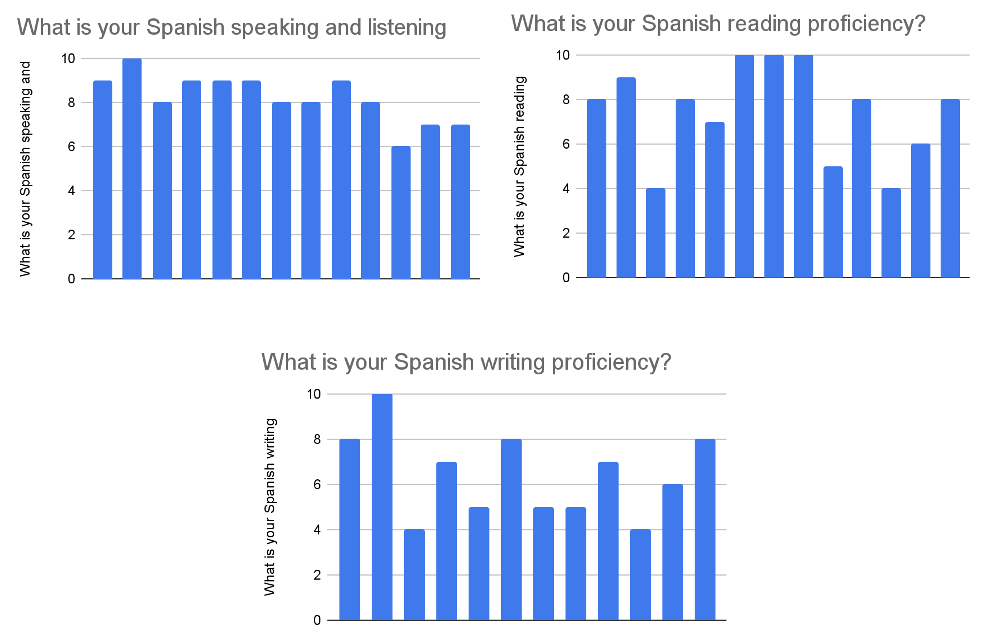
How LOL got between X and Z

Michelle Johnson, Kayla Sasser, Lucy (Chenyi) Wang, Grace Shoemaker, and Lien Joy Campbell

Figure 1. An example conversation between Gen X and Gen Z showing possible generational gap in the usage of humor markers – emojis in this case.

Even though the sad emojis in that exchange were used in a sad context, many people might laugh or find that inappropriate. Whether you are one of those people or someone likely to use emojis just like “Mom”, read on. As texting has grown to be a more popular form of regular communication, it may seem as if connecting with people has only become easier – but with ubiquity comes complexity. And if you are not among those at the vanguard of these complexities (the youth), you could be missing out. This brings us to the question: does expressing humor over text vary by generation? In this study we focused on Generation X and Generation Z’s use of emojis, emoticons, and other ways they chose to convey humor and tone in texts. In focusing on humor we were able to analyze the frequency of humor makers and their meanings in context. Based on our data, we found that there were definite differences in how the generations use and react to text language. Keep reading to learn what these key differences were and how we studied them (and maybe how to finally make that teenager in your life laugh).

[expander_maker id=”1″ more=”Read more” less=”Read less”]

Intro and Background 

Generation Z (those born between 1997 and 2012) grew up and learned how to communicate post-advent of the invention of instant messaging. Their texting style and speaking styles are intertwined and take inspiration from each other. On the other hand, those of Generation X (born between 1965 and 1980) had to transfer previously-established styles of humor and communication to the new technological medium (Downs, 2019). This accounts for the disconnect between considering texting to be a form of writing (like an email or letter) and considering it simply as talking put onto a screen. The term “written speech,” coined by John McWhorter, gives a name to the adaptation of texting to account for all the complexities of face-to-face communication that change how the content of a message is received: emotion, formality, humor, tone, body language and facial expression. Across platforms from iMessage to TikTok, young texters use unspoken and quickly changing combinations of punctuation, capitalization, and symbols to directly translate trends and slang into the digital world.

Methods

Following our belief that Gen X and Gen Z would communicate humor over text in significantly different ways and a path laid out by a study conducted by Sánchez-Moya and Cruz-Moya (2015), we chose to create a survey that focused on responder’s opinions on texting and their texting habits. We specifically targeted people’s habits in the use of humor markers like emojis and typed laughter by asking them to choose the most appropriate option to represent a feeling or as a response to various tonal and emotional contexts. Once we had our responses, we organized our data in terms of type of marker (emoji/emoticon/capitalization) and focused on whether the marker was used literally or creatively in relation to each generation. We expected a wider range of responses in Gen Z and more similar, literal responses from Gen X.

Results and Analysis  

We began our analysis by categorizing the responses we received in terms of whether they were literal or not, and we additionally compared the use of emoticons and capitalization. Further, we then also analyzed the frequency of answers we received for each question. We will present examples of each of these analyses and the contexts in which they were applied.

Beginning with our analysis of literal vs. non-literal use of markers, figure 2 presents a strong difference in Gen X and Gen Z’s preferences for literal and non-literal emojis.

The above graph illustrates a strong example of a general trend we found in our data: that overall, Gen X preferred to utilize emoji and other humor makers literally. In comparison, Gen Z showed a preference for less literal uses. Also, specifically for this question, within the categories of literal and non-literal, Gen X preferred a laughing emoji (😂) to show that they were laughing in 55% of their responses whereas Gen Z preferred a crying emoji (😭)–the exact opposite–to show that they were laughing in 42% of their responses. This was an even stronger non-literal response than expected suggesting a much higher degree of irony in Gen Z’s texting than in Gen X’s.

Moreover Figure 2.1 presents another strong case for Gen X’s preference for literal marker use and Gen Z’s preference for non-literal outside of just emojis. Figure 2.2 presents the response options as well as their categorization as either literal or non-literal.

Not only was Gen X’s preference for literal answers and Gen Z’s preference for non-literal answers illustrated in their selection of emojis but also in their preference for other answer types too. In the above example we took the unmarked and expected literal responses to the presented situation to be congratulatory, positive, and generally aligned with the topic of the context, whereas the non-literal responses demonstrate an indirect type of response by focusing on a non-topicalized part of the context (i.e. the bathroom). Again, we observed a strong preference from Gen X for a literal or positive response and a strong preference from Gen Z for a non-literal or indirect response.

In addition to studying the differences in how humor markers were used to convey literal and non-literal meaning we also wanted to provide insight into the different variations in the types of markers commonly used. Generally, we expected to see a more diverse use of these markers and variations, not just emojis, in Gen Z’s texting, leading us to figure 3. Figure 3 illustrates the overall differences in emoji (😂,😩) and emoticon ( :(, 🙂 ) use according to generation.

We chose to study emoji vs. emoticon use specifically as we believed that there would be a strong difference between the generations. However, both Gen X and Gen Z tended to prefer emojis. Unexpectedly, Gen X overwhelmingly preferred to use emojis over emoticons. We had thought that due to their longer history and generally less ambiguous and more established static meaning that Gen X would favor emoticons (Bai et al., 2019). This was not the case. Interestingly too, Gen Z actually tended to use more emoticons than Gen X. This result however supports our belief that Gen Z would demonstrate a broader range of humor marker use, splitting their results more evenly between emoji and emoticon. This could also demonstrate that Gen Z is exhibiting more creativity or nuanced flexibility in how they use these markers and what they take them to mean.

Next, we chose to study another variational marker, capitalization (OR SHOUTING). We chose to study capitalization in addition to emoji/emoticon differences as it is a unique action in texting that specifically denotes tone (McCulloch, 2019). Figure 4 below illustrates our comparison of capitalization use according to generation.

As shown above, Gen Z favored the use of capitalization while Gen X preferred messages that mixed capitalization and lowercase. This illustrates a stronger preference in Gen Z for using messages that convey a stronger or louder tone and demonstrates McWhorter’s idea of “written speech” in the younger generations (2017). Interestingly too, the younger generations’ relatively strong preference for “shouting” over text could indicate a recent change in what all-caps texting “means” and illustrate a higher level of comfort with the nuance of tone that all capitalized text creates. In comparison, Gen X may still interpret it as simply yelling at someone and therefore use it more sparingly. However, to corroborate those claims more testing would need to be conducted.

Finally, we got even more specific with our analyses–we categorized and analyzed the answers to each question on the survey to measure the frequency of each response per question for each generation. We did this to examine the specific texting behavior of the generations on a smaller, context-dependent scale. Figure 5 is a particularly interesting example that demonstrates the general trend in the generational behavior we observed.

We discovered, as in the above example, that Gen Z’s responses were more evenly spread out across the response options creating a much more dispersed answer graph (seen in red). Meanwhile, Gen X tended to answer more similarly to one another, strongly favoring one answer, ‘terrible 😔,’ as can be seen by the single tall blue bar. This pattern was relatively consistent across all of our data and was in line not only with our prediction that Gen Z would show a wider range of responses, but also with our prediction that Gen X would tend to use more literal responses. Moreover, another point to note in figure 5 particularly is that Gen X answered ‘terrible 😭’ 20.43% of the time, which in this context was interpreted as a literal use of a negative emoji. However, given our results in figure 1, this could also denote a more sarcastic or ironic tone. Such an analysis could also be in line with the other trend illustrated above as Gen Z showed a greater preference for answers that denote a less literal more ironic tone (terrible 🙃, terrible 😁).

Overall, our data demonstrated that Gen X tended to use emojis more literally and more consistently while Gen Z preferred to use them less literally and showed a wider range in their use. In terms of emoticons, both Gen X and Gen Z preferred emojis with Gen X showing a much stronger preference, and in cases of capitalization, Gen Z used messages in all caps much more than Gen X.

With all that said, we would like to address some possible confounds that could affect our data and analyses. Firstly, there was quite a disparity in the number of responses we received from each generation, heavily skewing toward Gen Z. This may have been because this survey was distributed by us (members of Gen Z), which also brings to light another possible issue: our own generational biases in both the analysis of the data and the creation of the survey. Additionally, this study’s construction as a multiple-choice survey poses the possibility that the choice of answers may have directed people’s responses. Moreover, we did not notice a significant effect of gender in our study. However, it could be a very interesting avenue to pursue in future research.

Discussion and Conclusion  

As seen in our data analysis, we found that there is in fact a gap in the usage of humor markers between the two generations, which supported our initial predictions. More specifically, based on the overwhelming choice by Gen X to use literal meanings, it could be suggested that they tend to use them (especially emojis) at a surface level. Meanwhile, Gen Z’s varied usage of all four markers looks to be a bit more nuanced. Their choices reflect that they use ironic and non-literal meanings frequently in humorous contexts. The variation in their responses also suggests that each marker of humor could have its own unique function or meaning depending on the context. Such variety among Gen Z could be the result of their community of practice, which frequently takes part in internet culture and has therefore been able to develop their own unique understandings of humorous texts. It also reinforces McWhorter’s earlier suggestion that texting can involve more than words–it conveys natural human conversational gestures as well. Overall, it does therefore seem fair to say that there is more at play in Gen Z’s usage.

After conducting our study, we identified limitations in our methods that leave room for improvement. As mentioned earlier, the survey was created entirely by members of Gen Z. This could prove to be problematic because the response options are potentially more biased toward a typical Gen Z response and not adequately represent typical Gen X responses. Including the input of Gen X members could have created a more balanced selection of responses. Another less obvious limitation of our study is that we did not account for phone differences. We realize that the appearance of Android and iOS emojis differ and that this difference may procure different emotional responses and therefore be used in a different context than our survey initially accounted for.

So, what are the next steps? Our findings and conclusions tell us that there is definitely room for further research on intergenerational communication over text. Improving upon this study’s weaknesses and widening its scale could provide more insights into the big differences that lie between the text-language of Gen Z and Gen X. Some new topics of interest include: different attitudes towards the appearances of emojis (i.e. Android vs. iOS), the evolution and idiosyncrasies of Gen Z’s online language, and analyses of textual gaps that may occur on the basis of factors other than generation.

References:

Bai, Q., Dan, Q., Mu, Z., & Yang, M. (2019). A Systematic Review of Emoji: Current Research and Future Perspectives. Frontiers in psychology, 10, 2221. https://doi.org/10.3389/fpsyg.2019.02221

Downs, H. (2019). Bridging the Gap: How the Generations Communicate. Concordia Journal of Communication Research, 6. https://doi.org/10.54416/SEZY7453

McCulloch, G. (2019). Because Internet. Penguin Adult HC/TR & Riverhead Books.

McWhorter, J. H. (2017). Words on the move: Why English won’t- and can’t- sit still (like, literally). Picador, Henry Holt and Company.

Sánchez-Moya, A. & Cruz-Moya, O. (2015). Whatsapp, Textese, and Moral Panics: Discourse Features and Habits Across Two Generations. Procedia – Social and Behavioral Sciences, 173, pp. 300-306. https://doi.org/10.1016/j.sbspro.2015.02.069


[/expander_maker]
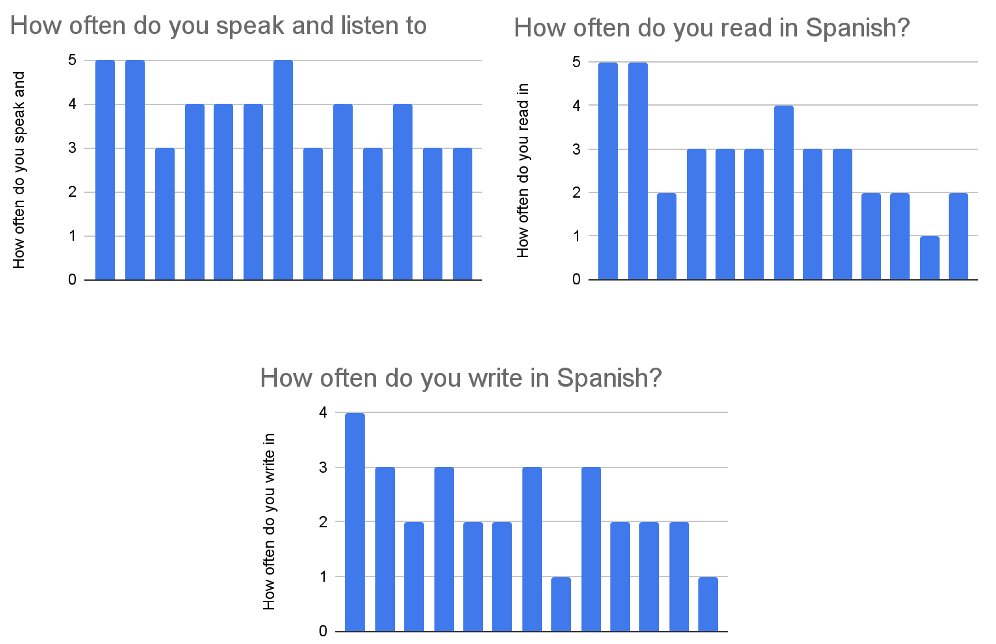
, , ,

Ukraine in Transition: The Process of Reducing Russian Language Usage

Iscelle Abad, Zhuoen Li, Ira Throne, Ryan Tsai, Max Yudowitz

With the ongoing invasion of Ukraine, language in the country is changing. In response to the war, many natives have expressed a desire to switch their primary language in daily life from Russian to Ukrainian. Although it’s been a while since it was conducted, the 2001 All-Ukrainian population census estimated that roughly 29.6% of the Ukrainian Population spoke Russian as a native language, equalling roughly 14.3 million people. Since there has been no new census conducted in over 10 years, it’s hard to approximate the exact number of Russian and Ukrainian speakers today. However, a recent 2022 national poll conducted by the independent sociological research group RATING (Рейтинг) showed that, among respondents, in the last 10 years the number of native Ukrainian speakers has steadily grown from 57% in 2012 to 76% in 2022 with the percent of native Russian speakers at around 20%.

Figure 1: Map showing the distribution of languages and ethnicities in Ukraine.

Given that a fair number of the population are not completely fluent in Ukrainian, the attempt to switch over has not been easy for everyone. The adjustment of switching primary language within a community is usually a long-term process spanning generations, but given the unique circumstances, many Ukrainians are going through it at an accelerated pace within just a few months.

Since this is a turning point for Ukraine linguistically, some crucial questions are necessary. How are people going through this process? What aspects of the transition come easier to people, and what struggles are they dealing with during this transition? Are there some sort of unique transitional stages that Ukrainians are going through in the same way?

[expander_maker id=”1″ more=”Read more” less=”Read less”]

These are the questions that prompted our research. An unprecedented level of media availability allows insight into how some speakers are utilizing code-switching (changing between different languages when speaking) in their daily lives today, almost in real-time. Some anecdotes that can give insight into how some Ukrainians are experiencing this change can be read in interviews in this article: Enemy tongue: eastern Ukrainians reject their Russian birth language | Ukraine | The Guardian. Another example is the subjects of our study, Ukrainian vloggers, who have made a noticeable shift from primarily speaking in Russian to primarily speaking in Ukrainian. Initially, before conducting this study, we anticipated that the subjects at first would most frequently code-switch from Russian to Ukrainian when they are telling jokes or just by inserting common words into their conversation.

The subjects of our study are three YouTube bloggers from a channel called “Lions on a Jeep” who spoke almost exclusively in Russian until after the full-fledged invasion of Ukraine started. They’re men in their late 20s – early 30s and were familiar with Ukrainian before, although they didn’t seem to actively use it on a daily basis. Starting March 3, 2022, they began to record live streams in their effort to collect donations for the Ukrainian military. Their first 2 streams were almost completely in Russian, but during the 3rd stream they started switching to Ukrainian at different rates. As of right now, they are still recording their streams and have transitioned to speaking Ukrainian for the most part. We collected over 70 speech samples from several live streams of theirs. The frequency, amount of videos in a short period of time, and the unedited and casual format of the conversation helped to consistently and closely analyze the transition.

Before gathering data, we divided the transition into 3 predicted stages: At the first stage they speak mostly Russian with some high frequency insertion of words/phrases from Ukrainian. At the second stage, they use more Ukrainian and there is continued high frequency insertion Ukrainian in addition to full switching between Russian and Ukrainian. Finally, at the third stage, they use mostly Ukrainian, occasionally borrowing words/phrases from Russian. We looked at the those stages individually for each speaker and then noted the code-switches that they had. We categorized each switch as a word, phrase, sentence, or clause, and counted the number of each type as they occurred. We then noted the context of each switch for further analysis so that we could more easily discover any code-switching patterns present later on.

When observing code switching, we used the categories of phrases, sentences, words, and clauses to organize cases. Phrases refer to switches from one language to the other halfway through a sentence, sentences refer to complete thoughts in one language, words to certain isolated switches, and clauses to small sentences embedded within larger ones. The main categories of contexts for code-switches in our data that we found were common Ukrainian word insertion, when showing national pride, humor, a slip, incorrectly using a Russian word believing it’s Ukrainian, and switching when not knowing the translation.

It’s clear to see these different kinds of contexts when looking at short examples such as in Figure 2. Here we can see that the speaker is inserting a Russian word into a Ukrainian sentence. Russian “уже” is a high-frequency word that closely resembles Ukrainian “вже”, so this is most likely a slip.

Figure 2: An example of a slip.  Red=Ukrainian and Blue=Russian.

In the second example in Figure 3, we can see how wordplay is utilized. The word “сварка” means argument in Ukrainian and in Russian it means welding. One of the subjects said in Ukrainian that he had an argument (“сварка”) with his mom, and the speaker joked that they were making a metal structure with his mom, and thus there was “сварка”, meaning welding. Here we can see how the speaker used a word that exists in both languages but used it with Russian meaning for a comic effect.

Figure 3: An example of switching humorously. Red=Ukrainian and Blue=Russian.

In Figure 4, the speaker was clearly struggling to recall the right word, so he inserted the phrase in Russian into a Ukrainian sentence.

Figure 4: An example of switching when not sure of the right word. Red=Ukrainian, Blue=Russian, and Pink=A mix of Ukrainian and Russian.

A clear example of the speakers assuming what they are saying is a correct word in Ukrainian can be seen in Figure 5.

Figure 5: Incorrect assumption of a word as Ukrainian. Red=Ukrainian, Blue=Russian, and Pink=A mix of Ukrainian and Russian.

The name of one of the speakers (Євген) is used in the nominative case, as it would be in Russian, whereas in Ukrainian, the vocative case (Євгене) should be used. “Bсе” is pronounced with a Ukrainian accent and is a hybrid of the Russian “всё” and the Ukrainian “усе”. The Russian word “понятно” is pronounced with a Ukrainian accent, and the speaker most likely assumes it to be a valid Ukrainian word. This seems to be a common pattern because we’ve seen several instances of it.

The speaker first uses masculine gender in Figure 6, because the Russian word for language “язык” is masculine, but then corrects himself and uses feminine gender, which is correct for the Ukrainian word “мова.” Also, you can see that he is inserting a clause in Ukrainian to prove that he has some proficiency in the language and show his Ukrainian identity.

Figure 6: Example of switch to show national pride. Red=Ukrainian and Blue=Russian.

Lastly, in Figure 7, the speaker is saying a common Ukrainian phrase that has been used extensively and is embedded by 2 sentences in Russian.

Figure 7: Example of switch when inserting a common phrase. Red=Ukrainian and Blue=Russian.

In cases of Ukrainian word insertion, speakers would add in phrases or words that are used regularly, such as greetings or slogans. Because of its fairly clear division amongst the stages in Table 1, we believe that the speakers first used phrases they were familiar and confident with as they began to transition as a way to clearly and immediately signal their solidarity and intent to distance themselves from Russian.

Table 1: The frequency of each pattern in Russian and Ukrainian at each stage as a percentage.

The speakers also used Ukrainian phrases and words to express national identity and pride. Similarly, to the case of common words and phrases, this behavior, as seen in Table 2, was utilized more in stage one than stages two and three to quickly and easily express their Ukrainian identity.

Table 2: The frequency of each context in each stage as a percentage.

The use of this context eventually decreased, just like common words and phrases did, as the speakers grew more confident in Ukrainian and did not need to quickly express their pride, since speaking the language fluently accomplished the task. This use to express national identity was higher than we originally thought it would be, and it was somewhat surprising to see it happen so often.

Another pattern we observed was the use of code-switching in a humorous or comedic manner. This kind of code-switching is intentional and utilizes parts of both languages such as intonation and meaning to create a joke or a wordplay. However, the frequency of humor, shown in Table 2, was surprising, as we anticipated it to be far higher than it actually was in stage one. The use of humorous code-switching was present scarcely in stage one, not at all in stage two, and was most prominent in stage three.

Slips in our data involved a speaker starting a sentence in Ukrainian but accidentally reverting to Russian before they finished expressing their thought. In some cases, the speakers would realize they had slipped and correct themselves, but in others the speakers would continue, finishing the thought in Russian. Table 2 also shows that slips accounted for the majority of code-switches from stages two and three. This is likely due to the speakers using primarily Ukrainian for the second and third stages, so slips in the first stage are less common given that little Ukrainian is actually being used.

We were able to find recurring contexts related to speakers as well. As we previously mentioned, speakers would often code-switch at the start in order to index themselves as Ukrainians. The speakers did so relatively the same amount, but Speaker M did this slightly more than the other speakers, as shown in Table 3.

Table 3: The frequency of each context for each speaker as a percentage.

The use of humor however showed a greater disparity. Speaker V humorously code-switched to a far greater percentage than his counterparts. A better mastery and confidence of the language would likely allow the speakers to make more jokes and use differences between the two languages more effectively. We found that Speaker V seems to have the greatest ability of the three to speak Ukrainian. He demonstrated this by completely skipping stage two and barely needing any time to transition, so we believe that he was able to use the language more effectively to make jokes through his knowledge of both languages and their differences.

Since Speaker V displayed different code-switching patterns when compared with his counterparts and did less code-switching in general, he did not at any point use clause insertion when code-switching, as in Table 4, which showed more evidence as to his strength in the language. For Speaker A, we noticed that he code-switched more sentences than Speakers V and M, especially when switching from Ukrainian to Russian.

Table 4: The frequency of each pattern in Russian and Ukrainian for each speaker as a percentage.

Looking further than these 3 subjects and this specific context, the data from our study may be a useful reference when looking at rapid language transition in other countries or perhaps what people tend to struggle with versus what they find easy when changing their primary language both in Ukraine and in other places. As this kind of research continues, we might be able to gain insight into how this rapid language transition could result in, or perhaps already has resulted in, new linguistic features such as an emerging accent or dialect and the creation of new words or slang from primarily Russian speakers becoming primarily Ukrainian speakers. If you are looking for additional information about the languages’ history and how they are being used in the ongoing war today, the following blog post, Ukrainian vs Russian: How Do These Languages Differ, is very useful.


References

Azhniuk, B. (2017). Ukrainian Language Legislation and the National Crisis. Harvard Ukrainian Studies, 35(1/4), pp. 311–329. http://www.jstor.org/stable/44983546

Gardner-Chloros, P. (2009). Code-switching. Cambridge, England: Cambridge University Press.

Krishnan, S., Noor, N., and Rasmani, K. (2011). Analysis on Stages of Code-switching by Bilingual Educators: A Case Study. International Conference on Applied Sciences, Mathematics and Humanities 2011, pp.  475-481. https://www.researchgate.net/publication/338357063_ANALYSIS_ON_STAGES_OF_CODE-SWITCHING_BY_BILINGUAL_EDUCATORS_A_CASE_STUDY

Mahootian, S. (2020). Bilingualism (Routledge Guides to Linguistics). London and New York: Routledge Taylor & Francis Group.

Myers-Scotton, C. (1993). Common and Uncommon Ground: Social and Structural Factors in Codeswitching. Language in Society, 22(4), pp. 475–503. http://www.jstor.org/stable/4168471

Rating Group. (2022, March 19). The Sixth National Poll: the Language Issue in Ukraine. Retrieved May 13, 2022, from https://ratinggroup.ua/en/research/ukraine/language_issue_in_ukraine_march_19th_2022.html

San, H. K. (2009). Chinese-English Code-switching in Blogs by Macao Young People (Publication No. 9877103) [Master’s thesis, The University of Edinburgh]. Edinburgh Research Archive.

State Statistics Committee of Ukraine. (2003-2004). All-Ukrainian population census 2001. Retrieved May 13, 2022, from http://2001.ukrcensus.gov.ua/eng/

[/expander_maker]
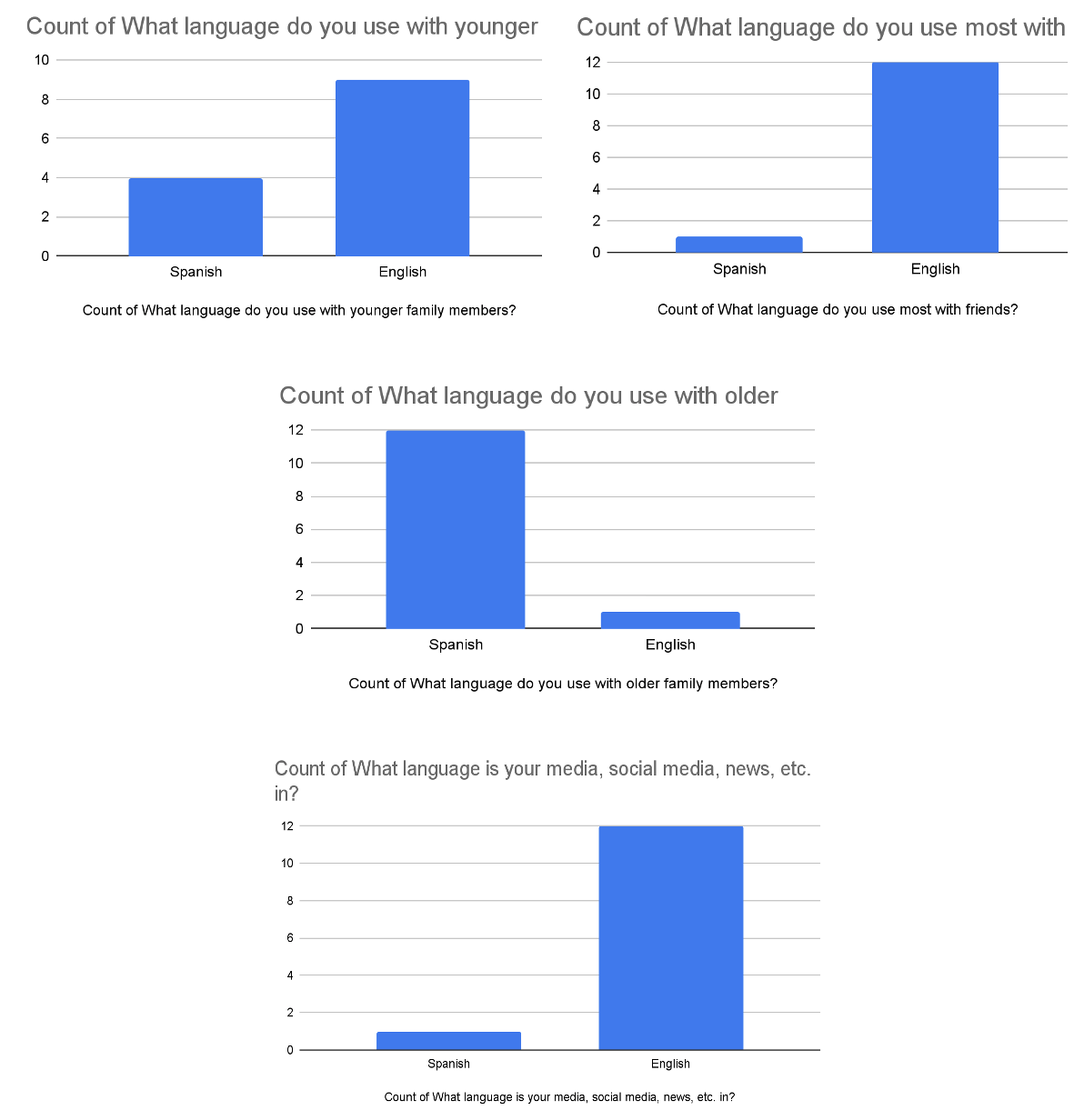
Scroll to Top