Sociolinguistics

Media & Reality All at Once: How ‘Everything Everywhere All at Once’ is doing its best to exemplify our code-switched conversations

Jacqueline Aguirre, Josiah Apodaca, Kaitlyn Khoe, Mason Uesugi, Wonjun Kim

Code-switching, or the use of more than one language, dialect, or code in an utterance or conversation, can be a way to signal identity. This study compares two sources of code-switching — conversations from media, specifically Everything Everywhere All at Once (2022), and conversations in real life — by categorizing utterances and types of code-switching. This study investigates the representation of code-switching in bilingual media and the similarities and differences to code-switching in daily life. The real life conversations were conducted with Mandarin-English bilinguals, and the two conversations ran for 8 and 10 minutes. The findings demonstrated that intersentential switching occurred more often in this particular media, while intrasentential switching was preferred by the real-life speakers. The various types and functions of code-switching were present in the media, which was expected given the larger sample size and production resources and timelines. Nonetheless, both case studies demonstrated significant levels and mannerisms of code-switching, aligning with the proposed variables and categories. Further studies could utilize other syntactic properties, pitch contours, and tonal articulations in order to auditorily represent accuracies and behaviors of code-switches as more bilingual media makes its way into the American entertainment landscape.

[expander_maker id=”1″ more=”Read more” less=”Read less”]

Introduction and Background

Code-switching (CS) refers to when a speaker alternates between two or more languages, or language varieties, within a single sentence or interaction. Code-switching is a linguistic function mostly used in bilingual speech communities to convey a mutual “in-group” status between speakers, as the ability to code-switch demonstrates proficiency in both of the utilized languages. Our study seeks to answer these questions: How is code-switching represented in media? What are the differences and similarities to code-switching in everyday life?

Deriving from the studies conducted by Shen, Gahl, and Johnson on English-to-Mandarin code-switches, we compared the types of code-switching between Mandarin and English in media, through the 2022 film Everything Everywhere All at Once (EEAO), versus real life to see how accurately code-switching is being represented. The aforementioned study by the researchers suggest the existence of “switch cost,” as the English-Mandarin bilinguals consistently displayed slower reaction times specific to the code-switches in sentence-medial positions, as highlighted in their eye tracking experiment (Shen et al,. 2020). However, while there are many studies giving structure to code-switching, there are fewer applying them to media. 

Our target population for this project were Mandarin Chinese and English bilingual speakers. Mandarin Chinese belongs to the language family of Sino-Tibetan languages, which is under the Sinitic branch (Odinye 2015). Internationally, about 1.3 billion people use the language, being the official language of China and Taiwan (Odinye 2015).
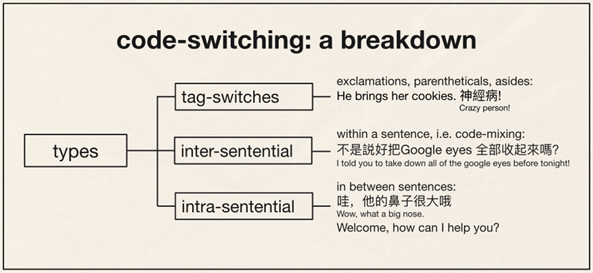
Figure 1. Explanation and examples of code-switching types.

There are three different types of code-switching: tag-switches, which are exclamations, parentheticals or an aside in another language than the rest of the sentence; intrasentential switches, which occur in the middle of the sentence and are typically called code-mixing; and intersentential switches, which occur between sentences (Appel & Muyusken, 2006). We will use these categories in our data analysis to see if some forms of media uphold current code-switching practices.
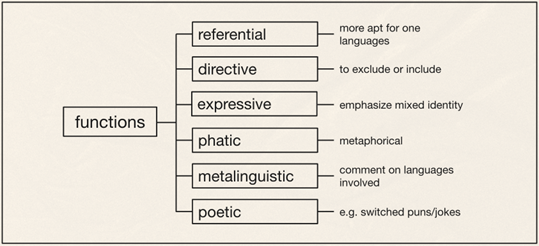
Figure 2. Explanation of code-switching functions.

Code-switching in a sentence can also serve different functions depending on the speaker, topic, and context of the language used. Researchers Appel & Muyuskend determined six categories as follows: (1) referential, where some subjects or words are more apt for one language, perhaps due to a lack of knowledge; (2) directive, to exclude or include the hearer; (3) expressive, emphasizing mixed identity; (4) phatic, or metaphorical switching; (5) metalinguistic, to comment indirectly or directly on the languages involved; and (6) poetic, which are switched puns or jokes (Appel & Muyusken, 2006).

There is going to be a lot left out about the filmmakers here, but in terms of context about the media that is relevant to code-switching, one of the writer/director duo ‘the Daniels,’ Kwan, is a second-generation Chinese-American. Having been in a Chinese Mandarin and English home environment, he is likely comfortable with engaging in code-switching because of his multilingual parents. One of the producers, Jonathan Wang, hopped on this project also because he wanted to tell a story inspired by his own immigrant parents, so he likely had a hand in ensuring language accuracy, like with the Cantonese, alongside with several translators. With this background in mind, we hypothesized that the movie’s representation of code-switching should be fairly accurate to how speakers code switch in real life.

We hypothesize that the participants and the script should have similar examples and amounts of code-switching in type and function within the given environmental parameters, as established earlier. Our research will help determine whether change is needed in how bilingualism is being represented, or if there is already a solid structure in place for new media to follow.

Methods
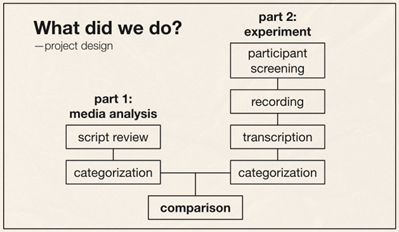
Figure 3. Step-by-step breakdown of our methodology.

Our project design comes in two parts: analyzing the media and analyzing a conversation in real-life. The script had both lines as they were spoken along with translations, so we could categorize them based on type of CS. We applied that same process to two conversations, around 10 minutes each, recorded between two sets of participants. They did know they were being recorded but eventually seemed to forget (over a period of around 10 minutes for each set), so the conversation seemed to flow naturally, with them code-switching subconsciously.
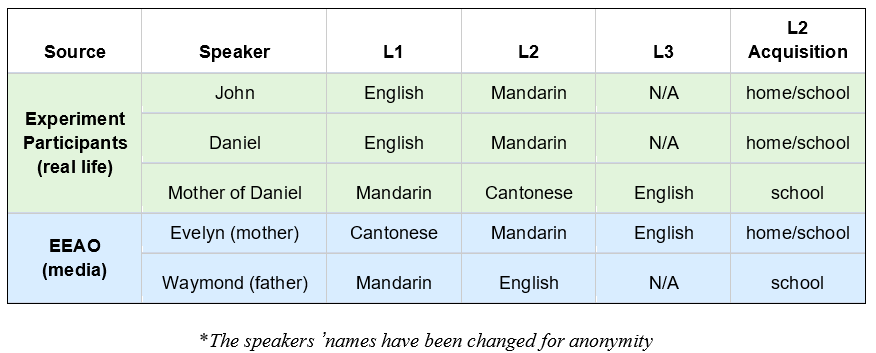
Figure 4. Language background of participants and EEAO characters.

We then analyzed the two sources of code-switching and made comparisons. For the screening process, we found our participants based on a language background survey collecting information, such as their L1, L2, and how they acquired their L2, as shown above. The characters’ method of L2 acquisition and L3 is speculated based on context. It is also likely that Evelyn is a simultaneous bilingual in Cantonese and Mandarin. Only the L2 acquisition method is listed, as it is relevant to our focus on bilingual speakers. Two of the participants (John and Daniel) were close cousins to reflect, while not exactly, the close relationship between Raymond and Evelyn. We also had one of them talk to their own mother to see if there would be a change with the different social dynamic. 

Results and Analysis

The table below shows the tallies for the types of code-switching used in the EEAO script (the blue indicating code-switching in media) and the conversations recorded with our participants (green for real-life code-switching). Since the conversations were not exactly the same amount of time, the proportions for each type of CS were calculated by dividing the total for each conversation by the count. There was insignificant information for tag switching in both the script and recordings, so it was left out of the table.
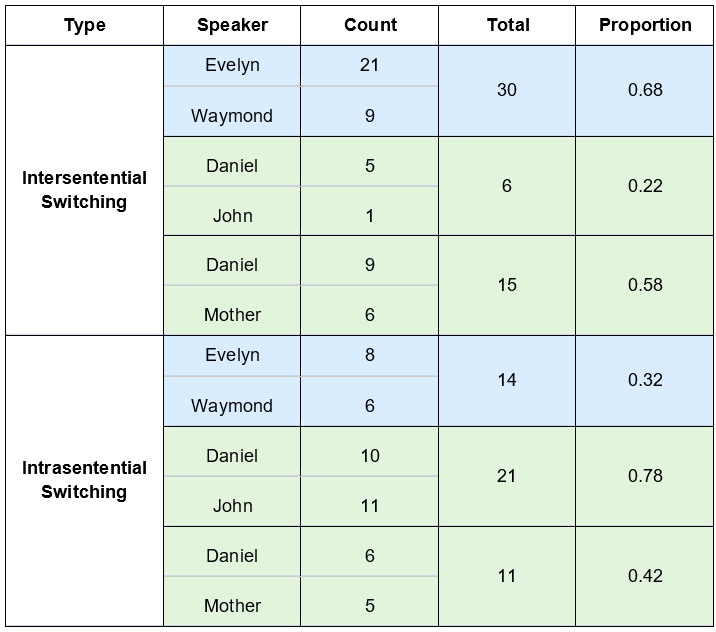
Figure 5. Code-switching frequency in media vs. recorded conversations. Proportion represents type of code-switching used in conversation out of total occurrences of code-switching.

Waymond and Evelyn used intersentential switching more than intrasentential (30 versus 14 times). That pattern is the same for Daniel and his mother (15 versus 11 times), while Daniel and John opted for more intrasentential switching (6 versus 21 times). The type of CS (intrasentential) that is more common for Daniel and his mother, whose language background and fluency matches best with EEAO characters, is the same as in EEAO conversations.

As for functions, each pair (Daniel and John, and Daniel and his mother) were dominant in the referential function, where some words or phrases are more easily expressed in one language. This outcome is likely because of the speakers’ proficiency in their second language — Mandarin. In a self-reported survey, both Daniel and John rated their L2 proficiency as a 3. The expressive and poetic function appear in the recorded conversations (CS was also used to repeat and clarify). The directive function likely does not appear in these conversations because they were recorded in isolated, controlled environments. Had they been in more natural environments, out in public, it is likely that the directive function would appear.

As for the functions present in the EEAO conversation, they were also dominant in the referential function of code-switching, with directive being the second most used. Considering the characters, Waymond and Evelyn, immigrated to America and were likely not exposed to their L2 (English) until later, it makes sense that the referential expression is dominant for them as well. Regarding their use of the directive function, this is most likely due to Waymond and Evelyn being in various environments where there was a third-party to exclude or include (e.g., customers, Gong Gong). Additionally, unlike our speakers, the expressive function does not appear in the movie, but the poetic function does show up once. 

Based on these results, it seems that the code-switching in EEAO supports the theory of the different types and functions of code-switching. When comparing our speakers’ code-switching with the movie, both align in having referential code-switching be primarily used in communication. Though with our speakers, they showed slightly more variety in function, as they covered expressive functions while the movie did not. While the movie significantly used the directive function, our speakers did not. Again, we conclude that this is due to a difference in environments between the speakers.

Discussion and Conclusion

The data promotes the idea that EEAO and its representation of code-switching is accurate. Since Daniel’s code-switching varied based on the hearers (with his cousin versus his mother), the movie’s representation is also accurate in representing how code-switching is employed for differing functions based on environment.

While the conversations and media we analyzed ended up with similarities, affirming our hypothesis of EEAO being an accurate representation of code-switching, further research is needed to extend these results to media in general. After studying natural conversations of English-Mandarin bilinguals, researcher Xitong Zhang found that “the occurrence of code-switching not only depends on the language ability of the speaker, but also the purpose and the environment in which the conversation occurs” (Zhang, 2019, p. 44). One of the ways to expand this study in the future would be to observe participants in more environments and situations over longer periods of time (e.g., recording conversations over the course of a week) because EEAO has more environments. This choice would provide more data for analysis and allow for a richer case study of CS.

It would also help to have participants whose language background better matches the characters even better because Daniel and John did not have the same L1/L2 as Waymond and Evelyn. However, the time constraint of this study provided a limited participant pool to see how identity and linguistic competency affect code-switching.

We could also look into instances of “bad” code-switching in media, likely tied to older media sources, to develop concrete standards of accurate code-switching — including what not to do — for future representations of the bilingual experience. We could just look at more films, maybe in other language pairings, or other sources of media, like TV shows, whether good or bad examples, as well.

In his video essay “English. Language. Movies. Parasite,” Kyle Kallgren studies code-switching in the 2019 film Parasite and the cultural implications of mixing English and Korean in conversation. The Parks, a rich family, often uses English to confide in each other or to establish solidarity with their hired workers. It seems that English is worked into the plot accents, signifying the divide between the poor and rich families. In a similar fashion, language boundaries reinforce relationships in the plot of EEAO, with code-switching being a big part of it.

America tends to fawn over foreign culture without realizing it is their own culture being sold back to them — just accented — which is probably why they find connection to it. There is something to be said about how these two movies employ code-switching as a tool to hint at language hierarchies. Studying the use of language and code-switching in media like this is important for providing a foundation for how to approach appropriate representation in media. There are harmful social implications if one does not consider the influence of how language is used in movies. As language hierarchies exist in reality, noticing and replicating them in media will only reinforce them when they should be dismantled. Understanding how media perpetuates practices in which social classes are tied to certain manners of speaking can help us counteract that.


References

Anindita, K. (2022). An Analysis of Code-Switching in the Movie “Luca”. ELTR Journal, 7(1 23-33. https://doi.org/10.37147/eltr.v7i1.164

Appel, R. & Muysken, P. (2006). Language Contact and Bilingualism. Chicago: University of Chicago Press.

Chen, Z., & Liu, X. (2023). Types and Functions of Code-Switching in the Film Everything Everywhere All at Once. Journal of Education, Humanities and Social Sciences, 13, 171-176. https://doi.org/10.54097/ehss.v13i.7889.

Kwan, D. and Scheinert, D. (Writer). (2022). Everything Everywhere All at Once. A24.

Odinye, S. I. (2015). Phonology of Mandarin Chinese: Pinyin Vs. IPA. Quarterly Journal of Chinese Studies, vol. 4, no. 2, p. 51–58.

Reformadita, A., & Setyaji, A. (2021, October). Code-Switching Analysis on Pixar’s “Coco” Movie. In Undergraduate Conference on Applied Linguistics, Linguistics, and Literature. (Vol. 1, No. 1, pp. 26-37).

Shen, A., Gahl, S., & Johnson, K. (2020). Didn’t hear that coming: Effects of withholding phonetic cues to code-switching. Bilingualism: Language and Cognition, 23(5), 1020-1031.

Zhang, X. (2019). Code-Switching in English-Chinese Ordinary Conversations. TESOL Working Paper Series, 17, 38-45.


Appendix A

PDF Link for EEAO Script

[/expander_maker]
, , , ,

Phonological Variation and Identity in L.A. Spanish: The Case of /s/ Debuccalization

Nicholas Guymon, Jafarri Nocentelli, Amanda Tai, Brian Cifuentes

In this study, we investigate how native speakers of Puerto Rican, Guatemalan, and Mexican dialects of Spanish use /s/ debuccalization, a phonological process which targets /s/ in the coda position and yields either [h] or [∅] through complete deletion, to signal informal speech in Los Angeles. By examining the national origin, age, gender, linguistic background, and education of these three consultants who currently reside in Los Angeles but hail from elsewhere; the phonological characteristics of their native dialects; and the characteristics and use of Español Vernáculo de Los Ángeles (EVLA), the preeminent variety of Spanish spoken in Los Angeles, we identify /s/ debuccalization as a significant sociolinguistic marker across formal and informal registers. Indeed, we argue that the (non-)application of /s/ debuccalization across formal and informal registers reflects one facet of our speakers’ adaptation to the diglossic environment of Los Angeles, where the prestigious variety, EVLA, influences informal speech practices and how this phonological variation contributes to the construction of identity in multicultural urban settings.

[expander_maker id=”1″ more=”Read more” less=”Read less”]

Introduction and Background

In this article, we investigate how male and female native speakers of Puerto Rican, Guatemalan, and Mexican dialects of Spanish living in Los Angeles signal informal speech through a phonological process known as /s/ debuccalization, which targets instances of /s/ in coda positions and yields [h] or [∅] through complete deletion. By considering the national origin, age, gender, linguistic background, and education of our consultants, the phonological features of their native dialects, and the interaction between geographically removed Spanish dialects in Los Angeles, we aim to answer the following questions: What phonological features characterize Puerto Rican, Guatemalan, and Mexican Spanish vis-à-vis EVLA (Español Vernáculo de Los Angeles), the preeminent variety of Spanish spoken in Los Angeles? How can diglossia explain the distribution of phonological phenomena (e.g., /s/ debuccalization in Puerto Rican Spanish) observed in the informal speech of these dialects in Los Angeles? How do speakers create connections between their homeland and construct their identities through their native dialects in a context of linguistic isolation and geographic dislocation?

In the speech of one of our consultants, a woman named Rosalie who currently resides in Los Angeles, for instance, we will examine the optionality of /s/ debuccalization, or /s/ aspiration, in Puerto Rican Spanish. We aim to answer the following questions: Can we predict in which environment(s) /s/ debuccalization occurs and what sociolinguistic variables affect the optionality of this rule itself? Is the (non-)application of this rule related to formality and prestige? How does Rosalie’s (non-)application of /s/ debuccalization index her membership to different speech communities of Spanish speakers?

We hypothesize that in informal contexts with speakers of the same dialect or other dialects in which /s/ debuccalization occurs, our speakers will apply /s/ debuccalization. Conversely, in formal contexts with speakers of the same dialect and other dialects of Spanish where this feature may or may not be present, our speakers will not apply /s/ debuccalization.

Methods

In order to contrast the characteristics of the informal speech of Puerto Rican, Guatemalan, and Mexican dialects of Spanish with EVLA, it is necessary to describe the phonological features of each of our speakers’ dialects and those of EVLA, a “Spanish koiné in Los Angeles which has a distinct Mexican flavor spiced with those Spanglish features typical of the intimate contact with English: convergence, borrowings, calques, switches, and so forth” (Sánchez-Muñoz, 2007, pg. 74–75).

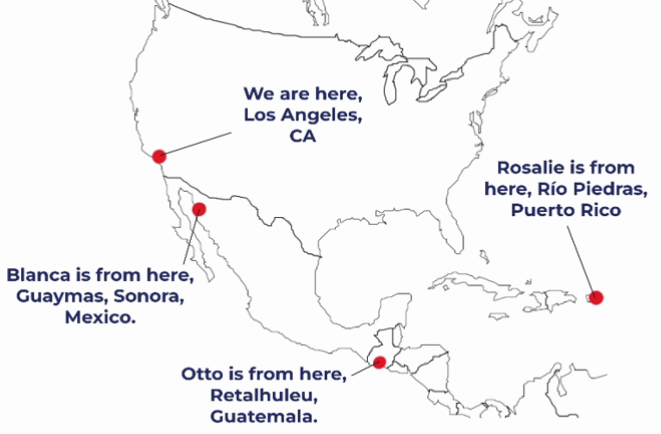
Before we could describe the phonological features of our speakers’ dialects of Spanish, we gathered demographic, geographic, linguistic, and biographic information through a questionnaire which each of our speakers completed independently. Among these questions, we asked our consultants about their age, preferred gender identity, educational background, native language, daily usage of and literacy in Spanish, and their perceived proficiency in any other languages. Finally, we asked about our consultants’ birthplace, the cities/regions in which they grew up, the duration of their residence in those cities/regions, and the duration of their residence in Los Angeles, California. We have marked the locations where our consultants grew up and the location of Los Angeles in the following map:

Figure 1. Cities of origin of our three consultants.

The geographical information helped us determine our consultants’ dialects of Spanish and the unique phonological phenomena which characterize these dialects themselves. In our consultants’ speech, we identified a common phonological process: /s/ debuccalization.

Excursus on Syllable Structure

Recalling that /s/ debuccalization is intimately linked to syllabic structure, we provide a brief discussion of syllabic structure, syllabification, and relevant terminology used throughout our analysis, drawn from Hayes (2009, pp. 251–253). Roughly speaking, the syllables have three main anatomical components: a nucleus, onset, and coda.

  • The nucleus is a vowel, diphthong, or syllabic consonant which forms the basis of a syllable.
  • The onset is the consonant(s) at the beginning or left-edge of a syllable.
  • The coda is the consonant(s) at the end or right-edge of a syllable.

With these terms in mind, words can be syllabified according to the following principles:

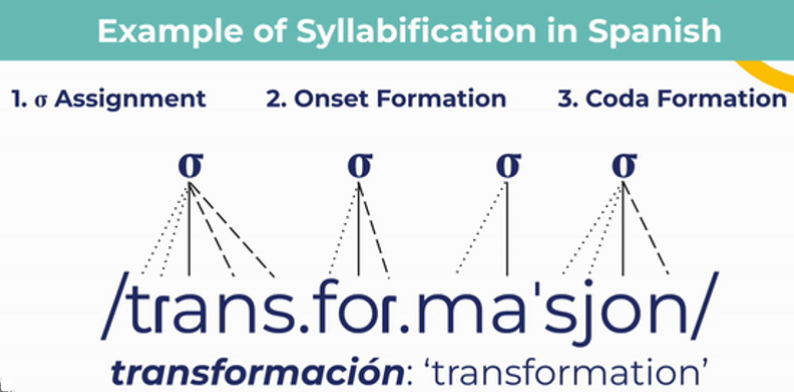
  1. σ Assignment: Assign syllable nodes (σ) to vowels, diphthongs, or syllabic consonants which share the feature [+syllabic].
  2. Onset Formation: “Join consonants to the following syllable, provided the resulting cluster can occur at the beginning of a word (Maximal Onset Principle)” (p. 253).
  3. Coda Formation: Any unsyllabified segment(s) join(s) the preceding syllable.

In Figure 2 below, we provide an illustrated example of the syllabification of the Spanish quadrisyllabic, or four-syllable, word transformación ‘transformation’ in phonemic transcription.

Figure 2. Example of how syllabification works in Spanish.

In this example, there are two instances of /s/: one /s/ appears in the coda of the first syllable, and another appears in the onset of the final syllable. Indeed, the phonological process of /s/ debuccalization will affect the surface realization of only the first /s/ in the first syllable of the word, found in coda position. The second /s/, belonging to the onset of a syllable, will remain unaffected.

/s/ Debuccalization and Spanish Varieties

/s/ debuccalization has been famously studied in Puerto Rican Spanish (García et al., 2023; Lipski, 2008; Sánchez-Muñoz, 2017; Tomás, 1999). In Guatemalan and Mexican dialects, however, its occurrence is geographically restricted. /s/ debuccalization is not typically observed in Guatemalan Spanish, “only along the border with El Salvador, along the Pacific coast, and near the border with Belize is a slight weakening of preconsonantal /s/ to be found” (Lipski 2008, p. 184). A similar situation holds in many Mexican dialects of Spanish, but there is “significant reduction of final /s/ … [also found in] rural northwestern Mexico, including the state of Sonora” (p. 85). Conversely, speakers of EVLA, as Sánchez-Muñoz identifies, do not debuccalize /s/ to produce [h] or [∅] (pp. 74–76). If speakers of EVLA, therefore, lack a synchronic phonological process of /s/ debuccalization, this process in any of our consultants’ speech will have an important indexicality value to speakers of EVLA and other varieties where this feature does not occur. The application of /s/ debuccalization may not only index our consultants as non-locals, but it may also have other important sociolinguistic ramifications involving prestige, social interactions, and linguistic attitudes.

Since EVLA is the preeminent variety of Spanish spoken in Los Angeles, we anticipate that the distribution of phonological phenomena, such as /s/ debuccalization, will be influenced by diglossia, with the high variety being EVLA and other dialects being low varieties. This categorization will allow us to compare the role of language prestige and other social factors in shaping informal speech patterns, shedding insight on how Spanish speakers from different national origins and linguistic backgrounds modify their speech to negotiate their social identities and community affiliations in a multicultural setting like Los Angeles.

Project Design

In order to collect quantitative data, we conducted a series of sociolinguistic interviews with our consultants, guided by methods outlined in Van Herk (2018, pp. 121–122). After gathering demographic and biographical information, we recorded our consultants as they read the first paragraphs of Menéndez Pidal’s Manual de gramática histórica española, a technical linguistics manual written in Spanish, and a Spanish word list of 87 items in which /s/ occurs in a variety of phonological environments. Finally, we recorded a live conversation between our consultants and another native speaker of the same dialect.

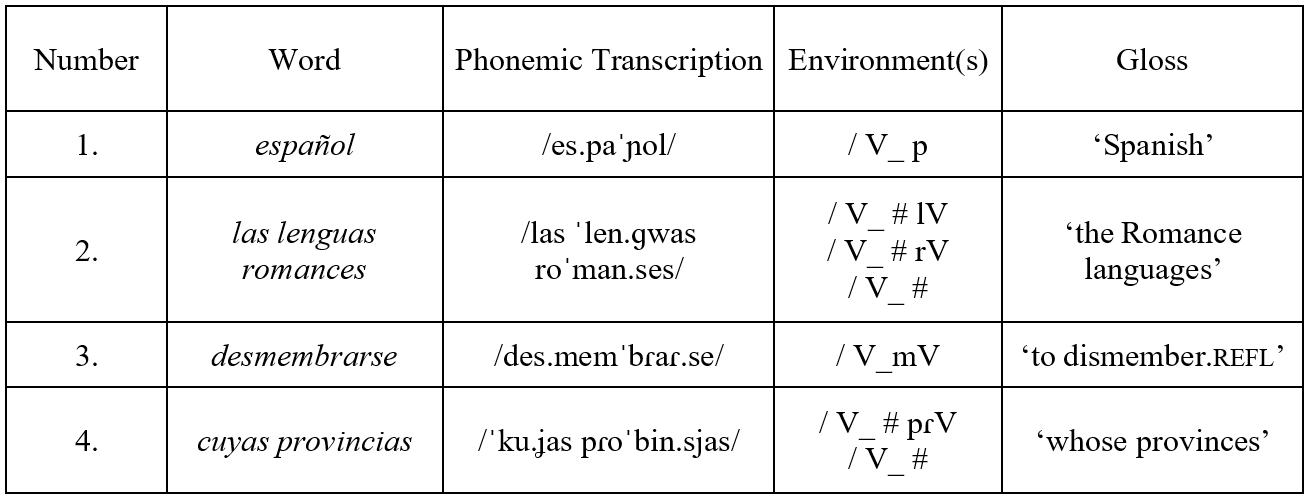
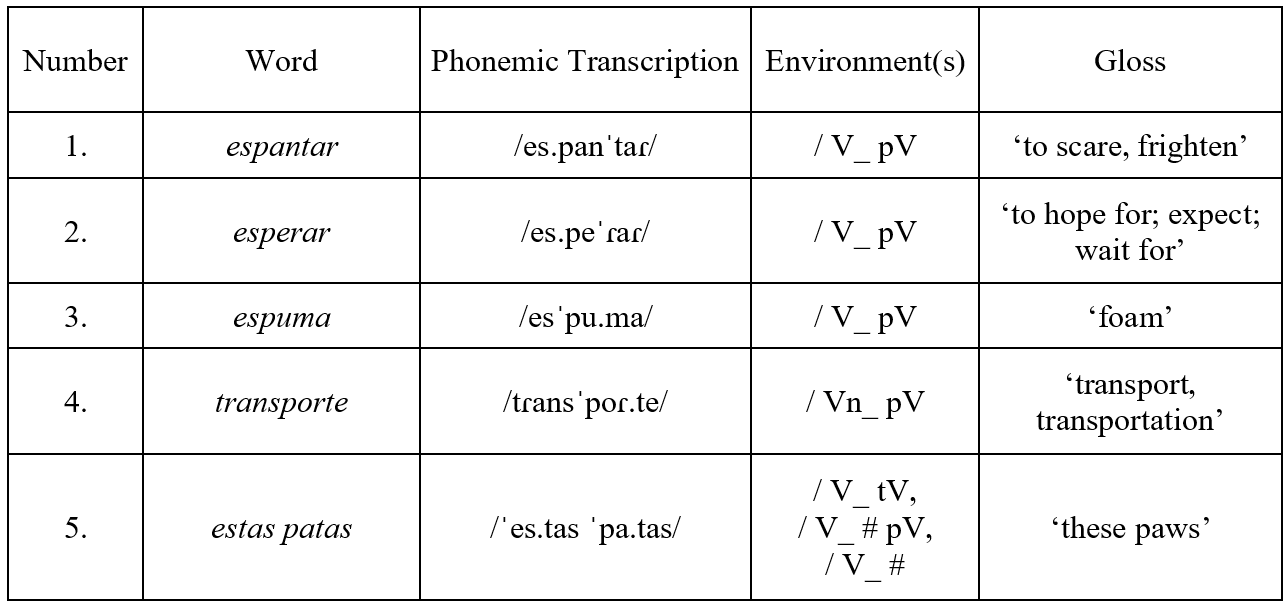
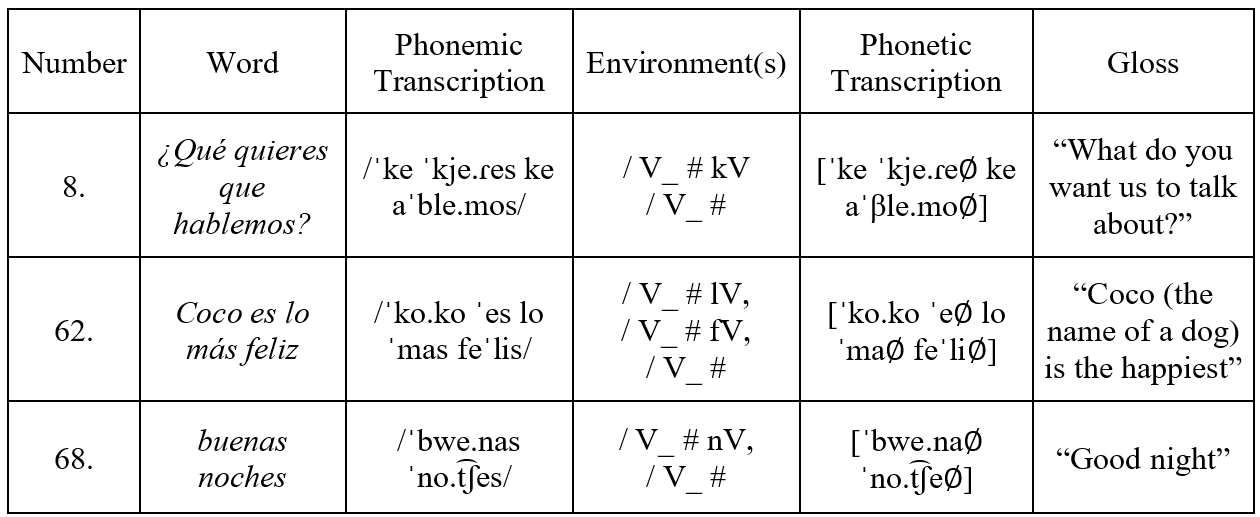
In all of these materials, we gathered environments in which /s/ appeared in coda position, using each instance as a token of /s/ subject to /s/ debuccalization which we later compared across styles. In Menéndez Pidal’s text, we identified 49 instances of /s/ in coda position, with 180 in our curated word list. As we prepared for our elicitations, we provided the orthography, phonemic transcription, and gloss of each Spanish word, following Harris (1969). We supply two sample tables below:

Figure 3. Spanish words from Menéndez Pidal’s Manual de gramática histórica español.
Figure 4. Spanish words used in elicitation.

After our elicitations, we reviewed our recordings, created phonetic transcriptions of each Spanish word, and compared our tokens of /s/ to the (non-)application of /s/ debuccalization. Then, we established proportions and calculated the percentages of the (non-)application of /s/ debuccalization. Lastly, we compared these proportions across styles and dialects.

We predicted that as our consultants read the passage and word list, knowing that we were recording, we would induce the observer’s paradox, and our consultants would engage in more self-monitoring, likely reducing the frequency of phonological phenomena which characterize informal speech (Labov, 1972, pp. 43; Llamas, 2007, p. 15).

Results and Analysis

Our study revealed distinct patterns of /s/ debuccalization among our Puerto Rican, Guatemalan, and Mexican consultants, demonstrating how this phonological process varies across different speech contexts and dialects.

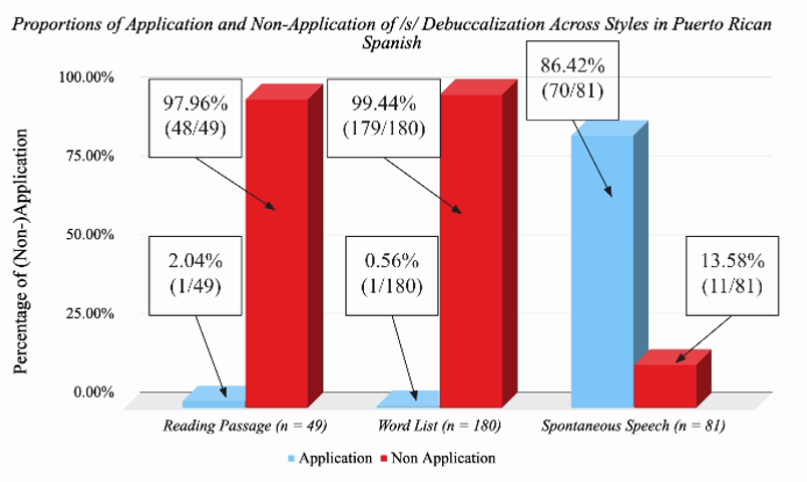
Rosalie, our Puerto Rican Spanish speaker, displayed a notable variation in the application of /s/ debuccalization depending on the speech context. In the reading passage, we observed a very low application rate of 1 out of 49 instances (2.04%). In our word list, we observed an even lower application rate of 1 out of 180 instances (0.56%). In spontaneous speech, however, Rosalie’s use of /s/ debuccalization sharply increased to 70 out of 81 instances (86.42%). Below are some representative examples of /s/ debuccalization recorded in Rosalie’s spontaneous speech:

Figure 5. Examples of /s/ debuccalization in Rosalie’s spontaneous speech.

The significant contrast of the application of /s/ debuccalization across styles suggests that Puerto Rican speakers switch between formal and informal registers, with /s/ debuccalization being a key feature in informal speech. These findings are summarized in Figure 6 below:

Figure 6. /s/ Debuccalization across styles in Puerto Rican Spanish.

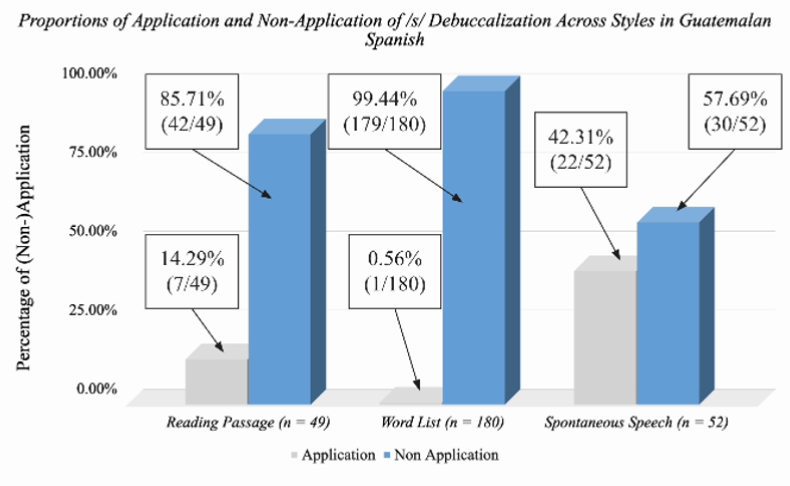
Otto, our Guatemalan Spanish speaker, exhibited moderate variation in the application of /s/ debuccalization. In the reading passage, his application rate was relatively low with only 7 out of 49 instances (14.29%). In the word list, his application rate was minimal with only 1 out of 180 instances (0.56%) observed. In spontaneous speech, his application rate rose to 22 out of 52 instances (42.31%). This variability suggests that while Guatemalan speakers may use /s/ debuccalization as a marker of informal speech, the extent of its use can vary significantly depending on the context. The moderate application in spontaneous speech suggests that this phonological process is associated with varying degrees of formality, but not to the extent witnessed in Puerto Rican speakers. These results are summarized in the bar graph below:

Figure 7. /s/ Debuccalization across styles in Guatemalan Spanish.

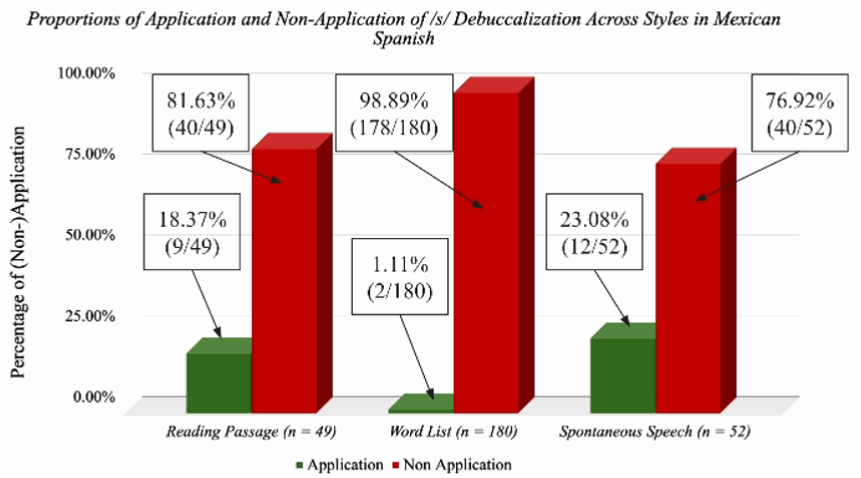
Blanca, our Mexican Spanish speaker, showed a low application rate of /s/ debuccalization in the reading passage at 9 out of 49 instances (18.37%). Her application rate was very low in the word list at 2 out of 180 instances (1.11%) and remained relatively low in spontaneous speech at 12 out of 52 instances (23.08%). These findings suggest that /s/ debuccalization is present in her dialect of Mexican Spanish across different styles, but it is not nearly as pronounced of an indicator of informal speech as in Guatemalan or Puerto Rican Spanish. The consistent yet low application across all contexts indicates that this feature may not be subject to significant sociolinguistic variation for Mexican speakers in Los Angeles. Additional research, however, may prove or disprove this claim. These findings are illustrated in the following chart:

Figure 8. /s/ Debuccalization across styles in Mexican Spanish.

Discussion and Conclusions

Indeed, our results indicate that /s/ debuccalization is a linguistic marker (Watt, 2007, p. 6) and that its use appears to be correlated with style. In the Puerto Rican dialect of Spanish spoken by Rosalie, the correlation is the strongest. In the Guatemalan dialect of Spanish spoken by Otto, the correlation is less pronounced than in the Puerto Rican dialect we investigated. In the Mexican dialect of Spanish spoken by Blanca, the correlation is the weakest. Although a correlation exists between style and /s/ debuccalization across these dialects, it must be noted that correlation does not imply causation. In other words, it would be fallacious to claim that differences of formality between styles alone affect the (non-)application of /s/ debuccalization. Such a claim risks removing agency from speakers themselves.

Within social interactions, a speaker’s consistent use or avoidance of geographically-specific features may signal a desire for particular associations which become salient depending on the sociolinguistic context. The use of these features is also mediated by the diglossic situation of Los Angeles, which affords varying levels of prestige to different Spanish varieties which come into contact in the city. For Puerto Rican speakers, for instance, /s/ debuccalization is a prominent feature in spontaneous speech, whereas for Guatemalan and Mexican speakers, its use is more variable and less pronounced. On the one hand, Rosalie, Otto, Blanca, and other Spanish-speaking LA residents, may adopt specific features of EVLA despite their own national origins and linguistic backgrounds because phonological processes such as /s/ debuccalization may index them as non-locals to speakers of EVLA and other varieties where /s/ debuccalization does not occur. On the other hand, the retention of dialectal features may be understood as a direct connection between speakers and their regions of origin where these features are found.

These sociolinguistic phenomena may also be understood according to the SPEAKING framework (Hymes, 1974b) and Accommodation Theory (Giles & Coupland 1991). We must consider our own identities and backgrounds as participants in our sociolinguistic interviews and those of the people whom our consultants called as variables which have influenced our interactions themselves. Accommodation Theory complements the SPEAKING framework of Hymes (1974b) by explaining sociolinguistic interactions through processes of convergence and divergence. In the former, speakers and interlocutors adapt their communicative behaviors, and in the latter, speakers accentuate their speech and nonverbal differences (Sánchez-Muñoz, 2017, p. 77). Thus, it is likely that our speakers’ convergence and divergence involving /s/ debuccalization involves a linguistic awareness of dialectal variation which is mediated not only by the presence or absence of this feature in the phonologies of their interlocutor(s) but also by the prestige afforded to EVLA at the expense of their native varieties.

Further Readings

If any of the topics above interested you, we recommend looking at some of the following blog posts and videos on YouTube:

  1. If you are interested in Puerto Rican Spanish, follow this link.
  2. If you are interested in language awareness and code-switching, follow this link. 

References

García, C., Walker, A., & Beaton, M. (2023). “Exploring the role of phonological environment in evaluating social meaning: the case of /s/ aspiration in Puerto Rican Spanish.” Languages, 8(3), 186. https://doi.org/10.3390/languages8030186.

Giles, H., & Coupland, N. (1991). Language: Contexts and Consequences. Brooks/Cole. Pacific. Grove, CA.

Herk, G. V. (2018). What Is Sociolinguistics? (2nd ed.). Wiley Blackwell.

Labov, W. (1972). “The social stratification of (r) in New York department stores.” In Labov, W. Sociolinguistic Patterns (pp. 43–54). University of Philadelphia Press. Philadelphia, PA.

Llamas, C. (2007). “Field methods.” In C. Llamas, L. Mullany, & P. Stockwell (Eds.), The Routledge Companion to Sociolinguistics (pp. 12–18). Routledge.

Lipski, J. M. (2008). Varieties of Spanish in the United States. Georgetown University Press. Washington, D.C.

Menéndez Pidal, R. (1958). Manual de gramática histórica española (10th ed.). Espasa-Calpe. Madrid.

Sánchez-Muñoz, A. (2017). “Tempted by the words of another: Linguistic choices of Chicanas/os and other Latinas/os in Los Angeles.” In J. Rosales & V. Fonseca (Eds.), Spanish Perspectives on Chicano literature: Literary and Cultural Essays (pp. 71–81). Ohio State University Press. https://doi.org/10.2307/j.ctv3znwwz.9.

Tomás, N. T., & de Ramírez, M. T. V. (1999). El español en Puerto Rico: contribución a la geografía lingüística hispanoamericana. La Editorial, UPR.

Watt, D. (2007). “Variation and the variable.” In C. Llamas, L. Mullany, & P. Stockwell (Eds.), The Routledge Companion to Sociolinguistics (pp. 3–11). Routledge.

Harris, J. W. (1969). Spanish Phonology. MIT Press, MA.

[/expander_maker]
, , , , ,

The Linguistic Portrayal of Social Mobility in Bollywood Cinema through Hinglish

Hashim Baig, Siuzanna Shaanian, Georgia Lewis, Jacob Cook, Christian Atud

The rise of English as the global lingua franca has had profound effects on multiple cultures worldwide. One such spot is the Indian subcontinent, especially with the emergence of India from centuries of colonial rule. This paper looks at how Hindi-English code-switching (popularly called Hinglish) in Bollywood films post-2000 both reflects and constructs social identities. It analyzes five contemporary Bollywood films and argues that the increase in Hinglish usage corresponds with characters’ social mobility, still signifying English as a potent symbol of prestige. This research aims to unearth the interplay of dynamics between language usage and perceived social standing in contemporary Indian cinema.

[expander_maker id=”1″ more=”Read more” less=”Read less”]

Introduction

English, being a global language, has influenced many cultures worldwide. One of the most impacted cultures was that of India, a former British colony. One of the most exciting consequences of this influence is the rise of Hinglish — a mixture of Hindi and English — primarily in the context of Bollywood films. Our project will investigate how Bollywood movies use Hinglish as a means of social change by depicting a character as having a higher social status through excessive code-switching into English.

Background

Bollywood is the leading film industry in India, providing fertile ground for the use and experimentation of different languages and linguistic expressions. The most salient is the integration of English into Hindi dialogues, often called Hinglish. This is relevant since some of the more recent films with this thematic feature in the foreground also depict the interaction between the English and Hindi languages as facilitators of social mobility. The fact that English is the prestigious code in Indian society and Bollywood is very influential in molding cultural trends, thus marking these films as good starting points for studying linguistic portrayals of social mobility.

Literature Review and Context

The Colonial Hangover

The continuing popularity of English in India began during the British colonial era, when the English language was used in administration and education. Within this context, the English language symbolized both sophistication and higher social status. Chandra (2014) says that in recent times, English has become a fashionable aspect of filmmaking in India, “associated with modernity and prestige.” Chakraborty (2022) also mentions what he refers to as the ‘Colonial Hangover.’ Knowledge of English, he says, is equated with higher social status and respect.

Bollywood’s Linguistic Landscape

Even in their language use, Bollywood films reflect changes in society. According to Rao (2010), English is identified with modernity and prestige; Hindi, however, is an intimate language of traditional values. Furthermore, this dichotomy has been depicted using code-switching. Context and social aspirations govern the switch between Hindi and English.

Code-Switching as a Tool of the Narrative

Si (2011) holds that code-switching is not random but rather a narrative device in Bollywood movies. English words or phrases are inserted into Hindi dialogues to portray a character’s social mobility, education, or cosmopolitanism. The present paper seeks to understand how, drawing from these studies, such linguistic choices could potentially stand synecdochally for social mobility in contemporary Bollywood films.

Project Design

This paper endeavors to examine and find evidence of any relationship that may exist between patterns of code-switching and the rise and fall of the characters’ social status in five films: Thank You for Coming (2023), Sukhee (2023), Laapataa Ladies (2023), Mission Raniganj: The Great Bharat Rescue (2023), and 3 Idiots (2009). The reason these movies have been selected for this purpose is that they essentially belong to a genre of ‘rags-to-riches’ stories and because they have been widely viewed.

Methodology

Collectively, we utilized a mixed-methods approach; qualitative content analysis was combined with quantitative frequency measures. We analyzed under what context code-switching occurs. That is, for particular scenes, social interaction and visual information related to socioeconomic status. We also counted the frequency of code-switching. We grouped each instance of code-switching into one of two categories: light and heavy. Light code-switching refers to sporadic insertions and alternations of English into Hindi, as well as forms borrowed from English. Heavy code-switching would refer to the use of extended English expressions, sentences, and rapid switching between English and Hindi. Each instance was counted across different narrative stages: exposition, rising action, climax, and falling action. Hopefully, through such an examination, we may develop insight into how Hinglish use is representative of social identities and how code switching shapes them in Bollywood films.

Results and Analysis

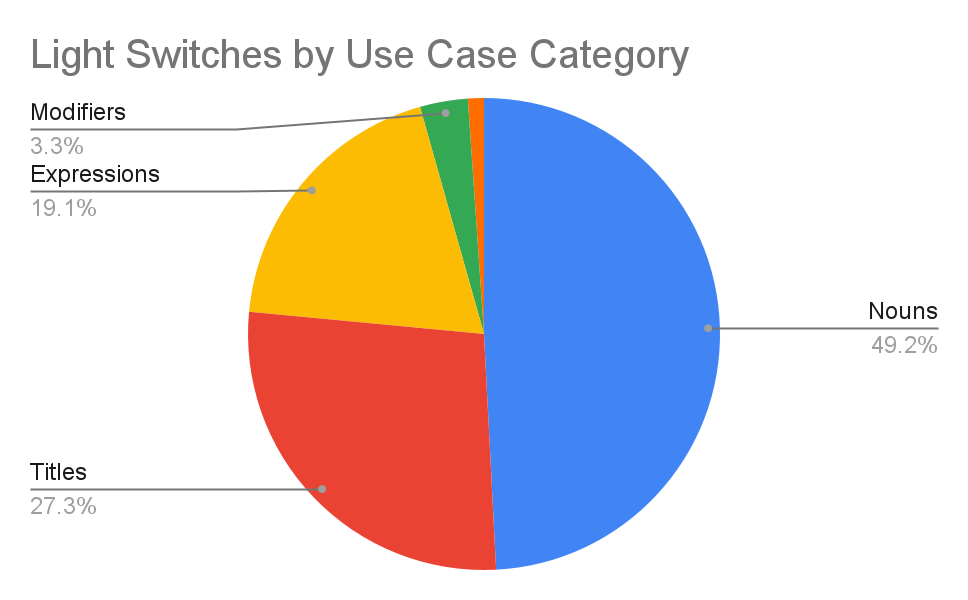
In this research, we found that there was a moderate use of light phrases in middle socioeconomic environments, with much more frequent usage towards and between people in high social positions. Light phrases are pervasively used in these environments and are almost entirely used for referring to specific items such as “boreholes” or “walls,” as well as specific titles such as “Sir” or “Doctor.”

Figure 1. Relative Distribution of Light-Switching: Categories. This pie chart summarizes the relative distribution of the types of light switching observed in this study. A majority of the switches were used to refer to nouns or specific nouns. Each category is defined by its context and use case. Discrimination was made between titles and nouns, as their use cases were notably distinct.

In this study, the average amount of light utterances per movie totals to around 400 phrases. Of those 400 phrases, about 25%, on average, include non-noun switching. This subset mostly consists of expressions/sayings (e.g., ‘Thank you,’ ‘I’m sorry’) and modifiers (insertion of adjectives, adverbs, etc.). Of the nouns, it is worth noting that a majority of these utterances are a form of borrowing from western culture. These include scientific/official names (e.g., ‘Carbon Dioxide,’ ‘Instagram’) and specific titles (e.g., ‘Doctor,’ ‘Sir,’ ‘Upper Management’). In especially institutionalized contexts, such as in educational or professional settings, this tendency is much more pronounced, as it would correlate with intelligence and competency. It is akin to using proper jargon when in an official discussion between peers or co-workers. Although nouns and titles share similar linguistic qualities, a distinction must be made between the two in order to account for their differing use cases. Titles, in particular, were commonly used towards individuals of high standing as a form of politeness and respect in a professional setting. One of the most common examples of this would be the usage of the word ‘Sir’ towards high ranking individuals. It is also worth noting that verbs were more commonly used in heavy switches and see little to no usage in light switches. This is largely due to the usage of English verbs in command/directive phrases rather than as a simple insertion/alternation. Most commands would be issued by an individual with authority and power. This would lead to the switching of the entire sentence to English, which would give the order a more serious/official connotation and allow the individual to leverage their position.

In regards to heavy code-switching, we observed 40-70 instances of heavy switching per movie, on average. This number would fluctuate depending on the overall setting of the movie. Movies set in professional settings, such as Mission Raniganj, would see a higher usage of heavy code-switching as a marker for ‘officiality.’ This trend exists because a much larger cast of characters are depicted as ‘intelligent’ and ‘powerful’ enough to use these forms. Heavy-switching forms can also be split into several categories: extended sayings/proverbs, official conduct, and narrative effect. The frequency of each category would also depend on the movie genre, with action movies opting for more instances of official conduct. Official conduct, in this study, would be a character’s tendency to use English as a medium to denote seriousness, power, and hierarchical respect. Medal ceremonies, press conferences, and board discussions would include many instances of ‘official’ code switching. Usage of English for narrative effect would mostly be tied to specific characters as part of one’s personality and could be used to highlight/exaggerate a powerful point during the movie. Such instances include the usage of English to look cool, smart, or funny. On the topic of sayings and proverbs, scriptwriters would use large English expressions to flesh out a specific character’s identity. One character, for example, would use the expression “I know this place like the back of my hand” as a catchphrase to denote professionalism, while also being entertaining for the audience.

Another interesting finding includes intentionality when switching between English and Hindi. We found several instances where rapid switching between English and Hindi would depend on the context and emotion behind each utterance. Some pivotal scenes would hinge on the differentiation between officiality and intimacy. Moments where a character must command/exert one’s authority in an official manner would invite the use of English. In moments of weakness, intimacy, and affection, characters would often switch back to Hindi. This finding runs similar to Rao (2010)’s findings, where he would describe this tendency as a “preservation of Indian values.”

To demonstrate this, we can take a look at an example from the movie Mission Raniganj.

Figure 2. Mission Raniganj. Protagonist Rescue Officer Gill (Left) confronts main antagonist Director Technical Dayal (Right) in front of a board of managers (Mission Raniganj: The Great Bharat Rescue, 2023, 1:40:32). Gill and Dayal each appeal to the managerial board using both English and Hindi. When appealing to status, they switch to English. Conversely, they switch to Hindi when appealing to emotion.

In this scene, the main character, Gill, is the main rescue officer in charge of rescuing 70 miners who were trapped in the Raniganj Colliery. Gill is rich and depicted as intelligent, calm, and heroic in a majority of the scenes he appears in. The other characters in this scene, such as Director Ujwall and Director Dayal, are all well-dressed and depicted as intelligent, powerful people. In this scene, the managing board is picking out an individual to head into the mines through a borehole to help manage the manual rescue of the miners. CO2 gas is forming, making the operation potentially lethal. Director Dayal, in an attempt to steal the credit, says: “No, we can’t be so selfish; [Gill has a bright future]; we can’t send a talented officer [down to sacrifice his life].” Gill responds: “Thank you for your concern sir, but I promise you, [I will have my morning tea with you].” The blue words that are within brackets represent phrases in Hindi, whereas all other words are mentioned in English.

This scene demonstrates the intentional switching between English and Hindi in an official setting. Here, we see both individuals speak in English when formulating an official response, such as Gill’s appreciation and Dayal’s request. They both, however, intentionally switch to Hindi when appealing to emotion and intimacy. This scene is powerful and successfully depicts Gill as not only intelligent but magnanimous in a way that parallels Indian values.

Film Analysis Examples (Excluding the already discussed Mission Raniganj)

  • Thank You for Coming
    • Brief Summary: Kanika Kapoor is the lead character. This 32-year-old unmarried girl lives with her mom and grandmother. Kanika goes on a journey searching for love and sexual satisfaction for herself, getting intertwined along the way with her college friend, a professor, and much later with some guy called Rahul. Nothing seems to satisfy her enough for her to reach that satisfaction. She learns that during depression, particularly after breakups or on her birthdays, Kanika finds support from her best friends, Pallavi and Tina.
    • Scene Example: In the first five minutes of the film, a young elementary school Kanika gets in trouble with her principal and asks to leave because she announces during a school play that their presentation of “conception” is incorrect and not how babies are made, but rather men and women “must have sex.” Following this formative memory and pivotal scene, the film cuts to Kanika’s mother speaking to the principal in Hinglish: “I don’t want to confuse my child, Miss Kukreja. Main ek clinic chalata hoon aur mareez aate hain-” (Translation: “I don’t want to confuse my child, Miss Kukreja. I run a clinic and patients come-”).
    • Visual Cue: Kanika’s mother is dressed in a floral suit jacket and pants as she communicates with the principal, who is much older than her mom. The principal is noticeably older and dressed in a sari. Her hair is perfectly curled, and she wears mid-sized purple hoop earrings.
    • Analysis: In Thank You for Coming, the mother of the protagonist repeats what her daughter has been telling her regarding how serious she is in going back to school, which she finds professional, in Hinglish. In the real sense, her daughter discusses with her classmates about sexual intercourse, which is not appropriate to her. Her use of the word “clinic” in English shows the pride she wants to pass on to the principal, implying that her work is medical. She then further reiterates that with English, saying “I do not want to confuse my child,” and stressing the gravity and formality of the issue at hand. This again pushes home the fact that she is a medical professional, hence her daughter’s excellent knowledge of sex.
  • Sukhee
    • Brief Summary: This light-hearted film narrates how Sukhee, an exuberant 38-year-old Punjabi housewife, gets tired of living a monotonous life and books herself a flight to Delhi for her high school reunion. Over that week, Sukhee rediscovers her teenage self and more; she got to experience new things for the first time in her life that brought back a zest for living. Through this journey, she undergoes a dramatic transformation from her housewife-mother duo role to rediscovering and asserting the woman within.
    • Scene Example: Towards the end of the film, after the crazy ups and downs of a reunion adventure, Sukhee and her three girlfriends are shown to have reunited and are sharing lessons learned and goals set for themselves. This emotional ending has the women sharing their plans for growth and evolution. One of the friends, Mansi Parekh, shares her goal-cum-intention, which contains a heavy amount of code-switching: “Central sunishchit karunga ki meri agli naukri mein mujhe respect, promotion, aur equal opportunities milein.” (Translation: “In my next job, I’ll assure respect, promotion, and equal opportunities.”)
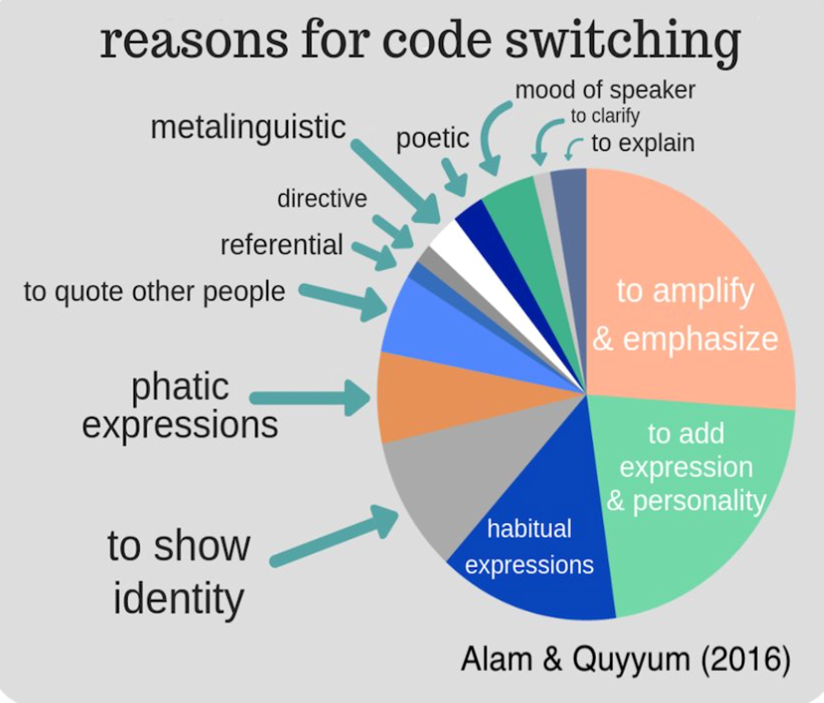
    • Visual Cue: The frame contains the four ladies dressed in relatively executive but casual clothes. Mansi, for instance, is dressed in a traditional blouse and denim. As all four pose in the camera frame, they demonstrate the increasing connotation of relative wealth and distance from the ideas of poverty, while maintaining the idea of closeness in their talk about future aspirations and promises to each other. Here, at the outset, Mansi is shown code-switching to express her goals and to “exaggerate and intensify” the need to achieve them (Alam & Quyyum 2016). The words “respect,” “promotion,” and “equal opportunities” are translated into English to show what makes them so vital and imperative. This also automatically infers an acknowledgment of the prestige factor because she fights for something that is her right, and by using English, she demonstrates her achievement of some type of social status.
    • Analysis: Here, Mansi is employing code-switching for the portrayal and “amplification as well as emphasis” of the desire that her demands be fulfilled sequentially. As Alam & Quyyum (2016) states: “respect,” “promotion, and “equal opportunities” are in English so that she lays stress on the importance and necessity of it. It automatically carries with it respectability as well because she is struggling for something she has to get. The use of English emphasizes the achievement of a particular social status.
Figure 3. Alam & Quyyum’s Functions of Code-Switching (2016). Alam & Quyyum (2016) describe the functions of code-Switching in conversational language. In relation to this study, several of Alam et al.’s findings provide reasons as to why characters code-switch regardless of the ‘weight’ of the code-switch. In this instance, the scriptwriters of Sukhee use English as a means to ‘amplify & emphasize’ Mansi’s desire for positional power. This is further exaggerated by India’s perception of English as a formal, powerful language.
  • Laapataa Ladies
    • Brief Summary: This is a story of two newlywed brides who get mixed up in a crowded train shortly after their weddings. One bride ends up with the wrong husband, Manohar, after landing at their destination, and they stay together until their situation can be resolved. It turns out that this bride is being abused by her just-married husband. When the two reunite, he slaps her, and therefore, she happens to be freed. They later find Manohar’s wife and reunite. The mixed-up, now-free bride is sent back to school to pursue her dreams.
    • Scene Example: In the following example, a character employs code-switching for just one word: “Kaise be? Hum to bahut saal se try kar rahe hain, kho hi nahi rahi sasuri…” (Translation: “How? I’ve been trying for many years, the damned thing is not going away…”)
    • Analysis: In contrast to examples of intra-sentential code-switching, this sentence only uses a singular English word: ‘try.’ It’s important to mention that an equivalent word for ‘try’ exists in Hindustani, so this is not merely an example of borrowing. Since no connotative meaning would be foregone if the native word were used, the reasons for employing this word would be social or linguistic. This word happens to be one syllable, as opposed to the Hindi word for ‘try.’ A quicker onset or lexical retrieval may be another reason for code switching in instances like this.
  • 3 Idiots
    • Brief Summary: This was a story about the friendship of three engineering students, and a satirical take on the societal pressures of the Indian education system.
    • Scene Example: During a classroom scene, one character uses Hinglish to make a point: “Sir, yeh formula toh practically impossible hai apply karna.” (Translation: “Sir, this formula is practically impossible to apply.”)
    • Visual Cue: He is shown in a prestigious engineering college, reflecting his academic aspirations.
    • Analysis: This student provides the most compelling example of using Hinglish during classroom discussion while he shows his learning journey through the use of 3 Idiots. Such switching tells that this character feels comfortable in both Hindi and English. It is a widespread phenomenon found in most urban educational institutes in India where the language of instruction is English. Hinglish allows the character to put his ideas across much better since the technicality of English is complemented by the conversational ease of Hindi. The same selection also exemplifies the pressure and tensions that an Indian student experiences in such an extremely stressful learning environment, where proficiency in English is equated with academic and professional success. The use of English terms such as “practically impossible” emphasizes the technicality of the discussion and how well the character is acquainted with academic vocabulary pertinent to the discussion, which is also an example of the fusion of cultures and languages common to modern Indian writing.
  1.  
  •  
  •  

Discussion and Conclusions
Our results elucidate the social mobility aspect of English usage and code switching in Indian cinema. In the films we analyzed, those who used more English were depicted as having a higher social status, better education, and better job prospects than those who used mostly or exclusively Hindi. The lexical decisions of Bollywood script writers is pertinent in this context, as well as Indian society as a whole, given the oversized impact that these movies have on the culture of South Asia. As such, code-switching in Indian cinema is reflective of broader social perceptions of English and its associations with coolness, erudition, etc.

India has more than a billion people. Given our small sample size of five movies, we are not able to make sweeping generalizations about code-switching in Indian society outside the context of its cinema. If we look at code-switching as a plot device used by Indian moviemakers, we are able to better understand the implicit interpretations of such language usage and thus, how it correlates with class and other socioeconomic indicators. This paper focused on several linguistic aspects of code-switching, including the syntactic category of the English words used. Overall, our statistical analysis is in line with previous findings on this topic, that is to say, that mostly nouns and titles are used in intra-sentential code-switching.


References

Balabantaray, S. R. (2020). Impact of Indian cinema on culture and creation of world view among youth: A sociological analysis of Bollywood movies. Journal of Public Affairs. https://doi.org/10.1002/pa.2405.

Chakraborty, O. (2022). Prevalence of Colonial Hangover in Bollywood Movies with Primary Focus on Queen and English Vinglish. https://www.questjournals.org/jrhss/papers/vol10-issue5/Ser-1/G10053338.pdf.

Chandra, S. (2014). Main ho gaya single I wanna mingle…: An evidence of English code-mixing in Bollywood Song Lyrics Corpora. 16(1). https://www.researchgate.net.

Mahbub-ul-Alam, A., & Quyyum, S. (2016). A Sociolinguistic Survey on Code Switching & Code Mixing by the Native Speakers of Bangladesh. Manarat International University Studies, 6(1). https://www.researchgate.net.

Rao, S. (2010). “I Need an Indian Touch”: Glocalization and Bollywood films. Journal of International and Intercultural Communication, 3(1), 1–19. https://doi.org/10.1080/17513050903428117.

Si, A. (2011). A Diachronic Investigation of Hindi–English Code-Switching, Using Bollywood Film Scripts. International Journal of Bilingualism, 15(4), 388–407. https://doi.org/10.1177/1367006910379300.

[/expander_maker]
, , , , , ,

Linguistic Features between University Students in California and New York: Reddit Version

Clyde Villacrusis, Sydnie Yu, Monique Tunnell, Michelle Kim

How often do you find yourself saying “hella” or “bet?” How does this differ for people across different regions? The research project discussed in this blog article compares linguistic markers, particularly slang, in Reddit communities of universities in New York and California. Using basic forms of natural language processing, we analyzed posts from multiple university-specific Reddit pages to identify regional slang differences. Results show distinct slang patterns reflecting local cultures — New York slang influenced by its diverse linguistic environment, and California slang shaped by surf and tech cultures. In addition, New York university students have shown that they are less susceptible to slang and jargon, as most of them are out-of-state students and therefore, grew up in a community where it is harder for them to immerse in NY culture and its language. For California students, it is easier for them to immerse in the language culture because most are in-state students. These findings highlight the role of language in forming regional identities in digital spaces, offering insights for sociolinguistic research and digital communication strategies.

[expander_maker id=”1″ more=”Read more” less=”Read less”]

Introduction and Background

As aspiring sociolinguists, we want to learn more about how different cultures can affect slang within our own communities and thus, affect their way of speech. More specifically, how do students at different universities use slang, and what are the implications of this language?

University culture is unique and cultivates an environment of relatability and unity. Language and communication play a big role in this culture, and with the rise of social media platforms, we decided to dive into a platform largely used by university students in order to analyze raw conversations between college students within a university. More specifically, we analyzed California university slang versus New York university slang. Reddit is a great place to analyze linguistic features and speech of people across the United States and how each geographical place affects their slang. Reddit is a social networking platform that was established in 2005 (Semrush, 2024). In addition, Reddit is divided into communities called “subreddits,” where people can interact and contribute with each other comfortably in their respective community. These subreddits generally consist of people with the same interests. In this case, we examined Reddit communities for universities, meaning most users go to the same college or university. Within these subreddits, users relate to one another using university- and state-specific slang.

New Yorkers have a diverse immigrant population and fast-paced urban lifestyle. They also tend to partake less in small talk and more in longer, conversational speeches (Allen 2023). In those conversations, there are a couple of common terms, such as “real talk” (attention grabber), “the city” (refers to Manhattan), and “Stoop” (steps outside of an apartment). Conversely, Californian slang and language reflect tech and entertainment culture, primarily because of the Los Angeles area or most of the tech companies that reside in San Francisco. In addition, Californians tend to use relaxed jargon and more informal speech patterns (Bucholtz, n.d). Some of the common terms they used are: “hella” (very much), “like” (mostly as a filler word), and “dank” (excellent). Based on these backgrounds we posed the questions: How do linguistic markers, especially slang, differ in New York vs. California universities on Reddit? How do regional, cultural, and social influences affect language? Do in-state versus out-of-state student populations affect the use of slang within university subreddits?

Overall, this research study examines the different linguistic features of the California and New York universities. We aim to show that these variations reflect the unique social and cultural aspects of each region, highlighting how language usage serves as a marker of regional identity in digital communication.

Methods

Earlier this year, a Reddit user named u/Watchful1 compiled data collected by other users, u/pushshift and u/raiderbdev, on posts and comments from Reddit between 2005 and 2023. We isolated six subreddits relevant to our study. We used scripts from Watchful1’s PushshiftDumps Github repository to count the occurrences of specific keywords in each subreddit from January 1, 2021 to December 31, 2023.

For web scraping, we used Python libraries like BeautifulSoup and PRAW to extract data from Reddit communities associated with universities in New York and California. We selected subreddits based on criteria such as member count, post frequency, and relevance to student life, focusing on threads that accurately represented each region’s schools.

We aimed to collect a diverse sample of posts and comments from each selected subreddit, ensuring representation across various topics, time periods, and user demographics. In cases where automated methods might miss nuances, human annotators manually reviewed and supplemented the analysis. We also prioritized ethical considerations by anonymizing or aggregating data to protect user confidentiality, ensuring compliance with Reddit’s terms of service and data usage guidelines. We also conducted thorough reliability checks to ensure the quality and accuracy of our data and analysis results.

In addition and most importantly, we intended to select a few universities because it would be time consuming and difficult to do all of the subreddits for California and New York universities. Thus, we chose to focus on a few universities in each state with the most active subreddits and number of reddit community members.

Finally, we maintained detailed internal documentation of our data collection process, including sources, sampling methods, and any preprocessing steps applied to the data.

Results and Analysis

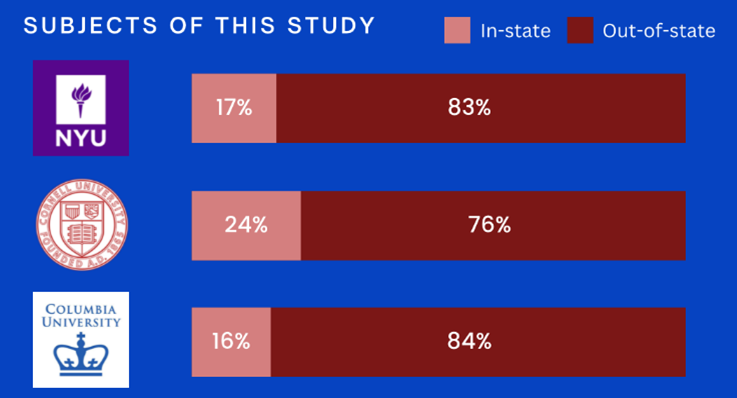
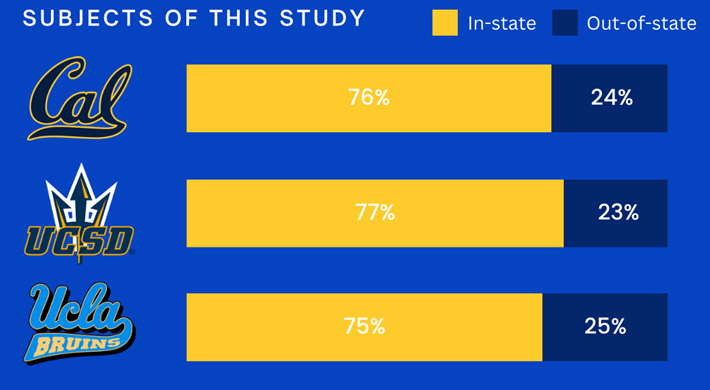
First, it is important to note the distribution of in-state versus out-of-state students. We collected this data from the universities, and the distribution is shown below.

Figure 1. Number of subjects per New York university subreddit and whether they are in-state or out-of-state students.


Figure 2. Number of subjects per Californian university subreddit and whether they are in-state or out-of-state.

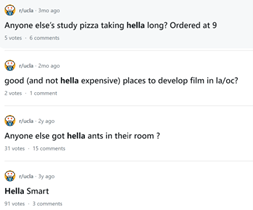
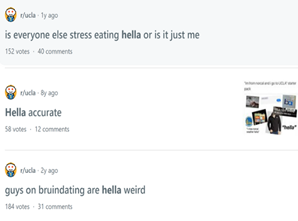
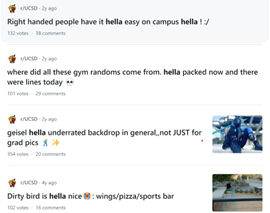
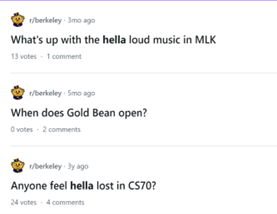
After using our methods of analyzing Californian and New York universities’ slang, we found that college students in California use the word “hella” the most at UCLA, even more than in UCSD and UCB, although it is still very prevalent in all three California schools. “Hella” means “there’s a lot of __.” The reasoning for the frequency is due to the recency of each university subreddits; the longer the comments were posted would not be helpful in determining today’s society’s slang. For instance, most of UCLA comments were from 3 to 6 months ago while UCSD and UCB’s comments were from 2-4 years ago, which is a significantly longer time. In addition, “hella” is “highly expressive [and] often” will destroy the gravity of a formal statement (Hummon 1994).

Common examples of the use of “hella” are shown below:

Figures 3 & 4. Instances of “hella” in r/ucla.


Figure 5. Instances of “hella” in r/UCSD.


Figure 6. Instances of “hella” in r/berkeley.

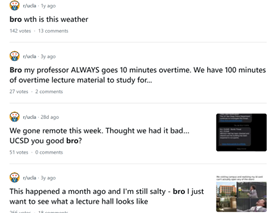
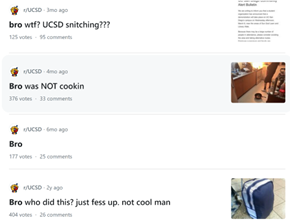
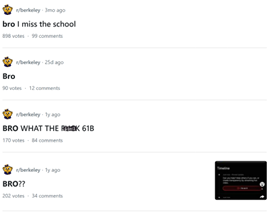
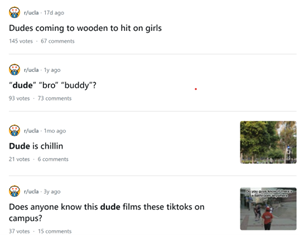
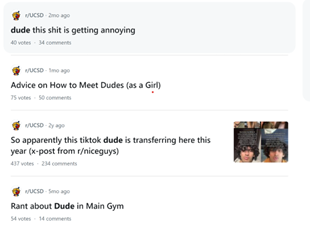
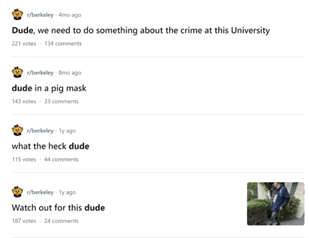
Secondly, we also found that college students among UCLA, UCB, and UCSD primarily frequent the slang “bro.” The comments we have found were not from too long ago, ranging from 4-9 months. Since these comments were recent, we can say that the accuracy of California universities students saying “bro” is likely. Moreover, we can also say the same for “dudes” because of how recent it is. Students say “bro” and “dudes” because omitting large chunks of a particular sentence or word helps the speaker say what they mean. In other words, it might be difficult for the speaker to say “brother,” a longer version of “bro.” Including the second half of the word loses the surrounding, cultural meaning of the sentence, i.e, “bro was not cooking” is not the same as “brother was not cooking” in terms of today’s societal norms. This shows how even slang has its own set of unspoken “rules” that must be followed to maintain a level of informality befitting more casual contexts. Shortening words seems to be a trend for making phrases more casual, and this could perhaps be due to how it allows a speaker to convey more in a shorter amount of time, as well as an implied mutual understanding between the speaker and listener that they understand the true meaning despite it being shortened, similar to a secret code. This could also be why slang usage is so prevalent nowadays, as everyone sees it as cool or modern to be part of a community that understands this secret code, the language of slang. Eventually, slang will become “accepted as equivalent to their unabbreviated and original forms” (Gordon 2020). Even though some slang words like “hella” are not widely spoken in other universities, it will be useful in the near future for linguistic research.

More examples of “bro” and “dudes” shown below:

Figure 7. Instances of “bro” in r/ucla.


Figure 8. Instances of “bro” in r/UCSD.


Figure 9. Instances of “bro” in r/berkeley.


Figure 10. Instances of “dude” in r/ucla.


Figure 11. Instances of “dude” in r/UCSD.


Figure 12. Instances of “dude” in r/berkeley.

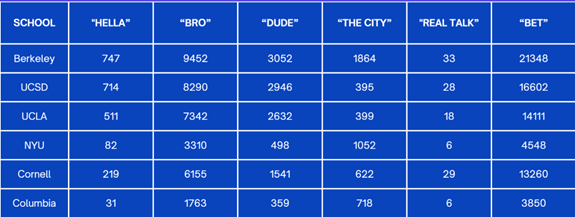
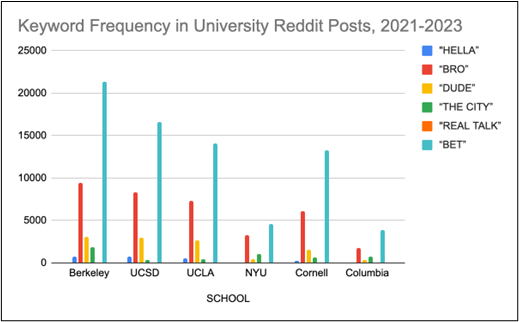
Moving on to the New York universities, we found that “the city” is used more frequently at NYU and Columbia than in Cornell. “The city” means Manhattan, and college students from NYU and Columbia use it more because they are closer to Manhattan than Cornell. However, another slang term, “real talk” (used as an attention grabber), is more common in Cornell than the two other universities. In addition, the most common frequency slang in Cornell is “bet,” meaning you are either asking the person to put money on your statement or an affirmative ‘yes.’ This is also slightly common in NYU and Columbia. Moreover, what we found interesting is that the subreddit comments of these NY slangs are from 3-4 years ago. However, when we tried to fact-check this with our current methodology using a Python script, we found that the slang “bet” is used by all universities from the west to east coast. For example, there are roughly 21,348 “bet” usages at UC Berkeley, followed by UCSD, while there are 9,452 slang “bro” at UCB. We also found that “real talk” is less common in all universities.

Here is the common occurrence table including data analyzed by the Python script between January 1, 2021 and December 31, 2023:

Figure 13. Table showing “bet” as the most common slang, followed by “bro” and “dude.”


Figure 14. Chart version of data appearing in Figure 13. The axes compare the 6 schools to the number of times their respective subreddits have said 6 different keywords from 2021 to 2023. “Bet” and “bro” dominate slang usage across all schools included in this study.

Discussion

After analyzing the linguistic features of California and New York, especially slang, we can safely say that slang words that would be considered be California slang are used heavily within Californian universities’ subreddits. This seems to have a direct correlation to the number of in-state students, unlike New York universities. We also observed several frequent uses of the same terms — “hella,” “bro,” and “bet” — across the Californian universities. In addition, we can say that college students who mainly grew up in an active social culture will most likely be accustomed to the slang and jargon around them.

Moreover, as for New York universities in their own respective subreddits, they use less frequent jargon and slang. Although still present, this seems to have a direct correlation with the amount of out-of-state students in each NY university, as fewer students grew up immersed in the New York culture and thus, are less likely to be accustomed to the city language influenced by the city’s culture.

Our research study contributes to a larger phenomenon in different ways. Firstly, by analyzing linguistic patterns in Reddit communities, the study sheds light on the social dynamics and communication styles within university-affiliated online spaces. This understanding can inform community management strategies and facilitate more effective online interactions. Secondly, our findings contribute to educational research by highlighting the role of language in shaping online discourse within academic communities. Sociolinguistic studies can benefit from a deeper understanding of how language reflects societal norms and values in digital environments.

Lastly, we can leverage insights from this research to develop more targeted and engaging digital communication strategies tailored to specific regional audiences. Understanding linguistic preferences and cultural references can enhance the effectiveness of online marketing and outreach efforts. For example, we can use common slang and jargon, such as using a lot of “bros” or “dudes,” in a men’s marketing campaign and planning how it will raise awareness.

Conclusion

Ultimately, each university and its own subreddit cultivates a community that is centered around shared and common experiences. These experiences can create and preserve slang and jargon that students feel comfortable using to express themselves. There is also a prevalent influence of regional culture on language and slang used by Redditors across the country, as shown by the different terms most used in California and New York. Even though students may move out of state to attend college, they will bring their own slang used by their hometown communities with them, rather than immediately assimilating into the language used in their new community. Overall, language stands as a symbol of hope and it is used so that other students accept and recognize one another as part of the same community.


References

Allen, I. L. (2023). The city in slang: New York Life and popular speech. Oxford University Press.

Bucholtz, M. (n.d.). Chapter 29- Word Up: Social Meanings of Slang in California Youth Culture. In A Cultural Approach to Interpersonal Communication: Essential Readings. essay.

Haas, C., Takayoshi, P., Carr, B., Hudson, K., & Pollock, R. (2011). Young People’s Everyday Literacies: The Language Features of Instant Messaging. Research in the Teaching of English, 45(4), 378–404. http://www.jstor.org/stable/23050580.

Hummon, D. M. (1994). College Slang Revisited: Language, Culture, and Undergraduate Life. The Journal of Higher Education, 65(1), 75–98. https://doi.org/10.2307/2943878.

Labov, T. (1992). Social and Language Boundaries among Adolescents. American Speech, 67(4), 339–366. https://doi.org/10.2307/455845.

Roth‐Gordon, J. (2020). Language and creativity: Slang. The International Encyclopedia of Linguistic Anthropology, 1–8. https://doi.org/10.1002/9781118786093.iela0192.

Saha, Koustuv & Choudhury, Munmun. (2021). Assessing the mental health of college students by leveraging social media data. XRDS: Crossroads, The ACM Magazine for Students. 28. 54-58. 10.1145/3481834.

“Top Websites in Worldwide (All Industries).” Semrush, www.semrush.com/trending-websites/global/all. Accessed 20 May 2024.

[/expander_maker]
, , , ,

Tech Bros and Tech Woes: A Perspective on Gendered Sociolinguistics in the Tech Industry

Jenny Wang, Madhavi Vivek, Rajana Chhin, Audrey Chung

In the expanding realm of technology, language serves as more than just a communication tool — it is a powerful marker of identity and belonging. Our study delves into gendered linguistic practices within the tech industry, focusing on “tech bro” culture and its impact on female experience and career advancement in this male-dominated field. Through interviews with male and female tech students and analysis on social media content, podcasts, and scholarly articles, we uncovered lexical variations and interactional patterns unique to the tech community. Utilizing a blend of qualitative and quantitative methods, we observed terms like “tech debt,” distinct pitch variations, and exaggerated “urban” accents during conversation. Our findings reveal that females in tech often adapt their language to conform to the hyper-masculine expectations of the tech workplace, further reinforcing clear gender biases and stereotypes within the industry. By highlighting these subtle linguistic barriers that perpetuate gender biases, we aim to emphasize the need for a more inclusive and supportive tech environment for all individuals.

[expander_maker id=”1″ more=”Read more” less=”Read less”]

Introduction and Background

The technology industry has long been known for its clear gender gap, given its predominantly male sector enforcing stereotypes and biases against women in the workplace. Despite advancements over the years, the tech industry still exhibits pervasive gender bias, often manifested through language. Recently, the term “tech bro” has been used to characterize the toxic masculinity prevalent in the workplace (Jones 2022). Our research aims to explore the unique lexicon and interactional patterns of this group, observing how they reinforce gender stereotypes and impact female experience in tech. In other words, how does the dense network of “tech bros” correlate to their use of vernacular variables? Does gender bias exist within language commonly used by “tech bros?”

Existing literature highlights the significant role of gendered language — the words and phrases that inherently carry gender bias—in shaping workplace dynamics. For instance, terms like “chairman” and “assertive” often assume a male subject, whereas words like “bossy” and “hysterical” are typically applied to females in leadership roles (Holmes 2008). Holmes’ study suggests that women in tech adopt more masculine speech patterns to gain respect and authority, such as using direct imperatives when commanding subordinates or purposefully disengaging from workplace arguments. Despite the growing awareness of these issues, there remains a gap in understanding the specific linguistic behaviors of “tech bros” and their effects on female colleagues.

Our hypothesis claims that the linguistic practices of “tech bros” do contribute to the exclusion of women from the tech sector. This exclusion manifests in daily communication, feedback, perception of qualifications, and performance evaluations. Our research aims to find out whether the male-dominated environment serves as a barrier to community entry and inclusion for women. Additionally, we aim to study the speech variation between genders within the community and its role in building professional relationships. By analyzing tech jargon and interactional patterns, we hope to uncover the subtle and pervasive barriers that gendered language creates in promoting workplace gender equality and diversity.

Methods

In order to conduct our research, our team relied on three main methods for data collection:

  1. Media: We collected quotes from social media portrayals of the stereotypical “tech bro”.
  2. Online Tech Hubs: We gathered data from popular tech communities on platforms like Discord and cross-referenced jargon with scholarly articles.
  3. Interviews: We conducted a total of three sets of interviews with male and female identifying students in the tech industry in order to evaluate of indexical shift as well as gendered language.

Going in order, we consistently evaluated new information against previous data. Further analysis included examining the spectrograms of interview snippets for distinct phonological features.

Results and Analysis

The following section will focus on the results of our study.

1. Media

As per our methodology, one of our primary sources of information was through the portrayal of stereotypical “tech bros” on social media. While this type of content is not the most scientific, it does provide context on societal expectations placed on the average “tech bro.” The comedic video linked here demonstrates several “tech bro” characteristics while mocking common stereotypes, such as remote work culture, cost-of-living in the Bay Area, and popular hobbies and vacation spots within tech communities. Additionally, we observed that the creator of the video speaks with an exaggerated coastal urban accent, similar to those of surfers or “frat bros.” This hyper-masculine accent underscores the inherently masculine nature of “tech bro” culture and serves as a starting point for developing a hypothesis surrounding the existence of a gender gap reflected in language.

2. Online Tech Hubs

Our team visited popular internet communities within the tech industry. The following quotes were taken from a popular Discord server called cscareers.dev, which is a community for student developers seeking internship and new grad opportunities in tech with over 8000 members.

Figure 1. Pictures from a conversation on Discord server cscareers.dev.

From these quotes in Figure 1, we gather that there is a linguistic overlap between tech communities and gamer communities. This would make sense as demographically, they are both male dominated, and technology and gaming share many similarities as fields and industries. Specific jargon like “jank” to describe an interviewer of poor quality and “cracked” to describe extremely accomplished people are two examples of somewhat-expected buzzwords. According to Wiktionary, the term “jank” exists as both computing slang and video game slang, though it is rarely used in technical contexts. The usage of this term colloquially shows the adoption of computing and gamer slang in broader environments. In the same vein, “cracked,” which usually carries video gaming implications, being used to express skill levels outside of gaming also shows the adaptive nature of the jargon.

3. Interview: Indexical Shift

Our first interview was conducted with Brandon and Brian, both third-year cognitive science students at UCLA. Brandon is a product manager intern, and Brian is a software engineering intern. Because the two have an established friendship, I conducted the interview with both participants present to simulate as natural of a conversation as possible. The interview was split into first, a professional chat, and second, a casual conversation in order to evaluate for indexical shifts. Throughout the professional chat, I asked Brian and Brandon questions about their experiences in tech through their professional organizations at UCLA. The following is a transcription of a snippet of the conversation:

Brian: Ensuring like, there’s not a lot of tech debt, I think is like super important across all the projects within DevX as a whole makes everything run very smoothly and there’s no churn.

Brandon: Yeah yeah, for sure. I think that’s a huge thing too, for a lot of projects, is because people are bouncing. Um, people bounce from projects all the time, um having tech debt is just like absolutely horrendous because like people who don’t know anything about the project, for lack of a better term, like a shitload of…

For the casual conversation, I asked the participants to describe updates in their lives, as well as share gossip, as if we were catching up. This is in order to establish the most natural and comfortable environment.

Brandon: ‘Cause I remember, I had- there was something about- but anyway, I saw them together, like they were like, like homies, like they were like, headed to a party together. I was like “oh, like birds of a feather” you know? Shit, like that tracks, that hella tracks, you know? Like I’m not surprised.

Brian: That’s wild.

Generally, I noticed that participants, especially Brandon, deliberately talked slower during the professional chat. During the casual conversation, I found that Brandon tended to stutter more, as well as exhibit doubling in order to emphasize certain phrases. In the professional chat, instead of doubling phrases, he slowed down and replaced those instances with filler words.

Tech jargon was noticeably present during the professional chat, including words like:

  • Tech debt: shortcuts in code that achieve the goal faster, but at the cost of uglier, harder-to-maintain code.
  • Churn: the frequent change of resources or team members within a project.
  • Bounce (rate): the rate at which people leave or exit, typically used in the context of webpage visits.

The following spectrograms closely examine Brandon’s use of the word “shit” in both the casual and professional context.

Figure 2. Spectrogram of Brandon’s use of “shit” in a casual conversation.
Figure 3. Spectrogram of Brandon’s use of the word “shit” in a professional conversation.

Here, we can see that during the casual conversation, there is a significant increase in pitch towards the end of the word, indicating a high rising terminal, which can be especially common amongst young people. In the spectrogram for the same word used in a professional context, Brandon maintains the same pitch. This is likely because a high rising terminal is not situationally acceptable in all professional settings. For example, it is usually not encouraged during job interviews. We can gather that a “tech bro” like Brandon understands this and subconsciously omits high rising terminal in professional contexts.

4. Interview: Gender and Culture

Our second interview was conducted with Jiin Kim, a fourth year Linguistics and Computer Science major who has experience as a software engineer through her internship at Microsoft. As she explained tech-specific language throughout the interview, she defined them in layman’s terms, constantly checking to assure my comprehension of the terms as an outsider to the tech sector. She mentioned how it can be hard to feel included entirely when there is a linguistic barrier made of tech jargon and expressions that often feel very exclusive and not easily accessible to be understood. She herself felt intimidated as an incomer into an established tech workspace. Linguistically, she found herself assimilating into the culture by reflecting speech patterns of those around her—particularly those superior to her. If she finds them to speak more directly, using imperatives, she herself would do the same. Even through a digital space, if she noticed someone using more emoticons in their messages, she would reflect that frequency. As a woman in the tech space, she attributes her not having much experience with discrimination or feeling out of place with the changing ages. As a young college student in an internship program seeking to give more opportunities to a diverse group of tech-workers, she felt well-supported by her company and her peers.

Our last interview was conducted with Matt Nieva, a fourth year Computer Science and Engineering major with experience as the Development Team Director for ACM (Association for Computing Machinery) at UCLA and as a software engineering intern at Cisco. Throughout his interview, he went deep into tech jargon, throwing out multiple technical words while describing tech projects in–depth. When asked about why tech-bro culture revolves so heavily around a specific tech lexicon, he responded saying that tech-jargon is perceived as proof of expertise.  There is a certain linguistic exclusivity that makes those who use it hold more authority and credibility. These common words in tech-space also seep into his daily vocabulary as well, signifying to others that he is a member of this tech-bro community.

These are words such as:

  • Bandwidth: the energy or mental capacity required to deal with a situation
  • Parallelize: a programming term to adapt a program for running on a parallel processing term
    • This however can be used in daily life as setting two thing simultaneously in motion
  • Velocity: rate of progress; a metric for work that has been done

In efforts to assimilate, he, like Jiin, would mimic the linguistic patterns of those around him. He discovered the concept of downtalking versus uptalking—downtalking being lower in pitch and making a speaker sound more assertive, and uptalking being higher in pitch and making a speaker sound less credible. One reason why downtalking could be perceived as more respectable might be that it is, based on pitch, masculine indexing, while the other is more feminine indexing.

Discussion and Conclusion

As mentioned in the background, tech-bro culture is characterized by an informal, male-centric atmosphere that often perpetuates gender discriminatory behavior and aids in maintaining the gender gap in the tech industry. The establishment of Title IX in 1972 was a turning point for the number of women in STEM, but women still face the leftover effects of this gender power dynamic now in more covert ways. This inequality is visible in how more masculine indexing ways of leadership such as authoritative/assertive styles that assert hierarchical status difference is perceived as more valid of leadership than leading in what is considered more feminine indexing ways such as facilitating group discussion.

Beyond perceived leadership and professionalism, research has found that gender comes to play even within the informal discourse at the workplace. Small talk is a core strategy to foster team and build rapport; however it is culturally coded as feminine specifically when it is not about anything that is work related or distinctly masculine. Research showed that at a female workplace, these pre-meeting talks would last longer and delve into topics such as family, beauty, healthcare, while when studying three different New Zealand IT organizations, small talk was either non-agenda work related or about sports. This may sound trivial but interpersonal discourse is key in fostering work relationships and an overall culture. This difference is visible in humor as well, where a female boss might make a self-deprecating joke to reestablish good relations with her subordinates, workplaces that were more masculine in one meeting  consisted of humor that 90% of was sarcastic or negative jibes intended to deflate the addresses. Gender hierarchy in the workplace, particularly within the linguistic space, is covert and embedded subtly into the ways we talk, the ways we perceive authority, etc.

Our findings indicate that the sociolinguistics of the tech industry have unique qualities, including those of which have an effect on the perception of male and female individuals that work in tech. As a male-dominated field, gender bias is highly prevalent in the industry. Our aim was to strengthen this claim in which this bias is confirmed and correlated to female “success” (defined as experience and career advancement), via the exploration of the pattern of language adaptation by females to male tech industry speech. Through this study, we found that the perpetuation of this gender bias is tied to the inherent gender gap that this industry creates in that a male-dominated environment contributes to female exclusion and strict gender-based hierarchy. Our research indicates that this exclusion and hierarchy contributes to the barrier against female success in male-dominated fields such as the tech industry. The continued observation of male-dominated power structures can aid in the effort for people of all genders in high-earning fields. There is thus a need for collective action toward increasingly inclusive, supportive, and sustainable workplace environments, especially the tech industry, for female-identifying people and other minority individuals.


References

Duchene, A., & Heller, M. (2012). Language in late capitalism: Pride and profit. Routledge.

Gleeson, P. (2017). Working with Coders. https://doi.org/10.1007/978-1-4842-2701-5.

Holmes, Janet. Gendered Discourse at Work , 2 Apr. 2008, onlinelibrary.wiley.com/doi/10.1111/j.1749-818X.2008.00063.x/abstract.

Ignatow, G. (2003). “Idea hamsters” on the “Bleeding edge.” Poetics, 31(1), 1–22. https://doi.org/10.1016/s0304-422x(02)00042-6.

Jones, H., & Sudlow, B. (2022). A contemporary history of Silicon Valley as global heterotopia: Silicon Valley metaphors in the French news media. Globalizations, 19(7), 1122–1136.

Moldovan, Andrei. “Technical Language as Evidence of Expertise.” MDPI, Multidisciplinary Digital Publishing Institute, 21 Feb. 2022, www.mdpi.com/2226-471X/7/1/41.

https://www.ucats.org/a-closer-look-at-gender-diversity-in-tech-departments-across-the-usa.html

miinii (@officialmiinii). (2024) “women in computer science stand up!” https://www.tiktok.com/@officialmiinii/video/7342179255356230955.

Tripathi, Pooja (@winnie_thepooj). (2024) “POV: date with a tech bro” https://www.tiktok.com/@winnie_thepooj/video/6962561340086996230?is_from_webapp=1&sender_device=pc&web_id=7279640957828630062.

Nasso, Austin (@austinnasso). (2024) “POV: you’re talking to a tech bro” https://youtube.com/shorts/qmGL0-U2Z58?si=DAulz7gNkYjYpRVH.

https://en.wiktionary.org/wiki/jank#Etymology.

https://en.wiktionary.org/wiki/cracked

[/expander_maker]

, , , , ,

The Power of Language in Human-Animal Relationships

Armine Mkrtchyan

Language is not merely a tool for communication but a fundamental factor that shapes our understanding of the world around us. The words we use when speaking about our surroundings, the symbols we attach to them, and then the meanings we impart play a profound role in sculpting our perceptions. This intricate process of assigning meaning extends notably to our interactions with non-human animals where the language we use plays a significant role in how we perceive, categorize, and consequently treat them. Whether in scientific settings, on farms, or in casual conversations, our choice of language can either humanize or devalue these creatures. It is a complex procedure that bears more weight than many realize. Through the lens of symbolic interactionism, specific linguistic categorizations, and inherent anthropocentric biases, it is clear how language shapes the views of non-human animals and reinforces human superiority within societal hierarchies, ultimately leading to their exploitation. It becomes evident that language is not just a conduit for casual expression but a driving force that molds our views and actions towards the non-human inhabitants of our shared world.

[expander_maker id=”1″ more=”Read more” less=”Read less”]

Symbolic interactionism explores the idea that symbols are used to represent the world, all in order to make sense of it (Arluke and Sanders, 1996, p. 9). These symbols are not inherently fixed but are rather subjective, influenced by an individual’s cultural, racial, and experiential background. Despite their subjective nature, these symbols are often collectively agreed upon within specific cultures or societies, shaping a shared understanding of meanings and representations. This is the core idea of E.O. Wilson’s biophilia which highlights the influence of culture on our relationship with the world around us (Herzog, 2010, p. 30). Ochs and Schieffelin’s perspective on socialization adds another layer to the understanding of how our attitudes and behaviors are shaped. They argue that, through the process of language acquisition, individuals also learn cultural meanings and become socialized into a competent member of society (Ochs and Schieffelin, 1984). It is through such a process that we can explain how and why we act in certain ways toward certain things. Our actions and attitudes are driven by the meanings that we have assigned, which have been acquired through culture, but ultimately processed and altered individually.

The way that these meanings are passed around and shared in the first place is through shared symbols. One common symbolic system is language. The words that we assign to different ideas have the power to shape and/or create new meaning associations. Taking animals as an example, there are many metaphors and sayings that affect our perceptions. For example, “It is easier to order a pound of beef from the butcher than a pound of cow” (Herzog, 2010, p. 31). This juxtaposition starkly illustrates the different connotations associated with the two terms. The act of ordering a pound of cow conjures a distressing image, evoking the inhumane treatment and handling of a living being. On the other hand, ordering a pound of beef illustrates a mundane act of ordering food. This simple example demonstrates how words are not just neutral tools for communication. Instead, they are mirrors reflecting our attitudes and moral views.

Moreover, the context from which the terms originate is significant. Different contexts justify distinct language patterns when referring to animals. In biomedical research laboratories that use animals as test subjects, animals are often depersonalized, devoid of names to maintain a detached, clinical approach. This practice ensures that researchers do not form emotional attachments to the subjects of their experiments (Birke, 2007). Similarly, in the realm of factory farming, dehumanizing and objectifying terms are used to refer to animals, reducing them to mere commodities. As seen in the documentary titled Death on a Factory Farm, employees of the Wiles hog farm used degrading terms when speaking to or about the animals they were about to painfully slaughter, serving as a precursor to the violence that would soon ensue (Simon, 2009). In one incident, an employee labels one of the piglets as a “stupid little pig” moments before smashing its head against a wall to “let it bleed out” (Simon, 2009). In another instance, another employee says that he would like to, “shoot the motherfucker [because he hates] pigs” (Simon, 2009). Such derogatory terms are most often not used when speaking about household pets who have assumed the roles of family members. The specific words used to describe animals in these contexts can either evoke neutral, negative, or positive connotations, thereby shaping the societal attitudes and treatment of these beings accordingly.

By framing animals in language that carries negative connotations, an inherent anthropocentric view is constructed. “Anthropocentrism … refers to the related idea that humanity is and should be the measure of all things” (Noske, 2007, p. 78). In this perspective, humans tend to see themselves as separate from the rest of nature, often viewing other living beings and the environment primarily in relation to human interests and needs. This perspective prioritizes human desires, ambitions, and overall well-being above those of other species. Language use further reinforces this idea, perpetuating a social construct that legitimizes human dominance and control over non-human animals. In doing so, humans are unfairly placed at the top of the sociozoological scale by their own standards, relegating non-human animals to a lower status (Arluke and Sanders, 2010, p. 170). This hierarchy becomes evident in the terms and phrases commonly used, many of which carry subtle but profound negative connotations. Words and phrases like “vermin,” “pests,” or “beasts” can connote a sense of inferiority, portraying animals as nuisances or inferior creatures in comparison to humans.

By employing such demeaning language, there comes an inherent distancing or “othering” of these non-human animals, reinforcing the perception of them as entirely separate and less deserving of empathy or consideration. This process of “othering” involves the psychological, social, and linguistic mechanisms by which individuals or groups are marked as inherently different or “other” from the dominant societal group or norm. In the context of animals, this “othering” manifests in various ways, primarily through language and societal attitudes. When animals are labeled with derogatory terms or reduced to negative stereotypes, it consequently reinforces the perception that they are less deserving of moral consideration or ethical treatment. This linguistic distancing perpetuates a societal mindset that wrongfully justifies the exploitation and mistreatment of animals, as they are perceived as inferior or insignificant compared to superior humans.

As a further result of the “othering” of non-human animals comes the widespread abuse and exploitation of these creatures to fulfill human needs and desires. This distancing from animals creates a moral disconnection, allowing for their mistreatment without due consideration for their welfare. Animals are often objectified and reduced to mere commodities or resources, viewed primarily in terms of their utility to humans. This perception of animals as inherently inferior or devoid of significant moral consideration justifies their exploitation across various industries, including agriculture, entertainment, fashion, research, and more. Consequently, as seen in the film Earthlings, animals are subjected to confinement in factory farms, exploited in circuses and entertainment industries, used for their fur or skin in the fashion industry, and subjected to unethical experiments in laboratories (Monson, 2005). The process of “othering” not only justifies but also perpetuates these exploitative practices, creating a cycle where animals are marginalized, their suffering disregarded, and their rights dismissed in favor of human interests and convenience.

The “othering” of other beings solely based on their species, otherwise known as speciesism, is best understood in the context of a familiar concept: racism. Marjorie Spiegel draws an insightful comparison between racism and speciesism, identifying them as two ways of “othering” certain groups (Spiegel, 2007). Both racism and speciesism involve the judgment and discrimination of a group of animals based on perceived differences when compared with the presumed “superior” group. As such, a subjective hierarchical categorization unfolds. This classification leads to the justification of the discrimination, exploitation, and mistreatment of those deemed inferior based on arbitrary characteristics, whether that be race or species. In both ideas, the oppression of the “other” is damaging especially because there is no sound way to decide “who is better than whom” when looking through a strictly evolutionary lens (Spiegel, 2007, p. 238). This goes to show that the differences we have drawn between groups are completely fabricated. They have no sound reasoning behind them, except for made-up ways to put others down to elevate themselves. Consequently, the unwarranted utilization and exploitation of these marginalized groups, whether in industries like factory farming, fashion, or entertainment, stand as morally unwarranted actions.

Yet, the abuse and exploitation of animals continues. The reason for doing so serves one main purpose: to elevate the status of humans. Humans, who already regard themselves as the highest-ranking animals on the sociozoological scale, employ all means necessary to ensure that no other animal comes close to occupying this level (Arluke and Sanders, 2010). To do this, they put other animals down and make sure that they cannot pass them up. One way they do this is by belittling animals. Starting from degrading words such as “treacherous and cowardly” when speaking of dogs, this manifests itself in the lowering of animals’ worth through tangible actions (Spiegel, 2007, p. 235). As a result, animals are often marginalized and viewed as inferior, justifying their unfair treatment and abuse. This is evident in dog fights. In dog fights, dogs are abused to entertain a crowd and to, ideally, boost the ego of male dog owners (Evans et al., 2007). The dogs’ well-being is the last concern of the participants in this show. They can be thrown around, seriously injured, or even killed, but those issues are not weighed as important as the reputation of the dog owners amongst peers. Just this one example is strong enough to display the unfortunate carelessness of humans regarding animals, for the sake of their own status. All in all, it just shows that humans, as a whole, lack basic empathy and ethical consideration of non-human animals.

In stark contrast to the degrading language often used to describe animals, there are instances where language suggests a paradigm shift towards recognizing animals as deserving of empathy, respect, and consideration. One notable example is in the realm of pet ownership, where animals are often treated as beloved members of the family rather than mere possessions. Communities within the FluentPet project exemplify this shift in perception (Wilson, 2021). Here, pet lovers invest significant time and effort into teaching their animals to communicate using specialized soundboards. Each pet is given a name, treated as an individual with distinct preferences and personalities, and afforded the opportunity to express themselves in meaningful ways. In this way, these animals are not only regarded as companions but also as sentient beings capable of forming deep emotional bonds with their human counterparts. The language used within these communities reflects a view of animals as intelligent, deserving creatures with inherent worth. By acknowledging animals’ capacity for communication and understanding, these practices challenge traditional notions of superiority and domination, fostering a more compassionate relationship between humans and animals. Through language that elevates animals to the status of deserving individuals, we begin to reshape societal attitudes and behaviors, paving the way for more ethical treatment of all living beings. For instance, animals on farms may be treated with greater consideration and compassion, even in the processes leading to their death. Take for example Nuria, a cow who was given a name and afforded a more humane end (DW Documentary, 2023). By recognizing animals as deserving of dignity and respect, farmers may adopt practices that prioritize welfare, opting for methods of slaughter that minimize suffering. On this opposite end of the spectrum, language once more emerges as a significant shaper of perceptions.

Exploring patterns in language use toward animals makes it clear that the root of the problem comes from an anthropocentric perspective that employs specific language patterns to maintain a particular order. The meanings attached to the degrading language that is used when speaking or thinking about non-human animals open the doors to their further mistreatment. This language often carries negative connotations, depicting them as inferior or unworthy of empathy. Terms and expressions laden with derogatory or dehumanizing implications not only influence societal perceptions but also establish a framework that legitimizes the exploitation and disregard of these creatures’ well-being. Justifications for their use and abuse in various industries deeply take over. By embedding negative connotations into our language regarding animals, we inadvertently contribute to a mindset that rationalizes their mistreatment, reinforcing a cycle where their suffering is overlooked, their rights diminished, and their exploitation perpetuated, all for the greater purpose of elevating human status. Instances where this is not the case are, unfortunately, few and in between.

All in all, by examining these facets, this paper underscores the intricate relationship between language and human perceptions of animals, emphasizing the significant role of linguistic constructs. Language not only shapes our thoughts but also dictates the actions that come thereafter. Influenced so much by our thoughts and attitudes, our actions reflect the degrading perceptions we have of animals. With these in mind, the wrongful exploitation of animals unfolds with the accompanying wrongful justification of them. As a further consequence of their use and abuse, humans hold on tightly to the idea that their actions are warranted as a means of maintaining their high status on the sociozoological scale. Ultimately, these detrimental consequences stem from the immense power vested in language, underscoring its ability to shape societal attitudes and perpetuate unjust practices towards non-human animals.

References

Arluke, A. & Sanders, C.R. (1996). 9-18 in Regarding Animals (Animals, Culture and Society). Temple University Press.

Arluke, A. & Sanders, C.R. (2010) The Sociozoologic Scale. Regarding Animals (Animals, Culture and Society) (167-186). Temple University Press.

Birke, L. (2007). Into the Laboratory. In Kalof, L. & Fitzgerald, A. (Eds.), The Animals Reader (323-335). Berg Publishers.

DW Documentary. (2023). Factory farming, animal welfare and the future of modern agriculture [Video file]. Retrieved from: https://www.youtube.com/watch?v=6VOqNVt_cmM.

Evans, R., Kalich (Gauthier), D, & Forsyth, C.J. (2007). Dogfighting: Symbolic Expression and Validation of Masculinity. In Kalof, L. & Fitzgerald, A. (Eds.), The Animals Reader (209-218). Berg Publishers.

Herzog, H. (2010). Some We Love, Some We Hate, Some We Eat: Why It’s So Hard to Think Straight About Animals. New York, NY: Harper.

Monson, S. (Director). (2005). Earthlings [Film]. Nation Earth.

Noske, B. (2007). Speciesism, Anthropocentrism, and Non-Western Cultures. In Flynn, C.P. (Ed.). Social Creatures: A Human and Animal Studies Reader (77-87). Lantern Books.

Ochs, E. & Schieffelin, B. (1984). Language acquisition and socialization: Three developmental stories and their implications. In R. Shweder, & R. Levine (Eds.), Culture Theory: Essays on Mind, Self and Emotion (276-320). Cambridge University Press.

Simon, T. (Director). (2009). Death on a Factory Farm [Film]. HBO.

Spiegel, M. (2007). An Historical Understanding. In Flynn, C.P. (Ed.). Social Creatures: A Human and Animal Studies Reader (233-244). Lantern Books.

Wilson, L. (2021). From Clever Hans to Bunny the TikTok Dog: An Exploration into Animal-to-Human Communication. The Macksey Journal, 2(1).

[/expander_maker]
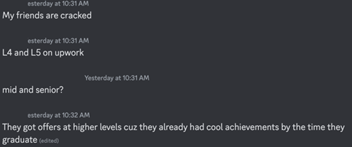
, , ,

The TikTok Influencer Voice: Do Sociolinguistic Features Influence the Success of TikTok Videos?

Natalia Adomaitis, Lam Hoang, Maryam Shama, Sydney Trieu, Kristina Zhao

TikTok is a growing social media platform that launched in 2016 and since has gained 1 billion monthly active users, 60% of which are a part of the Gen Z demographic. Many influencers have rapidly grown in popularity, leading to social changes due to trendsetting by these influencers. In our study, we analyzed linguistic features used by three TikTok influencers: Erika Titus, Katie Fang, and Alix Earle. Our goal was to analyze how the use of two linguistic features: filler words and rising intonation (uptalk) by female Gen Z TikTok influencers impact engagement. We gathered data by comparing analytics of 6 videos from each of the three influencers, 3 of which being their most popular videos and 3 being of average performance. We tracked the number of times rising intonation and filler words were used per video along with video length and amount of views and likes. We hypothesized that influencers incorporate these specific linguistic elements to better relate with their audience, which ultimately leads to an increase in video engagement.

[expander_maker id=”1″ more=”Read more” less=”Read less”]

Introduction and Background

TikTok has become one of the most popular video-sharing social media apps since its launch in 2016. Approximately 60% of the users and influencers who daily consume or create content on this app belong to Gen Z (Moshin, 2022; Rezek, 2022). In addition, it is predicted that TikTok will have 1.8 billion monthly users by the end of 2024 (Iqbal, 2024).

Because of the rapid growth of this app in recent years, in addition to its daily prevalence in our target demographic of Gen Z individuals (ranging from ages 18-24), and its continuous expected growth, we were motivated to investigate if the verbal linguistic content, or language and speech pattern used by TikTok influencers, had any role or influence in determining the success of their videos.

Our research focused on the sociolinguistic features frequently observed in the language content from popular TikTok influencers: Erika Titus, Katie Fang, and Alix Earle. Specifically, we analyzed upward intonation, filler words, “Valley Girl” speech, and conversational style.

  • Upward intonation- also known as “uptalk”, a speech pattern where the pitch of a voice rises, is typically used at the end of sentences to indicate a question or throughout a sentence to signal that a phrase is incomplete. This tactic can keep the viewer anticipating what will come next.
  • Filler words- Examples include “like, um, literally, actually”. Use of this speech pattern maintains the flow of speech, fills pauses in a conversation, thus keeping the viewer’s attention.
  • “Valley Girl” speech/conversational style- the previously mentioned speech patterns “uptalk” and filler words, are reminiscent of the “Valley Girl” speech and are commonly associated with being used by affluent, middle-class teenagers from California (Nycum, 2018). When used in videos, it can create a casual, one-on-one, conversational-like style that connects with Gen Z.

Erika Titus, Katie Fang, and Alix Earle all have a substantial following with Titus having 4 million followers, Fang with 5.1 million followers, and Earle at 6.8 million followers as well as belonging to the Gen Z demographic. Geographically, Titus along with Earle were born in the U.S. and currently reside in the U.S., and Fang was born in Taiwan, but resides in Canada.

These influencers mainly create lifestyle content such as daily routines, “get ready with me” videos, fashion choices, and product endorsements. Erika Titus and Katie Fang similarly produce casual, at-home, sit-down videos, whereas Alix Earle creates more spontaneous videos in addition to at-home style videos.

Our overall hypothesis is that video success (high like and view count) is attributed to influencers’ use of sociolinguistic features: upward intonation, filler words, and “Valley Girl” speech, which contribute to creating a conversation-like style that is effective at engaging and connecting with the Gen Z audience.

Methods

Our project aimed to investigate the impact of filler words and rising intonation phrases on the success of TikTok influencers’ videos. Success was measured through view count and like count, assessing whether there was a correlation between the frequency of these linguistic features and video engagement success.

To conduct this study, we analyzed six videos from each of the three selected TikTok influencers. For each influencer, three of their best-engaged videos (identified by the highest number of likes and views) were selected, along with three average-performing videos.

Several key factors were tracked for each video. We recorded the number of rising intonation phrases and counted the occurrences of filler words such as “like,” “literally,” and “um.” Additionally, we noted the number of likes and views to measure engagement success and tracked the length of each video in seconds for further analysis. This methodology enabled us to compare the frequency of linguistic features across different levels of video success.

We hypothesized that a higher frequency of filler words and rising intonation phrases would correlate with an increase in views and likes, suggesting these linguistic features enhance engagement.

Results and Analyses 

Following our methods, our results are shown below:

From this data, we extract two key metrics: the average frequency of rising intonation and the average frequency of filler words. We focus on the frequency of these elements in terms of occurrences per unit time (e.g., one occurrence every x seconds) rather than their rate (e.g., x occurrences per second). This perspective allows us to contextualize sociolinguistic factors within TikTok videos, which are short-form content designed to capture attention. Following our hypothesis, influencers’ most popular videos tend to employ rising intonation or filler words frequently (e.g., every 5 seconds) to maintain audience engagement.

Based on our hypothesis, we expect that higher average frequencies of rising intonation and filler words are correlated with more likes and views on the videos. We will compare these metrics between popular and less popular videos to potentially reveal their effects on engagement. Initially, we will analyze the data for each influencer individually before aggregating and analyzing the data as a whole.

Erika Titus:

As observed in Erika Titus’s case, her popular videos exhibit an average of one rising intonation every 18 seconds, while her regular videos feature an average of one rising intonation every 9 seconds. Similarly, the frequency of filler words is lower in her popular videos compared to her regular ones. These patterns suggest that for Erika Titus, both rising intonation and filler words appear to have an inverse relationship with engagement, implying that lower frequencies of these features may be associated with higher popularity.

Katie Fang:

Moving on to Katie Fang, we observe a similar pattern to that seen in Erika Titus’s videos. Katie’s popular videos exhibit a lower frequency of rising intonation and filler words compared to her regular videos. Both factors again seem to have an inverse effect on engagement. From the line graphs depicting sociolinguistic factors versus views, it appears that these sociolinguistic features negatively correlate with views, suggesting that lower frequencies may contribute to higher popularity.

Alix Earle:

For Alix Earle, we observe the opposite pattern compared to Erika Titus and Katie Fang. Alix’s popular videos have a higher frequency of both rising intonation and filler words. These factors appear to have a positive effect on engagement. The line graphs depict a positive linear relationship between both rising intonation and filler words with views and likes, suggesting that higher frequencies of these features are associated with increased popularity.

Overall:

Looking at the data across all three influencers, we observe that popular videos generally exhibit a higher frequency of both rising intonation and filler words. These factors appear to have a positive effect on views and likes. However, the line graphs reveal scattered data, and the line of best fit does not clearly indicate a direct relationship, suggesting that other variables may also influence engagement.

Discussions and Conclusions

To summarize, Erika Titus and Katie Fang’s data do not support our hypothesis, but most of the data we collected from Alix Earle’s does support our hypothesis. Given these findings, our data is inconclusive about whether or not rising intonation and the use of filler words have a positive effect on the success of audience engagement on TikTok.

The differences in like and view count in the data between the influencers can be attributed to multiple factors that would need to be taken into consideration and further researched. Elements such as differences in influencers’ backgrounds, the racial identity and/or personality traits of the influencers, video content, and editing style may have played a role in the use of “uptalk” and filler words, which in turn would affect the success of their videos (Swerts, 1998).

Additionally, negative associations with “Valley Girl” speech could have also played a role in causing less engagement from audiences. Use of this speech by individuals who might not sociologically parallel the stereotypes accompanying the linguistic features of the “Valley Girl” accent, such as “being white, privileged”, can raise questions about how authenticity is perceived by the Gen Z audience, as well as reveal structural biases held by audiences on TikTok (Habasque, 2021). In an article by Sophia Smith Gaeler, Gaeler elaborates on the identities associated with these speech patterns and how linguistic features of female TikTok influencers can pave the way for new forms of English to evolve. (Gaeler, 2024).

Furthermore, having a substantial following and audience can potentially cause the influencer to be or appear more anxious, which in turn may lead to the use of more filler words that can also impact the success of a video (Bodie, 2010).

Video length, content, quality, and editing styles could also be investigated. We observed that Alix Earle created more spontaneous content, while Erika Titus and Katie Fang created more at-home content, which may have impacted the relevancy of the content to the viewer. The general public views spontaneous content as a reflection of the influencer’s true self. In a study done by Jacqueline Rifkin and Katherine Du, the participants rated content creators as “more sincere, genuine, and authentic.” (Du and Rikfin, 2023). Therefore, more people would be drawn to influencers that create more spontaneous content, which in turn would influence which particular linguistic features they utilize to engage their audiences.

Editing styles such as “jump cuts” which produce choppy transitions, can result in the cutting off of rising intonation at the end of a video and negatively affect the success of the video. As reported, the effect of these jump cuts can affect our brain’s perception of what we visually and audibly understand as starting or ending (McMullan, 2021). While collecting data, it was observed that Erika Titus and Katie Fang had choppier editing in their videos. Additional research would be needed to determine if content with these factors negatively impacts the quality of the video, in addition to the viewer’s experience, and therefore resulting in a lower like count. 

Moreover, other aspects like trends, hashtags, and the TikTok algorithm in addition to the aforementioned factors, can inconclusively support that linguistic styles may have more of an impact on the type of audience influencers attract, rather than audience engagement or video success.

Further research can be done to analyze other linguistic styles in comparison to “Valley Girl” speech and possibly account for linguistic features like word choice and vocal fry, to determine more conclusive results about the positive effects of linguistic features on audience engagement or the prevalence of certain linguistic features across varying categories of content. For example, in an article by Alice Hall on Vice, she discusses how different types of content utilize different linguistic features to capture audiences and maintain their engagement (Hall, 2023).

Other research can be done to investigate how influencers linguistically construct their personal brands, what linguistic techniques or features influencers use to engage with their audience in comments and direct messages, or how influencers use language to build and maintain a community among their followers.

This research and further research’s findings exemplify how language adapts and evolves with the increasing use of digital media and technology. It also contributes to the construction of personal identity and community on digital platforms. Lastly, it can be used to analyze how to engage audiences and keep their engagement from a marketing standpoint.

References

Bodie, G. D. (2010). A Racing Heart, Rattling Knees, and Ruminative Thoughts: Defining, Explaining, and Treating Public Speaking Anxiety. Communication Education, 59(1), 70–105. https://doi.org/10.1080/03634520903443849.

Habasque, P. (2021, December 21). Is creaky voice a valley girl feature? Stancetaking & Evolution of … Anglophonia. French Journal of English Linguistics. https://doi.org/10.4000/anglophonia.4104.

McMullan, J. (2021b, January 21). View of the Great Jump Cut (r)evolution: A case for studying the evolution of vlogging production techniques. https://firstmonday.org/ojs/index.php/fm/article/view/10547/11266.

Mohsin, M. (2022, September 3). 10 TikTok Statistics That You Need to Know in 2019 [Infographic]. Oberlo; Oberlo Dropshipping app. https://www.oberlo.com/blog/tiktok-statistics.

Nycum, R. (2018, May). In Defense of Valley Girl English. In The Compass (Vol. 1, No. 5, p. 4).

Rezek, A. “How Brands Go Viral: An Analysis of Successful Brand Marketing on Tik Tok with Gen Z” (2022). Honors Theses. 2645. https://egrove.olemiss.edu/hon_thesis/2645.

Swerts, M. (1998). Filled pauses as markers of discourse structure. Journal of Pragmatics, 30(4), 485–496. https://doi.org/10.1016/S0378-2166(98)00014-9.

Cross-Referenced Sources

Source 1: Hall, Alice. “Why Does Everyone on TikTok Use the Same Weird Voice?” Vice, 29 Mar. 2023, www.vice.com/en/article/k7zq49/why-everyone-uses-tiktok-voice.

Source 2: Rifkin, Jacqueline, et al. “Research Identifies Why People Prefer Spontaneity in Entertainment.” Phys.org, phys.org/news/2023-06-people-spontaneity.html.

Source 3: Smith Galer, Sophia. “How TikTok Created a New Accent – and Why It Might Be the Future of English.” Www.bbc.com, 23 Jan. 2024, www.bbc.com/future/article/20240123-what-tiktok-voice-sounds-like-internet-influencer.

[/expander_maker]
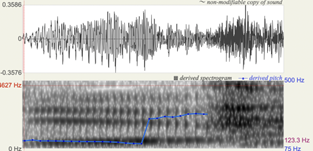
, , , , , , , , , ,

In-Person vs. Digital Communication Styles Among Classmates

Megu Kondo, Devina Harminto, Yixing Wang, Yinlin Xie, Batool Al Yousif

In the rapidly evolving landscape of communication, the distinction between in-person and digital communication has become a focal point of linguistic and sociocultural studies. This project delves into the nuanced differences in language use, expression, and understanding across these two modes of communication. The purpose of this study is to investigate how individuals adapt language styles, tones, and dialects between in-person and digital communication. Additionally, our study aims to explore these preferences specifically among classmates, shedding light on the nuances of their communication choices. By examining various linguistic features such as informality, use of emojis, turn-taking, and the adaptation to the absence of non-verbal cues in digital platforms, this study illuminates how digital communication often necessitates a shift from traditional language norms observed in face-to-face interactions. We designed a survey using Google Forms for accessibility and ease of distribution and collected data from 30 college students (18-22 years old) who engage in both in-person and digital communication.

[expander_maker id=”1″ more=”Read more” less=”Read less”]

Introduction and Background

In the evolving landscape of communication, the distinction between in-person and digital interaction has become a key area of sociolinguistic study. This project investigates how language styles, expressions, and understandings are adapted between these two modes of communication, particularly among college students. The study examines linguistic features such as informality, emoji usage, and turn-taking, shedding light on the nuances of their communication choices.

Traditionally, in-person communication has been valued for its richness and immediacy. This mode allows for a wealth of non-verbal cues such as gestures, facial expressions, and tone of voice, all of which enrich the communication experience and help in accurately conveying emotions. Face-to-face interactions also foster a sense of connection and immediacy, which are often crucial for forming strong interpersonal relationships. On the other hand, digital communication offers unparalleled convenience and flexibility. Platforms like Snapchat, Instagram, and WeChat have revolutionized how we interact, making it possible to maintain relationships over long distances with ease. The digital transformation of communication has brought about significant changes in the linguistic practices of individuals, particularly young adults. The incorporation of multimedia elements such as images, videos, and emojis attempts to bridge the gap in emotional expression that the lack of physical presence creates. However, these elements, while helpful, often fall short of fully replicating the subtleties conveyed through face-to-face interactions. The gap highlights the potential for misunderstanding and the need for enhanced digital literacy in order to navigate the complexities of modern communication.

The primary focus of this study is to assess the preferences of college students (aged 18-22) who regularly engage in both in-person and digital communication. It aims to document their perceived advantages and drawbacks of each mode, particularly in terms of emotional expressiveness and the potential for misunderstandings. Additionally, the study delves into the phenomenon of code-switching — altering one’s language, tone, or style according to the communication platform — which reflects broader cultural identities and adaptability in digital spaces.

Methodology

To examine the differences in communication styles between in-person and digital interactions among college students, we conducted a thorough survey of students aged 18-22. Our methodology ensured that we collected data from a diverse and representative sample, which is critical for drawing meaningful conclusions.

The survey was created with Google Forms, leveraging its accessibility and ease of use to reach a large audience. We divided the survey into three major sections: demographics, communication preferences, and emoji usage. The demographics section gathered basic data such as age, nationality, and primary languages spoken. The communication preferences section explored the participants’ preferred modes of communication, the differences in word and phrase usage between these modes, the ease of conveying emotions, and their awareness of changing language styles or tones. The final section focused on emoji usage, asking about frequency, meanings, and emoji-related misunderstandings. We ensured a diverse participant pool by distributing the survey through social media platforms and student groups, which reached students from a variety of cultural backgrounds and academic disciplines. 

Figure 1. Example of a survey question from the section on communication preferences.

The survey responses were automatically compiled into a Google Sheets spreadsheet, allowing for efficient organization and preliminary analysis. We calculated frequencies, percentages, and averages for the quantitative data to summarize demographic information and communication preferences, giving us a clear picture of the data’s major trends and patterns. We used thematic analysis to examine qualitative data, particularly open-ended responses about emoji usage and communication preferences. This process involved coding the responses and identifying common themes, which allowed us to gain a better understanding of the participants’ experiences and perceptions. We used this methodology to gain a thorough and nuanced understanding of how college students navigate the complexities of in-person and digital communication. By analyzing both quantitative and qualitative data, we were able to identify key trends and patterns in communication styles, providing valuable insights into the changing landscape of digital communication. The use of advanced data analysis tools and rigorous thematic procedures ensured that our findings were robust and reflective of the diverse experiences within our sample. This methodology not only provided a strong framework for our research, but it also ensured that our findings were based on a diverse and representative sample, adding to the larger conversation about language use and social interaction among young adults.

Analysis and Results

We were able to attain a total of 30 participants, whose ages were between 19 to 26. Figure 2 shows that the majority of participants were Asians at 73.3%, and the other 26.7% of the participants were American. The results of the survey garnered a better understanding of how college students prefer in-person communication over online conversation.

Figure 2. Chart detailing answers to the question “What is your nationality?”

Figure 3. Chart detailing the responses to the question “What are your preferred social media platforms?”

Figure 3 shows that Instagram is the most popular social media platform among college students with 80%. 24 participants use Instagram to communicate with others since Instagram is very common among the younger generation; people can post pictures and send each other direct messages. 13.3% of the participants like to use WeChat, which is because some of them are international students who can easily communicate with their friends in China through the platform.

Figure 4. Chart displaying whether respondents prefer to talk to classmates online, in person, or either/both.

The data from Figure 4 shows a strong preference for in-person communication among participants, with 50% favoring this way over online interactions or a combination of both because they feel more productive communicating in person. On the other side, 23.3% prefer online communication, reflecting a significant proportion that values the convenience and accessibility of digital platforms. Meanwhile, 26.7% of participants are comfortable with both ways, suggesting a flexible communication preference that could be influenced by situational factors.

Figure 5. Chart displaying respondents’ feelings about how easy it is to convey emotion through text vs. in person.

In-person communication is generally considered to be more effective in conveying emotions than text-based communication, with 80% of respondents preferring face-to-face communication. Only 10% of respondents believe that online platforms are effective in conveying emotions, and online platforms are likely to use GIFs and emojis. This suggests that digital interactions are not perceived to be enough to express emotional states, which may lead to a lack of empathy in conversations. Face-to-face interactions remain crucial for a deeper emotional connection, underscoring the limitations of digital platforms in replicating the richness of in-person exchanges.

Figure 6. Chart representing whether respondents believe emojis can lead to misunderstandings.

43.3% of respondents believe that emojis can lead to misunderstandings, while the same percentage of respondents said they do not. This polarization highlights the ambiguity of emojis, which may be interpreted differently depending on individual circumstances and cultural backgrounds. The remaining 13.3% respondents were unsure of their impact. 

Figure 7. Question from emoji usage portion of survey.

Based on the data collected from our survey, it is evident that emoji interpretations vary significantly among users. An analysis of the responses revealed divergent interpretations of several emojis. For instance, the smiley emoji 😃, conventionally associated with happiness and positivity, was perceived by some participants as conveying creepiness. The skull emoji 💀, which typically signifies extreme laughter, frustration, or affection according to Apple’s official description, was interpreted by respondents as representing extreme fatigue or exhaustion, akin to the expression “I am so tired, I am dying.” Moreover, it was also seen as indicating laughter, albeit more intense and devoid of any undertones, compared to 😭. Notably, the 😭emoji has lead to the most misunderstanding in their online conversation compare to others. 😭, which Apple describes as depicting a face with an open mouth, wailing, and shedding streams of heavy tears, symbolizing inconsolable grief or intense emotions such as uncontrollable laughter or overwhelming joy, was commonly misinterpreted. Participants reported using it in adverse situations, with connotations such as “yikes” or “can’t believe my bad luck,” “need help,” and some even perceived it as laughter accompanied by a sense of embarrassment. The findings from our survey underscore the complexity and variability in emoji interpretations among users, which can be quite different from what they are officially meant to represent. This can sometimes lead to confusion in online conversations. It’s important to remember these differences when using emojis, suggesting a need for greater awareness of contextual differences in emoji usage to avoid misunderstandings and make sure our messages are clear.

For additional insights and nuances, the context of the communication also appears to play a critical role in the preferred mode. For instance, for quick updates or logistical arrangements, digital communication is often favored for its efficiency. However, for more complex discussions or sensitive topics, in-person interactions are preferred due to the richer, more nuanced exchange they enable. It is also worth noting that some students reported a gradual shift in their preferences towards digital communication as they adapted to the constraints imposed by recent global events such as the pandemic. This adaptation process reflects the dynamic nature of communication preferences in response to external changes.

Based on the data, the majority of college students still prefer and find it more effective to communicate in person, particularly for emotional interactions. The findings indicate that although some students recognize the advantages of online communication, most still believe that in-person contact is more beneficial, especially when it comes to expressing emotions, and students feel more productive since people can get through everything right away. This outcome contradicts our hypothesis, highlighting the complexity of communication preferences among college students. Further analysis shows that communication preferences may vary significantly based on factors like the student’s academic major, cultural background, and prior exposure to diverse communication platforms.

Discussion

Our findings contradict the idea that generation Z is used to being on online communication platforms. In the article by Janssen (2021), generation Z is often referred to as “digital natives.” They are considered the first generation to grow up entirely in the digital age, influencing their communication habits significantly. They are described as “native speakers” of the digital language of computers, video games, and the internet. Texting and instant messaging are preferred over traditional communication methods like phone calls and emails. Generation Z uses smartphones heavily for personal communication, often choosing texting or messaging apps over voice communication. Despite their preference for texting, generation Z adapts to professional communication norms. For example, they use email extensively at work, despite rarely using it in personal contexts. This indicates flexibility in their communication styles, adapting to different linguistic expectations based on context. Surprisingly, our findings are totally opposite from this perspective of generation Z.

For the limitations of the study, while our study focused on college students aged 18-22, this demographic may not fully represent the broader population’s communication preferences. The age group and educational environment might influence communication styles more specific to this demographic, such as familiarity with digital platforms or developmental aspects related to social interactions. Additionally, the study relies heavily on self-reported data, which can introduce bias. Participants might respond in ways they perceive as socially acceptable or based on their aspirational self-image rather than their actual behavior. This can affect the accuracy of data concerning preferred communication modes and the effectiveness of emoji usage in conveying emotions.

The phenomenon of code-switching, where individuals adapt their language based on the audience’s cultural and linguistic background, further illustrates the adaptability required in digital communication and highlights the ongoing evolution of language use on these platforms. “Another study conducted by Alfaifi (2013) on intrasentential CS in Facebook comments written by 10 Saudi Arabic-English bilinguals found that intrasentential CS was used with gossip and humor, English was used for academic and technical terms, and Arabic was used for religious topics” (Elhija 357). Digital communication often sees a higher incidence of code-switching, where bilingual or multilingual speakers switch between languages or dialects depending on the audience, topic, or platform. While this can showcase linguistic flexibility, it also highlights the challenges of maintaining cultural nuances in digital communication, which may not always provide the contextual cues necessary for appropriate language use. This underscores the persistent value of traditional communication methods in an increasingly digital world and suggests that digital platforms still need to evolve to support the subtleties of human emotion and expression fully.

Conclusion

Our study began with the hypothesis that college students would prefer online communication over in-person interactions, primarily due to the flexibility and reduced social anxiety that digital platforms are presumed to offer. This hypothesis was rooted in the belief that the modern digital environment, with its asynchronous communication and absence of physical presence, might alleviate the pressures associated with face-to-face interaction. The data, however, painted a different picture. Contrary to our expectations, 50% of the participants clearly preferred to communicate with their classmates in person, appreciating the depth of emotion and clarity that comes with real-time, face-to-face interactions. Only 23.3% expressed a preference for online communication. This finding suggests that despite the convenience of digital platforms, they are insufficient for fulfilling all communicative needs, especially those that involve emotional depth and nuance.

The results of our study provide a nuanced understanding of how college students navigate the complexities of digital and in-person communication. While digital platforms offer undeniable convenience and flexibility, our findings suggest that they do not fully replicate the emotional richness and immediacy of face-to-face interactions. Half of the participants expressed a preference for in-person communication, particularly valuing its effectiveness in conveying emotions — a fundamental aspect of human interaction that digital platforms have yet to fully capture. Moreover, our investigation into emoji use revealed a balanced scenario: emojis enhance textual communication by adding emotional depth, yet they also lead to misunderstandings in nearly half of the cases reported. This indicates a significant gap in how emotional nuances are perceived and understood in digital contexts. By realistically assessing these results, we acknowledge that while digital communication technologies have transformed how we connect and interact, they are not a complete substitute for in-person interactions. Instead, they are a complementary medium that requires further refinement to meet the emotional and contextual needs of users fully. Future research should focus on developing and testing new technologies that can better accommodate the complex dynamics of human communication, bridging the gap between the efficiency of digital communication and the emotional depth of face-to-face interactions. As a result, this study not only challenges previous assumptions about digital communication preferences but also enriches our understanding of how young adults toggle between digital and real-world interactions, shaping their social identities and relationships in the process.

References

Brenda Danet, Susan C. Herring, Introduction: the Multilingual Internet, Journal of Computer-Mediated Communication, Volume 9, Issue 1, 1 November 2003, JCMC9110, https://doi.org/10.1111/j.1083-6101.2003.tb00354.x.

Defede, N., Magdaraog, N. M., Thakkar, S. C., & Bizel, G. (2021). Understanding How Social Media Is Influencing the Way People Communicate: Verbally and Written. International Journal of Marketing Studies, 13(2), 1-. https://doi.org/10.5539/ijms.v13n2p1.

Ehrensberger-Dow, M., & Granger, S. (2019). “English as a Lingua Franca in Digital Communication: Diverse Voices, Similar Scripts?” Lexis Journal in English Lexicology, 14, 193-217. https://doi.org/10.4000/lexis.1831.

Elhija, D. A. (2023). Code Switching in Digital Communication. Open Journal of Modern Linguistics, 13, 355-372. https://doi.org/10.4236/ojml.2023.133021.

Psych Minds. (n.d.). Communication: Online vs. Face-to-Face Interactions. Retrieved from https://psychminds.com/communication-online-vs-face-to-face-interactions/.

Schroeder, J. (2019). Two Social Lives: How Differences Between Online and Offline Interaction Influence Social Outcomes. https://escholarship.org/content/qt94n9w8b9/qt94n9w8b9_noSplash_293949a5e051fffc8e1fdcc9ffc168c4.pdf?t=qdtezb.

Zhao, Y. (2021). The Impact of Digital Media on Language Styles and Communication Methods Based on Text, Image, and Video Forms. ResearchGate. https://www.researchgate.net/publication/378739166_The_Impact_of_Digital_Media_on_Language_Styles_and_Communication_Methods_Based_on_Text_Image_and_Video_Forms.

D. Janssen and S. Carradini, “Generation Z Workplace Communication Habits and Expectations,” in IEEE Transactions on Professional Communication, vol. 64, no. 2, pp. 137-153, June 2021, doi: 10.1109/TPC.2021.3069288.

Appendix

Our survey link: https://docs.google.com/forms/d/e/1FAIpQLScCFoDiKMbxxYVWXmxPAEwQIKfTjg8mx1qtZFL9oA55R9WpPg/viewform?usp=sf_link

[/expander_maker]
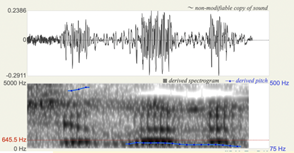
, , , , ,

Social Media Use Among College Students

Jasmin Carranza, Andres Guzman, Luwuam Haile, Armine Mkrtchyan, Tzlil Pinhassi

Social media plays a significant role in the lives of college students, shaping how they connect, communicate, and express themselves. Given its pervasive influence, it is natural to assume that they would have an understanding of their own language use online. This study works to uncover just that. It specifically explores the linguistic features of grammar and vocabulary use among college students on various social media sites and examines their self-awareness of these patterns. We conducted a survey asking students about their social media usage and perceptions of their language, then analyzed their interactions through provided screenshots. Our findings confirm that students adapt their language to fit the platform’s context: Snapchat and TikTok are characterized by informal language and relaxed grammar, while LinkedIn and Facebook maintain higher formality with complex grammatical structures. Students’ perceptions of their language use closely align with their actual usage, indicating a high level of self-awareness. On platforms like Twitter and Instagram, students correctly estimate their use of informal vocabulary and abbreviations while recognizing the formality of their language on LinkedIn. This research highlights the dynamic nature of language use by college students across social media platforms, showcasing their ability to navigate different communication environments effectively. Our findings underscore students’ awareness of the distinct linguistic norms required by various social networks, adjusting their language accordingly with minimal discrepancy between self-perception and actual use.

[expander_maker id=”1″ more=”Read more” less=”Read less”]
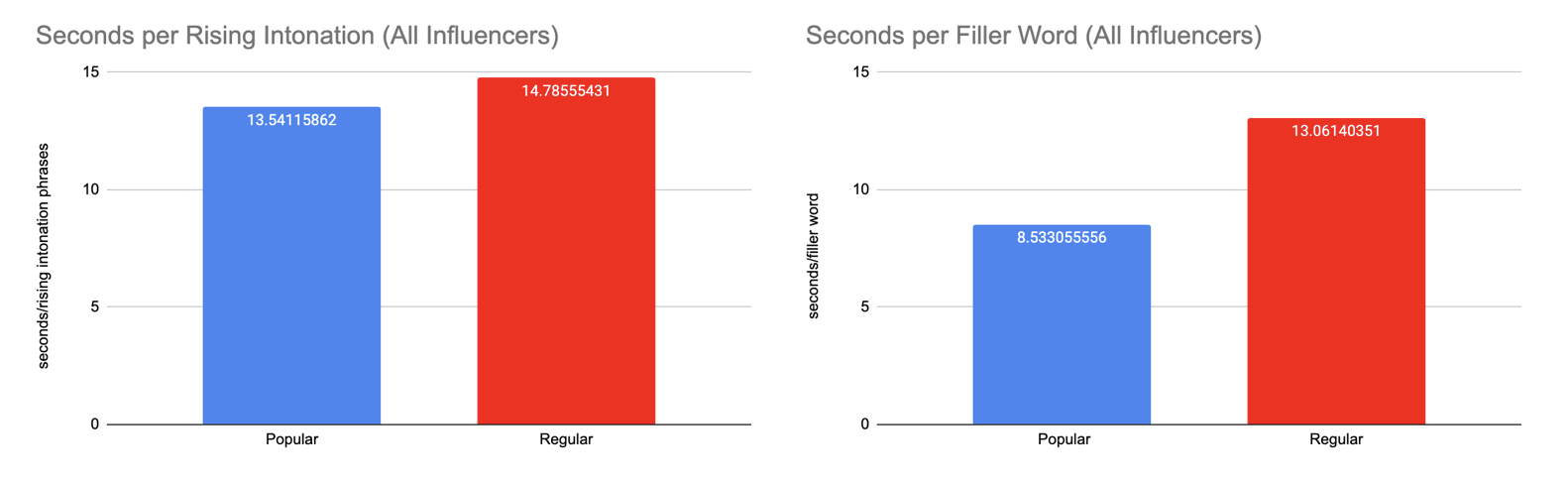
Introduction and Background

In today’s dynamic digital age, social media is a premier medium for immediate conversation and communication, significantly influencing how individuals interact and express themselves (Merchant, 2006). Platforms like Instagram, Facebook, Snapchat, Twitter, TikTok, and LinkedIn serve as tools for social interaction and spaces where unique linguistic patterns emerge. While existing research highlights variations in language use across social media, a notable gap exists in understanding how these linguistic features manifest among college students (Kemp et al., 2021). Additionally, there is limited exploration into how these students perceive their language use across different platforms and whether their perceptions align with their usage patterns. This study addresses these gaps by examining grammar and vocabulary use among college students across various social media platforms. By analyzing formality, vocabulary, use of slang, and emoji frequency, this research aims to uncover the differences in language use. Furthermore, it investigates the self-awareness of college students regarding their language use, comparing their perceptions to their actual linguistic behaviors. Thus, our research question is: How do linguistic features, specifically grammar and vocabulary use, vary across the social media platforms of college students, and how do these students’ perceptions of their language use align with their actual usage?

Methods

To explore the linguistic features and self-awareness of language use among college students on various social media platforms, our study employed a mixed-methods approach, combining quantitative surveys with qualitative content analysis. To start, we sent out a survey to students of UCLA who self-reported their language on various social media platforms. Then, participants were asked to provide screenshots of their interactions on each of the social media sites. This allowed for a direct comparison between self-reported data and actual language use. With this information, we were able to confirm or deny each student’s self-perceptions of their online language usage. The provided screenshots were anonymized to protect participants’ privacy.

Building on previous research by Skierkowski & Wood (2012) and Kemp & Clayton (2017), we hypothesized significant variations in vocabulary use, syntax, emoticon usage, and adherence to communication norms across different social networks. By investigating aspects of text messaging, including textese density and response times, for example, we provided a comprehensive understanding of language adaptation within different social circles. Ultimately, the study contributes to the broader comprehension of communication dynamics in the digital age, offering insights into how language is utilized and adapted within college students’ social networks.

Results and Analysis

The results are important in providing insight into the nature of the linguistic choices, not only consciously but also subconsciously, by young adults in digital communication. Taking a deeper dive, we analyze the results from each platform we considered — LinkedIn, Twitter, and Instagram—and provide examples to illustrate these trends.

LinkedIn: Formal Language Use

Appearance in LinkedIn, the professional networking site, invited a thicker coat of calcified tongue for student use of semi-formal scholarly language. This meant, simply: full sentences, big words, industry talk or just a professional sheen to it overall. Analysis revealed students’ self-reports on the language they used were consistent with their actual posts.

Example: In a typical post, a student wrote, “I am thrilled to announce that I have accepted an internship position at Boeing, where I look forward to contributing to the innovative team and developing my professional skills further.”

This example underscores the formal, structured language typical of LinkedIn, reflecting the professional nature of the platform.

Twitter: Casual and Expressive Language

On Twitter, where brevity and timeliness reign, a similar but distinct trend was apparent. Students frequently used slang, abbreviations, and emoticons with whom they clearly identified, as they later recognized and reported in their questionnaires. The students were able to note the spontaneity and personal expression that helped keep their informal tone, well, informal.

Example: A tweet from one of the participants read, “Just saw the weirdest episode of my fave series ever! 😱🤣 Can’t believe what just happened… #mindblown #bingewatching.”

This tweet is representative of the casual and expressive language that defines Twitter, complete with emoticons and hashtags that add a personal touch.

Instagram: Visual and Informal Communication

Instagram, a visually rich platform, also is a part of the informal text conversation game. In sharing their pictures, students were juxtaposing the images with very informal language, often with self-deprecating serializations, and using all sorts of creative text styling. Once again, students’ perceptions of their language use and the actual content analyzed were highly correlated.

Example: An Instagram caption accompanying a beach sunset photo stated, “No filter needed for this sunset 🌅 🌊  #sunsetvibes #beachlife.”

The use of emojis and hashtags enhances the visual experience, reflecting the informal and personal communication style prevalent on Instagram.

The consistency across different platforms suggests that students possess a clear understanding of the appropriate linguistic forms for each social media context. This was particularly evident in their ability to adapt their language to match the formality of the platform, whether in professional settings like LinkedIn or more personal spaces like Twitter and Instagram.


These findings are crucial for understanding the impact of digital communication on college student’s language use and identity construction in the digital age. By demonstrating how students adeptly navigate the linguistic landscapes of various social media, this research contributes significantly to broader discussions about digital literacy and the dynamic nature of language in social media settings.

Discussion and Conclusions 

The study aimed to explore the linguistic features of grammar and vocabulary use among college students on various social media platforms and examine their self-awareness of these patterns. Our findings provide valuable insights into how social media environments shape language use and how aware students are of their linguistic behaviors online. One of the key findings of our research is the adaptability of college students’ language based on the context of the platform. On platforms like LinkedIn, which are perceived as professional and formal, students consistently used structured, complex sentences and formal vocabulary. This indicates a clear understanding of the expectations and norms of professional communication. Conversely, platforms such as Twitter and Instagram, known for their casual and expressive nature, saw students employing informal language, including slang, abbreviations, emoticons, and hashtags. Snapchat and TikTok, which emphasize spontaneity and visual content, also reflected relaxed grammar and informal vocabulary. These variations in linguistic styles underline the students’ ability to navigate different communication environments effectively.

Another significant aspect of our study was the alignment between students’ perceptions of their language use and their actual usage. The survey results, paired with the analysis of online interactions, revealed that students accurately estimated their use of informal vocabulary and grammar on platforms like Twitter, Snapchat, TikTok, and Instagram. Similarly, they recognized the formality required on LinkedIn and Facebook. This high level of self-awareness suggests that students are not only aware of the different linguistic norms across social media platforms but also consciously adjust their language to fit these norms. This could be attributed to the fact that social media has a great presence in the lives of college students, making it easy to be familiar with and adapt to its expectations.

The findings of this study also help us understand how digital environments influence social interactions among young adults. The fact that college students are able to alter and modify their languages to fit several different social media platforms demonstrates a form of digital code-switching. There is a clear navigation between linguistic styles and norms, which mirrors larger societal practices of adapting communication styles in several social settings. Students are not only enhancing their digital literacy but also building their online identities that correspond to their desired social persona. As such, this adaptability in language use shows a larger phenomenon of identity formation and management in today’s digital age, where college students as well as other individuals curate their self-presentation across different platforms in online environments.

In conclusion, this research highlights the dynamic nature of language use by college students across social media platforms. Students demonstrate a keen awareness of the distinct linguistic norms required by various social networks and adjust their language accordingly. The minimal discrepancy between their self-perceptions and actual usage underscores their proficiency in navigating digital communication landscapes. These insights contribute to a broader understanding of communication dynamics in the digital age, emphasizing the importance of digital literacy. As social media continues to evolve, further research could explore how these linguistic adaptations and self-awareness develop over time and across different demographic groups. Understanding these patterns can help educators and policymakers create more effective communication skills in digital contexts, preparing students for the multifaceted nature of online interactions.

References

Kemp, N., & Clayton, J. (2017). University students vary their use of textese in digital messages to suit the recipient. Journal of Research in Reading, 40(December 2017), S141–S157. https://doi.org/10.1111/1467-9817.12074

Kemp, N., Graham, J., Grieve, R., & Beyersmann, E. (2021). The influence of textese on Adolescents’ perceptions of text message writers. Telematics and Informatics, 65, 101720. https://doi.org/10.1016/j.tele.2021.101720

Merchant, G. (2006). Identity, Social Networks, and Online Communication. E-Learning and Digital Media, 3(2), 235-244. https://doi.org/10.2304/elea.2006.3.2.235

Raccanello, Paul J. (2011) “Social networking texts among college students: identity and imagination online”. Doctoral Dissertations. 216. https://repository.usfca.edu/diss/216

Skierkowski, D., & Wood, R. M. (2012). To text or not to text? The importance of text messaging among college-aged youth. Computers in Human Behavior, 28(2), 744–756. https://doi.org/10.1016/j.chb.2011.11.023

, , ,

The Gender Playbook of Stand-Up Comedy

Shaveon Sisson, Daria Avtukh, Chelsea Garcia, Frieda Lopez Mesina

When it comes to humor, women are typically criticized for being less funny or for trying too hard to be funny. There is a sense of discrimination and inequality when it comes to comedy and gender. Asking the questions, how do sex differences have an effect on comedic styles during stand-up comedy? And, to what extent do female comedians adopt male mannerisms and verbal expressions in their performances? We believed that in order for women to be taken seriously in comedy they possibly had to take up certain character roles in order to fit into their male-dominated industry. Believing that female comedians mimic male comedians, through mimicking in body language, word choice, and pragmatics like pitch in order to be seen as monetarily successful in humor and in the industry, which then phases out as they acquire more experience on stage. Through video observations of 3 different pairs of comedians that include various ethnicities and one sample from male and female groups, we were able to make a discovery about our theory that we did not expect.

[expander_maker id=”1″ more=”Read more” less=”Read less”]

Introduction

Aayushi Sanghavi (2019) highlights that gender norms and perceptions of femininity have significantly prevented women from being recognized as “funny.” Historically, patriarchal systems have positioned men superior, including in humor. Research indicates that women’s speech is often perceived as tentative and powerless due to their use of tag questions, uptalk, and diminutive adjectives, while men are more direct and assertive, which applies to humor. This has led to the fallacy that women are not capable of exhibiting aggressive comedy. Most research in this area, conducted by men and focused on men, resulted in a bias associating masculinity with humor. In an industry where ‘funny men’ are celebrated but ‘funny women’ are merely tolerated, the question arises: Do female comedians need to adapt their communication style and stage presence to appear more masculine to be accepted and marketable? Our research focuses on comedians with less than ten years (newbies), ten to fifteen years (mid-career), and fifteen to twenty years (late-career) of professional experience. We will examine a woman and a man in each category, randomizing race, keeping track of filler words, body language, uptalk/pitch, and laughter by observing their performances and analyzing recorded material to gather data for our research.

Methods

To properly analyze comedians’ stand-up videos, we addressed the following questions: How do sex differences affect comedic styles during stand-up? To what extent do female comedians adopt male mannerisms and verbal expressions in their performances? Does this affect audience engagement? Are there differences in body language and vocal delivery between male and female comedians? Our group studied 6 comedians (3 female, 3 male), varying in experience (<10 years, 10-15 years, >20 years) collecting 1 hour of data per person. We watched two Youtube videos to study Ralph Barbosa and Andrea Jin, one Amazon Prime special and one Netflix special to study Mo’Nique, and 6 Netflix specials for Bill Burr, Taylor Tomlinson, and John Mulaney (two/each comedian)1. We analyzed vocal techniques, physical performance, joke content, structure, and timing. Inspired by Weitz’s “Sex differences in nonverbal communication” (1976), we focused on how sex roles affect each comedian’s profession. We identified differences in their rising voice intonation, fillers, body language, and laugh tracks based on their years of experience in the comedy industry. Our research indicates that the longer a comedian is in the industry, the less likely women are to adopt male mannerisms to fit into a male-dominated field, slightly contradicting our initial hypothesis.

Results

Vocal techniques.

  • Andrea Jin and Ralph Barbosa’s vocal shift was at a steady pace throughout the entireshow and I did not observe any shift between these two comedian styles.
  • Tomlinson often uses vocal fry and change in pitch to portray characters. Mulaney usesaccents and volume shifts to differentiate characters instead.
  • Monique uses code-switching and regional dialects from the South and East Coasts of theUnited States, while Bill employs a British accent. Both use uptalk/rising terminal, pitch,

    and volume shifts to portray different characters and emphasize the punchline. Physical presence.

  • Jin’s stage presence was frankly odd; she stayed in one spot throughout the whole show, in which she occasionally moved and showed the same presence. I recognize a similar behavior with Barbosa in which he was very stiff throughout the whole show, stayed in one spot, and once in a while he would sway back and forth.
  • Tomlinson remains mostly stationary, relying heavily on facial expressions, and only moves when portraying other characters. Mulaney uses his entire body, utilizing the entire stage, even when the joke doesn’t require it.
  • Mo’Nique seldom remained stationary; she favored a confident stride while she paced. Additionally, she utilizes gestures with her free hand approximately 95% of the time during her spoken communication. Bill Burr uses many gestures, such as kneeling, lunging, using the mic stand as a prop, and mimicking a blow-up doll, as well as utilizing gestures like strangling and kicking to depict violence. Bill accompanies his speech with hand gestures and is in motion about 80% of the time

Jokes content

  • Jin’s jokes were about personal stories, gender topics, and her transition from China. Barbosa particularly displayed his jokes about drugs, smoking, personal stories, and ethnic background. I noticed that both comedians shared a lot in common with their jokes.
  • Tomlinson jokes about sex, failed romantic relationships, gender differences, and religious trauma. Mulaney jokes about drug addictions and tells long autobiographical stories. Neither of the two used an excessive amount of filler words.
  • Mo’Nique incorporates camaraderie into her jokes about her numerous husbands, weight, being Black in Caucasian spaces, her career, and her experiences as a student in special education. Burr displayed traits from the feminine speech community while discussing male feminism, cultural appropriation, cancel culture, white male privilege, and family dynamics. In two hours, he used 115 filler words, 13 discourse markers, and 82 tag questions. They both use a significant amount of expletives. 

Structure

  • Jin’s structure of her jokes was very rushed, she didn’t give the audience a chance to soak in the jokes and moved along very quickly. I did notice that Jin had a lot of extra sentential switches which at the end of every joke she would say “uhhhuh” to let the audience know that she was done. Barbosa on the other hand was slow with his jokes but gave he the audience a chance to soak in the jokes with frequent pauses.
  • Tomlinson’s jokes are presented in separate sections with noticeable transitions. Mulaneytreats his performance as one long story with many sub stories.
  • Monique and Burr presented jokes in separate sections. Mo’Nique engages with thecrowd, while Burr uses “ahhh” and “alright” as transitions. Timing.
  • As I mentioned before Jin rushed her transition between topics in which the structure of her jokes didn’t follow through and there were multiple awkward pauses in between her transitions. Barbosa on the other hand had noticeable transitions but did take a long time to finish a joke.
  • Both comedians used more pauses later in their careers. Tomlinson would use “anyway”, “so yeah”, “and uh…” right after delivering the punchline to seem nonchalant or to possibly prepare in case the joke doesn’t “land”. Mulaney took noticeably long, dramatic pauses to let the audience laugh.
  • Although Burr’s timing varies with choppiness, short pauses, and speeding through the jokes, Monique, on the other hand, takes fewer pauses and delivers a slowly timed punchline. 

Discussion

The observed patterns have supported our hypothesis only minimally. In early career comedians, Andrea Jin did fit the style of a hypothesis, appearing to have a masculine style. She used arm motions to dissociate body parts, joked about typical gender issues to connect with the female audience. Barbosa, however, maintained a neutral approach, which did not support our gender-based hypothesis. Mid-career comedians Taylor Tomlinson and John Mulaney showed more contrasting styles, Tomlinson being more timid and scripted, while Mulaney was more relaxed and confident. However, surprising findings include Tomlinson’s prevalence in sex-related jokes compared to Mulaney. Our findings possibly suggest that women feel more restricted in their performances, while men have greater confidence to take up more space. However, we soon found contradicting evidence, with Mo’Nique’s performance challenging this idea, since this late-career comedian embraced her feminine sexuality through her attire, confident struts on the stage, and bold delivery of jokes. Contrary to the existing literature on usage of filler words between genders (Laserna, Seih, and Pennebaker), we found that filler words were not used by women, with seasoned comedian Bill Burr using them the most, while others hardly used them. Observing both of the late-career comedians raised questions on whether Mo’Nique felt the need to compensate by her spectacular presentation since she is a double minority as a black woman, and if being a part of a majority (white male) influences the comedic style of a comedian.

Our content study challenges the notion that female comedians must adopt male mannerisms to be seen as competent in the field. While gender norms play a role, factors like parenting styles, personal choices and branding, past experiences, and social conditioning are also influential. Our hypothesis was partially supported as less experienced female comedians showed more masculine behavior, and this decreased after 10 years in the field. Females in their mid-career and late career often joked about sex and porn, unlike beginner female comedians and male comedians. Notably, Bill Burr who has been in the industry for 30 years, used many filler words, compared to beginner performers who instead used more awkward sounds. Future studies should explore larger samples, longer time frames, and in-person observations to provide deeper insight. We found that female and male comedians viewed certain topics differently with women feeling more comfortable joking about sex. While our hypothesis was minimally supported, comedy styles seem to be shaped by socio-cultural background, personal styles, and past experiences, rather than by gender mimicry. Further research is needed to assess how gender dynamics evolve in a comedian’s career trajectory.

References

Binder, M. (Director). (2022). Bill Burr: Live at Red Rocks [TV Special]. Netflix. https://www.netflix.com/

Binder, M. (Director). (2019). Bill Burr: Paper Tiger [TV Special]. Netflix. https://www.netflix.com/

Lakoff, R. (1975). Language and woman’s place. Harper And Row.

Laserna, C. M., Seih, Y.-T., & Pennebaker, J. W. (2014). Um… Who Like Says You Know: Filler Word Use as a Function of Age, Gender, and Personality. Journal of Language and Social Psychology, 33(3), 331-340.

Mercado, K. (Director). (2022). Taylor Tomlinson: Look at You [TV Special]. Netflix. https://www.netflix.com/

Mizejewski, L. (2014). Pretty/Funny. University of Texas Press.
Raboy, M. (Director). (2020). Taylor Tomlinson: Quarter-Life Crisis [TV Special]. Netflix.

https://www.netflix.com/
Ritchart, A., & Arvaniti, A. (2013). The use of high rise terminals in Southern Californian

English. The Journal of the Acoustical Society of America, 134(5), 4198–4198.

https://doi.org/10.1121/1.4831401

Frazier, L. (Director). (2023). Mo’Nique: My Name Is Mo’Nique [TV Special]. Netflix. https://www.netflix.com/

Sanghavi, A. (2019). The Effects of 21st Century Digital Media On the Changing Perceptions of Women’s Humour and Female Comedians. https://doi.org/10.33422/6th.icrbs.2019.07.430

Small, L. (Director). (2004). Mo’Nique: One Night Stand [TV Special]. Amazon. https://www.amazon.com/

8

Timbers, A. (Director). (2023). John Mulaney: Baby J [TV Special]. Netflix. https://www.netflix.com/

Timbers, A. (Director). (2018). John Mulaney: Kid Gorgeous at Radio City [TV Special]. Netflix.https://www.netflix.com/

Kallstig, A. (2021). Laughing in the Face of Danger: Performativity and Resistance in Zimbabwean Stand-up Comedy. Global Society : Journal of Interdisciplinary International Relations, 35(1), 45–60. https://doi.org/10.1080/13600826.2020.1828295

Weitz, S. Sex differences in nonverbal communication. Sex Roles 2, 175–184 (1976). https://doi.org/10.1007/BF00287250

Appendix A.

“Andrea Jin: Comedy Central Stand up” (2024).” Youtube. “Bill Burr: Live at Red Rocks” (2022). Netflix Special. “Bill Burr: Paper Tiger” (2019). Netflix Special.
“John Mulaney: Baby J” (2023). Netflix Special.

“John Mulaney: Kid Gorgeous at Radio City” (2018). Netflix Special. “Mo’Nique: My Name is Mo’Nique” (2023). Netflix Special. “Mo’Nique: One Night Stand” (2004). Amazon Special.
“Ralph Barbosa: Comedy Central Stand up” (2023). Youtube.

“Taylor Tomlinson: Look At You” (2022). Netflix Special. “Taylor Tomlinson: Quarter-Life Crisis” (2020). Netflix Special.


, , , ,
Scroll to Top