Your Voice Speaks Volumes: Linguistic Insight Into the Trauma Affiliated with Adoption
Sakina Qadir
Adversity plays a large role in how one thinks, behaves, and acts. Early life experiences countlessly show both negative and positive long-term effects that can be brought out in later stages of adult hood. This study looks at how early childhood adversity can induce differences in speech patterns. Additionally, to properly measure adversity this study focuses on adopted children as subjects and transcribes interactions with parent guardians from a set of YouTube videos on the channel called “The Cut”. This study also compares gender differences between these interactions to see if male or female behaviors exist and whether they show deviant behavior. More so, two linguistic features: volume and word choice tests whether further differences exist, such as tone of pitch and vocabulary. This study will seek to determine if linguistic features and gender differences between the adopted and biological children exist in the way they communicate and whether societal pressures push children to act in a certain manner. Different identity faces give insight into how individuals react in their environment and this paper analyzes whether a child’s upbringing provides a reasonable explanation to their linguistic variances.
Introduction & Background
Jim Beggs once said, “What we say is important…for most cases the mouth speaks when the heart is full.” The way we talk is tightly connected to social norms that motivate our choices. As humans we reflect upon the community we surround ourselves to. A lot of research has shown connections to cognitive differences with speech fluctuations. Interestingly enough, the Social Affective Neuroscience and Development (SAND) Lab at UCLA shows that adopted adolescents seem to show the highest level of cognitive variances and therefore are a vital group to conduct a study on. While a stressed-induced situation may vary, for the purposes of this paper a stressful situation is defined as the adoption of children. This experience has been proven to show markers that indicate adopted children deal with more trauma in their childhood and therefore have more fluctuations in the way they speak (Silvers et. Al, 2017). With this in mind, this paper identifies linguistic differences within these groups of children by looking at their volume of speech and word usage. Beyond this, gender may play a role in the interactions of male and female adopted and non-adopted children as topic of conversation may vary and volume of voice can be lower for females than males.
As seen from Eckert, construction of an identity is based on obligations and rights that one has, and based upon the expectation they have within a society (Eckert et.al, 2013). As human beings we are subjugated to indexicality 1 as we are constantly constructing to build new personas based on the experiences that occur around us. Gender can have different responses and the context that individual places themselves in will allow one to make choices and choose which face they want to display. The environment we are in shapes us and the outcome is the communicative style we put forward. In other words, people use different performative displays to communicate aspects of their moment-to-moment identities (Butler, 1990).
In considering speech differences between genders, Debora Tannen’s viewpoint on gender is that men portray their speech behavior as hierarchical, meaning that they are actively trying to assert dominance, whereas women are seen as more supportive and less demeaning (Tannen, 1990). In simpler terms a man is deemed in society to be more assertive, whereas women are not. This study demonstrates how adolescents’ use of volume and word choice become stylistic resources to convey momentary identity displays consistent with gender expectations as a response to authority.
Methods
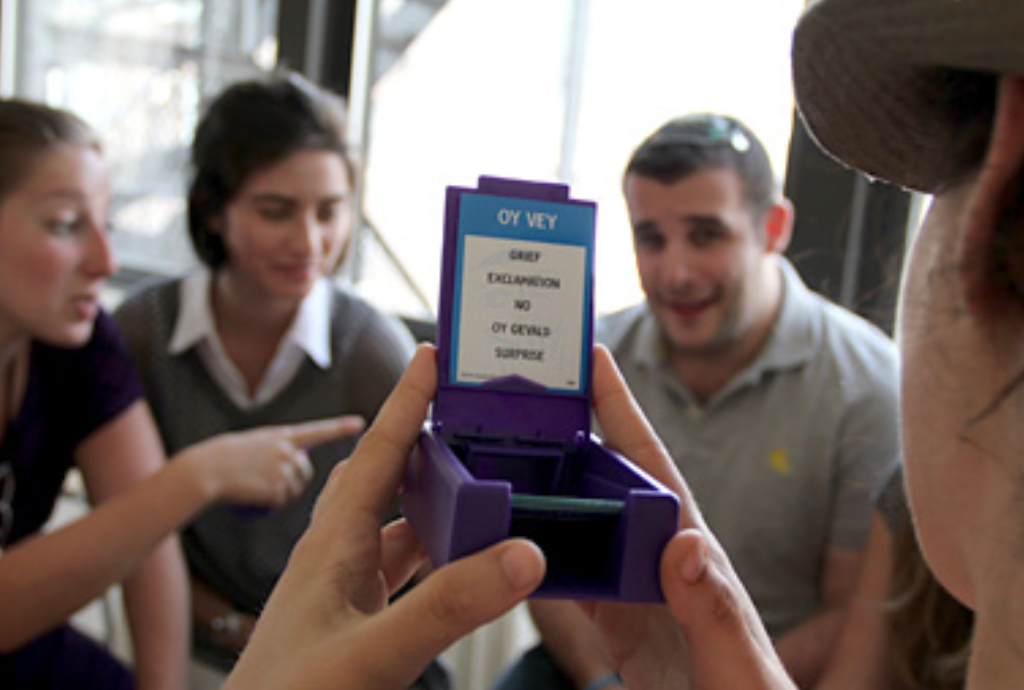
For this paper, language differences are being analyzed from a YouTube series called, “The Cut”. These short six-minute videos adequately provide interactions that happen between adopted children and their parents as well as biological kids and their parents. The set-up of the conversation involves answering questions from a deck of cards (Figure 1), and those questions that go unanswered elicits the individual taking a shot of alcohol.

This behavior can act as a type of identity display, for sake of understanding it deems to see whether the act of taking alcohol, i.e. not answering the question, is a nature seen in one group of kids over the other. The reason this behavior is of importance is because the individual forgoes from talking and therefore indicates a level of deviance from a normal conversation that should occur. On top of linguistic differences in speech orientation, it seeks to answer whether this identity display of taking a shot of alcohol is seen more heavily between adopted kids or not, or if this behavior is more often associated with males or females which would highlight important differences between gender. These videos also deem to answer and compare occurrences of behavior that may be expected by society when in reality there could be occurrences that may not adhere to an anticipated outcome.
Results
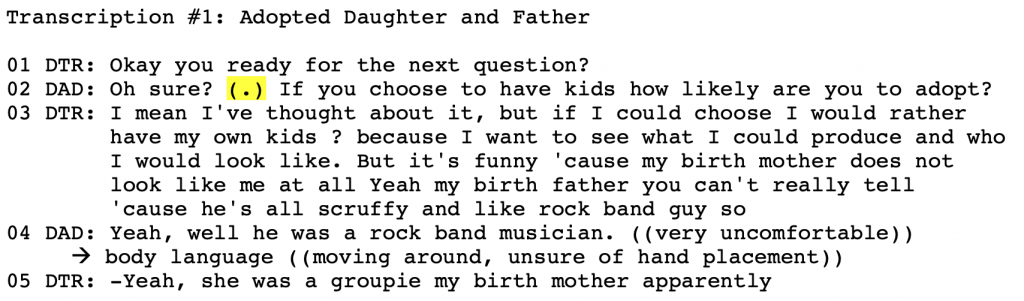
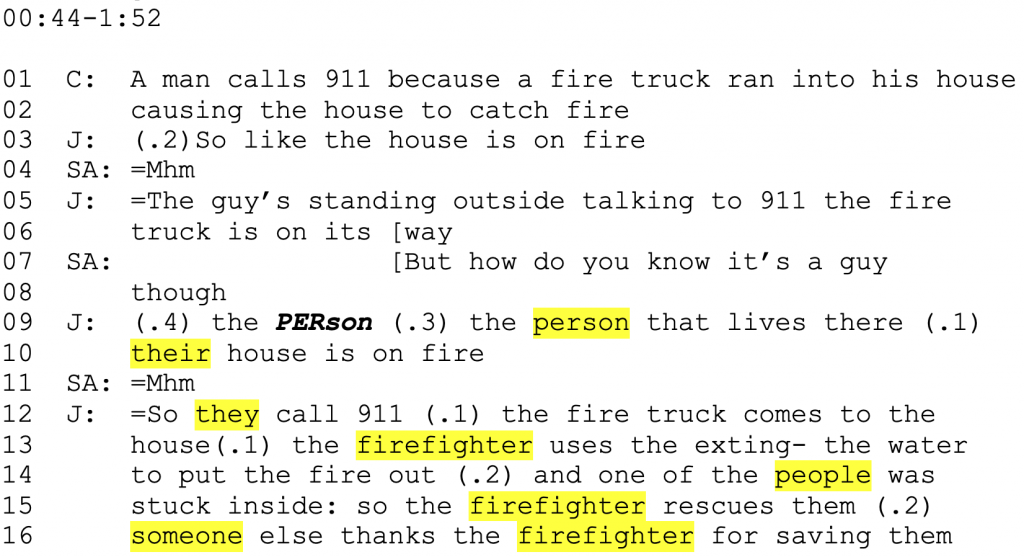
Arrow: shows deviant body behavior
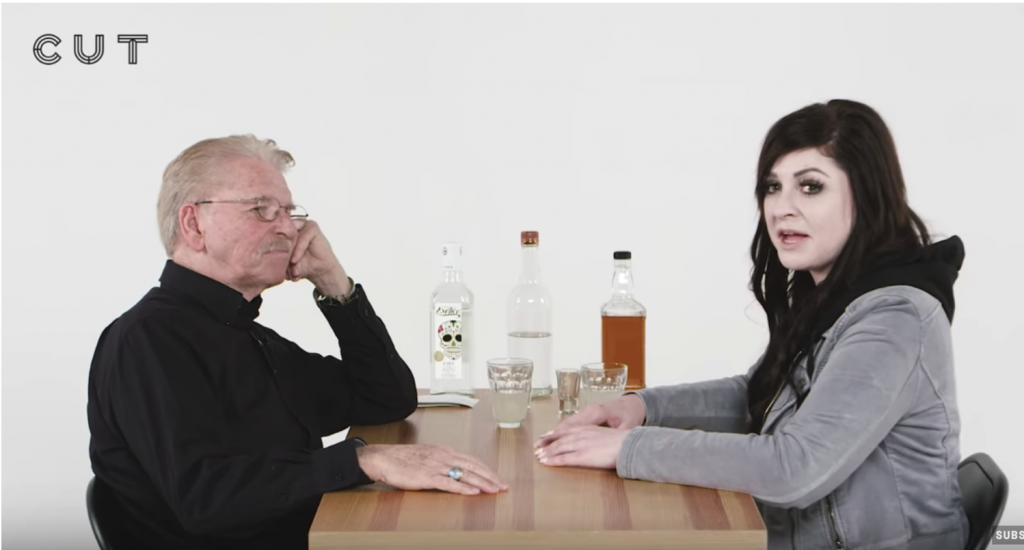
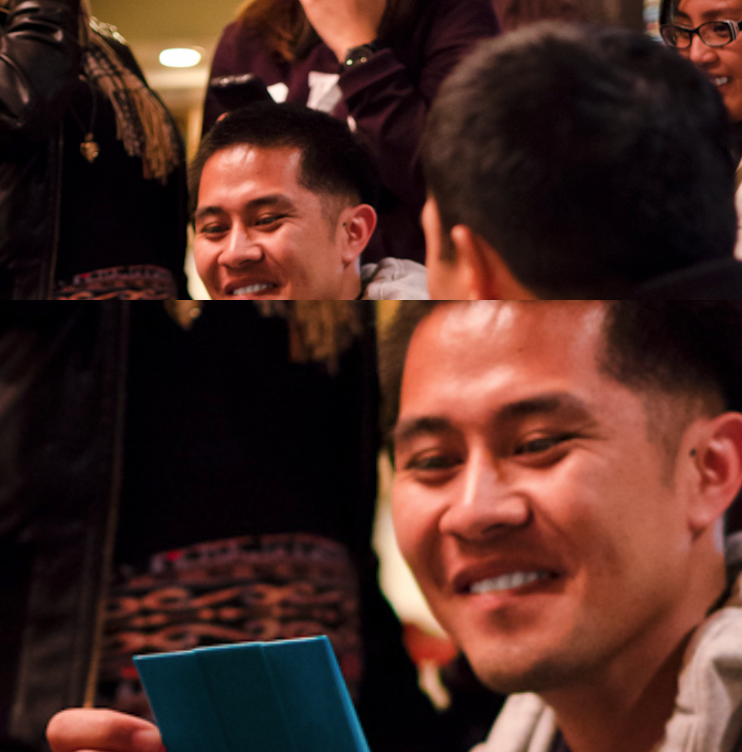
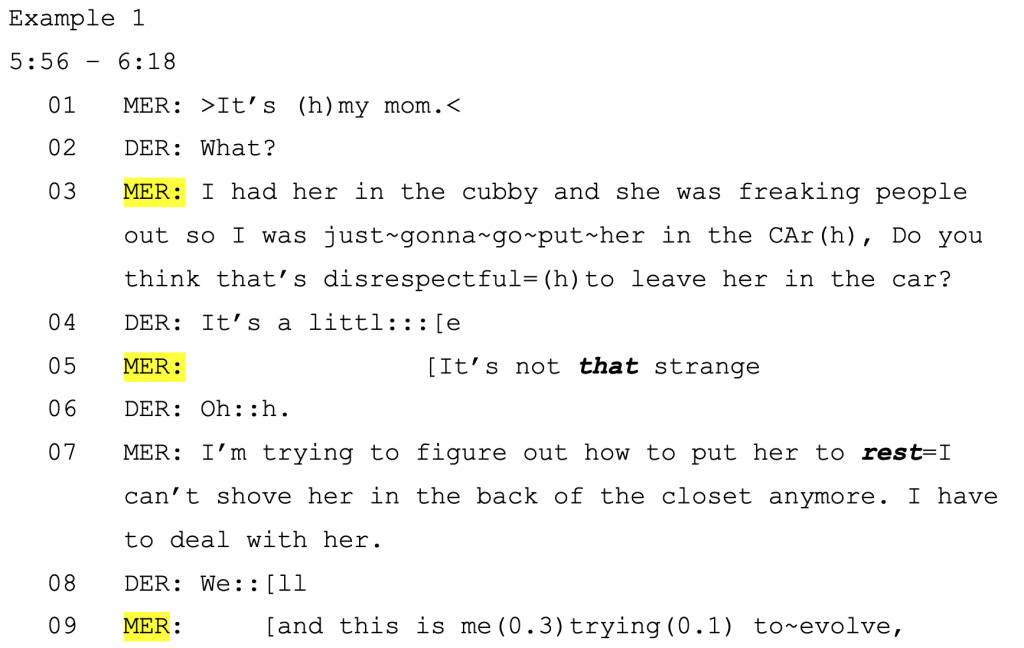
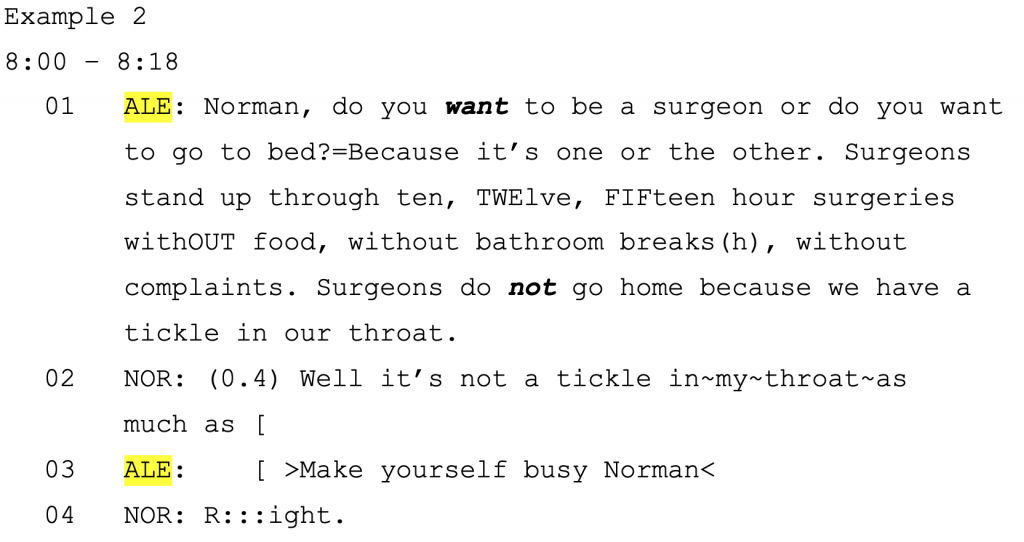
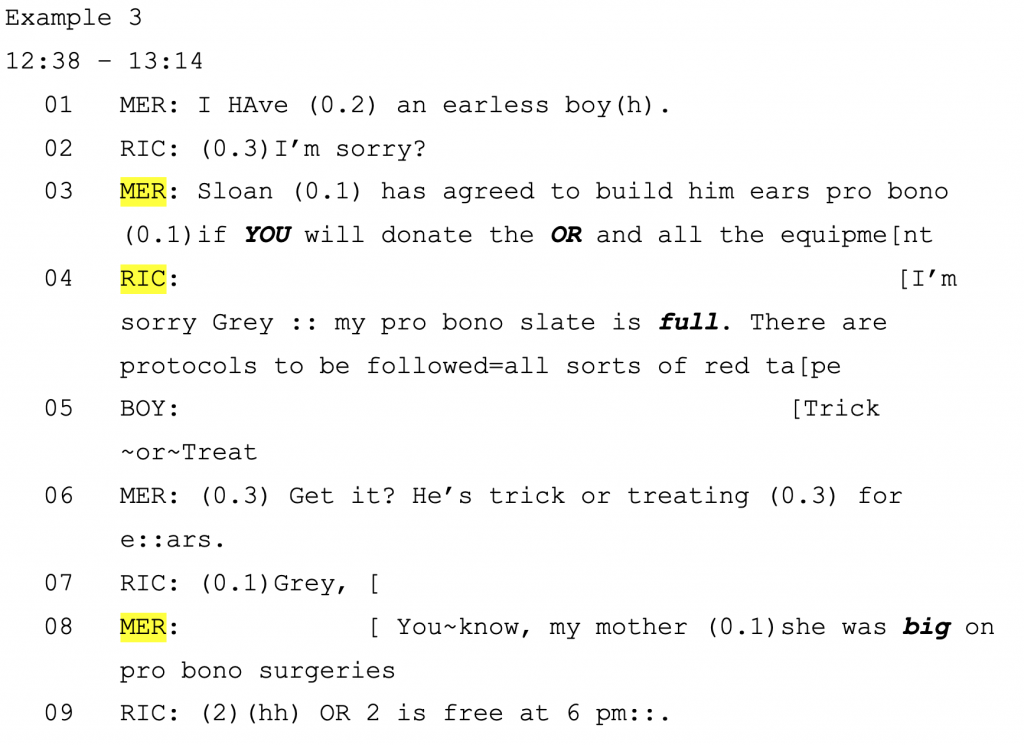
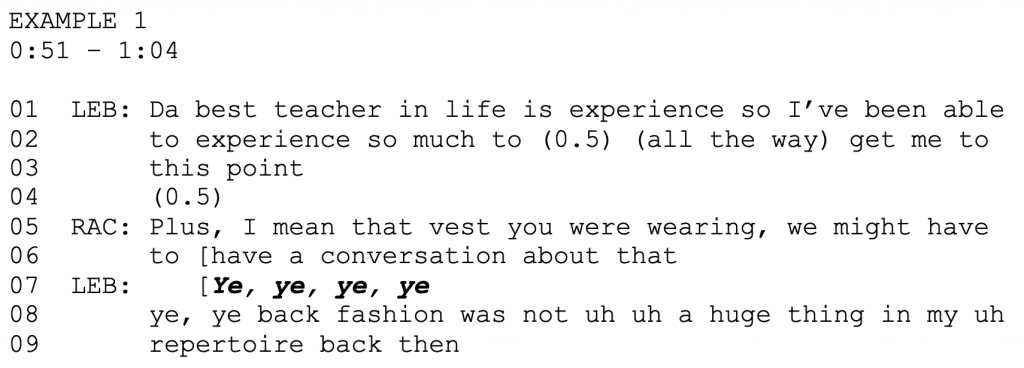
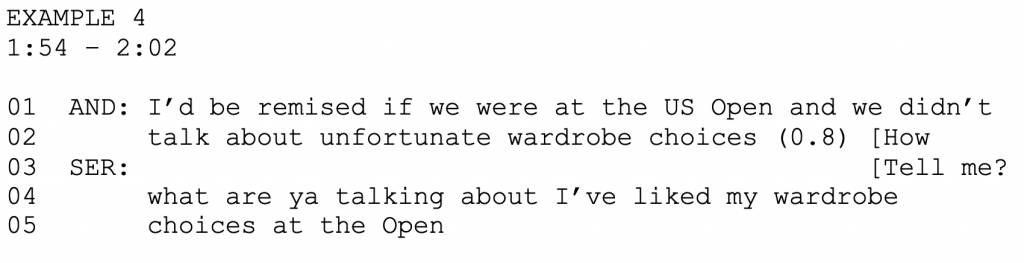
This is one example of a conversation between an adopted daughter and her father. This analysis is unique because it highlights an occurrence of negative face 2 when the daughter answers no to adopting any children, which in itself shows a response unlikely to be perceived as a decent one in any community. As seen in line 3 of the transcription above, there are some serious differences in both language and body behavior (Figure 2) when the father asks his adopted daughter the question and the response he gets from her. Even more so, the adopted child seems more alert when answering this question and answers it quite thoroughly without any hesitancy to show some remorse or compassion. This interaction seems very deviant because the adopted child then seems to go on about her real parents in which the father seems to have a reaction to, as he starts to shift in his chair and becomes unsure on how to respond. The daughter displays a face threatening act as she is critiquing her father. We believe that adopted children seem to avoid this subject but this participant also uses a higher pitch which is a behavior more associated with a biological child. Indexicality in this example is outwardly defiant as the daughter displays herself as someone who is unable to be affected by her past, and goes to the extent in which she seems disapproving of her dads choice in adopting children.
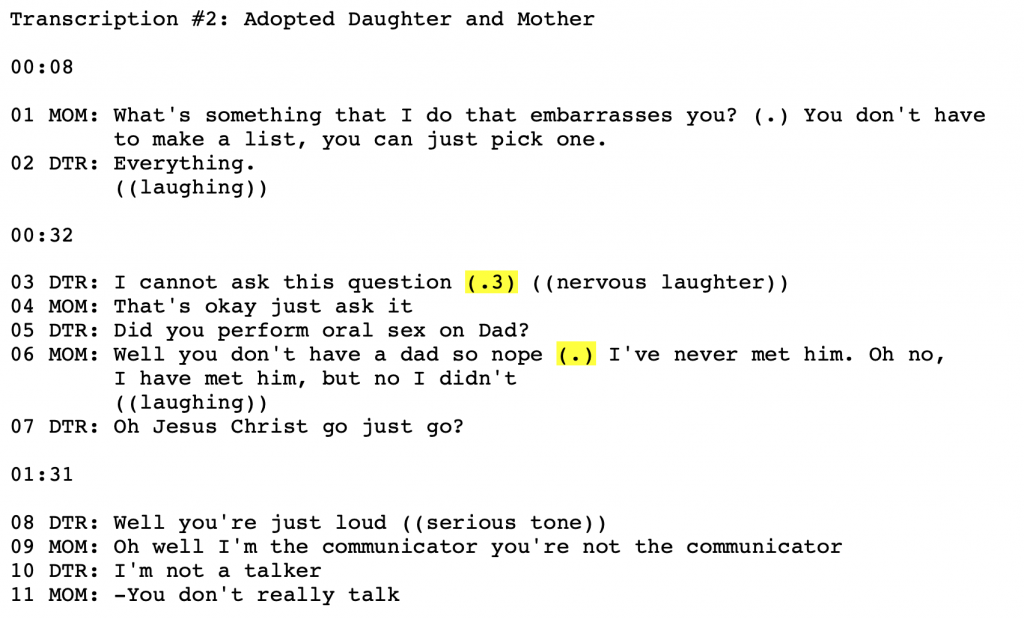
One other example, that seems more cohesive and supportive of the hypothesis is an interaction between an adopted daughter and her mother. In this example, the daughter is extremely hesitant to ask her mother a question, as seen in line 3, whereas biological children in the other interactions in the same videos had no problem in doing so. Her shyness comes off as peculiar as the question, although personal, is not anything to be hesitant from. This highlights an identity face that could have been developed due to strenuous conditions from her childhood that makes this child unsure of her actions. As Tannen also proclaimed, women tend to be less assertive as compared to men so a gender difference could be in effect in this example as well. However, that is not to say that all adopted children act in one way as there are some cases where the adolescents are actually more geared to raise their volume and use proactive language to purposefully exhibit bad behavior. Children are often times a tricky group to study as their development can be easily altered by what they face and respond by displaying different indexicalities (Umberson et. al, 2014).
Conclusion
In conclusion, differences in behavior can be well associated with how the world perceives certain people to behave. Even though this paper points out various examples of behavior that elicit differences in gender and language, there is no guarantee that this is a product of how these young children believe that they should behave versus the way they truly want to. Both word usage and speech volume showcase a wide variety of implications that can still vary by situation. Adopted children are faced with an early childhood adversity and the way they behave can be the product of their hardships (Juffer et. al, 2011). Kids are often times neglected, especially adopted children, so they develop to pick up on cues around them which they are seldom aware of and this leads to speech and gender differences which coincidently arise from their identity displays they have inherently adapted (Silvers et.al, 2017).
Useful YouTube links
A Crash Course on Language and Meaning
Academic references
Butler, J. (1990) Gender Trouble: Feminism and the Subversion of Identity. New York: Routledge.
Eckert, P., & McConnel–Ginet, S. (2013). Speech situations, events, and activities. Language and gender (2nd edition).
Juffer, F., Palacios, J., Le Mare, L., Sonuga-Barke, E., Tieman, W., Bakermans-Kranenburg, M., Verhulst, F. (2011). II. Development Of Adopted Children With Histories Of Early Adversity. Monographs of the Society for Research in Child Development, 76(4), 31-61. Retrieved February 25, 2020, from www.jstor.org/stable/41408756
Silvers, J.A., Goff, B., Gabard-Durnam, L., Gee, D.G., Fareri, D.S., Caldera, C., & Tottenham, N. (2017). Vigilance, the amygdala, and anxiety in youth with a history of institutional care. Biological Psychiatry: Cognitive Neuroscience and Neuroimaging, 2, 493-501.
Umberson, D., Williams, K., Thomas, P., Liu, H., & Thomeer, M. (2014). Race, Gender, and Chains of Disadvantage: Childhood Adversity, Social Relationships, and Health. Journal of Health and Social Behavior, 55(1), 20-38. Retrieved February 25, 2020, from www.jstor.org/stable/43186878
Tannen, D. (1990). You Just Don’t Understand: Women and Men in Conversation. New York, NY: Morrow.
YouTube Videos
Cut. (2019, March 7). Adopted Kids & Their Parents (Frederick & Marisa)|Truth or Drink [Video]. YouTube. https://www.youtube.com/watch?v=ob1m8CU70E0&t=83s
Cut. (2019, March 14). My Adopted Daughter & I Play Truth or Drink (Cynthia & Tabitha |Truth or Drink [Video].YouTube. https://www.youtube.com/watch?v=0z6gznGsfBM&t=98s