Sociolinguistics

Fanquan language: How Chinese Fandom Culture Sweeps the Nation

Hanlin Meng, Ming Chen, Tianyuan Yan, Weilin Zeng

‘yyds, u1s1, dbq…’ These indecipherable words all come from a prominent and active group of young people in China, namely the fans who are promoting campaigns for their idols online and call themselves Fanquan, the fan circle. As exclusive as their language seems, it has actually gained popularity among the masses. Would they eventually make it into the mainstream culture as some people are concerned about? Or would they perish after a short time period as others predict? We aim to examine the correlation between the emotional polarities of popular words from Fanquan language and their popularities, in order to gain some insight on the future of this online language register. We predict that Fanquan lexicon with positive and commendatory attributes are more easily accepted and used by the public. We have also found some fascinating phenomena going on with this virtual register such as language policing, through which we can show that people’s attitudes towards the language are actually reflections of their attitudes towards the population of its users.

[expander_maker id=”1″ more=”Read more” less=”Read less”]

Introduction and background

According to Yunfei Tan, a Chinese fan culture researcher, “In China, communities known as “fan circle” (饭圈, fànquān), transliterated from the English word ‘fan,’ have become prominent on Weibo, WeChat, QQ, and other social media platforms in the last decade distinguishing themselves from individual fans (散粉, sǎnfěn) who support their idols independently.” (Tan, 2020) In the 2010s, with the popularity of the Internet and the maturity of social media platforms like Sina Weibo, the fans of actors and singers started converging and building their groups on social media platforms. According to China People Think bank, most of these groups are combined by online female fans under 18 years old. On the one hand, the generations born in the 21st century enjoy decent material conditions to support their entertainment. On the other hand, most of them have no siblings due to the Chinese one-child policy, so they lack companions in their growth. The Internet is the best access for the fans who live diversely, to connect with others. Data shows that the number of fans in first-tier cities and fourth-tier cities is 10% higher than those living in other cities. (Yin, 2019) A salient characteristic of Fanquan language is its unique word choice on Media. Most words are original in various ways, so they are hard to understand for the people out of the circle. The exclusion makes the group enjoy their uniqueness, but it is observed that some novel words would spread in their daily conversation with others. Previous studies suggest some features of Fanquan lexicon that facilitate the spreading. (Lu, 2020) First of all, they are reproducible, which allows outsiders to mimic the use of Fanquan words. Secondly, the meanings of these words can change over time or in different contexts.

For example, “宝藏男孩” is used by fans to describe a male idol who has a tainted background. However, it is widely used outside the circle to refer to one who is versatile and gifted. It is evident that the emotions related to Fanquan lexicon can change drastically in the process of spreading. Finally, the spreading is heavily affected by people’s choice of words. Widely used Fanquan lexicon varieties are often related to trending events or applicable in multiple scenarios.

Based on previous studies, we decided to investigate the relationship between the spreading of Fanquan lexicon varieties and the emotions evoked by them. Fanquan words can be categorized as positive words and negative words. Usually, positive words are used to praise their idols. For example, the word ‘juejuezi’ is a popular Fanquan word to express admiration and can always be seen in the comments of their idols’ weibo (a platform like Twitter). However, there are also negative words for attacking the users who have negative words about their idols. The phrase ‘penzi’ is used to humiliate others that criticize their idols. We hypothesized that positive Fanquan words are more widely spread and accepted due to the variability of their meanings and more applicable scenarios compared to negative words.

Methods

Our methods consist of two parts. The first step was conducting interviews with Fanquan language users around us regarding their personal observations. Based on their accounts, we could hypothesize about the mechanisms under their linguistic behaviors. It follows that the second step was to collect responses to a list of survey questions about people’s actual use of Fanquan words and their preferences for semantic positivity or negativity.

Results and analysis

We found three interviewees, using Fanquan language at different levels and their idols are successful in different fields. Zhang Shihang has been an idol of a Korean band since her junior high. Defining herself as a moderately active user, Zhang treated Fanquan language positively and explained that the spread of the language was a process of renewing cyber languages. She added, “Fanquan word is easier to type on the keyboard and cover some ‘dangerous’ words at the same time. For example, we never say ‘jizi’ because the word related to money would be censored. Instead, we call it ‘jz’ to avoid the trouble.” Zhang always unconsciously uses yyds (greatest of all time), juele (perfect), and plmm (beautiful girls), these positive Fanquan words when talking with friends. She was pleased to explain these words to her friends to spread fan culture. Wang Durian, a fan of a Chinese table tennis player, is a severe user. She only uses the word for fun without thinking of its value. She agreed that Fanquan words are easy to understand within the circle, but she has to explain the meaning to her friends who are distant from the culture. The word she likes to use is also “yyds”.

From another interviewee, we have received some quite different opinions. Han, a 24-year-old female who has studied applied linguistics and education, expressed her concerns with the negative impact Fanquan language may have on standard Mandarin. For example, according to her, yyds (English cool, awesome) can express a lot of emotions, so people would cease to specify the language use and a lot of emotion words could die out. She has provided us with new perspectives to work on in terms of different biases on Fanquan language.

Focusing on the application degree as well as the public acceptance towards fandom lexicon, we surveyed 105 young people about their use of Fanquan words and preference for positive/neutral/negative words.

Diagram#1 shows data that was generated from question number 2 “Which following words do you know the meaning of?” Among the total of 105 participants of question 2, 89 know the meaning of more than half of the options. This further proves that – fandom lexicon is nowadays quite of a phenomenal word choice category. According to the data generated from Q2, fandom lexicon with positive attributes was chosen as “know the meaning of it” 338 times, this result has proven that they are wider known by the outsiders.
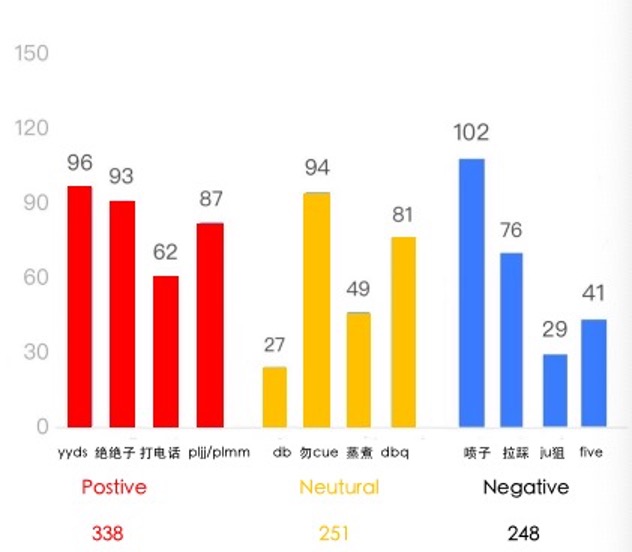
Diagram 1

Diagram#2 shows data which were generated from question number 3 “Which of the following words have you used before?” None of the options were left unchosen thus further explains that fandom lexicon are being widely applied to common daily context by outsiders of fan group members. According to the numerical data generated from Q3, fandom lexicon varieties with positive attributes are more likely to be applied at daily practice in comparison to those with neutral or negative attributes.
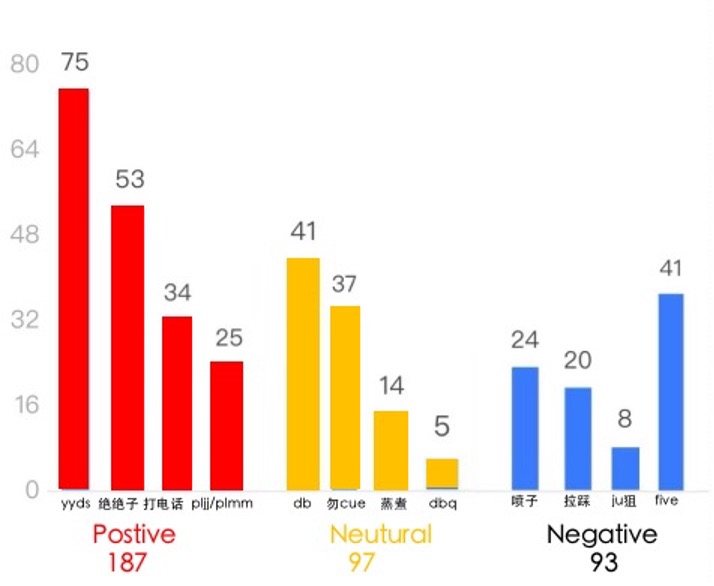
Diagram 2


In summary, the survey shows that the fan dictionary is not only widely known and accepted by outsiders in the fan group, but also accepted by the public and used for various purposes. In addition, another important thing we realized from this survey is that fandom dictionaries with positive attributes are generally more likely to be applied outside of fandom activities.

Since it is not very straightforward to investigate a language in its entirety in such a short passage, we would like to reference a theoretical framework from an earlier study by Teahlyn Crow (2019) on K pop language in online fandoms. First of all, we have identified the fans that are currently inventing Fanquan language as a community of speech, but we must also realize that Fanquan words alone have a wider variety of audience. The speaker does not have to fully develop their competence in Fanquan language before they can use it quite freely. That being said, it seems that the indexicalities of Fanquan words are still very robust. If a person uses Fanquan words frequently, then they are automatically identified to be a regular Fanquan language user, and there exists a stereotype that only active fans in online forums are such users. For example, the fans of a particular idol must coin words for themselves and for their idol. Identities can become very refined through language use. One can determine from a post that the fan might be a fan who not only loves her idol, but also wishes her idol to express love for another idol. This is called a CP fan, an abbreviation from English word couple.

The construction of a fan identity works both ways. Some online communities have an implicit rule that, when it comes to idol-related contents, only those who use Fanquan language can be considered true fans. Therefore, fans can create bonds and their own identities by performing linguistic activities.

Moreover, what we have found from Fanquan language features is astonishingly similar to what Crow (2019) has found in online Korean K-pop fandom and what Gardiner (2019) has found in online Japanese pop culture fandom. The most notable shared feature is language mixing including loanwords and some code-switching. The aforementioned word, CP fan, is an abbreviation made by blending English and Chinese, and there are a number of new word-compounding rules that could demonstrate fandom’s innovative power with languages. It is also worth mentioning that while Gardiner (2019) found Japanese fandom words to be mainly nouns or noun phrases, we do not see such restrictions with Mandarin fandom words. Rather, the exclusivity of Fanquan words is its most debated characteristic. The more involved the person is in the fandom culture, the more they are willing to use the language outside of fandoms and even offline in daily life, but interviewees who are not so invested in fan campaigns have commented that they do not wish Fanquan language to spread further, because it has no intrinsic value (c.f. Han’s example). Finally, the interviewees all agree that negative Fanquan language is only used to attack malicious people online. Our survey has attested that positive words are more likely to be used in communication outside of fandoms, while the negative words are not uncommon inside fandoms. These words have gotten out their original registers and acquired mainstream acceptance.

Discussion and conclusions

Overall, we have verified our hypothesis through interview analyses as well as survey data. The knowledge of Fanquan language is not limited to fans, but the majority of young people might have contact with it through friends, suggesting that Fanquan language and the fandom culture at its background are actually very influential. Those Fanquan words that can be used more widely are mostly positive words, although some negative words have emerged as not uncommon. More data is required to verify if those negative words are being widely used outside of fandoms, which can pose substantial challenges to our theory.

Furthermore, during our investigation with specific Fanquan words, we found that interestingly, negative Fanquan words are considered to be even more vicious than swears in standard Chinese, despite the fact that the latter typically involves offense on family while the former only involves the idols. This has been used as evidence by critics against Fanquan language on its hostility or aggressiveness. We hypothesize that the emerging stereotype imposed on Fanquan language declares that it has a more aggressive nature than standard language because of its association with a higher percentage of aggressive usage or users. Such attitudes have been accurately reflected in current Chinese literature and argued with little evidence. For example, Lv (2020) claims that all language that does not conform to mainstream culture, or themes of the current political agenda, should be eliminated and ‘purified’. Such censoring targeting Fanquan language is a form of language policing, which we did not anticipate but came up as a highly relevant issue that deserves more sociolinguistic research.


References

Crow, T. F. (2019). K-Pop, Language, and Online Fandom: An Exploration of Korean Language Use and Performativity amongst International K-Pop Fans. Northern Arizona University.

Gardiner, R. E. A. (2019). ‘Weeaboo Japanese’: exploring English-Japanese language-mixing in online Japanese popular culture fandom: a thesis presented in partial fulfilment of the requirements for the degree of Master in Philosophy in Linguistics at Massey University, Albany, New Zealand (Doctoral dissertation, Massey University).

Lv, W. (2020). The Analysis of the Language of “Fanquan” under the Perspective of Sociolinguistics. Modern Linguistics, 08(02), 185–191. https://doi.org/10.12677/ml.2020.82026

Lu, Huiran. 以模因理论解读“饭圈”用语传播,Journal of News Research,May. 2020, https://www.cnki.com.cn/Article/CJFDTotal-XWDK202010132.htm

[/expander_maker]
, ,

Fellas, is it really gay to express affection for your homies?

Joseph Anderson, Jason Luna, Ethan Perkins, Helia Woo

An increasing and alarming number of cishet men performing purportedly homosexual behavior can be seen on social media. Current research suggests there is also a decrease in homophobia and homohysteria. Our study aims to explore how changes in support of homosexuality have also changed the language of homosocial relationships. In this context, homohysteria is defined as the heterosexual’s fear of being thought gay when performing gender atypical behaviors. Homophobia is defined as attitudes and behaviors that demonstrate intolerance of sexual acts, identities, morality, and the rights of homosexuals. To test our hypothesis that cisgender heterosexual (cishet) men will use language commonly indexed and correlated with the language of women and homosexual men when interacting in homosocial conversations with close friends, we analyzed 40 TikTok videos which featured cishet men in homosocial environments, and recorded five 30–40-minute conversations that took place either in person or online via Zoom and Discord. We found that cishet men, when in a comfortable setting with other cishet men, seem to use linguistic patterns that are typically indexed with cishet women and gay men. These results suggest that our hypothesis is true, despite our limited data.

[expander_maker id=”1″ more=”Read more” less=”Read less”]

Intro

Like many of our peers, our nights are filled with casually staring at the screen of our phones, scrolling for hours through an endless number of TikTok videos. Yet, after watching some cute puppy videos, hilarious scripted comedy, and some fantastic lip-syncs, we noticed a common theme of the videos in between: TikToks of two allegedly straight men, going in for a kiss, only for the camera to cut out right before their lips would touch. The most puzzling part: the #nohomo and #homiesexual tags underneath.

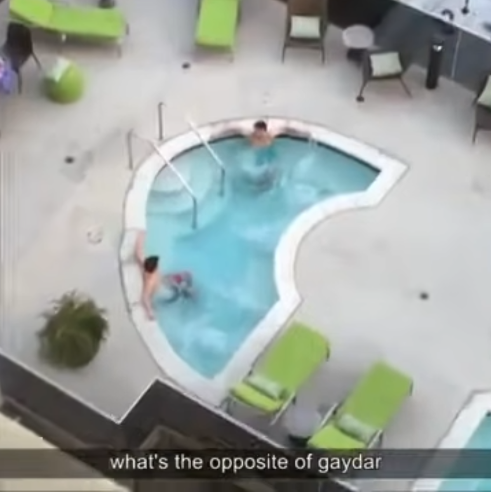
In recent years, contemporary pop culture seems to have an obsession with homosexuality — just without the part that requires anyone involved to actually identify as non-heterosexual. Like the TikToks mentioned above, various other social platforms, such as YouTube and Instagram, seem to be becoming home to male influencers engaging in “gay” behaviors with other men, despite neither party involved actually identifying as part of the LGBTQ+ community. From the iconic “Two bros sitting in a hot tub” Vine (Figure 1, re-uploaded to YouTube here), to recent online discourse about men keeping their socks on during sex acts with other men to keep it “no homo” (Figure 2), performative homosexuality seems to always be played for comedic effect. However, with the emergence of the phenomenon of men “playing gay” online in conjunction with the introduction of words like “homiesexual,” we were curious as to the ways in which language played a role in homosocial relationships, or the relationships between cisgender heterosexual males.

Figure 1. A famous Vine where the user zooms in on two men, distanced in a hot tub, while singing “Two bros sitting in a hot tub five feet apart ‘cuz they’re not gay.”


Figure 2. A TikTok creator lies in bed cuddling with three of his close male friends until they become uncomfortable when they notice they don’t have socks on. (@chrisp118 on TikTok)

Background

Current literature identifies three phenomena — homophobia, homohysteria, and queerbaiting — as core to the emergence of the identity of the homiesexual, which, according to the NYT involves “straight men who go beyond bromance and display nonsexual signs of physical affection.”

  1. Homophobia is an umbrella term for all attitudes and behaviors that demonstrate intolerance of sexual acts, identities, morality, and the rights of homosexuals (McCormack & Anderson, 2014).
  2. Homohysteria involves the heterosexual male fear of being thought gay when performing gender atypical behaviors (McCormack, 2011).
  3. Queerbaiting and gaybait are the deliberate insertion of homoerotic subtext in order to court a queer following without actualizing the subtext (Brennan, 2018).

Primarily, research on the subject centers on how increases in the acceptance of homosexuality and decreases in homophobia and homohysteria have led to new interpretations of what it means to be a cishet male (McCormack & Anderson, 2010; McCormack, 2011). However, this interpretation of the construction of the cishet male identity focuses on the concept of “bromance” and conversational dyads rather than group relationships among men and lacks discussion of specific linguistic properties (Robinson et al, 2018). Still though, other literature discusses the stereotype of male conversation being emotionally closed and unaffectionate (Sargent, 2013, Roberts et al, 2017).

Our research aims to fill the gap between the identification of these cultural phenomena and the analysis of specific linguistic forms and explore how changes in support of homosexuality have also changed homosocial relationships. There is a dearth of research on the speech of straight men because the speech of straight men is commonly perceived as the norm to be compared against when investigating minority speech. Cameron (2014) comments that this might be because the foundations of the monolith that is straight speech include a massive, diverse group of individuals, meaning that it would be hard to identify straight men as a singular community of practice. In fact, heterosexuality could be seen as an unmarked sexual identity because it is society’s default and no one has to “come out” as straight.

Additionally, in the same speech, Cameron states that this lack of research may be due to the fact that advocating for more research on heterosexuality could be seen as hostile to the larger purpose of the study of language as activism meant to advocate for minority communities.

However, to understand the gender performance and gender identities and what place that has in the social landscape, especially for minorities, it is essential that we study all groups, including heterosexual men, in order to ascertain whether something is actually specific or actual indexical of certain identities.

There has also been some study of the concept of “sounding gay” and the idea that non-heterosexual men, specifically homosexual men, often index the speech of heterosexual men in order to seem “straight passing” (Gaudio, 1994). Though, again, not much work has been done to understand how straight individuals might index non-straight language.

So, after recognizing the phenomenon of cishet men possibly becoming more comfortable with non-traditional performances of masculinity, sexuality, and gender, we wanted to uncover if these beliefs might also be influencing the language of cishet men.

Hypothesis

We hypothesize that cisgender, heterosexual (cishet) men will use language commonly indexed and correlated with the language of women and homosexual men when interacting in homosocial conversations with close friends.

This language may include:

  • compliments on attractiveness
  • calling one another pet names
  • raising pitch and using falsetto
  • hedging
  • pausing

Methods

In order to shed light on this phenomenon, our research entailed two components: (1) a content analysis from popular social media clips and (2) conversational analysis of interactions among friend groups involving at least two cishet men.

1. Content Analysis:

We analyzed 40 TikTok videos from compilation videos on YouTube with titles such as “straight guys being gay guys” or from the TikTok tags “#nohomo” or #homiesexual”. This analysis was performed to reveal preliminary insights into what behaviors we might be searching for during real-life conversations. Primarily, we analyzed conversation sequencing, diction, and body language.

2. Conversational Analysis:

Subsequently, we recorded five 30 – 40 minute conversations either online (through Discord or Zoom) or in-person in groups of 3 to 5 people including the recorder. Participants were told that at some point during the conversation, the researcher would begin recording. Sometimes the participants would be informed when the recording would start and other times they would not.

Results and Analysis

TikTok Data

Observations of the TikToks included the following:

  • escalation, competition, one-upping (e.g., “gay chicken”)
  • mirroring couple-like behavior (e.g., using pet names, intimate physical behavior, a man engaging in activities with another man that he’s only done with his girlfriend)
  • signals of discomfort after initiating gay behavior
  • comedic effect created through heteronormativity
  • comedic effect created through homohysteria
  • comments about each other’s bodies
  • dropping the gay act in the presence of a third party
  • use of a third party (girlfriend or other audience) to signal that gayness is not serious
  • hypersexualization of gayness (e.g., horniness or making sexual advances being the foremost marker of gayness)
  • making advances at the expense of the other man’s comfort
  • gayness being ingrained in heterosexual male friendships
  • use of the phrase “no homo” to ward off homosexuality

Findings from the TikToks can be grouped into three categories: homohysteria and heteronormativity, gender roles and misconceptions about homosexuality, and the spectrum, or lack thereof, of male intimacy.

Homohysteria and heteronormativity

Typically, comedy involves surprise—a subversion of expectations. TikTok creators relied on the concept of heteronormativity, the assumption that everyone is straight, as well as the normalization of homohysteria to create a comedic effect. Cishet men also played up homohysteria for humor by acting gay or hinting at one another’s gayness, while simultaneously expressing discomfort.

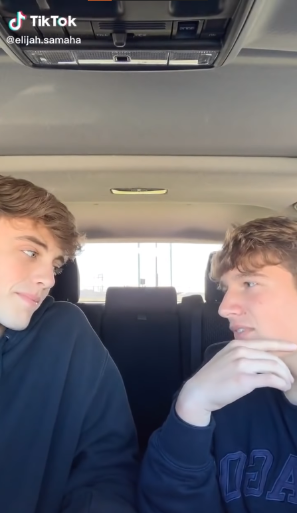
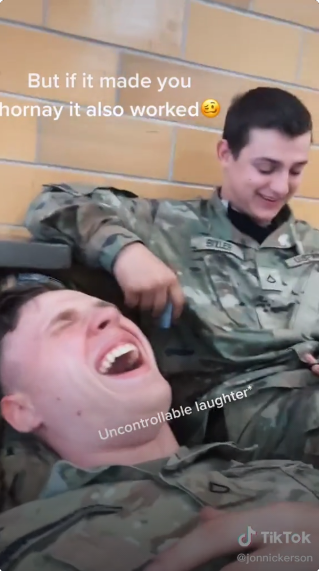
Heteronormativity also manifested itself more subtly in other ways: men filmed gay TikToks in front of their girlfriends, reinforcing the norm of heterosexual hegemony by using the idea of gay couples as a joke (Figure 3). When calling other men by pet names, men occasionally used names typically associated with women, such as “baby girl,” once again reinforcing the norm that a couple consists of one man and one woman (Figure 4).

Figure 3. Two boys flirt with each other right before one of their girlfriends catches them from the backseat. (@elijah.samaha on TikTok)


Figure 4. A friend of a TikTok creator calls him “baby girl,” then makes him laugh by giving his justifications for the pet name. The captions read, “But if it made you hornay it also worked” and “Uncontrollable laughter*”. (@jonnickerson on TikTok)

Gender roles and misconceptions of homosexuality

Other TikToks revealed the gender norms prevalent between male relationships, as well as a clear misinterpretation of homosexuality by cishet men. Cishet men, in acting gay, often joked that their girlfriends wouldn’t “find out” ignoring morality (of cheating on a signficant other) in favor of producing a humorous effect (Figure 3). They also hypersexualized gayness; many interactions involved words such as “horny,” “sexy,” and words relating to the sexual organs, and behaviors such as moaning or eating a sausage. This hypersexualization often blurred the line of comfort for those on the receiving end of a straight man’s gay advances—many men were confused and/or uncomfortable, as evidenced by their facial expressions or verbal reactions, even though they did not resist (Figure 5).

These behaviors signal misconceptions, often harmful, about male homosexuality—that homosexuality is inherently more sexual or less ethical than heterosexuality. However, because of the comedic nature of such behaviors, it is also implied that many of these men are aware of their misconceptions and deliberately play on them to heighten the humorous effect. They also signal an adherence to gender norms, as we will discuss further in the conclusion.

Figure 5. A TikTok creator making unexpected advances towards a friend, resulting in initial surprise or disapproval. (@grahamnation_ on TikTok)

Extremes on the spectrum of male intimacy

Cishet men showed a tendency to either avoid any intimacy, or show it at an extreme level. In particular, men frequently said “no homo” to immediately eliminate any assumptions of legitimate homosexuality. On the other end of the spectrum, they often played “gay chicken” (in which they continued to act more and more gay until one person finally cracked) or tried to one-up each other in acts of gayness. In some situations, men did not necessarily try to compete with the other, but refused to show weakness by stepping away from their advances (Figure 6). These competition-centered interactions are likely attempts in asserting dominance and subordinating one another.

Figure 6. One man comes closer and closer to another, who stands still but suppresses his laughter. (@alexwillis1 on TikTok)


Discord Calls / In-Person Recordings Data

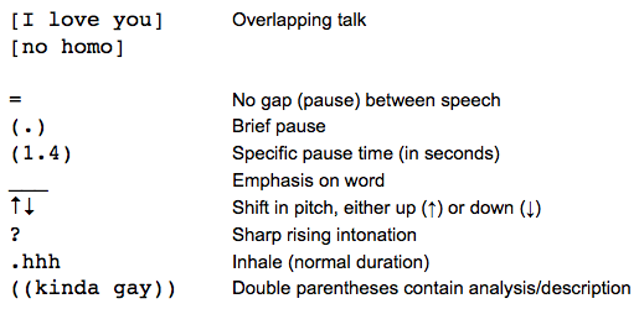
For the online Discord recordings, as well as the in-person recording, interactions were able to be placed in a few categories. Each interaction is numbered based on the order in which we are presenting them, rather than the order in which they were recorded. Firstly, many interactions could be considered compliments, both innocent (not inherently sexual) and explicit (sexual in nature). Figures 7.1 and 7.2 below show examples of innocent compliments, in which participants A and C compliment each other’s hair.

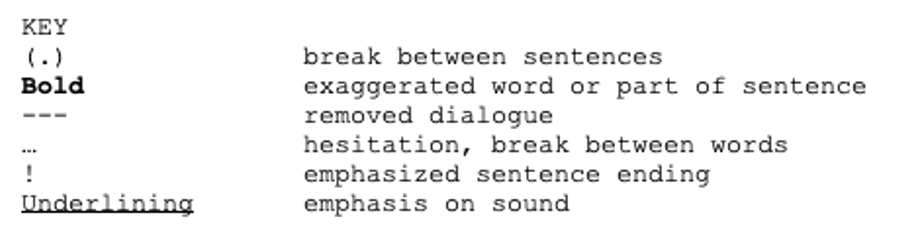
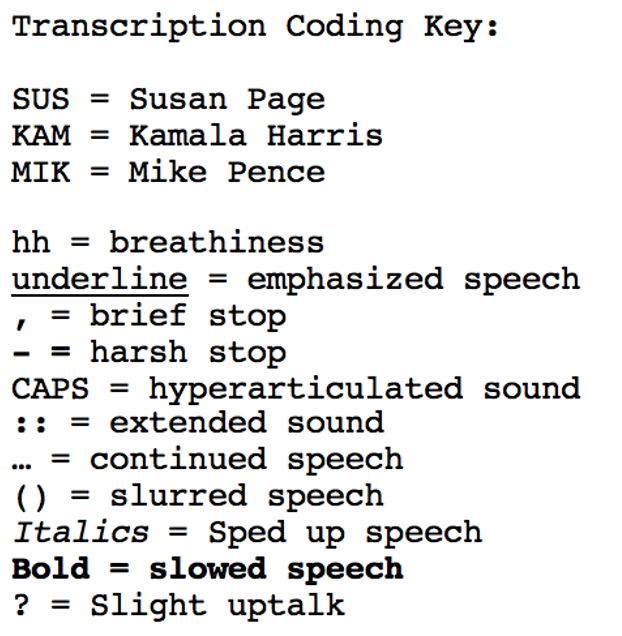
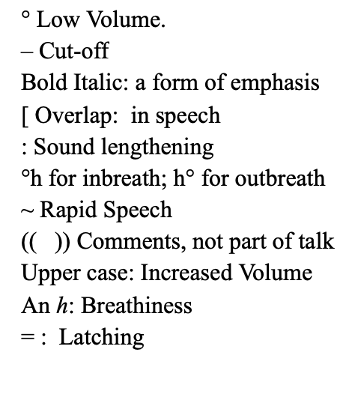
Conversation Analysis Transcription Key

Innocent Compliments

Figure 7.1. Transcript of first compliment about hair.
Figure 7.2. Transcript of second compliment about hair.

Physical Touching

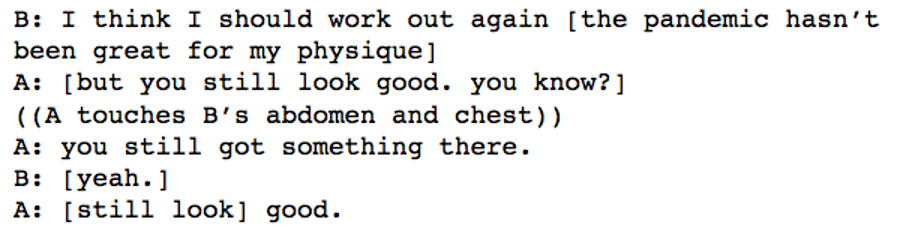
In Figure 8.1 below, we can see another example of a compliment; however, A’s compliment of B’s physical appearance also includes physical touching. Here, as is shown in the ((double parentheses)), A touches B’s abdomen and chest while complimenting him. There were other instances of physical touching, such as the interaction in Figure 8.2, in which A slapped B’s buttocks.

Figure 8.1. Transcript of compliment about body, and physical touching.
Figure 8.2. Transcript of intimate physical touching.

Explicit Compliments

Other compliments given from one participant to another were explicitly sexual, such as the below interaction in Figure 9.

Figure 9. Transcript of a sexually-charged compliment.

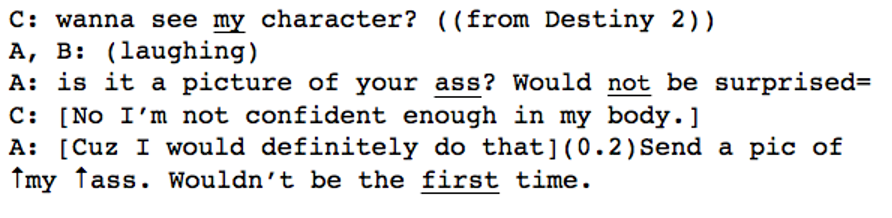
In Figure 9, A and C were referring to participant B’s male character from the video game Destiny 2, with A referencing a specific meme in the last line.

Pet Names

A pet name was only recorded in one interaction, seen below in Figure 10, in which A referred to B as his “lil piss baby.”

Figure 10. Transcript of a pet name.

Other Flirtatious Interactions

Additional flirtatious behavior was recorded, including the interaction in Figure 11. For some context, A and B were comparing video game characters from Destiny 2, when C offered to show his character, jokingly, since he did not play the game.

Figure 11. Transcript of a flirtatious interaction.

Intonation

When it came to intonation changes (as illustrated in the figures by the up or down arrows), the pitch of the participants’ voices seemed to raise when mentioning a body part in a sexual manner. This is seen in Figure 9, when C mentioned “bulge,” as well as in Figure 11, when A mentioned “my ass.” Additionally, intonation rose when A and C were complementing each other in Figures 7.1 and 7.2. A’s intonation also significantly rose when calling B by a pet name, as shown in Figure 10.

Hedging

Finally, we looked at hedging, or filler words that mitigate or downplay the severity or seriousness of a statement. The most common hedges found in our data were “you know,” “I mean,” and “I don’t know, but.” An example of the hedge “you know” can be seen in Figure 8.1, after A complimented C. Additional hedges included “might” and “really,” as shown below in Figure 12, where A hedged his opinion on the TV show “The Office.”

Figure 12. Transcript of an instance of hedging.


Discussions and Conclusions

Our data and analysis support our hypothesis. Cisgender and heterosexual men, in interactions with other cisgender and heterosexual men, tend to use linguistic patterns indexed with gay men or straight women; these patterns include higher intonation and hedging. In addition, cishet men use flirtatious speech in these homosocial environments, such as compliments, pet names, and sexually-charged comments, many of which were observed with higher intonation. An important note to make, however, is that despite similarities in speech patterns, many of the behaviors cishet men exhibit in homosocial settings are not indexed with gay men or straight women. For instance, the hypersexualized actions cishet men engage with seem to be exclusive to cishet men.

The main conclusion we can draw from our findings is that despite decreasing levels of homophobia and shifting views on non-traditional forms of masculinity, sexuality, and gender, heteronormativity and gender norms remain prevalent. As explained in the analysis section, cishet men’s “gay act” relies on heteronormativity to create humor in the first place. Gender norms can explain the ubiquity of confusing or unwanted advances towards other men: it is likely that men expect other men to show less “fragility” and therefore “take it like a man,” as the saying goes. The convention of male dominance also may explain the competitive aspect of acting gay. Furthermore, the dissonance between the two extremes of male interaction (overly intimate or not intimate at all) implies once more the pervasiveness of gender roles and stereotypes, as men are expected to be less affectionate and more emotionally closed-off. Thus, although cishet men know how to index gay or non-cishet male identities, as indicated by their shifted speech patterns, they are still heavily influenced by larger outside forces that suggest our views have yet to fully break away from the heterosexual and patriarchal norms.

Additional Reading / Viewing

Everyone Is Gay on TikTok (New York Times)

The Evolution Of Queerbaiting: From Queercoding to Queercatching (YouTube – Rowan Ellis)

Project Presentation (Anderson, Luna, Perkins, Woo)


References

Brennan, Joseph. “Introduction: Queerbaiting.” The Journal of Fandom Studies 6.2 (2018): 105-113.

Cameron, D. (2014). Straight talking: the sociolinguistics of heterosexuality. Langage et société, (2), 75-93.

Gaudio, R. P. (1994). Sounding gay: Pitch properties in the speech of gay and straight men. American speech, 69(1), 30-57.

McCormack, M. (2011) Mapping the Terrain of Homosexually-Themed Language, Journal of Homosexuality, 58:5, 664-679, DOI: 10.1080/00918369.2011.563665

McCormack, M. (2011). The declining significance of homohysteria for male students in three sixth forms in the south of England. British Educational Research Journal, 37(2), 337-353.

McCormack, M., & Anderson, E. (2014). The influence of declining homophobia on men’s gender in the United States: An argument for the study of homohysteria. Sex Roles, 71(3), 109-120.

McCormack, M., & Anderson, E. (2010) The re-production of homosexually-themed discourse in educationally-based organised sport, Culture, Health & Sexuality, 12:8, 913-927, DOI: 10.1080/13691058.2010.511271

Roberts, S., Anderson, E., & Magrath, R. (2017), Continuity, change and complexity inthe performance of masculinity among elite young footballers in England. The British Journal of Sociology, 68: 336-357. https://doi.org/10.1111/1468-4446.12237

Robinson, S., Anderson, E., & White, A. (2018). The bromance: Undergraduate male friendships and the expansion of contemporary homosocial boundaries. Sex Roles, 78(1), 94-106.

Sargent, D. (2013). American masculinity and homosocial behavior in the bromance era.

[/expander_maker]
, , ,

Gender Stereotypes or Breaking Barriers? A Look into Moana

Búverley Trezile

Clements, R., Musker, J., Williams, C., & Hall, D. (2016). Moana. Walt Disney Studios Motion Pictures.

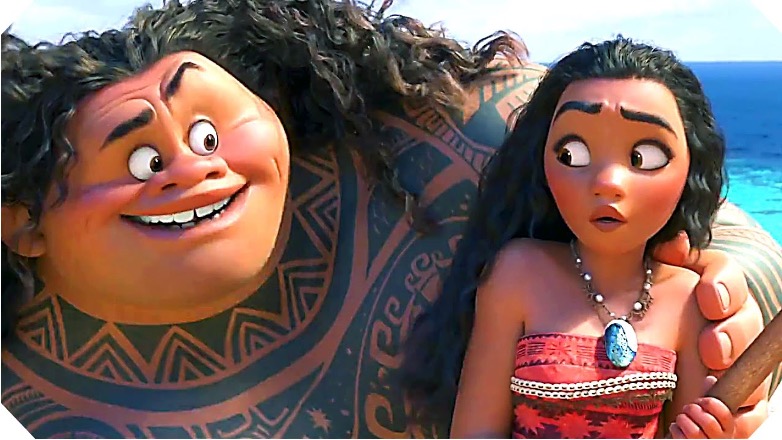
Set on the mythical Polynesian island of Montinuti, the critically acclaimed movie, Moana (2016) is one of the most successful movies to date (Robinson, 2016). Moana has been portrayed as a strong female character that defies gender stereotypes. However, a closer look at the film reveals that Moana conforms to many stereotypical feminine linguistic features regarding interruption, pitch, and word choice. The conversations between Moana and her male adventure partner reveals that he interrupts her at high rates. Thus, this preserves the gender stereotypes that many Disney films are known for. Maui’s character serves the purpose of representing the stereotypical dominant roles of men in society through his muscular and supernatural abilities. This paper criticizes the consensus and instead argues that this film perpetuates gender stereotypes. To support this claim, selected conversations between the male and female protagonists that include specific instances of interruption, pitch, and word choice are examined.

[expander_maker id=”1″ more=”Read more” less=”Read less”]

Introduction and Background

Movie critics have claimed that Moana is quite revolutionary in its approach to break gender barriers as a result of being an unapologetic feminist film (Schiele et al., 2020). Throughout the film, the sixteen-year-old character is shown as a strong female lead, who is considered headstrong. However, is there more to the surface of this coming to age story? Throughout history, many Disney princess films have followed a trope of conforming to gender stereotypes, whether it is a princess waiting on their prince charming to come to save them or another version of a damsel in distress. Needless to say, Moana doesn’t fall too short from the tree of conforming to the common trait of gender stereotypes that many Disney films are known for. This study explores ways of how some linguistic features such as interruptions, pitch and word choice between the verbal conversations of Moana and her travel partner, Maui supports the idea that Disney films still present gender stereotypes.

Schiele et al. (2020)  make an appealing point that Moana is a fiercely independent lead female character who does not participate in the typical storyline of a damsel in distress in movies such as Cinderella. Yet the author fails to bring up that Maui may be seen as the stereotypical masculine man that illustrates some of the ideologies of men abusing their power to exercise male power and entitlement. In their article, (Schiele et. al, 2020) state, “The theme is crystallized in movies set in premodern societies, such as Moana, where male power and patriarchal expectations have unrivaled authority.” However, there is not enough background in the article to support this claim, because there is more than one protagonist in the film that can symbolize and engage in gender stereotypes. Furthermore, it is important to note that the bare minimum should not be praised. Another author (Hays, 2019) agrees with the sentiments, as they suggest, “With the progression of how women are portrayed in Disney’s princess films, the opportunity to become more diverse and inclusive exists.” There is still much progress to be made in Disney Princess films overall as they continue to sustain different forms of gender stereotypes.

Methods

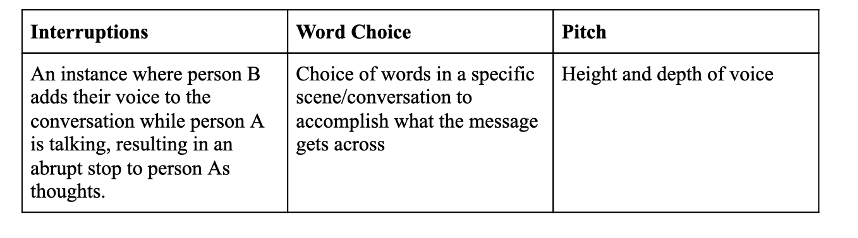
This research paper analyzed three linguistic features in the film: Interruption, Word Choice and Pitch. Selected conversations between Moana and Maui were transcribed to highlight these key features – they are defined below.

The purpose of analyzing these features in the film was to gauge how effective they would be in supporting the argument that Moana perpetuates gender stereotypes. During the first viewing of the film, it served as a refresher of the film. The interruption was defined as a moment where Moana’s words came to an abrupt end as a result of Maui simultaneously adding in his thoughts. Interruptions from Maui were tallied during the second viewing of the film to keep track of the power dynamics between him and Moana. Adding on, tallying was useful in terms of picking which scene represented Interruptions the most. The transcription that represented word choice was picked to show words from the conversation of Maui and Moana that stood out the most. The feature of Pitch was a bit more subtle to catch and required active listening and engagement in a reserved room to choose the most relevant data that could be applied and supported with the claims in this research paper.  The specific scenes were typed in a separate Google document and converted to an image after it was transcribed.

Results & Analysis

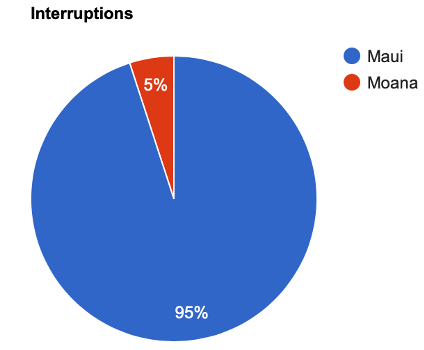
As a result of the tallying method, this indicated that Maui interrupted Moana at higher rates throughout the film. The results were converted to a pie chart as depicted in Figure 1.

Figure 1: Amount of interruptions from Maui and Moana throughout the film.

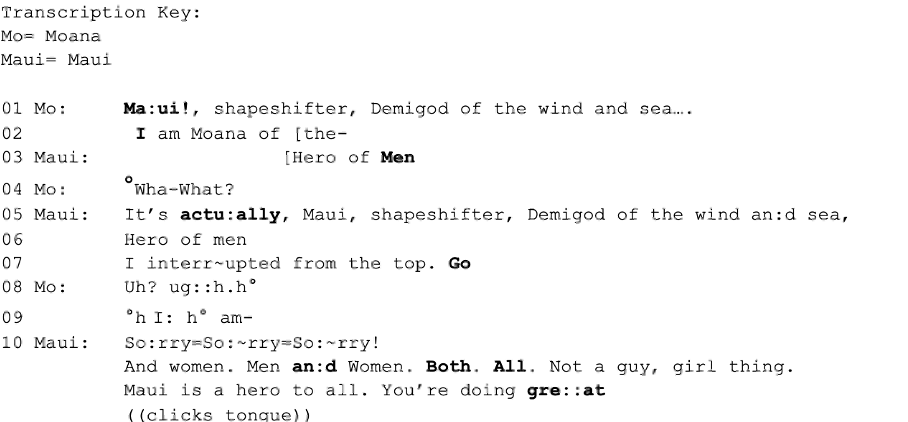
A research study conducted in 2014 indicated that 33% of women are interrupted more often when conversing with men (Hancock, 2015). Maui establishes his desire for dominance when he interrupts Moana several times in Figure 1. (James & Clark, 1993) interpret interruptions in conversations as violating normal conversational rules, which can also be interpreted as an attempt to overpower and control the floor of the topic of the conversation.  Maui’s interruption in Figure 2 emphasizes that not only was he insufficient in waiting till she finished her sentence, but also had no intention of hearing her self-introduction once he proceeded to interrupt her for the second time.

Figure 2: Maui and Moana meet for the first time.

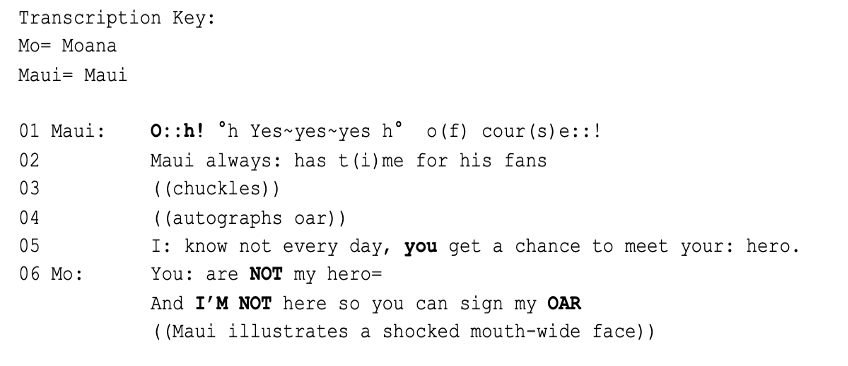
Gender stereotypes in language may often be perceived as socialized differences and norms after a while as a result of Disney films. In the second example (Figure 3), the concept of word choice is introduced when Moana makes it clear from her words, “you are not my hero” that she is not a fan and does not look up to him as he suspected. Maui presents a stereotypical “traditional masculinity” which is defined as traditional masculinity as traits that are respectively more typical of men and women (Kachel, Steffens, Niedlich, 2016). Thus, Maui’s initial lack of understanding of the purpose of their conversation reiterates that he was focused on talking rather than listening, this further supports the claim that he yearned to dominate the conversation.

Figure 3: Continuation of the first conversation between Moana and Maui

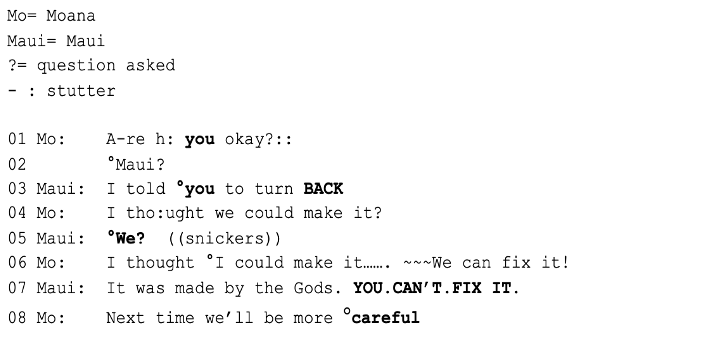
In Figure 4, the indication of pitch is introduced when it is apparent that Mana’s voice gets low as she is caught off guard by Maui’s exasperation. The pitch in this scene illustrates Moana’s genuine concern for Maui and his fishhook, yet Maui failed to reciprocate the same concern as he was focused on releasing his anger at the wrong person. This insight suggests that men fail to explicitly observe women’s pitch and tone, as this can reveal many emotions. Similarly, this may trace back to the idea that men were not raised to focus on these features, since they participate in more of the talking while women play the role of the listener. (McConnell-Ginet, 1978) recognizes this as she states that, “… the pitch is particularly important for understanding sex differences in speech strategies…” McConnell’s insights support the suggestion that men lack the routine of analyzing women’s speech based on the pitch because of the male-dominated ideas that are ingrained in society. The multiple exchanges between Maui and Moana emphasize the idea that there are gender stereotypes that other Disney princess movies preserve, and in this instance, where the film is centered around male-domination that may go beyond the scope of the film. 

Figure 4: Maui and Moana’s first failed attempt to restore Te Fiti.

Discussion and Conclusions

Although Moana is one of the most popular animated Disney films, it still upholds some of the traditional gender stereotypes that Disney films are known for. The character Moana was a well-thought-out and progressive Disney princess — in comparison to those that currently exist as she upholds assertive traits that present as masculine and feminine throughout the film — the three features of interruptions, word choice, and pitch illustrates that gender stereotypes are still a long going issue in Disney films. The claims presented in this paper reveal that the linguistic features play a role in the image they may present on the stereotypes of both men and women. Future research based on this film can look into the concept of which age and age gap amongst the characters may play a role in some of the gender stereotypes of male’s desire to dominate every aspect of their life and where that stems from with a physiological perspective.


Full Transcription Key


References

Hancock, A. B., & Rubin, B. A. (2015). Influence of communication partner’s gender on language. Journal of Language and Social Psychology, 34(1), 46-64.

Hays, C. (2019). From Snow White to Moana: how Disney’s leading ladies became more than just a pretty face.

James, D., & Clarke, S. (1993). Women, men, and interruptions. Gender and conversational interaction, 231-280

McConnell-Ginet, S. (1978). Intonation in a man’s world. Signs: Journal of Women in Culture and Society, 3(3), 541-559.

Kachel, S., Steffens, M. C., & Niedlich, C. (2016). Traditional masculinity and femininity: Validation of a new scale assessing gender roles. Frontiers in psychology, 7, 956.

Robinson, T. (2016). Moana Review: After 80 Years of Experiments, Disney Has Made the Perfect Movie. The Verge.

Schiele, K., Louie, L., & Chen, S. (2020). Marketing feminism in youth media: A study of Disney and Pixar animation. Business Horizons, 63(5), 659-669.


[/expander_maker]
, , , , ,

A Linguistic Analysis of Gender Differences in Lying Behaviors Among Politicians

Joe Pei

What constitutes an authentic lie? Do males and females lie differently, especially when they are purposeful? Lying has always been a mysterious part of people’s everyday social lives, as it varies from individual to individual. This study aims at uncovering patterns embedded in deceptions among different genders. Politicians are naturally perfect subjects with which to study deception strategies, as they often need to lie to achieve various goals — covering a bad habit in the past, hiding a contrary political stance, or making an empty promise to gain ballots. They are usually also the most deliberate, as sometimes a lie being exposed might lead to the end of their career. This study looks at the different language patterns in House of Cards, a famous American political drama that closely resembles a true officialdom. Upon reading this article, you will be fascinated by the unconventional gender differences the study discerns in forming and delivering deceptions.

[expander_maker id=”1″ more=”Read more” less=”Read less”]

Background

Whether admitted or not, much of our social behavior is controlled for the purpose of interpersonal presentation (DePaulo, 1992), and lying constitutes a considerable portion of our social behavior. On the one hand, much research has been conducted around the topic, and past research and studies have found many strategies self-reported by good liars. On the other hand, a heterogeneous sample of written and spoken text reveals consistent gender differences in language use (Newman et al. 2008). This paper combines former studies on gender differences and lying behaviors and takes it one step further to study how men and women tell lies differently and especially whether, in addition to common strategies implemented by good liars of both genders, some strategies are more evident in successful male deceptions, while others are more evident in female deceptions.

Through analyzing selected language features with conversation analysis, as well as looking at the presence of politeness patterns, the study finds various unconventional gender differences in forming and delivering deceptions, which gives novel insights on how men and women set up different images in their environments and thus survive and move up differently.

Methods

In this research, data was collected from House of Cards. The main focus was on Francis and Claire Underwood, a couple who worked their way up the officialdom and later became the 46th and the 47th president of the United States. In this analysis, four instances of deceptions, two successful ones and two unsuccessful ones, were collected for each gender and are analyzed and compared from word choices to deliveries. Successfulness was defined as whether the other interlocutor believed in the deception.

In the conversations collected, several aspects of the speech were analyzed in depth. On a macro level, the main focus was on whether a kind image was set up with compliments and politeness strategies. On a micro level, the focus was on rising and falling intonation, length and frequency of pauses, and latching (meaning there is no gap between the end of a prior turn and the start of a new turn).

Results and Analysis

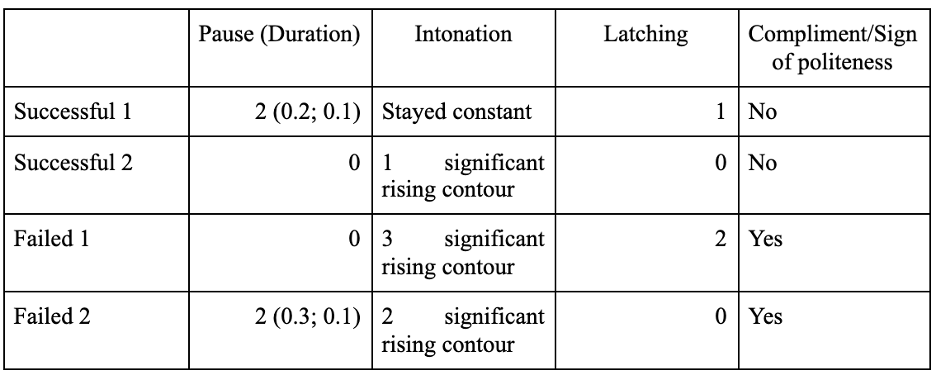
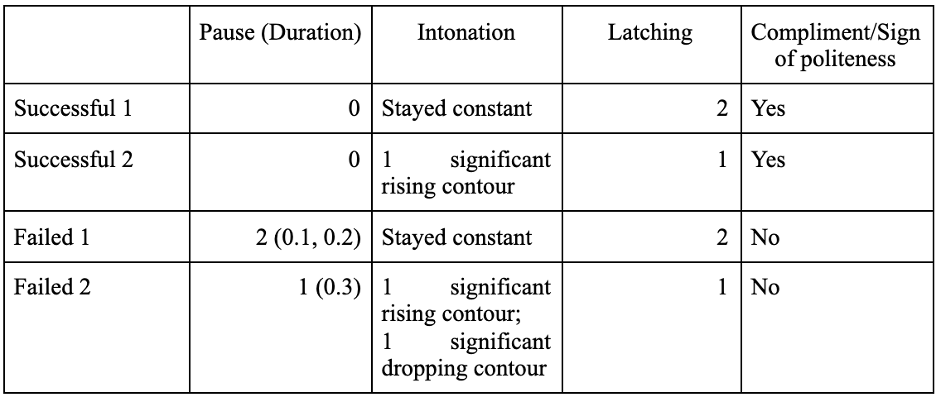
In the tables below, information regarding the number and lengths (in parentheses) of pauses, the changes in intonation, the number of latching, and usage of compliments and other politeness strategies was collected for each conversation and each gender:

Table 1: Collected patterns of selected features among female deceptions.
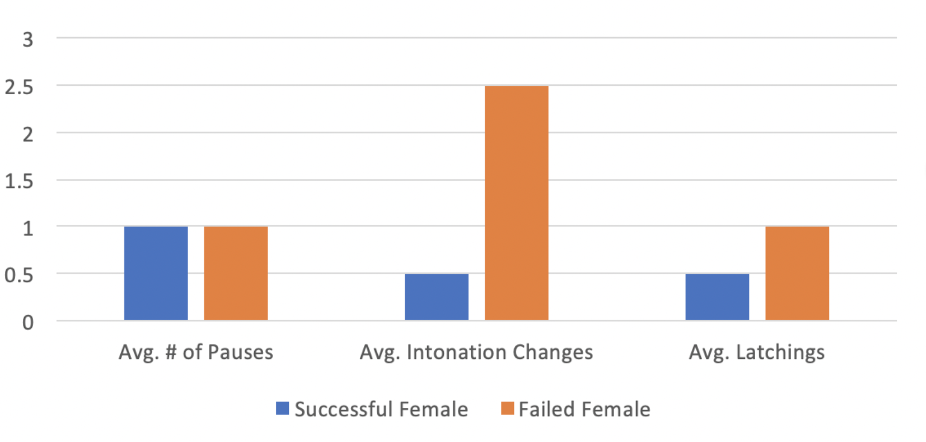
Figure 1: Comparison between selected features among female deceptions.

The conversation analysis of selected features showed different patterns between successful and failed deceptions for males and females. For females, the figure reveals to us that the differences were mainly in changes in the intonation patterns. Pauses were sometimes present and sometimes absent, and so were latching, but there were significantly more rising intonations in failed deceptions.

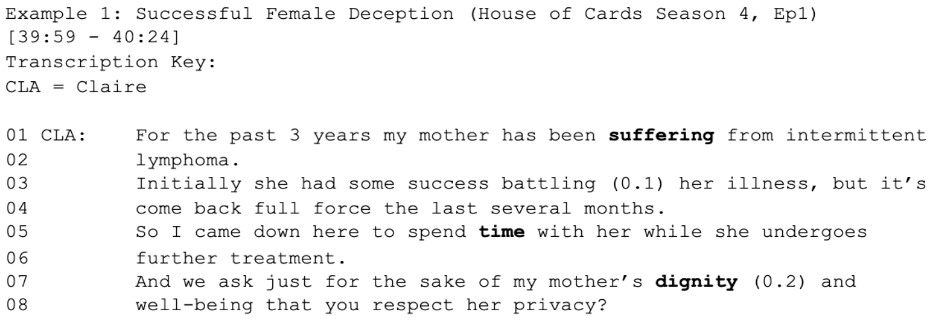
Figure 2 is an example of a successful female deception:

Figure 2: Transcript of a successful female deception.

The speech took place when Francis and Claire were having disputes on their political beliefs, so Claire went back to her hometown. Annoyed by the rumors of their marital problems, Francis and Claire decided to lie to the public that Claire’s trip was to visit her mother who got sick. Claire’s intonation was notably flat throughout her speech, except for a slight rising intonation in the last sentence. There were two pauses in the speech, one after the word ‘battling’ and another after ‘dignity,’ possibly to strengthen these words. Most notably, Claire did not use any compliment or show any sign of politeness. She purely stated the made-up reason behind her coming back to her hometown and requested for the media to respect their privacy and nothing more. The finding contradicted the standard model of women’s language according to Lakoff (Lakoff, 1973), which stated that women use more rising intonations and polite forms.

Table 2: Collected patterns of selected features among male deceptions.
Figure 3: Comparison between selected features among male deceptions.

For males, there were also varying patterns of successful and failed deceptions. Intonation patterns and latchings were somewhat random, unlike in the female deceptions. More pauses were present in failed deceptions, while there was no pause in successful ones.

Figure 4 presents an example of a successful male deception:

Figure 4: Transcript of a successful male deception.

The conversation took place when Francis was blamed for a mistake when he and Donald Blithe (a member of the House of Representatives) were responsible for reforming an education act. He tried to make Donald believe it was his fault so he could resign and hand his power entirely to Francis. He used two latchings in lines 5 and 10, possibly expressing that he was quick and firm in his response, thus showing he was recalling rather than making up a story. There were not many changes in intonation patterns except for a slight falling contour in line 3, and this was common in male speeches as men used less rising intonations, and frequently the speeches stayed constant in terms of intonation. There were many strengthenings of words in Francis’ response in between lines 5 and 8. His voice was raised in pitch. The emphasis was mainly on words that complemented Donald — words like ‘vital,’ and words that showed Francis’ hatred towards the made-up “betrayal” against Donald. With those emphases, Francis was likely to convey pathos to Donald and quickly gained his trust.

The two genders also displayed opposite results in their usage of politeness. The successful female deceptions displayed no compliments, while the failed deceptions showed signs of compliments and politeness. For males in a successful deception, the lie teller always showed signs of politeness and even gave compliments, while in unsuccessful ones, these features were not present.

Discussion and Conclusion

In this research, analysis showed that male and female successful lie tellers differ not only in their delivery but most surprisingly, in the different attitudes they displayed towards the other interlocutor. It was more or less understandable that for males in an officialdom, they needed to make nice to let the other interlocutors feel respected and in turn, make a good impression in front of them and appear convincing. However, for females, successful lie tellers actually abandoned the use of compliments and politeness strategies and appeared more assertive and competent. The finding presented in the paper coincides with William Labov’s famous gender paradox theorem, which states that “women conform more closely than men to sociolinguistic norms that are overtly prescribed, but conform less than men when they are not” (Labov, 2001). Officialdom is undoubtedly a new environment for women, and there are not many “overtly prescribed” norms for them to conform to. It might be because of this that women tend to utilize new and unexpected strategies, which in turn helps them survive and move up in officialdom differently from males. In the future, more studies can be done to further explore other environments and positions to which women were traditionally less exposed.


References

DePaulo, B. M. (1992). Nonverbal behavior and self-presentation. Psychological bulletin, 111(2), 203.

Labov, W. (2001). Principles of linguistic change Volume 2: Social factors. Language in Society. Oxford University Press.

Lakoff, R. (1973). Language and woman’s place. Language in society, 2(1).

Newman, M. L., Groom, C. J., Handelman, L. D., & Pennebaker, J. W. (2008). Gender differences in language use: An analysis of 14,000 text samples. Discourse Processes, 45(3).

[/expander_maker]
, , , ,

The Charm of Dark Humor: Interruptions in “Rick and Morty”

Christina Baek

American sitcoms have attracted large audiences with the utilization of satire and dark humor. Some popular long-running sitcoms, loved by the public, include “It’s Always Sunny in Philadelphia, “Family Guy,” and “The Simpsons.” However, one show has recently gained popularity amongst a young demographic. “Rick and Morty,” which centers on the adventures of a sociopathic scientist, Rick, and his grandson, Morty, has achieved mainstream success. But what can be attributed to “Rick and Morty’s” cult following?

“Rick and Morty” follows the lives of the dysfunctional Smith family and appeals to the young masses by engaging popular social media issues and caricaturizing celebrities. An analysis of the lack of gendered interruptions in the show highlights how “Rick and Morty” tackles social constructs of masculinity and criticizes gender stereotypes. This study found that aggressive characters, without regards to gender, utilized interruptions in their speech more frequently. By employing satire and irony, it is no surprise that “Rick and Morty” has gained the recent traction that it did amongst millennials and Gen Z.

[expander_maker id=”1″ more=”Read more” less=”Read less”]

Introduction and Background

By employing dark humor, “Rick and Morty” engages with its young audience that birthed social media and grew up with the beginnings of the internet. A Pew Research study found that a majority of teens, regardless of income boundaries, saw anxiety and depression as a top major mental health concern among their peers (Graph 1). With the COVID-19 pandemic, uncertainty over job prospects and the future has contributed to the generational rise in negative feelings of anxiety and depression (Horowitz et al., 2020). The deprecating humor used in “Rick and Morty” has found a cult following by appealing to these young audiences enchanted by a specific type of absurdist and dark comedy. These young audiences are attracted by dark humor, which shows a shift in the demographic over generations.

Graph 1: Mental health concerns cross income boundaries

Methods

This study analyzed the number of interruptions in the episode “Raising Gazorpazorp.” Interruptions are typically exemplified in masculine speech because they break the flow of the conversation. By speaking over or preventing the other party from speaking, interruptions allow the user to control the conversation and exude dominance. In “Raising Gazorpazorp,” a total of 17 interruptions were indicated (Graph 2). There was a negligible difference in the number of interruptions used by each gender.

Graph 2: Interruptions by Gender in the episode “Raising Gazorpazorp

Results

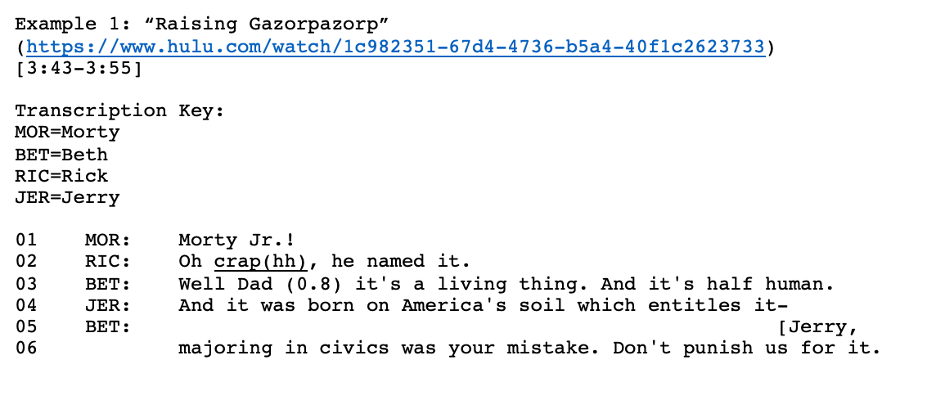
In “Raising Gazorpazorp,” Morty has sex with a robot doll, which gives birth to a half alien Gazorpazorp species and a half human doll. Beth interrupts Jerry in line 5.

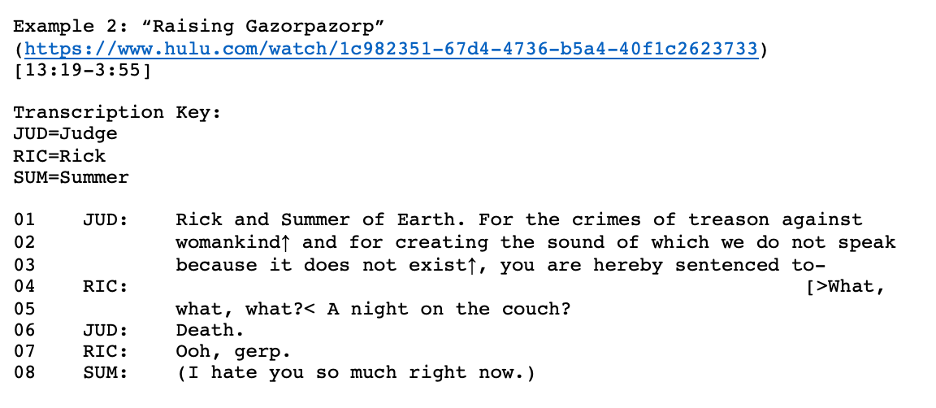
Later in the same episode, Summer and Rick go to the Gazorpazorp planet to find a foster parent for Morty’s child. They get sentenced to death for coming from Earth, which has a patriarchal society that the female Gazorpians disapprove of. Rick interrupts the Gazorpian judge in line 4.

Analysis

In the first excerpt, Beth cuts off her husband, Jerry from speaking further. By interrupting her husband, Beth prevents Jerry from going off on a tangent and forces the family to focus on the issue at hand – her teenage son birthing a half alien child. She controls the flow of the conversation while mocking Jerry for pursuing civics as a major, which might insinuate to the audience that she does not respect her husband and sees him as inferior. A common trope in “Rick and Morty” tackles the marital issues between Beth and Jerry, and portrays the latter as an incompetent male who impregnated his young wife during their teen years. By interrupting Jerry, Beth exudes dominance and ensures that the family remains focused on Morty’s problem.

In the second excerpt, Rick interrupts the judge Gazorpian and prevents the latter from executing him and his granddaughter, Summer, to death. By interrupting the judge, Rick also adds comedic effect by insinuating that a society that places women in a higher class would employ less drastic punishments, like “a night on the couch.” However, he responds with “Ooh, gerp” in line 7 to show that he was gravely mistaken and immediately regrets interrupting the Gazorpian judge, who is in a higher position than him. By interrupting the judge, Rick not only shows that he remains level-headed in disadvantageous situations, but also employs typical masculine linguistic features. He stops a judge from informing him and Summer, the prisoners, of their sentence in front of a large audience. Rick fights against all odds and proves time and time again that he is capable of escaping predicaments when Summer and him safely escape the Gazorpazorp planet and returns to Earth.

In “Raising Gazorpazorp,” we found a negligible difference in the number of interruptions by gender. In fact, characters in “Rick and Morty” who take more dominant roles, like Summer, Beth, and Rick, interrupted other characters the most. Morty and Jerry, who are more passive male characters, conversely got interrupted by Beth and Rick.

Conclusions

With a lack in gendered interruptions in “Raising Gazorpazorp,” “Rick and Morty” shows how relevant, popular sitcoms highlight the issues with gender stereotypes and social constructs of masculinity. “Rick and Morty” places aggressive characters like Beth, Summer, and Rick, above passive characters like Morty and Jerry. Other sitcoms that analyze the dysfunctional family trope, like “Family Guy,” employ these same values by putting stronger, confident characters on a pedestal and berating those that enforce negative, patriarchal views. With the changing social demographics of younger generations, like millennials and Gen Z, comedies have adapted to their target audiences by utilizing dark humor and satire. In particular, “Rick and Morty” tackles important societal issues at hand and this can be exemplified by analyzing the linguistic features of the characters’ speech.


References

Horowitz, J. M., & Graf, N. (2020, May 30). Most U.S. Teens See Anxiety and Depression as a Major Problem Among Their Peers. Pew Research Center’s Social & Demographic Trends Project. https://www.pewresearch.org/social-trends/2019/02/20/most-u-s-teens-see-anxiety-and-depression-as-a-major-problem-among-their-peers/

Koltun, K. (2018). Rick, Morty, and Absurdism: The Millennial Allure of Dark Humor. The Forum, 10(1), 99–128. https://digitalcommons.calpoly.edu/forum/vol10/iss1/12

[/expander_maker]
Joe Rogan and Brené Brown: An Analysis of Interruptions in Podcasts by Gender and Role

Veronica Rasmusen

This article explores the gender dynamics of interruption strategies in the context of podcasts. Podcasts are becoming more and more popular every day, and as they are beginning to hold more influence in media, it is important to analyze how traditional gender roles and gender hierarchies are reflected in the conversations that are the heart of podcasts. Through the examination of same-gender and cross-gender conversations from two podcasts, The Joe Rogan Experience and Unlocking Us With Brené Brown, patterns in interruption strategies across gender and interview roles became clear. After counting and categorizing all interruptions made by each individual in conversation, this study found that men used all three interruption types more often than women in alignment with a dominance perspective to interruption. However, on closer examination of specific conversational gender compositions and role pairings, interruption strategies become more complicated and nuanced.

[expander_maker id=”1″ more=”Read more” less=”Read less”]

What do we know about interruptions and gender?

Interruptions have been well-researched by the linguistics community, however there is no clear consensus in the literature on whether there are any gender differences. In Zimmerman & West (1996), they found that in cross-sex conversations, almost all interruptions were made by male speakers rather than female speakers. Marche & Peterson (1993) found in their examination of 20-minute conversations of various young age groups that there were no interactions with interruptions and gender.

This mixed literature led some researchers to study interruptions in specific contexts in order to get a better picture of how interruption strategies function in conversation. In a study investigating the specific context of Supreme Court justices, female justices were interrupted more during arguments (Feldman & Gill, 2019). In another study with specific context, comparing interviews of Hillary and Bill Clinton, Hillary was interrupted more via overlap while Bill Clinton was interrupted more times successfully. As seen through these studies, when analyzing interruptions in very specific contexts, subtle nuances of interruption strategies between genders are revealed.

Why study interruptions in podcasts?

From these findings, there is a clear need for interruption research to be conducted in specific contexts in order to determine what situations make individuals more likely to interrupt or more at risk at being interrupted. One context where interruptions have not been researched are podcasts. Podcasts are becoming increasingly popular, increasing its audience by 43 million weekly listeners from 2013 to 2019 (Koetsier, 2020). Two extremely popular podcasts are The Joe Rogan Experience and Unlocking Us With Brené Brown. These podcasts follow a casual conversational interview format with permanent hosts and new guests each episode. Since it is possible that interruptions are more related to interview roles than gender in this context, interview role was analyzed in this study as well.

Men’s language can be analyzed through a dominance-based approach that is manifested in response to male desire for power, status, and control (Aries 1996, as cited in Feldman & Gill, 2019). This may lead men to use interruptions more often in order to dominate conversation. Women may have a more supportive language approach that is responsive and concerned about social connection, reflective of gender asymmetries (Mulac 1989, as cited in Feldman & Gill, 2019). Using a dominance-based approach to analyze interruption, this study examined how interruption strategies are used differently by individuals of different genders and interview roles during informal podcast interviews to assert societal power or appease others according to the gender hierarchy.

How were interruptions studied using podcasts?

Unlocking Us with Brené Brown and The Joe Rogan Experience were chosen since they both feature solo hosts of similar age, have freeform conversational interview formats, and are on top podcast charts. This study examined two random podcast episodes from each host on Spotify, one with a male guest and one with a female guest. For Unlocking Us with Brené Brown, episodes with Emmanuel Acho and Melinda Gates were chosen and For The Joe Rogan Experience, guests Fahim Anwar and Tulsi Gabbard were picked.  

Each interruption in the first ten minutes of conversation was counted and categorized by the following: cooperative, competitive or backchanneling. Interruptions were counted as any instance where an individual began speaking before the current speaker had finished their turn, creating overlap of speech. Competitive interruptions were counted as when an individual stopped the current speaker’s turn by changing the subject, disagreeing with a statement, or answering a question prematurely. Cooperative interruptions were classified as when the interruptor asked the current speaker to repeat or explain something, agreed with a statement, or helped to finish the current speaker’s sentence, and then allowed for the interrupted speaker to continue after. Backchanneling interruptions were counted as when the interruptor interjected with a one word “yeah”, “uh-huh”, “mhmm”, “right”, or “okay” without ending the current speaker’s turn.

What were the results?

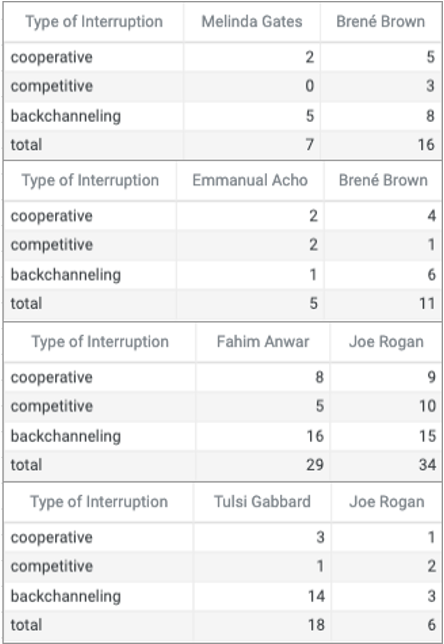
The amount and type of interruptions made by each individual in each conversation examined is summarized in Figure 1.

Figure 1. Amount and Type of Interruptions for Each Individual

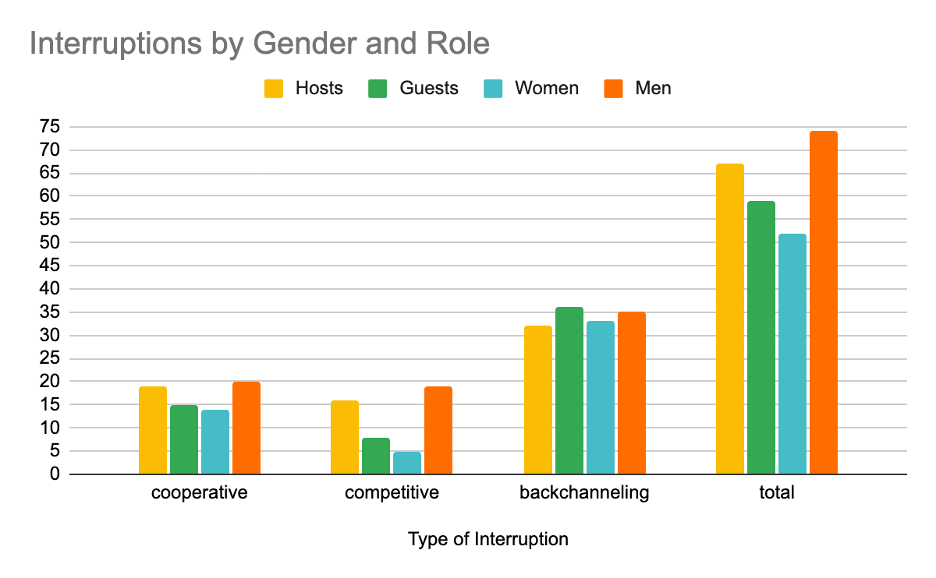
The data was broken down into 4 categories by role and gender: hosts, guests, women, and men as shown below in Figure 2.

Figure 2. Interruptions by Gender and Role

What do these results mean?

The patterns in this analysis indicate that people utilize different interruption strategies based on gender and role during conversational interviews, and that these interruption strategies are related to the gender hierarchy and traditional gender roles. Men were hypothesized to interrupt in all situations more often than women. This was confirmed by the results which indicated that men interrupted 74 times compared to 52 times by women. This could be explained by gender hierarchies which may make men feel they have more right to conversational floor and have the power to violate polite turn-taking convention, confirming the dominance model. In addition, gender had a larger correlation with interruption strategy overall than interview role.

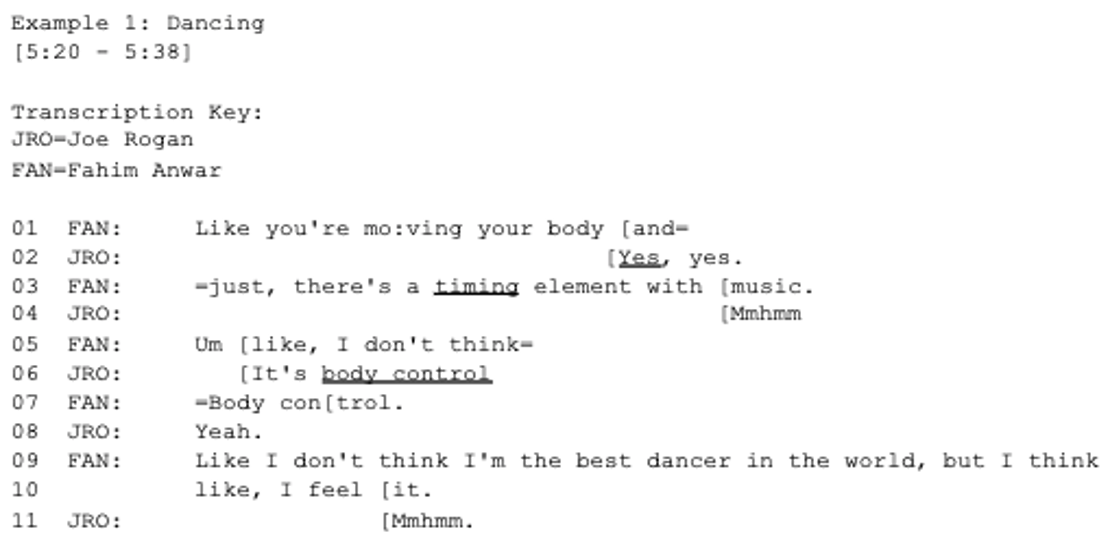
Against predictions, women did not backchannel more often than men, however this was the only interruption type where men and women showed similar levels of interruption. It is of interest to note that men backchanneled the most when speaking to other men. This can be seen in Joe Rogan and Fahim Anwar’s conversation about dancing in Example 1, specifically lines 5 and 12.

When speaking to Tulsi Gabbard, Joe Rogan only used backchanneling 3 times, compared to 15 times with Fahim. This could indicate a societal understanding that two men have equal status and therefore both deserve to show each other they are actively following their conversation, in contrast to speaking with a woman who may have perceived lower status and does not “deserve” the politeness.

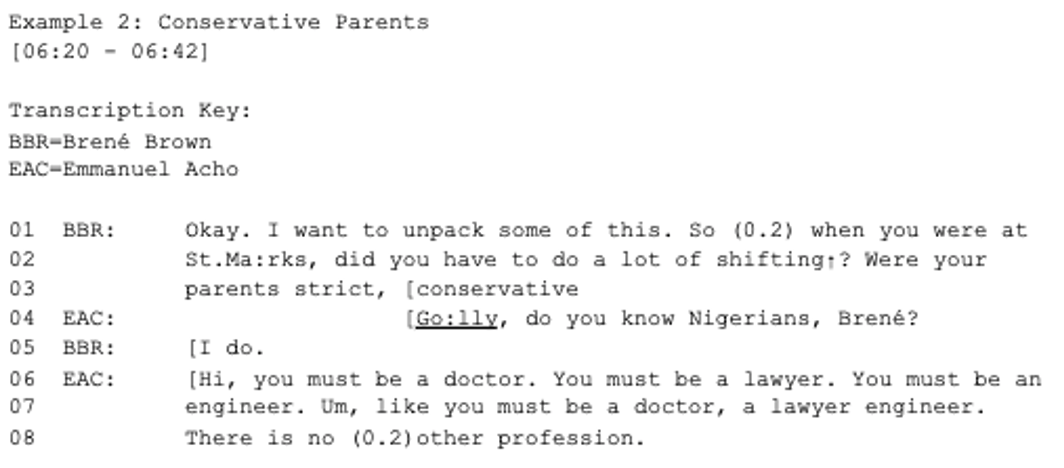
Hosts did use more cooperative and competitive interruptions than guests, however there was one interaction where the guest did make more competitive interruptions. For the female host-male guest interaction, Emmanuel Acho made more competitive interruptions than Brené Brown, one such interruption shown in example 2, where they talk about Emmanuel’s strict upbringing.

Emmanuel first interrupts Brené by asking her another question before she asks her question to him in line 4. Again, he does not allow Brené to fully answer before he continues speaking in line 6. Competitive interruptions are more hostile than cooperative interruptions, so the fact that a male guest, who should be in a lower power position than a host, exercised his power to take over a turn, shows that gender is a more important determinant than role in this context. This could possibly be due to the power imbalance and role-gender power mis-match in this pairing.

Concluding Thoughts

This analysis provides more research on the topic of interruptions in dyadic informal interview conversations with same-gender and cross-gender interactions, using podcasts as a context. Men used all interruption types more than women and hosts made more cooperative and competitive interruptions than guests. There were some special cases, such as male-male conversations that showed men backchannel most when speaking to women and male-guest and female-host interactions in which there were deviations from the pattern. The results indicate that a pattern does exist with respect to gender and role in informal podcast conversations that reflects traditional gender norms and the societal patriarchy. Interruption strategies do vary by gender and role during informal podcast interviews. Negative interruptions impede an individual’s ability to speak or share their opinion, as well as reinforce the gender hierarchy through speech, thus it is important to determine what situations individuals may be at risk of increased interruptions based on their gender. Future directions should continue to study interruptions in more contexts to broaden our understanding of how interruptions are used in different situations by different people. 


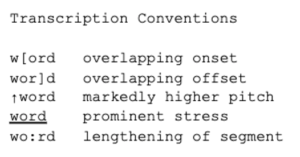
Notation Scheme


What to Read Next:

Researchers Identify Nine Types of Human Interruptions in Conversations

Linguistic science has revealed a stunning truth about a chaotic debate

Exploring what an interruption is in conversation | Stanford News


References

Almoaily, M. (2020). Impact of age and gender on frequency of interruption in dyadic interviews. Interaction Studies, 21(2), 187-199.

Eckert, P., & McConnell-Ginet, S. (2013). Language and Gender. Cambridge University Press.

Feldman, A., & Gill, R. D. (2019). Power dynamics in supreme court oral arguments: The relationship between gender and justice-to-justice interruptions. Justice System Journal, 40(3), 173-195.

James, D., & Clarke, S. (1993). Women, men, and interruptions. Gender and conversational interaction, 231-280.

Koetsier, J. (2020, May 21). Joe Rogan Takes $100 Million To Move Podcast To Spotify, Drops Apple, YouTube. Retrieved from https://www.forbes.com/sites/johnkoetsier/2020/05/19/joe-rogan-moves-podcast-with-286-million-fans-to-spotify-drops-apple-youtube-other-platforms/?sh=7ecebf3a2a23

Marche, T. A., & Peterson, C. (1993). The Development and Sex‐Related Use of Interruption Behavior. Human communication research, 19(3), 388-408.

Sacks, H., Schegloff, E. A., & Jefferson, G. (1974). A simplest systematics for the organization of turn‐taking in conversation. Language, 50, 696 – 735. doi: 10.17323/1728-192X-2015-1-142-202

Suleiman, C., & O’Connell, D. C. (2008). Gender differences in the media interviews of Bill and Hillary Clinton. Journal of psycholinguistic research, 37(1), 33-48.

Yang, L. C. (1996). Interruptions and intonation. In Proceeding of Fourth International Conference on Spoken Language Processing. ICSLP’96 (Vol. 3, pp. 1872-1875). IEEE.

Zimmermann, D. H., & West, C. (1996). Sex roles, interruptions and silences in conversation. AMSTERDAM STUDIES IN THE THEORY AND HISTORY OF LINGUISTIC SCIENCE SERIES 4, 211-236.

[/expander_maker]
, ,

“I need to marry a Jackie not a Marilyn”: The Perpetuation of Gender Stereotypes Through Insults in Romantic Comedies

Tina Izad

While previous studies have explored the gendered differences in linguistic traits and plot lines between male and female main characters, they have failed to provide significant focus on the differences in insults directed towards male and female main characters and the gender stereotypes which these differences may be perpetuating. Thus, this blog will analyze how differences in intonation, word choice, and the impact of insults on male versus female main characters in romantic comedy movies perpetuate gender stereotypes. These stereotypes include the ideas that men demonstrating emotion is a sign of weakness, females categorically demonstrate inherently inferior capabilities intellectually, physically, and professionally, that a woman’s primary occupation should be to maintain a specific aesthetic appearance, and if she does not, she should anticipate, if not expect, to be insulted, and, finally, the idea that a female needs a heteronormative relationship in order to feel fulfilled and truly succeed. Thus through the stereotypes perpetuated through insults, romantic comedies may contribute to the systemic oppression of women and subsequently uphold the socially antiquated gender binary.

[expander_maker id=”1″ more=”Read more” less=”Read less”]

Introduction and Background

In an era in which technology is central to our lives and learning, film has developed the power to color our perceptions and sway our understanding of social norms. Romantic comedies are no stranger to this, as not only their plotlines but also their use of linguistic properties exhibit significant differences between male and female main characters. For example, a study at Heriot Watt University at Edinburgh found that enjoying the romantic comedy, “The Wedding Planner,” a film based on an engaged man falling in love with his wedding planner, was associated with poor communication with romantic partners, thus demonstrating the powerful influence romantic comedies may have over our interactions.

Previous studies have failed to draw attention to the differences in insults directed towards male and female main characters; thus, this blog will analyze how differences in intonation, or shifts in pitch and volume, word choice, or the deliberate presentation of certain language, and the impact of insults on male versus female main characters in romantic comedy movies perpetuate gender stereotypes. These stereotypes include the ideas that men demonstrating emotion is a sign of weakness, females categorically demonstrate inherently inferior capabilities intellectually, physically, and professionally, that a woman’s primary occupation should be to maintain a specific aesthetic appearance, and if she does not, she should anticipate, if not expect, to be insulted, and, finally, the idea that a female needs a heteronormative relationship in order to feel fulfilled and truly succeed. Thus through the stereotypes perpetuated through insults, romantic comedies may contribute to the systemic oppression of women and subsequently uphold the socially antiquated gender binary.

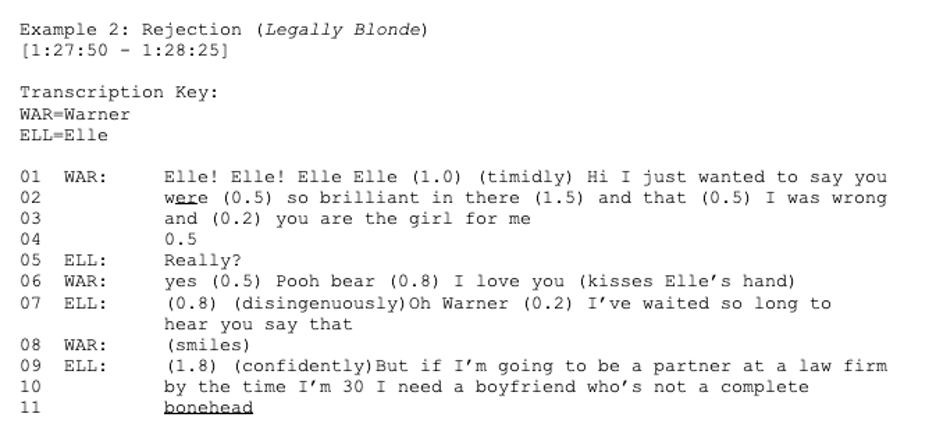
This study focused on the three romantic comedies “She’s the Man,” “How to Lose a Guy in 10 Days,” and “Legally Blonde.” Although the insults in all three films were analyzed in depth, this blog will focus on gendered differences in insults in the film “Legally Blonde.” “Legally Blonde” focuses on the main character Elle Woods, a sorority president, who makes her way into Harvard Law after her Harvard Law boyfriend, Warner, the male main character, breaks up with her to find a more serious relationship which will put him on the right path towards eventually becoming a senator.

Methods

While watching each film, I took notes on the context of each insult, the speaker and the recipient, word choice, intonation, impact of the insults, and the frequency of insults directed towards the male and female main characters in each film.  Close attention was paid towards insults perpetuating gender stereotypes including the need for males and females to adhere to heteronormative societal standards, women’s obligation to maintain a specific aesthetic appearance and that her appearance contributes to her worth as a person, the necessity for women to act lady-like (including the need to not be “too” sexually active) to be accepted, the idea that women are inherently inferior intelligently, physically, and professionally, and that men must refrain from showing emotion in order to appear manly.

Results

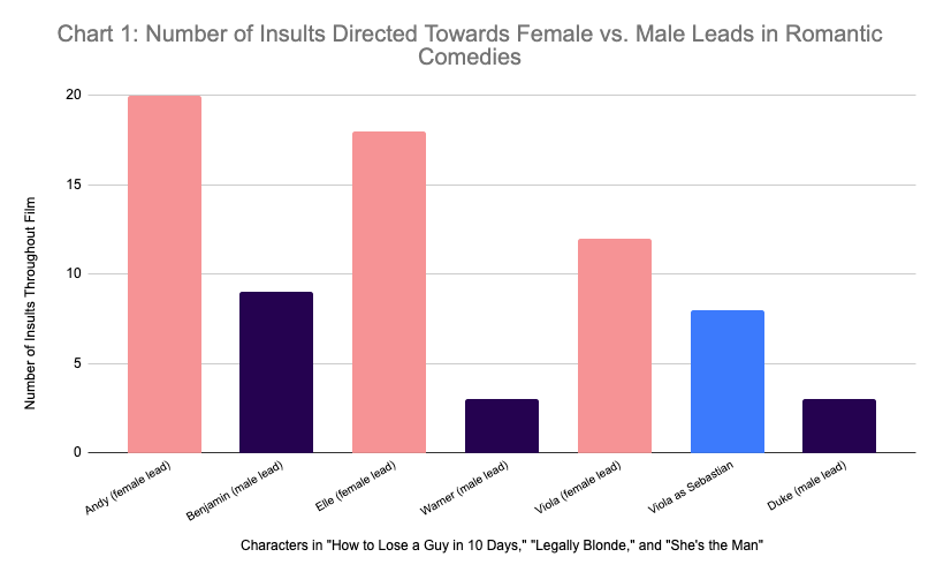
Among the three studied romantic comedies, the frequency of insults directed towards the female main characters was approximately triple that of the frequency of insults directed towards the male main characters, with the exception of the number of insults directed towards Viola in “She’s the Man,” while she is disguised as Sebastian (as shown in Chart 1). Across the three films, there were a total of 50 insults directed towards female main characters and a total of 15 directed towards male main characters and an additional 8 which were directed towards Viola while she was “Sebastian.” Furthermore, of the 15 male-directed insults, five were in regard to the male lead’s intelligence and professional abilities, 2 were directed at his sexuality or sexual performance and one was about him being too lady-like or not manly enough. This does not include the six insults directed towards Viola dressed as Sebastian which were about “him” not being masculine enough. Among the 50 insults directed towards the female main characters in these movies, 21 were in regard to her intelligence and professional abilities, 10 were about her sexuality and/or appearance and five were about her being too manly, or not lady-like enough.

Gentler and more polite word choice with less negative connotations both emotionally and historically and softer intonation were used more in male-directed insults than in female-directed insults. Additionally, across all three films, the female lead’s goals were talked down upon, mainly by men and she was spoken to as if her career aspirations were outlandish, while men in the same positions were not questioned. Lastly, the male-leads responded more strongly to the insults directed towards them, while the female leads brushed off insults more often.

Discussion

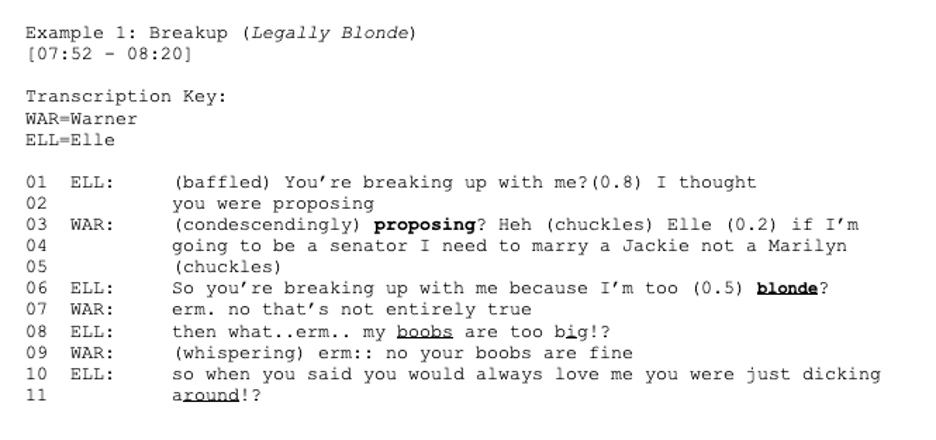
The delivery and impact of insults vary based on if they are directed towards male or female leads. Through all three films, the male-lead reacted much more shocked when insulted, emphasizing the infrequency at which this occurs. In contrast, women seem to nearly anticipate insults as they tend to react in a more muted fashion and will even insult themselves while attempting to understand others’ decisions about them. In “Legally Blonde,” while at dinner, Elle is broken up with by her boyfriend, Warner. The following transcription depicts Elle’s response to the breakup and Warner’s explanation to his decision, much of which exemplifies Elle’s socially induced perception that her appearance constitutes a significant portion of her worth as a person and Warner’s misogynistic leaning and disrespect towards Elle.

As Elle is baffled, stating that she anticipated a proposal, Warner responds, while chuckling with lines 3-4.  Elle immediately responds to this misogynistic insult by questioning if his rejection of her has to do with her boob size or hair color, further emphasizing her perception that a significant portion of her worth as a woman has to do with her external appearance.

Furthermore, Elle does not react to Warner’s insult in itself, ignoring the sexist leaning of his comparison of her to Marilyn Monroe, who was thought to have had an affair with John F. Kennedy, and contrasting of her character with Jackie Kennedy, who was viewed as more sophisticated and classier. Elle’s lack of response to the insult in itself emphasizes her possible expectation for such misogynistic comments. This loaded insult from Warner can be contrasted with a later insult from Elle directed towards Warner, as shown in example 2.

Elle adopts the same format as Warner’s insult, and responds with lines 9-11. While it is noteworthy that she adopted the same structure, “bonehead” is a far less condemning and charged insult than Warner’s comparison. Further, Warner’s speechless reaction indicates that he likely is not insulted often, even in this somewhat elementary way.

Additionally, while Elle’s insult towards Warner in lines 9-11 of example two is said with confidence, implying respect for herself, Warner insults Elle in line three of example one with a condescending tone, outwardly implying a lack of respect for her and belittling her intelligence. This contrast in tone demonstrates the way in which insults towards male main characters may be softened, whether through intonation or other methods, to reduce the insult’s impact, while the same considerations are often not taken with women.

Conclusion

The results of this study corresponded to previous research done on gender differences in romantic comedies, however it is worth noting that limitations were present in this study, as all three films held a primarily straight, white, cis-gendered cast. This lack of diversity limits the applicability of the study to society as a whole and also emphasizes the need for greater diversity in film.  This study in particular shone a light on the differences in insults directed towards male and female main characters and the ways in which not only the words verbalized, but also the tone of voice used during these insults along with the impact of these insults contribute to the perpetuation of gender stereotypes and thus continuously normalize a gender binary and the acceptance of outdated gender roles.


References

Angyal, C. S. (n.d.). GENDER, SEX, AND POWER IN THE POSTFEMINIST ROMANTIC COMEDY. Retrieved February 6, 2021, from Edu.au website: http://unsworks.unsw.edu.au/fapi/datastream/unsworks:12432/SOURCE02?view=true

How to Lose a Guy in 10 Days. (2003). Available from https://play.google.com/store/movies/details?id=6SHj4gXvPk8&gl=US&utm_source=na_Med&utm_medium=hasem&utm_campaign=MoviesPLA&pcampaignid=MKT-DR-na-us-all-Med-pla-mo-Evergreen-Dec1115-1-movieslibrary&gclid=CjwKCAiA9vOABhBfEiwATCi7GAK5dyy7YlgLnuPH5FR_Kv-W_e1CtcYpk1hJgOlwNaA_05DM9_qMIBoCtQ0QAvD_BwE&gclsrc=aw.ds

José Mateo, F. Y. (n.d.). Towards an intercultural pragmatic taxonomy of insults. Retrieved February 12, 2021, from Personal.ua.es website: https://personal.ua.es/francisco.yus/site/insults.pdf

Lauzen, M. (2016, June 8). Articles about our Research. Retrieved February 25, 2021, from Sdsu.edu website: https://womenintvfilm.sdsu.edu/contributions/about-our-research/

Legally Blonde. (2001). Available from https://www.amazon.com/gp/video/detail/amzn1.dv.gti.f8a9f71d-741f-7cff-a561-efc0b720b6d9?autoplay=1&ref_=atv_cf_strg_wb

Legally Blonde wallpapers – wallpaper cave. Retrieved from https://wallpapercave.com/legally-blonde-wallpapers

Raymond, C. W. (2013). Gender and sexuality in animated television sitcom interaction. Discourse & Communication, 7(2), 199–220.

Scharaga, J. A. (n.d.). Female moments / male structures: The representation of women in romantic comedies. Retrieved February 6, 2021, from Ursinus.edu website: https://digitalcommons.ursinus.edu/cgi/viewcontent.cgi?article=1008&context=media_com_hon

She’s the Man. (2006). Available from https://www.amazon.com/Shes-Man-Amanda-Bynes/dp/B015O3MPZA

The representation of love in Romantic Comedies. (n.d.). Retrieved February 25, 2021, from Centreforjournalism.co.uk website: https://centreforjournalism.co.uk/content/representation-love-romantic-comedies

Vignozzi, L. B. A. (n.d.). Gender Stereotypes in Film Language: A Corpus-Assisted Analysis. Retrieved February 6, 2021, from Openedition.org website: https://books.openedition.org/aaccademia/2367?lang=en

Wright, B. (n.d.). Gender and language: Challenging the stereotypes. Retrieved February 6, 2021, from Birmingham.ac.uk website: https://www.birmingham.ac.uk/Documents/college-artslaw/cels/essays/sociolinguistics/Wright5.pdf


[/expander_maker]
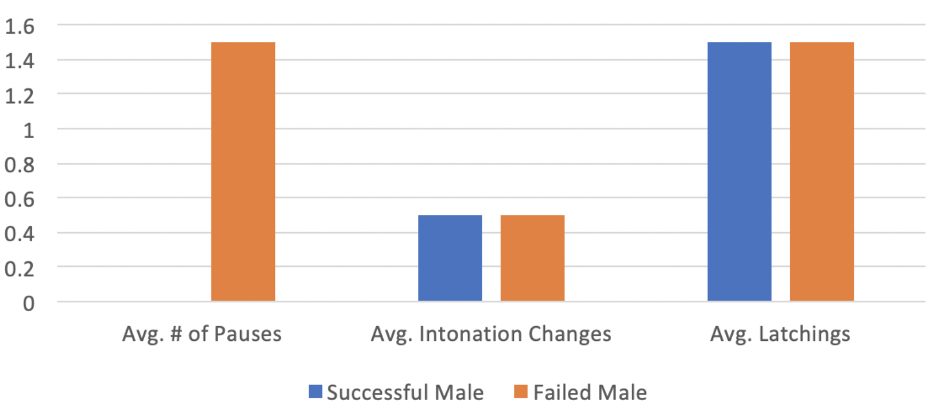
Language Use in Sports

Liam Anderson

The interaction between coach and athlete is one that is gendered and incorporates the dominance model. The show the Last Chance U gives examples of how coaches use gendered word choice and vulgar language to interact with their male athletes. What was found is that coaches want their athletes to be mentally tough but this can sometimes get stacked with vulgar language. This vulgar language is on top of all of the stress and pressure of the sport at hand. This is when it becomes gendered because the vulgar language is expected to be handled with mental aspects of the sport. Male athletes are not supposed to show any emotion, which is a male gender stereotype which incorporates the dominance model. This leads to coaches perpetuating male gender stereotypes when trying to get the most out of their athletes through promoting mental toughness. Through this, sports continues to perpetuate gender stereotypes that we are trying to get rid of.

[expander_maker id=”1″ more=”Read more” less=”Read less”]

Introduction

Have you ever seen a coach cuss out an athlete for doing something wrong? Coaches will use vulgar language towards their male athletes to try and get the most out of them and make them perform better. The use of vulgar language towards male athletes that coaches use can be seen as gendered as it can perpetuate male stereotypes. Stereotypical male characteristics like being strong and not showing emotion can be perpetuated through the word choice of coaches. This research will give a linguistics view on how sports can further gender stereotypes like being the strongest and most dominant male. This incorporates the dominance model and can be seen through the interaction between coach and athlete. The dominance model is the stereotypical notion that men are above women in society. Coaches word choice and tone affect the interaction between coach and male athletes and how this can incorporate the dominance model and perpetuate gender stereotypes. To look at these aspects the show Last Chance U will be analyzed to give examples of discussion between coach and athlete. The show Last Chance U is about junior college football athletes trying to make it to a Division 1 program and this is their last chance of making it in football.

Methods

The methods that were used to answer these questions were by watching the show Last Chance U. The show gives lots of interaction between coaches and male athletes and how their relationship is on the field. This type of source gives lots of conversations and allows to dissect information about coaches’ word choice and tone. The show also gives multiple perspectives of coaches and athletes which allows for further analyzing from each side. It also gives examples of coaches talking negatively to athletes and what words are used to try and get the best out of the athletes. Through multiple seasons there were a lot of examples and information that gave a good representation of the interaction between coach and athlete.

Different linguistic studies also helped with analyzing the interaction between coach and athlete. The linguistic studies helped identify what the interactions that were going on in Last Chance U meant and how this was shown linguistically. Through different studies on the linguistics of sports it gave a background knowledge of what types of words and tones coaches would use with their athletes. These studies helped in finding answers to how coaches used word choice and tone to perpetuate gender stereotypes.

Results

The results found that linguistically there are a lot of gendered interactions between coach and athletes that incorporate the dominance model. The idea of being mentally tough was found as an aspect that coaches pushed on athletes. This idea of being mentally tough is that an athlete must be mentally tough and be able to handle the mental stress of a sport as well as the physical. Mental toughness seems to improve sports performance based on Chang (2012), “Numerous studies have indicated that mental toughness plays a significant role in successful sports performance”. Therefore, so many coaches push for mental toughness and can even overextend the limits of mental toughness with vulgar language. Through vulgar language and negative word choice coaches can stack this with mental toughness to try and push their athlete. In Feezell (2008) Coach Knight uses vulgar language and justifies it by saying that the athlete should handle it by being mentally tough. Based on Feezell (2008), “Coaches like Knight might think they’re only trying properly to motivate an athlete, but the possible damage done by a coach’s tirade might still be palpable and unacceptable”. Coaches will use vulgar language and harsh word choice to try and push their athlete but this can be confused for mental toughness. This is stacked on top of mental toughness and it is expected for male athletes to be able to handle it because of male gender stereotypes. This type of motivation from a coach is perpetuating the male stereotype that males are not supposed to show emotion.

Discussion/Conclusion

Coaches will use harsh language with their athletes to try and perform better but sometimes this can result in the athlete using it themselves to push themselves. There is a lot of pressure for athletes to do well so they will use vulgar language themselves.  Below is a transcription from Tovares (2010).


This transcription is of an athlete talking to themselves while running a marathon and it shows some of the pressure that the athlete is facing. The vulgar language is present in transcription, and it is showing what mental toughness is all about. This is what a coach would push for an athlete to do because it is an example of mental toughness. This language is reflecting the gender stereotype and is a way of establishing masculinity. This falls right into the incorporation of the dominance model because emotions are supposed to be put aside for men and this is an example of bottling up emotion.

Example 1 from the show Last Chance U demonstrates how the word choice of coaches can become gendered and even make them feel marked. Marked is when someone feels like an outsider or does not fit in fully. This example is at practice when the coach Diaz pulls Malik to the side and tells him that he is making him look bad in front of everyone else.

The word choice of “lipstick” and “fuckin’” make this interaction between coach and athlete gendered. The coach is referring to how Malik is making him look like a woman on the football field. This in football is unacceptable for a football coach and is something that coach Diaz lets Malik know. This is an idea of markedness because coach Diaz feels like an outsider with his reference of feeling like he has lipstick on his face. This gendered interaction perpetuates male stereotypes and makes it seem like you can only be a strong and emotionless man to be on the football team.

The hall of mirrors effect could be present in this research because by searching up the topic some of the information that contradicts my claim could be overlooked. The sources that were used fit my claim and therefore no sources that contradicted it were found which is why the paper could fall into the hall of mirrors effect. This research contributes to the larger phenomenon that sports drive a lot of stereotypes that society is trying to rid of but they stay in sports.


References

Chang, Yu-Kai, Lin Chi, and Chih-Shiung Huang. “Mental Toughness in Sport: A Review and Prospect.” International Journal of Sport and Exercise Psychology, vol. 10, no. 1, 2012, pp. 79-92. ProQuest, https://search.proquest.com/scholarly-journals/mental-toughness-sport-review-prospect/docview/1011870028/se-2?accountid=14512, doi:http://dx.doi.org/10.1080/1612197X.2012.661202.

Tovares, Alla V. “Managing the Voices: Athlete Self-Talk as a Dialogic Process.”Journal of Language and Social Psychology, vol. 29, no. 3, 2010, pp. 261-277. ProQuest, https://search.proquest.com/scholarly-journals/managing-voices-athlete-self-talk-as-dialogic/docview/758115517/se-2?accountid=14512.

Feezell, Randolph. “Vulgarians of the World Unite: Sport, Dirty Language, and Ethics.” Journal of the Philosophy of Sport, vol. 35, no. 1, May 2008, pp. 17–42. EBSCOhost, doi:10.1080/00948705.2008.9714725.

[/expander_maker]
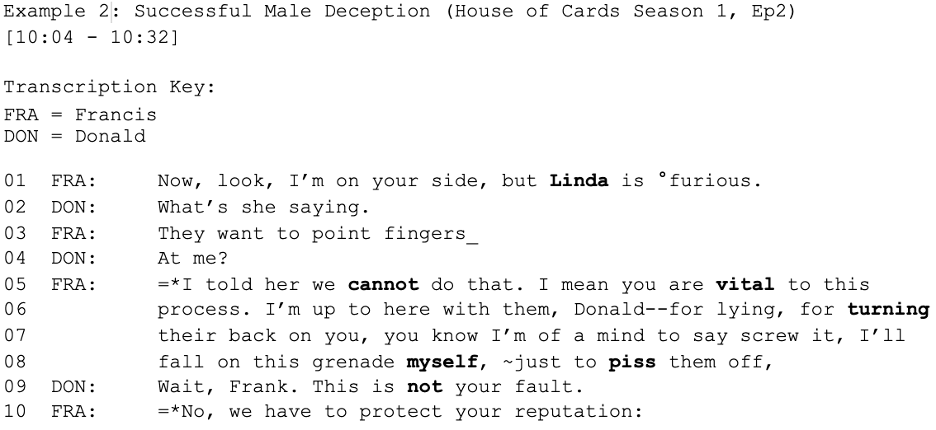
Women in Politics: Confident not Coy

Ahmed Elauri

I have a dream (…) that one day (….) my children (…) will grow up to read Cat in the Hat.  Now that probably sounded a lot more dramatic than it actually was. People, especially American politicians, love to take pauses while speaking. Martin Luther King Jr. did it, Barrack Obama did it, Nancy Pelosi does it. Pauses are often used because their versatile roles, especially in politics. Pauses can be used to provide emphasis, invoke emotion, or just to catch someone’s breath. Due to the flexibility of pauses, this research investigated how men and women within politics use silence within their speech differently. While women were expected to take more pauses to sound less aggressive and to prevent standing out, the data suggests men may take more pauses during their speech.  This research compared the speech of Vice President Kamala Harris and former Vice President Mike Pence to see who spoke more fluidly during the 2020 Vice Presidential Debate. Harris used fewer pauses, indicating women in politics may be more confident and fluid speakers than their male counterparts.

[expander_maker id=”1″ more=”Read more” less=”Read less”]

Linguistic Restraint in Politics and Gender

Introduction & Background

Politics is centered around public perception of individuals, making each political figure highly subject to scrutiny (Shabrina, 2016). Specifically, the speech of Kamala Harris, and Mike Pence were analyzed. Vice President Harris hails from California, where she had experience as a U.S. Senator, and as District Attorney. Former Vice President Pence comes from Indiana, where he had been Governor. Both individuals have had bright political careers, although they do have differences. Vice President Harris is a female of color from California, whilst former Vice President Pence is a white male from the Midwest. This study focused comparisons based on differences in gender.

This research was performed to answer the following research questions. How does gender affect usage of pauses and silences within speech in a political environment? More specifically, how often are pauses used, what functions do they primarily serve, and how effective are they at completing their function

Males and females were expected to respond differently due to the Difference Theory because politicians do not want to sound strange. Therefore, they likely would conform to social norms and act within specific gendered behaviors. 

Females were expected to use pauses more often than men, possibly to invoke an emotional response from the audience or to prevent appearing aggressive and overbearing. Conversely, men were expected to use fewer pauses. They may include pauses to add emphasis or to change flow of speech to keep the audience engaged. Men were expected to speak more smoothly, likely due to the male dominance in politics and having more comfort in the spotlight. The Difference Theory argues that men and women have separate genders, and thereby learn to socialize separately (Tannen, 1991). The difference in socialization leads to each gender performing different practices. For men, this means they primarily communicate to convey information(Tannen, 1991). For women, this means they have a rapport speaking style, where they speak to build relationships (Tannen, 1991). Similarly, the concept of perceived affordances, or what people feel they are socially permitted to do, also factors into how men and women will use pauses (Norman, 1999). The way we speak is a reflection of our entitlement within society (Segalowitz, 2001). As men and women have different roles within society, their entitlement based on affordances will alter when they use pauses, and the pauses’ associated function.

Previous studies have shown that power imbalances can lead to differences in the linguistic features that are used (Kollock, 1985). It has been speculated that these linguistic differences are linked to gender, more information on gendered power in politics can be found here.

During the Senate confirmation hearings for Clarence Thomas, the use of silence was very deliberate by Senators and by Judge Thomas. In said case, the pause time allotted between answers given and the following question being asked, for Judge Thomas was adequate enough for him to be able to respond with a calm tone and with sound answers. Conversely, Dr. Hill was given substantially less pause time, causing her discomfort and stress in attempt discredit her (Mendoza-Denton, 2001).

Much of the past research is decades old, and focused on different specific sociolinguistic factors. The age of past research and the absence of research on pauses within a political speaker’s message leave a knowledge gap that is filled by this work.

Methods

This study specifically examined conversations and dialogue between Vice President Kamala Harris, and former Vice President Mike Pence. The conversations that were analyzed were from the 2020 Vice Presidential Debate. Considerations of this text include the female moderator, Susan Page, who was facilitating the debate. Conversations were randomly selected, transcribed, then analyzed.

Both parties were afforded equal speaking time and opportunities to speak at the debate, having strong previous political careers and being in contention for the same position. Transcriptions were recorded and made for each example and can be deciphered using the key found in the Appendix of this blog.

Results

Figure 1. Summary of the research study findings, particularly the average values of pauses throughout the examined conversations.

Two examples will be briefly shown in Figures 2 and 3.


The first example titled ‘Prayers and Concern’ (Figure 2) came from Pence (video link here). As shown in lines 2-5, there is a high number of pauses, within his four lines of speech. Furthermore, he exhibited two glottal stops. The significance here is in the density of his pauses, which have a high frequency within a short section of speech, and have long individual lengths.

Figure 2. An excerpt from a conversation between Mike Pence and Susan Page.

Pence performs eight long mid-speech pauses within his answer, and about two per each line of text. Pence has two glottal stops in speech, both during line 2. The line 2 glottal stop seems relevant to the long pauses in lines 2,3, and 4 which are discussed below. The early stops indicate they are not meant to disturb flow, or provide emphasis on any points made, as there are no points made yet. This is different from the next transcript.

Example 2 titled ‘Confidence’ (Figure 3) is a transcript that follows Harris’ response to the same question (video link here). Immediately you can see the contrast between Harris’ response and Pence’s response in Example 1. The significance in this example is from the lack of pauses and the confidence in her answer.

Figure 3. An excerpt from a conversation between Kamala Harris and Susan Page.

Harris has three lines of text here, fewer than Pence’s response of four lines, but nonetheless, her answer is much different. Whilst Pence has two pauses per line, for a total of eight pauses; when answering the same question, Harris had only two long pauses, both of which were significantly shorter than the mid-speech pauses exhibited by Pence.

Discussion & Conclusion

Harris’ speech faired as more fluid than Pence’s speech, including fewer glottal stops, fewer pauses, and shorter pauses. Many of Harris’ pauses were directly following bold claims or negative statements towards her opponent. This directly contrasts with the hypothesis which predicted women in politics to be timid. Furthermore, Pence’s pauses were often used at times when he seemed flustered, or as though he was struggling with choosing words to say.

While these results are limited, as they focused on a singular event and two specific politicians, this research indicates that times are changing. Further research including analyzing more individuals in different situations must be done to support the results found here. Nonetheless, the findings within this study indicate women have strong voices within American politics, and are willing to aggress head-to-head with their male counterparts.


References and other used sources

C-Span. (2020) Vice Presidential Debate, https://www.youtube.com/watch?v=t_G0ia3JOVs

Mendoza-Denton, N. (2001). Pregnant pauses. Teaching Modern Foreign Languages: A Handbook for Teachers, 50.

https://languagelog.ldc.upenn.edu/nll/?p=49201&fbclid=IwAR1JIOXRML8cIeeKnHIkKo4KY1o_gHrH8DK5urOB_Y4utetBEPYskijLOQE

Holiday, N. (2020). Kamala Harris and the Prosody of Parody.https://languagelog.ldc.upenn.edu/nll/?p=49201&fbclid=IwAR1JIOXRML8cIeeKnHIkKo4KY1o_gHrH8DK5urOB_Y4utetBEPYskijLOQE

Raymond, C. W. (2019). Category accounts: Identity and normativity in sequences of action. Language in Society, 48(4), 585-606.

Kollock, Peter, Philip Blumstein & Pepper Schwartz. (1985). Sex and power in interaction: Conversational privileges and duties. American sociological review, 50.34-46.

Rickford, J. R., Duncan, G. J., Gennetian, L. A., Gou, R. Y., Greene, R., Katz, L. F., … & Ludwig, J. (2015). Neighborhood effects on use of African American vernacular english. Proceedings of the National Academy of Sciences, 112(38), 11817-11822.

Shabrina, I. (2016). Persuasive strategies used in Hillary Clinton’s political campaign speech (Doctoral dissertation, Universitas Islam Negeri Maulana Malik Ibrahim).

Tannen, D. (1991). You just don’t understand: Women and men in conversation (1. ed). Ballantine Books.

Norman, D. (1999). Affordance, conventions, and design. Interactions, 6, 38–42. https://doi.org/10.1145/301153.301168

Segalowitz, N., Cohen, P., Chan, A., & Prieur, T. (2001). Musical Recall Memory: Contributions of Elaboration and Depth of Processing. Psychology of Music, 29(2), 139–148. https://doi.org/10.1177/0305735601292004

[/expander_maker]
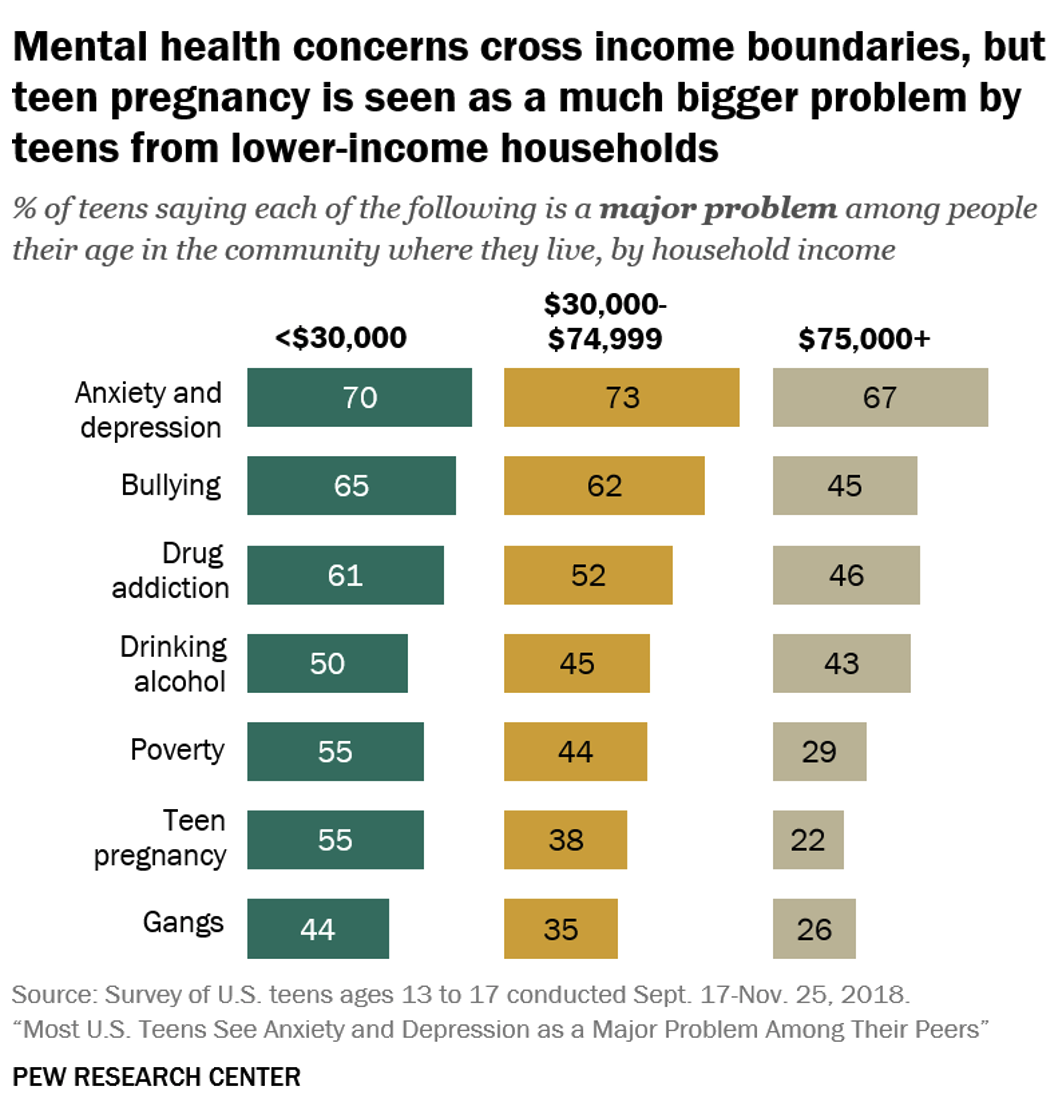
, , , , , , , ,

Love at First Site? The Impact of Medium and Sex on Flirting Behavior

Christian Bury, Maddy, Valerie Beketava, Marissa Schulner, Luming Zhou

Smiling at the cute cashier, batting your eyes at your work-crush, or even strutting up to greet an attractive stranger at the bar, whether Dr. Love himself, or merely an average joe looking to land a date, we’re all aware of the tried-and-true signs of flirting. It’s with this familiarity in mind, that the recent emergence of social media and popular dating apps have revolutionized these age-old flirting techniques, reimagining themselves in the form of risqué DM’s and overly animated texts featuring the all too infamous winky face emoji. Biological sex has long stood as the primary element of influence within flirting behavior, but with the prevalence of today’s digital technology, the actual medium of such communication has been introduced as yet another important factor regarding one’s approach to flirting. Despite this being the case, a few features of flirting remain ubiquitous across both face-to-face and virtual mediums regardless of biological sex: the use of compliments and exaggerated reactions. With this in mind, the following article lays-out and reflects on the aforementioned features of flirting, shedding light on how differences among sex and medium impact flirting behavior, perception, and tendencies.

[expander_maker id=”1″ more=”Read more” less=”Read less”]

Introduction

Before diving into all the nitty-gritty details of these recent observations, it is important that we introduce the background of such research, and more specifically, the features of flirting we will be paying special attention to. With longstanding studies on flirting and communication, it doesn’t take an astrophysicist to know that flirting relies heavily on non-verbal signals and exaggerated reactions such as laughing, smiling, looking someone in the eye for a significant period, and winking (Eckert & McConnell, 2003). For this exact reason, more contemporary research has concluded that without the traditional non-verbal signals of face-to-face communication, virtual flirting tends to rely on emojis, capitalization, and punctuation, as substitutes for conveying exaggerated excitement (Whitty, 2004). Our study of “exaggerated reactions” refers to the act of responding over-enthusiastically while flirting, usually laughing, smiling, or speaking louder and faster to signal interest and excitement. More specifically, this feature may take form in face-to-face contexts by giggling at an attractive person’s joke as if it’s way funnier than it actually is, or appear in a virtual sense, with the excessive use of emojis, punctuation, and capitalization, while texting “HAHAHA…waaaaiitt, I LOOOOVE that!!!!” Likewise, in regard to modern analysis surrounding the use of compliments between men and women, it’s been widely observed that women are more likely to both give out and accept compliments, while men are more likely to deflect and misread compliments when flirting (Tannen, 1990). From this standpoint, we’ve chosen to further examine such behavior, particularly researching what we’ve classified as “direct and risque compliments.” This feature refers to the act of essentially cutting straight to the point and making a flirtatious or sexually suggestive compliment while flirting. Most notably, such behavior may be observed within the likes of face-to-face flirting by telling someone “you’re gorgeous,” or appear in a virtual context while sliding into someone’s DM’s to say “you’re super hot, can I get your snap?” Now at this point, you may be thinking so what’s the big deal? Well, by taking these features into account, we’ve developed exciting new insight on the medium and types of compliments preferred by men and women, in addition to which medium is perceived to involve more exaggerated reactions, as well as direct and risqué compliments. We predict that flirting face-to-face is the preferred medium of both men and women, being perceived as more sincere, and therefore, more effective. Moreover, we also expect to find that flirting virtually tends to involve more direct and risqué compliments, as well as exaggerated reactions.

Methods

With regards to the methodology of such research, we decided to approach this study with three separate phases and means of collecting data. First and foremost, we developed a multiple choice google survey, gathering responses from 27 male and 27 female UCLA students. In particular, this survey gauged the tendencies and perceptions, as well as the use of compliments and exaggerated responses by men and women when flirting face-to-face and/or virtually. Next, we cross compared our survey results with 14 anonymously submitted screenshots of flirting over Tinder, Instagram DM’s, and Text messages, effectively countering the potential survey bias of our data by presenting more “real-world” flirting behavior in practice. Lastly, we gathered and analyzed an assortment of media clips containing flirting scenes from various movies and shows, once again cross referencing such examples with our survey data and screenshots of virtual flirting to develop more comprehensive results. 

Results and Analysis

Moving on to the results and analysis of this three-phase approach to data collection, we see that our survey results indicate that men and women are strikingly similar when it comes to their perception and use of really any notable feature and medium of flirting. In this case, our survey data shows that the only notable disparity between sex appears over which medium is more likely to contain exaggerated reactions, with men saying that virtual flirting contains more exaggerated reactions, while women reported the contrary, highlighting the exaggerated reactions of face-to-face flirting instead (as seen in Graph #5). Beyond this minor disagreement, both men and women said that face-to-face was their preferred flirting medium (Graph #1), agreeing that it’s more sincere (Graph #2), and therefore, more effective (Graph #3), while also perceiving that virtual flirting tends to involve far more direct and risqué compliments (Graph #4).


Taking this into account, our analysis of the virtual flirting screenshots showed that in many cases people will say things online that they may not say in person (Screenshot #1 and #2). This observation carries over similarly to an apparently high volume of exaggerated messages and responses (Screenshot #2 and #3). As noted earlier, this behavior likely stands as a means of compensating for the lack of traditional nonverbal flirting signals missing from virtual mediums. Lastly, our examination of media clips focused mainly on scenes from the films “Back to the Future”, “Crazy, Stupid, Love”, and “The Departed” (see links below).

“Back to the Future” Flirting Scene

“Crazy, Stupid, Love” Flirting Scene

“The Departed” Flirting Scene

In each case, all three clips displayed an exchange of compliments, usually coming from the man initially, as well as indications of exaggerated reactions, usually occurring in the form of giddy laughter, smiling, and louder, faster speech.

Discussion and Conclusions

Relying on surveys, research, and media analysis we draw several conclusions regarding flirting behaviors among young adults. By analyzing our survey results we can conclude that flirting face-to-face is the preferred medium of both men and women. This came as no surprise to us but was very interesting to analyze the many possible reasons and explanations that resulted in this conclusion. One reason for this result is that both genders indicated that they found flirting in person to be perceived as more sincere, effective, and the most time effective method of getting to know a person they are attracted to. Virtual flirting was shown to be more prone to direct and risqué communication that can often be misinterpreted whereas in-person can be seen to show much more clear and precise expression of intentions. The more playful and sincere compliments observed through in-person flirting is preferred for both men and women over the more scandalous and risqué ones prevalent among virtual flirting. As we previously assumed, virtual flirting prompts much more exaggerated and animated reactions than in-person. We assume that this exaggerated behavior is used as an attempt to combat the non-verbal cues we get when flirting in person. These non-verbal cues include smiling, touching, laughing, as well as other micro-expressions we observe when you are attracted to another person. Those who are more introverted and less confrontational may prefer online flirting as their preferred medium as there is much less physical embarrassment when a flirting tactic fails to elicit the desired response. For an online flirting medium such as Tinder, where you most likely have not met the person, you are talking to and, the person may believe they have to come off strong to provoke a response and make an impression among a much larger pool of potential partners. While our survey did compare results among both men and women, our analysis found that the medium, rather than sex, has a much larger impact on the use and perception of compliments and exaggerated response when flirting. Overall, most of our research data and analysis confirmed our hypothesis that young adults prefer face-to-face over online flirting, leaving the door open for further insight that could promote future research on this topic.


References

Tannen, D. (1990). You just don’t understand: Women and men in conversation. New York, NY: Morrow.

Eckert, P., & McConnell-Ginet, S. (2003). Language and gender. Cambridge: Cambridge University Press.

Holmes, J. (1988). Paying compliments: A sex-preferential politeness strategy. Journal of Pragmatics, 12(4), 445–465. https://doi.org/10.1016/0378-2166(88)90005-7

Smith, J. (2014). The Perceived Impact of Online Versus Offline Flirting on Romantic Relationships . (Electronic Thesis or Dissertation). Retrieved from https://etd.ohiolink.edu/

Narissra M. Punyanunt-Carter and Thomas R. Wagner.Cyberpsychology, Behavior, and Social Networking.Apr 2018.229-233.http://doi.org/10.1089/cyber.2017.0608

Whitty, M.T. (2004). Cyber-flirting: An examination of men’s and women’s flirting behaviour  both offline and on the Internet. Behaviour Change, 21(2), 115-126

[/expander_maker]
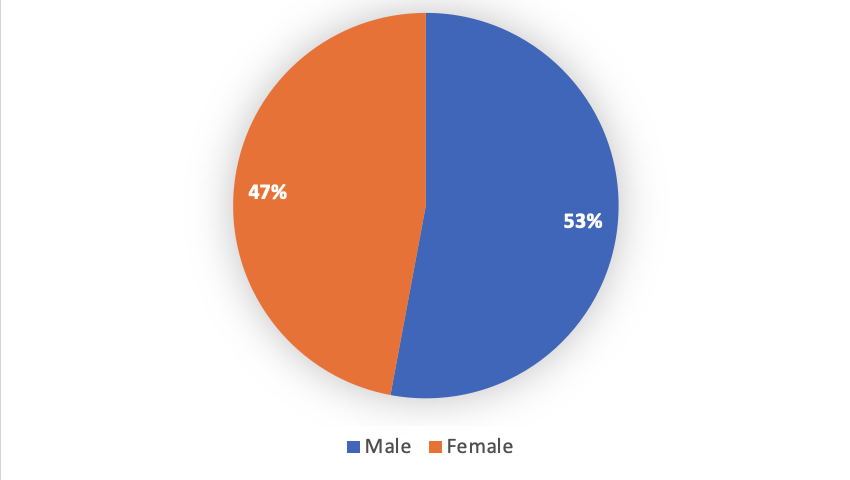
, , , , ,
Scroll to Top