Driving from 101 to The 101: An Analysis of Determiner Usage in Californian Speech
Pranav Singh, Melissa Yang, Yoosoo Jang, Ross Perry, and Nathan Midkiff
Do you refer to Highway 101 as “101” or “the 101”? Perhaps many people have seen the case of putting ‘the’ in front of the highway. A determiner, like “the”, is an important element of grammar, and is usually used in front of a noun that has a specific meaning. But the rule of determiner “the” can be ignored in particular cases. We can also observe from the mass media that it is sometimes a little different when referring to highways. We found two videos from YouTube that show different ways to call Highway 101 according to region.
In the news on Los Angeles, Highway 101 is referred to as ‘the 101’.
In the news on San Francisco, Highway 101 is referred to as ‘101’.
Most people know that language can be influenced by culture and geography, but the majority of people do not know how they’ve influenced the language. Little research has been done to explore what reasons affect the difference between regions especially in referring to highways, so in this study we aim to analyze the connection between specific sociological/geographic factors and the usage of “the 101” or “101” by collecting data.
Introduction
On the outside, California may be seen as a monolithic region that has developed its culture around the year-round sunny skies and proximity to beaches. However, locals of the state have a much more varied view of the state and often see it as made up of distinct regions (Bucholtz et al., 2007). The most apparent divide would be between Northern California and Southern California, and good representations of these two regions would be the San Francisco Bay Area for Northern California and Los Angeles (LA) for Southern California, as both are extremely popular areas for their respective regions.
The divide between these two regions has created a difference in speech and cultures. One such difference is the way Bay Area locals omit the determiner “the” before referring to highways, while LA locals include the determiner “the” before referring to highways. For example, Bay Area locals would refer to highway 101 as just “101” while LA locals would refer to highway 101 as “the 101.” This is a widely acknowledged phenomenon, but there hasn’t been much empirical evidence to back up the claim that LA locals use “the” before referring to highways more than Bay Area locals do. So we’ve decided to examine whether or not this claim can be sustained with concrete evidence.
In addition, we believe that if there happens to be an increased usage of the determiner for LA locals, then this may be a result of a more prominent driving culture for the LA region than the Bay Area region. The LA region may have a culture that revolves around driving due to driving’s necessity and time-consumption. Driving takes up a large chunk of time in LA locals’ lives, both physically and mentally, so its importance is reflected in the usage of “the”, as the determiner is often used to signify importance or familiarity for the following noun (Birner, 1994).
Methods
In order to analyze this, we turned to the social media platform Reddit. Using the community pages (“subreddits”) for the Bay Area and Los Angeles (https://www.reddit.com/r/bayarea/ and https://www.reddit.com/r/LosAngeles/), we collected a sample of posts on each subreddit which referenced U.S. Highway 101. We chose to examine discussions of US-101 because this highway runs plays a major role in transit in both of these communities. It runs through both San Francisco and San Jose, two of the major cities which make up what is considered the Bay Area, and it runs through a large part of Los Angeles. We wanted to choose a highway that is common to both of the regions in order to rule out the possibility of the determiner use being a purely lexical distinction that is used only in combination with the names of specific roads.
We turned to Reddit for our data collection because it provided us good access to the members of the community in a natural setting. And, we decided that because this distinction was of a lexical nature, that it was likely to carry over into the written speech of both communities. Most importantly, by examining these Reddit communities, we are studying the speech patterns of people according to their identity. By participating in an online forum specific to a community, an individual establishes that they identify as being a member of that community, therefore showing that our observations are measuring people who identify as Los Angeles or Bay Area residents.
We collected a sample of posts discussing U.S. 101 from each subreddit, then observed the proportion of those in which the determiner “the” was used before the highways number. In order to examine the importance of the highway in each community, we then examined the proportion of posts in each subreddit that made reference to U.S. 101 within the past 3 months.
Results
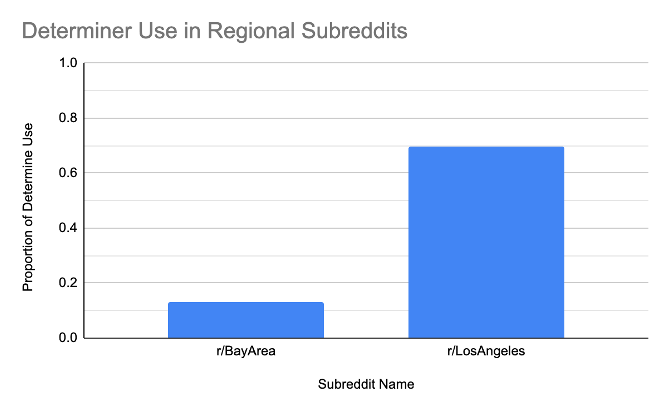
What we observed was that members of the Los Angeles subreddit did, in fact, use the determiner “the” more often when referring to U.S. 101. In r/LosAngeles, 16 out of the 23 posts collected referred to U.S. 101 as “the 101”, whereas in r/BayArea, only 3 posts did so in the same sample size. In both communities, posts without determiner use included simply referring to “101”, or including other technical terms related to highways, such as “N”, “North”, “S”, “South” etc.
Our analysis of the rate of discussion about U.S 101 revealed that in the Los Angeles community, 14 of the 6364 posts from the past 3 months referred to the highway, and in the Bay Area Community, 11 out of the 5637 posts from the same time period did so. While Los Angeles referred to the highway only slightly more, leading to us being uncertain of its significance, the similarity between the rates at least shows that our belief that the highway was of similar importance to both communities is substantiated.
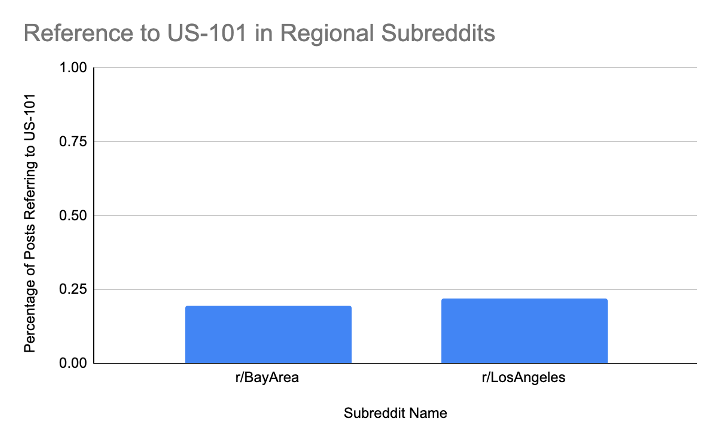
If we perform some simple statistical tests on this data, we can see that what we guessed is true. Our first test, looking at use of the word “the” before the highway number, was statistically significant, with a p-value of p=0.00005. This means that if our hypothesis was incorrect, and the Los Angeles subreddit didn’t use the determiner more often, then there would be a probability of 0.005% of getting the data we collected. This means it is very likely from our sample that our hypothesis is correct. However, when we do the same calculation on our test, looking at all posts in a three-month period, we get a p-value of 0.38209. This means that we are not able to conclude anything about how often the subreddits mention U.S. 101. Therefore our tests support the common belief that people from Los Angeles say “the 101”, but we can’t be sure if they talk about the 101 more than the Bay Area, so our experiments aren’t able to give a conclusive reason as to why people from Los Angeles say “the 101”.
There have been some limitations in our study that prevent certain conclusions. For one, our research is purely correlational, so we can’t say that the increased importance of driving resulted in the usage of “the” before freeways. Instead, we can only say that as the importance of driving increased, so did the usage of “the”. In addition, we only look at the 101 as a representation of all Californian freeways and the Reddit forum as representation of each community. But there may be many highways that have different circumstances than the 101, and there may be many different kinds of people that don’t use Reddit. And those who do use Reddit and choose to post may have unique motivations to do so, which skews our representation of the communities even more. This means that our results don’t necessarily apply to other freeways or the complete LA/Bay Area community, so we can’t be too general with our conclusions.
Conclusions
The usage of “the” with the highway 101 is much more common in the Los Angeles area than in the Bay Area. This is a well-known phenomenon: the California residents in our group unilaterally recognized that there was a divide between Northern and Southern California residents and that Los Angeles residents favored usage of “the.” In the article “‘The’ culture war” from the University of Pennsylvania’s Language Log, the author Mark Liberman cites a San Francisco advertisement reading:
“Bank while you wait for the BART or the Muni”
The Language Log viewer who sent in the advertisement claims that the company has “clearly … lost their SF roots” (Liberman, “‘The’ culture war”). This notion of “losing” a geographical identity by using a particular linguistic feature associated with another geographic location shows evidence of the determiner “the” possibly indexing a Southern California identity. However, it’s important to note that this phenomenon might be unique to highway names. Later in the article, Liberman brings up Northern California “the”-isms, such as “the Embarcadero” and “the Bay Bridge”, while also referring to a surprising group of Southern California non-“the”-isms, such as “Wilshire Boulevard” and “Rodeo Drive.”
Are highways special for this purpose? Is there something inherently important about public transportation infrastructure that makes a Los Angeles resident that much more of a Los Angeles resident? We cannot say for sure, but we aren’t the only people who notice it.
In the Saturday Night Live skit “The Californians: Stuart Has Cancer,” the linguistic cues that appear to index a Los Angeles-area identity are the exaggerated, annoying, and comedically out-of-place references to driving and highways. For example, when the character Stuart comes home to find his lover eating another man’s face (figuratively of course, this isn’t “The Transylvanians”), he tells him to leave in the following way:
“I said go home! Get back on San Vicente, take it to the 10, switch over to the 405 North, and let it dump you out onto Mulholland where you belong!” (Saturday Night Live, 2013, 1:03)
No rational spouse is thinking of giving the object of their wife’s extramarital desire directions home. Usually, pop culture tends to handle this situation with a crisp “I think you should get the f*** out right now.” But this is the key point: the writers are calling attention to Californians’ fascination with car culture by making it the central focus of every sentence, markedly indicating that Californians are obsessed with cars, getting stuck in traffic on highways, and memorizing every street name they encounter. And to further confirm findings from the Language Log article, when referring to the I-10 and the I-405, Stuart uses the determiner “the” while choosing not to use it for the street names of Mulholland and San Vicente.
From our empirical results in this study, we see that Los Angeles residents have a predilection for using the determiner “the” and talking about highways like US-101. And from our external links in this section, we can see that this phenomenon is well-known. We see that highway talk and the determiner “the” might be ways that Los Angeles residents are viewed to exert their local identity, and we would recommend that budding sociolinguistics researchers devote attention to how “car culture” affects Californians in other ways that we might not have captured.
Reference
Birner, B. et al. (1994). “Uniqueness, Familiarity, and the Definite Article in English.” Proceedings of the Twentieth Annual Meeting of the Berkeley Linguistics Society: General Session Dedicated to the Contributions of Charles J. Fillmore.
Bucholtz, M. et al. (2007). Hella Nor Cal or Totally So Cal? The Perceptual Dialectology of California. University of California, Santa Barbara.
CBS Los Angeles. (2018, November 9). The Woolsey Fire Jumps The 101 Freeway. YouTube. https://www.youtube.com/watch?v=H4AU_U9YwlM
KPIX CBS SF Bay Area. (2020, August 18). San Jose Police Standoff That Shut Down Hwy 101 Comes To Dramatic End. YouTube. https://www.youtube.com/watch?v=1OSYGcRN5P4
Liberman, M. (2010, December 16). ‘The’ culture war [Web log post]. Retrieved December 16, 2020, from https://languagelog.ldc.upenn.edu/nll/?p=2844
Saturday Night Live. (2013, August 12). The Californians: Stuart Has Cancer – SNL. YouTube. https://www.youtube.com/watch?v=Tt-tG6ufH90