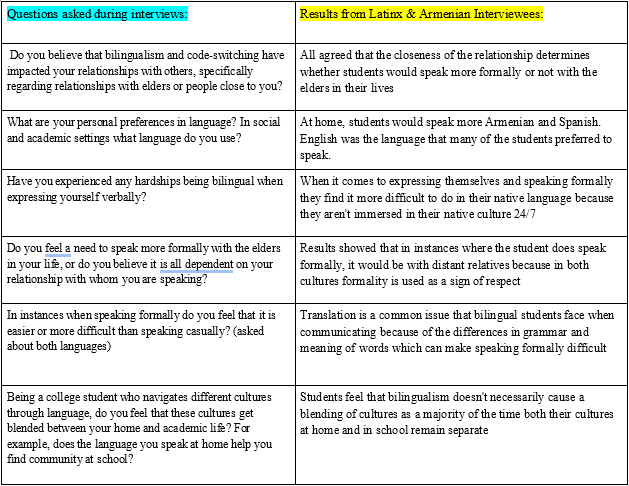
Have you ever wondered how code-switching and bilingualism can differ depending on the person you are communicating with? Do you feel that it can have an impact on relationships that are formed between people among different generations? This study explores how bilingual individuals across many generations who speak Armenian and English or Spanish and English may alter their approaches to communication when interacting with certain people. Additionally, we were curious to find out whether or not the closeness of people’s relationships affects their formality when communicating and code-switching. In order to find results, we conducted numerous semi-structured interviews and listened in on the conversations between college students and their relatives, while paying attention to word choice, syntax, and grammar when speaking. We concluded that (87%) of our interviewees believe that their relationship with their elders determines the formality of their communication style, often leading to difficulty when expressing oneself. By studying code-switching and bilingualism, we discovered a relationship between identity and communication that spans across generations.
Throughout our research, our target audience is the diaspora of bilingual individuals of a variety of age ranges, who speak either Spanish and English or Armenian and English. Our main goal is to focus on code-switching and the ways in which people of different generations communicate with one another. From our research, we sought to understand how students’ perspectives on being bilingual play a crucial role in understanding how speaking two languages can have an impact on their daily lives as they socialize with elders and people of their age. Prior to conducting any of our research, we hypothesized that Spanish and Armenian bilingual individuals would speak with more formality when with older family members and switch to speaking with less formality when with those whom they are closer to in age and relationship.
Methods
We looked at bilingual students who spoke English, and either Armenian or Spanish. We wanted to look at interactions between older and younger generations, so we focused on college students, as well as two parents with college children to have a contrasting perspective. Listening to phone calls allowed us to figure out which language was being used and when, although this method only allowed us to listen to one side of the conversation. We did this to see if there was a specific timing or reason that bilingual speakers switched the language being used. Another element we listened for in these phone calls was how formally college students were talking to those who were older than them. We determined formal speech by whether the speaker used slang, curses, or other language that would not be considered proper when speaking to the older generation. For Spanish speakers, the formal ‘usted’ was an indication of formal speech. After listening to phone calls, we also conducted interviews. The interview questions we used were open-ended and the same questions were used for all participants. We decided to use open-ended questions to allow freedom in responses. The questions asked can be found below, but all had to do with the participants’ thoughts on bilingualism as well as how they interact with those of the older generation.
Results and Analysis
Figure 1: Summary of interview questions and answers
Discussion and Conclusions
In conclusion, our research has provided us with valuable insights into the intricacies of code-switching among bilingual individuals within the Spanish-English and Armenian-English speaking diasporas. By focusing on intergenerational communication patterns, we have uncovered the significance of word choice and formality levels in interactions between different age groups. Our findings highlighted that the main influential factor for one’s word choice and formality of speaking was having respect for older individuals with whom they are communicating as such respect is a cultural facet. This evidence sheds light on the intricate connections between language, cultural norms, and social relationships, showing how language use is shaped by both internal and external environmental factors. Overall, our research has given us an extensive and comprehensive understanding of the nuanced ways in which bilingual individuals communicate in various social situations.
References
Babino, A., & Stewart, M. A. (2017). “I Like English Better”: Latino Dual Language Students’ Investment in Spanish, English, and Bilingualism. Journal of Latinos and Education, 16(1), 18–29. https://doi.org/10.1080/15348431.2016.1179186
Heredia, R. R., & Altarriba, J. (2001). Bilingual Language Mixing: Why Do Bilinguals Code-Switch? Current Directions in Psychological Science, 10(5), 164–168. http://www.jstor.org/stable/20182730
Mata, R. “Bilingualism Is Good but Codeswitching Is Bad: Attitudes about Spanish in Contact with English in the Tijuana – San Diego Border Area.” Critical Inquiry in Language Studies, vol. 20, no. 4, 2023, pp. 386–407, https://doi.org/10.1080/15427587.2022.2136672.
Meisel, J. M. (1994). CODE-SWITCHING IN YOUNG BILINGUAL CHILDREN: The Acquisition of Grammatical Constraints. Studies in Second Language Acquisition, 16(4), 413–439. http://www.jstor.org/stable/44487780
Code Switching in Bilingual Development: a video showing examples of children coded-switching to give readers an audio/visual representation of what code-switching is
Sarah Bassiry (Sky), Anna Harutyunyan, Akina Nishi, Jasmine Shao
Diaspora communities and heritage language speakers are a very unique population when it comes to language and bilingualism. Heritage speakers vary greatly in their language skills, language background, and environment. As heritage speakers are generally exposed to their heritage language only at home or in other limited contexts such as a cultural community group, this study investigated to see if social media may also be a context of heritage language exposure for some heritage speakers. If so, this study investigates the role social media might play in language competence. Four Eastern Armenian and four Mandarin heritage speakers attending UCLA and one native speaker in each language, were participants in this study. The participants were given a language background survey, a grammaticality judgment test, and an elicitation task judged by a dominant native speaker using a Likert scale. Initially, we expected to see a positive correlation between social media usage in the heritage language and the participants’ heritage language skills. However, the results did not provide sufficient evidence to support this hypothesis. Thus, further testing with a larger sample size is recommended to further investigate whether or not there might be a correlation.
The concept of bilingualism is interesting to discuss in the context of heritage speaker populations, as these groups include speakers of a vast variety of language competence. Heritage language speakers ‘may or may not be frequent users of the language or exceptionally proficient in the language” (Mahootian, 2000). Many heritage speakers are also receptive bilinguals, which Nakamura (2019) notes, “does not imply zero production of the weaker language but highly limited language use in interaction.” These speakers usually have strong listening and comprehension skills but weaker production skills in their heritage language.
This study sets out to determine if there is a correlation between heritage speakers’ social media consumption in their heritage language and their competence in that language. A prior study on bilinguals and newspaper consumption conducted by Moring (2011) et al., found media to be an instrumental resource in maintaining language competence. Flewitt and Zhao (2020) also conducted a study investigating the relationship between heritage speakers and social media usage. In their study, they observed two adolescent Mandarin Chinese heritage speakers and their usage of WeChat to connect with relatives in the heritage language. They found that WeChat acted as a “springboard to include multilingual practices” and facilitated a motivating environment of supportive feedback from interlocutors for their language to grow.
Given the previous research in the field, we hypothesized that our study would show that more frequent social media consumption in the heritage language will be correlated with a higher degree of language competence. Previous studies have noted that in the case of young children, engagement with social media often involves “several types of learning and socialization occurring all at once” (Zhao, 2019). In this study, we aimed to observe the role social media activity plays in the heritage language competence of young adults at UCLA.
Methods
The population this study investigated was heritage speakers of either Mandarin or Eastern Armenian who attend UCLA, testing 4 participants for each language. This project utilized survey methods, grammaticality judgment tasks, and elicitation tasks to investigate the research questions.
Our general survey asked participants basic questions regarding demographics, social media usage in the heritage language, and information regarding details of heritage language background and exposure. Two separate grammaticality judgment tests with 20 questions each were created by bilingual speakers of each language from the research team. The Eastern Armenian task tested plural suffixation and word order, the morphosyntactic structure of the language. The Mandarin task tested participants’ knowledge of aspect markers and measured words. We chose to test structures that differ from English, which are commonly lost by heritage speakers. They also included romanization and audio recordings of the tasks to account for the varying degrees of literacy.
The elicitation tasks consisted of a story-retelling exercise where the participants were virtually shown an animated short story from Youtube in the heritage language and then asked to retell the story in the heritage language. A Likert scale was then used by a native speaker to judge each participant’s fluency levels as they viewed the recording of the participant’s elicitation.
Results
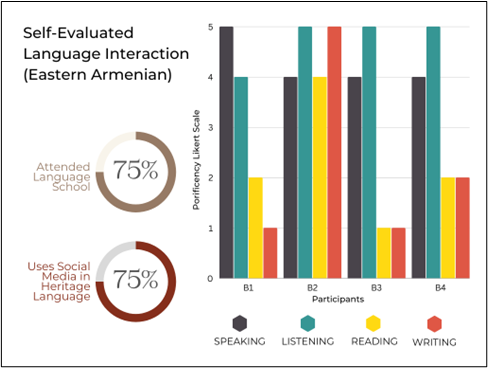
Figure 1. Self-Evaluated Language Interaction Survey Results (Eastern Armenian). Figure above shows that more than half of the participants use social media in their heritage language and received formal education in Armenian.
The participants in the study varied in the production and comprehension levels of their respective heritage languages, and their use of social media in the heritage language.
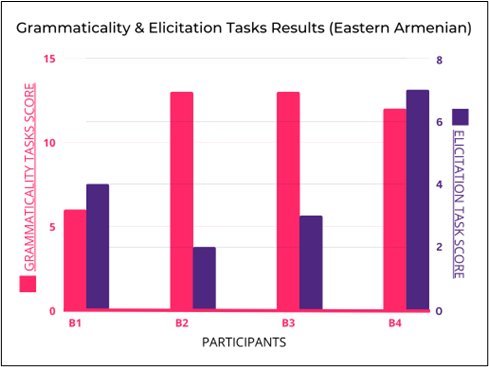
Eastern Armenian heritage speakers varied in their production and comprehension levels of the language. Based on the results of the elicitation and grammaticality tasks, it appears that receptive knowledge is not necessarily related to expressive knowledge. For instance, the native speaker ranked participants B2 and B3 as the lowest proficient speakers of the heritage language, but these same participants had two of the highest scores for correctly identifying grammaticality judgments in their heritage language.
Figure 2. Grammaticality & Elicitation Tasks Results (Eastern Armenian). Figure above shows that participants had varying results on the grammaticality judgment tasks and the elicitation task. Only B4 has high scores on both tasks.
Additionally, the Eastern Armenian heritage speakers who score the highest on the elicitation and grammaticality judgment tasks consumed social media in various amounts, ranging from rarely or never to as frequent as daily consumption. Participants B2 and B3 scored the highest on the grammaticality judgment tasks, but B3 said that they rarely or never consume social media in their heritage language, while participant B2 did so on a daily basis, in formats of video, audio, and text. Participant B4 scored highest on the elicitation task and the second highest on the grammaticality judgment tasks, and used social media in the form of Instagram video multiple times a month. Lastly, participant B1 scored the lowest on the elicitation task and had a somewhat low score on the grammaticality judgment task. They consume social media in their heritage language on a weekly basis in the form of audio and text.
All in all, the data from our Eastern Armenian speakers does not represent any correlation between social media usage and heritage language competence.
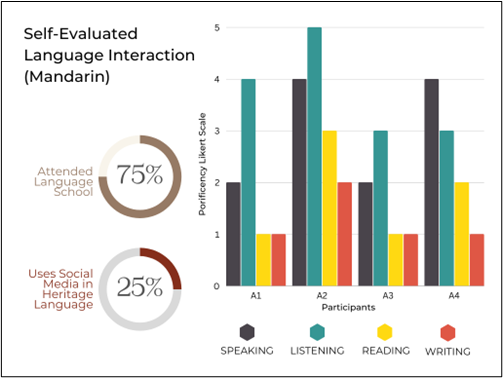
Figure 3. Self-Evaluated Language Interaction Survey Results (Mandarin). Figure above shows that more than half of the participants received formal education in Mandarin and only a quarter of the participants use social media in Mandarin.
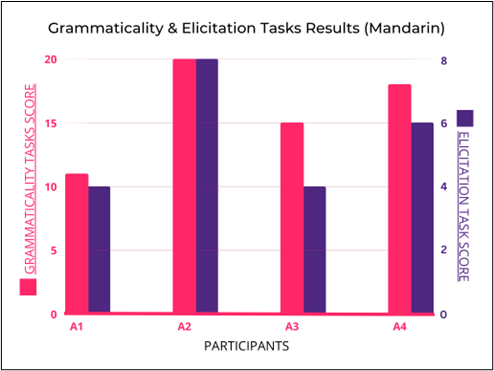
Our Mandarin heritage speaker participants also varied in their levels of fluency. Diverging from the lack of relationship we observed in Armenian, those who performed highly on one test usually performed highly on the other. Only one of our four participants for Mandarin, participant A2, expressed consumption of social media in Mandarin, and this participant also had the highest score on the grammaticality judgment tasks. This speaker could serve as one data point to support our hypothesis that heritage language social media consumption is correlated to higher levels of retention in the heritage language. However, participant A4 scored second highest on both tasks, but they do not consume social media in Mandarin. Participants A1 and A3 also do not consume social media in their heritage language and received lower scores on both tests. Although the rough possibility of a correlation exists in the Mandarin data set, there is not enough evidence to definitively support our hypothesis.
Figure 4. Grammaticality & Elicitation Tasks Results (Mandarin). Figure above shows that participants had varying results on the grammaticality judgment tasks and the elicitation task. Only A2 has high scores on both tasks.
Discussion and Conclusion
As a result of our investigation, we were unable to find supporting evidence for our initial hypothesis that higher social media consumption in the heritage language corresponds with higher competency in the heritage language. Some factors that led to this conclusion is the lack of concrete and frequent social media usage among the participants. For instance, in the Mandarin heritage speakers cohort, participant A2 claimed they use social media and received the highest scores on both tasks as seen in Figure 4, however, participant A4 who claimed they don’t use social media got the second-highest scores in the task. Similarly, in the Armenian heritage speaker cohort, participants B2 and B3 received similar results in both tasks (Figure 2) and the two highest on the grammaticality judgment task. However, participant B3 claimed they use social media never/rarely, while participant B2 uses social media on a daily basis. The contrast can be thought of to be due to formal instruction in the heritage language.
Our new finding, formal education, correlated with higher scores on both tasks. For instance, participants B2, B3, and B4 received formal instruction in learning Eastern Armenian. The Mandarin heritage speaker who performed the highest on both tasks, A4, also received formal education in Mandarin. This correlation was of interest for other scholars who claim that the lack of formal education has negative effects on the acquisition of the heritage language; children who don’t receive formal education do not learn the formal registers, vocabulary, and complex structures in written language (Montrul, 2010). Our data reflects the aforementioned claim as the participants who did not receive formal instruction in Eastern Armenian and Mandarin performed the lowest or second lowest on the grammaticality judgment task which tests their knowledge of the language grammar. While formal education can be a factor that influences higher competency in the heritage language, this correlation has to be interpreted in terms of production or grammatical knowledge. This is because the participants who received formal education performed well on the grammaticality judgment task, but not as well on the elicitation task. These results show that analysis between formal education and heritage language competency should be further investigated.
Another factor that can influence the participant’s competence in the heritage language is the age of exposure. There is contrasting data on how the age of exposure relates to language competence. Proponents of the Critical Period Hypothesis claim that children should be exposed to a language at a certain age to be able to acquire it native-like (Mahootian, 2020). Others claim that other factors such as ‘the child’s temperament or motivation’ can affect their learning of a language (Yuldasheva, 2021). In our research, we found that 7 out of the 8 participants in our study claimed that they were exposed to their heritage language from 0 to 3 years old, with one exception, A4, who claimed they were exposed to their heritage language from 4 to 8 years old. In addition, more than half of the participants, 5 out of 8, claimed that they were exposed to both English and the heritage language at the age of 0-3, simultaneously. The participant who performed the best on both tasks in Mandarin claimed to have been exposed to English and Mandarin simultaneously from the age of 0-3. The participant who performed the best on both tasks in Eastern Armenian stated that they were exposed to English from the age of 4-8 and Armenian, from the age of 0-3. This shows that age of exposure may not play a major role in the heritage speaker’s language competency. Perhaps, the difference lies in simultaneous and sequential bilingualism. Age of exposure to the heritage language may be a sufficient factor in the heritage language competency, however, this factor has to be accompanied by other factors, perhaps, social media consumption and formal education in the heritage language.
Another finding is that there may be a correlation between longer attendance to formal instruction and higher social media usage. Social media in the heritage language provides an extension to the traditional classroom setting. Going back to Zhao & Flewitt’s case study, heritage language speakers’ language practices on WeChat extended their “Chinese-speaking social world and provided them with opportunities to engage in contextualized, transnational heritage language and literacy practices beyond their home and Saturday Chinese school environment.” (Zhao & Flewitt, 2020). We could make the claim that formal instruction and social media in the heritage language complement one another to learn, and a longer history of instruction may motivate the bilingual speaker to seek more natural and conversation-based learning environments, such as social media.
Overall, claiming that the heritage speakers’ competency in the heritage language correlates with their social media consumption would be invalid based on the findings of our research. Other variables that can account for this contrast are formal education in the heritage language or age of exposure to the language. Perhaps, formal education in the heritage language could account for these three heritage speakers’ higher performance on the grammaticality judgment and in one of the cases, the elicitation task. In a similar manner, the age of exposure to the language can be a variable that influences the results. A detailed analysis above shows that these are sufficient factors of heritage language competency and the limitations of our study prevent further research into these variables. Some of the limitations of our study include a smaller sample size. With a larger sample size, the findings of our research could be more reliable and generalizable.
However, it was interesting to see a small sample size showcase such a wide variety of language proficiency. Bilingual heritage speakers have unique backgrounds in their heritage language because of many internal and external factors, such as “the role of the school system and other institutions, the historical experiences of particular language communities, the unique circumstances involved in the adoption by some communities or individuals of proxy HLs as part of the complex multiple identities of contemporary life, and the specifiable impact of a language ecological pattern over the life cycle of individuals and families” (Lo Blanco, 2001). Our participants had different characteristics, such as high proficiency in listening but lower proficiency in writing, or vice versa, as well as the amount of formal education, ranging from a couple of years to over 10 years.
For future research, if these methods are adapted, we suggest that elicitation tasks are performed in an in-person setting rather than virtual, where the native speaker listens to the heritage speaker’s elicitation and rates them in person. Additionally, the elicitation tasks should be reviewed by different native speakers. We believe that these changes will allow the results to be more reliable and generalizable.
References
Lo Bianco, J. (2001). Language Policies: State Texts For Silencing and Giving Voice. Difference, Silence and Textual Practice: Studies in Critical Literacy, 31-71.
Mahootian, S. (2019). Bilingualism. Routledge.
Montrul, S. (2010). Current issues in heritage language acquisition. Annual Review of Applied Linguistics, 30, 3-23.
Moring, T., Husband, C., Lojander-Visapää, C., Vincze, L., Fomina, J., & Mänty, N. N. (2011). Media use and Ethnolinguistic Vitality in bilingual communities. Journal of Multilingual and Multicultural Development, 32(2), 169–186. https://doi.org/10.1080/01434632.2010.541918
Nakamura, J. (2019). Receptive bilingual children’s use of language in interaction. Studies in Language Sciences, 18, 46-66.
Yuldasheva, D. (2021). Age and The Second Language Acquisition. Research Jet Journal of Analysis and Inventions, 2(04), 124-130.
Zhao, S. (2019). Social media, video data and heritage language learning. In G. Falloon, J. Rowsell, & N. Kucirkova (Eds.), The Routledge International Handbook of Learning with Technology in Early Childhood. Routledge.
Zhao, S., & Flewitt, R. (2020). Young Chinese immigrant children’s language and literacy practices on social media: a translanguaging perspective. Language and Education, 34(3), 267–285. https://doi.org/10.1080/09500782.2019.1656738.
In everyday conversations, bilingual speakers frequently code-switch between their languages. With our modern society, we can see this becoming prevalent in media during emotional scenes with bilingual characters; specifically in movies and TV shows. In this study, we investigated three different shows and movies with bilingual actors who use their heritage language as a part of their character to see whether there is a correlation with code-switching in highly emotional situations. We chose three sources to gather this data that have at least one bilingual main character; Jane the Virgin (2014), Everything Everywhere All At Once (2022), and Modern Family (2009). For each source, we analyzed around 120 minutes to have an equal amount of data. Analysis of this data found that code-switching during emotional scenes did occur, but was more prevalent in more recent media. The study helps to show that code-switching is becoming more representative for bilingual speakers in modern media.
Entertainment media heavily relies on creating a connection between the viewers and the characters and themes presented. The characters in media are often the biggest attraction because of their relatability. Thus, the representation of characters with different backgrounds, including gender, ethnicity, age, socioeconomic status, etc. is very powerful in shaping viewer and societal perceptions. Characters rely heavily on language and emotion to give away key details and shape who they are and what their role is. This is especially evident in American entertainment media with actors who play ethnic characters, with cultures other than dominant U.S. culture. Bilingualism and code-switching are some of the biggest tools used to portray identity within these characters’ roles. This makes their heritage language use very strategic and intentional for character depiction. Recognizing the power of media and how it aims to reflect real-life ideas, our project focuses on where entertainment media uses second languages, and how it intersects with emotion to reflect ideas about a language or a character.
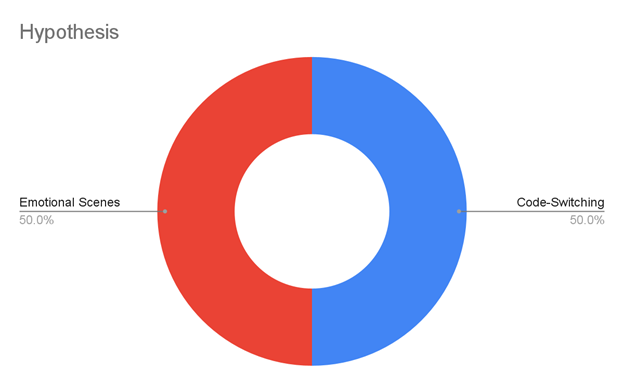
Our project focuses specifically on bilingual actors within entertainment media who use their heritage language as part of their character. We want to investigate when this heritage language is used and if it is associated with highly emotional scenes or situations. Research on language and emotion in real-life scenarios has indicated that language use and choice can be influenced by emotions that we correlate with that language. Looking specifically at American media, our goal is to observe whether or not heritage language use occurs in more emotional situations than non-emotional scenes, and identify if there are emotions that occur more often in a heritage or dominant language. This project will be focusing on language contexts, both positive and negative, and then observing what language it occurs in. Based on our own experiences with code-mixing, media depictions, and language perceptions, we hypothesize that in highly emotional situations, characters will code-switch to their heritage language, other than English. We predict that the characters are written to represent real-life bilingual speakers to deepen their character and the media. Many viewers may find this relatable or can connect with the cultural identity of both languages being presented – which could contribute to further media representations.
Gaps in Research
Though bilingual speakers often use one language in specific settings, and the other in other settings (e.g. heritage language at home and in informal contexts, and dominant language in formal settings like work, especially if that second language is the standard language of their country), they also often use both languages at once (Ferguson, 1959). This most commonly happens when speaking to other bilingual people, but it does happen elsewhere as well. This use of both languages at once is referred to most commonly as code-switching, where interlocutors will use both languages at their disposal within the same utterances, often without consciously making the decision to do so. Though there are many ways and uses of communicating via multiple languages at once, a prominent trigger for code-switching comes from emotionally arousing situations. One study found that, through direct observation of participants in a high-stress problem-solving task, people code-switched more frequently when expressing negative emotions. Specifically, participants switched to their heritage language to express these negative feelings rather than using the dominant language (Williams, Srinivasan, Liu, Lee, Zhou, 2020). We anticipate that our study will recognize some of the same characteristics of code-switching and plan to focus on a character, then identify the number of situations in which this occurs.
Additionally, in these highly arousing emotional situations, it is more likely that speakers use their first language to react, rather than their second language. We see this in the study conducted by Ariana Mohammadi titled, “Swearing in a second language: the role of emotions and perceptions.” Additionally, a study conducted by Shahrzad Mahootian covers these emotional situations in their study and they state, …the list of evocative switches was “more meaningful” in Spanish, that they carried “more emotional power,” (“emotional statements will be said in Spanish. English is not sufficient”) that they were used to “create solidarity,” that they were “much stronger” when said in Spanish (Mahootian 2005). This study helps to show how speakers would be more motivated to code-switch in order to convey their words more effectively between themselves and their listeners. As we have shown, there has been a good amount of research done on the connections between code-switching and heritage language use with emotion but this research has not been carried over to the media. There has not been research done specifically on character use of code-switching and heritage language use and the emotion of their character or scene. We hope to fill this gap with our research in this project and we can anticipate that the media we have chosen for our study will be able to reflect these previous findings.
Methods
To understand whether code-switching occurs in half or more emotional instances in media, we used three sources that each include at least one bilingual main character and are from the 21st century. Specifically, Jane the Virgin (2014), Everything Everywhere All At Once (2022), and Modern Family (2009).
From left to right: Jane the Virgin (2014), Everything Everywhere All At Once (2022), Modern Family (2009)
Additionally, we made sure that all three of these sources’ bilingual characters’ heritage languages were relevant to the characters themselves, but not a dominant focus for the storylines. All bilingual characters were interacting in a space where their heritage language is not the dominant language (which is English in all three sources).
We analyzed roughly 120 minutes of each source to ensure that the amount of data we collected from each would be equal, based on the length of Everything Everywhere All at Once. (We looked at three Jane the Virgin episodes (each ~40 minutes), and 6 Modern Family episodes (each ~20 minutes)).
We noted (coded) each instance of an emotional scene in each source, as well as instances of code-switching within these emotional scenes. This would allow us to calculate a ratio (number of code-switching instances in emotional scenes divided by the total number of emotional scenes), and thus a percentage, to understand how accurate our hypothesis is.
Before coding each source, we defined what “emotional” meant to ensure that each researcher was coding via the same guidelines. Highly emotional instances could come in the form of:
Voice: raised voice, yelling, screaming, whimper
Exaggerated body language
Clearly emotional facial expressions that last (e.g. no microexpressions)
Crying
Results
Everything Everywhere All At Once
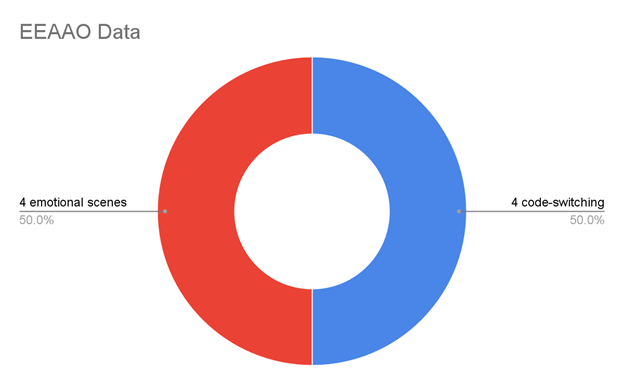
4 code-switching instances in 8 total emotional scenes → 50% code-switching
Jane the Virgin
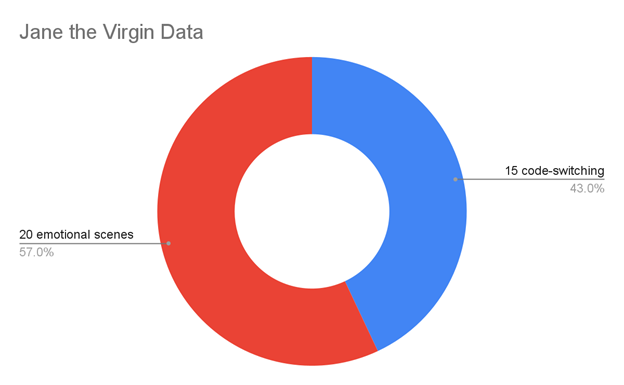
15 code-switching instances in 35 total emotional scenes → 43% code-switching
Modern Family
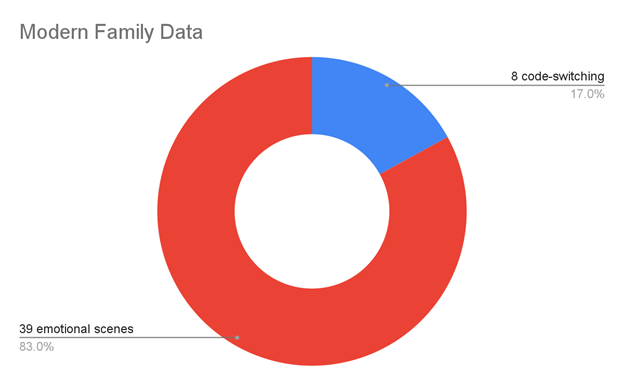
8 code-switching instances in 47 total emotional scenes → 17% code-switching
Combined: 27/90 → 30% of all emotional scenes across the three sources included code-switching.
Everything Everywhere All At Once was the only source to meet the hypothesis that at least half of the emotional scenes would include code-switching. However, it is important to note that there was quite a bit of diversity in how many instances of emotional scenes there were per source. Everything Everywhere All At Once only included eight, likely because it has deep themes compared to the sitcom-like shows, and the scenes are generally longer. Modern Family, on the other hand, is fast-paced (only 20 minutes per episode) and includes generally more exaggerated characters, leading to their behaviors being more exaggerated and emotional as well. This is reflected in the 47 total emotional scenes, compared to the eight from the movie.
However, even though Modern Family had the most emotional scenes, it had the lowest ratio (17%) – this is likely because there is only one bilingual character (Gloria), giving her fewer opportunities and reasons to code-switch (e.g. code-switching out of instinct when stepping on a Lego, versus code-switching to communicate an idea to someone who also speaks English and Spanish that she wouldn’t otherwise be able to explain).
Visual Media
Patterns and Analysis
Results of our study did not exactly align with our data but did highlight some interesting patterns. There were three particular patterns that were recurring in the data and had a similar basis to previous research in the realm of bilingualism in the media.
The first pattern observed from our data was the use of bilingual code-switching for reference terms. In all three of the media forms, characters code-switched when referring to another character they were close to or comfortable with. In Jane the Virgin, this was observed with the consistent referral to Jane’s grandmother as “abuela,” even when the rest of the sentence was in English. ‘Gloria’ in Modern Family also did this frequently when referring to her husband with terms of endearment such as “mi amor” (season 9, episode 3) and when referring to Haley’s children as “mis niños” (season 11, episode 6). This pattern touched on previous research that found that heritage language is used when speakers are more comfortable, which would make sense for using with family (Cho, 2015).
Another pattern observed was use of bilingual code-switching as a form of addressing certain audiences. During scenes where characters were in the presence of other bilingual characters, or when they wanted to speak to someone directly, sometimes to the extent of using language to be private. This example was seen in Everything Everywhere All At Once when ‘Evelyn’ is standing up to ‘Gong Gong’ and switches between languages to focus on different scenarios, despite him understanding each of the languages. Evelyn chooses to code switch from Cantonese, English, and finally Mandarin to allow the listeners of that scene, her daughter and husband, to better understand her feelings. Other scenes like in Jane the Virgin used code-switching to Spanish to make sure the police didn’t understand their plan of action while he was in the room. This pattern is reflective of previous research that concluded that negative languages are more typically expressed in the heritage language, which could explain why it was used to exclude someone from a conversation (Williams, Srinivasan, Liu, Lee, Zhou, 2020).
Finally, we observed bilingual code-switching as an indicator of urgency. Characters who were experiencing a sense of urgency and trying to communicate this hurry used code-switching to do so. This example can be seen in Everything Everywhere All At Once when Evelyn is dealing with multiple stressful situations while her family members are adding to that stress, which makes her frantic. The audience can see her emotions overflow as she code switches from Mandarin to English in order to fully express her frustration in that situation. Given that urgency could be related to other feelings, such as stress and desperation, this observation came closest with our hypothesis.
Despite the shows having different content matter, being different genres and having different amounts of bilingual characters (and thus different instances of code-switching), these were patterns that overlapped in at least two of the three media examples used. The patterns occurred in various examples throughout each of the shows and seemed to be consistent parts of the character and their role in the plot. Each of the patterns identified was relevant in various instances throughout the shows and highlighted some real-life uses for code–switching and bilingualism. Although it wasn’t what we were expecting, it definitely taught us a lot about what to expect for bilingualism in both media and everyday life.
Limitations
Within our study, there were some limitations that potentially contributed to the results being different than our predictions, but definitely impacted the process. In relation to content, our project primarily focused on three media examples. Had we used more than two shows and one film, our results may have had more range in code-switching and examples of bilingualism. Essentially, a wider range in media examples would have been more beneficial for getting a wider scope of media examples. This connects with the second limitation: variation within the media content examples. Modern Family definitely had more “feel-good,” positive moments which is different from Jane the Virgin which dealt with heavier themes and was more of a drama. While this variation was definitely better for maximizing examples of bilingual code-switching, the lack of consistent storylines and genres didn’t allow for the same amount of opportunities for code-switching during impassioned speech. Instead, the variation in content and storylines would have made code-switching more of a chance occurrence than a predictable feature.
Finally, perhaps the most impactful limitation in our research project was that most characters were the only bilingual characters in the show. This was specifically the case for Modern Family, where ‘Gloria’ was the only character who spoke Spanish and didn’t have any other main character to speak it with. In Jane the Virgin, even though ‘Jane’ and ‘Xiomara’ were Spanish-English bilinguals, they would respond in English and ‘Abuela’ was the only one who spoke Spanish the entire time. Each of these limitations could have contributed to the results and for future studies would be important to avoid.
Future Study
Considering the limitations previously mentioned and in collaboration with the patterns mentioned, a refined, future study would certainly involve a wider range of media for observation. For standardization purposes, it would be important for shows to be produced and based in the US, be from the same range of years (as in our example, the last two decades/the 21st century), and have the same amount of minutes watched, but this new study would focus on shows with more bilingual characters. Considering these elements and our previous interest in bilingualism and code-switching in the media, further research conducted could be based upon media that covers different backgrounds to be more inclusive towards the American audience. We can see a trend of this from big companies, like Disney, who have produced movies like Encanto and Turning Red. With this trend of inclusivity, there is a high possibility of representation for bilingual speakers in future media. In turn, this would allow for more possible studies to look into the instances of code-switching during emotional scenes.
Conclusion
This analysis of bilingualism in media is a good first step for better understanding how bilingual and multicultural people are represented through TV, specifically to American, English-dominant audiences. However, no broad conclusions can be drawn from this study alone; without a large sample size, we may have missed important themes and patterns on the representation of code-switching from real life, or the patterns that we did find may not appear to the same degree on a larger scale.
A larger sample size, both in terms of the amount of minutes analyzed for each source, and the amount of diverse sources chosen, should be used to create a clearer picture of how writers choose to represent bilingual characters’ language use in media.
Despite the limitations and potential to make this study broader, this introductory analysis still has shown how some patterns of code-switching (proven to be common via research studies mentioned earlier) in real life are accurately represented in media as well. As the representation of multicultural and multilingual people in the United States is being more and more encouraged in American media, the more we are actually seeing it. As in Everything Everywhere All At Once – the most recent, and most diverse, media source used in this study, it was the one source that did meet our hypothesis (50% code-switching in emotional scenes).
As screenwriters continue to portray a more accurate representation of the diversity in the United States, the more we should expect to see multi-language dialogue, filled with code-switching in these shows and movies. In future studies, a specific focus on the function of code-switching by bilingual characters, both in and out of emotional contexts, could give even more insight into how multilingual and multicultural people are represented in older media versus current media. Some examples of code-switching (and code-mixing) functions include keeping conversations private from others, raising the status of the agent who is speaking, making side comments or humorous remarks, emphasizing what is being said, or reiterating something (Gumperz, 1982). Taking this approach and categorizing the linguistic reasons for code-switching would be a great potential first step for understanding where United States media companies are at in terms of true representation of the diversity in this country.
References
Cho, G. (2015). “Perspectives vs. Reality of Heritage Language Development Voices from Second-Generation Korean-American High School Students.” https://files.eric.ed.gov/fulltext/EJ1065385.pdf
Ferguson, C. A. (1959). “Diglossia” WORD, vol. 15, no. 2, pp 325-340., https://doi.org/10.1080/00437956.1959.11659702
Lee, J. S. (2010, April 23). The Korean Language in America: The Role of Cultural Identity in Heritage Language Learning. Taylor & Francis Online. Retrieved February 5, 2023, from https://www.tandfonline.com/doi/abs/10.1080/07908310208666638
Mahootian, S. (2005). Linguistic change and social meaning: Codeswitching in the media. International Journal of Bilingualism, 9(3-4), 361-375.
Mohammadi, A. N. (2020). Swearing in a second language: the role of emotions and perceptions. Taylor and Francis Online. https://www.tandfonline.com/doi/full/10.1080/01434632.2020.1755293
Williams A, Srinivasan M, Liu C, Lee P, Zhou Q. Why do bilinguals code-switch when emotional? Insights from immigrant parent-child interactions. Emotion. 2020 Aug;20(5):830-841. doi: 10.1037/emo0000568. Epub 2019 Mar 14. PMID: 30869940; PMCID: PMC6745004
Ashley Ghodsian, Madeleine Kostant, Maxime Guerra, E Perez
There are various classifications for bilingual speakers in the formal study of bilingualism. Among these are heritage speakers, who have acquired a minority language in the home prior to gaining dominance in their majority language of the society upon being exposed to it in the community and in school. This results in unbalanced bilingualism in detriment to the minority (or heritage) language, a process of grammatical loss or weakening known as attrition. The emphasis of this study is whether this attrition in the heritage language can be attributed to transfer from the majority language, or if it is due to general loss of input or other extralinguistic factors. In order to accomplish this task, this study analyzed a specific syntactic (or sentence structure) construction, prepositional relative clauses, in populations of English-dominant and French-dominant heritage speakers (“HSs”) of Spanish. We hypothesized that previously reported attrition in the grammars of English-dominant Spanish HSs was due to dominant language transfer from English and that French-dominant HSs would not exhibit this same attrition. We conducted both receptive judegment tasks and oral production tasks in order to test this phenomenon, and found evidence that seems to largely be in favor of our hypothesis. We conclude by commenting on the broader implications of our research on bilingualism and pedagogy, especially as it relates to heritage language maintenance.
This study aims to examine heritage speakers’ attrition through the lens of dominant language transfer by probing this question with two groups of HSs: English-dominant Spanish HSs and French-dominant Spanish HSs. To do so, we focus on the syntactic structures of prepositional relative clauses. Relative clauses (“RCs”) are clauses used to modify a noun (e.g., In The dress that Mary wore was very old, the clause that Mary wore is an RC that modifies the noun phrase the dress.).
Prepositional relative clauses, which are notable because they contain a prepositional object, have two possible realizations in a sentence. The first is preposition-stranding (“P-stranding”), which occurs when a preposition is “stranded” at the end of a relative clause (e.g., The track which they train on _ is slippery and dangerous). The second, pied-piping, occurs when the preposition and the wh-element move together to the front of the clause to form a relative clause (e.g., The track on which they train _ is slippery and dangerous). All three languages explored in this study—Spanish, French, and English—accept pied-piping constructions. Our central motivation behind choosing these three languages, however, stems from the fact that English accepts P-stranding, but it is ungrammatical in both Spanish and French. We will return to this cross-language split of grammaticality with P-stranding shortly.
Several previous studies on this topic have inspired our investigation and experimental design. Kim (2007) found that Korean HSs in the U.S. exhibited more attrition of a specific syntactic construction than their counterparts in China. Although this had to do with a different construction than P-stranding, the findings demonstrate language transfer in action, specifically because Korean and Chinese share the same grammatical setting with respect to the construction being tested, whereas English holds a different setting from the other two. This study has been the largest source of motivation for us to investigate dominant language transfer for other types of syntactic constructions.
Further research on P-stranding and Spanish heritage speakers inspired our experiment design, notably Depiante and Thompson (2013) and Pascual y Cabo and Soler (2015). Depiante and Thompson (2013) conducted acceptability judgement tasks with heritage Spanish-English bilinguals, asking their participants to judge pied-piping and P-stranding in various constructions, including relative clauses. They determined that Spanish HSs generally accepted P-stranding more than their Spanish-dominant counterparts. A follow-up study by Pascual y Cabo and Soler (2015) replicated the experiment and further found that the timing of English acquisition also had a notable effect on the rate at which the speakers accepted P-stranding. Both of these studies relied on receptive judgement tasks in which participants read sentences and evaluated their grammatical acceptability. Our study seeks to contribute to this conversation by combining oral production tasks alongside receptive tasks.
The other gap in research that we hope to fill has to do with testing the two different groups of heritage speakers that we are studying, as previously mentioned. Our research question is as follows: is the apparent attrition of Spanish heritage speakers’ grammar (i.e., the acceptance of preposition-stranding) due to a general loss of input or to transfer from the grammar of the dominant language? We are able to investigate this question largely because the three languages we are exploring have the same pattern as the three languages in the Kim study: P-stranding is grammatical in English but ungrammatical in Spanish and French. Therefore, if we find no difference between our English-dominant and French-dominant speakers, we would not be able to attribute any potential attrition to transfer from the dominant language. However, if we find that our English-dominant HSs accept and produce P-stranding at a higher rate than the French-dominant HSs—which is what we hypothesize for this study—we can make the claim that this is due to the fact that English accepts P-stranding and French does not, and therefore that attrition is due to dominant language transfer in the case of prepositional RCs.
Methods
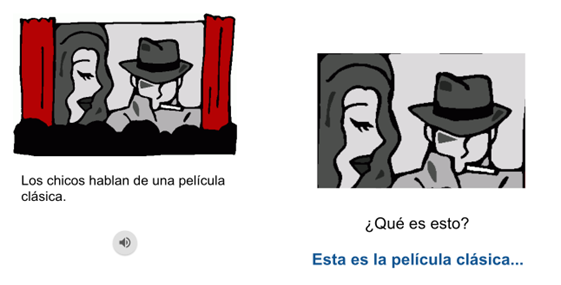
We recruited six participants total; five Spanish-English bilinguals from the U.S., and one Spanish-French bilingual from France. All of the speakers were heritage speakers of Spanish, with ages ranging between 19-23 years old. After recruitment, participants completed our experiment in several stages. First, they completed the production task over Zoom, during which they were shown a presentation with clipart images and accompanying sentences, some of which were test sentences and some of which were fillers. Each test sentence contained a prepositional object, and participants were prompted to rephrase that sentence with a relative clause so that we could see where they placed the preposition. An example of one of these slides is shown in Figure 1 below.
Figure 1. Example from the elicitation task in which participants are prompted with the first sentence (left), “The children talk about a classic movie,” and are then required to complete the second one (right), which asks “What is this? This is the classic film…” and results in the response “… about which the children talk” if participants use pied-piping or “…which the children talk about” if they use preposition-stranding.
After the production task, participants completed a “pre-survey” called the Bilingual Language Profile (BLP) (https://sites.la.utexas.edu/bilingual/), a tool that linguistics researchers use to determine the language exposure and dominance of bilingual speakers. The BLP contains 19 main questions, each with their own sub-questions, which probe participants’ language exposure, linguistic history, daily use, confidence in fluency, and linguistic identity. All of this data is then used to automatically generate a dominance score, which determines which of the two languages the participant is dominant in. We used the dominance score and our participants’ self-reported ages of exposure in order to ensure that all participants were heritage speakers.
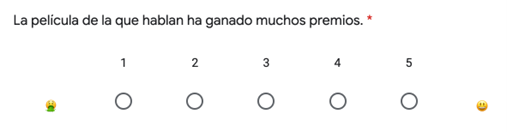
After the BLP, participants completed a main survey (the receptive task) in which they ranked sentences with relative clauses with prepositions, in addition to filler sentences, on a scale of 1 to 5 based on how natural or unnatural they sounded according to their intuitions. Our test conditions were evenly divided between pied-piping and P-stranding sentences. An example of one of our test sentences is shown below in Figure 2.
Figure 2. Example from the receptive task where participants were asked to rate sentences on a scale of 1-5 based on how natural or unnatural they sounded. This sentence is a pied-piping example, and it reads: “The film about which they speak has won many awards.”
Results
We found that for both the elicitation and receptive tasks, the Spanish heritage speakers from the U.S. produced or accepted P-stranding at a higher average rate than the participant from France. It is important to note that we ended up having four (4) Spanish heritage speakers from the U.S. and one (1) from France. Initially, we had five (5) participants from the U.S., but one of them rated the aforementioned “good” (i.e., grammatically correct) control sentences in the acceptability judgment task too low; as such, we disregarded their data.
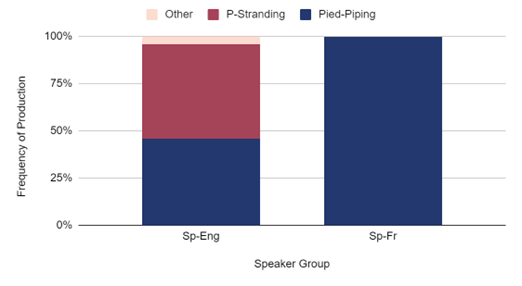
Figure 3 below presents the production task results. The U.S.-based Spanish heritage participants produced P-stranding constructions 50% of the time, compared to 0% of the time for the French participant. For example, each participant was given the prompt: “Los meseros trabajaban con una cocinera famosa. Esta es la cocinera famosa…” (‘The waiters worked with a famous cook. This is the famous cook…’) and asked to complete the sentence. Two out of four (50%) of the U.S. participants responded with “…que los meseros trabajaban con” (‘…whom the waiters worked with’), stranding the preposition “con” at the end of the phrase. In contrast, the French participant responded “…con que los meseros trabajaban” (‘…with whom the waiters worked’). Given that P-stranding is not grammatical in French or Spanish, these results are in line with our hypothesis, which predicts that the English-Spanish bilinguals would produce more P-stranding than their French-Spanish counterparts due to transfer from English grammar.
Figure 3. Average Production Results Across Speaker Groups: out of all opportunities to produce P-stranding (every relative clause with a preposition), the 4 U.S.-based speakers produced it 50% of the time whereas the participant from France did not produce it at all and produced pied-piping 100% of the time.
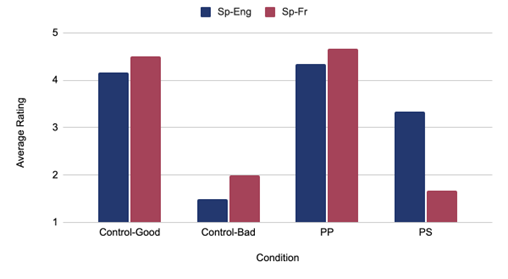
Figure 4 below presents the acceptability task results. As explained above, the participants were given a mix of P-stranding, pied piping, and grammatical and ungrammatical filler sentences in Spanish, and asked to rate their grammatical acceptability on a scale of 1 to 5 (5 being the most acceptable). The U.S.-based Spanish heritage participants rated P-stranding constructions to be an average of 3.33, compared to 1.67 for the French participant. For example, when given the sentence “La serie que hablan de tiene críticas muy buenas” (‘The show which they talked about has really good reviews’), the Spanish-English bilingual speakers gave it an average acceptability rating of 4 compared to 2 for the Spanish-French bilingual speaker. These results align with our hypothesis, which predicts that the Spanish-English bilingual speakers would accept P-stranding more than the Spanish-French bilingual speaker due to transfer from English grammar.
Figure 4. Average Acceptability Ratings Across Speaker Groups: Spanish-English bilinguals judged P-stranding with an average rating of 3.33 out of 5 on an acceptability judgement scale and the Spanish-French bilingual judged P-stranding with an average rating of 1.67 out of 5.
Discussion
Our data from both the elicitation and acceptability judgement tasks provides evidence in favor of our hypothesis that attrition experienced by Spanish heritage speakers with respect to the production and judgement of prepositional relative clauses is due to grammar transfer from their dominant language. It is important to note that due to our small sample size, these results are just numerical comparisons of averages; we cannot assert statistical significance.
The asymmetry between our speaker groups (four (4) from the U.S. and only one (1) from France) is another significant limitation for this experiment. It was difficult to recruit Spanish heritage speakers from France given that we are based in the U.S. and considering the time constraints on our experiment. For example, one of our U.S.-based participants never produced P-stranding constructions in her elicitation task. If she had been our only participant from the U.S., our results would have shown no attrition in the production task for either speaker group. However, we are attributing this to her dominance score from the Bilingual Language Profile (see “Methods”), because she was the only participant whose score was slightly dominant in Spanish. The other three (3) Spanish-English bilingual speakers were dominant in English, and the Spanish-French bilingual speaker was dominant in French. Our hypothesis allows for these results because it attributes attrition to grammar transfer from one’s dominant language; therefore, a heritage speaker dominant in Spanish may not exhibit attrition to the same degree as one dominant in the majority language of their society.
Another potential limitation could be the fact that our French participant had been learning Spanish formally in school for most of his life, while none of the U.S.-based participants reported taking Spanish for more than a couple of years. Foreign language educator Dr. Kathleen Stein-Smith highlights the discrepancies in second-language education between the U.S. and European countries in her 2013 Ted Talk, “The U.S. foreign language deficit” (https://www.youtube.com/watch?v=8CZ7zu5Aeu0). She argues that educational institutions, businesses, and government-funded programs can help to promote foreign-language teaching at the societal level. While our French participant was a heritage speaker of Spanish (and therefore not learning Spanish as a “second” language), the fact that France has such a comparatively robust Spanish language curriculum was unavoidable and may have skewed our results. If a speaker is explicitly taught prescriptive grammatical rules—for example, not to strand prepositions—they are less likely to violate these rules than speakers with no formal education in a language they only acquired in the home.
Conclusion
This experiment allowed us to explore the source of grammatical attrition in Spanish heritage speakers in terms of producing and accepting prepositional relative clauses. We conducted an elicitation task and an acceptability judgement task for five (5) participants: four (4) Spanish heritage speakers from the U.S. and one (1) from France. We found that on average, the participants from the U.S. produced and accepted P-stranding constructions more than the participant from France. Given that English allows P-stranding and French and Spanish do not, these results provide evidence in favour of our hypothesis that grammatical attrition in heritage speakers is caused by transfer from the grammar of speakers’ dominant languages. In other words, our study suggests that the participants from the U.S. are allowing and producing P-stranding in Spanish because they are dominant in English, which allows P-stranding. These findings shed light on how and why heritage speakers experience grammatical attrition, and have pedagogical implications for reinforcing heritage speakers’ language maintenance in the classroom. Bilingual education advocate Aminah Ghanem sheds light on the importance of reforming the U.S. language education system in order to promote multilingualism in her 2019 Ted Talk, “Reforming Our Bilingual Education System” (https://www.youtube.com/watch?v=vvCUk9qJQmE). She highlights the positive effects of multilingualism in terms of celebrating diverse cultures, preventing language discrimination, and the marginalisation of heritage speakers. We hope that our study will contribute to this conversation and promote future research and educational policy decisions as they affect heritage bilinguals.
Isabelle Sandbank, Leonardo Diaz-Garcia, Huiyu Liu, Taehwan Kim
This study investigates the variations in code-switching behaviors between undergraduate students and faculty members at UCLA, with an emphasis on the generational impacts on word choice and conversation content. It utilizes a mixed-methods approach that incorporates surveys and text analysis, and it reveals that while both professors and students code-switch, there are clear disparities in their patterns of when they do it. In particular, younger students regularly code-switch with abbreviated phrases or words, whereas senior faculty members and professors typically tend to use formal language. Additionally, it also reveals that the word and phrase choices used while code-switching differ between generations, with younger students selecting more colloquial language when talking about day-to-day affairs and older faculty members favoring more modern language use and more serious topics. These results have significant repercussions for comprehending how generational disparities influence language practices and social identities.
UCLA is known for being a very multicultural and diverse university, according to the school’s website. Through its population, it represents 118 countries and is home to over 5,000 international students (UCLA Facts & Figures, 2023). Within this body are multilingual students, professors, and faculty, some of which have the ability to switch between two languages, or varieties, at once, also known as code-switching (CS) (Washington-Harmon, 2022). Code-switching, a widely used technique, enables multilingual speakers to jump between languages without losing the syntax or structure of the prior language. People often code-switch from one language, such as English, to another, like their home language, in order to identify with a specific social group or convey specific information. Through the categorization of code-switched words in text messages, we were able to distinguish linguistic variations in word choice between bilingual UCLA undergraduates and the older professors and faculty members of the university to show that age affects the content of CS.
Background
Code-switching (CS) is a common phenomenon in multilingual communities (Bhatti, 2018). It is often a useful communicative tactic for bilingual communities as they believe code-switching helps them express what they want to communicate more clearly, directly, and efficiently (Bahous, 2013). It’s interesting to see that many who code-switch do not realize it- most students who speak in a bilingual environment do not realize that they are infusing English terminology when using a non-English language, and it seems that audience, context, identity and the effectiveness of information transmission will make multilingual people code-switch (Sichyova, 2005). This isn’t from unawareness due to a young age, as a recent study shows that even teachers do not realize that they code-switch (Bahous, 2013). Although we are aware of code-switching among both professors and students, there is still a lack of research that examines the linguistic disparities between these two cohorts.
Changes in CS patterns are also inseparably linked to personal experience. The speaker will tend to change languages according to the conversational style of the person whom they’re talking to; they will move between obvious CS and non-obvious CS, indicating their position in the group (Ellison, 2021). According to the findings of the Ellison study, which looked at the patterns of code-switching between languages such as Hindi and English, it was found that people of different ages often have distinctive and unique methods when it comes to changing between languages.
Does this mean that students and professors differ in their word choice of code-switching as well? Although previous research has looked at code-switching situations, this is currently a new idea and one we would like to explore.
Methodology
The population includes two distinct school cohorts, comprising of undergraduate students and faculty members at UCLA, with different age groups and unique school identities. Yet, each has something in common: they are all bilinguals. The experiment was conducted by sending out surveys to the UCLA community and asking them to share conversation logs screenshots. In the survey, participants would be asked about their demographic (i.e. gender, age, and school identity), their awareness of code-switching, and the frequency of code-switching in different scenarios. Furthermore, the participants were requested to share their email addresses voluntarily to facilitate follow-up communication, enabling us to collect the screenshots of their conversation logs at the end of the survey.
We used the judgmental sampling method, which uses our knowledge to select the individuals or cases to be included in the sample based on the research question addressed. Judgmental sampling method is a method that targets a population and maximizes the benefits of the analysis (Jagero, 2011). This provided a direction for data collection for our project.
After collecting surveys and participants’ conversation logs, researchers translated, transcribed, and categorized their code-switched sentences and words before analyzing possible patterns of code-switching between our established age parties (undergraduate students and faculty/professors).
Acknowledging the potential for bias in our study prior to presenting our findings is vital. The text samples are more susceptible to bias compared to our surveys. This is because there is a possibility that certain participants may have selectively shared specific segments of their text conversation with us, and the screenshots of the conversations shared by students and teachers may only represent a subset of the entire conversation.
While we may use alternate techniques of data gathering in future research, we must emphasize that for this specific study, we must consider the chance that it may not be composed of all possible data. Privacy issues are in fact a delicate subject that cannot be ignored, but something we would’ve hoped to get around.
Results and Analysis
Our research revealed that undergraduate students had a proclivity to employ abbreviated phrases or words via code-switching more often than faculty, who were more inclined to incorporate formal language while code-switching. By comparing two sets of conversational logs between undergraduate students and faculty, we observed that the former demonstrated a higher rate of code-switching within the logs as well.
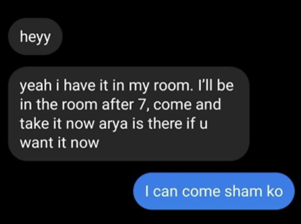
Figure 1: CS Text message in English (switching to Hindi) from undergraduate student to another Shaam ko: “right now”
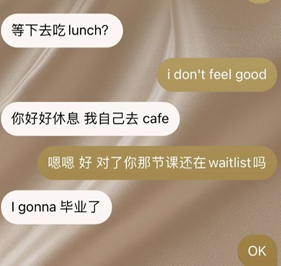
Our analysis revealed that undergraduate students were more apt to partake in code-switching during informal conversations with close friends. We observed this phenomenon primarily through the use of nouns pertaining to daily life (e.g., lunch, cafe, and waitlist, see Figure 2). Moreover, these students tended to initiate sentences with shorter verbal phrases such as “I gonna” and “I am”, while also utilizing code-switching at the conclusion of a sentence when they wished to express a particular time frame, specifically denoting in English for requests to happen “right now” or “today” (see Figure 1).
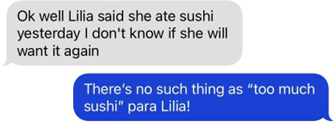
Figure 2: CS Text message in Mandarin (switching to English) from undergraduate student to anotherFigure 3: CS Text message in English (switching to Spanish) from faculty to another older adultsFigure 4: CS Text message in Russian (switching to English) from professor to another older adult
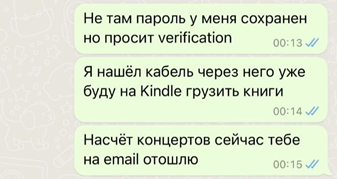
Faculty seem to talk most about modern issues such as technology or politics, but at times, even in simple conversations such as talking about what to eat for dinner, they may code-switch just to use the word “for” in their native language (see Figure 3). Prepositions were a common code-switched word in faculty conversations. Further screenshots provided by UCLA faculty revealed a preference for proper nouns and more formal terms, such as “Kindle,” “verification,” and “email” (see Figure 4). Our data demonstrated that undergraduate students code-switched more often than faculty members when communicating through text messaging, or at times, more common to professors, email.
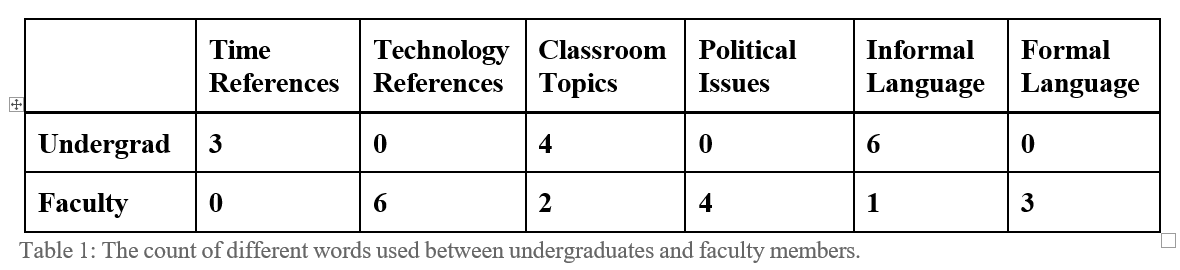
As stated so far, we’ve found code-switched words to fall into similar categories, such as prepositions, technological terms, legal jargon, or classroom topics. Table 1 categorizes the words used between undergraduates and faculty in order to more easily display the differences between both groups. The last two categories are a little vague- informal language relates to any time in which the participants shortened their words (example: “u” for “you”). Formal language relates to any time in which participants used words often meant to be polite (example: Mr. or Mrs.).
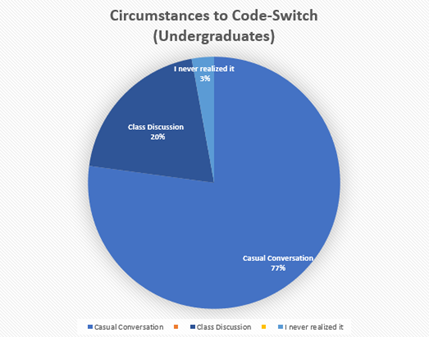
Figure 5: Pie Chart Denoting Undergraduate Code-Switching Circumstances (Casual Conversation: 27, Class Discussion: 7, I never realized it: 1); n = 35
In our survey, we asked both parties under which circumstance they code-switched in more to see if it may provide an explanation for the texting outcomes we obtained. For example, perhaps faculty talked about citizenship and taxes because they were talking to employers, and maybe undergraduates spoke about getting waitlisted and class because they were codeswitching during class discussions. Yet our survey results show that most students code-switch in casual conversation with their friends, with only 20% of undergraduates code-switching during class-related activities.
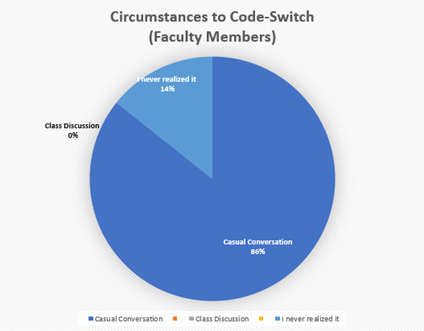
Figure 6: Pie Chart Denoting Faculty/Professor Code-Switching Circumstances (Casual Conversation: 6, Class Discussion: 0, I never realized it: 1); n = 7
Here, our hypothesis is once again proven wrong, displaying that none of our older participants code-switched with employers but instead solely during casual conversation. There was an option to state where else they code-switch, but all other participants (except for those who couldn’t recall or stated they didn’t realize it) said that they only code-switch among friends and family during casual conversation.
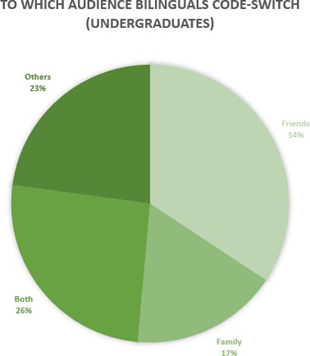
Figure 7: Pie Chart Denoting Audience of Undergraduate Code-switching (Family: 6, Friends: 12, Both: 9, Others: 8); n = 35
Using the same dataset, we made another distinction between undergraduate students and faculty members using one of the questionnaires from the survey: To which specific audience did you code-switch to more often? There are four variables that we chose to analyze, which are Friends, Family, Both, and others. The data of “others” include answers like, “teachers,” “people my age who look ethnically similar to me,” and “work environment.” The pie-chart above represents the data of undergraduate students. Based on the chart, we could tell how undergrads tend to CS with friends the most, followed by both friends and family (2nd), others (3rd), and family (4th). This corroborates the notion that bilingual undergraduate students are more likely to engage in code-switching during informal settings, such as chatting with friends, rather than in more intimate settings, like family discussions.
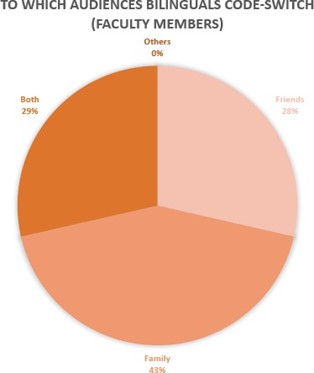
Figure 8: Pie Chart Denoting Audience of Faculty/Professor Code-switching (Family: 3, Friends: 2, Both: 2, Others: 0); n = 7
Next, this is another pie-chart that represents the data of faculty members and professors. Based on the chart, we could tell that UCLA faculty members and professors tend to CS with family members the most, followed by both (2nd), friends (2nd), and others (3rd). In contrast to the data regarding undergraduates, it is evident that faculty members tend to code-switch more frequently in personal settings, such as family conversations.
Conclusion
This research focused on the possibility of age affecting the way that bilinguals code-switch, both in content and environment. Through analysis of text messages and survey data, we were able to display some common bilingual texting patterns in UCLA undergraduates and faculty. Our research showed that bilingual people, regardless of age, do tend to transition between languages in casual conversations rather than in more formal, workplace or educational, situations. However, we saw some intriguing contrasts in the subjects that younger and older bilinguals code-switched about. It seems that when talking about less casual subjects, like political issues and business, older bilinguals are more inclined to switch languages. This could be the result of having more exposure to these kinds of interactions, while younger bilinguals may not code-switch in these certain situations because they have not yet encountered these themes as frequently. Our research also revealed that bilinguals’ code-switching behavior is influenced by the setting in which they are in. In casual situations, like conversations with friends, bilingual undergraduates tend to engage in code-switching more frequently than the faculty, who tend to reserve code-switching for more personal environments, such as with their families. The complexity of bilingualism and code-switching, as well as the ways that environment and age can affect these behaviors, are highlighted by our study. Understanding these subtleties is crucial for efficient communication and social integration in an increasingly linked society.
Although it seems as if most bilingual individuals, no matter the age, code-switch in casual conversations, older bilinguals tend to code-switch when talking about less casual topics, such as political issues and business, while younger bilinguals code-switch about daily life issues, like where to get lunch next.
References
Bahous, R. N., Nabhani, M. B., & Bacha, N. N. (2013, August 20). Code-switching in higher education in a multilingual environment: a Lebanese exploratory study. Language Awareness, 23(4), 353–368. https://doi.org/10.1080/09658416.2013.828735
Bhatti, A., Shamsudin, S., & Said, S. B. M. (2018, May 14). Code-Switching: A Useful Foreign Language Teaching Tool in EFL Classrooms. English Language Teaching, 11(6), 93. https://doi.org/10.5539/elt.v11n6p93
Ellison, T. M., & Si, A. (2021, June 28). A quantitative analysis of age-related differences in Hindi–English code-switching. International Journal of Bilingualism, 25(6), 1510–1528. https://doi.org/10.1177/13670069211028311
Jagero, N., & Odongo, E. K. (2011, March 30). Patterns and Motivations of Code Switching among Male and Female in Different Ranks and Age Groups in Nairobi Kenya. International Journal of Linguistics, 3(1). https://doi.org/10.5296/ijl.v3i1.1164
Mabule, D. R. (2015). What is this? Is It Code Switching, Code Mixing or Language Alternating? Journal of Educational and Social Research. https://doi.org/10.5901/jesr.2015.v5n1p339
Roni Grushkevich, Iffet Dogan, Isaac Verdugo, Nandana Suresh
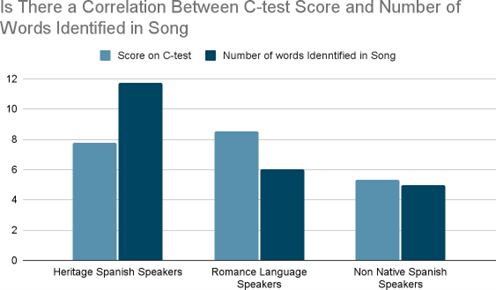
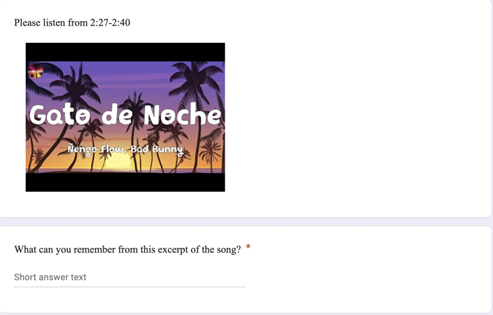
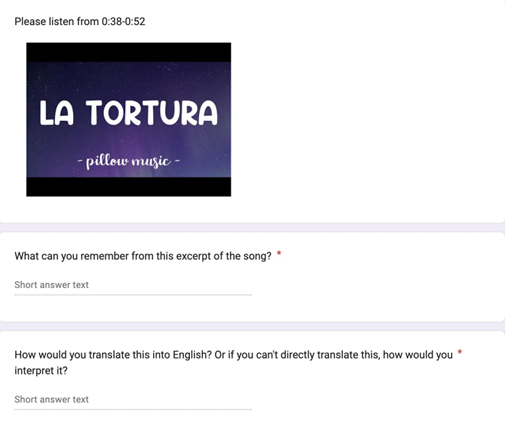
The following research on receptive multilingualism seeks to observe if exposure to popular Spanish singing artists of various dialects impact Spanish heritage and non-Spanish heritage speakers’ ability to comprehend their song’s lyrics. 8 participants (4 native Spanish speakers, 2 romance language speakers, and 2 individuals who learned Spanish in school) were given a combination of a C-test and song test via Google survey. The C-test was administered to standardize the level of basic Spanish comprehension across the participants. 3 separate song tests were made for each of the following Spanish singing artists of different Spanish dialects: Vicente Fernandez (Mexican), Bad Bunny (Puerto Rican), and Shakira (Columbian), containing their most popular song. Out of the 8 participants, only 25% of them stated to have relied on their romance language in order to comprehend Spanish. Direct translations were uncommon, however, interpretations of the music were accurate. The results from the study suggest that heritage Spanish speakers were able to comprehend more than their non-heritage counterparts.
Can exposure to various dialects within the context of music impact a Spanish speaker’s ability to comprehend lyrics of a dialect they can not necessarily speak? As widely known global sensations, Bad Bunny, Vicente Fernandez, and Shakira are enjoyed by speakers of various languages. These artists, Bad Bunny originating from Puerto Rico, Vicente Fernandez from Mexico, and Shakira from Columbia, sing in various dialects of Spanish and have the potential to subliminally impact non Spanish heritage and Spanish heritage speaker’s ability to comprehend Spanish from exposure alone. This phenomenon relates to receptive multilingualism, which refers to a mode of interaction wherein people can use a language or language variety that the person with whom they are communicating does not speak, without compromising any understanding between both parties, and without the use of any additional lingua franca (Rehbein et al. 2011). This essentially means that people who have been exposed to a particular language can develop the ability to understand it, without necessarily being able to speak it. This phenomenon allows for different, varied modes of communication, especially between speakers of similar languages and dialects, who may be able to understand each other while not speaking each others’ mother tongues. Similar research on this topic has revealed mixed findings. A study by Gooskens & Heeringa (2014), found that Norwegian speakers, who tend to be more exposed to different dialects of Norwegian, were better at translating texts in other Scandinavian languages than Danish speakers. In Sloboda & Nábělková (2013), the researchers found that in online spaces, there were mixed results on whether Slovak is intelligible to Czech speakers. The following research differs from existing findings as it focuses on receptive multilingualism within the context of music, focusing on heritage and non-heritage Spanish speakers specifically. We predict that through receptive multilingualism, Spanish heritage speakers will have the highest comprehension of song lyrics of various dialects; however, non-heritage speakers will have some level of comprehension through learned Spanish or familiarity with Spanish.
From left to right: Shakira, Bad Bunny, Vicente Fernández
Methods
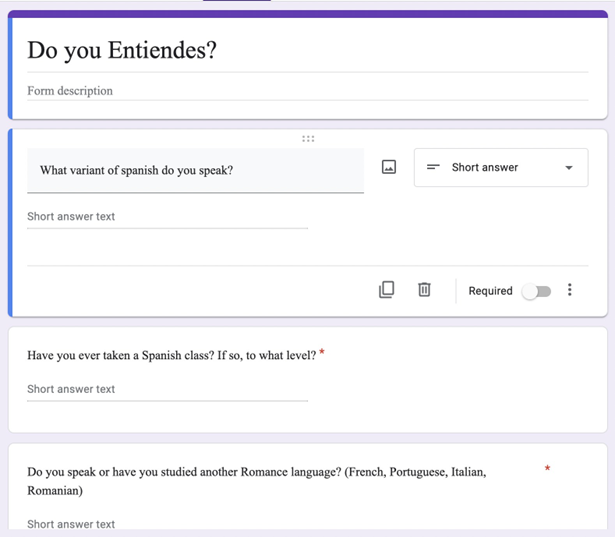
Our participants were composed of both heritage Spanish speakers and non-heritage Spanish speakers. Participants were not asked to report their age or other demographic information. All of our participants are based in Los Angeles, California and were UCLA students. We got our participants by asking individuals who we know meet the requirements and asking individuals enrolled in a UCLA Italian course. We ended up having 8 participants (4 heritage Spanish speakers, 2 romance language speakers, and 2 individuals that learned Spanish in school). Non-native Spanish speakers were asked to report if they had received formal education in Spanish and if they did not speak Spanish, what Romance language they did speak.
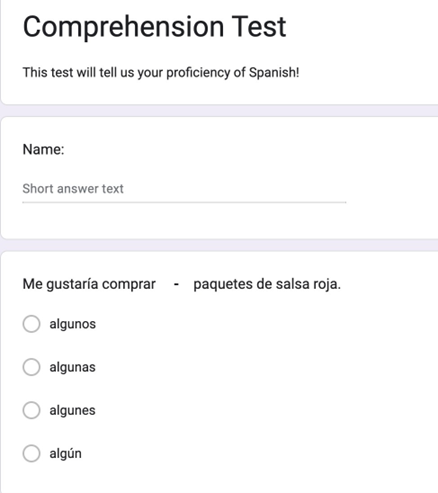
We were able to conduct our study via C-test and song test, both of which were presented to the participants online in one survey. A C-test is a tool to measure language proficiency and this shows us where the participant’s levels of proficiency in Spanish is placed. We used the C-test from an online source (One to One Spanish). We chose to have this C-test in Spanish because it would allow us to compare our participants although they all come from different backgrounds. The entire C-test is multiple choice but we asked each participant to explain what skills they used to answer the questions.
The second part of the Google survey consisted of a set of questions that revolved around a song by one of the Spanish language artists, Vicente Fernandez, Bad Bunny, and Shakira. The participant was given a survey with one of the artists that does not sing in the variation of Spanish that they are privy to in the case that they are one of the heritage speakers of that variation. For example, a heritage Mexican-Spanish speaker was not given Vicente Fernandez as their musical artist to interpret. Moreover, each participant was pre-screened and elaborated on which type of Spanish they are familiar with/speak in order to select the song from an artist who sings in a variation of Spanish they’re unfamiliar with. The survey asked questions like what variation of Spanish they speak, if they have ever taken a Spanish-language class, if they have studied another romance language and to what level. Upon answering these questions, the participant listened to a section of the song they were given. Upon listening to the section of the song, the survey asked participants what they remember hearing from the song and followed up with asking the participant how they would translate what they heard into English and if they could not do so, how would they interpret what they heard. Lastly, they were asked how they came to this interpretation. We anticipated word chunks to be an important element in the analysis because of the similarities some words have with a similar romance language which would contribute to the receptive multilingualism. We evaluated the amount of word chunks that they were able to register in each survey. We accounted for the amount of word chunks they input as well as the frequency of entire sentences they input among the three different songs.
Results / Analysis
Based on our results, it is clear that our participants scored fairly well on the C-test. Out of nine questions, we were able to compare participants’ comprehension of Spanish in comparison to each other. As shown by Figure 1, the heritage Spanish speakers and romance language speakers performed better on average in comparison to the non-native Spanish speakers. This is something that we predicted when creating our study. This could be due to the fact that the heritage and romance speakers have more background with Spanish and have better knowledge to apply when taking the C-test. It is important to note that the non-heritage Spanish speakers scored exactly where we predicted they would. With some prior knowledge in Spanish, averaging a 5.5/9 on the C-test is fairly high.
Figure 1 aims to see if there is a correlation between the score participants got on the C-test and the number of words/chunks they identified in the second part of the Google survey when listening to the song. It is clear that heritage Spanish speakers performed the best at identifying words/chunks out of the song they heard. One surprising thing we do see in the graph is that the romance language speakers did much better on the C-test portion in comparison to the music component. This could be due to the fact that the C-test relies more on recall because it is multiple choice. This means that romance language speakers see the options listed which could help them reach the right answer. However, when needing to write chunks/words they remember, it is a much harder task that requires more knowledge of Spanish.
Overall, Figure 1 proves the fact that the performance on C-test is highly correlated to the way participants performed on the song test.
Figure 1. Shows correlation between the score participants got on their C-test and how well they performed on the second part of the Google survey.
Below is a column chart that displays the amount of participants that were able to register word chunks, entire sentences, and no sentences or word chunks. The heritage Spanish speakers were able to register more word chunks and entire sentences than their non-heritage counterparts.
Figure 2. Column chart with participant’s results.
The excerpts from each song were less than 15 seconds each and displayed roughly three whole sentences. Vicente Fernández’s Volver Volver included the lyrics “Nos dejamos hace tiempo pero me llegó el momento de perder. Tú tenías mucha razón le hago caso al corazón y me muero por volver.” Our two participants that were given the song Volver,Volver comprehended a good amount of lyrics that they were able to translate into small pieces of information like word chunks. Their knowledge of pop-culture and their respective romance language backgrounds were able to assist them in their interpretations of the song and lyrics. Bad Bunny’s Gato de noche exhibited the following lyrics from the excerpt “Tú ere’ mi loca y hoy te toca la terapia si no se lo meto le da rabia puedo tener más de veinte pero tú ere’ mi bichota, tú ere’ mi sicaria tanto’ pece’ en el mar”. Three heritage Spanish-speakers were able to register the entirety of the song excerpt; however, they did not register every word. Their knowledge in Spanish and the use of context clues based off of that knowledge was able to assist them in their interpretation of the song. The one non-heritage Spanish speaker that was given the Bad Bunny excerpt registered a few word chunks but did not succeed in translating the excerpt entirely. They did mention that their romance language assisted them in their interpretation and therefore led to their response aligning with what the lyrics entailed.
Shakira’s La Tortura was given to two participants, both of whom are heritage-Spanish speakers. The following lyrics were exhibited in the excerpt: “Ay amor me duele tanto, me duele tanto. Que tú fueres sin decir a dónde ay amor fue una tortura perderte.” The two participants had very accurate translations of the excerpt as well as the amount of word chunks and sentences they were able to register. Both of them translated the lyrics and their interpretation of the excerpt was accurate. They stated that their background in Spanish was the main reason for their accurate responses. Out of the eight participants, only 25% of them stated to have relied on their romance language in order to comprehend Spanish. Direct translations were uncommon, however, interpretations of the music were accurate.
The findings of the data suggest that heritage Spanish speakers were able to comprehend more than their non-heritage counterparts. Given that we received eight responses, it is not clear whether or not the findings reflect this on a macro level.
Discussion and Conclusions
Overall, while our C-test results were mixed, there certainly was a positive correlation between one’s prior exposure to Spanish and the amount of words they were able to translate during the music component of this experiment. This shows that, for the romance language speakers and non-native Spanish speakers, the prior exposure that they may have had to Spanish or another romance language probably did help them translate the song lyrics that were given to them, especially when we consider the fact that, even though many of the non-native Spanish speakers were not able to perfectly translate the lyrics, a large proportion of them were still able to accurately understand the meaning of the song lyrics. In essence, while they may not have been able to understand the meaning of each individual word, they may have been able to use what they did know, in conjunction with context clues, to make an educated guess as to what the general meaning of the lyrics were.
As it turns out, this is a strategy that many of our participants reported that they were able to follow, in that they described being able to recognize some of the more “important” content words (nouns, verbs, adjectives, and adverbs), and use them to their advantage. These words happened to be those that were either well known to non-Spanish speakers, such as loca, or those that share a similar form to their counterparts in English or other romance languages. From there, they described being able to use context clues to help them derive the meaning of the surrounding word chunk. Aside from this, there were some non-linguistic aspects of each song that may have somewhat aided the participants in their translations, in that features like tone, rhythm, tempo, etc. may have helped them identify the mood, and likely subject matter of the song. we did not see this described in our data enough, though, to make any concrete conclusions surrounding this.
However, when discussing this experiment, it is important to consider factors such as formal education that may have skewed our data—many of our non-native Spanish speakers had taken Spanish to quite a high level in the past, which can explain the relatively high proficiency that was found in their C-test results, and may have boosted their ability in the song lyric task as well. This is not necessarily a bad thing, since it doesn’t disprove that receptive multilingualism is the underlying mechanism in their success in these tasks. In terms of better understanding the strength of receptive multilingualism, though, we would probably have wanted to include participants who had less, but still some, exposure to Spanish. In this way, we would have been able to draw stronger conclusions from the data we collected—if people who had a very basic level of formal exposure to Spanish were still able to understand the meaning of the song lyrics, while likely performing poorly on the C-test, it would ultimately mean that their receptive capabilities were the main reason as to why they were able to understand the lyrics.
Additionally, only two out of the three videos we used to present the songs to the participants contained closed captions, which definitely showed in our data. We noticed that while most participants were able to understand the lyrics of the songs that contained closed captions, the participants that were assigned to the song that did not have closed captions struggled considerably with recognizing words and translating lyrics as a whole. This is not particularly surprising—while many words may share written forms between English, Spanish, and other Romance languages, they don’t necessarily sound similar. Because of this, when participants were forced to rely purely upon auditory stimuli during the music component, they may not have recognized some words that they would have recognized if they had access to closed captions while listening. In terms of receptive multilingualism, this indicates that people’s receptive abilities are stronger when they have both audio and visual input, as opposed to just audio input, as it makes it easier to make connections between the words in the received language and their counterparts in their native languages.
While we cannot make any claims about whether this makes it easier to then learn these words in the received language, perhaps, in the future, doing something like adding closed captions to all songs would help people understand their lyrics, even if they don’t speak the language that the song is sung in. Thus, receptive multilingualism can be a powerful tool in understanding non-native languages especially when considering songs and other forms of media, because we have various amounts of ways in which we can present information to listeners to aid their understanding of the material, no matter what their background may be.
Appendix
Comprehension Test
Survey Inquiry
Song Test A: Bad Bunny
Song Test B: ShakiraSong Test C: Vicente Fernandez
Bulatović, S., Schüppert, A. & Gooskens, C. (2019). Receptive multilingualism versus ELF: How well do Slovenes understand Croatian compared to Croatian speakers’ English? . Journal of English as a Lingua Franca, 8(1), 37-65. https://doi.org/10.1515/jelf-2019-2005
Gooskens, C. & Heeringa, W. (2014). The role of dialect exposure in receptive multilingualism. Applied Linguistics Review, 5(1), 247-271. https://doi.org/10.1515/applirev-2014-0011
Rehbein, J., ten Thije, J. D., & Verschik, A. (2012). Lingua receptiva (LaRa) – remarks on the quintessence of receptive multilingualism. International Journal of Bilingualism, 16(3), 248–264. https://doi.org/10.1177/1367006911426466
Sağın-Şimşek, Ç., & König, W. (2012). Receptive multilingualism and language understanding: Intelligibility of Azerbaijani to Turkish speakers. International Journal of Bilingualism, 16(3), 315–331. https://doi.org/10.1177/1367006911426449
Sloboda, M. & Nábělková, M. (2013) Receptive multilingualism in ‘monolingual’ media: managing the presence of Slovak on Czech websites, International Journal of Multilingualism, 10:2, 196-213, DOI: 10.1080/14790718.2013.789523
Verschik, A. (2012). Practising receptive multilingualism: Estonian–Finnish communication in Tallinn. International Journal of Bilingualism, 16(3), 265–286. https://doi.org/10.1177/1367006911426465
Sylvia Le, Lien Joy Campbell, Jose Orozco, Noah SS
Do you know BTS? – If you answered no, where have you been? In the past five years Korean pop music (K-pop) has undergone a global explosion. Built into the successful business model of K-pop is the central idea of English as a Lingua Franca. While several studies throughout the years have focused on code combinations in lyrics, our study addresses specifically code-switching in a less structured environment: interviews. We elected to focus on the “biggest boy band in the world” and, arguably, the most well-known and culturally recognizable act in the international K-pop industry, BTS. The central question driving us was: does code-switching correlate to the success of BTS? In this study, we focused on interviews from three parts of BTS’s career and analyzed them for the structure, type, and cause of code-switching, while also comparing the frequency to their album sales and streams. We found that while language as a tool for international growth may be tangible, it is perhaps not as productively used as we assumed.
Oftentimes, musicians and artists have found language to be a barrier between them and larger, global audiences. As artists, they are responsible for their audience connecting with their work, as well as their audience connecting with them as artists – and the way we use language in conversation has a huge impact on other people’s perception of us. So, the language in which an artist communicates can play a huge role in the reception of their work and the way they connect with fans and audiences. Recently, this has been a distinct element of modern music, where global streaming and social media connection is at an all-time high. In particular, K-Pop groups have found an increasingly English-speaking audience.
Recognizing this, we chose to investigate more deeply whether K-Pop groups have relied more on code-switching when interacting with their audience. Specifically, we wanted to analyze how K-Pop groups have used English, incorporating it into their interviews, music, and public persona, to garner a wider audience, as according to Ahn (2021), English is one of the main factors associated with the success of K-pop on the world stage.
Code-switching, for our purposes, may be defined as the practice of alternating between two or more languages or varieties of language in conversation.
While plenty of K-Pop groups have, over the years, made serious international inroads, it is arguable that none have achieved as much success as the boy band Bangtan Sonyeondan, BTS. They debuted in 2013 producing and performing hardcore hip-hop music and enjoyed their first breakthrough and commercial success in 2015, after the release of HYYH, a Youth series demonstrating their evolving musical style. Alongside the shift in music, they began using “more elaborate storylines” and “multi-layered narratives” to create the BTS Universe. HYYH was aimed at the Chinese market, but after the Chinese government closed its market to K-pop in 2016 due to the THAAD crisis, BTS was one of the first K-pop bands to actively aim at the US market, the largest and most influential in the world. Now, BTS is widely regarded as the biggest boy band in the world (Parc & Kim, 2020).
Given the established desirability of the US market from Shin and Kim (2013) and an understanding of the growing power of English as lingua franca in Asia from Kirkpatrick (2010), we chose to study instances specifically of BTS’ English/Korean code-switching.
Methodology
Several studies have focused on the use of code-switching in the actual performance and songs of K-Pop. We believed that studying English in interviews would be more casual and supplement previous lyric research. We were inspired by a study conducted by Octaviani and Yamin (2020) on the triggers of code-switching in the TV show, The Immigration, and a thesis conducted by Luthfiyani (2014) based on code-switching in the TV show, The After School Club.
Our data took the form of BTS’ interviews given to English-speaking international press/media. The selection of these was based on the popularity of the interviews as well as their chronological position in BTS’s career. Exempting their hiatus years, we split BTS’ career into three parts. We analyzed the two most viewed international interviews, via YouTube, from the beginning (2013-2015), the middle (2016-2018), and the most recent part of their career (2019-2021).
As BTS present themselves as a group and to account for variance in Korean/English proficiency, we elected to analyze them as a group rather than on an individual basis. Instances of single word assent, echoing, and “noise” were not counted as instances of switching, as they generally contributed to the sound texture of the interviews rather than content.
We then analyzed BTS’s rate of codeswitching and compared this to their album sales and song streams. We also categorized the switching as intrasentential, intersentential, and extrasentential as originally introduced by Poplack (1980). We additionally analyzed the type of code-switching in relation to Blom and Gumperz (1972) and Yohena’s (2003) categorizations: situational and metaphorical code-switching. Situational code-switching is based in situations where the speakers find that they speak one language in one situation and another in a different situation with no topic change. Metaphorical code-switching happens when there is a topic change (formal to informal, official to personal, serious to humorous, and politeness to solidarity). Finally, we analyzed the contextual motivations for code-switching using the frame of functions laid out by Holmes (2013).
We predicted that the frequency of code-switching would increase in reflection of their international career growth, and that their code-switching would grow in contextual complexity in relation to growing exposure to international environments. We further predicted that the contexts of code-switching would display more metaphorical use, too, as an indicator of their growing international group identity.
Results and Analysis
Before presenting our results, there are some confounders and limitations from our study that must be addressed. One limitation was our small sample size. This was a case study done for only one band and due to time limitations, we analyzed a small number of interviews. The conductors of this research are not native Korean speakers, so some of the code-switching analysis was aided by outlet provided subtitles, which could lead to mistakes due to cultural differences in the language and phrases that are used during Korean code-switching. Finally, band-wide analysis lacks granular specificity. It is difficult to draw causational lines in band-data, there being many extraneous variables, so although our study deduces a correlation, we cannot conclude causation.
We began our analysis by looking at the structures in which code-switching occurred. We found that there was an overwhelming preference for intersentential code-switching, see Figure 1.
Figure 1: Table illustrating structural types of code-switching and the rate at which they appear in the data. Also included are example sentences from the data, exempting the theoretical example. Additionally of note is the singular instance of a word level/morpheme mix with the Korean NP and English plural morpheme -s
Interestingly, most intersentential examples were the result of turn-taking by the speaker. This points to the conclusion that most code-switching occurred independently and did not involve grammatical combinatorial structures. Typically, code-switching preferentially occurs intrasententially, as Koban (2013) confirmed with English/Turkish bilinguals. However, in this case, perhaps the semi-structured nature of interviews produces a preference for providing “complete” answers resulting in standalone sentence switches. Additionally, intersentential switching may be more accessible as they could have time to prep and foresight into normal interview questions.
In terms of the total lack of extrasentential switching observed, there are two primary possible causes. The first is that this form of switching – most often found in the form of tag questions – likely is more common in contact situations, as well as in situations where the languages occur in a more balanced distribution and particularly productive phrases remain active across both languages, which, due to the language imbalance observed in BTS, is less likely. The second possible cause is the interview format, which is not conducive to the use of tag questions.
We next compared the rate of code-switching that BTS engaged in throughout their career in relation to their album sales and streams. Firstly, we found that BTS’ popularity grew exponentially over the years we studied. We compared their sales over time and the amount of their streams of Spotify over time and both showed a clear increase, as shown in Figure 2.
Figure 2: BTS’ record sales over per release as well as their average streams on Spotify per year
This was directly proportional to another criteria we considered that calculated the amount of English utterances the group produced per minute. There was a similar exponential increase with 1.13/min. in their Early era, 1.40/min. in their Mid era, and 2.06/min. in their Recent era, shown in Figure 3. This increase was directly proportional with the impact of their music and, therefore, their brand, strongly suggesting that their use of code-switching is related to their popularity and global exposure.
Figure 3: English utterances per minute across the three time periods as well as the frequency 1/s of the code switches across the time periods
Additionally, we looked at the styles of code-switching that the band engaged in utilizing the framework of situational and metaphoric switching. The data samples found in Figures 4 and 5 are examples of these switches.
Figure 4: An example of situational code-switching note that RM uses a switch to English to recenter the interview’s social context on the interview and transition to the next question [BTS Answer the Web’s Most Searched Questions: 2:50 – 2:54]Figure 5: An example of metaphoric code-switching. Note that RM transitions more strongly than in figure (4) in social position from fellow to leader and on-screen translator to repair the socially awkward/non-answer by V, and to create distance between himself and V’s display [BTS Chats to Andy Trieu at SBS PopAsia HQ: 2:52 – 3:08]Interestingly, the two examples are relatively similar. The defining feature between these two are the stances conveyed. In the situational switch, RM is stopping the Korean conversation to transition the conversation to a new topic and it is directed at the members to refocus them. In comparison, the metaphoric switch conveys both emotional distance from V, as well as a shift in his attention and language goal from being a team-member to the leader, so there is a social position change conveyed as well. Additionally, Jin acknowledges RM’s switch, displaying solidarity by making a joke also in English, targeting V’s “weird behavior.”
In our comparison of situational vs. metaphoric switching over their career, we found that there was a strong preference for situational code-switching, as seen in Figure 6.
Figure 6: The percentage of use for both metaphoric and situational code-switching in relation to BTS’ early career, mid career, and late career. Interestingly there was no metaphoric switching found in their mid career
Our data shows a general preference for situational switching overall and unexpectedly very little change in metaphoric switching. Metaphoric switching remained consistently low, even dipping to 0% in their mid-career. However, this may be due to the interviews that were analyzed for this period. This was unexpected, however, metaphoric switching is more indicative of a speaker’s internal world, or how they situate themselves in a social interaction, which lends itself to more advanced multilingual speech – this may require a higher English proficiency to be used strategically than many BTS members currently possess. This can be corroborated by the fact that many of the metaphoric switches observed were performed by RM, who is fluent in English, and the most balanced and practiced bilingual of the group.
The final aspect of code-switching that we analyzed was Holmes’ influencing factors, which can be defined as
Participant: motivated by a change in the participants or goal receiver of utterance
Solidarity: signaling shared group membership
Social Context: motivated by a change in the social dimension of conversation
Topic: motivated when a specific topic is more accessible in one language
The data samples found in Figure 7-Figure 10 provide examples of these different influencing factors.
Figure 7: An example in which RM code-switches as the goal receiver of the sentences changes from James Corden to the rest of his members. [BTS Carpool Karaoke: 8:01 – 8:05]Figure 8: Suga, recognizing V’s struggles, switches to Korean to show solidarity with V as a fellow Korean speaker and member. [BTS Reveal Their Hidden Talents, Impersonate Each Other, and Reveal Their Celebrity Crushes to Andy Trieu: 2:14 – 2:20]Figure 9: J-Hope switches to Korean to say his favorite song on the album, after joking with the puppies about the title track; it is a reaction to the socially more formal question. Interestingly this triggers the other members to switch to Korean and continue joking. (Jin’s comment is a play on words that sounds like the shortened version of the title RM uses to confirm with J-Hope) [BTS Plays With Puppies While Answering Fan Questions: 1:49 – 1:57]Figure 10: Unlike the last example in Figure 7, where RM’s translation and subliminal signal that a switch to Korean is fine, the conversation continues in English, as some members have specific nicknames. This is a topic that they are more comfortable discussing in English [BTS Carpool Karaoke: 5:15 – 5:36]In our analysis of our data, we found that complexity actually decreased somewhat from their early career to their mid/recent career as seen in Figure 11.
Figure 11: Comparisons in the different influencing factors that affected BTS’ code-switching throughout their career
Moreover, the complexity of code-switching exhibited in their mid and recent careers did not show the same distribution of influencing factors – with notable shifts in the prominence of Social Context and Participants. This could be due to the style of interviews, as well as growing sensitivity to interacting with English-speaking interviewers/hosts. However, the decrease in overall complexity from their early career points to a relatively consistent pattern of code-switching in terms of broad contextual influence.
Discussions and Conclusions
In recent years K-Pop has undergone a surge in popularity and groups like BTS have begun to code-switch more to relate with fans. With English being a lingua franca, we analyzed the code-switching between Korean to English from BTS. Some unexpected findings were that metaphorical switching did not increase as they began to grow. Originally, we thought that metaphorical switching would increase, but this was not the case. BTS displayed a preference for situational switching and there was little change in their metaphorical usage. We also believed that their code-switching would grow in complexity as they gained greater exposure to international environments, but this was not the case as per our research. This data is significant because it provided a greater insight into code-switching and how L2 language learners switch more in a certain style than others. It may also demonstrate that outside pressure to use an L2 language – in this case English – may not have as much effect on the actual surfacing of this language in use.
We found that most intersentential examples were member-by-member, which suggested that code-switching in this case was a standalone feature in the languages. We typically have seen new language learners start from intrasentential code-switching. This could be true for some learners, but perhaps intersentential sentences are sometimes simpler in structure and less complex. They are used in isolation, so it is easier to remember, and these types of sentences are used in everyday conversations so they are easier to pick up. So, complex mixing may be less frequent amongst BTS due to this reason, as more complicated structures require more advanced knowledge of the language. Such limited access to L2 can shape a language learner’s usage of metaphoric language as well, since it requires more proficiency in the language. Learners may struggle to use and understand metaphorics efficiently as they cannot comprehend the nuances such as with cultural references or ties. Since BTS is a Korean group, the cultural aspects of code-switching also bring in further struggles when attempting to switch to English, predominantly American English.
In conclusion, the code-switching for BTS was mainly intersentential, as the data demonstrated. There were clear preferences for intersentential code-switching over other types. We believe that this was due to the fact that the group is not very proficient in English. Based on the data that we collected, BTS code-switching has stayed relatively constant throughout the years, further illustrating the fact that they had a preference for the type of switching they use. Generally speaking, groups code-switch with friends and family when they are most comfortable. These groups may also code-switch to impress others or to send a different perception of themselves to a larger audience. Having the group code switch amongst themselves could have helped gain further attraction among fans. Meanwhile, code-switching would have also been used to convey their English skills, as it is an important language to learn in the fields of business and music.
There was an increase in overall code-switching as the group grew in international popularity. This makes sense, as they have to spread to keep up with demand. Due to this, corporations tend to gravitate to these markets where they can capitalize the most. From this standpoint, it makes sense as to why groups like BTS code switch to English rather than another language, or why their prevalence is so large among English-speaking nations and across the world. However, with the rising popularity of K-pop and Korean culture internationally, too, there has been a spike in Korean language and culture studies, so perhaps there will be a lessening of overt pressure to perform multilingualism in the future. Overall, it appears that the usage of English has aided BTS’ popularity; however, it may not be as definitively related to their success in the international music industry as we assumed.
While there were certain limitations to our study, as mentioned previously, in the larger phenomena of linguistics and bilingualism with its relation to code-switching, the data and analysis we had created could be important for future work. Future research could focus on the effects of code-switching on BTS’ audience and their reactions to it rather than how often they code-switch and why, encompassing whether or not the perception of code-switching amongst fans enhances or detracts from their appreciation of the music. On a similar note, we could also analyze the cultural implications of code-switching and how it impacts Korean culture on a global scale. This data can help future researchers better understand code-switching and its impacts on an audience relating to global sales, popularity, and positive outlook.
References
Ahn, H. (2021). English and K-pop: The case of BTS 1. English in East and South Asia, 212-225.
Blom, Jan-Petter, and John Gumperz. (1972). “Social Meaning in Linguistic Structures: Code Switching in Northern Norway.” In: John Gumperz and Del Hymes (eds.): Directions in Sociolinguistics:Sociolinguistics: The Ethnography Communication, 407-434.
Holmes, J. (2013). An Introduction to Sociolinguistics (4th ed.). Routledge. https://doi.org/10.4324/9781315833057
Kirkpatrick, A. (2011). English as an Asian lingua franca and the multilingual model of ELT. Language Teaching,44(2), 212-224. DOI:10.1017/S0261444810000145
Koban, D. (2013). Intra-sentential and Inter-sentential Code-switching in Turkish-English Bilinguals in New York City, U.S. Procedia – Social and Behavioral Sciences, 70, 1174–1179. doi:10.1016/j.sbspro.2013.01.173
Luthfiyani, F. (2014). Code-switching and Code Mixing on Korean Television Music Show After School Club (thesis). UIN Syarif Hidayatullah Jakarta: Fakultas Adab dan Humaniora, Jakarta.
Nilep, C. (2006). “Code-switching” in Sociocultural Linguistics. Colorado Research in Linguistics, 19. https://doi.org/10.25810/hnq4-jv62
Octaviani, Andita Dyah & Yamin, Haruki Manik Ayu. (2020, July 30). The Rise of English Among K- Pop Idols: Language Varieties in The Immigration. Proceedings of the International University Symposium on Humanities and Arts (INUSHARTS 2019), 117-121. DOI: 10.2991/assehr.k.200729.023
Parc, J., & Kim, Y. (2020). Analyzing the reasons for the global popularity of BTS: A new approach from a business perspective. Journal of International Business and Economy, 21(1), 15-36.
Poplack, S. (1980). Sometimes I’ll start a sentence in Spanish y termino en Español: Toward a typology of CS. Linguistics 18, 581-618.
Shin, S.I. & Kim, L. (2013). Organizing K-Pop: Emergence and Market Making of Large Korean Entertainment Houses, 1980–2010. East Asia30, 255–272. DOI: 10.1007/s12140-013-9200-0
Yohena, S. O. (2003). Metaphorical code-switching revisited. (Vol. 38, pp. 138–158). essay, Ferris University.
Danbi Jang, Louise Chen, Katherine Escobar, Alena Hong
Bilingual speakers code-switch for conversation consistency. Code-switching is more effective when describing cultural words with only that language and when both speakers are in an argument situation because code-switching increases conversation compatibility. Our research looked at the Kim’s Convenience Season 1 show and analyzed the Korean-Canadian bilingual family code-switching pattern. We analyzed Kim’s family’s conversation and found that intra-sentential code-switching is the most frequent type. Additionally, we realized that the function of each code-switching frequently happens for expressing identity, objectification, interjection, and clarifying repetition. The results showed that bilingual code-switching is necessary and efficient between two bilingual speakers when they intend to create connections with each other or solve problems. As a result, code-switching creates smoother conversations for bilingual speakers so they rather naturally mix two languages than only talking in one.
If you are a bilingual speaker, you must code-switch at least once. Bilingual communities frequently use code-switching. It has become a powerful communication tool for expressing and developing language skills. Code-switching is the process in which a bilingual (or multilingual) person alternates between two (or more) different languages in a bilingual (or multilingual) communication environment. There are several reasons bilinguals do code-switching. According to past research by Stępkowska (2022), bilingual people may demonstrate dissimilar verbal behavior in their two languages. Interlocutors perceive languages differently depending on their language in a given context. Additionally, attitudes toward languages permeate daily life and impact communication patterns within the couple (ibid.). Based on past research, we were curious whether bilingual speakers are more compatible than speakers who do not code-switch. According to another research, code-switching gives “a built-in sensibility that conversational regularities are both content-independent and context-sensitive” (Dumanig et al., 2015). Therefore, our research question is how bilingual speakers code-switch to communicate effectively. We mainly focused on Korean-Canadian bilingual speakers’ families and close friends, as well as investigated how Korean-English bilingual speakers code-switch to communicate effectively in complicated discussion situations and daily life.
Methods
We mainly collected data from the show Kim’s Convenience, season 1. We observed code-switching in bilingual speakers, how frequently they switched, and what purpose and function the code-switch served to communicate with other bilingual speakers in conversations. We attempted to provide transcriptions of specific examples of code-switching. We analyzed the type of code-switching primarily in categories of Inter-sentential, Intra-sentential, and Extra-sentential code-switching. We defined Inter-sentential code-switching as the language switch done at sentence boundaries, like sentences before, in the middle, or after another sentence. In our data, we have mostly seen this type of code-switching in fluent bilingual speakers. Intra-sentential code-switching is done within the sentences, with no pauses or interruptions to indicate a shift. The speakers in the show usually switched this type when they called Korean appellations, or greetings within part of the sentence. Finally, we found extra-sentential code-switching, which is switching a slang or a single word from one language to another (ESEN, 2022). In addition, we defined culturally related words or phrases such as 갈비찜(galbi-jjim) and those expressing feelings and interjections as extra-sentential code-switching.
Furthermore, we investigated the functions and purpose of code-switching and how the speakers resolved their disputes and communicated well based on the context of conversations. We classified the functions of code-switching into four which are interjections, objectification, clarifying repetition, and expressing identity. Then, we focused on examining when the bilingual speakers use code-switching to communicate more effectively in the conversation. Also, we quantified whether the data retrieved from the show conveyed more compatibility and resulted in conflicts resolved by observing any frequent types of code-switching and different functions of code-switching in speech patterns of the show. We hypothesized that code-switching plays a different role in each context, helping promote effective communication.
Results and Analysis
From the data we collected, we observed that code-switching is a highly-efficient communication tool for the Korean-English bilingual Kim’s family. At the same time, there are several talks taking place in between the monolingual speaker and the bilingual speaker. In the same way that code-switching helps bilinguals solve problems more easily and quickly in situations where there might be an argument, misunderstandings tend to last longer and occur more frequently in monolinguals because they cannot do code-switching. For instance, in episode 7 from 18:15-19:13, there is a good example of a monolingual and bilingual argument about Taekwondo and Hapkido that doesn’t go smoothly. Here we include a shortened version of the script.
Mr. Kim: wah you know 태권도(Taekwondo)?
Customer: Not really but I’m a big fan.
Mr. Kim: They have 태권도 (Taekwondo) in Africa?
Customer: oh yeah! Somalia won silver at the 2003 international open.
Mr.Kim: wow impressive! You don’t look Somalian.
Customer: No I’m not. This is just a Taekwondo fact.
Mr. Kim: 태권도(Taekwondo) is Korean.
Customer: I know.
Mr. Kim: I am a Korean
Customer: I know.
Mr. Kim: 합기도(Hapkido) is Korean too!
Customer: Hapkido?
Mr. Kim: Yea but the much better fight style! Choi he invited 합기도(Hapkido) while serve in the military in Japan.
Customer: So.. in a way it could also be considered as Japanese martial art.
Mr.Kim: No! (angry face) You joking me?
Customer: no… I just meant… Taekwondo was invented by Korean too?
Mr.Kim: Of course Korean!
Customer: I didn’t realize Korean was that strong!
In this case, Mr. Kim and the monolingual customer have a small fight because the customer does not truly know about Taekwondo or Hapkido, but he thinks he does. So, the original topic was to discuss a group of children learning Taekwondo, but due to the misunderstanding, Mr. Kim needs to expand more about Taekwondo and Hapkido knowledge. In a way, it implies that there is a higher chance for monolingual speakers to have misunderstanding or misapprehension thus reducing the consistency of the conversation. When the same situation happens on two bilingual speakers, they don’t need to stop and explain the content of their code-switching. According to Brezjanovic-Shogren (2002), code-switching “establishes a connection between the contributions of the participants thus making the conversation coherent. Considering participants are always “talking about something”, focusing on the “description of the topic” will answer directly what is the topic of the conversation.” This suggests that code-switching helps speakers stay on a certain topic and creates consistency for the conversation. Thus, there is a positive relationship between code-switching and communication.
There are three types of code-switching, intra-sentential, inter-sentential, and extra-sentential. To our surprise, intra-sentential is far more numerous than the other two types (See Fig.1). This is because inserting another language phrases or words is more natural and simple than whole sentences. A significant number of these intra-sentential data come from Korean appellations, such as 아빠(Dad), 엄마(Mom), 아줌마(Auntie). The transformation of the titles into Korean reflects the function of code-switching in expressing identity and establishing connection. Prihatin (2018) proves that code-switching occurs to express identity when an individual wishes to express solidarity with a social group. According to the statistics (See Fig.2), this function is the most common one, accounting for 77.7 percent. There are also three other major roles of code-switching, namely, objectification (11.5%), interjection (7.4%), and clarifying repetition (3.4%). Code-switching uses for objectification can quickly help speakers get a more concrete image in their mind about the topic. Because this function is often present on culturally relevant code-switching, it can often be classified as the extra-sentential type. For example, Mr. Kim says Korean 합기도 (Hapkido) instead of English pronunciation Hapkido in episode 7 where the conversation takes place between him and his bilingual daughter, Janet. Because Hapkido is a Korean traditional activity, Mr. Kim wants Janet to quickly recall what 합기도(Hapkido) is and all the information related to it. This is where the advantage of code-switching comes in. Sometimes people code-switch to interrupt someone, this is the function called Interjection, doing so helps get attention or start a new topic. In other cases, code-switching is able to emphasize or reaffirm the topic when the speaker does clarifying repetition (See Appendix).
Fig. 1. Frequency of each type of code-switching in Kim’s Convenience Season 1
Fig. 2. Percentage of each function of code-switching in Kim’s Convenience, Season 1
Discussion and Conclusions
The findings from our study contributed to our understanding of interpersonal communication, more so how to make communication more effective through the use of code-switching. Our data suggests that code-switching occurs as a way to fulfill a purpose in communication such as expressing identity through the ability to relate to cultural values and strengthen relationship bonds. Additionally, through other functions such as objectification, repetition, and interjections, it improves communication by clearing any misunderstanding for phrases that do not translate well into the dominant language. In a similar field of research, Helena Merschdorf presented a TED Talk about the paradox of intercultural communication. Her studies suggest that there are invisible understandings, where biases from our primary language and culture can cause misunderstandings and misconstrue due to societal norm differences (Merschodorf, 2022). In the case of Kim’s Convenience, we found that code-switching occurred to address these societal differences. As the show was based in Canada, the respectful terms don’t translate with the same cultural significance so characters would code switch in order to express their Korean identity, avoiding an invisible understanding of potential disrespect or disregard for their Korean heritage. For example, in episode 8, the context surrounds a neighborhood pastor for Koreans, though all are welcome. The pastor is very close with the Kims as he is a frequent patron at the convenience store, but because he takes advantage of his important and influential role at the church, he believes he can get away with taking gum without needing to pay anything. The Kims are obviously worried because the continual free gum will begin to add up once rent is due, or Pastor Choi could begin to take something of greater value should he get comfortable not paying. Mrs. Kim did not want to let this continue, so she code switches and says “목사님 (Moksanim) I think we cannot…” (E8, 20:41). The purpose of this code switch was to express their Korean identity by using a formality to show respect to Pastor Choi despite telling him something that he probably would not like to hear. Because the formality does not translate in English, the code-switch in this instance eliminates a misunderstanding of disrespect as Mrs. Kim did not want to let the pastor continue misunderstanding their kindness for generosity.
Originally, our focus was to explore if code-switching would make communication more effective in couples that are in an argument. What we ended up studying was the types of code-switches and the instances in which they occur. By isolating four different purposes for the code-switch, we unveiled that by serving one of those purposes, code-switching was used to prevent miscommunication or to find a way to clarify true meaning despite a language barrier. As Merschodorf (2022) suggested, a way to prevent misunderstandings is to take into account the different linguistic knowledge from other cultures before communicating. By doing so it would prevent any marginalization or discriminatory language. This could be done through “pidgin” languages such as Konglish or Spanglish, where combining two languages that were stripped to the simplest forms, may serve as a means to accommodate both parties in a conversation in a way that keeps all cultural identities intact. Though marginalization can be perceived as a phenomenon usually concerned with targeting an individual’s identity, excluding someone through unfamiliar words and phrases without considering their needs can also be a form of marginalizing. Code-switching can then resolve this issue by allowing speakers to clarify what their true intending may be in an inclusive manner. This could be seen in episode 9 of Kim’s Convenience, where this episode follows interactions between Pastor Nina and Mrs. Kim. Mrs. Kim was dealing with embarrassment over her son’s Jung intimate relations with someone from the church, so when Pastor Nina said she heard something about Mrs. Kim, her mind was worried that there was gossip about how sexually active her son is though Pastor Nina was talking about 갈비찜, the meat dish galbi-jjim (E9, 10:03). Her attempt to code switch was to affirm and create a closer relationship with one of her church regulars, Mrs. Kim, by relating to her culture and being inclusive of the Korean language. Additionally, she asks Mrs. Kim if her pronunciation was correct, showing that she is eliminating an egocentric bias of assuming she was correct, and actively seeks feedback from Mrs. Kim as she recognizes that she is unfamiliar with Korean linguistic culture. Overall, our findings uncover that code-switching in a broader context serves to prevent misunderstandings as a result of a language barrier, through the fulfillment of communication purposes such as expressing identity, objectification, repetition for clarification, and interjections for emphasis. Without such purposes in mind, perhaps code-switching might not have an influence on the quality of communication between speakers as misunderstandings could occur without the clarification and inclusivity that code-switching can elucidate.
Choi, I., White, K., writers. Kim’s Convenience. Season 1, episode 9, “Best Before.” Directed by James Genn, featuring Jean Yoon and Amanda Brugel. Aired December 6, 2016, in Canadian Broadcasting Corporation (CBC). https://www.netflix.com/watch/80236369?trackId=14170289
Pietikäinen, K.,S. (2014). ELF couples and automatic code-switching. Journal of English as a Lingua Franca, 3(1), 1-26. https://doi.org/10.1515/jelf-2014-000
Griffin Gamble, Erin Kwak, Joanna Kwasek, and Hannah Shin
A heritage language is defined as a minority language spoken at home that is not part of a dominant language in society. This study looked specifically into Korean heritage speakers living in the United States and investigated whether language proficiency in Korean will align with the degree of Korean cultural identity. In order to study this relationship, we utilized two separate data collection methods: an elicitation task to assess language proficiency and a self-reported questionnaire to record cultural identity. As expected, we found that the more grammatical errors the participants made, the less they identified with their Korean culture. This finding suggests a positive relationship between Korean language proficiency and Korean self-identity, which contradicts previous findings that higher proficiency in a heritage language predicts a more balanced bicultural identity that is not dominated by one culture.
With the U.S. being known as a melting pot of cultures, numerous languages are constantly being spoken and intermingled in public and private. Following this observation, we were interested in understanding how heritage speakers–more specifically, Korean heritage speakers–juggle multiple cultural identities.
Previous findings suggest that one’s cultural identity and language proficiency are correlated. Lee (2002) studied the relationship between heritage language proficiency and cultural identity of Korean heritage speakers. They were able to observe that Korean heritage speakers who were proficient in Korean largely reported having a bicultural identity, or one that is equally American and Korean (Lee, 2002). Furthermore, Adaobi (2014) studied the link between a minority language, Etulo, and the majority language, Tiv, to understand if bilingualism affects self-identity. Similarly to Lee (2002), Adaobi found that Eluto speakers identified with both cultures, but did experience a sense of identity conflict, or dual identity, from time to time (Adaobi, 2014). Such findings indicate that proficiency in both the dominant and minority languages facilitate a unique bicultural identity.
One of the biggest limitations that we observed in the studies above was the use of self-assessments as a measure of language proficiency. Self-reports can be unreliable in producing standardized data, as it does not involve an objective assessment of language proficiency; it is susceptible to biases about how well one believes they can speak a language. Therefore, in our study, we have decided to implement a widely used method in the study of bilingualism: the elicitation task (Bialystok and Frohlich, 1980; Dechert, 1983). As grammatical competence is often a strong predictor of overall oral proficiency (Magnan, 1988), it is plausible to assume that grammatical errors will decrease as the proficiency level increases. With such assumptions, the current study conducted a grammaticality judgment of participant speech to determine language proficiency (Cornips & Poletto, 2005), in hopes of enhancing both the validity and reliability of the research addressing heritage language proficiency and cultural identity.
We hypothesized that there will be a positive relationship between Korean language proficiency and Korean cultural identity. In other words, Korean heritage speakers who 1) exhibit higher grammatical accuracy in Korean and 2) are able to utilize more cultural references will identify with the Korean identity to a larger degree.
Methods
We studied twelve Korean heritage speakers currently living in Southern California, between the ages of 15 and 23. Eight of the participants identified as female, three as male, and one as other. They had differing levels of exposure to formal Korean language education but all of them used Korean at home with their family (aligning with our definition of a heritage speaker).
Table 1: Participant Demographics
The study utilized two separate data collection methods. The first was an elicitation task, which involved a slideshow that depicted the Korean fairytale titled The Heavenly Maiden. We began by telling the story to the participants in English, accompanied by the corresponding image for each scene (See Figure 1).
Figure 1: Example of a slide from the elicitation task
The participants were then asked to retell the story in Korean as we flipped through the images in the slideshow. Their speech was recorded and transcribed for further analysis. The second data collection method was a questionnaire that was distributed to participants after the elicitation task. By doing so, the questions regarding ethnicity, culture, and comfortability in speaking Korean did not influence their performance in the storytelling task. The survey also included questions about the participants’ general background information, such as their age, the circumstances in which they learned Korean, in what situations and how frequently they use Korean today, etc.
The recording was reviewed for two main variables: instances of any grammatical errors (such as subject, verb, and object word order errors) and the usage of culturally-relevant vocabulary within the story. Regarding the culturally-relevant vocabulary, there are a few terms, such as 선녀 (“heavenly maiden”) and 두레박 (“bucket”), that are important aspects of the fairytale. We expected to find that participants who are more in touch with Korean culture would be able to better identify and use those cultural references.
Results and Analysis
Out of the twelve participants, only ten participants fully participated in our study as two people opted out of the elicitation task as they felt that the task would be too difficult with their language abilities. However, we still decided to give them the option of completing the questionnaire so that we could note any potential patterns.
When analyzing the data, we noticed two main patterns amongst the participants: irregular formality and sentence structure. These were interesting to us because the Korean language is highly sensitive to different degrees of formality–that is, a speaker should not be suddenly switching between multiple formality levels unless the recipient has changed. An instance of irregular formality can be seen in this excerpt of participant 1’s transcript: “사슴이 남자에게 도움을 요청했습니다. 사냥꾼이 사슴을 사냥하고 있었다.” The first sentence ends with –습니다, which is formal and respectful. However, the next sentence ends with –다, which is less formal and more direct. Additionally, Korean sentences typically follow a subject-object-verb order, but the participants seemed to use different word order structures purposefully. Korean-American speakers were repeatedly and deliberately utilizing an alternative word order structure as a stylistic choice, not as a momentary mistake. An example of irregular sentence structure can be observed in this excerpt of participant 4’s transcript: “사슴이 살려달라고 그래서 나무속에 숨겨놨는데 사냥꾼이 와서 찾았어요 사슴을.” This sentence notably ends with an object (“사슴을”), which is not common in Korean speech, and more resembles English’s subject-verb-object order.
Surprisingly, participants were generally lacking in the use of cultural references with two people using none, seven people using one, and one person using two. Patterns regarding the usage of cultural referents were thus not evident, which made it difficult to answer the relevant aspect of our hypothesis.
Regarding the self-reported cultural identity of our participants, a majority of our participants considered themselves Korean-American, but more Korean or equally Korean and American. None of our participants considered themselves fully American with no Korean identity. Interestingly, the participant with the least amount of errors and highest self-perception of being Korean (i.e., they viewed themself as fully Korean, rated themself 5 in Korean proficiency, and 5 for how comfortable they are in speaking Korean), only utilized one cultural referent throughout the whole speech. She instead opted for a more casual and simple nuance, using Korean versions of an English word, such as “샤워” ([ɕʰawʌ] ‘shower’) and 버켓 ([bʌket̚] ‘bucket’). We also noticed that the two people who opted out of the task but filled out the questionnaire were the only ones who marked “very uncomfortable” for the question asking how comfortable they are in speaking Korean and “strongly agree” for the statement “I celebrate most American holidays.”
In comparing the self-identity question to their overall error ratio in speech, we found that the average error ratio increased as the participants identified as more American (See Figure 2). Although we were not able to run a formal statistical analysis due to our limited sample size, we expect this trend to transfer onto a bigger sample size as well due to its concreteness.
Figure 2: Self-Identity and Error Ratio
Another interesting observation we made was that those who marked that they took Korean in school for foreign language credit (which were participants 9, 10, A, and B) had either: the highest ratios of errors or completely opted out of the elicitation task due to low proficiency.
Discussion and Conclusion
The results suggest that language proficiency and cultural identity seem to have a positive correlation, as the participant who rated herself as fully Korean had the least errors in speech, and the average error ratio of participants increased along with American identity. In addition, we also observed a common linguistic pattern among our Korean-American participants. Those who rated themselves a score of 2 or 3, and therefore did not fully identify as Korean, were using a word order structure similar to English subject-verb-object (SVO). This word order is not technically ungrammatical in Korean, but it’s usually only used if the second clause is an afterthought therefore it can come off as awkward especially if used repetitively. However, the Korean-American participants appeared to be using it as a stylistic choice, and not by mistake. This finding opens up a new area of research for bilingualism: emerging linguistic patterns in heritage speakers that were not previously observed in native speakers. By studying how this linguistic trend is preserved or even replaced within generations, we would also be able to study how multiple languages reform as they come in contact with a different language. In the case of our participants, it was mainly the fusing of English and Korean that prompted the rise of English’s SVO-like word order structure in Korean.
One of the biggest limitations was our small sample size. A larger sample size would help identify stronger, statistically significant correlations between our variables, and in turn, promote the external validity of our findings. Furthermore, we could better target the elements within our hypothesis by improving the elicitation task. As we were unable to observe a consistent use of cultural references among the participants, we could better assess the role of cultural proficiency or cultural awareness by utilizing or creating a story that prompts the use of more cultural references. The analysis method of our study would also have been more standardized if the grammaticality judgment was not done by the researchers themselves. Although we were limited in our time and resources, recruiting a panel of native Korean speakers to rate the grammaticality of each participant’s speech would lead to a more concrete assessment of language proficiency.
So why do these findings matter in our day-to-day lives? First of all, the observations we made throughout our study support the idea of a bidirectional relationship between language and identity. Even though our main research question dealt with the positive connection between language proficiency and the corresponding cultural identity, this relationship encompasses so many other factors such as our attitude towards our culture, the amount of language use per day, the quality of language use, the context of language use, and much more. Each of the aforementioned variables could equally serve as a byproduct of or the driving elements behind one’s language proficiency. For instance, one could be using their heritage language only with their parents because they lack proficiency, or lack proficiency because they only use it with their parents and no one else. If you factor in the role of cultural identity, it further raises the question of “which came first?” as it could be the depth of cultural identity that motivates language use or vice versa. Knowing this, it brings us to the second reason why the findings of this study are important: we could potentially promote language proficiency and cultural identity by elevating one another! To provide an example, enhancing one’s cultural identity could serve as a big motivator behind learning a heritage language. The positive attitude allocated to a specific culture could definitely act as an incentive for learning a language while enhancing the learning process itself. Similarly, one might wish to identify with their heritage culture on a deeper level. The findings in this study suggest that increasing one’s proficiency in their heritage language could in turn intensify one’s respective cultural identity.
References
Adaobi, N. O. (2014). Bilingualism and identity in etulo. OGIRISI: A New Journal of African Studies, 10(1), 23. https://doi.org/10.4314/og.v10i1.2
Bialystok, E., & Fröhlich, M. (1980). Oral Communication Strategies for Lexical Difficulties.
Interlanguage Studies Bulletin, 5(1), 3–30. http://www.jstor.org/stable/43135243 Cornips, L., & Poletto, C. (2005). On standardizing syntactic elicitation techniques (part 1).
Dechert, H. W. (1983). How a story is done in a second language. In C. Faerch, & G. Kasper, (Eds.), Strategies in Interlanguage Communication, 175-196. New York: Longman.
Jee, M. J. (2016). Exploring Korean heritage language learners’ anxiety: ‘We are not afraid of Korean!’ Journal of Multilingual and Multicultural Development, 37(1), 56–74. https://doi.org/10.1080/01434632.2015.1029933
Lee, J. S. (2002). The Korean language in America: The role of cultural identity in heritage language learning. Language, Culture and Curriculum, 15(2), 117–133. https://doi.org/10.1080/07908310208666638
Magnan, S.S. (1988). Grammar and the ACTFL Oral Proficiency Interview: Discussion and Data. The Modern Language Journal, 72, 266-276.
Rothman, J. (2009). Understanding the nature and outcomes of early bilingualism: Romance languages as heritage languages. International Journal of Bilingualism, 13(2), 155–163. https://doi.org/10.1177/1367006909339814
Korean dramas, otherwise known as “K-dramas,” have become easier to watch than ever before. With shows previously only being televised on South Korean TV stations, many people can now watch K-dramas on popular streaming platforms like Netflix and Hulu. Because of this, the popularity of K-dramas has spread everywhere, including in the U.S. With this rise in popularity, there has also been an increase in the amount of Konglish (Korean-English) being spoken in K-dramas. This study explores the number of code-switching instances from Korean to English in K-dramas targeted toward a specific age demographic and looks into code-switching characters. Our research focuses on eight K-dramas, four aired in the morning for older audiences, and four aired in the evening for younger audiences. We hypothesize that Korean-English code-switching will be more frequent in K-dramas targeted at a younger audience and that higher socioeconomic status will play a role in regarding who code-switches. Our data highlights which age demographic tends to code-switch more, focusing on inter-sentential and intra-sentential code-switches, and provides an overview of the types of characters that speak in both Korean and English.
Korean culture has steadily been rising in popularity, and K-dramas are part of this universal fame, thanks to their easy accessibility through streaming services. Along with the recent success of Squid Game, many have watched K-dramas and might have noticed that English is frequently used in the Korean language. The bountiful use of English can be explained by the vast influence English has in modern Korea. For example, students are required to learn English starting from the age of 10, and it is also part of the official Korean SAT. The reputation of English in the current Korean society is untouchable, and Barratta (2014) describes that English is associated with modernity and power, creating a more modern identity for Koreans.
In this study, we wanted to analyze the frequency of code-switching in K-dramas and how it is affected by age and socioeconomic status. How would these factors affect how and when characters code-switch with each other? Since English is a sign of luxury and youth in Korea, this could affect the production of K-dramas. We hypothesized that Korean to English code-switching would be more frequent in K-dramas targeted at a younger audience. After evaluating our results, we concluded this is true but also noticed that more data might be needed for further detailed analysis.
Before diving any further, it is essential to explain what exactly code-switching is and how it differs from lexical borrowing. Lexical borrowing is a phenomenon whereby a loanword, at some point during the history of a language, entered its lexicon as a result of borrowing, transfer, and copying (Haspelmath, 2009). These words are part of the Korean language and are primarily loanwords that originate from English. On the other hand, code-switching is the alternating use of several languages by bilingual speakers (Muysken & Milroy, 1995). It is the practice of switching between two languages and is more frequent in conversation than in writing. Code-switching is used among speakers to convey meaning above and beyond the referential. There are three types of code-switching classified by linguists, but we decided to focus only on two: inter-sentential and intra-sentential. The first one happens at sentence boundaries, while the second one happens in the middle of a sentence.
Dramas are divided into two groups in Korea: morning and evening shows. Morning shows air sometime between 7:50 AM to 9:30 AM and is meant for an older audience, such as housewives or the elderly who have the time to watch TV early in the morning. It is rare for students or business people to watch morning shows since they are either studying or working. On the other hand, evening K-dramas air between 10:00 PM to 11:50 PM, usually after the daily news. These shows are targeted at a younger audience, such as students or other people who only have time to watch TV in the evening.
Our data was collected from a total of eight K-dramas. Four dramas targeting the younger audience were: Business Proposal, Sky Castle, Vincenzo, and You’re Beautiful. The other four targeting the older audience were: Always Springtime, Cheongdam-dong Scandal, Lady of the Storm, and Pink Lipstick. All of these shows were set in a contemporary setting (Modern day Seoul, Korea) and aired between 2010 and 2020.
Methods:
As our data collection method, we investigated code-switching occurrences in Korean dramas in an effort to find relations between the frequency of code-switching and the factors that influence code-switching. To conduct our research efficiently, we only analyzed the first episode of each drama that are equal in length (1 hour approximately, for a total of 480 minutes of data analyzed). Furthermore, we limited our subjects to only characters that are native Korean speakers that opted to code-switch to English and excluded any native English speakers or foreigners that had to code-switch out of necessity.
To collect our qualitative data, we analyzed the conversations where code-switching occurred and considered different factors that stimulated code-switching in context. As mentioned above, we hypothesized that socioeconomic status and age would influence our subjects hugely. We counted characters under 35 as younger speakers and over 35 as older speakers. To determine our subjects’ socioeconomic status and age, we searched their characters’ names on the “AsianWiki” site. There, it led us to find more about each character’s background. Another procedure we adopted was to analyze the instances of code-switching by applying the Leipzig Glossing Rules to dissect our data more precisely. This step assured us of avoiding any misinterpretation of any sort from switching from Korean to English and reinforced the clarity of our findings.
As our quantitative data collection method, we recorded every code-switching instance. We sorted out any cases that showed resemblance to code-switching but did not entirely satisfy the requirements such as lexical borrowing, copying, and transfer. This data was collected in order to see if any specific patterns of code-switching exist in these eight K-dramas, such as intrasentential code-switches vs. intersentential code switches. Any instance of code-switching was noted down, along with the character’s background, the situation they are in, the listener, and the type of code-switching. An example of how we collected data is seen in Figure 1 below.
Figure 1: An example of code-switching found in Vincenzo
Results & Analysis:
As we initially predicted, there were more instances of code-switching in K-dramas meant for a younger audience. Figure 2 below depicts the number of times code-switching was used in K-dramas comparing the shows intended for older and younger audiences.
Figure 2: Number of times Code-switching was used in K-dramas
As the figure reveals, code-switching was three times more frequent in K-dramas meant for a younger audience. Age is an important factor in code-switching, and K-dramas seem to imply more English-speaking characters if the show is meant for a more trendy and youthful audience.
Only two types of code-switching were found in the K-dramas we analyzed: intra-sentential and inter-sentential switching. Figure 3 below shows the number of each code-switching moment found in the K-dramas we analyzed.
Figure 3: intra-sentential and inter-sentential code-switching in K-dramas
The data presents how both instances of code-switching were often used, but intra-sentential switching was 1.5 times more frequent than the other. It seems Korean speakers are fonder and more capable of code-switching in between sentences.
Also, characters of higher social status used code-switching more often than those of lower social status. Figure 4 below exhibits the number of code-switching instances based on age and socioeconomic status.
Figure 4: Number of code-switching moments used among younger and older speakers of different class
As the figure shows, younger speakers were more likely to use code-switching. Also, speakers of higher class would use code-switching more often than those of lower class. This data relates to how socioeconomic status is an essential factor influencing the frequency of code-switching found in K-dramas.
Figures 5 & 6 below show the code-switching moments found in K-dramas meant for younger and older audiences, respectively. It also divided which type of code-switching was used for each Korean TV show.
Figure 5: Number of Code-switching moments found in K-dramas (Young)Figure 6: Number of Code-switching moments found in K-dramas (Old)
As shown in Figure 5, there was a relatively even number of inter-sentential and intra-sentential code switches in two of the four K-dramas targeted at a younger audience. However, in Sky Castle and Vincenzo, there was a larger amount of intra-sentential code switches than inter-sentential. Similarly, in Figure 6, there was a fairly even number of inter-sentential and intra-sentential code switches in two of the four K-dramas targeted at an older audience. However, in Pink Lipstick, there were zero inter-sentential code switches but three intra-sentential code switches. In Cheongdam-dong Scandal, there were no instances of intra-sentential code switches, but there was one instance of an inter-sentential code switch.
Considering the differences in word order between Korean Subject-Object-Verb (SOV) and English Subject-Verb-Object (SVO), the instances of code-switching between the two languages found in the data oftentimes served as emphases and iterations of the main points rather than facilitating communication. In many cases, the characters who used code-switching had the word order jumbled between Korean and English and formed redundant and garbled phrases. This phenomenon can also be attributed to the absence of articles in many Korean phrases. Unlike English, the Korean language does not require articles in every sentence structure. When the speakers switched from Korean to English, English articles were omitted in many cases.
Figure 7: An example of code-switching found in Sky Castle
As shown in Figure 7, the speaker used “always” in Korean and “all the time” in English to emphasize his point. Both “always” and “all the time” can be used interchangeably and mutually mean the same in this context to express his frustration. Hence, the instance of code-switching in Figure 7 can be considered redundant and impractical. Many other instances of code-switching occurrences were reiterations of the same phrase or expression said in Korean before or after within the sentence boundaries. Additionally, in K-dramas for an older audience, it was all younger speakers that used code-switching, except for one instance. This unique example was found in Always Springtime, where an older speaker repeats the word “family” twice, once in Korean and once in English, to emphasize his point comically.
Lastly, we analyzed many different characters and found that the most frequently used code-switching phrase was “Oh My God,” which was found in a total of four K-dramas: Always Springtime, Business Proposal, Pink Lipstick, and Vincenzo. This phrase was usually said to add comedic effect to the conversation. One example can be seen here in one of the K-dramas, Business Proposal, with the character Jo Yoo Jung. She is seen as a high-status individual as she is the director of Marine Beauty, a (fictional) famous company in South Korea. At the beginning of this scene, she can be seen walking in and saying hello to the people who work for her. She starts speaking in Konglish, directing everyone to “go have some coffee” in English. The people she is talking to do not respond back in English. When Jo Yoo Jung turns around and notices that she is wearing a very similar outfit to another main character in Business Proposal, Jin Young-Seo, she yells, “Oh my god!” in fright.
In this particular scene, Jo Yoo Jung attempts to boast and advertise her English knowledge to characters of lower status than her. She is a high-class younger character who uses code-switching to raise her status and add authority to a message. This moment relates to how English is used to mark dominance and emphasize modernity. She is also aware that the people around her are of a lower class, so she might be attempting to make them feel excluded and point out their lack of English education. Jo Yoo Jung continues to code-switch after encountering another high-class speaker, knowing that she is capable of understanding her English phrases.
Discussion and conclusions:
We can see that higher class speakers were prone to code-switching, regardless of their age. When lower class speakers code-switch, it was primarily used for comedic relief, exaggeration, or imitation of a higher-class speaker. Also, when code-switching happened, it often occurred between the same age group: young & young or old & old. It rarely happens between different age groups. Additionally, the use of code-switching would often portray the character’s personality. For example, in the K-drama You’re Beautiful, an older speaker would use code-switching to express his quirky and upbeat personality to the audience.
We also noticed that higher class speakers use English to establish authority and dominance over the listener. On the other hand, lower class speakers would use code-switching because they want to fit in and raise their social status by using English. Younger speakers code-switched with each other to mark their group identity of youth and trendiness. Overall, it seems that English acts as a symbol of youth, modernity, and authority in the current Korean society.
However, our study also had some limitations. First, only a small number of K-dramas were analyzed, so the data is quite limited. Only the first episodes were evaluated, so we are missing several code-switching moments throughout the whole series. Also, it was difficult finding K-dramas meant for an older audience. K-dramas for a younger audience could easily be found on streaming platforms, but this was not the case for the other K-dramas. They would only be available in Korea and were hard to find on the internet. The difficulty of finding K-dramas for an older audience might have affected the small size of our data. Additionally, more accurate and neutral results might have been possible if the genres of the selected K-dramas were unified. Instead of having four to five different genres, having just one genre (ex: slice-of-life) could have led to more proper outcomes.
To further expand our research, we could look into code-switching moments happening in other Korean media sources. For example, more speech patterns could be analyzed in different forms of media such as movies, reality shows, etc. Also, we could analyze code-switching frequency in different time periods to observe how English was used in the Korean language several decades ago. For example, a K-drama from the 1980s might have less English usage and not have any code-switching instances at all. However, even with different analyses, we can observe that English has become a symbol and gained dominance in Korean society, influencing the language itself.
References:
Baratta, A. (2014). The use of English in Korean TV drama to signal a modern identity: Switches from Korean to English within Korean TV dramas signal an identity of modernity and power. English Today, 30(3), 54-60. doi:10.1017/S0266078414000297
Eversteijn, N. (2011). All at once: Language choice and codeswitching by Turkish- Dutch teenagers. PhD thesis. Tilburg, the Netherlands: Tilburg University.
David, M. Tien, W. Meng, Y. & Hui, G. (2009) Language choice and code switching of the elderly and the youth. International Journal of the Sociology of Language. DOI:10.1515/IJSL.2009.044
Fauziyah, Wulidatil. “An Analysis of Code Switching Used by Captain Yoo in Korean Drama Descendant of the Sun.” Etheses of Maulana Malik Ibrahim State Islamic University, 15 Dec. 2017, http://etheses.uin-malang.ac.id/11890/.
Jamie Shinhee Lee. (2006). Linguistic Constructions of Modernity: English Mixing in Korean Television Commercials. Language in Society, 35(1), 59–91. http://www.jstor.org/stable/ 4169478
Mahootian, Shahrzad (2020). Bilingualism. Routledge, Taylor & Francis Group, London & New York.