“El niño hits la pelota”: Syntactic Language Transfer in Spanish-English Bilinguals
Leslie Cheng, Madeline Netto, Grace Yao
This study explores the extent of which language transfer affects Spanish L2 learners, Spanish heritage speakers, as well as Spanish-dominant speakers. Previous research shows that Spanish L2 learners differed in their reliance on English when interpreting Spanish depending on their fluency, showing various levels of syntactic transfer. We wanted to expand this to Spanish heritage speakers and Spanish-dominant speakers as well. We found that SVO was the most commonly produced sentence structure, as well as the only produced transitive sentence word order, across all three groups, and that VSO and VOS were not preferred across all three groups. Our results suggest that the canonical SVO word order is the most natural and unmarked for all Spanish speakers, while syntactic transfer or language contact may have affected the acceptability of non-SVO sentences.
[expander_maker id=”1″ more=”Read more” less=”Read less”]
Introduction and Background
English and Spanish are both typologically SVO languages, but they use different syntactic strategies to mark the subject and object relationship within a sentence. English predominantly uses word order to mark the subject and object relationship, so the SVO word order of transitive sentences is relatively fixed (Morett, 2013). For instance, in English, it is acceptable to say “John wrote the book,” (SVO) but “The book wrote John” (OVS) is nonsensical and ungrammatical.
On the other hand, Spanish uses verb conjugation and subject-verb agreement, alongside other cues and strategies such as animacy and differential object marking, to mark subject and object. These properties allow Spanish sentences to have a more flexible word order: both “Juan escribió el libro” (John wrote the book; SVO) and “El libro lo escribió Juan” (The book, wrote Juan; OVS) are common, grammatical constructions. In fact, Spanish allows for all six basic word orders: SOV, VOS, VSO, OSV, and OVS, are all grammatical in addition to the canonical SVO order, which is more flexible than English and other Romance languages, such as French and Italian (Lahousse & Lamiroy, 2012).
Language transfer is the application from one of a bilingual’s languages onto another language. Because English and Spanish have these differences in syntax and word order, we are able to study how word order from English transfers onto the Spanish of bilinguals. A previous study investigated how English syntactic structures transferred onto the Spanish of L2 Spanish learners. They found that at first, learners relied heavily on English interpretation of syntax when interpreting Spanish sentences. As the learners became more advanced, however, they were able to use more cues unique to Spanish. We expanded on this research by testing more types of Spanish speakers than just L2 learners. We broke down our participants by language background, as either L2 learners, heritage Spanish speakers, or Spanish dominant (ES-dominant) speakers. Making these groups allows us to investigate if linguistic background plays a role in language transfer (Morett & MacWhinney 2013).
In comparing Spanish L2 learners, heritage speakers, as well as ES-dominant speakers, we wanted to determine the extent that language transfer affects each group. We hypothesized that Spanish L2 learners will experience the highest level of language transfer and rely on their knowledge of English grammar, since they are not yet fluent in Spanish. We expected the ES-dominant speakers to experience the lowest level of language transfer because of their fluency in Spanish, while heritage speakers would fall somewhere between these two groups since their Spanish fluency level also falls somewhere in between.
Study Design
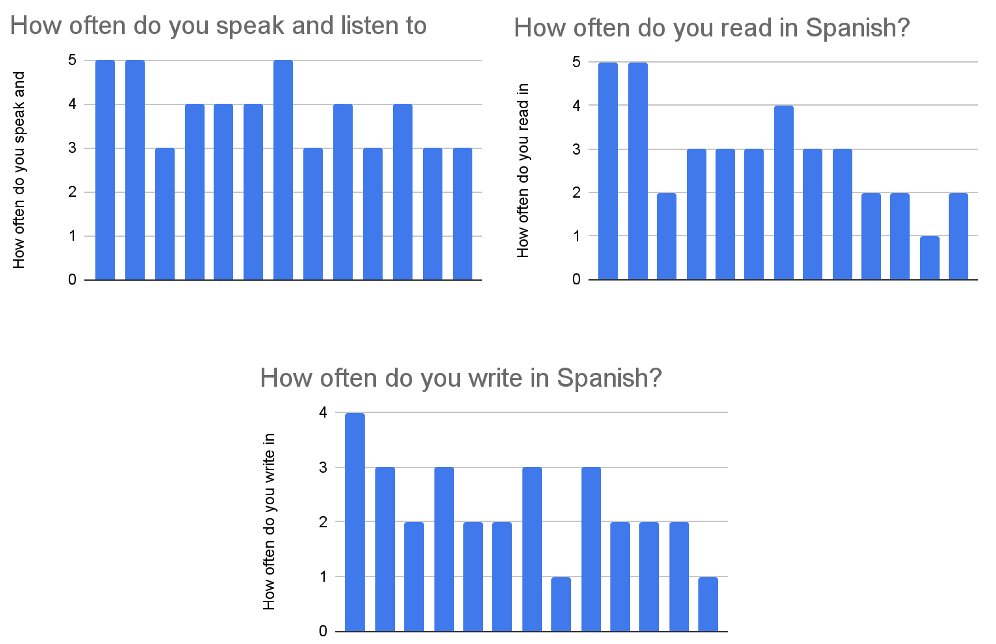
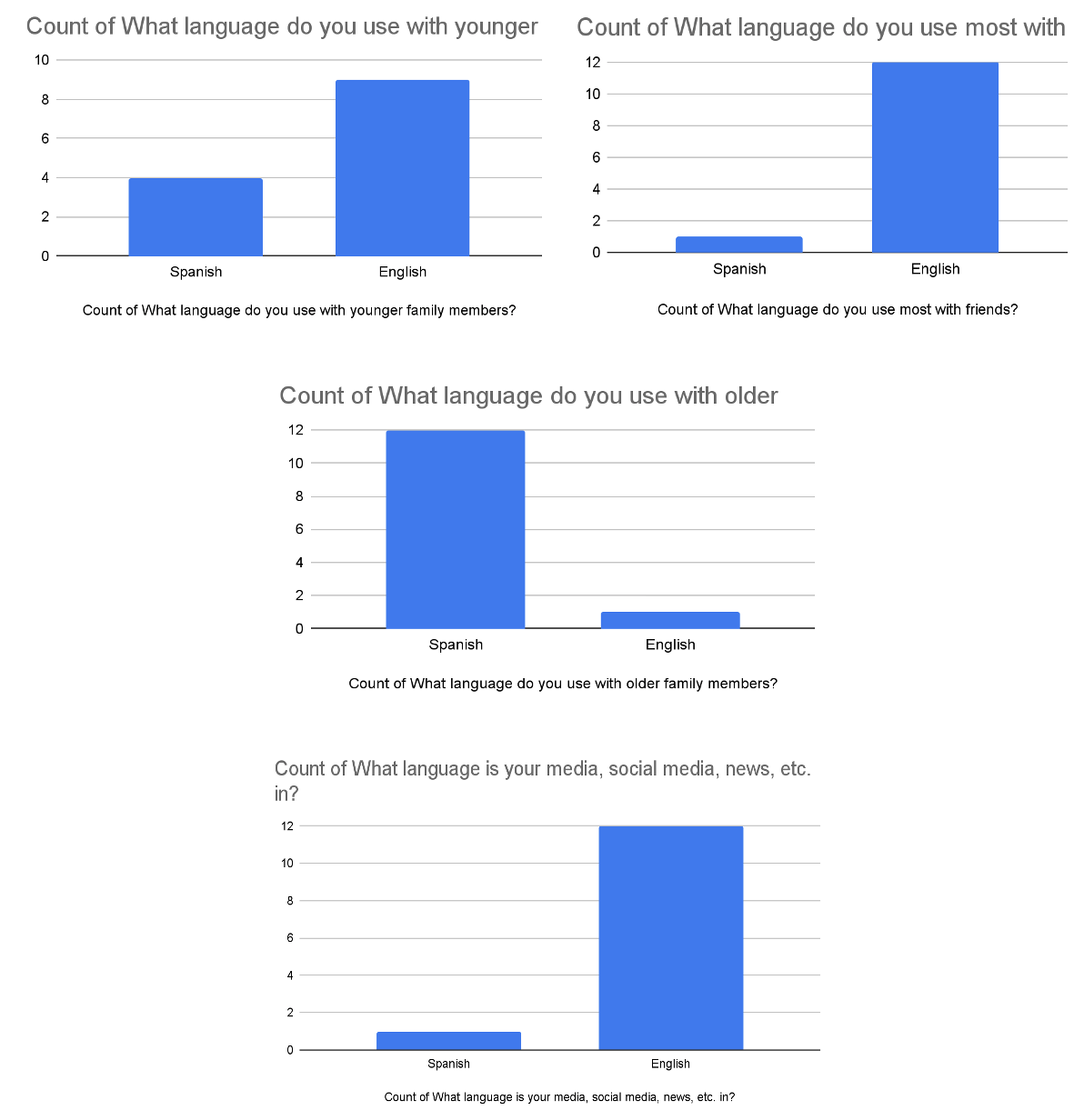
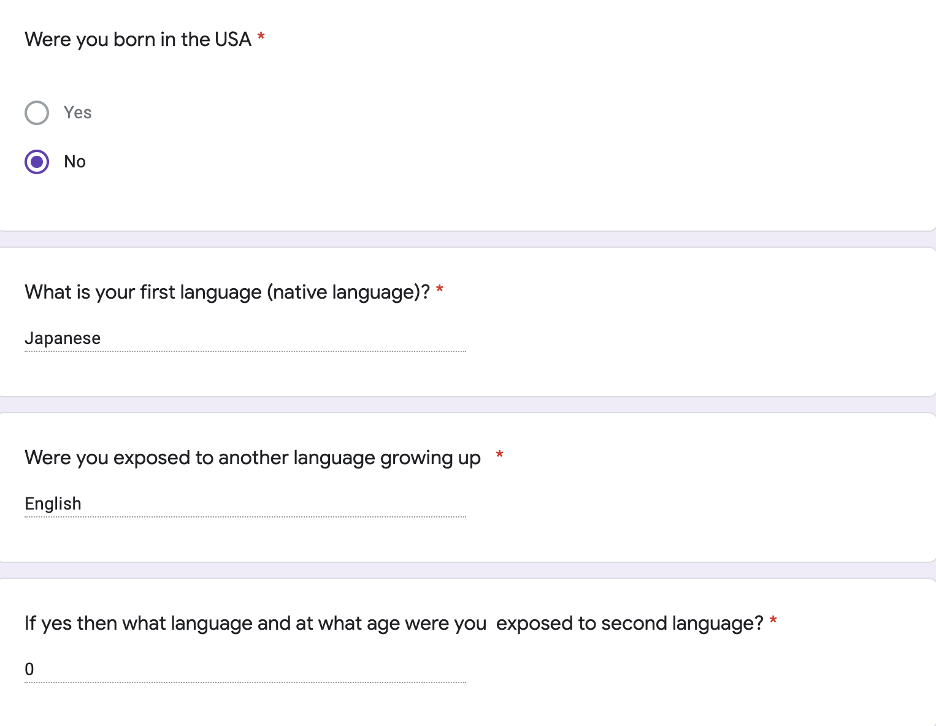
We utilized a Google form with two tasks: elicitation and judgment, followed by a demographics section at the end that collected data about each participant’s fluency and usage with Spanish and English, how they learned each language, and other background information. The elicitation section asked participants to write a series of short transitive sentences consisting of 3-8 words in Spanish based on simple pictures, such as a cat chasing a mouse or a teacher reading to students. There were six pictures in total. Refer to the Appendix for sample pictures, as well as instructions from the tasks. The goal of this task was to elicit transitive sentences, observing the frequency of certain word orders within each subject group.
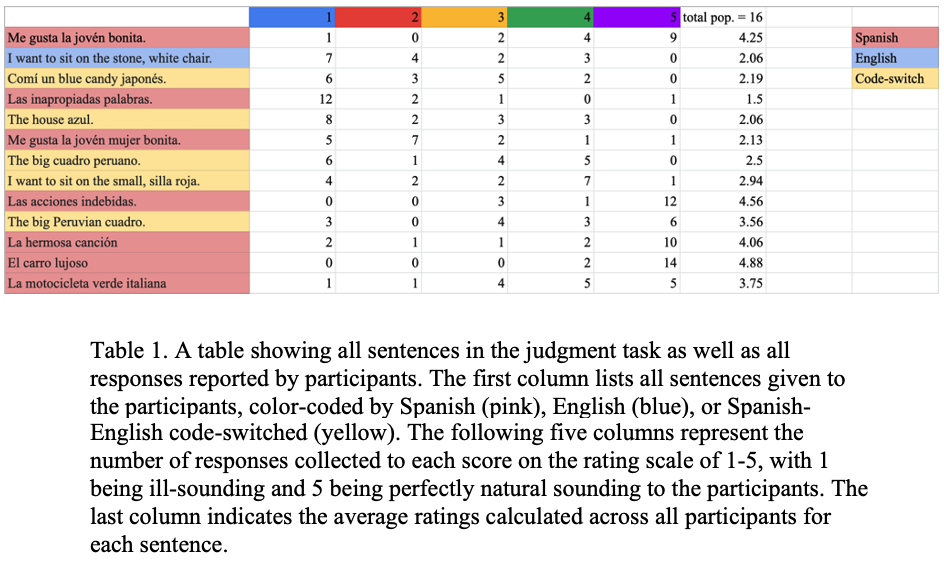
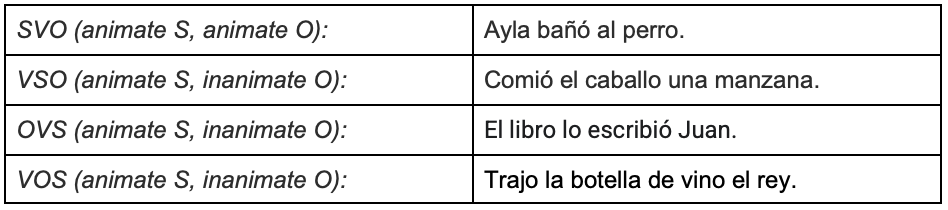
The judgment section presented participants with a series of short Spanish transitive sentences in various word orders and asked them to judge whether the sentence was grammatical or not. If they judged it grammatical, they were asked to identify the subject of the sentence. This task contained eight transitive sentences in varying word orders: SVO, VSO, OVS, and VOS are example constructions. Table 1 below show sample sentences used in our Google form:
Results
These tasks measure syntactic language transfer. Groups that were less accepting of non-SVO word orders show the most language transfer. The elicitation test was designed with the idea that groups with less language transfer would use more varying word order. On the judgment task, more language transfer would mean accepting more of the sentences as correct. We expected differences in the amount of language transfer between the groups with ES-dominant speakers demonstrating the least language speakers, meaning that we expected they would use and accept more non-SVO word orders. Based on the previous research, we also believed that L2 learners would show the most language transfer by relying on English syntactic cues to have narrower use and acceptance of word order. Heritage speakers were expected to fall in the middle.
When forming the groups, we determined L2 learners to be respondents who began learning Spanish in middle school or later. Heritage speakers were ones who learned Spanish before preschool but are more comfortable using English, and ES-dominant bilinguals are those who learned Spanish as a first language, and continue to be most comfortable speaking Spanish.
In our elicitation task, we observed four main sentence construction types: transitive, intransitive, prodrop, and copula, as shown in Table 2. These example sentences are actual responses to our elicitation task, but they were taken from respondents of all three groups, so they are not representative of any one group.
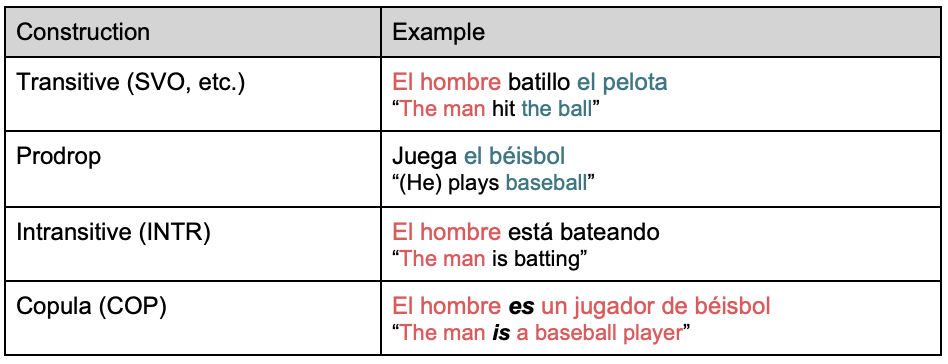
Transitive sentences are ones that contain a subject, object, and a verb, and as such we were able to categorize them by word order: for example, SVO. Spanish grammar also allows for sentential subjects to be optionally dropped, giving a sentence with just a verb and an object, where the subject is only implied. These sentences were labeled as prodrop to reflect this. Intransitive sentences contained only a subject and a verb that does not take an object, labeled as INTR in our data. Lastly, copular sentences are ones that include the verb “to be” and a subject predicate, labeled as COP.
As a note, our analysis of the elicitation task data only included responses that gave full sentences. We had several responses that were simple noun phrases, for example “el chico.” These were particularly common in the L2 data, most likely due to a lack of proficiency with Spanish. We excluded these phrasal responses because our goal was to observe transitive sentence word order.
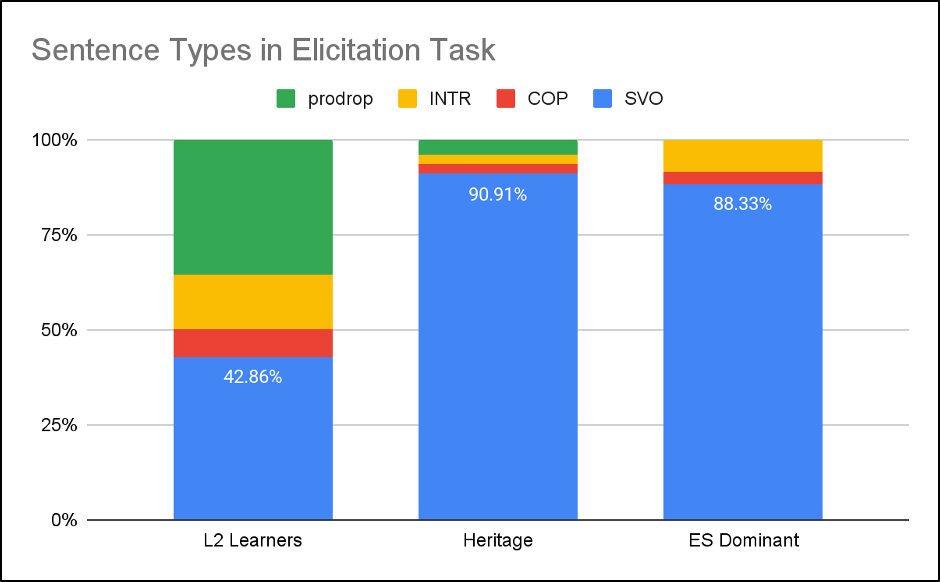
Looking at the quantitative data from the elicitation task presented in Figure 1, the most notable observation is that SVO is the only observed transitive sentence pattern for all three groups. SVO sentences accounted for about 90% of all responses from heritage speakers and ES-dominant bilinguals. Full transitive sentences were less common for L2 learners, accounting for just over 42% of responses; instead, there was a tendency to use simpler constructions such as prodrop or intransitive sentences that did not include all three of subject, object, and verb. Like with the excluded phrasal responses, this was likely due to a lack of proficiency in Spanish.
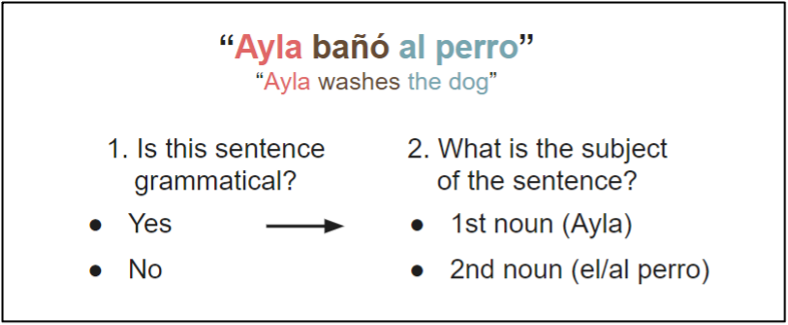
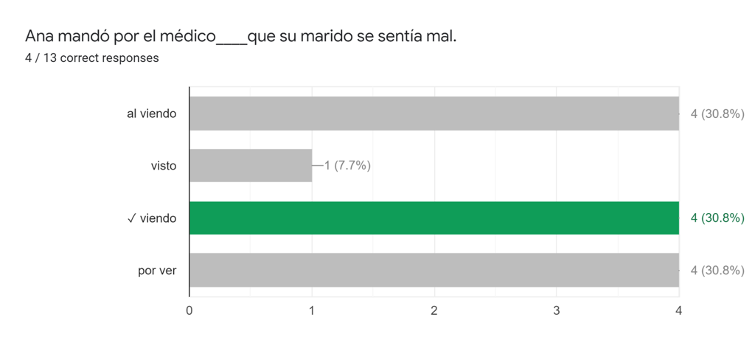
In our judgment task, we gave several grammatical sentences of varying word orders to our respondents and asked them to make two judgments about each sentence: first, is the sentence grammatical? If the response was yes, we then asked them to name the subject of the sentence. This format is shown in Figure 2. We analyzed this data in two parts, consolidating responses for word order types in each group: first, the results of the grammaticality judgment task, and second, the results of the subject identification task.
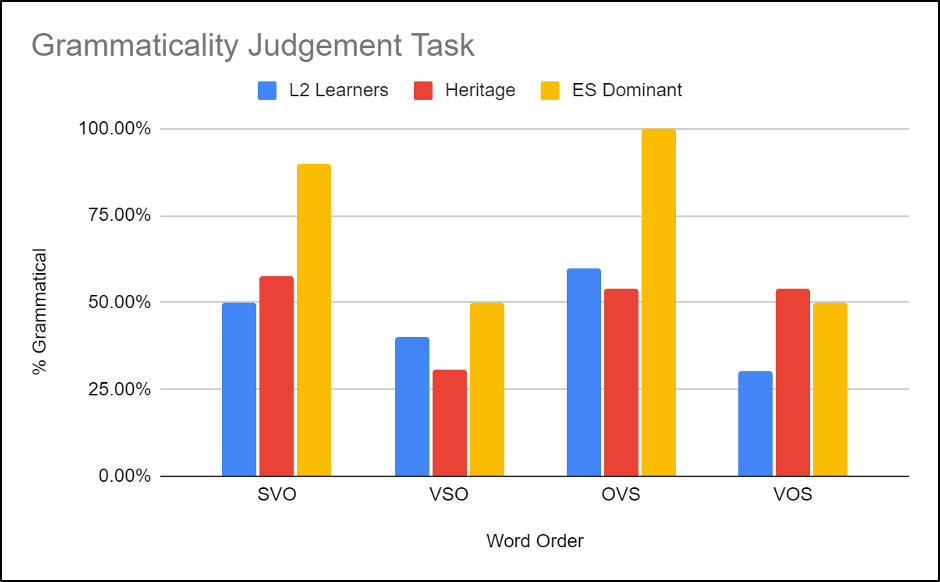
There was a clear difference between ES-Dominant bilinguals and the other two groups in the grammaticality judgment task, since ES-Dominant speakers accepted our SVO and OVS sentences far more than the other respondents (Figure 3). Performing a chi-square test of independence on each word order category showed statistically significant differences in grammaticality judgment among the three groups for SVO and OVS sentences (p < 0.05), but no significant differences for VSO and VOS sentences (p > 0.40), which were the least accepted word orders overall. While we did not expect the verb-initial sentences to be so unfavorable for all groups, the ES-Dominant bilinguals displayed the most flexibility with regard to word order, which aligns with our hypothesis.
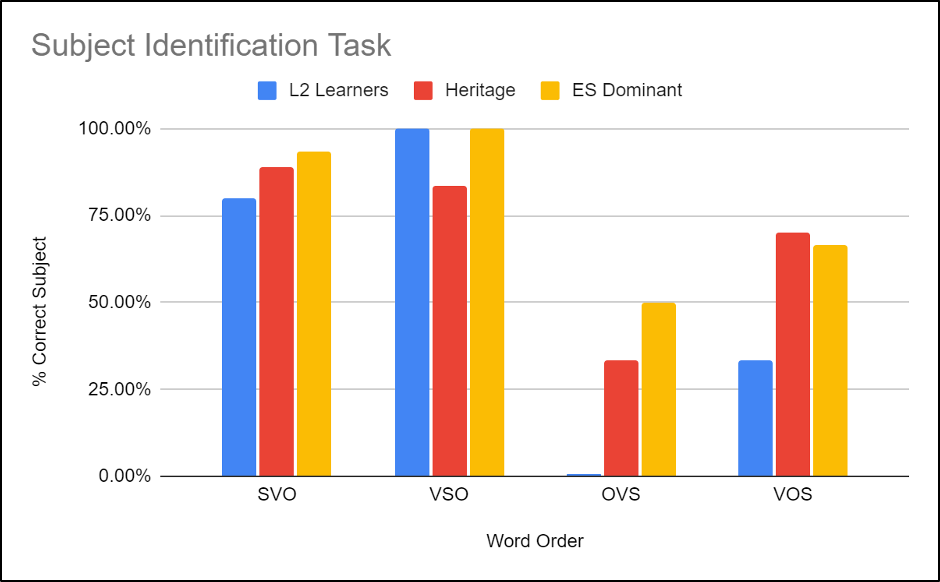
As demonstrated in Figure 4, there was a high rate of correct responses for all groups in SVO and VSO sentences, which have the subject as the first noun. The correct identification rate drops sharply in OVS and VOS sentences, where the subject is the second noun, demonstrating a tendency across all three groups to just choose the first noun as the subject.
Notably, the L2 Learners had a much lower correct identification rate than the other groups for second noun subjects, with no correct responses when identifying subjects for OVS sentences. However, when we performed a chi-square test on this data, we did not observe any statistically significant differences in the groups for any word order (p > 0.30). This is most likely because of our very small sample size, since we only asked the respondents to identify the subject if they said the sentence was grammatical.
Discussion and Conclusions
This study allowed us to explore differences in English-Spanish syntactic transfer between L2 learners, heritage speakers, and ES-dominant bilinguals. The most notable result we found was that SVO was the only observed transitive word order in our elicitation task. This overwhelming prevalence of SVO sentences suggests that it is the unmarked, preferred word order for all groups of Spanish speakers. Conversely, non-SVO word order in Spanish is likely marked in some way, for example as a form of focalization for the fronted word (Campos & Zampini, 1990).
Thus, a possible extension of this research could involve the elicitation of sentences from a question instead of from a picture, as was done in this study. Questions that take a verb or object as an answer, for example “What is the man doing?” or “What is the girl eating?” could be used to elicit non-SVO sentences through focalization, with the goal being to compare the frequency of non-SVO word orders produced by each group.
Overall, L2 learners and heritage speakers had similar grammaticality judgments for each word order, while ES-dominant bilinguals were far more accepting of SVO and OVS word orders than the other two groups. However, all three groups found the VSO and VOS sentences to be disagreeable, which may indicate an inherent dislike for movement of the verb. We interpreted these differences in grammaticality judgments as possible evidence of language transfer, with ES-dominant bilinguals exhibiting the least syntactic transfer from English, but other factors such as dialectical differences in lexicon and grammar may also have contributed to these results. Language contact with English may be another possible reason for the unacceptability of VSO and VOS sentences, even for the ES-dominant group.
L2 learners chose the first noun as the subject more so than any other group. Although both heritage speakers and Spanish-dominant speakers showed a slight tendency to also pick the first noun, it was not to the extent that L2 learners did. A possible explanation for why this occurred is that the participants may not have known what a grammatical or syntactic subject refers to. Even native speakers of a language may not necessarily have explicit grammatical instruction that would allow them to identify what a grammatical subject is.
Some other limitations of this study include the fact that the number of responses to our survey was a bit unbalanced between the groups. We received 5 L2 learner responses, 13 heritage speaker responses, and 10 Spanish-dominant speaker responses. It would have been ideal to have balanced groups as well as more participants overall. Furthermore, we tried to pick obvious pictures that would produce a limited range of sentences, yet we still received a variety of creative answers which were more difficult to codify. Lastly, as the survey could not be too long in order to keep participants’ attention, we were limited in the number of questions we could ask. More questions would have been ideal to observe more consistent results and be more certain of our results.
Despite these limitations, we hope this study will serve as a foundation for more language transfer studies in the future. Although we focused on certain specific aspects of language transfer in Spanish-English bilinguals, we believe that having this metalinguistic knowledge about the existence of language transfer would be especially useful for L2 learners when they are first acquiring Spanish, or any other foreign language. Many L2 learners struggle with overcoming the biases of their first language, but learning about the ways in which their native language can transfer over to the language they are trying to acquire is useful knowledge that will assist in their foreign language learning journey. As our world becomes more interconnected than ever, foreign language learning will surely become even more prevalent, and knowing about language transfer is a cornerstone to that.
Additional materials
https://www.languagetransfer.org/
As the name suggests, a website of free language learning materials that utilizes the ideas of language transfer to approach foreign language learning in a different way. This includes audio courses on French and Spanish.
https://www.youtube.com/watch?v=zByu8ilyxPg
A short video explanation of flexible word order in Spanish and possible different meanings that varying word orders can create.
References:
Campos, H. & Zampini, M. (1990). Focalization Strategies in Spanish. Probus, 2 (1), 47-64. https://doi.org/10.1515/prbs.1990.2.1.47
Erdocia, K., & Laka, I. (2018). Negative transfer effects on L2 word order processing. Frontiers in Psychology, 9. https://doi.org/10.3389/fpsyg.2018.00337
Lahousse, K. & Lamiroy, B. (2012) “Word order in French, Spanish and Italian:A grammaticalization account” Folia Linguistica, 46 (2), 387-416. https://doi.org/10.1515/flin.2012.014
Morett, L. M. & MacWhinney, B. (2013). Syntactic Transfer in English-speaking Spanish Learners. Bilingualism: Language and Cognition, 16 (1). DOI: 10.1017/S1366728912000107
Rodrigo, L., Tanaka, M. & Koizumi, M. (2020). The role of word order in bilingual speakers’ representation of their two languages: the case of Spanish–Kaqchikel bilinguals. J Cult Cogn Sci, 4, 275–291. https://doi.org/10.1007/s41809-019-00034-4
Vaughan-Evans, A., Kuipers, J. R., Thierry, G., & Jones, M. W. (2014). Anomalous transfer of syntax between languages. Journal of Neuroscience, 34 (24), 8333–8335. https://doi.org/10.1523/jneurosci.0665-14.2014
Appendices:
Example of Task 1, composition, which aims to elicit sentences from participants based on simple pictures:
Instructions: In this section, you will be presented with a series of images. Please write a short sentence in Spanish (3-8 words) describing the action in each image. You are free to look up words in a dictionary, replace single words with English, or skip the question if any terms are unfamiliar, but do not use a translator for full sentences.

Example of Task 2, multiple choice, testing various word orders in Spanish and whether the participants will judge them grammatical or not.
Instructions: In this section, you will be presented with a series of sentences. There are two parts. First, indicate whether the sentence is grammatical or not. Please note that “yes” indicates “this sentence is technically OK,” not “I would say it like this.” If “yes,” please indicate the subject of the sentence.
[/expander_maker]