Do you Entiendes?
Roni Grushkevich, Iffet Dogan, Isaac Verdugo, Nandana Suresh
The following research on receptive multilingualism seeks to observe if exposure to popular Spanish singing artists of various dialects impact Spanish heritage and non-Spanish heritage speakers’ ability to comprehend their song’s lyrics. 8 participants (4 native Spanish speakers, 2 romance language speakers, and 2 individuals who learned Spanish in school) were given a combination of a C-test and song test via Google survey. The C-test was administered to standardize the level of basic Spanish comprehension across the participants. 3 separate song tests were made for each of the following Spanish singing artists of different Spanish dialects: Vicente Fernandez (Mexican), Bad Bunny (Puerto Rican), and Shakira (Columbian), containing their most popular song. Out of the 8 participants, only 25% of them stated to have relied on their romance language in order to comprehend Spanish. Direct translations were uncommon, however, interpretations of the music were accurate. The results from the study suggest that heritage Spanish speakers were able to comprehend more than their non-heritage counterparts.
Introduction and Background
Can exposure to various dialects within the context of music impact a Spanish speaker’s ability to comprehend lyrics of a dialect they can not necessarily speak? As widely known global sensations, Bad Bunny, Vicente Fernandez, and Shakira are enjoyed by speakers of various languages. These artists, Bad Bunny originating from Puerto Rico, Vicente Fernandez from Mexico, and Shakira from Columbia, sing in various dialects of Spanish and have the potential to subliminally impact non Spanish heritage and Spanish heritage speaker’s ability to comprehend Spanish from exposure alone. This phenomenon relates to receptive multilingualism, which refers to a mode of interaction wherein people can use a language or language variety that the person with whom they are communicating does not speak, without compromising any understanding between both parties, and without the use of any additional lingua franca (Rehbein et al. 2011). This essentially means that people who have been exposed to a particular language can develop the ability to understand it, without necessarily being able to speak it. This phenomenon allows for different, varied modes of communication, especially between speakers of similar languages and dialects, who may be able to understand each other while not speaking each others’ mother tongues. Similar research on this topic has revealed mixed findings. A study by Gooskens & Heeringa (2014), found that Norwegian speakers, who tend to be more exposed to different dialects of Norwegian, were better at translating texts in other Scandinavian languages than Danish speakers. In Sloboda & Nábělková (2013), the researchers found that in online spaces, there were mixed results on whether Slovak is intelligible to Czech speakers. The following research differs from existing findings as it focuses on receptive multilingualism within the context of music, focusing on heritage and non-heritage Spanish speakers specifically. We predict that through receptive multilingualism, Spanish heritage speakers will have the highest comprehension of song lyrics of various dialects; however, non-heritage speakers will have some level of comprehension through learned Spanish or familiarity with Spanish.

Methods
Our participants were composed of both heritage Spanish speakers and non-heritage Spanish speakers. Participants were not asked to report their age or other demographic information. All of our participants are based in Los Angeles, California and were UCLA students. We got our participants by asking individuals who we know meet the requirements and asking individuals enrolled in a UCLA Italian course. We ended up having 8 participants (4 heritage Spanish speakers, 2 romance language speakers, and 2 individuals that learned Spanish in school). Non-native Spanish speakers were asked to report if they had received formal education in Spanish and if they did not speak Spanish, what Romance language they did speak.
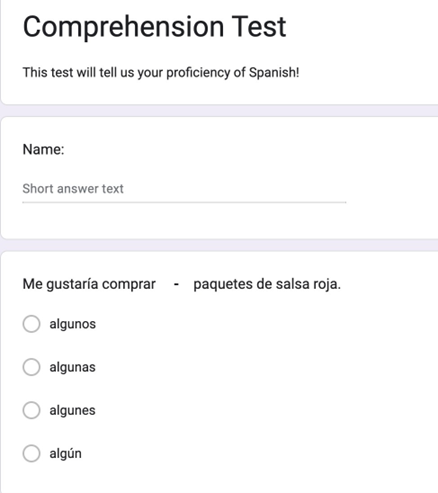
We were able to conduct our study via C-test and song test, both of which were presented to the participants online in one survey. A C-test is a tool to measure language proficiency and this shows us where the participant’s levels of proficiency in Spanish is placed. We used the C-test from an online source (One to One Spanish). We chose to have this C-test in Spanish because it would allow us to compare our participants although they all come from different backgrounds. The entire C-test is multiple choice but we asked each participant to explain what skills they used to answer the questions.
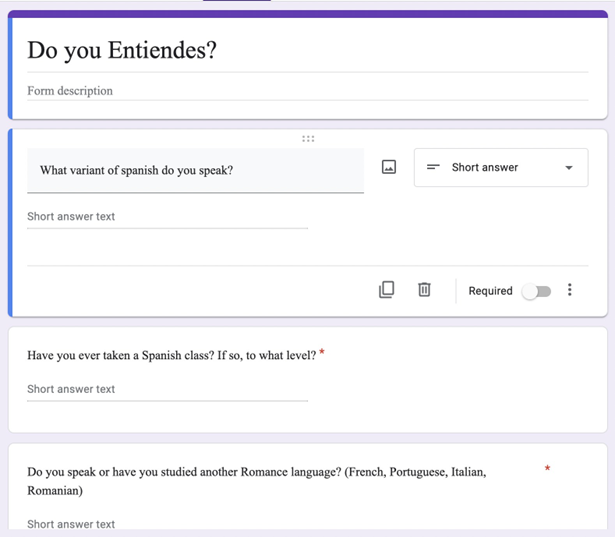
The second part of the Google survey consisted of a set of questions that revolved around a song by one of the Spanish language artists, Vicente Fernandez, Bad Bunny, and Shakira. The participant was given a survey with one of the artists that does not sing in the variation of Spanish that they are privy to in the case that they are one of the heritage speakers of that variation. For example, a heritage Mexican-Spanish speaker was not given Vicente Fernandez as their musical artist to interpret. Moreover, each participant was pre-screened and elaborated on which type of Spanish they are familiar with/speak in order to select the song from an artist who sings in a variation of Spanish they’re unfamiliar with. The survey asked questions like what variation of Spanish they speak, if they have ever taken a Spanish-language class, if they have studied another romance language and to what level. Upon answering these questions, the participant listened to a section of the song they were given. Upon listening to the section of the song, the survey asked participants what they remember hearing from the song and followed up with asking the participant how they would translate what they heard into English and if they could not do so, how would they interpret what they heard. Lastly, they were asked how they came to this interpretation. We anticipated word chunks to be an important element in the analysis because of the similarities some words have with a similar romance language which would contribute to the receptive multilingualism. We evaluated the amount of word chunks that they were able to register in each survey. We accounted for the amount of word chunks they input as well as the frequency of entire sentences they input among the three different songs.
Results / Analysis
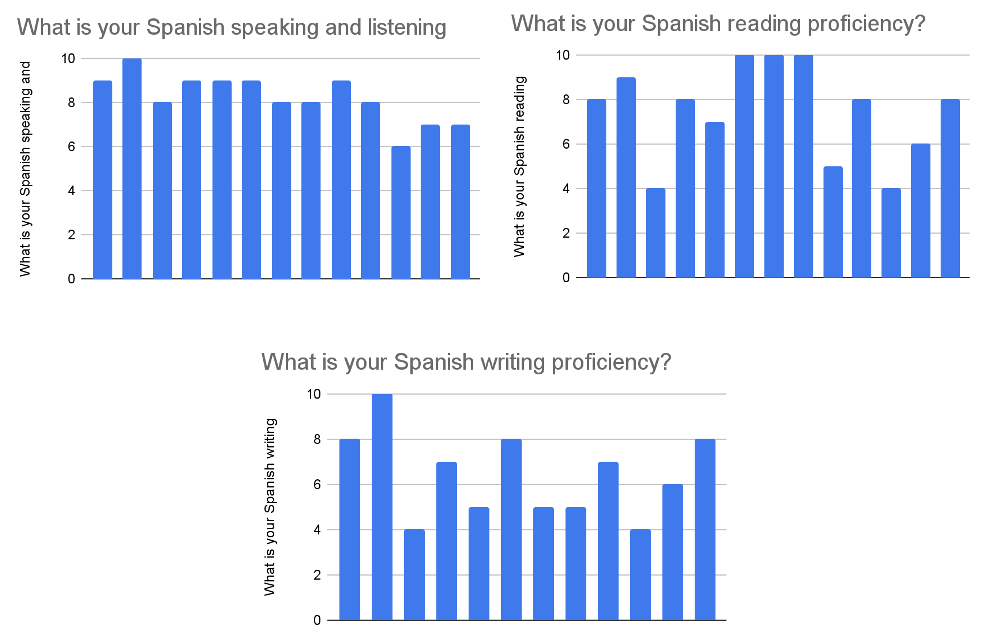
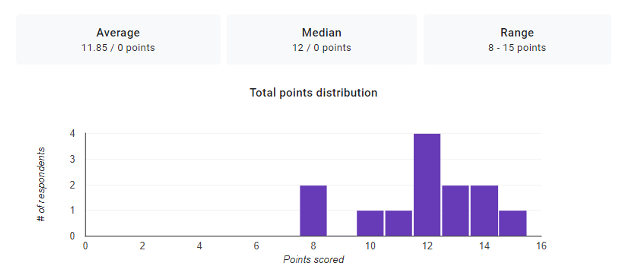
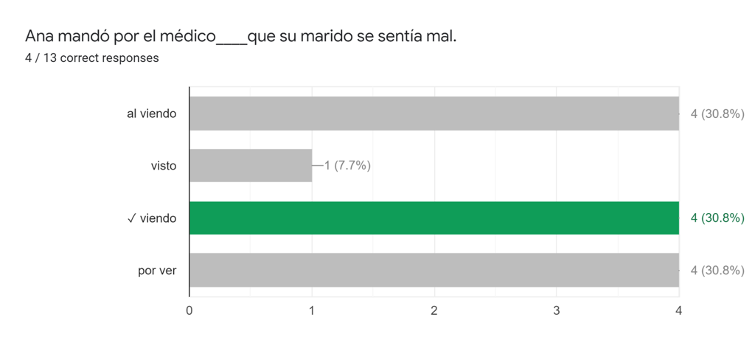
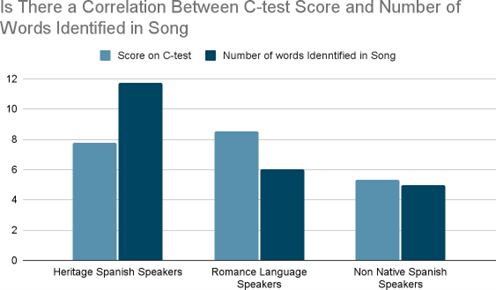
Based on our results, it is clear that our participants scored fairly well on the C-test. Out of nine questions, we were able to compare participants’ comprehension of Spanish in comparison to each other. As shown by Figure 1, the heritage Spanish speakers and romance language speakers performed better on average in comparison to the non-native Spanish speakers. This is something that we predicted when creating our study. This could be due to the fact that the heritage and romance speakers have more background with Spanish and have better knowledge to apply when taking the C-test. It is important to note that the non-heritage Spanish speakers scored exactly where we predicted they would. With some prior knowledge in Spanish, averaging a 5.5/9 on the C-test is fairly high.
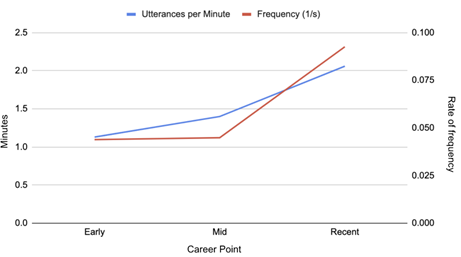
Figure 1 aims to see if there is a correlation between the score participants got on the C-test and the number of words/chunks they identified in the second part of the Google survey when listening to the song. It is clear that heritage Spanish speakers performed the best at identifying words/chunks out of the song they heard. One surprising thing we do see in the graph is that the romance language speakers did much better on the C-test portion in comparison to the music component. This could be due to the fact that the C-test relies more on recall because it is multiple choice. This means that romance language speakers see the options listed which could help them reach the right answer. However, when needing to write chunks/words they remember, it is a much harder task that requires more knowledge of Spanish.
Overall, Figure 1 proves the fact that the performance on C-test is highly correlated to the way participants performed on the song test.
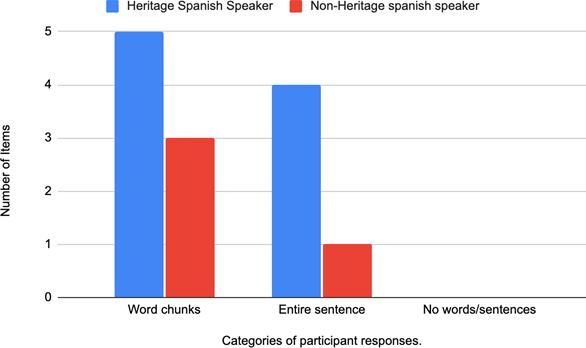
Below is a column chart that displays the amount of participants that were able to register word chunks, entire sentences, and no sentences or word chunks. The heritage Spanish speakers were able to register more word chunks and entire sentences than their non-heritage counterparts.
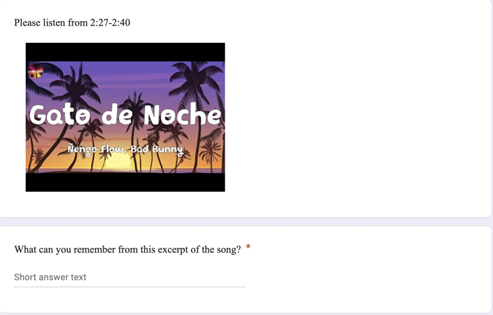
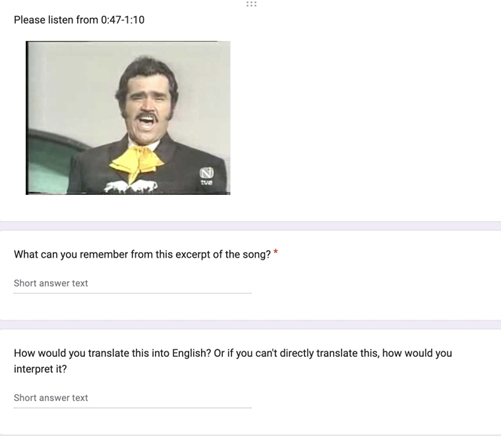
The excerpts from each song were less than 15 seconds each and displayed roughly three whole sentences. Vicente Fernández’s Volver Volver included the lyrics “Nos dejamos hace tiempo pero me llegó el momento de perder. Tú tenías mucha razón le hago caso al corazón y me muero por volver.” Our two participants that were given the song Volver,Volver comprehended a good amount of lyrics that they were able to translate into small pieces of information like word chunks. Their knowledge of pop-culture and their respective romance language backgrounds were able to assist them in their interpretations of the song and lyrics. Bad Bunny’s Gato de noche exhibited the following lyrics from the excerpt “Tú ere’ mi loca y hoy te toca la terapia si no se lo meto le da rabia puedo tener más de veinte pero tú ere’ mi bichota, tú ere’ mi sicaria tanto’ pece’ en el mar”. Three heritage Spanish-speakers were able to register the entirety of the song excerpt; however, they did not register every word. Their knowledge in Spanish and the use of context clues based off of that knowledge was able to assist them in their interpretation of the song. The one non-heritage Spanish speaker that was given the Bad Bunny excerpt registered a few word chunks but did not succeed in translating the excerpt entirely. They did mention that their romance language assisted them in their interpretation and therefore led to their response aligning with what the lyrics entailed.
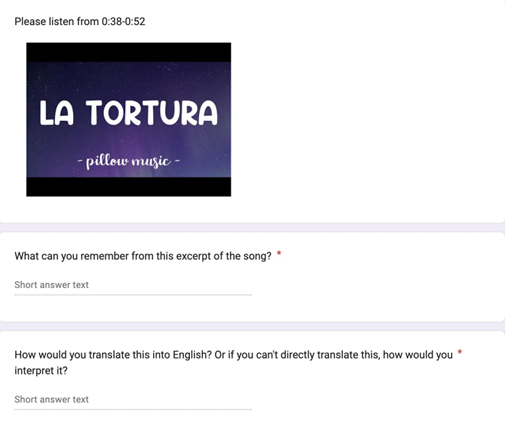
Shakira’s La Tortura was given to two participants, both of whom are heritage-Spanish speakers. The following lyrics were exhibited in the excerpt: “Ay amor me duele tanto, me duele tanto. Que tú fueres sin decir a dónde ay amor fue una tortura perderte.” The two participants had very accurate translations of the excerpt as well as the amount of word chunks and sentences they were able to register. Both of them translated the lyrics and their interpretation of the excerpt was accurate. They stated that their background in Spanish was the main reason for their accurate responses. Out of the eight participants, only 25% of them stated to have relied on their romance language in order to comprehend Spanish. Direct translations were uncommon, however, interpretations of the music were accurate.
The findings of the data suggest that heritage Spanish speakers were able to comprehend more than their non-heritage counterparts. Given that we received eight responses, it is not clear whether or not the findings reflect this on a macro level.
Discussion and Conclusions
Overall, while our C-test results were mixed, there certainly was a positive correlation between one’s prior exposure to Spanish and the amount of words they were able to translate during the music component of this experiment. This shows that, for the romance language speakers and non-native Spanish speakers, the prior exposure that they may have had to Spanish or another romance language probably did help them translate the song lyrics that were given to them, especially when we consider the fact that, even though many of the non-native Spanish speakers were not able to perfectly translate the lyrics, a large proportion of them were still able to accurately understand the meaning of the song lyrics. In essence, while they may not have been able to understand the meaning of each individual word, they may have been able to use what they did know, in conjunction with context clues, to make an educated guess as to what the general meaning of the lyrics were.
As it turns out, this is a strategy that many of our participants reported that they were able to follow, in that they described being able to recognize some of the more “important” content words (nouns, verbs, adjectives, and adverbs), and use them to their advantage. These words happened to be those that were either well known to non-Spanish speakers, such as loca, or those that share a similar form to their counterparts in English or other romance languages. From there, they described being able to use context clues to help them derive the meaning of the surrounding word chunk. Aside from this, there were some non-linguistic aspects of each song that may have somewhat aided the participants in their translations, in that features like tone, rhythm, tempo, etc. may have helped them identify the mood, and likely subject matter of the song. we did not see this described in our data enough, though, to make any concrete conclusions surrounding this.
However, when discussing this experiment, it is important to consider factors such as formal education that may have skewed our data—many of our non-native Spanish speakers had taken Spanish to quite a high level in the past, which can explain the relatively high proficiency that was found in their C-test results, and may have boosted their ability in the song lyric task as well. This is not necessarily a bad thing, since it doesn’t disprove that receptive multilingualism is the underlying mechanism in their success in these tasks. In terms of better understanding the strength of receptive multilingualism, though, we would probably have wanted to include participants who had less, but still some, exposure to Spanish. In this way, we would have been able to draw stronger conclusions from the data we collected—if people who had a very basic level of formal exposure to Spanish were still able to understand the meaning of the song lyrics, while likely performing poorly on the C-test, it would ultimately mean that their receptive capabilities were the main reason as to why they were able to understand the lyrics.
Additionally, only two out of the three videos we used to present the songs to the participants contained closed captions, which definitely showed in our data. We noticed that while most participants were able to understand the lyrics of the songs that contained closed captions, the participants that were assigned to the song that did not have closed captions struggled considerably with recognizing words and translating lyrics as a whole. This is not particularly surprising—while many words may share written forms between English, Spanish, and other Romance languages, they don’t necessarily sound similar. Because of this, when participants were forced to rely purely upon auditory stimuli during the music component, they may not have recognized some words that they would have recognized if they had access to closed captions while listening. In terms of receptive multilingualism, this indicates that people’s receptive abilities are stronger when they have both audio and visual input, as opposed to just audio input, as it makes it easier to make connections between the words in the received language and their counterparts in their native languages.
While we cannot make any claims about whether this makes it easier to then learn these words in the received language, perhaps, in the future, doing something like adding closed captions to all songs would help people understand their lyrics, even if they don’t speak the language that the song is sung in. Thus, receptive multilingualism can be a powerful tool in understanding non-native languages especially when considering songs and other forms of media, because we have various amounts of ways in which we can present information to listeners to aid their understanding of the material, no matter what their background may be.
Appendix
Comprehension Test
 Survey Inquiry
References
Bahtina-Jantsikene, D. (2013). Mind Your Languages: Lingua Receptiva in Estonian-Russian Communication. LOT. http://www.lotpublications.nl/Documents/338_fulltext.pdf
Bulatović, S., Schüppert, A. & Gooskens, C. (2019). Receptive multilingualism versus ELF: How well do Slovenes understand Croatian compared to Croatian speakers’ English? . Journal of English as a Lingua Franca, 8(1), 37-65. https://doi.org/10.1515/jelf-2019-2005
Gooskens, C. & Heeringa, W. (2014). The role of dialect exposure in receptive multilingualism. Applied Linguistics Review, 5(1), 247-271. https://doi.org/10.1515/applirev-2014-0011
Rehbein, J., ten Thije, J. D., & Verschik, A. (2012). Lingua receptiva (LaRa) – remarks on the quintessence of receptive multilingualism. International Journal of Bilingualism, 16(3), 248–264. https://doi.org/10.1177/1367006911426466
Sağın-Şimşek, Ç., & König, W. (2012). Receptive multilingualism and language understanding: Intelligibility of Azerbaijani to Turkish speakers. International Journal of Bilingualism, 16(3), 315–331. https://doi.org/10.1177/1367006911426449
Sloboda, M. & Nábělková, M. (2013) Receptive multilingualism in ‘monolingual’ media: managing the presence of Slovak on Czech websites, International Journal of Multilingualism, 10:2, 196-213, DOI: 10.1080/14790718.2013.789523
Spanish Quiz – Prueba de Español – B1. Free Spanish quiz B1 – Intermediate Low level. (n.d.). https://121spanish.com/spanish-quiz-B1
Verschik, A. (2012). Practising receptive multilingualism: Estonian–Finnish communication in Tallinn. International Journal of Bilingualism, 16(3), 265–286. https://doi.org/10.1177/1367006911426465
Weiss, Gretchen. (2021) The Effect of Music Instruction on Bilingual Early Language Acquisition. [Master’s thesis, California State University]. https://scholarworks.calstate.edu/downloads/1j92gd72g#:~:text=Children’s%20songs%20 and%20chants%20taught,and%20reinforcement%20by%20the%20family.