Ryan Bakshian, Nicholas Bekeredjian, Rhea Chhabra, Nicholas Lumidao, Philena Nguyen
Accents are not merely ways of speaking. They often signal social information about who a person is and where they belong. In England, regional accents are strongly associated with class, status, and geographic origin, making them a powerful lens for understanding how people interpret social meaning. This project explores how listeners perceive speakers with different English accents and whether these judgments reflect a simple prestige hierarchy or more nuanced assumptions about identity. Specifically, we examine how accents influence perceptions of intelligence, competence, authority, and social belonging. Listeners evaluated three well-known English accents: Received Pronunciation (RP), which is often associated with social prestige; Cockney, traditionally linked to working-class London; and the West Country accent, associated with rural southwestern England. Our analysis investigates whether listeners separate perceived ability from expectations about who “fits” positions of power or status. Beyond this, we also focus on the role of listeners’ own self-perceptions, which makes this research distinct from prior studies on accent-based social judgements. Our findings suggest that accent bias is more layered and complex than commonly assumed. While certain accents may still be associated with higher competence, listeners also make judgments about whether a speaker’s voice aligns with socially expected identities of authority. These patterns reveal that accent perception is not only about evaluating ability but also about interpreting speakers’ social identities and their perceived place within existing hierarchies.
Keywords: Accents, England, hierarchies, authority, judgements, status
[expander_maker id=”1″ more=”Read more” less=”Read less”]
Introduction
Language is one of the most immediate signals people use to form impressions of others. Within seconds of hearing someone speak, listeners often make assumptions about a speaker’s background, intelligence, education, or social status. In England, where regional accents are closely tied to class and geographic identity, these perceptions can carry particularly strong cultural significance. Accents such as Received Pronunciation (RP), Cockney, and the West Country accent have long been associated with different positions within England’s social hierarchy, shaping how speakers are perceived in professional, educational, and social contexts (Fraser, 1988).
Previous research has consistently found that RP is often associated with prestige and competence, while more regionally marked accents are sometimes evaluated less favorably (Wongkittiporn, 2024). However, less attention has been given to whether listeners separate judgments of a speaker’s ability from their sense of whether that speaker’s voice aligns with socially expected identities of authority, status, or belonging. These perceptions may also reflect deeper assumptions about how speakers see themselves and how they are expected to fit within broader social hierarchies.
Background
One way to understand accent bias in England is to look at how certain ways of speaking became linked to power in the first place. Over time, institutions like schools, government, and media helped establish which accents sounded “professional” or authoritative. These associations were not based on linguistic correctness, but on who was using those accents and in what contexts (Wongkittiporn, 2024). Received Pronunciation (RP) is a good example of this process. It became associated with elite education and national broadcasting, which gave it a reputation for sounding credible and intelligent because it is found “to be most dominant in the areas of South East England which are most populated by the highest socioeconomic classes” (Cole, 2021).
In contrast, accents like Cockney and West Country English developed very different associations. Cockney is tied to “the white working class in East London”, while West Country English is linked to rural areas in the southwest (Cole, 2021). Because of these social and geographic connections, they are often perceived as less formal or less professional, even though there is nothing linguistically inferior about them.
Methods
This study examined how individuals from England perceive their accents and how these perceptions influence their speech in various situations. There were two groups: the interview group and the outsider group. Participants in the interview group consisted of 3 college-aged adults who were either born in England or had spent a significant amount of their lives there, ensuring familiarity with different accents. Participants came from different regions and ethnic backgrounds, allowing for variation in accent types and experiences. The outsider group consisted of 15 individuals born or raised outside of England and was used to examine outsider perceptions of accents within England.
Data were collected through virtual interviews and an online perception survey. Participants in the outsider group completed an online, audio-based survey where they listened to 20-second speech clips of different English accents: Cockney, Received Pronunciation, and West Country. After each clip, participants rated the speaker on various social factors such as status, friendliness, and intelligence. This helped establish that accent-based hierarchies exist, which were then further explored through interviews with participants from England.
The interview group explored participants’ personal experiences with their English accents, including how it shapes their identity, as well as how it influences their speech in professional and social contexts. Other questions addressed whether participants felt pressured to modify their speech or code-switch due to past experiences with accent prestige and hierarchy. Participants were also asked to reflect on general changes in their regions’ accents over time, including accent leveling and intergenerational differences.
Analysis focused on identifying themes in participants’ self-reflections on their accent, its role in identity, and how they adjust their speech across contexts. Specifically, we examined patterns in participants’ descriptions of accent stereotypes, accent-based judgments, and the role of accent in shaping social and professional interactions.
Findings
The survey asked outsider participants to rate RP, Cockney, and West Country speakers across four traits on a 1 to 7 scale. On perceived education and status, the results aligned with existing assumptions about English accent hierarchies. RP speakers scored highest on education (5.87) and status (5.0), Cockney fell in the middle (5.13 and 4.27), and West Country scored lowest on both (3.0 and 2.53), nearly three full points below RP on education alone.
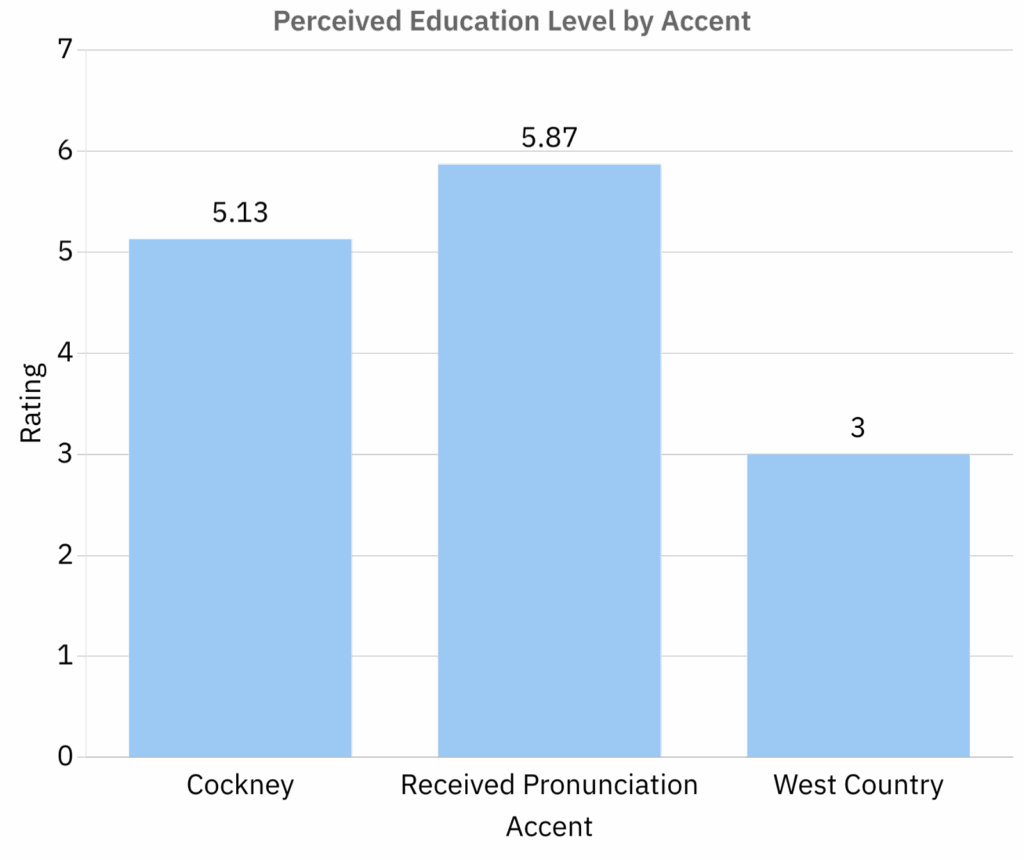
Figure 1. Perceived education level by accent, with RP rated highest, Cockney moderate, and West Country lowest on a 1–7 Likert scale.
The more revealing results came from trustworthiness and approachability. West Country speakers scored highest on approachability (5.6) and nearly matched RP on trustworthiness (5.53 vs 5.4), despite their low education and status scores. Listeners make distinct judgments depending on the trait in question, and regional accents, while penalized on markers of competence, can actually outperform prestige accents on markers of warmth.
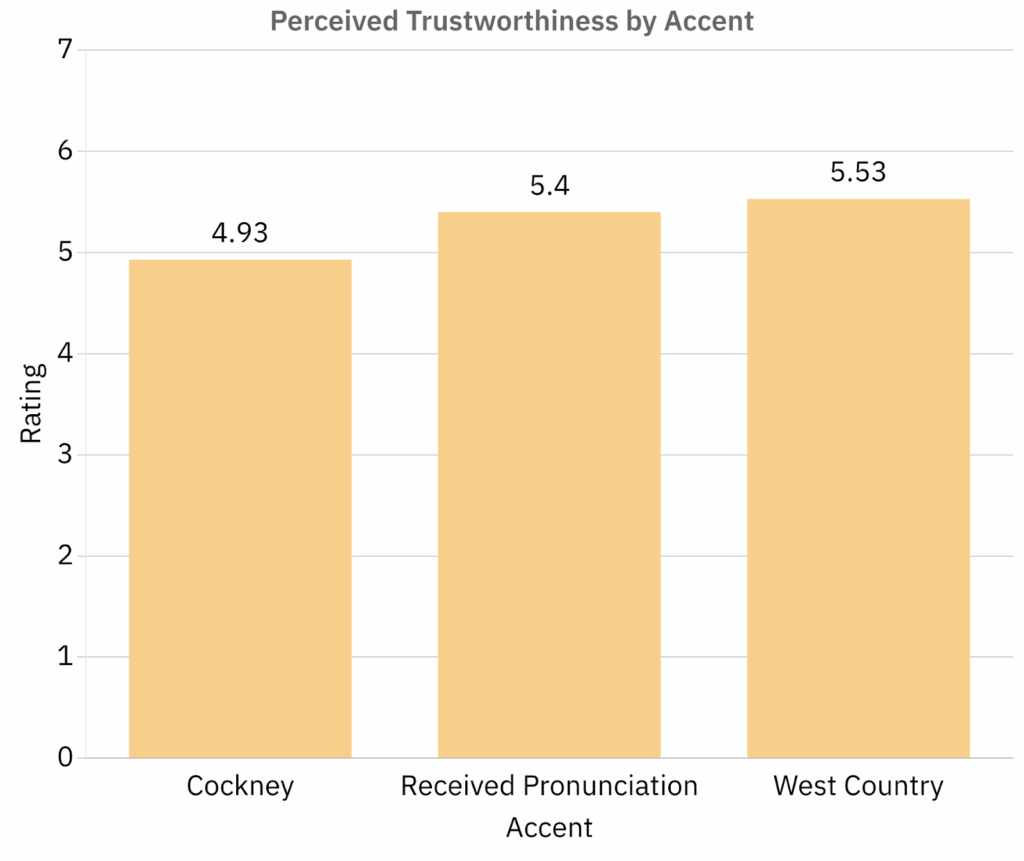
Figure 2. Perceived trustworthiness by accent, with West Country rated highest, RP moderate, and Cockney lowest on a 1–7 Likert scale.
The interviews added an important personal dimension. Charlotte, our RP speaker from outside Oxford, described RP as “just the default” growing up, an assumption that shifted when a manager told her she “sounded competent” before her interview had even concluded. Yet she also noted that people would “stiffen up” when she spoke in meetings. The two participants with hybrid accents described a different experience entirely, one noting that speaking formally meant being “taken more seriously,” while the other characterized her speech adjustments as both “strategic and subconscious.” For these participants, accent required active and ongoing management.
Impact
Accents in England shapes perceptions of education, authority, and social standing, but it also shapes how speakers understand and present themselves. Every participant demonstrated a clear awareness of the hierarchy around them. Charlotte acknowledged that her accent had “opened doors” she never had to knock on, while also recognizing that it came loaded with assumptions she did not always welcome, including being perceived as “out of touch.” Meanwhile, the participant raised across India and South Africa described a period in his life when he consciously tried to change the way he spoke to fit in socially, something he later described as “disingenuous” to his own identity. These are not abstract observations. They are the lived consequences of a hierarchy that assigns social value to the sound of a person’s voice.
What makes accent-based bias particularly difficult to address is that it is rarely treated as a serious form of discrimination. Accent tends to be framed as something neutral or changeable, which makes it easy to dismiss. But the patterns this study uncovered suggest otherwise. The hierarchy was not something any participant had been explicitly taught. As Charlotte put it, she only became “more aware” of her accent over time and “more critical of what she used to think was neutral.” That gradual, largely unconscious absorption is precisely what makes accent bias so durable. When a prestige accent feels like the default rather than a privilege, the inequalities it produces become very difficult to see, let alone challenge.
References
Cole, A. (2021). Disambiguating language attitudes held towards sociodemographic groups and geographic areas in South East England. Journal of Linguistic Geography, 9, 13–27. https://doi.org/10.1017/jlg.2021.2
Fraser, S. A. (1988). Language and social class in Britain. Social Information Science, 4, 157–172. https://doi.org/10.60171/00005114
Wongkittiporn, A. (2024). Phonological features: Standard British English and the West Countries dialects. Proceedings of the RSU International Research Conference (RSUCON-2024). Rangsit University. https://rsucon.rsu.ac.th/files/proceedings/RSUSOC2024/IN24-025.pdf
[/expander_maker]