The Persian Identity Crisis
This study delves into the intricate relationship between language practices and the construction of individuals’ sense of belonging and cultural identity, with a specific focus on the Persian language, also known as Farsi. For second-generation Iranians residing in Los Angeles, this linguistic journey takes on a multifaceted nature, as they navigate a complex interplay between Farsi and English. This often leads to the adoption of code-switching, a phenomenon where individuals seamlessly alternate between the two languages, colloquially referred to as ‘Finglish’ or ‘Pinglish.’ Through interviews and observations within Iranian diaspora communities, this research aims to answer the following question: “Have Persians lost their self-identity and how is this reflected in language use? Our results would shed light on explaining how language proficiency, cultural adaptation, and social dynamics intertwine to shape the nuanced ways in which code-switching serves as a mechanism for negotiating and expressing multiple cultural identities, thus shedding light on its implications for Persian identity.
Introduction
The complex relationship between language practices and the construction of individual identity within diaspora communities is an interesting area to study, particularly in the context of second-generation Iranians residing in Los Angeles. Our project focuses on the Persian language, also known as Farsi, and its role in shaping cultural identity among the demographic. In the hugely diverse and multicultural landscape of Los Angeles, navigating between Farsi and English becomes a complex journey, often manifesting in code-switching or more commonly known as “Finglish”. Through a mix of interviews and observations within the Iranian diaspora, it begs the question: Have Persians lost their identity? Furthermore, what language traditions have changed to reflect that language might be a casualty of this identity crisis? Does a change need to happen to regain a sense of identity within the Fasi-speaking communities? By unraveling the complexities of language proficiency, cultural adaptation, and social dynamics, we seek to illuminate how code-switching serves as a mechanism for negotiating and expressing multiple cultural identities, thereby offering insights into the implications for Persian identity in diaspora settings.
Background
When we examine Iran’s rich history, it becomes evident that Iranians possess a heritage steeped in antiquity, vastly different from the modern Iran that it is today. This historical depth is intricately interwoven with the Persian language, serving as a tangible reflection of Iran’s multifaceted evolution. Among some Iranians, regardless of their location, Persian is revered as a cultural benchmark, embodying resilience and continuity across generations. However, the accessibility of resources pivotal for preserving and nurturing Persian proficiency varies among Iranian Americans. While some benefit from cultural events, media outlets, and language courses, others encounter barriers that impede their linguistic immersion and connection to their community.
Thus, many Iranian Americans resort to “code-switching,” a practice where an individual uses two or more language varieties in the same speech event or exchange, as defined by Woolard (2004). Within the diaspora, instances of code-switching manifest in colloquial phrases such as “is so zesht” to denote something ugly or rude, or expressions like “Kheili cute-eh,” signifying endearment. However, code-switching often elicits skepticism within the diaspora, particularly among native speakers. They perceive it as a departure from correct language usage, thereby exacerbating a disconnect between generations and contributing to the evolving linguistic landscape of Persian.
This disconnect is even more evident in the results of the ACS data analysis conducted by Bozorgmehr and Douglas (2011). Their findings reveal a notable linguistic divide within the second-generation Iranian diaspora: while 40% reported proficiency in Persian, a striking 98% acknowledged fluency in English, underscoring the prevalence of English as the dominant language of communication. As second-generation Iranians struggle with the intricacies of their linguistic identity amidst shifting cultural landscapes, this study sheds light on the nuanced dynamics shaping contemporary Persian language usage within the diaspora.
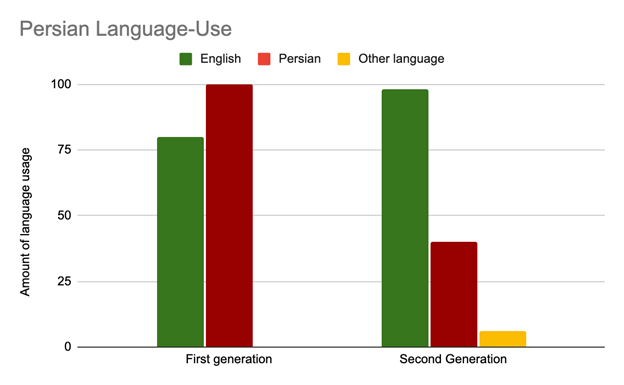
Furthermore, in the middle of this linguistic mismatch, most of the participants in this survey acknowledge only speaking Persian, while speaking with their group of friends in Farsi alongside English. As a result, diaspora youth unknowingly serve as informal language brokers, facilitating the seamless exchange and merger of both languages in their daily lives. This informal linguistic exchange not only highlights the intricate interplay between cultural adaptation and identity creation but also demonstrates the adaptability of the second-generation Iranian diaspora.
Discussion
The information discussed in this section is a widespread concern among the Persian diaspora. It is a common question of whether Persian is being taught enough, and if not, why parents are not teaching their children Persian. Although the first generation of Iranians overwhelmingly understands Persian and could teach it to their children, they choose not to due to Persian’s position when compared to English. Should a parent teach their child Persian to keep the language alive, and thus risk their child’s ability to speak fluent English, or do they teach their child English first and risk their child’s ability to speak the native tongue well? When framed against the financial success of the Persian diaspora, it makes sense that many would stray away from teaching Persian, even when they could do so.
Survey
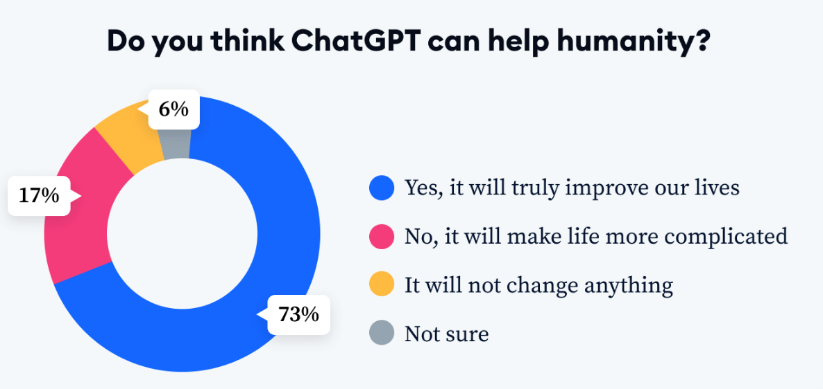
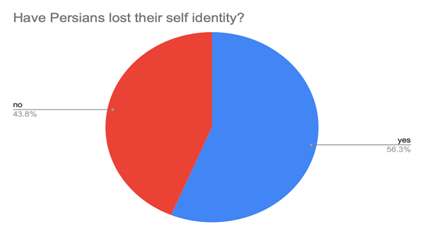
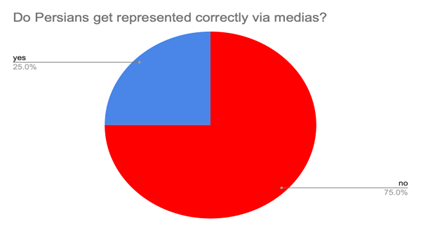
To get a better grasp of Persian Identity, we conducted a brief survey on the UCLA campus and asked participants, mainly of Iranian backgrounds, whether they believe that Persians have lost their self-identity or not. When we gained our participant’s answers and compared them to our original hypothesis, the data shown below was not surprising to us, however, what followed next was:
Survey Experiment Conclusion
From the two surveys that we conducted, the data clearly showed us that most Persians do not believe that they have kept their original identity and almost all of them agreed that the media’s coverage of Iranians does not help at all to fix this issue. When we take the findings we gathered from this experiment and combine them with our other data, we constantly see the same trends and conclusions about the Iranian people and their identity which will be discussed in more detail below!
Discussion and Conclusion
When we take a moment to evaluate all of our data and findings that we have stated so far, it is clear to us that the Persian people have lost their identity to some shape or extent. As shown, a lot of our data and participants believe this to be true for the most part and many agreed that for the Persian community to regain their identity and status, something must change with the Iranian Regime (government) representing them back in Iran. Although we do not have public data on this topic many of our participants and even articles universally agree that a direct change to the Iranian regime influences the words views and perceptions of the Iranian people. Overall, we are pleased to report that our original hypothesis of how “Persians have lost their self-identity” is to at least some extent true and the continued destiny of whether it remains true or not simply depends on the actions that the Iranian government and Iranian people continue to take.
References
Bozorgmehr, M., & Douglas, D. (2011). Success(ion): Second-Generation Iranian Americans. Iranian Studies, 44(1), 3–24. http://www.jstor.org/stable/27919961
Woolard, K. A. (2004). Codeswitching. In A. Durantic (Ed.), A companion to linguistic anthropology. Malden: Blackwell Publishing.
Survey Results