“Of course, right” and “I was just asking to ask”: Women’s Relationship With Cooperative Language and Their Perception
Zoe Curran, Emmeline Hutchinson, Rylee Mangan, Kamiron Werking-Volk
Why do we like Elle Woods from Legally Blonde? Why do we dislike Miranda Priestly from The Devil Wears Prada? Of course, part of it is because that is who the movie tells us to like and dislike, but is another aspect of that how they use language?
Based on existing knowledge that men and women use communication differently, taking divergent paths to accomplish tasks, we sought to determine how these variations distinctly affect men and women. We focused specifically on the effects on women and how their language use changes their perception. Are they the heroine or the villain? Are they the sweetheart or the b*tch? Our study examined the representation of women in the media and explored the implications of cooperative conversational styles on a woman’s perceived image.
We predicted that the way women in movies use language to facilitate, or inhibit, conversation contributes to their perception in aspects that do not affect men. Based on scenic analysis and tracking of key features, we found a correlation between the characters’ use of cooperative linguistic features and their representation in the film that may be integrated into everyday life.
Introduction and Background
Did you know that women are 33% more likely to be interrupted when speaking with men? And that men speak almost twice as often as women in formal conversation? As an all-female research group, we wanted to explore why we were being cut off in some conversations and completely ignored in others (read more about this topic here). Previous findings state that females utilize conversational styles that foster connection and community, while males utilize styles that attempt to strengthen their independence and dominance over the discussion’s topics (Ersoy, 2008). We do understand that men and women converse differently, but why did it seem like our communicative style was inferior when it is an attempt to be more engaging?
An explanation to this unbalanced communication might be women’s more active use of minimal encouragers, nonverbal gestures, and agreements that are intended to facilitate conversation but as we experienced, can yield opposite results. We geared our research towards understanding the implications of what we have termed Cooperative Conversation Linguistic Features (henceforth, CCLFs). CCLFs are a collection of words, phrases, and nonverbal gestures that promote a cooperative speaking style to encourage a conversational partner. These features help balance the conversation by allowing the speaker to continue talking. However, a woman’s increased use of these features can render them as a less-dominant speaker who might be inferred as subordinate and less powerful. To determine if there is a relationship between CCLFs and the speaker’s perceived identity we studied how women and their control, or lack of, the conversation affects their image and in an essence their likeability.
We studied samples of both same-sex and cross-sex conversation groups in popular media. Although movies are not perfect depictions of real life, stereotypes are often constructed from visible patterns of behavior and actions of real people (Kubrak, 2020). Media characters exaggerate the usage and effect of these linguistic features in a manner that can be studied effectively. We hypothesized that female characters’ increased usage of CCLFs will be associated with perceptions of decreased power, confidence and intelligence. We believed it would also be associated with increased likability in the eyes of the audience and/or their conversational counterparts.
Methods
High-stakes conversations between female and male counterparts in contemporary films where there was either a negotiation, conflict or high-profile discussion were analyzed. Our chosen films included The Devil Wears Prada, The Proposal, Erin Brockovich, Fargo, Legally Blonde, and The Social Network. Eight female characters from a total of six films were examined and individually identified as cooperative or uncooperative roles. These characters included iconic figures such as Elle Woods, the protagonist in Legally Blonde, who was coded as highly cooperative, versus Miranda Priestly, the antagonist in The Devil Wears Prada, coded as highly uncooperative.
We counted the number of CCLFs and uncooperative actions (henceforth, UAs) displayed by female characters. CCLFs included minimal encouragers and cooperative overlap, which we defined as words or phrases that serve to promote intimacy, support the conversational partner and indicate encouragement. Another CCLF of interest was cooperative nonverbal cues like making consistent eye contact, nodding, leaning in and making supportive hand gestures. Our last CCLF was facilitating questions, which we defined as any question that served to stimulate conversation, support the conversational topic or encourage the conversational partner. In order to have a full picture of how cooperative vs noncooperative characters are constructed in film, we also documented the number of UAs. These were defined as verbal and nonverbal communication that was disruptive or uncooperative in nature, such as changing the conversational topic, not responding, disruptive interruptions, lack of eye contact, walking away, or arguing with the counterpart’s motives or ideas. We adopted many of these features from Selma Ersoy’s work on collaborative versus competitive communication styles (2008) and added other components we felt assisted or inhibited conversation from our own experiences and the experiences of peers.
Read more about the difference between cooperative overlap and interrupting here!
Quantitative methods were used to calculate the frequency of CCLFs and UAs for each character. Qualitative methods were used to evaluate any unique features of the specific conversational styles of the characters and to make note of how the character of interest was perceived by other characters in the scene.
Results and Analysis
Perhaps unsurprisingly, we noticed a dramatic disparity between the ‘cooperative’ and ‘uncooperative’ groups. Across the board, the women in the cooperative group used the CCLFs at a greater rate. These women also used the uncooperative actions at a substantially lower rate than the uncooperative group: the cooperative group only using them three times in all of their scenes. Much differently, the women in the uncooperative group frequently used the UAs at a total of 17 times. Additionally, the women in the uncooperative group rarely used CCLFs to foster cooperative conversation. Only one uncooperative character used these features at all, for a total of three uses.
Since we were watching movie scenes of various lengths to collect data, we found it important to ensure that the scene length was not skewing our information. To avoid this misrepresentation, we converted the number of features used to the rate the characters used them. This information was calculated as the specific feature usage per minute. We found that Erica Albright and Marge Gunderson were standouts in their high rate of CCLF use at approximately 8 and 7 per minute respectively. Simply put, Erica would use a CCLF every seven and a half seconds in a conversation, and Marge every eight and a half seconds (find our example scene with Erica here). The women in the uncooperative group had a much lower use of CCLF’s per minute, with all but one character using 0 per minute.
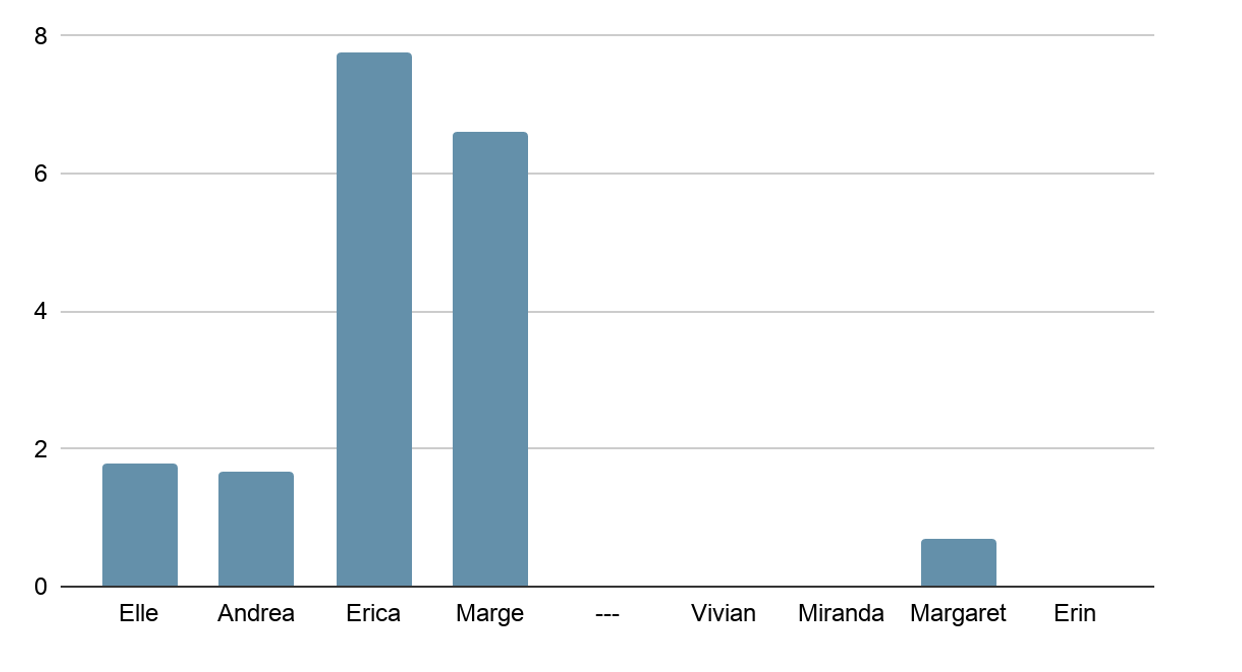
We also converted the uncooperative actions to a use per minute rating and found that characters such as Vivian and Erin (uncooperative group members) had the highest rates of use at approximately three and two per minute respectively.
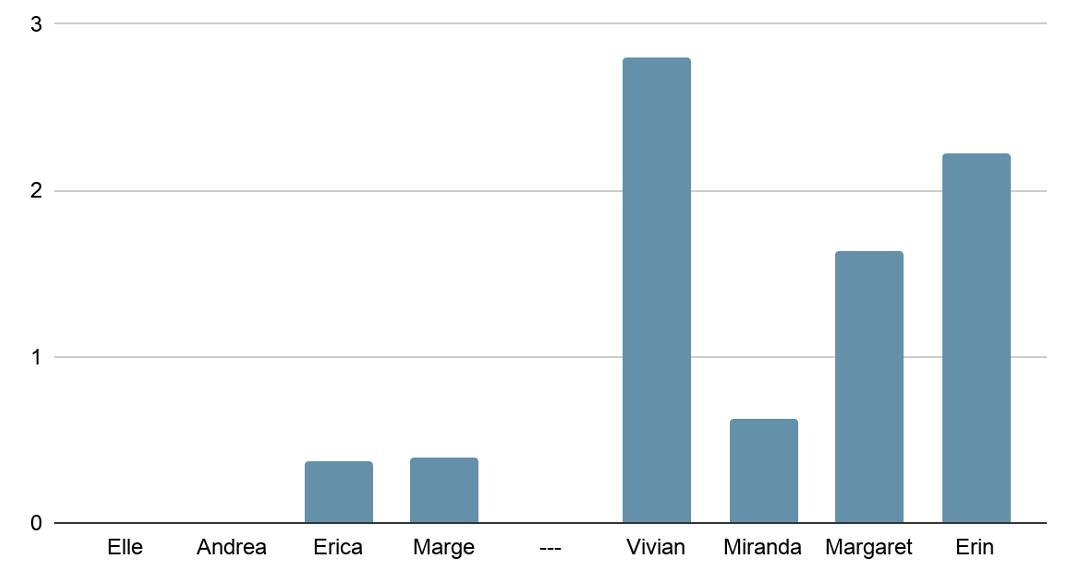
Overall, our data showed that the cooperative group had a higher rate of CCLF use than the uncooperative group, comparing an average of 4.5 features per minute to 0.175 features per minute.
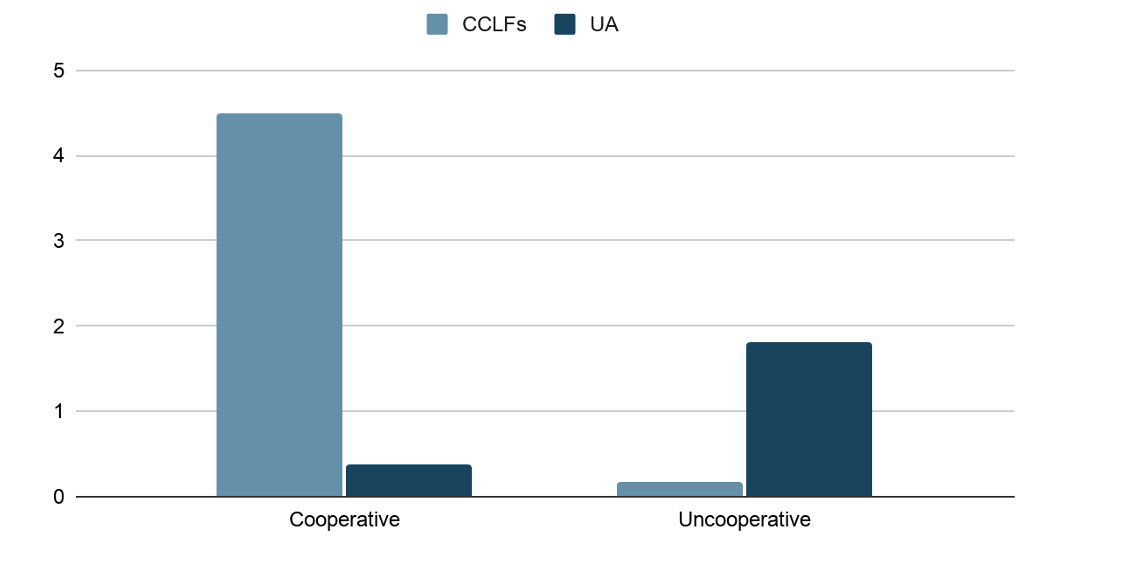
The opposite was found with the uncooperative actions, with the cooperative group using them much less frequently at an average rate of 0.38 per minute, compared to the uncooperative at 1.82 per minute. These stark differences can be more clearly described as the cooperative group using CCLFs at a rate 26 times that of the uncooperative group, and using UAs at a rate about 5 times less than the uncooperative group.
Discussion and Conclusions
As for how the use of CCLFs and UAs relates to perception of the character we noticed a common connection between the use of CCLFs among characters that the audience is supposed to like, the people we are supposed to root for, as well as a connection between the characters who used more UAs and their positions as villains in the narrative.
To paint a clearer picture let’s look at the movie Legally Blonde. Elle, a character from our cooperative group is the hero of the movie, while Vivian from the uncooperative group is one of the main antagonists. We as an audience are not supposed to side with Vivian until she changes her ways and becomes friends with Elle. (See our example scenes with Elle and Vivian). This is not a motif isolated to Legally Blonde since the same can be seen in The Proposal. Sandra Bullocks’ character Margaret Tate is called a “witch” and a “monster” by her peers, sending a clear signal to audiences on what to think of her character. It is not until her character’s journey to her relationship with the male lead, Andrew Paxton, and her becoming somewhat nicer that she gets praise and a happy ending.
In our sample these same motifs simply did not exist for men. A prime example of this being Mark Zuckerberg in The Social Network, a character that practices disruptive communication. He is offstandish and objectively unkind in the opening scene and throughout the movie, adopting many of the UAs we identified, but at the end of the movie he is still praised. The audience sympathizes with Mark and despite his flaws he is not given a redemption arc in his movie, he is simply allowed to exist. The male characters we observed did not have to be perfect or traditionally nice to be liked. We believe that this may reflect a broader standard that women are held to in the real world. Our research speaks to how movies shape us and give us hints about who we are supposed to be.
For more insights on how movies shape us, watch this TEDTalk.
Although our study stuck to a relatively strict gender binary and focused on white, middle to upper class, straight coded characters, we feel it brings up valid questions about the perception of women and what standard women are held to both in media and in real life.
References and Used Sources
Borresen, Kelsey. “How To Know If You’re An Interrupter Or A ‘Cooperative Overlapper’.” HuffPost, HuffPost, 4 Mar. 2021, www.huffpost.com/entry/interrupting-or-cooperative-overlapping_l_603e8ae9c5b601179ec0ff4e.
Ersoy, S. (2008). Men compete, women collaborate. Kristianstad University: Language and Gender. http://www.diva-portal.org/smash/get/diva2:231309/FULLTEXT01.pdf
Fincher, D. (2010). The Social Network. Columbia Pictures.
Kubrak, T. (2020). Impact of Films: Changes in Young People’s Attitudes after Watching a Movie. Behavioral Sciences, 10(5). https://doi.org/10.3390/bs10050086
Luketic, R. (2001). Legally Blonde. Metro-Goldwyn-Mayer & Marc Platt Productions.
Stokes, C. (2012, November). How movies teach manhood. https://www.ted.com/talks/colin_stokes_how_movies_teach_manhood
Susan Chira. (2017, June). The Universal Phenomenon of Men Interrupting Women—The New York Times. Retrieved March 17, 2021, from https://www.nytimes.com/2017/06/14/business/women-sexism-work-huffington-kamala-harris.html