“I’m Sorry”: A comparative study of gender and individual differences in applying apology strategies in YouTube videos
Kristin Nguyen, Luxuan Huang, Vanessa Zhu, Andrea Mata, Shiyun Zhou
In recent years apology videos have become a very popular tactic used by social media influencers in efforts to help restore their online image. This study will compare and contrast the apology strategies used in 3 male and 3 female YouTuber apology videos by investigating the types of linguistic features that are found in both genders. Moreover, we will further explore how the specific apology strategies being used influence the perception that their audiences/supporters have towards these specific Youtubers based on the comment section. The results showed that male Youtubers are more likely to use the “acknowledgement of responsibility” and “promise of forbearance” approach when apologizing while females are more likely to use the “explicit expression of apology” and explanation or account” strategy. Interestingly enough, the videos with the most positive responses came from 2 male and 1 female YouTuber which suggests that, according to their data set, there is a pattern in certain apology strategies that are more effective than others.
Introduction & Background
An increasing number of influencers apologized by publishing YouTube videos as an act to save faces and restore their images in the public’s mind. Previous studies about gender differences in using interpersonal apology strategies categorized apology strategies into 4 categories — explicit expression of apology, explanation or account, acknowledgement of responsibility, and a promise of forbearance, and concluded that women used more explicit apologies than men in interpersonal apologies (Holmes, 1989). However, apology videos are a fairly new phenomenon, and we wonder whether the pattern would also appear in our studies. As a result, we form our topic as a comparison study of gender difference and individual differences in Youtube apology videos in which we would explore the individual YouTuber’s choices of apology strategies and also gender differences based on the categorization mentioned above.
Project Design
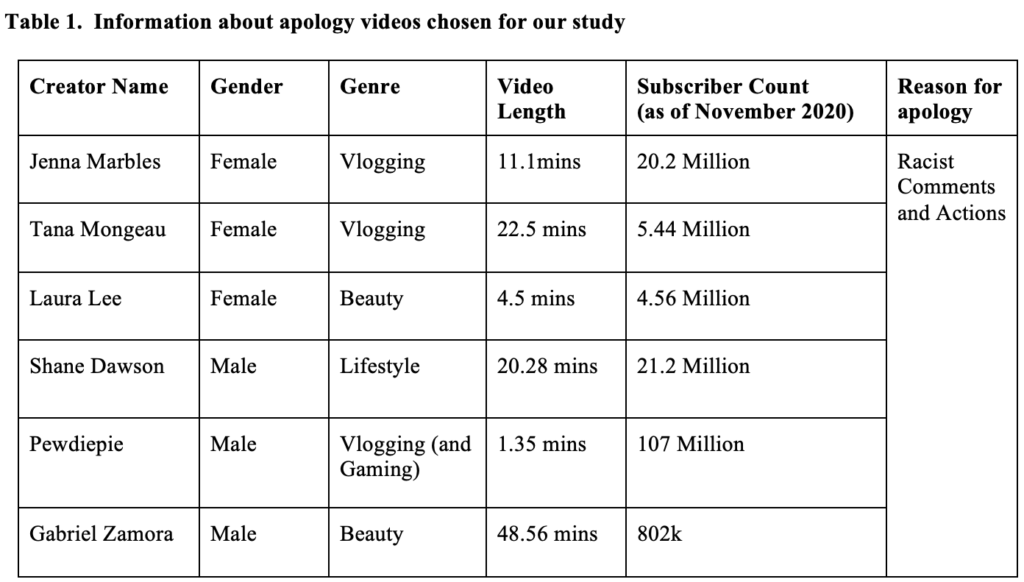
To identify how different apology strategies are used by individual YouTubers as well as by each gender, we chose a sample of 6 Youtube apology videos, 3 by females and 3 by males (see Table 1). The criteria for sample choice were based on Karlsson (2020)’s standards, which are 1) made by an independent Youtuber who runs and owns the channel, 2) made originally for Youtube and conducted in English, 3) belong to Beauty, Lifestyle, or Vlogging genre, 4) apologized for racist comments. By choosing videos addressing the same controversy over past racist comments, we minimized the influences of social and cultural contexts.
Following Holmes (1989)’s categorization for apology strategy, we collected the instances from each apology video that fit into the classification. Both qualitative and quantitative methods were used to analyze each individual video as well as all videos produced by each gender. We mainly employed discourse analysis to conduct the qualitative research when examining each individual Youtuber’s utterances as categorized by the four apology strategies and we also calculated the proportions of each strategy usage as divided by the total instances of apology in individual videos as well as in all videos produced by each gender. Besides, we also took the top 10 comments into account to evaluate how these apology videos were perceived (negative or positive), which then gave us implications of the effects of different combinations of apology strategies.
Results & analysis
A. Individual Differences
A.1. Jenna Marbles – apology video
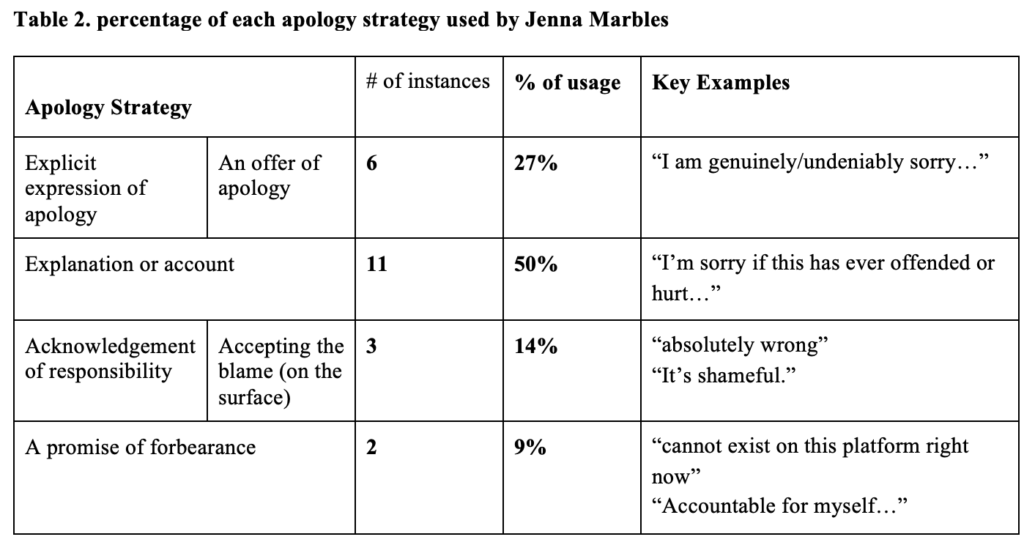
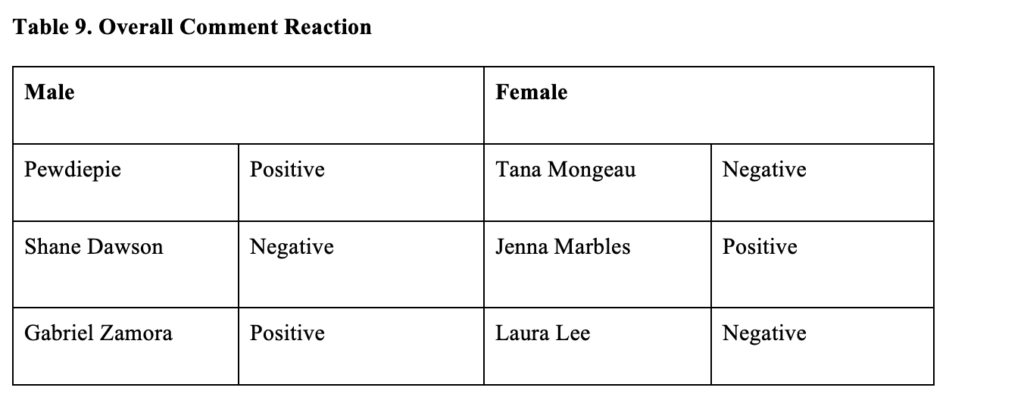
Jenna Marbles’s apology video (which has been taken down along with her channel by Marbles herself) consisted of four different occurrences that she addressed. Three were ones that people criticized and questioned her about, and one was an issue that she felt she needed to apologize for, despite her claim that no one said anything negative about this issue. Her most used strategy was “explanation or account,” which was 11 times out of the total 22 strategies in her video. She showed regret in her old content and emphasized that when she made those videos, her intention was never to hurt anyone. Although the comments we analyzed were not pulled from the original video, we still believe they reflect the general opinion of her apology. Viewers almost unanimously agreed that her apology for all four instances were genuine, and many users actually displayed sympathy for her. Her apology generated many conversations and discourse about the existence of “cancel culture.” Her least used strategy was “promise of forbearance”; however, this is arguably her most effective strategy. Marbles claimed that she wanted to “be accountable for myself” and that she could not continue being on Youtube. Since the release of the apology, Marbles has not returned to Youtube.
A.2. Tana Mongeau – apology video
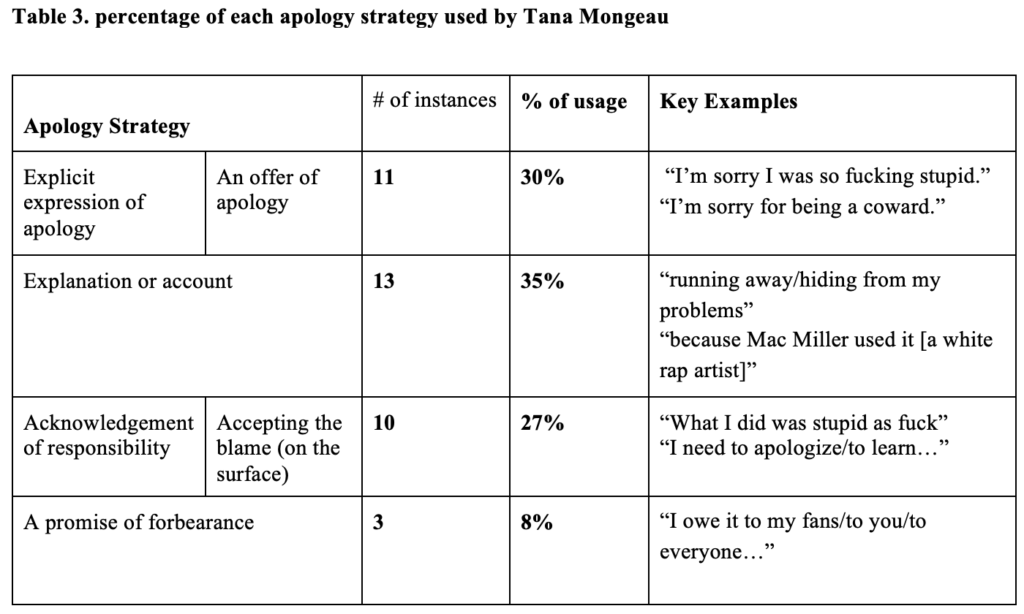
Tana Mongeau is a “storytime-centric creator. To preface this particular analysis, she was already well-known for embellishing some of her stories. It is interesting to note that her credibility was already questionable before the apology was released. This apology was in regard to her younger self using the N-word and to her reaction to another creator (iDubbbz) heavily criticizing her for this. Looking at the numerical data of her strategy usage, “explicit expression of apology” and “explanation or account” are nearly equal, with 11 times for the former and 13 times for the latter. However, 17 out of the 22 minutes in run time consisted of her explaining her logic of why she used to believe the Nword was acceptable to use and why she reacted aggressively towards iDubbbz. It was important to take into account the runtime and to consider that the number of times she used “explanation or account” alone does not fully reflect the implications of this strategy. She often repeated her explanations with slight variation in syntax but the overall lexical meaning was retained; she explained she was always “running away” or “hiding from my problems.” When there were “explicit expression of apology,” Mongeau also frequently berated her own image and character along with the explicit expression, such as “I’m sorry I was so fucking stupid.” Her apology had a significant negative reaction from her the audience, and many did not find her apology to be sincere or authentic.
A.3 Laura Lee – apology video
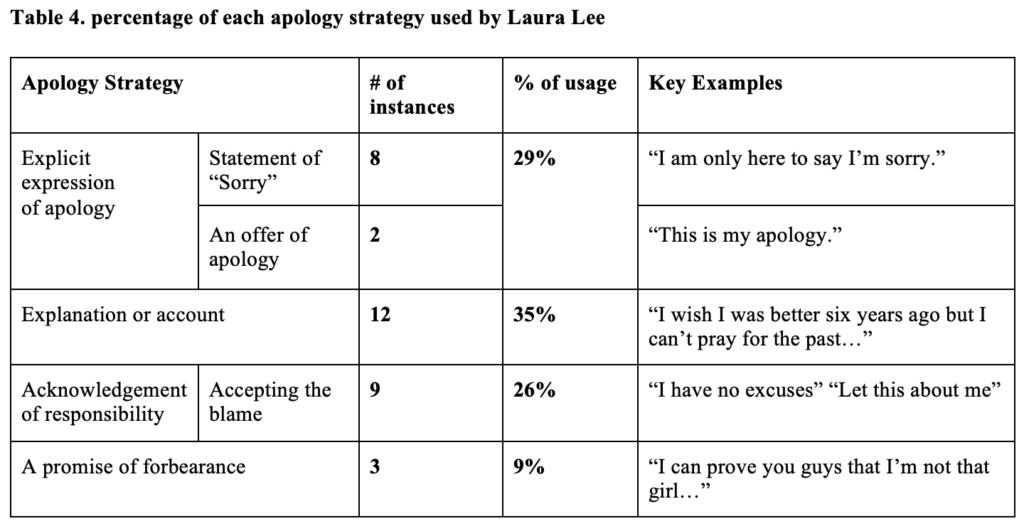
Laura Lee apologized for retweeting with racist comments in the year 2012. In her apology video, she applied explicit expression of apology 10 times, explanation or account 12 times, acknowledgement of responsibility 9 times, and a promise of forbearance 3 times. Laura used explanation or account most (p=35%) and explicit expression of apology (p=29%). Laura’s accounts or explanations were supposed to express remorse or clearly present the context of the event, but she ended up shifting blame. Laura’s strategy was to shift the responsibility to the younger her by reiterating the time when the retweet event took place was “six years ago” when she was “stupid and ignorant”. In terms of explicit expression of apology, Laura expressed her apology 10 times to different target audiences. She used “sorry” 8 times out of 10 and only said “apology” 2 times in the video which set an informal tone to her video. Overall, Laura’s apology video was like an interpersonal talk to her subscribers. Thus, even after editing, the apology video was not logical and seemed that she did not plan ahead and the use of sorry instead of a more formal term “apology” fit with this general tone.
A.4. Pewdiepie – apology video
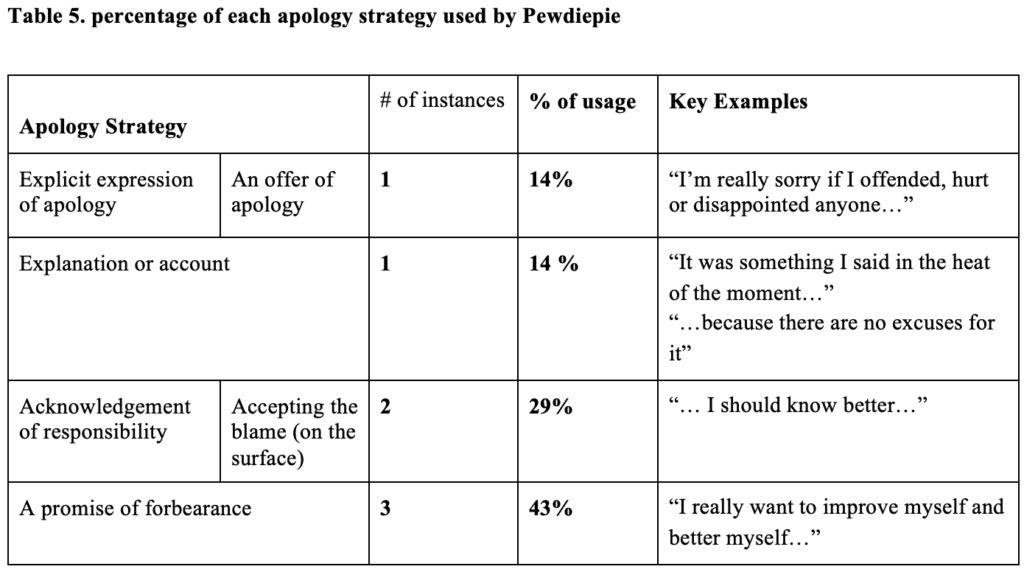
From our pool of samples, Pewdiepie (Felix Kjellberg) had the shortest video where the run time was under two minutes. He has over 100 million subscribers, and he made the apology video in order to address and apologize for his use of the N-word during a livestream. He used all strategies a total of only six times. He only explicitly apologized for hurting and offending viewers once, and his most used strategy was “promises of forbearance.” He explained he had used the slur in the heat of the moment but that it was ultimately an inexcusable action. He placed focus on his own need to be accountable for his character and what he planned to do moving forward. His video was extremely concise compared to our other samples, and viewers seemed to react positively towards his apology. In general, most viewers commented and judged that his apology was genuine. It is also interesting to note that his comment section had many users comparing aspects about his apology to other apologies, especially that of Laura Lee’s and Tana Mongeau’s.
A.5. Shane Dawson – apology video
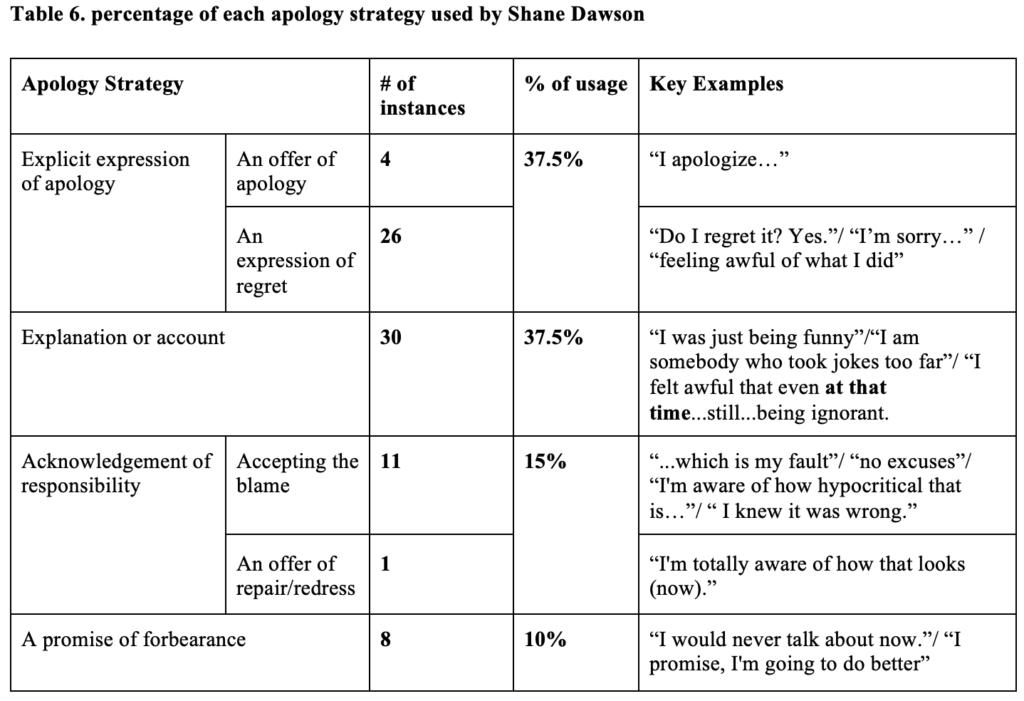
Shane Dawson made an apology video for doing blackface and saying the n-word in past racist YouTube videos. In his video, 80 instances counted as apology strategies, Shane mostly used “explicit expression of apology” (p = 37.5%) and “explanation or account” (p = 37.5%). “Acknowledge of responsibility” made up 15% of his apology, followed by 10% of “a promise of forbearance”. Specifically, the way Shane used “explicit expression of apology” mainly focused on expressing his regret (N = 26) through informal offers of apology “I’m sorry” which indicates Shane’s intention to resonate with his audiences. By repeating “I’m sorry” with the lowering of pitch, Shane reinforces his remorse and desperation. In terms of how Shane explained his wrong-doing, he frequently used –“funny” and “joke[s]” — to define his past mistakes. Moreover, he shifted to a higher pitch to imitate what the young Shane thought. However, this voice-shifting may not contribute to the apology but create the impression that Shane was trying to disassociate from the then-self and shift the blame. Shane also addressed himself from a third-person perspective, such as “I can’t even…see this white fucking guy do blackface.” The way he referred to himself may strengthen the impression that he was shifting the blame. The Youtuber did not frequently employ “acknowledgement of responsibility” and “a promise of forbearance”. Shane accepted the blame mostly and hardly offered a repair. Shane’s promises are also quite general and vague, such as his use of the demonstrative pronoun “that” in “I would never talk about that now”, which does not specify the action or mindset he would change.
A.6. Gabriel Zamora – apology video
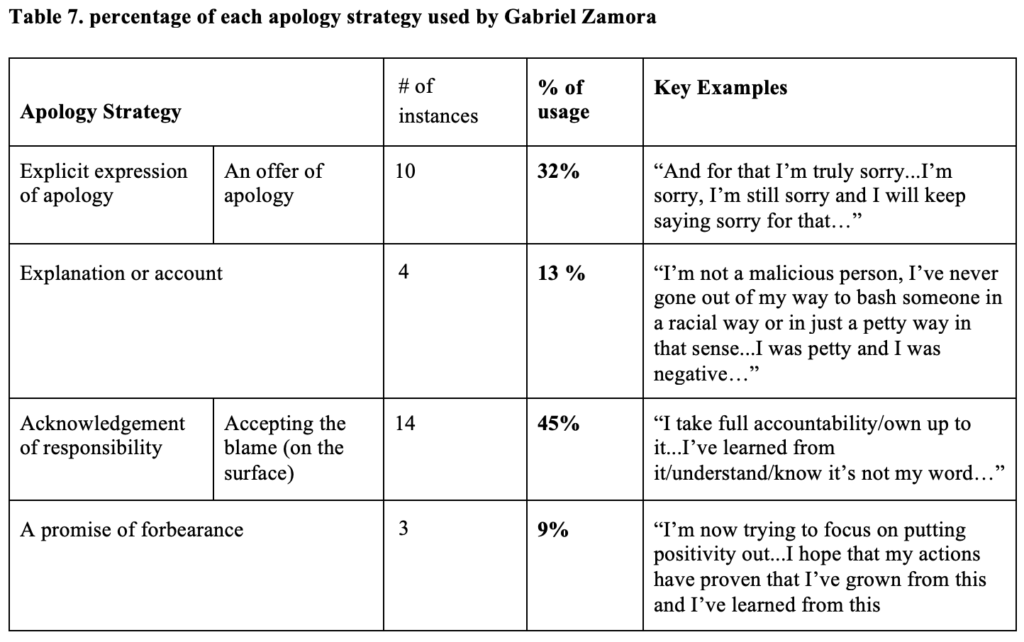
Gabriel Zamora, an influencer with over 800 thousand subscribers, made an apology video for racist tweets he has posted in the past. By analyzing his apology video the data set above reveals that his most used strategies were “acknowledgement of responsibility” (p = 45%) and “explicit expression of apology” (32%). That being said, conclusions could be made towards the fact that those specific strategies are what contributed to bringing a positive light to his image because he is not just ignoring what he did, rather he is owning up to his mistakes and not making any excuses for himself. He recognizes his ignorance and explicitly states taking full accountability for it repeatedly throughout his video. Interestingly, he consistently used the phrase “truly sorry” 4/7 times he used the word “sorry”…“and for that i’m truly sorry…“the fact that i wasn’t [a positive creator] im truly sorry…” I believe his way of using it allowed for a greater expression of the extent to how regretful he actually was. Gabriel occasionally combined his strategies with “explanation or account,” his third most used (p = 13%) in efforts to disclose his true intentions…“i’m not a malicious person, i’ve never gone out of my way to try to bash someone in a racial way or in just a petty way in that sense.” Lastly, Gabriels usage in “promise of forbearance,” he promises his supporters/audience that he has educated himself and continues to do so. He also takes it upon himself to spread more awareness on the history behind the n-word by linking two educational videos about it in the description of the video. Although this seemed to be his least used strategy (p = 9%), the videos he linked helped boost his reputation by showing his audience that actions speak louder than words and he is moving towards the right direction to prove his growth.
B. Gender Differences
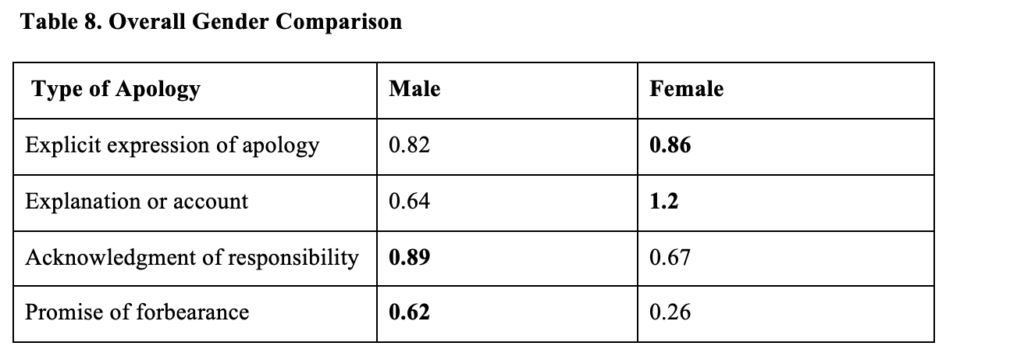
In Table 8, we calculated the ratio of each apology strategy usage by gender and came to the following realizations:
- The Frequency of Apologies: The result seems to buttress the theory that females were more likely to present explicit expressions of apology (Holmes,1989). However, as an evitable part of an apology video, the percentage of male and female using this approach is relatively close. From this point of view, gender seems to merely exert an influence on the linguistic differences of these stances (Stubbs, 2001).
- Explanation or Account: Based on the data collections, females seem undoubtedly offer more verbal explanations or accounts than males. While most of the explanation or account for females is recounting the emotions, their apology video became longer and more complex. Females seem to include more verbal statements of concluding the whole controversial incident than males frequently may be less willing to use affirmative words to go over the account (Bennet, 2008). Overall, explanation or account drew huge linguistic differences between how males and females approach their apology.
- Acknowledge of responsibility: Males present more acknowledgment of responsibility than females from the final data set. Gender differences in this stance are evident that males seem more likely to recognize their faults of actions. The mythological consideration for some females is vague. In Laura Lee’s video, she uses the denial strategies to shift the responsibility (Benoit, 2008), hence leading to an adverse audience reaction. In comparison, males seem more willing to acknowledge responsibility and re-evaluate the prior self who committed the transgression.
- Promise of forbearance: Males perform more promise of forbearance than females. As usually the last part of an apology video, the promise of forbearance is crucial to provide the major idea of remedy to the transgression. Males seem more likely to provide corrective action and repair in the collecting data (Benoit, 2008). However, the overall proportion of promise of forbearance seems to appear identical for two genders without looking at the data of Shane Dawson who used this strategy the least. Hence a concrete conclusion is hard to draw from these 6 limited cases.
Discussion & Conclusion
The discussion on individual differences and gender differences are presented above. This section dedicated to looking at the audience’s overall comments reaction as outlined in Table 9, only Pewdiepie, Gabriel Zamora, and Jenna Marbles received a positive response. They all have different focuses on their strategies. Pewdiepie addressed most in the promise of forbearance, Gabriel Zamora focused on Acknowledge of responsibility and Jenna Marbles spent most of her video approaching explanation and account. Which might indicate promise of forbearance, acknowledgement of responsibility and explanation and account are more effective strategies. The overall conclusion is females are more likely to approach explanation and the frequency of apologies while males approach acknowledgement of responsibility and promise of forbearance strategies. However, all these conclusions just came from the limited 6 data sets and in a broader view, after excluding the extreme cases, most of the data appear to be identical between both genders (Holmes 1989). A key implication for this research is the importance of not only considering the difference in gender while looking at the apology videos, but also by looking at the approaches taken by different people on a larger view. The analysis and data for this paper might provide a good sample for further future studies of linguistics features in gender differences and apologies approaches.
References
Benoit, W. L. (2008). Image restoration theory. The International Encyclopedia of Communication.
Bennet, S. (2008). Gender and apologies: Exploring offended females’ perceptions of apologies from males and females. https://ro.ecu.edu.au/theses_hons/127
Cheng, M. (n.d.). The Stance of Personal Public Apology. Retrieved November 17, 2020, from https://scholar.uwindsor.ca/ossaarchive/OSSA11/papersandcommentaries/96/?utm_source=scholar.uwindsor.ca%2Fossaarchive%2FOSSA11%2Fpapersandcommentaries%2F96
Gabriel Zamora. (2018, Aug. 21). My Truth. [Video]. YouTube. https://www.youtube.com/watch?v=QWnmPEHzRrk&list=PLsuhXm2zs07IwijVL8Mkm4EnPab78F7TC&index=8
Holmes, J. (1989). Sex Differences and Apologies: One Aspect of Communicative Competence1. Applied Linguistics, 10(2), 194-213. doi:10.1093/applin/10.2.194
Jenna Marbles. (2020, July 2). Jenna Marbles Apology. [Video]. YouTube. https://www.youtube.com/watch?v=679d-SQfWLk
Karlsson, G. (2020). The YouTube Apology: analysing the image repair strategies and emotional labour of saying sorry online. Retrieved 2020, from https://www.diva-portal.org/smash/get/diva2:1483089/FULLTEXT01.pdf
Laura Lee. (2018, Aug. 20). Laura Lee apology video with original captions. [Video]. YouTube. https://www.youtube.com/watch?v=NYVmWxitVSQ&t=182s
Leppänen, S., Møller, J., Nørreby, T., Stæhrc, A., & Kytölä, S. (2015). Authenticity, normativity and social media. Discourse, Context and Media, 8, p. 1-5
Maclachlan, A. (2013). Gender and Public Apology. Transitional Justice Review, 1-21. doi:10.5206/tjr.2013.1.2.6
Pewdiepie. (2017, Sep. 12). My Response. [Video]. YouTube. My Response (Pewdiepie)
Shane Dawson. (2020, June 26). Taking Accountability. [Video]. YouTube. https://www.youtube.com/watch?v=ardRp2x0D_E
Smith, N. (2008). I was wrong: The meanings of apologies. New York: Cambridge University Press.
Tana Mongeau. (2017, Feb. 17). An Apology. [Video]. YouTube. https:/ /youtu.be/Fazh9Lm1kDE