Why do people interrupt? It depends on the situation you are in.
Mariane Bangui, Oi Kei Cheung, Oscar Franco, Yunjae Lee
We have all been interrupted by others while saying something. Being interrupted is a universal experience, but have you ever hypothesized what contexts affect how we interrupt? Here we present a project investigating how dynamics in negotiations can be reflected through the use of interruptions (N=100) under familial and political contexts.
We hypothesized that (1) family members use interruptions to build rapport and politicians use interruption to exert power, as well as (2) belonging to a culture, whether to individualistic or collectivistic culture, contributes to which type of interruption one prefers to use in a negotiation. To see whether our hypotheses could be justified, we found the frequency of each type of interruption and applied a conversational analysis that examined the influence of culture and context on the use of interruptions in a conversation.
After all data was collected and analyzed, we found that our data did not fully support our initial hypothesis. Even though people in the familial context use rapport interruption to maintain a harmony within negotiations, the results showed that members also use power interruptions just as frequent as in a political context to exert authority. On the other hand, we discovered that the fact of being raised in a collectivistic culture does not affect a person using more rapport or neutral interruptions than power interruptions. Other factors, such as carrying out self-perceived role in a negotiation, contributed much more to the occurrence of our findings.
Introduction
We have all been interrupted by others while saying something. Being interrupted is a universal experience, but have you ever thought of what factors affect how we interrupt? In the following, our team will present to you in what ways dynamics in negotiations can be reflected through the use of interruptions under familial and political contexts.
By comparing U.S. politicians to American families of Asian descent, we will first examine which type of interruptions (power, rapport, or neutral) people prefer using in these two situations respectively. We assume family members may mainly use interruptions to build rapport, while politicians interrupt for the purpose of exerting power.
After taking a closer look at the composition of each interruption, we are going to analyze the cultural background of why some interruptions emerge in the conversations to search for potential generalizations about the connection between contexts and the use of interruptions. We hope that by considering the influence of individualistic/collectivistic culture (American vs countries like Korea and the Philippines), we can understand why certain interruptions occur.
Background information
Conversation is usually organized in a way, such that only one person speaks at a time. Speakers take turns talking, and use a wide range of linguistic cues indicating the end of their turn (Sacks, Schegloff, & Jefferson 1974 p.670). However, norms of turn-taking can be violated when a speaker “starts up in the midst of another’s turn at talk[ing]” as well as “disturbs his/her finishing” (Jefferson 1984 p.16).
Interruption in turn-taking has been regarded as a sign of possessing power over others in past literature. Natale et al.’s discovery in 1979 shows the more confident a person is about his/her position with regard to the conversation partner(s), the higher the rate of successful interruptions he/she imposes (p.874). Besides displaying social power, interruptions can serve other functions. According to Goldberg’s study (1990), interruptions are not only acts of conflict but also acts of collaboration. On some occasions, the speaker interrupts so as to demonstrate that he/she understands the conversation and relates to his/her listeners. Yet, there are interruptions that neither aim at building rapport nor displaying power — neutral instances where “repair[s], repeat[s], or clarification[s] of the prior, interrupted utterance” take place (p.888). Building on Goldberg’s findings (i.e., how to identify three main types of interruption), our team finds the relationship between interruptions and contexts is worth further discussion.
Another question we would like to answer is why certain groups use certain interruptions. Our potential explanation will be based on the collectivism-individualism theoretical framework. The framework classifies cultures into two categories: individualist (e.g., the U.S.) and collectivist (e.g., China, Korea, and the Philippines). The former prioritizes individual attainment above team goals, creating a sense of competition among people. In collectivist cultures, on the other hand, people place more focus on achieving group goals than satisfying personal desires (Triandis and Gelfand 2012 p.513).
Indeed, some research provides empirical evidence to support the idea that culture plays a significant role in determining the occurrence of interruptions. For instance, Li mentioned in his study that Americans use more intrusive interruptions in conversations than Japanese (2001 p.261-262). We therefore aim to extend people’s understanding of the relationship between contexts and interruptions by applying the cultural theory of individualism and collectivism.
Methods
Investigating interruptions within a familial situation, two of our group members voice-recorded a couple of (around 5-10) negotiations in casual dialogue between the parent and children in those families. In both the Filipino and Korean households, our group members left their recording devices in the rooms where each family negotiated about their certain topics. The members then uploaded the recordings they collected to Youtube and pinpointed the exact times that interruptions occurred in the conversations. They transcribed all the labeled interruptions (as well as a few utterances and spoken sentences before/after the interruption) for future analysis.
In order to explore interruptions within a political environment, we analyze the 2016 presidential debates. This debate featured Republican nominee Donald Trump and Democratic nominee Hillary Clinton. The debates’ transcripts that we based on and added more details into can be found here.
With the data we gathered, we identified all interruptions occurring in the negotiation. Then, we categorized them into three types of interruptions: power, rapport, or neutral interruptions. To see whether or not our hypotheses could be justified, we not only counted the frequency of each type of interruption but also a conversational analysis that examines the influence of culture and context on the use of interruptions in a negotiation.
Results
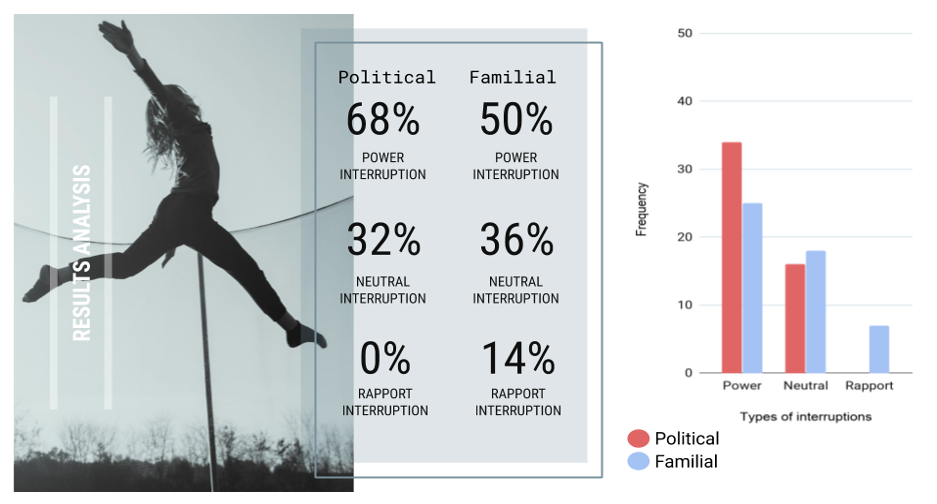
Figure 1 reflects the percentage of each interruption type (i.e., power, neutral, and rapport) occurring in political and familial contexts. We discovered 50 interruptions within the families and throughout the debates from the political aspect respectively. Among the politicians, 68% of interruptions is used to exert power while 32% of them belongs to neutral interruption; in the extreme, no rapport interruption could be found. Unexpectedly, the most frequently-appeared type of interruption in familial context is power (25 out of 50). Rapport interruption only accounts for 14% of the total interruptions in familiar negotiation, and the percentage of neutral interruption exceeds it by 22%.
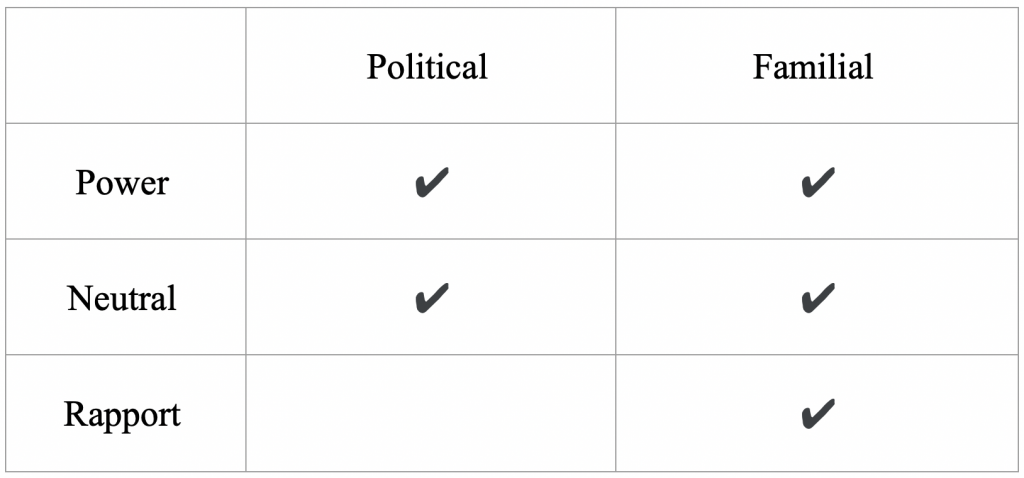
The most significant difference between political and familial negotiation is the frequency of rapport interruptions. As you can see in Table 1, the data that we have collected from the political dialogue only had power and neutral interruptions. It means rapport interruption did not occur in the political negotiation. On the other hand, we can find all three types of interruptions in the familial negotiation. We initially assumed that family members mainly use interruptions to build rapport; meanwhile, politicians interrupt for the purpose of exerting power. Yet, now it seems like what we assumed is not the case in reality.
Discussion and Conclusions
As mentioned earlier, we discovered that family members and politicians interrupt for the purpose of exerting power most times. But unlike politicians, family members occasionally use interruptions to build rapport. So why is there such a difference? Let’s try to answer this question by first looking at this excerpt adapted from one of the audio recordings that depicts a negotiation among family members:
1  S:   I don’t drink mom (0.8) or smoke (0.3) so you’re good.

2  S:   I don’t do neither of those

3  S:   I know better than that

4  M:   We don’t:::

5  D:       [Can I chaperone mom?=

6  M:   =Eh that’s if you go with him

7  D:                         [Yes, I will go with him

8  S:   (1.0) To drop me off (chuckles)

9  D:   I, I

10 M:      [we::ll

11 D:           [I:: will spy on him

12 M:                  [then you’re gonna leave him

13 D:   No I won’t leave him
In this negotiation, the 17 year-old boy (S) is trying to convince his “strict” mom (M) to let him go to a birthday party. The mother is hesitant and skeptical of letting her son go due to the family’s upbringing and cultural background. When the mother is giving a lecture to the son, the daughter (D) interrupts the mother and offered if she could chaperone her brother to the party. Her suggestion created a middle ground between the worried mother and the son who wants to go to the party. What the daughter did is an example of rapport interruption in familial context.
But in political context, none of the interrupters empathizes with the interruptee and/or the speech content. Before explaining why this is the case, take a look at the following excerpt (a modified version of the original transcript):
1  W:   Hold on [hold on wait Hold on, folks.

2  T:           [nono that

3  W:   Because we… this is going to end up getting out of control
        Let’s (0.2) try to keep it quiet so

4  W:   (0.5) for the candidates and for the American people=

5  T:   =So just to finish on the borde[rs

6  W:                                  [Yes

7  T:   She wants open borders (0.2) People are going to pour into
        our country

8  T:   People are going to come in from Syria. She wants 550
        percent more people than Barack

9  T:   <Obama, and he has> thousands and thousands of people
        They have no idea where they come from...
This excerpt shows an example of neutral interruption in political context. The moderator Wallace (W) acted as a participant who held a neutral stance, and tried not to let candidates like Trump (T) move away from the topic throughout the negotiations. We all noticed that the role that Wallace played in the negotiation is moderator, a role that requires him to adopt a neutral stance.
Not only was the stance that he can adopt restricted but also his use of interruption types was limited to neutral and power. On the contrary, the daughter in the familial context was inclined to maintain harmonious relationship among the two participant who were in a direct confrontation. Being a mediator, she could pick side and choose to help the son to persuade the mother for letting him to go to the party. Factors like this play a significant role in creating situations where certain type of interruption happens (more frequently) in one context but not the other.
Moreover, the fact of being raised in a collectivistic culture does not affect a person using more rapport or neutral interruptions than power interruptions. Rather than cultural reasons, other factors (such as carrying out self-perceived role in a negotiation) contributed much more to the occurrence of our findings. Therefore, in the future, if we are given a chance to continue our study, we will identify more factors behind the way of how political and familial contexts affect speakers’ preference in which type of interruptions they use. And hopefully, we will seek another theoretical framework to explain all the differences we discover.
References
Clayman, S., & Heritage, J. (2002). The News Interview: Journalists Public Figures on the Air, doi: 10.1017/CBO9780511613623. Cambridge University Press.
Clayman, S., & Heritage, J. (2010). Talk-in-Action: Identities, Interaction and Institutions. Journal of Language and Politics, 320.
Eckert, P. (2012). Three waves of variation study: The emergence of meaning in the study of sociolinguistic variation. Annual Review of Anthropology, 41, 87-100. doi: 10.1146/annurev-anthro-092611-145828
Goldberg, J. A. (1990). Interrupting the discourse on interruptions. Journal of Pragmatics, 883–903.
Jefferson, G. (1984). Notes on some orderliness of overlap onset. Discourse analysis and natural rhetoric, 11- 38.
Li, H. (2001). Cooperative and Intrusive Interruptions in Inter and Intracultural Dyadic Discourse. University of Northern British Columbia. 20. 259-284. doi: 10.1177/0261927X01020003001
Natale. M., Entin, E., & Jaffe, J. (1979). Vocal interruptions in dyadic communication as a function of speech and social anxiety. Journal of Personality and Social Psychology, 875. doi: 10.1037/0022-3514.37.6.865
Sacks, H., Schegloff, E. A., & Jefferson, G. (1974). A simplest systematics for the organization of turn‐taking in conversation. Language, 50, 696 – 735. doi: 10.17323/1728-192X-2015-1-142-202
Schegloff, E. (2001). Accounts of Conduct in Interaction: Interruption, Overlap, and Turn-Taking, 287-320. doi: 10.1007/0-387-36274-6_15
Schenkein, J. (1978). Identity Negotiations in Conversation. 57-78. doi: 10.1016/B978-0-12-623550-0.50009-4.
Triandis, H., & Gelfand, Michele J. (2012). A theory of individualism and collectivism. Handbook of theories of social psychology, Vol. 2 498-520. doi: 10.4135/9781446249222.n51
Zimmerman, D., & West, C. (1975). Sex roles, interruptions and silences in conversation, 211. doi: 10.1075/cilt.125.12zim