What Comes First, the Noun or the Adjective? An Analysis of Adjective Order Among Spanish Heritage Speakers
Fernando Beltran, Yvette Gamez, Flor Ramirez, Chenyi Wang
This study explores the cross linguistic influence of adjective ordering among Spanish heritage speakers. Recently, a multitude of research has been developed to understand the tendencies of heritage speakers regarding adjective ordering in their less dominant language, which oftentimes is Spanish. The purpose of this study is to untangle the various options of ordering adjectives in Spanish. Participants were presented with two tasks: a judgment task and a production task. Results for the judgment task suggest that heritage speakers of Spanish at UCLA prefer the conventional adjective ordering in Spanish – that is, a single adjective in a post-nominal position. Findings from the production task demonstrate that heritage speakers elicit a single adjective postnominally and rarely produce multiple adjectives for a single noun. Further analysis uncovers that code-switched adjectival phrases are not seen as grammatical or native-like by heritage speakers. Overall, the findings reveal that there is little to no crosslinguistic influence from English to Spanish in regard to adjective ordering.
Introduction and Background
Spanish, which is one of the most popular Romance languages, often presents adjectives after the noun; this is known as a post-nominal adjectival position (Sanchez & Camacho, 2021). For example, “las palabras inapropiadas” follows this post-nominal order. However, in Spanish, it is acceptable to place adjectives before nouns or in what is known as a pre-nominal adjectival position, e.g., “las inapropiadas palabras.” The variation in adjective placement in the Spanish language reflects the flexibility of a looser grammatical rule. Even so, in Spanish and other Romance languages, pre-nominal adjectives are more constrained than post-nominal ones (Pérez-Leroux et al., 2020). Moreover, only a single adjective can appear in the pre-nominal position for adjective-noun-adjective (ANA) phrases. An example of this is ¨las hermosas nubes azules¨, in which one adjective is pre-nominal and one is post-nominal, but not both pre-nominal. Despite this, Spanish adjectives are relatively flexible as both post-nominal and pre-nominal constructions are generally appropriate (Camacho 2018).
English, on the contrary, has a strict noun-adjective order, with adjectives almost always preceding nouns; that is, the conventional adjective position in English is pre-nominal, so much so that there is a near categorical use of this adjectival position. While there is no technical arrangement of Spanish adjectives within a noun phrase, in English, “a small, round ball” would appear much more appropriate than “a round, small ball”. This is known as a strict hierarchical order for adjectives: Size > Color > Nationality > Noun – one example is “The big brown English dog.” (Pérez-Leroux et al., 2020). This specific order must be followed in English; otherwise, the sentence will sound unnatural with the adjectives repositioned.
The study we will discuss in this blog article seeks to dissect such distinctive adjective-noun and adjective-adjective placements in Spanish and English. It also attempts to analyze if heritage speakers transfer the stricter grammar of English into Spanish. The target population of this study is intended to be adult Spanish heritage speakers at different levels of proficiency in the language. Heritage speakers are individuals who learn their native language from an early age at home and later acquire a new language, often at school, that becomes their dominant language used in social, educational, and professional settings. The language that is used less often then becomes the heritage language (Montrul, 2012), and because the speaker uses it less frequently, they become less proficient in this language. However, a heritage speaker’s abilities in their heritage language can vary depending on the input and frequency in which they continue to speak and/or write it. For example, a Spanish heritage speaker could speak native Spanish (heritage language) at home with family members and some friends, while using English (dominant language) at school and/or work. There is a wide diversity in the competence of heritage speakers: some are proficient in their native language, while other speakers may demonstrate characteristics similar to second language (L2) learners.
Given the known differences in the order of adjectives and nouns between Spanish and English, we hypothesize that some aspects of these rules may transfer across languages (i.e., English to Spanish), resulting in a phenomenon in which less proficient heritage speakers of Spanish will have a preference for stricter adjective order than more proficient Spanish heritage speakers. More proficient Spanish heritage speakers, on the other hand, will have a looser interpretation of noun-adjective order than less proficient Spanish heritage speakers.
Methods
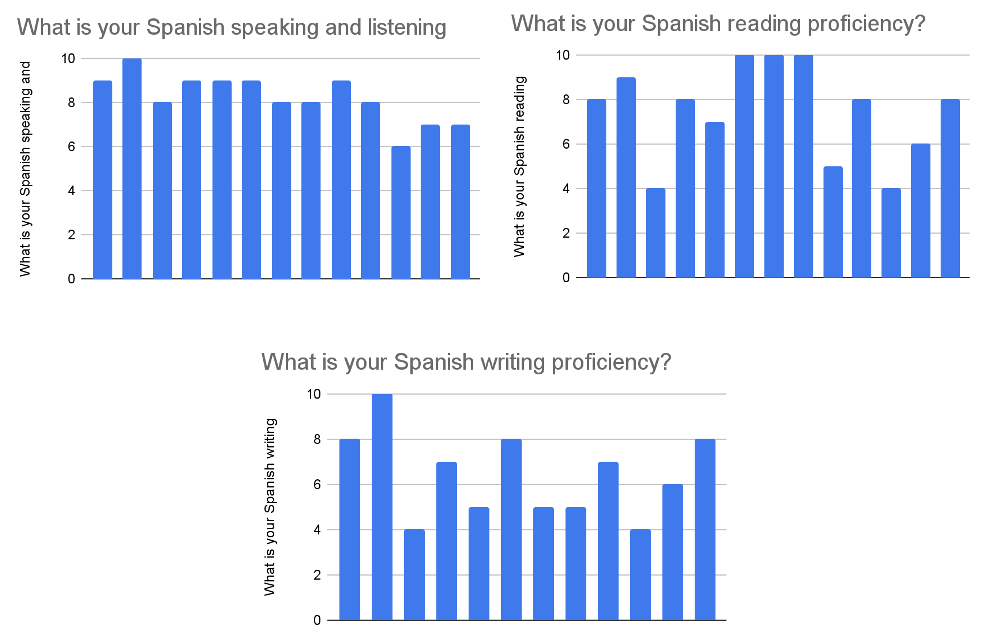
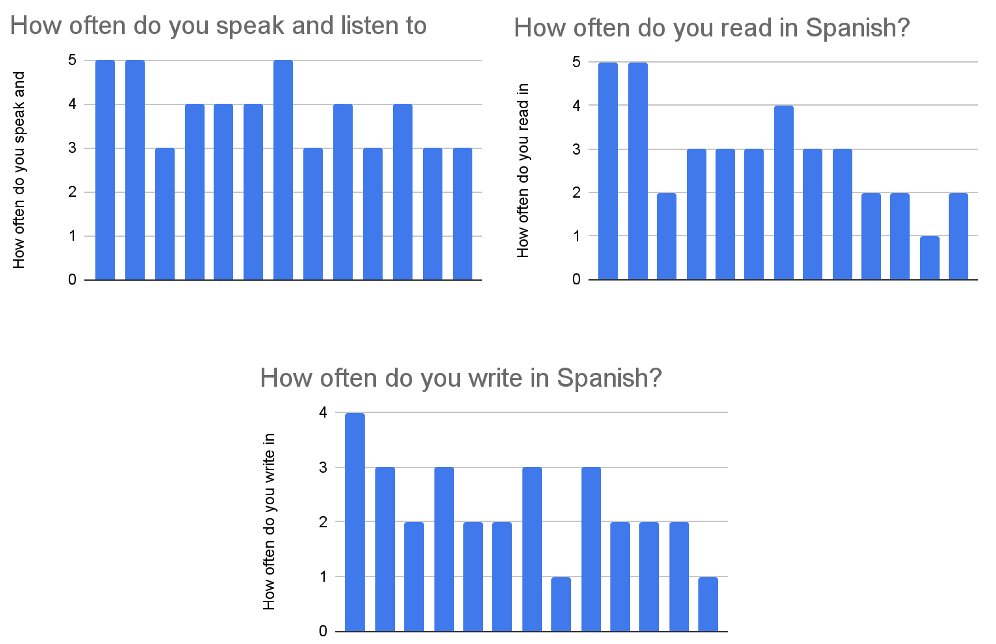
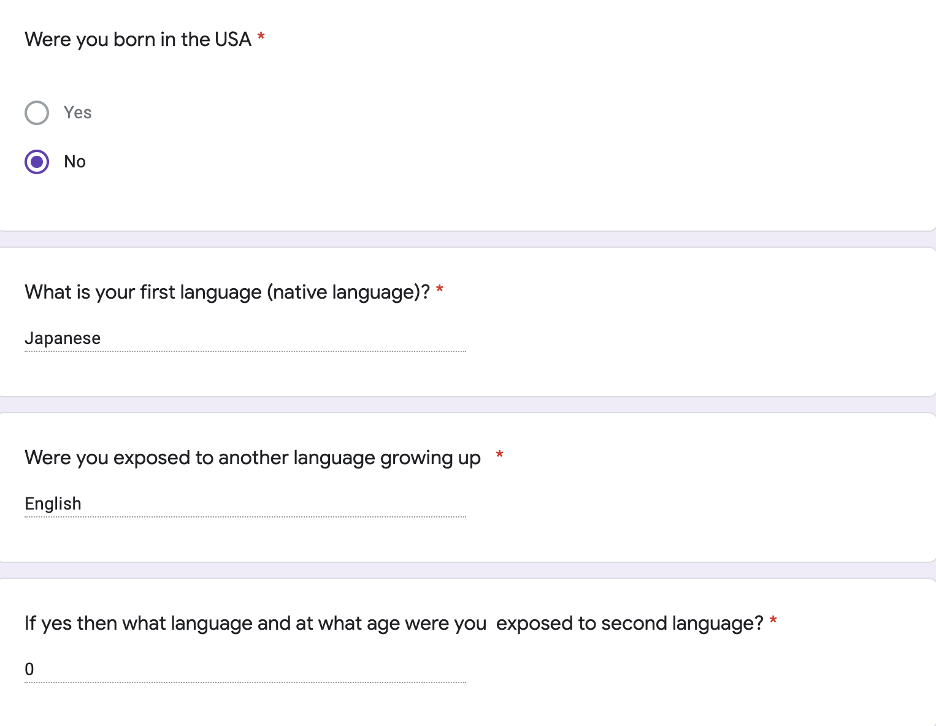
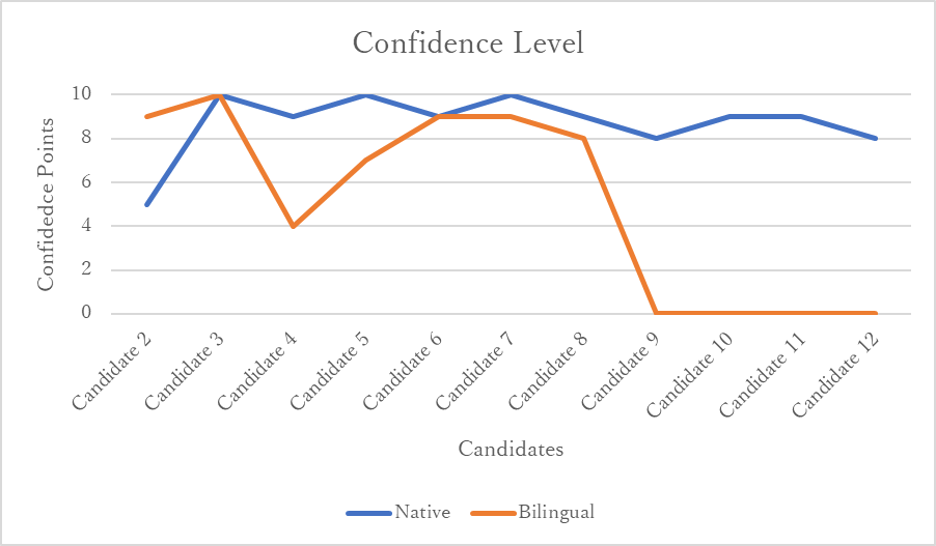
The intended target population in this study consists of Spanish heritage speakers at different levels of Spanish proficiency from the University of California, Los Angeles (UCLA). To control for the variation in Spanish dialects and influences, these participants are chosen to be of Mexican-American descent only. Participants of linguistics majors are also excluded. For participants who do not meet our criteria, their data is excluded from the study. Based on the participants’ self-reported confidence and self-assessment of Spanish skills, they are grouped into either the more proficient or the less proficient group in which the more proficient heritage speakers may resemble native speakers and the less proficient heritage speakers may resemble L2 learners. After conducting the main study tasks, as discussed below, the participants are asked to fill out a Bilingual Language Profile (BLP) questionnaire (Birdsong 2012), which determines their linguistic abilities in each language: English and Spanish.
The main study consists of two portions: a judgment test in which participants judge the correctness/soundness of Spanish, English, and Spanish-English codeswitched phrases based on their noun-adjective order, and a naming test in which participants are prompted to produce Spanish adjective phrases after being presented with two descriptive images. The first part of the study involves sentences that participants have to rate on a scale of 1-5 (1 being not correct at all and 5 being 100% correct). We also ask participants for their reasoning behind their ratings of the provided sentences in order to exclude any irrelevant biases. To ensure the quality of the given sentences, a balanced bilingual – one who is proficient in both English and Spanish – is invited to first judge the same sentences later sent to the participants. In the second part of the study, participants are presented with two pictures that should elicit Spanish noun-adjective phrases using multiple adjectives. For example, images of a small, red house and a big, green house are shown, to which participants are asked to provide a verbal description in Spanish.
For the judgment test, responses were recorded according to speakers’ perception of correctness of the adjective order in Spanish and English. We compared the averages for the ratings the participants give to the sentences in this task. For the naming task, we first record the participants’ ordering of the nouns and adjectives in their sentences and later analyze how closely (if any) the noun-adjective order in the spoken sentences adheres to the rules in English. For both tasks, we predict less proficient Spanish heritage speakers will perform in such a way that they adhere to the adjective ordering of the English language more so than the more proficient Spanish heritage speakers.
Results/Analysis
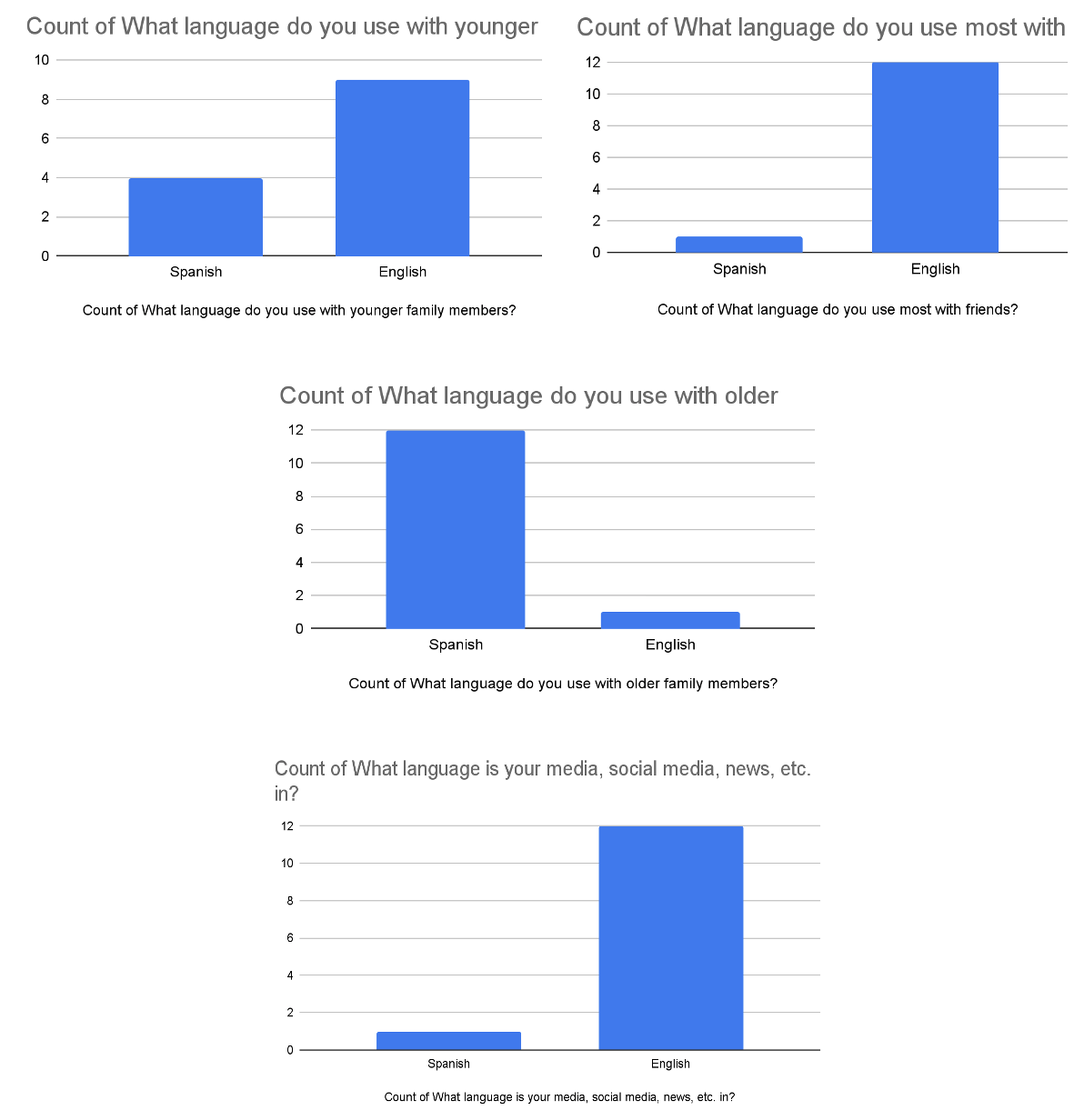
As mentioned in the methods section, in order to determine the proficiency level of the participants in our study, we had them fill out a demographics survey. Unfortunately for the purposes of our study, none of our participants answered the questionnaire in a way that would qualify them as a lower proficiency Spanish speaker. In this case, we cannot address our hypothesis directly. Instead, a general analysis is provided on our results and data.
Table 1 below shows the average ratings of each sentence in the judgment test across all participants as well as the number of responses for each rating on the 1-to-5 scale for each sentence.
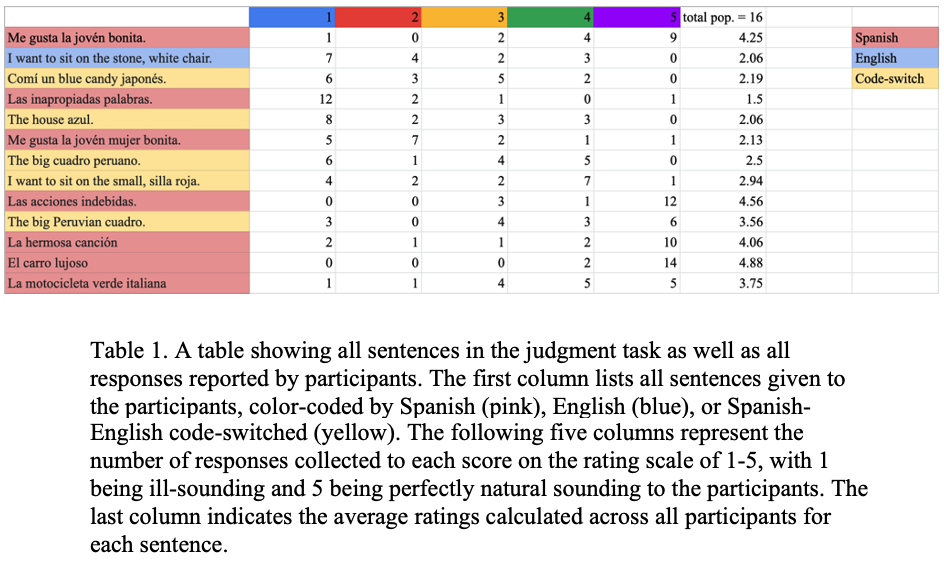
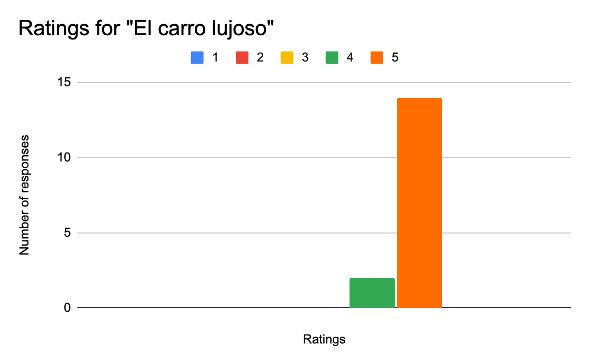
Looking at the average ratings from the participants for the judgment task, in which they judged sentences on a scale of 1 to 5 with a score of 1 being not appropriate sounding, and 5 being very appropriate, participants reported a score higher than 4 for sentences with a single adjective in the post-nominal position. This result is expected, since these sentences follow the typical Spanish noun-adjective order. Examples include: “El carro lujoso” (Table 2), “Las acciones indebidas”, and “Me gusta la jovén bonita”. For Spanish sentences that violate this typical grammatical construction, participants assigned average scores lower than 2. An example is “Las inapropiadas palabras.”
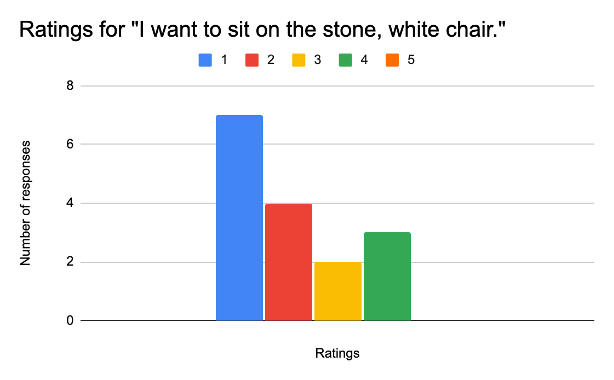
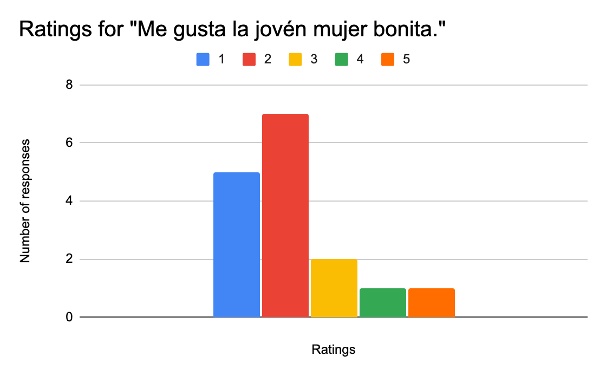
For English and Spanish-only sentences that contain more than one adjective, the participants’ scores appear to be on the lower side, but one sentence is also rated as more neutral (approximately a score of 3) in judgment. In the case of “I want to sit on the stone, white chair”, the average rating is 2.06, and this may be explained by the order of English adjectives, in which color adjectives are usually placed before material ones, such as “I want to sit on the white, stone chair” (Table 3). In the case of “Me gusta la jovén mujer bonita”, the average reported score is 2.13 (Table 4). This may be due to the fact that the sentence incorporates a less common adjective structure by locating one adjective pre-nominally and another post-nominally seen in Spanish. English-only grammar would adopt one or the other. Therefore, given that the sentence is in Spanish, participants may prefer to have both adjectives in the post-nominal position as it is seen by the participant as more native-like. A more neutral rating (approximately 3) is given to “ La motocicleta verde italiana”. Unlike the adjective-noun-adjective (ANA sequence) case above, both adjectives are placed post-nominally in this sentence, and since Spanish does not limit adjective hierarchy in the post-nominal position, some participants may prefer “verde italiana” while other prefer “italiana verde”, resulting in the more neutral distribution in score.
Lastly, the average ratings for most code-switched sentences are lower than 3, which indicates that the participants do not judge these phrases as appropriate sounding. See the following examples:
1. Comí un blue candy japonés. 2.19 (Table 5)
2. The house azul. 2.06
3. The big cuadro peruano. 2.5
4. I want to sit on the small, silla roja. 2.94
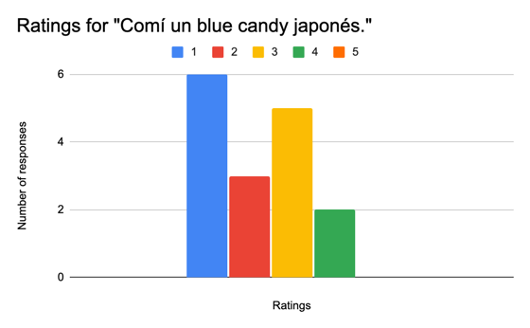
In Spanish grammar, an adjective-noun-adjective order is possible, but in the data shown above, most participants do not agree and do not accept this structure. One explanation may be the occurrence of transfer from English grammar. If this is the case, then the participants may subconsciously have an English-dominant syntactic structure in mind while processing these code-switched sentences, resulting in this lower rating. The following sentence further supports this explanation and shows a more neutral response from the participants:
5. The big Peruvian cuadro. 3.56
In this sentence, both adjectives – one English and one Spanish – appear before the noun, and on average, the participants think this sentence is more acceptable than the cases above. This suggests that participants deem an adj-adj-noun order more suitable than the cases above (including ANA sequences), which is the grammatical order seen in English but not Spanish sentences. Given that most participants self-reported to have had more formal instructions in English, have spent most of their life in an English-speaking region, talk to themselves mostly in English, and on average are more proficient in English skills than Spanish ones, this hypothesized explanation is possible. However, only one such sentence is reported in this study, and a rating of 3.56 is relatively neutral and not strong enough to indicate any determining conclusion on the possible transfer of English syntactic rules to Spanish.
Discussion
We originally hypothesized that heritage speakers of Spanish with lower proficiency in the language would adhere more closely to the English norms regarding noun-adjective order. Therefore, we predicted that less proficient Spanish heritage speakers would have a stricter understanding of noun-adjective order. However, since none of the participants rated themselves as low in proficiency in Spanish, we, again, conducted only a general analysis using all data.
As addressed above, our results do not show any solid evidence for cross-linguistic transfer of English adjective ordering rules to Spanish. In addition to the individual sentences mentioned above, an overall analysis dissects all data to suggest little to no transfer from English to Spanish: 1) most ratings are low for adj-N order in Spanish 2) use of mostly N-adj phrases in production 3) lower ratings of ANA sequences in Spanish. The first two observations would indicate no transfer from English. The third case may suggest possible transfer from English since English does not allow for ANA sequences. However, this may also be due to the infrequency of ANA sequences in general. According to the post in FluentU by Whitney Grace, the most common adjective sequence is to have only one adjective before the noun or after.
Furthermore, when later asked, the participants reported that a lower score is given to the code-switched sentences simply because they did not like having two languages mixed in a single sentence. They would prefer having either just Spanish or English in one phrase, or if code-switching does occur, it would be more natural-sounding to them when this switch occurs in sentences that are much longer instead of a short sentence as presented in our judgment task.
Our study also has multiple limitations. For one, our small sample size (16 people) restricts the generalizability of our study. Moreover, we were not able to ask all our participants about their reasoning regarding their judgments because unfortunately, we did not build this into the task. As a result, only the handful of participants who completed the naming task clarified why they answered the way they did on the judgment task. This is a major limitation, especially for the judgments made on the codeswitched sentences, since many of them could have rated them as unnatural only for the reason that they were codeswitched, not because they did not follow the rules of English or Spanish. Thus, our finding that participants experienced transfer from English is not clear as Spanish heritage speakers obey the adjective ordering that is most commonly used and may not be fully aware of the less frequent syntactic rules in Spanish, which then limits a holistic and evidential insight as to whether transfer from English has occurred.
Conclusion
From this study, it is shown that Spanish heritage speakers prefer the Spanish adjective order of noun-adjective in most Spanish-only cases and prefer the strict English order of adjective-noun in English-only sentences. On code-switched phrases, heritage speakers rated the constructions as non-native and would have preferred only one language per sentence. In terms of practical implications, our findings could contribute to improving Spanish classes specifically designed for heritage speakers. Although our results do not match with our initial hypothesis that syntactic transfer from English to Spanish may occur, the study nonetheless highlights some preferences and thoughts of processing languages from Spanish heritage speakers. In the future, it would be great to analyze heritage speakers of different proficiency levels in Spanish (as we originally intended) as well as heritage speakers growing up in different environments. This type of study can further be applied to heritage speakers of other languages to examine not only the linguistic differences across languages used by heritage speakers but also their cognitive processes and their intuition when presented with varying combinations of the distinct language systems.
References
Birdsong, D., Gertken, L.M., & Amengual, M. Bilingual Language Profile: An Easy-to-Use Instrument to Assess Bilingualism. COERLL, University of Texas at Austin. Web. 20 Jan. 2012. <https://sites.la.utexas.edu/bilingual/>.
Camacho, José. “The Interpretation of Adjective-N Sequences in Spanish Heritage.” Languages 3.4 (2018): 46–. Web.
Montrul, S. A. (2012, August 8). Is the heritage language like a second language? University of Illinois Urbana-Champaign.
Pérez-Leroux, Ana et al. “Restrictions on Ordering of Adjectives in Spanish.” Borealis (Tromsø) 9.1 (2020): 181–208. Web.
Sánchez, Liliana & José Camacho. 2021. Adjectives in Heritage Spanish. Isogloss. Open Journal of Romance Linguistics 7, 3:1-20.
Whitney Grace. “The Guide to Spanish Adjective Placement: Quit Misplacing Those Descriptives!” FluentU Spanish, 18 Jan. 2022, https://www.fluentu.com/blog/spanish/spanish-adjective-placement/.