Okay So…Vloggers You Know?
James Beasley, Mahta Marefat, Betsy Wo
The present article focuses on identifying how YouTube content creators shape their material and influence viewers’ language through storytelling. The evident popularity of YouTube among younger generations leads to the hypothesis that linguistic variants displayed by content creators subtly influence the conversation styles of young adults. This study was designed to gauge the correlations between YouTube viewing, storytelling frequency and variant usage among young generations through survey responses. The survey sample consisted entirely of UCLA students, who indicated high amounts of YouTube viewing and storytelling. Additionally, respondent data showed that many linguistic variants used by vloggers are also commonly used by respondents. Previous research on the impact and practices of vloggers also align with our results. The takeaways from our results suggest that the prevalence of YouTube viewing and personal storytelling among respondents are similar. Furthermore, the linguistic variants used by respondents match those used by YouTube vloggers, implying a subtle influence of vlogger language practices on viewer variant usage.
The Innovative Internet
The world we exist in is dynamic. Constantly shifting and advancing, everything observed in our lives reflects the rapidity with which information is transmitted and trends rise to popularity. The internet is a large contributor to this speed, and allows for instant communication and advances that have enabled the growth of Western society.
Since its inception, the internet has marked itself as a necessity — vast, collaborative, and informative — it is able to interweave itself into our daily lives. It has paved the way for innovative forms of communication, networking, and socialization; social media as an entity exists solely due to the impact and presence of the internet.
One such social media platform that has gained enormous popularity is YouTube, a web-based service that allows users to both create and view videos online. If you have access to the internet, you have access to the billions of videos that are housed on YouTube. Viewers are able to utilize this in a plethora of capacities, whether that be for educational, motivational, or entertainment purposes (and these are only three basic categories in which people are able to interact with these videos). Content creators (people who record, edit, and post videos) are able to construct YouTube Channels, which act as a centralized location for all of their videos. They are able to design their own aesthetics and target specific audiences and populations through the videos they post. While there are many facets to creating popular content (performing certain acts, including other YouTubers in videos, interacting with viewers and outsiders, making specific types of videos such as lifestyle or beauty), it is through utilizing specific language and editing styles that these creators are able to attract their audiences and impact viewers’ lives.
What do we know about vlogs?
To narrow down our investigation, we decided to focus on one video form: the vlog. While there are at least a dozen genres that exist on YouTube, we anticipated that nearly every college-aged student would have had exposure to vlogs in some way or another.
First, we started off by finding a basic definition of vlogs, which we found in a study by Heather Molyneaux, Susan O’Donell and Kerri Gibson (2009):
“‘Vlogs,’ also known as video blogs, are video web logs[… ]Vlogs are a form of online publishing, allowing everyone with web access[…] to create and post content. Most vlogs are authored by individuals and focus on personal themes.”
This further proves our idea that multitudes of youth have connections to these types of videos, as they are created with the intention of fostering personal connections and sharing intimate details of a vlogger’s life.
Yet settling on this genre of video is not narrow enough in its scope to truly observe any sociolinguistic phenomena. To rectify this, we decided to specify a target population — to identify not only a type of vlog, but also a similar group of vloggers.
It is evident that YouTube is a social media platform where hundreds of millions of videos are posted telling or portraying the image of women (Molyneaux et al. 2009). Vlogging videos are not only showcasing women, but also influencing the women watching these videos. When focusing on the context of storytelling, there are certain methods vloggers use to keep their audience interested. In scientific terms, vloggers use a participation framework and language that reflects audience design through things like terms of address, questions, and directed language (Frobenius 2014). This basically means that vloggers produce their speech to create an environment where the viewers aren’t actually speaking but are still a part of the conversation. In a sense, there is an audience involvement resembling a face-to-face conversation, and more specifically, a storytelling conversation. When a vlogger tells a story, there is a lack of turn taking since the viewer isn’t actually able to reply, which is what frames the way vloggers speak (Frobenius 2014). If a viewer frequents a certain vlogger’s video, then a community-based knowledge system is formed, which results in a mutual understanding on many topics. In this situation, the fanbase becomes acclimated to the vlogger’s language variants, and may adapt these variants into their own speech. This is how we came to the conclusion that the linguistic variants displayed by these content creators must influence the conversation styles of young adults. Our study will help reveal the impact vloggers (strangers who feel like virtual friends) have on their audience. We were most interested in observing the speech trends in the young women of today. To do this, we needed to evaluate the effects the internet has on not only stylistic and linguistic changes among a specific population, including its reach, speed, and popularity, but also on the use of these variants in people’s lives outside of the internet.
How did we do it?
We took inspiration from an interesting prior study – a content analysis of vloggers, and audience response to these vloggers (Molyneaux et al. 2009). In this study, the subjects, who were all in their teens to 20s, were given a demographic background check and shown a few vlogs. A survey was then conducted to investigate insight into the influence of gender. We employed their survey method to collect and analyze data on the variable of speech variants. Our survey was distributed it to our peers online (through email, Facebook, and other social media), polling students on their personal demographic information as well as their entertainment preferences online. We also provided key phrases that exemplified the linguistic variants we investigated and asked that they self-report how they first came across the phrases, and how frequently they estimate their use weekly. In order to make our survey interesting, the second portion included fun stills and clips of the variants we were investigating in order to ensure the self-reported data was an accurate reflection of the variants (this way participants would be aware of which motions and phrases we were explicitly asking about, and could then compare to their own behaviors). We expected that the responses to the second part of our survey would garner more explicit and clear results exemplifying the variants in question. Here are some of the variants that we observed in vloggers, and used in our survey:
-
- Okay so…
-
- You know?
-
- Hand gestures
-
- The ‘welp’ expression
-
- Repeating words
-
- Pause and awkward smile
What did we find?
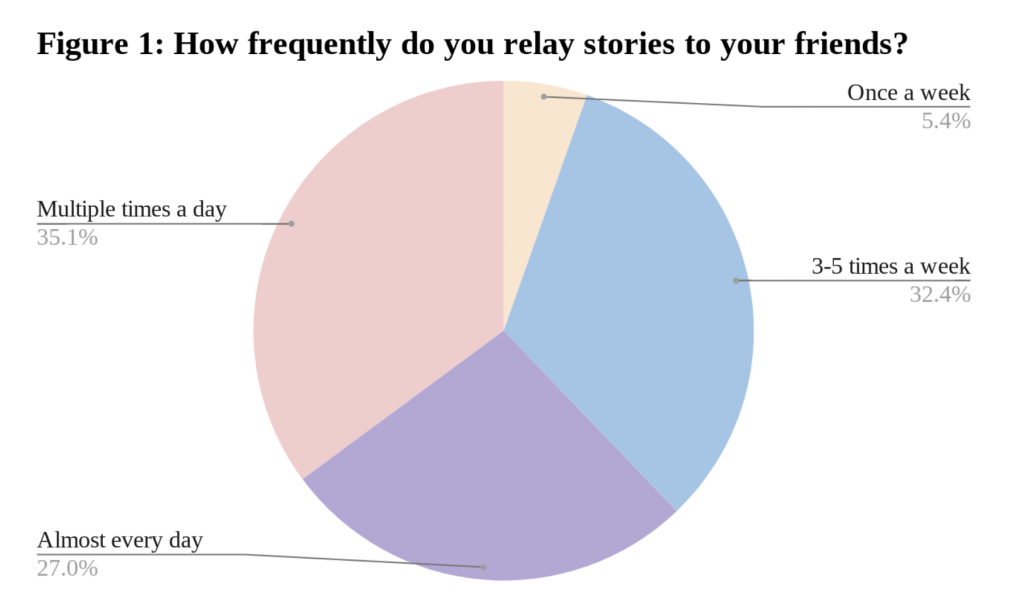
Utilizing the data from our survey, we were able to generate the following figures that summarize results to key questions. As seen in Figure 1, all participants indicated they tell stories at least once a week, with over 60% reporting casual story-telling on a daily basis. This information is useful as it ensures the data we collected is actually applicable to our study.
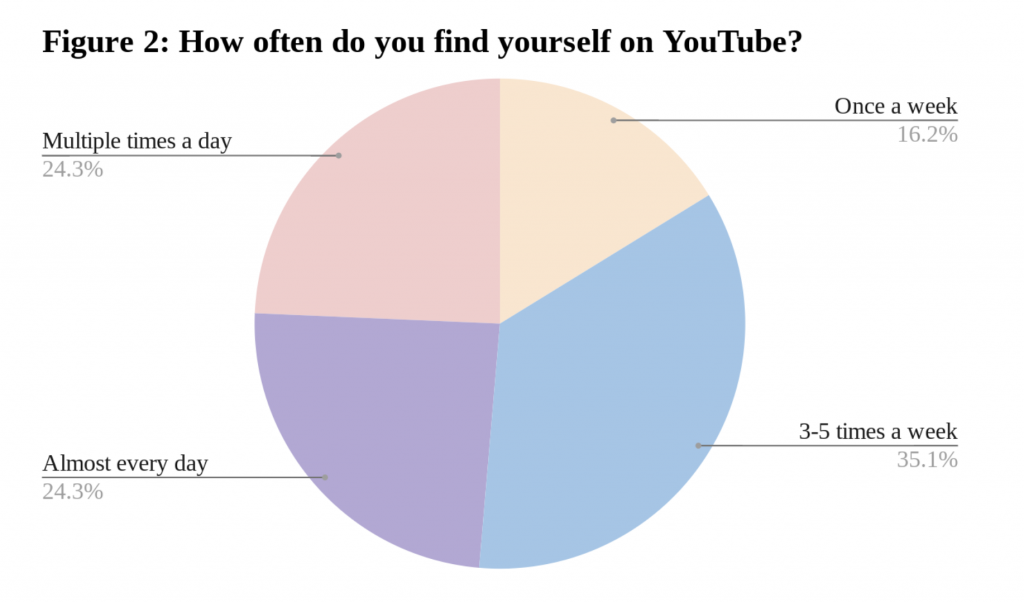
Additionally, Figure 2 also helps validate our results as it shows that all participants watch YouTube videos at least once a week. These statistics are crucial for our analysis as they confirm that students who responded to our survey are representative of our target population.
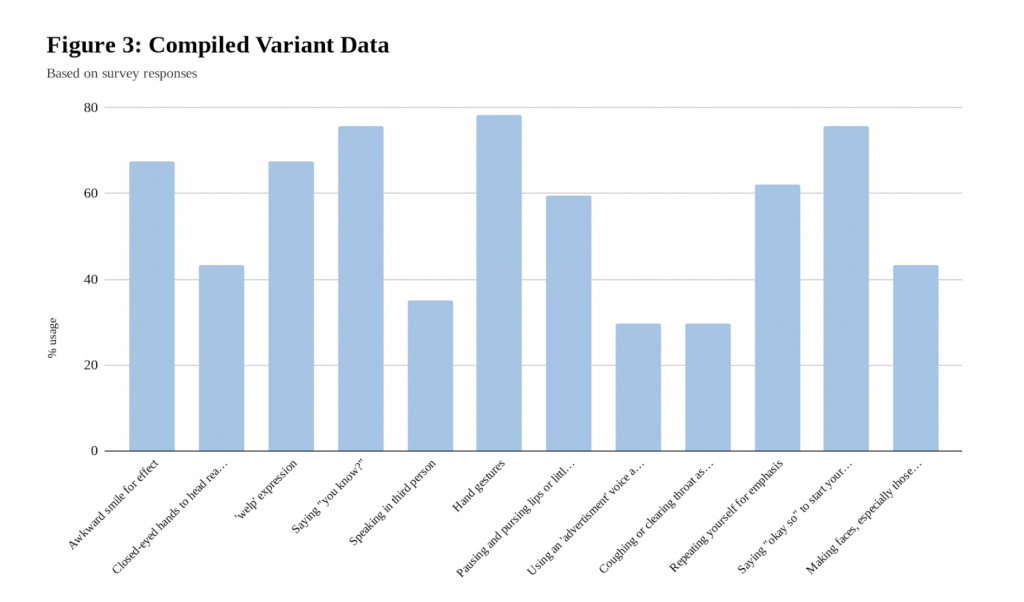
Some of the most used variants, as indicated by survey participants, include hand gestures, saying “you know” and “okay so,” using the ‘welp’ expression, and smiling awkwardly for effect. The total percent usage of each variant is summarized in Figure 3.
In an effort to acquire more reliable data (as self-reported information can easily be inaccurate or falsified), we also analyzed recordings of people telling stories offline as well. We counted all instances in which the variants in question appeared in these exchanges and generated a frequency chart, as seen in Figure 4. This analysis revealed that the most commonly utilized variants offline include hand gestures, making faces, repetition, and smiling awkwardly for effect.
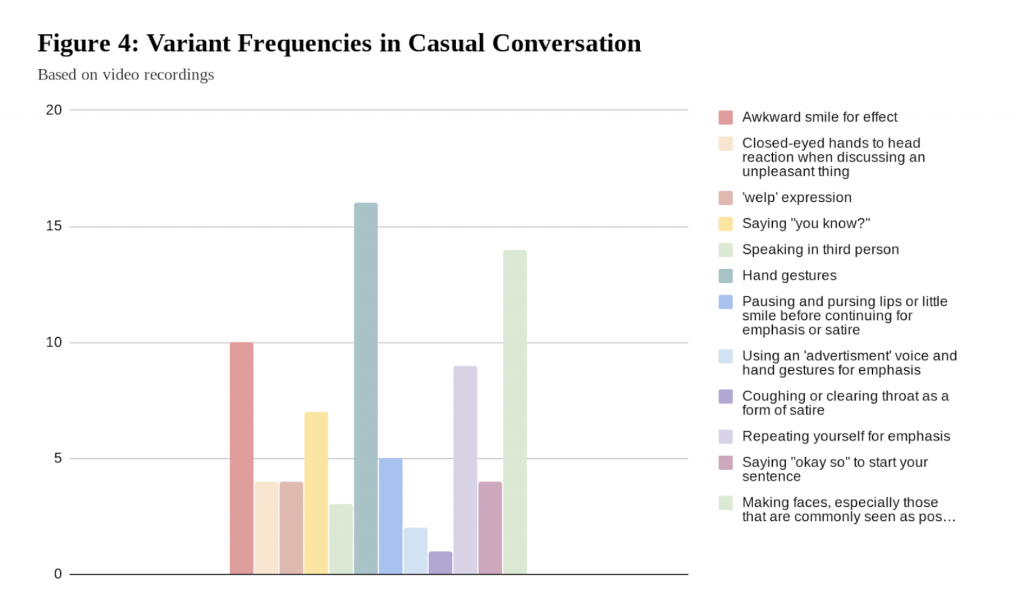
A comparison of the trends observed from survey responses and the video recordings shows that overall, the most popular and widely-used variants are saying key phrases such as “okay so” and “you know,” giving an awkward smile, and using hand gestures and facial expressions.
The big picture
The apparent growth of YouTube’s content creators and their following base led to our hypothesis that linguistic variants are used by YouTubers to draw and influence their audience. Our results support our hypothesis that linguistic features associated with popular YouTubers are utilized by our sample in their own personal conversations. First, the sample data indicates that almost the entirety of respondents (94.5%) engage in storytelling at least multiple times a week. Building on this, the entire sample watches YouTube at least once a week. The combination of these results imply that our sample was a strong representation of YouTube viewers, such that the respondents are evidently influenced to some degree by YouTube content. This combination of results also aligns with Zappavigna’s assertions (2012) regarding the substantial influence of internet content in our lives, since our sample’s frequency of watching YouTube is roughly the same as the frequency of their story-telling. In other words, our respondents spend almost as much time being influenced by YouTube content as they do influencing others with their own personal content.
Our results continue to illustrate the interaction between YouTube viewing and personal story-telling, and show that respondents often use linguistic variants associated with vloggers. The usage of each linguistic variant across our sample is at least 25%, with usage rates above 50% for seven out of the 12 variants. When compared to the frequency in which variants were used in the casual conversation recordings, each variant was used at least once, with three variants appearing at least 10 times. In sum, people do not just use vlogger linguistic variants in their own personal conversations, they use them frequently.
Some limitations to the conclusions of our study are based on potential ambiguity of our survey questions and influences from our respondents’ social backgrounds. The first question about story-telling frequency may be confusing to respondents, causing some to indicate more or less than they actually tell stories. This may explain the group of respondents that only tell stories once a week, or the group that tells stories multiple times a day. Additionally, some respondents may identify with social groups that frequently use linguistic variants that happen to overlap with the variants used by vloggers. For instance, our sample consisted of UCLA students, and UCLA language culture may have similar variant usage to vloggers. In this case, respondents are influenced by at least two separate entities, but the amount of influence from each entity varies. That is not to say that those respondents are not influenced by vloggers, but that the influence is possibly less than the results suggest. Overall, the limitations of our study may show that the influence and draw of vloggers’ linguistic variants are less than the results suggest, though still present.
Future research on this topic could focus on the influence of vlogger language variants on those who identify as men. A study focused on the differences in vlogger influence based on gender may reveal some factors that gender identity have on certain linguistic variant uses. Another topic that could be explored further is the growing influence of vloggers relative to traditional celebrities (e.g., actors, musicians, models). Influence on viewers may be stronger with vloggers due to relatability, but the extent of this effect should be investigated. Finally, the ability to which a popular vlogger can use their influence to market products may reveal that vloggers have more responsibility than they think.
Bibliography
Bestdressed, director. My last weekend in LA…. YouTube, 24 Oct. 2019, www.youtube.com/watch?v=IJcJEMAOJA4&t=53s.
Center for Health and Safety Culture. (2011, January). Validity of Self-Report Survey Data. Retrieved from https://www.minnetonkaschools.org/uploaded/Documents/Dist/Tonka_Cares/Reveal_What%27s_Real/Validity_of_Self_Report.pdf
Frobenius, Maximiliane. “Audience Design in Monologues: How Vloggers Involve Their Viewers.” Journal of Pragmatics, vol. 72, 2014, pp. 59–72., doi:10.1016/j.pragma.2014.02.008.
Frobenius, Maximiliane. “Beginning a Monologue: The Opening Sequence of Video Blogs.” Journal of Pragmatics, vol. 43, no. 3, 2011, pp. 814–827., doi:10.1016/j.pragma.2010.09.018.
Molyneaux, H., O’Donnell, S and Gibson, K. (2009). YouTube Vlogs: An Analysis of the Gender Divide.
Ur Mom Ashley, director. Forcing a GLOW UP the Day before College (FAST Transformation). YouTube, 8 Sept. 2019, www.youtube.com/watch?v=3YCM-Gj1b4w&t=50s.
Ur Mom Ashley, director. My first week of college VLOG *junior year*. YouTube, 13 Sept. 2019, https://www.youtube.com/watch?v=wZr4k_Z6APw&t=124s.
Zappavigna, M. (2012). Discourse of Twitter and Social Media: How We Use Language to Create Affiliation on the Web.