Dylan Mayhue, Darel Morado, Leslie Pena, Arianna Serna, Jason Sung
Have you ever been doomscrolling on social media and stumbled upon new slang, only to suddenly see you and your friends using it in your everyday conversations? What starts as a viral post or funny video can quickly influence your everyday language. We examined how social media has accelerated linguistic change and enabled viral terms (e.g., slang, memes) to function as indexical markers. By conducting a digital ethnography comparing Generation Z (1997-2012) and Generation Alpha (2011-2025), we learned that language doesn’t just function as a tool of communication but can signal identity or the generation you belong to (i.e., indexical markers). Although we found that both generations consume similar amounts of digital content, it was clear that there is still a generational language gap between the outskirts of each generation (older Generation Z & younger Generation Alpha). Our group argued against the popular opinion that Generation Alpha’s language is deteriorating because of the internet; however, we found language to be digitally adapting. In a world of viral videos, influencers, and daily content, this new Generation has redefined online/in-person communication as multimodal by conforming online media to multiple forms of hyper-visual communication (e.g., videos, emojis, and memes/GIFs).
Keywords: Indexicality, Digital Ethnography, Multimodality, Generation Alpha, Generation Z
[expander_maker id=”1″ more=”Read more” less=”Read less”]
Introduction
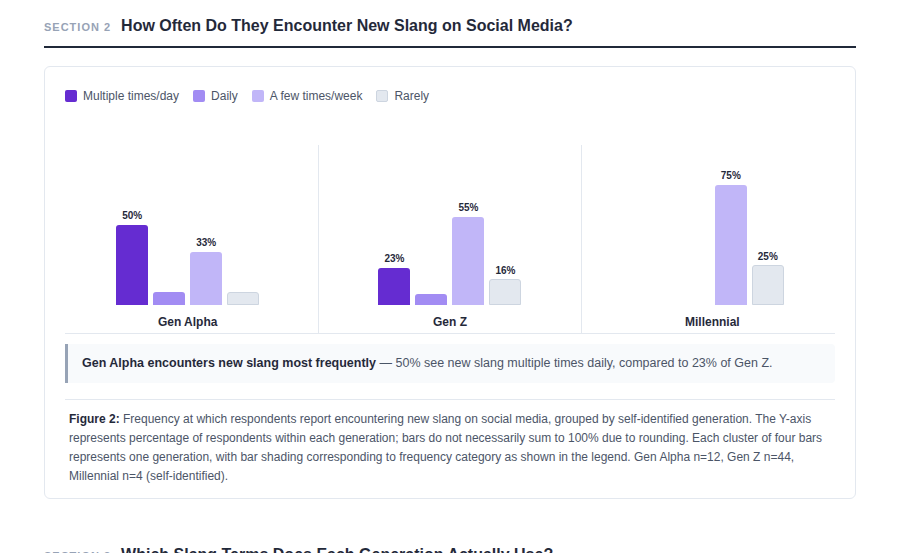
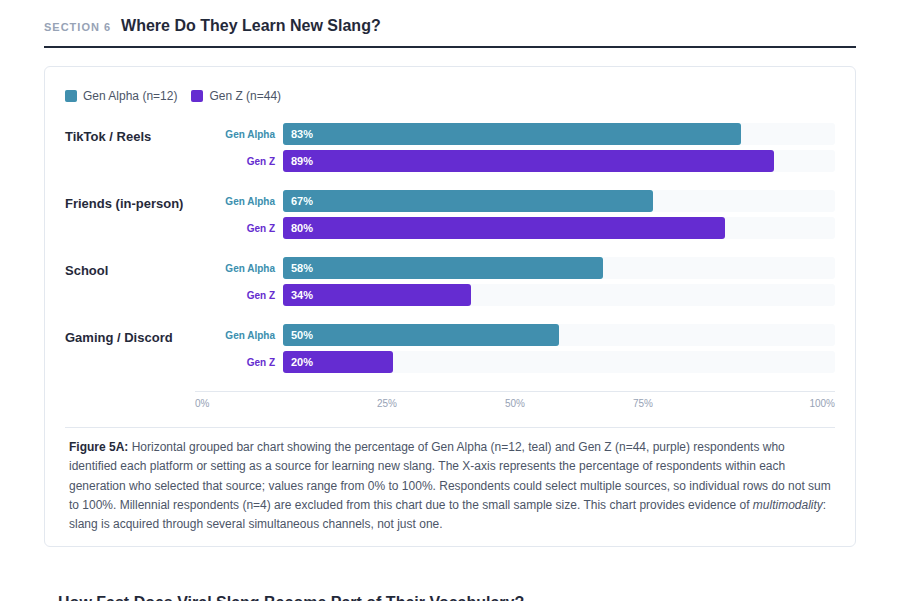
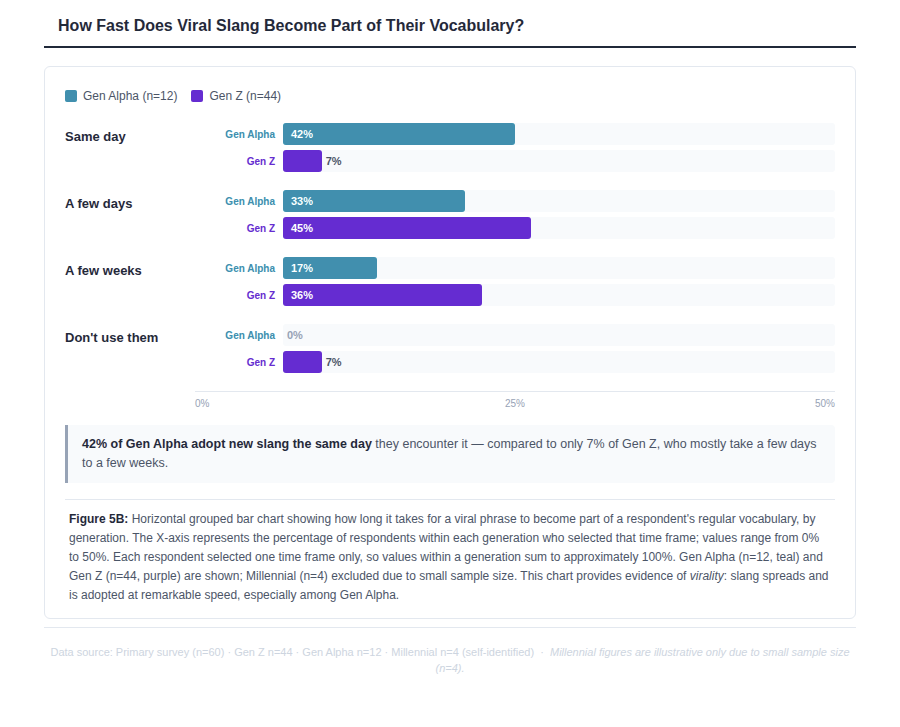
Viral media is popular for bleaching daily content into our lives; terms that once only survived on social media are now affecting our everyday lives. Terms like “sigma,” “mid,” or “slay” can be commonly found in comment sections and are now moving into our everyday vernacular. In fact, about 42% of our Gen Alpha participants said new phrases become part of their way of talking within the same day (Figure 5B). In a digital environment where millions of people consume the same content simultaneously, language is changing faster than ever before. Traditionally, linguists have studied language change as a slow process that unfolds over decades. However, the rise of social media platforms such as TikTok, Instagram, and YouTube has accelerated the spread of new linguistic forms (Figure 2). Research in sociolinguistics has long shown that language functions not only as a tool for communication but also as an indexical marker of identity, signaling group membership and social belonging. Despite growing attention to digital language practices, there remains a gap in understanding how evolving social media environments influence generational linguistic differences, particularly between the two youngest generations. Generation Z (1997–2012) experienced the rise of mainstream social media platforms such as Instagram and Twitter, while Generation Alpha (2011– 2025) has grown up immersed in algorithm-driven, short-form media ecosystems such as TikTok and interactive gaming environments like Roblox (Figure 5A). These different digital environments may shape how each generation develops and interprets slang, humor, and online communication styles. Given what we know about the relationship between social media and our two generations, it allowed our group to form the research question: “How has social media directly accelerated linguistic change, and how have Gen Z and Gen Alpha digitally adapted their slang to be used as an indexical marker that signals generational identity?” Allowing us to explore how social media accelerates linguistic change and contributes to generational identity formation by comparing the language practices of the two generations, specifically in their use of slang and style of humor. We examine how slang and humor function as indexical markers that signal generational belonging, how short-form media platforms influence the spread of viral language, and how humor styles differ between Gen Z’s layered irony and Gen Alpha’s “brainrot” communication through a multimodal methodology. By analyzing these patterns, this project argues that emerging digital slang is not evidence of linguistic decline, but rather a reflection of language adapting to new technological and cultural environments.
Background
Existing research supports the idea that youth slang plays an important role in expressing identity and belonging. Mary Bucholtz argues that slang among youth communities functions as a social marker that signals identity, group affiliation, and cultural positioning (Bucholtz, 2017). More recent studies have examined how digital platforms accelerate this process. For example, Eti and Rosalinah (2025) analyze TikTok comment sections and show that Gen Z slang spreads rapidly through online interaction and meme culture. Similarly, Khairunissa and Budiwati (2025) demonstrate how influencers contribute to the circulation and normalization of digital slang across social media audiences. Comparative studies of youth language further suggest that Gen Z and Gen Alpha are developing distinct communicative patterns shaped by their digital environments (Paoleti & Mujahidah, 2025; Pillai, 2025). While these studies highlight the role of digital platforms in shaping slang, fewer studies directly compare how these linguistic patterns function as generational identity markers across both Gen Z and Gen Alpha.
Methods
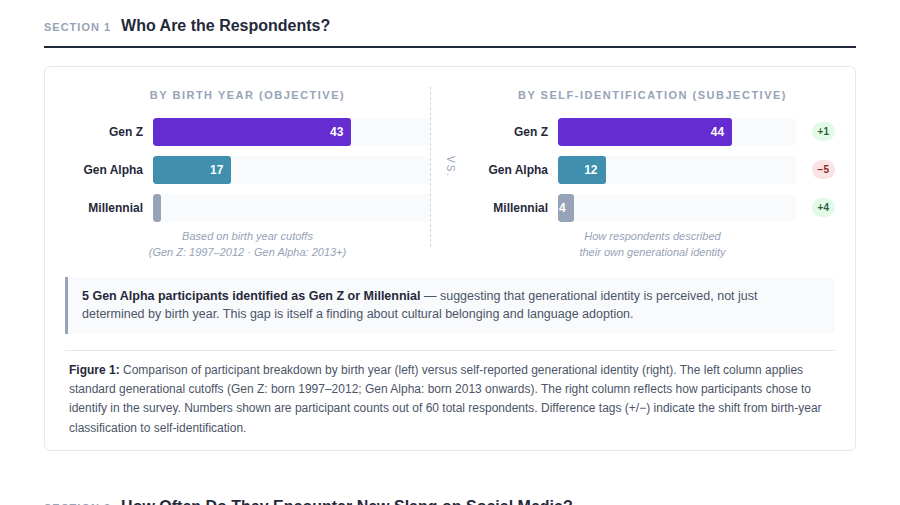
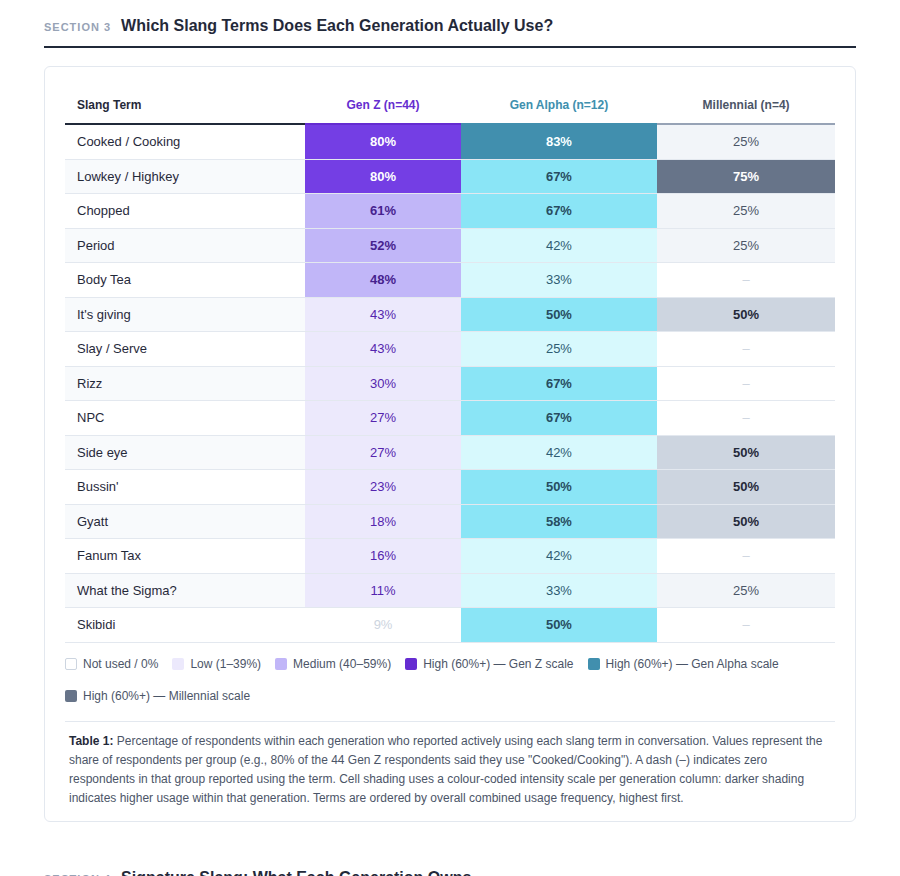
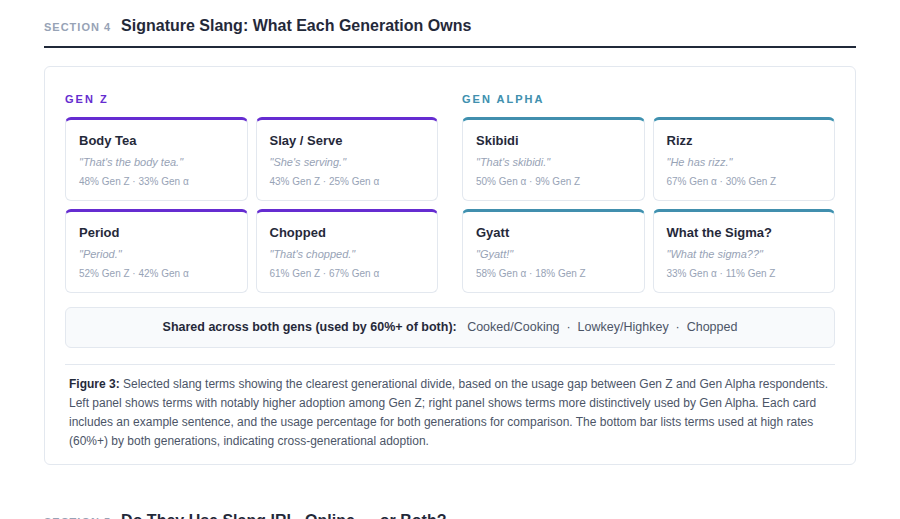
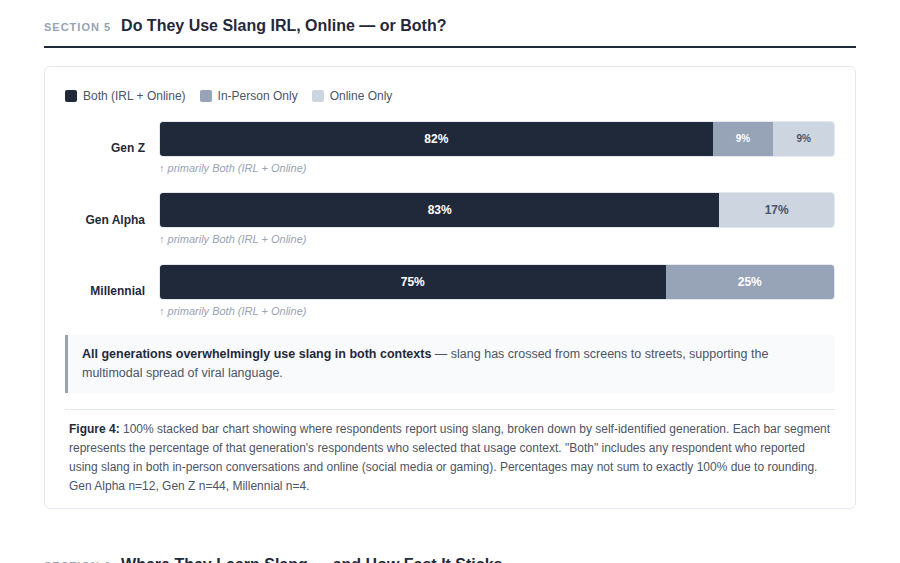
In our methods for this project, we have conducted a digital survey on the two generations, in which we received 60 responses in total. Within our defined parameters, 43 participants were Gen Z, and 17 were Gen Alpha. But to further understand our language gap, it should be noted that how they identified themselves was different; 44 people said they were Gen Z, 12 were Gen Alpha, and 4 identified more with millennials (Figure 1). In our survey, we asked what type of slang and brain rot the participants are familiar with, which generations they belong to, their social media usage, and in which context they might use different slang. The participants involved are acquaintances and family members, with Generation Z (1997-2012) making up the majority of our responses, in contrast to those in Generation Alpha (2011-2016). With this reported data, we see that the participants spend a majority of their time on social media platforms like TikTok and Instagram, and also become their main source for developing new slang. We also saw through our 2 interviews with siblings, one in Generation Z and the other in Generation Alpha, how easily language can be influenced not only by consuming social media but also by simply being around a different generation. In Table 1, it is shown that one of the most popular phrase choices among all our generational participants was “cooking/cooked” or “lowkey/highkey.” This demonstrates that there is a bridge between these two generations and shows the similarities in not only how they develop language but also in the type of slang words they share. This allows us to understand that there is a relationship between social media exposure and how language is being adopted into daily vernacular and identity, as well as within the generations we focused on.
Result/Analysis
Discussion and Conclusion
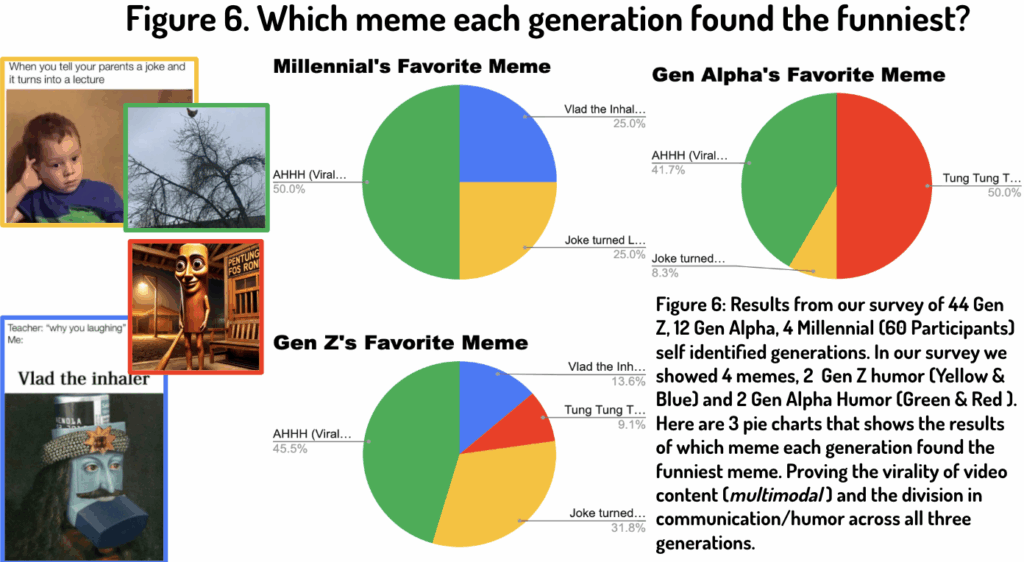
Our research shows that digital slang serves as more than casual vocabulary. The language used in this study serves as an indicator of which generation an individual belongs to. Our results, specifically in Figure 6, demonstrate that social media platforms operate as multimodal communication systems that allow users to share meanings through textual content, visual elements, and generation-specific humorous content. Our research shows that Gen Z and Gen Alpha use language to create new ways of communication, including daily content such as new videos/audios. Our research results have limited how broadly these findings can be applied since we did not account for factors such as sibling influence or cross-generational interaction. Future research comparing older generations, such as Gen X, could further clarify how digital environments could influence language shifts. Recognizing how slang shows identity may help reduce generational stereotypes and improve communication across age groups. Remember, language found on social media can equal identity, and it is evolving faster than ever. So next time you’re doom-scrolling, you may just be scrolling away the next big trending slang.
References
Bucholtz, M. (2017). Word Up: Social Meanings of Slang in California Youth Culture. Escholarship.org. https://escholarship.org/uc/item/0c7141bs#main
Eti, S. H., & Rosalinah, Y. (2025). An Analysis of Gen Z’s Digital Slang: Patterns from TikTok Comment Sections. IDEAS: Journal of Language Teaching and Learning, Linguistics and Literature, 12(2), 3250-3262. http://ejournal.iainpalopo.ac.id/index.php/ideas/article/view/5911
Khairunissa, M., & Budiwati, T. R. (2025). THE USE OF GEN Z SLANG BY DIGITAL INFLUENCER “AWKARIN” ON HER SOCIAL MEDIA: A SOCIO-SEMANTIC STUDY. Language Literacy: Journal of Linguistics, Literature, and Language Teaching (Online), 9(2), 1092–1098. https://doi.org/10.30743/ll.v9i2.12177
Paoleti, V. D., & Mujahidah, N. F. Z. (2025). YOUTH LANGUAGE UNCOVERED: META-SYNTHETIC INSIGHTS INTO GEN Z AND GEN ALPHA SLANG. English Review: Journal of English Education, 13(1), 9-16. https://doi.org/10.25134/erjee.v13i1.11425
Pillai, S. (2025). Generational Linguistics in the Digital Age: A Comparative Study of Gen Z and Gen Alpha English. Research Journal of English Language and Literature (RJELAL), 13(3), 343–347. http://www.rjelal.com/13.3.25/343-347%20Dr.%20Surabhi%20Pillai.pdf
Other Related Sources
Gen Alpha is Brainrotted And That’s Okay | Kiara Galway | TEDxKGV School Youth
https://www.youtube.com/watch?v=WCkabQRxdhY
Brain Rot:The Hidden Cost of Endless Scrolling | Vishnu Nemala | TEDxInternationalSchoolOfHyderabad
https://www.youtube.com/watch?v=Jkr8XmF394o
[/expander_maker]