Srimahita Addagarla, Joanna Bui, Afruja Jarin, Arman Shahbandaryan, Yura Yamamoto
The first minutes of a college class carry more weight than they might seem. Before the syllabus gets handed out and before a single concept is taught, an instructor’s introduction is already doing significant work. This study examines how UCLA professors use language to establish classroom environments from their very first interaction with students. Drawing on naturalistic observation of BruinCast lecture recordings and paired surveys of both instructors and students, we analyzed the pragmatic and semantic features of four UCLA professors’ first-day introductions, including tone, gesture, word choice, and sentence structure, and compared these against how each party described and rated their classroom environment. Our findings suggest that the linguistic and pragmatic strategies instructors deploy in their introductions closely align with the environments both they and their students perceive to exist throughout the course. Smiling, questioning, and informal phrasing each shaped how comfortable, engaged, and challenged students felt before any course material was introduced. This research contributes to a gap in the literature on classroom discourse by drawing a direct line between first-day instructor language and the broader communicative norms that define a learning space.
Keywords: UCLA Instructors, first impressions, classroom environment, relational, pedagogy
[expander_maker id=”1″ more=”Read more” less=”Read less”]
Introduction and Background
We’ve all been there, where we’re sitting in a lecture hall on the first day of the quarter, waiting for the professor to speak. While it might feel like a routine formality, the way an instructor introduces themselves is a pivotal linguistic event. Research shows that students’ initial perceptions of a course and its learning environment are greatly influenced by the instructor introductions given on the first day of class (Tanner, 2013). These introductions serve more purposes in higher education settings than just giving out information; they set expectations, represent authority or approachability, and indicate the classroom’s social and academic norms (Cazden, 2001). Our project focuses on these introductions as an important moment of interaction between instructors and students. Specifically, we explore how instructors use language and communication strategies to establish the kind of classroom atmosphere they hope to create from the very beginning. We analyze syntactic, pragmatic, and semantic elements within these introductions. Pragmatic features include tone, friendliness, stance, and gestures, while syntactic and semantic features focus on how instructors structure and phrase their sentences. Language is rarely neutral, especially in education. By observing some hidden strategies, we want to understand how a room full of strangers is transformed into a cohesive academic environment before the first syllabus is even handed out. The purpose of this study is to determine how obvious and covert language strategies used within instructor introductions reflect the educational environment the instructor intends to foster, and we hypothesize that linguistic and pragmatic behaviors displayed in instructor introductions will specifically reflect the levels of expectations, comfort, and engagement that the instructor attempts to promote within the classroom.
Cross Reference: TED Talk explaining the major impact, both positive and negative, introductions, shaped by our tone and words, can have on our biases and perceptions of people: https://www.youtube.com/watch?v=GHGoIsrQZFs
Methods
For our project, we conducted both naturalistic observations and interviews to investigate our research question: What do instructor introductions in higher education classrooms reveal about classroom environments? We started by asking for permission and once granted, analyzing the recordings of four UCLA professors’ introductions, which were available through BruinCast lectures. As we ethnographically transcribed them, we looked out for the features that could shape the way a student would understand the lecture environment. Some behaviors we noted included the way the sentences are structured, the use of rhetorical questions, the use of examples, the tone, and the use of gestures. We also looked at relevant literature to help us interpret and assess the behaviors and patterns we found in our transcriptions.
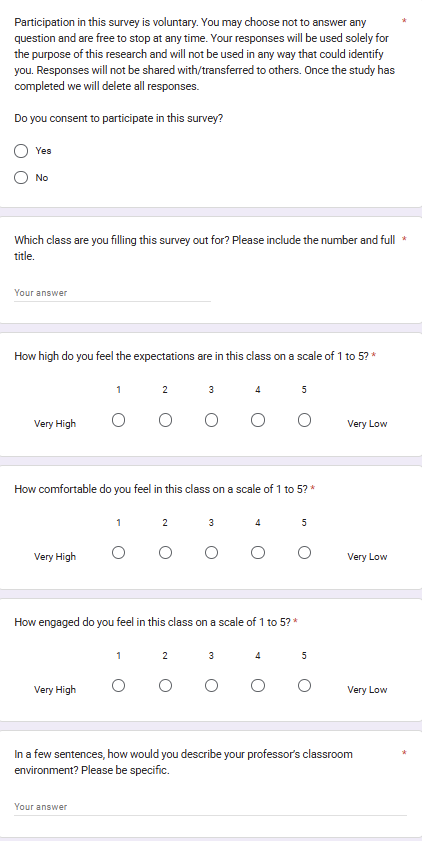
Along with these observations, we went a step further to survey the professors and the students to find out what kind of environment professors were aiming to create as well as what kind of environment the students perceived the classroom to have. The surveys asked both the professors and students to describe their classroom environment in their own words and rate the engagement, comfort, and expectation on a likert scale from 1-5, with 1 being the highest and 5 being the lowest. Finally, we conducted thematic analysis where we divided the survey answers into themes and compared these themes to the linguistic behaviors we found within the transcribed introductions.
Google Forms Survey for Students
Google Forms Survey for Professors
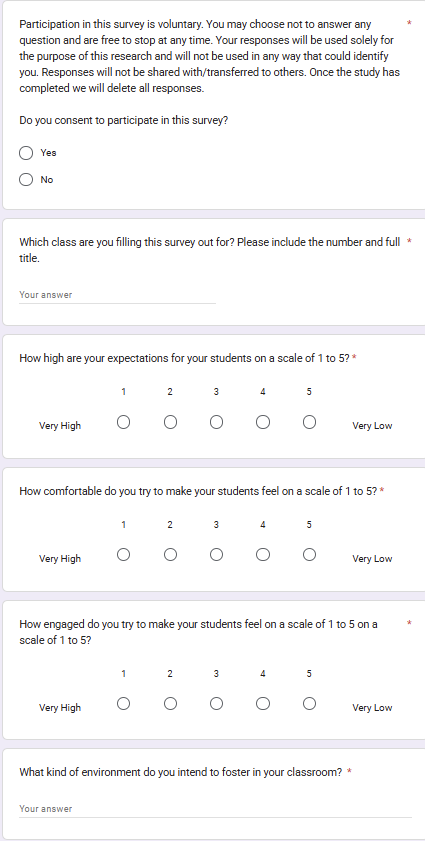
Through this process, we would be able to discover whether the features within the instructor introductions would contribute to the overall classroom environment the professor aimed to create, as well as whether these features would shape the students’ views of the classroom environment in the same way as the professor intended.
Results and Analysis
Table 1: The most common linguistic and pragmatic behaviors within introductions and student and professor perspective of classroom environments amongst 4 UCLA classrooms
| Professor | Professor 1 | Professor 2 | Professor 3 | Professor 4 |
| Linguistic and pragmatic behaviors within their introductions | – Rhetorical questions (syntactic) – Personal/ relatable examples (semantic) – Emphasis on “you” (syntactic) | – Hand gestures (pragmatic) – Jokes (semantic) – Asks questions (syntactic) – Laughs and smiles (pragmatic) | – Admits he is bad at emailing (semantic) – Asks “okay?” at the end of his explanations (syntactic) | – Calm tone (pragmatic) – Slight smile (pragmatic) – Pauses to allow for responses (pragmatic) – To the point – no jokes (semantic) |
| Professor Perspective of Environment | – Challenging – Critical Thinking – High Expectations – Very Engaging – Very Comfortable | – Open and informal – High expectations – Very Engaging – Very comfortable | – Functional – Transparent – Friendly – Rigorous – High expectations – Engaging – Comfortable | – Rigorous – Supportive – Inclusive – High Expectations – Very Engaging – Very Comfortable |
| Student Perspective of Environment | – Entertaining – Organized – High Expectations – Very Engaging – Comfortable | – Collaborative – Moderate Expectations – Moderate Engagement – Very Comfortable | – Open – Helpful – High Expectations – Engaging – Comfortable | – Collaborative – Open to different perspectives – Moderate Expectations – Moderate Engagement – Comfortable |
Across all data points, we noticed that the student and teacher perspectives were relatively in line with each other, where every student and professor in each class rated the levels of expectations, engagement, and comfort in the classroom as moderate or higher. We also found a correlation between the student and teacher perspectives of the classroom environment in aspects other than expectations, engagement, or comfort. For instance, for Professor 2 and Professor 4, both the students and the professor viewed their classroom environment as being very inclusive and open to student’s different perspectives.
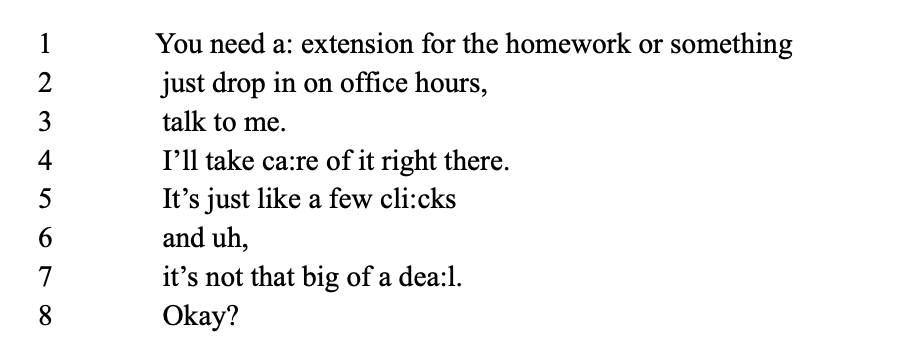
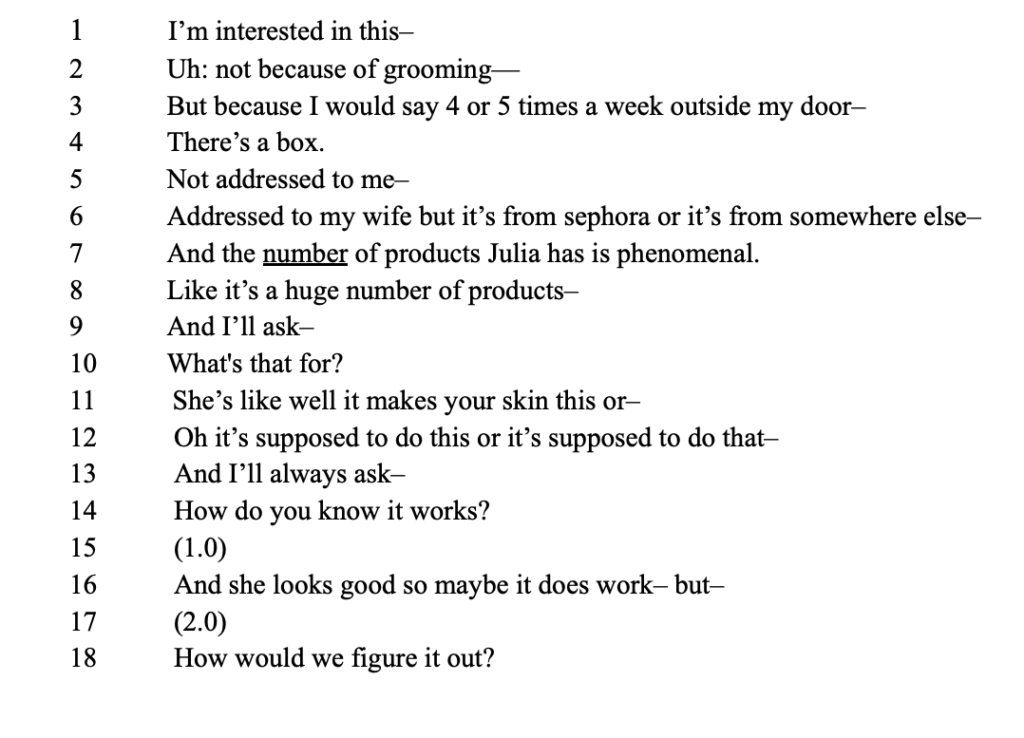
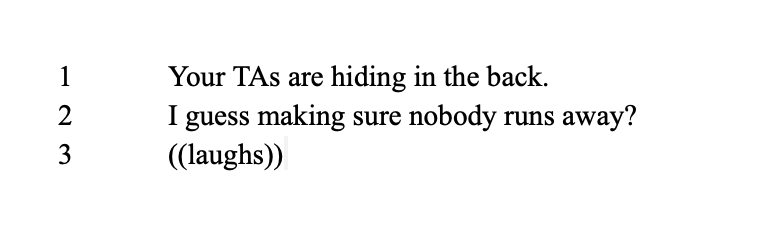
In addition, we found that the behaviors displayed by each of the professors we looked at could be categorized into three main categories: syntactic, pragmatic, and semantic, and within each category, there were certain behaviors that multiple professors shared. Syntactically, the most common behavior we found amongst the instructor introductions was questions. Semantically, there were multiple professors who used personal stories or examples within their introduction. Finally, the most common pragmatic behavior amongst the professors was smiling and laughing as they introduced themselves.
Transcription 1: Professor 3 Example of Questions
Transcription 2: Professor 1 Example of Personal Stories/Examples
Transcription 3: Example of Smiling/Laughter
After analyzing our data from both the transcriptions and the surveys, we looked into literature and found that each of the linguistic and pragmatic behaviors that the professors use within their introductions were found to enhance the features of the environments that both the professors and students viewed the classroom to have. Pragmatically, smiles, displayed by both Professor 2 and 4, are found to be “the most important gesture for greeting and an invitation to communicate” (Teodorescu, 2025). By making sure to consistently smile throughout their introduction, the professors can contribute to the inclusive environment they try to foster and encourage students to share their thoughts in class. Syntactically, Professor 2 also uses a lot of questions which not only tests how well the students understand the content, but also prompts discussion and peer interactions amongst the students in the class (Elsner et al., 2013). With these questions incorporated, the professor can make sure that the students are engaged from the very start of the class all while encouraging them to think and share their ideas with those around them, creating an informal and engaging classroom.
Discussion and Conclusions
These findings point to a larger phenomenon: lasting impressions can be formed based on initial information. In classroom settings, instructor introductions shape expectations and influence students’ perceptions of the classroom environment before any real learning begins.
We found that the way instructors introduce themselves actually has a noticeable impact on how students perceive the classroom. The linguistic and pragmatic choices in these introductions seem to reflect the kinds of classroom environments instructors intend to create, and students actually pick up on these cues.
For example, Professor 2 said that they hoped to foster a classroom environment that is open and very comfortable. During their introduction, they laughed and smiled. When surveyed, their students also described the classroom environment in similar terms, saying that it was very comfortable. So, in this case, Professor 2 successfully employed linguistic and pragmatic behaviors to convey their intended classroom environment, and the students’ perception of it was consistent. This also aligns with existing research. Studies suggest that behaviors like smiling can contribute to a more friendly atmosphere (Teodorescu, 2025).
Overall, our findings suggest that instructors can and should use their introductions intentionally. Syntactic, semantic, and pragmatic behaviors can all be tools for setting expectations and fostering a classroom environment right from the first day of class. If professors have a specific environment in mind, they should intentionally plan and employ linguistic and pragmatic behaviors from the very first day.
References
Cazden, C. B. (2001). Classroom discourse: The language of teaching and learning. Heinemann.
Elsner, J., Tofade, T., & Haines S. (2025). Best Practice Strategies for Effective Use of Questions as a Teaching Tool. American Journal of Pharmaceutical Education, 77(7), 155. https://doi.org/10.5688/ajpe777155
Tanner, Kimberly D. (2013). Structure Matters: Twenty-One Teaching Strategies to Promote Student Engagement and Cultivate Classroom Equity. CBE—Life Sciences Education, 12(3), 322-331. https://doi.org/10.1187/cbe.13-06-0115
Teodorescu, R. (2025). Teacher’s Nonverbal Language: Unimportant Detail or Influencing Factor in the Educational Process. Euromentor Journal, 16(3), 142-156. https://www.proquest.com/scholarly-journals/teachers-nonverbal-language-unimportant-detail/docview/3287118264/se-2
[/expander_maker]