Ralph Lawrence Guevarra, Mia Horton, Alexi Seale, Christina Tan
Imagine you are speaking to an acquaintance and they use the word “ick” in a sentence. Did you just form an opinion about the kind of person they are? This project analyzes how varying generational speech styles shape judgment of qualities such as intelligence, trustworthiness, and professionalism. We ran a small matched-guise test with 10 participants, five Gen Z and five Millennials, in which they listened to conversation clips and were asked to evaluate the speakers. We aimed to determine whether stereotypes about generational speech affect character judgment when the external cultural context is controlled. What we found deviated from our hypothesized results: conversationalists who used slang and casual speech consistently received negative assessments from both generations, not just from Millennials; Gen Z listeners also rated Gen Z speech as less professional. Moreover, nearly all participants guessed the speakers’ ages inaccurately, posing the question: Is generational difference the problem, or individual lexical features, such as slang?
Keywords: Gen Z, Millennials, slang, professionalism, perceptions, digital culture
[expander_maker id=”1″ more=”Read more” less=”Read less”]
Introduction and Background
Gen Z and Millennials constantly interact in professional and educational environments, and intergenerational lexical differences can become evident. These differences may be in the form of slang usage, tone, formality, turn-taking, discourse markers, and conversational structure. Our study aimed to understand how generational language ideologies shape people’s perceptions of others’ character. To achieve this, we analyzed how Gen Z and Millennials perceive their own and each other’s generations from a linguistic perspective.
We know these differences have been examined before. Studies suggest that generational speech differences are a product of societal pivots and technological developments, with Millennials using slang to strengthen social ties and keep up with evolving trends, and Gen Z naturally adopting behaviors reinforced by online algorithms (Juli et al., 2024). What’s less studied is how they affect the assessment of one’s character. Through our project, we asked the following questions: Does speech style have the power to make someone appear less trustworthy? More creative? More kind? More professional? And do these perceptions rely on assumed generational identity? This is the gap our project addressed, using the concept of language ideology as our framework, or the idea that specific speech features carry socially constructed meanings.
Methods
To answer our questions, we designed our study using a matched-guise test paired with open-ended interview questions. Our goal was for participants to listen to a natural conversation and share their initial impressions of the speakers without bias. We aimed to assess participants’ judgements based solely on speech, designing the study so as not to reveal the research focus or any additional information about the speakers.
To achieve this, we recruited 10 participants to represent our target population through a convenience sample: 5 Gen Z participants, ages 18 to 25, and 5 Millennial participants, ages 29 to 45. Each person listened to four audio clips of real conversations. Two clips featured Gen Z speakers, and two featured Millennial speakers. To maintain consistency in our representation of each generation, we used one female-to-female conversation and one female-to-male conversation for each generational group. Additionally, we sourced one audio recording from a reality television show and one from a podcast for each group. Every conversation occurred between people who were newly acquainted. The topics were generally informal, ranging from icks in dating (Babich, 2025) to lip balm (Call Her Daddy, 2026) to zodiac signs (Anything Goes, 2025) to country music (Coelen, 2025). We did our best to control for conversation length, topic, and overall tone, while also prioritizing authenticity to each generation. To reduce the effects of established opinions and other external variables on results, we ensured that the speakers and media featured in the clips were unknown to the participants.
After listening to each recording, participants were asked to share whether they believed the speakers were intelligent, trustworthy, creative, and kind. We also asked open-ended questions to allow participants to explain their reasoning, such as “Would you feel comfortable working on a group project with them? Why?” “Would you take their advice?” and “What assumptions (if any) did you make about the speakers?” These questions provided insight into which speaker behaviors influenced participants’ opinions, such as slang, discourse markers, tone, and conversational structure. After listening to all four conversations, participants were asked to assess the speakers in relation to one another (e.g., “Which group sounded the most professional?” “Which group did you relate to most?”). This assessment aided the comparative aspect of our study.
We then looked for patterns in both the ratings and the interview responses. More specifically, we examined how each generation interpreted speech from Gen Z and Millennial speakers and whether participants responded more positively to the speech style of their own generation. This helped us better understand how generational language ideologies shape the way people judge others based on speech.
Results and Analysis
1. Slang and Informality: A Double-Edged Sword
The clearest pattern across all ten interviews was that Gen Z speakers received harsher judgment in all categories of character assessment. 80% of Gen Z participants rated the speakers in both Gen Z clips as unintelligent and unprofessional. Simultaneously, 80% of Gen Z participants selected a Gen Z conversation as the most relatable, demonstrating that familiarity does not guarantee positive perception. While we may understand what drives the use of lexical features associated with our own generation, the results suggest that awareness does not minimize the effects of features such as slang and discourse markers on perceived intelligence, authority, and self-confidence.
Millennial listeners were not far behind Gen Z, with nearly 50% determining Gen Z conversationalists as unintelligent and unprofessional. Slang, filler words, stretched vowels, and what a few participants cited as “brain-rot” terms, all pushed ratings down regardless of who was listening.
Figure 1: How each generation evaluated informal speech Trait Evaluated
| Trait Evaluated | Gen Z Listeners | Millennial Listeners |
| Intelligence | – Often regarded speakers as unintelligent when slang was heavily used | – Regarded Gen Z speakers as less intelligent due to heavy use of slang – Regarded millennial speakers as having average to high intelligence |
| Creativity | – Frequently determined that speakers were not creative, with the few positive responses being to clips 2 (Millennial) and 3 (Gen Z) | – Typically, more likely to feel that speakers were creative than Gen Z participants – Majority Millennials rated Gen Z clips as creative (clips 1 and 3) |
| Trustworthiness | – Frequently regarded Gen Z speakers as untrustworthy – More likely to rate millennial speakers as trustworthy | – Typically determined that group 3 (Millennial) was trustworthy) – Majority responded that Gen Z speakers did not seem creative |
| Kindness | – Frequently regarded as speakers in millennial clips as kind – Regarded the majority of Gen Z speakers as neutral or unkind | – Frequently determined that speakers were kind (with no variation through the generations) |
| Professionalism | – Identified most speakers as unprofessional regardless of generation, with a few outliers determining speakers in clips 2 (Millennial) and 3 (Gen Z) as professional | – Determined speakers in clips 2 (Millennial) and 4 (Millennial) are professional, and remaining groups (Gen Z) are unprofessional |
2. Natural Professionalism in Millennials
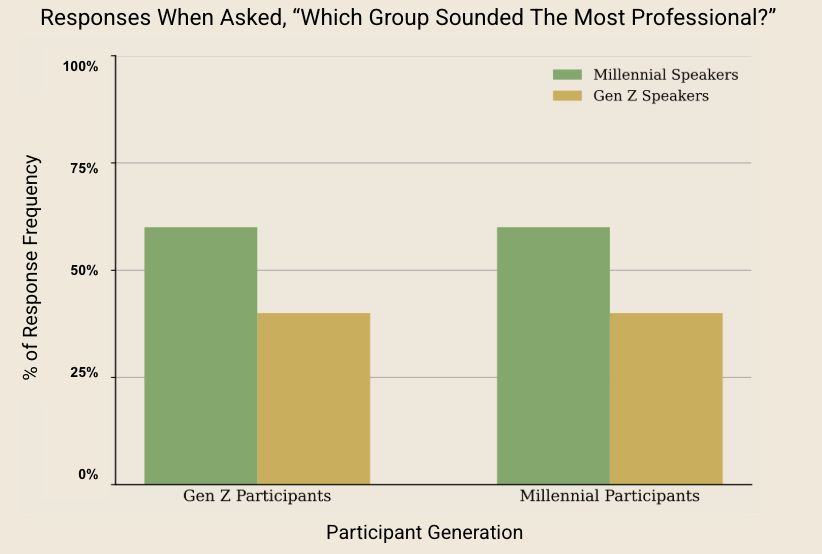
When asked which group was the most professional, 60% of Gen Z participants and 60% of Millennial participants identified a Millennial pair, as demonstrated in Figure 2. Across both generations, Millennial speech was more frequently associated with professionalism, even when conversations were considered informal. This demonstrates that, regardless of content, Millennial speech behavior is more likely to be perceived as professional than Gen Z in the context of our experiment.
Figure 2: Responses When Asked, “Which Group Sounded The Most Professional?”
Discussion and conclusions
Our original hypothesis, that participants would evaluate speech associated with their own generation more positively, was ultimately disproven by our results. Gen Z participants typically described Millennial speakers as more professional, especially when the speech involved minimal slang. Similar to Millennial participants, Gen Z participants often characterized the usage of slang and filler words as signals of unintelligence. Our prediction that Gen Z participants would perceive Millennial participants as less trustworthy was also disproven, as participants from both generations often determined that more professionally perceived individuals were trustworthy, suggesting that professionalism may enhance perceptions of trust rather than diminish them.
Both generational groups frequently misidentified speakers’ ages, providing interesting context and suggesting that perceived age is not a leading factor in judgment, and rather, assumptions are made from lexical features alone.
We additionally recognize that our study possessed limitations, some of which came to light through the results. For instance, we intended to assess perceptions of others based solely on speech, but some participants expressed that conversation content and topic contributed to their opinion of the speakers. While we did take this into account when selecting conversations, even eliminating some contenders for fear that the topic would affect perception, finding conversations for the study turned out to be much more difficult than we anticipated.
Despite this, our study suggests that lexical features, which can be tied to generational speech styles, influence how people judge others, even when listeners can’t see the speaker. The commonalities between both participant groups’ judgments of the speakers, as well as the frequent misjudgments of speakers’ generational identities, perhaps suggest that individual lexical choices, rather than perceived generational identity, drive character assumptions. For Gen Z participants, particularly, intragenerational connection does not eliminate judgment of intelligence and professionalism based on informal speech behavior. Considering this, it is important to be mindful of lexical and tonal choices when speaking in professional settings or simply making first impressions, regardless of the perceived age of your conversation partner. What you say says more about you than you may think.
Bibliography
Anything Goes With Emma Chamberlain. (2025, January 22). The Reality of Being a Gymnast, a Talk with Nia Dennis. [Video]. Youtube. www.youtube.com/watch?v=OBQSnRKsLhQ.
Call Her Daddy. (2026, January 23). Anna Kendrick: Pitch Perfect, Twilight & Relationships (Full Episode) [Video]. YouTube. www.youtube.com/watch?v=WwzJHLPkF6o.
Babich, M. (Creator). (2025, June 3). Welcome to New York (Season 1, Episode 1) [TV series episode]. In Next Gen NYC. 9th Degree Productions. Bravo.
Coelen, C (Creator). (2025, February 14). I Have a Husband (Season 8, Episode 1) [TV series episode]. In Love Is Blind. Kinetic Content. Netflix.
Juli, A., Suci, M., & Esti, A. (2024). Comparison of slang in millennials and Gen Z: A semantic analysis in the context of linguistic learning. Semantik: Jurnal Riset Ilmu Pendidikan, Bahasa dan Budaya, 2(3), 206–215. https://doi.org/10.61132/semantik.v2i3.792
[/expander_maker]