Leela Babakhyi, Tess Brimmer, Ruby Jantzen
Imagine walking through Los Angeles and seeing graffiti covering the walls of buildings, tunnels, and storefronts. Some people see vandalism, while others see vibrant and cool public art. But what if graffiti is something more? What if it were a form of language that communicates identity, belonging, and even cultural history? This blog explores how graffiti functions as a linguistic practice in Los Angeles. Through the comparison of graffiti in downtown Los Angeles and Venice, as well as an interview with an active graffiti artist, the project examines how graffiti actually communicates meaning through things like tags, lettering, styles, and location. The findings suggest that graffiti operates as a learning system of communication that signals local identity and community belonging. However, the legitimacy of graffiti varies depending on neighborhood contacts. Sanctioned murals in Venice are often valued more than unsanctioned tagging practices in downtown. These patterns show how public space regulates whose voices are considered legitimate and whose forms of expression are dismissed.
Key Words: Graffiti, Los Angeles, communication, urban, public art, culture
[expander_maker id=”1″ more=”Read more” less=”Read less”]
Who Gets to Speak on the Walls of Los Angeles?
If you don’t know how to read graffiti, it can all look the same, like layers of overlapping tags, stylized letters, and symbols that seem chaotic or illegible. But for those inside the culture, these markings are anything but random. They are readable, recognizable, and meaningful. In linguistic anthropology, public space is often understood as a “linguistic landscape,” where language appears in forms like graffiti. Still, most conversations about graffiti focus on whether it is art or vandalism, leaving a gap in how we understand it as a system of communication. This blog builds on that gap by exploring graffiti in Los Angeles as a form of visual language. By comparing Venice and Downtown LA and drawing on an interview with an active graffiti writer, we argue that graffiti communicates identity and belonging and that its meaning shifts depending on neighborhood context and control over public space.
How Did We Do It?
We built our project using several methods so that we were not relying on only one kind of evidence. A large part of our research came from a 30-minute interview with an active graffiti writer, which one group member conducted as part of the project. That interview gave us a strong starting point for thinking about graffiti from the perspective of someone with direct knowledge of how it is made, read, and understood. We also included a walking interview through Downtown Los Angeles so that the conversation could continue alongside actual examples in the neighborhood. During that walk, the interviewee pointed out details that would have been difficult for outsiders to notice on their own, including how certain pieces were made, what kinds of styles were recognizable, and how many people may have been involved in creating particular works. Using both a formal interview and a more informal walking conversation allowed us to gather information in different settings and build a fuller picture of how graffiti is understood on the ground.
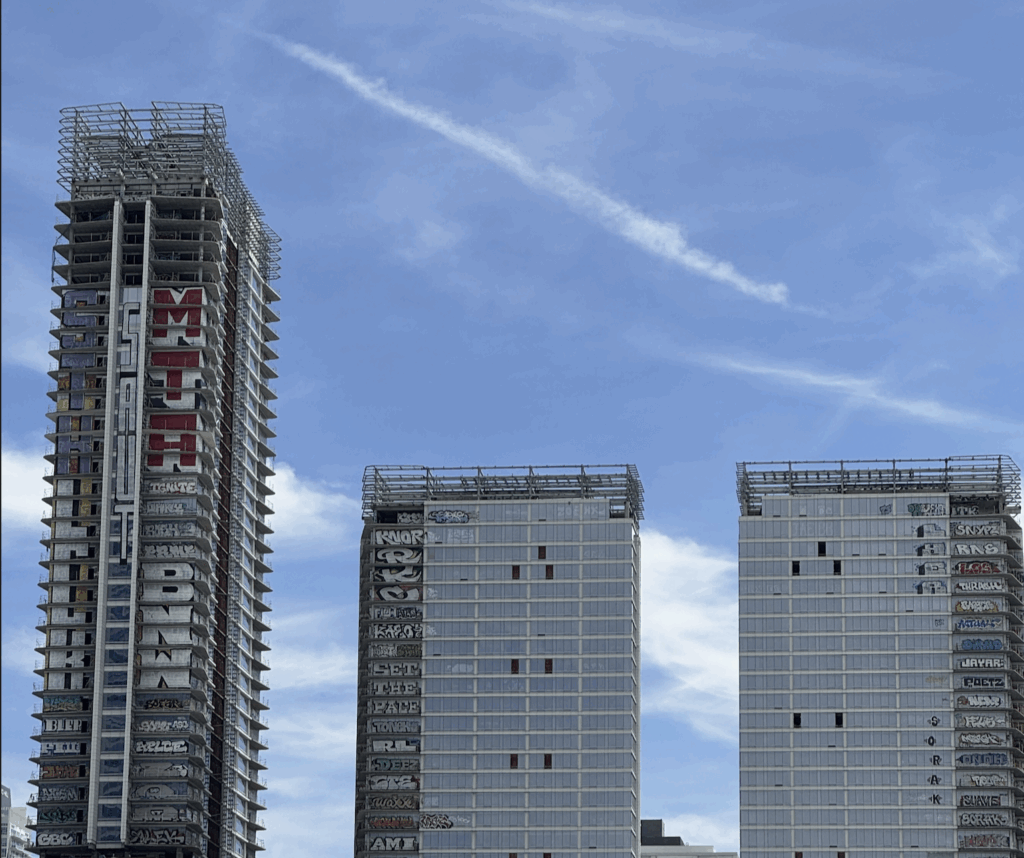
Figure 1 – Downtown LA graffiti towers
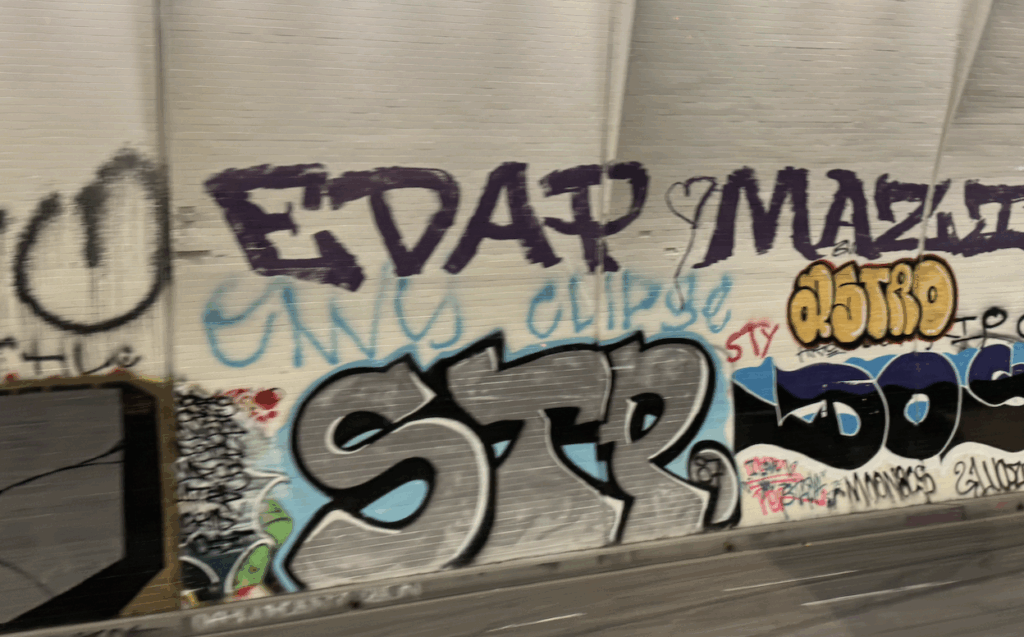
Figure 2 – Second Street Tunnel Downtown LA
Alongside the interview, we carried out a comparative analysis of graffiti and mural practices in Downtown LA and Venice. We collected photographs from both neighborhoods and paid attention to repeated features such as tags, typography, abbreviations, symbols, placement, and the layering of different markings over time. We also turned to our academic sources throughout the project, as it was not based on observation alone. These sources helped us think about graffiti as a literacy practice, a linguistic landscape, and a social form that takes on different meanings depending on where it appears.
What Did We See?
Our findings suggest that graffiti operates as a learned communicative system that requires cultural knowledge to interpret. For example, we learned from our interview that graffiti literacy develops over time. The artist explained: “When I first started, I couldn’t read anything. Once you learn how to paint and read tags, it becomes easier to read other graffiti… It’s practice and understanding different styles.” This proved just how non-random graffiti is. We learned that it is a specialized writing system that insiders can actually recognize and interpret. We also learned that graffiti functions as a way to mark presence and social networks. The artist describes how writers recognize each other’s tags across cities, saying, “You’ll see something and be like, ‘Oh, so-and-so’s in the city right now,’ because you know the tag.” This ultimately proved to us how graffiti indexes identity and belonging and signals who is part of the local community and who is visiting from elsewhere. One of the most important and insightful observations we made was how institutional approval shapes the way graffiti is perceived.
In areas like Venice, there are large murals that are commissioned by the city and celebrated as public art. However, tagging styles seen in downtown areas are very often viewed negatively. The artist explained this in a great way by saying, “They think there’s good graffiti and bad graffiti. I’ve asked random people what they think of something, and they’ll say it looks bad or messy, but then they’ll like some mural in Venice, which was commissioned.” This distinction shows just how important public attitudes are with graffiti and how they aren’t just based on aesthetics but also on whether the work had institutional approval. Expanding on that, we learned the ways graffiti reflects broader changes in different neighborhoods. The artist touched on how the disappearance of graffiti can signal a sort of shift in urban culture. “Neighbors that are getting gentrified, you see messages in LA all the time from people from that area, putting something political out there, like “f*ck ICE. Graffiti goes with the times that it’s in, history, whatever is going on in the world, and the neighborhood is changing. If there’s less graffiti in a neighborhood, I don’t think that necessarily makes it safer. I think it just means things are getting more corporate.” This allowed us some insight into how graffiti is, in many ways, an indicator of cultural presence and how removal of it leads to gentrification or increased regulation of public space.
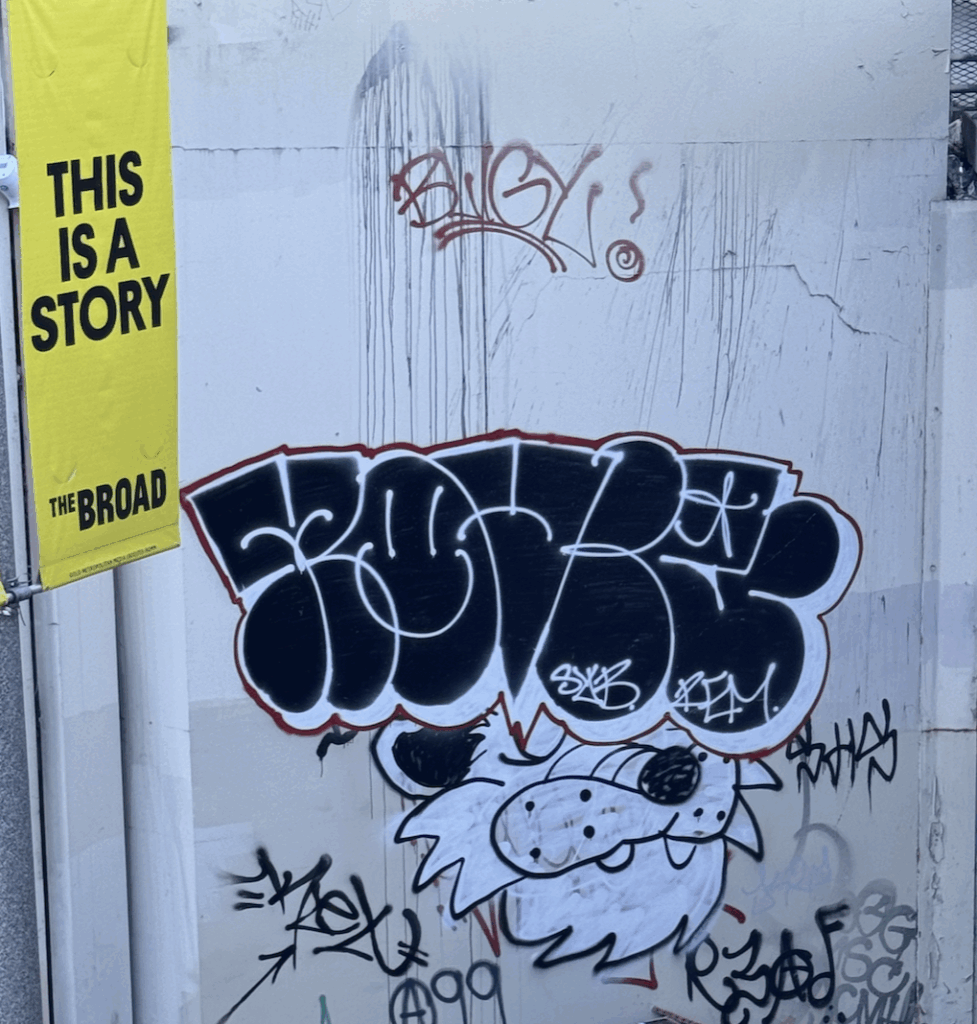
Figure 3 — Freeway Overpass Graffiti DTLA
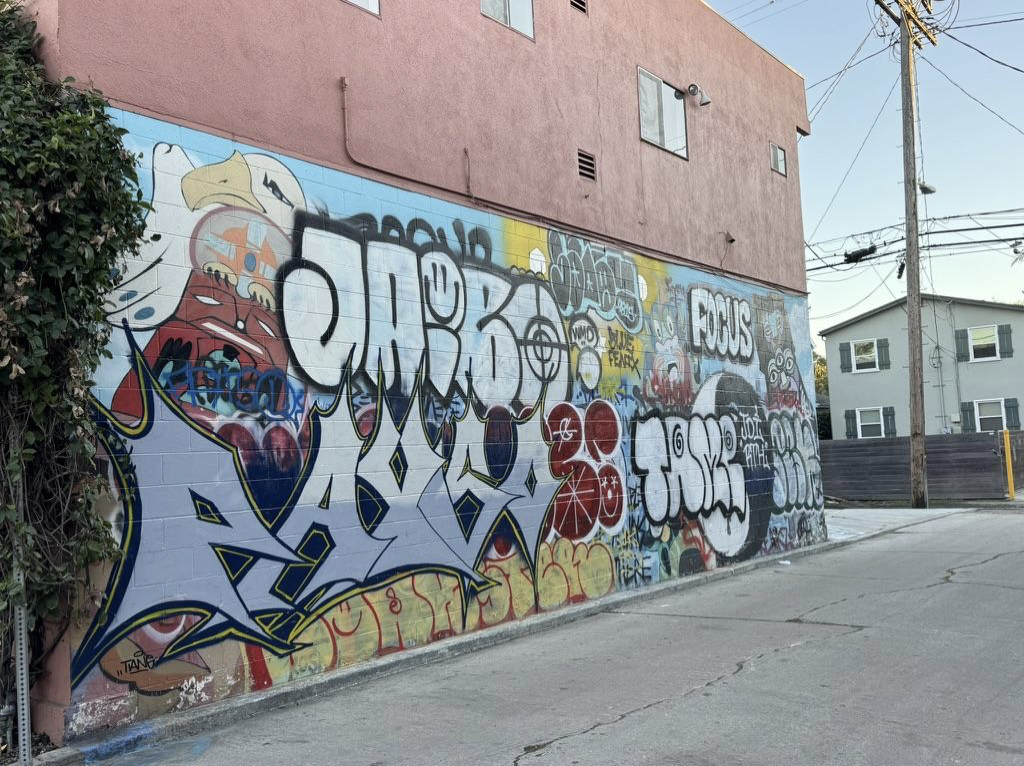
Figure 4 — Abbot Kinney Street Mural
So, What Do the Walls of Los Angeles Really Say?
Our findings suggest that graffiti in Los Angeles is much more than just paint on the walls, rather, it’s a localized linguistic system that communicates identity and signals community belonging. We’ve seen that graffiti works as a visual language shared among insiders, where meaning is learned over time, much like a language. Through features like tags and lettering styles, this visual language indexes identity, allowing artists to express individuality and recognize presence within a space. By comparing Venice and Downtown LA, we’ve seen that what changes across neighborhoods is not whether graffiti communicates, but how that communication is interpreted and valued. In Venice, murals are often recognized as legitimate art, while in Downtown LA, tagging is more likely to be erased or dismissed. This contrast highlights how institutional control over public space shapes which forms of expression are accepted and which are marginalized. What this points to more broadly is that language in public space isn’t just about what is written, but about who is allowed to be seen and heard. In this way, graffiti reminds us that public space isn’t neutral – it’s shaped by who gets to leave a mark and whose voices are erased, pushing us to rethink what counts as language in the city.
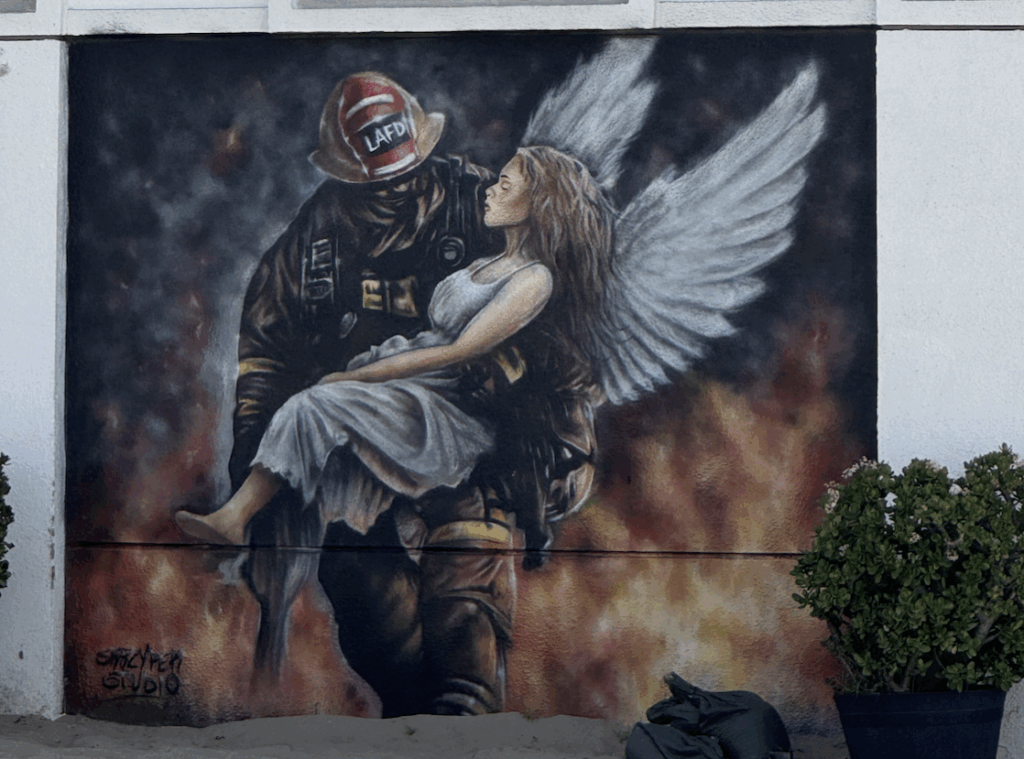
Figure 5 — Venice Beach Firefighter Mural
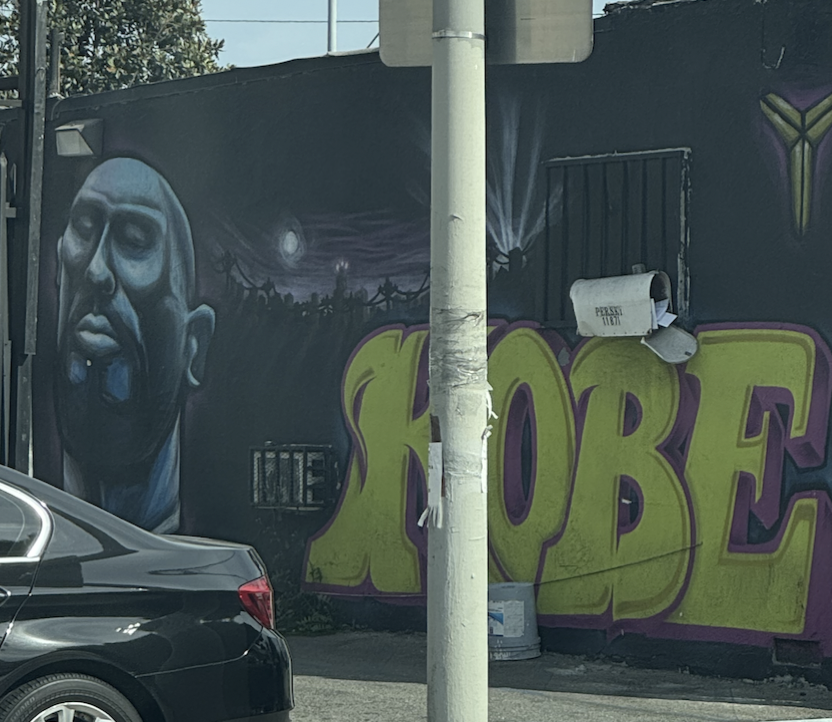
Figure 6 — South Central LA Kobe Mural
References
Aguilar, J. A. (2000). Chicano Street Signs: Graffiti as Public Literacy Practice. https://files.eric.ed.gov/fulltext/ED441891.pdf
Bloch, S. (2012). The illegal face of wall space: Graffiti-murals on the Sunset Boulevard retaining walls. Radical History Review, 2012(113), 111-126. https://www.researchgate.net/publication/279413323_The_Illegal_Face_of_Wall_Space_Graffiti-Murals_on_the_Sunset_Boulevard_Retaining_Walls.
Gasparyan, G. (2020). Graffiti as a Linguistic Phenomenon: Different Theoretical Approaches. Foreign Languages in Higher Education, 24(1), 39–51. https://doi.org/10.46991/FLHE/2020.24.1.039
Latorre, G. (2008). Graffiti and murals: Urban culture and indigenist glyphs. In Walls of empowerment: Chicana/o indigenist murals of California (pp. 100–139). University of Texas Press.
Montenegro, A. (2025). Muralism, Graffiti, and Gentrification in Los Angeles: Nuances of a Radical Imagination. Visual Arts Research 51(1), 78-91. https://muse.jhu.edu/article/960237.
Valladares, M., & Rodriguez, J. (2024, February 21). Uncovering the history and impact of graffiti writing in Los Angeles. LAist. https://laist.com/news/arts-and-entertainment/la-graffiti-writing-art-politics.
[/expander_maker]