Brooke Abess, Ria Bagga, Jin Kwak, Jennifer Montes, Michelle Parada
In multilingual communities, language choice reflects the dynamic relationship between power and belonging. This can be seen in Spanish-speaking communities in Los Angeles, where everyday speech becomes a site for reinforcing and negotiating social hierarchies. This study analyzes how power relations and cultural norms shape language use, specifically focusing on code-switching between Spanish and English across public and private settings. Using a mixed-methods approach of surveys, participant observation, and informal interviews, we examined how speakers navigate linguistic expectations in different settings and what factors contribute to this shift. Our findings show that while Spanish is a central part of home and social settings, English dominates institutional spaces such as work and schools reflecting a broader structure of authority. While most of the participants generally viewed mixed speech positively, there was stigma present in the answers of others, especially around ideas of what is considered, “proper” Spanish. These results suggest that language practices are not solely shaped by external institutional pressures but also by internal community norms.
Key Words: Spanish, multilingual, power dynamics, Los Angeles, community
[expander_maker id=”1″ more=”Read more” less=”Read less”]
Introduction & Background
Language is a powerful tool of communication that is constantly negotiating between
power, identity, social norms, and belonging. Not only does the world around us shape how we
communicate, but so do our personal identities and the communities we belong to. Because of
this, our everyday language practices and uses signal the broader social hierarchies and cultural
norms to which we adhere. To better understand this phenomenon, we wanted to look at a
multilingual community that practices language maintenance and code-switching, in the hopes of
finding patterns between language use and social hierarchies. We decided to focus on the
Spanish-speaking community of Los Angeles, where the language has deep historical roots; in
fact Los Angeles County has the largest Spanish-speaking population in the United States (Los
Angeles Almanac, n.d.). Prior research on Spanish language maintenance and shifts in the United
States shows generational patterns where first-generation immigrants tend to maintain the use of
Spanish, while second-generation speakers increasingly shift towards the use of English. This is
especially true for public and professional spaces (Michnowicz et al., 2023).
In this study we hope to answer this question by studying code-switching between
English and Spanish in public and private spaces. Code-switching is not treated here as random
mixing of languages, but as a socially meaningful practice that reflects audience, context,
institutional expectations, and perceived legitimacy. We also consider how heritage and
Indigenous languages are maintained, marginalized, or erased within Spanish-speaking
communities. Drawing on a raciolinguistic perspective (Phuong, 2024), we look at language and
race as co-constructed through dominant listening practices and institutional norms. Going in, we
hypothesize that in communities where multilingualism is actively accepted and supported,
speakers are more likely to maintain and use Spanish and other heritage languages instead of
defaulting to English. This connects to the ways in which social hierarchies are either reinforced
or challenged, which is the central focus behind our research question: How do power relations
and cultural norms shape multilingual practices and contribute to Spanish language maintenance
or shift among Spanish-speaking communities in Los Angeles? Our findings suggest that these
dynamics operate not only through institutional preference for English, but also through internal
community expectations about what forms of Spanish or mixed speech are considered legitimate
Methods
To gather data, we used a mixed-methods approach including surveys, participant
observation, and informal interviews. Our surveys were developed to measure comfort speaking
English and Spanish across different contexts, sources of linguistic pressure, and language
modification through likert-scale questions, multiple-choice responses, and open-ended prompts
to gather both quantitative and qualitative data. For the Spanglish-focused survey, conceptually
related Likert-scale items were also combined into a simple index to capture overall attitudes
toward the legitimacy of Spanglish. Participant observation was conducted through informal
conversations within family and community contexts, paying close attention to code-switching
patterns and language or accent modification and shifts. Semi-structured interviews also allowed
participants to describe moments when they changed their language use due to perceived power
dynamics, safety concerns, or social expectations. This combination of methods allowed us to
analyze multilingual practices from multiple angles, providing data on larger patterns and
backing it up with our observations and inquiries
Results & Data Analysis
After our data collection, we cross-analyzed results from each part of our research. Our
survey responses provide us with overarching patterns on a quantitative level, while our
observations and interviews back up our findings and may help to make sense of these patterns.
Most notably, we observed patterns of Spanish being the primary language used in home and
family spaces, whereas English was predominantly used in school, work, and government
settings (Figure 1). This supports the notion that setting and institutional authority influences
language use and can either support or hinder the use of a non-English language.
Figure 1 – Language Use by Context
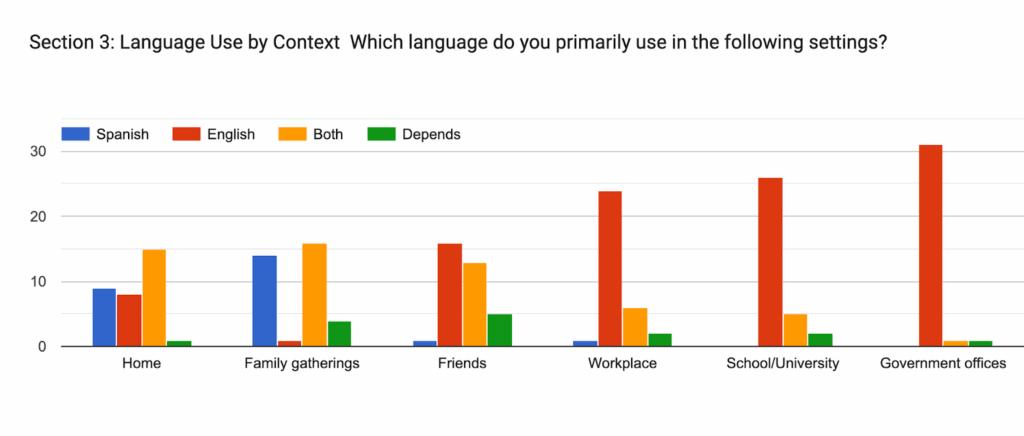
Note. Results collected from a checkbox matrix in the study’s survey.
Another notable aspect of our results was the data on Spanish proficiency and judgement
around language use. As shown in Figure 2, survey participants generally rated their Spanish
speaking and listening proficiency higher than their Spanish reading and writing proficiency.
Along with our data on Spanish being used frequently in private settings, these trends suggest
that Spanish is typically learned more through practice than formal education. Furthermore,
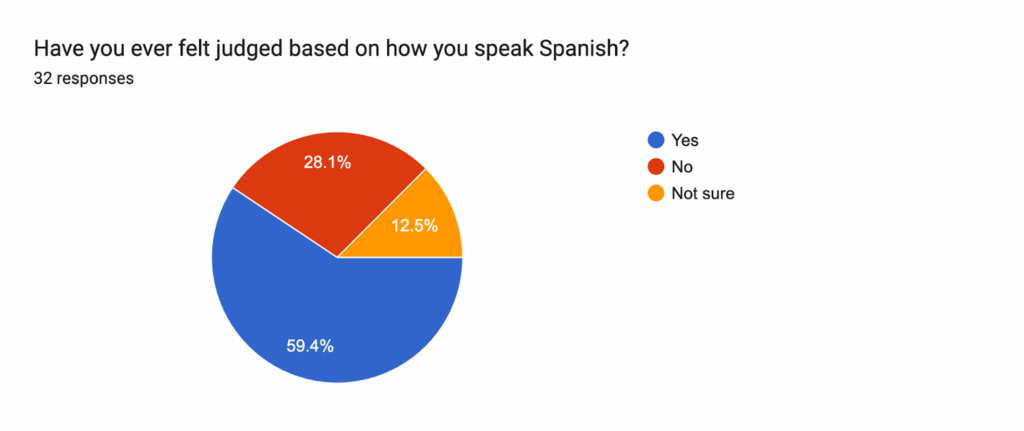
Figures 3 and 4 show that people have tended to feel more judged for their Spanish use, perhaps
due to a lack of comfort with Spanish proficiency.
Figure 2 – Language Proficiency
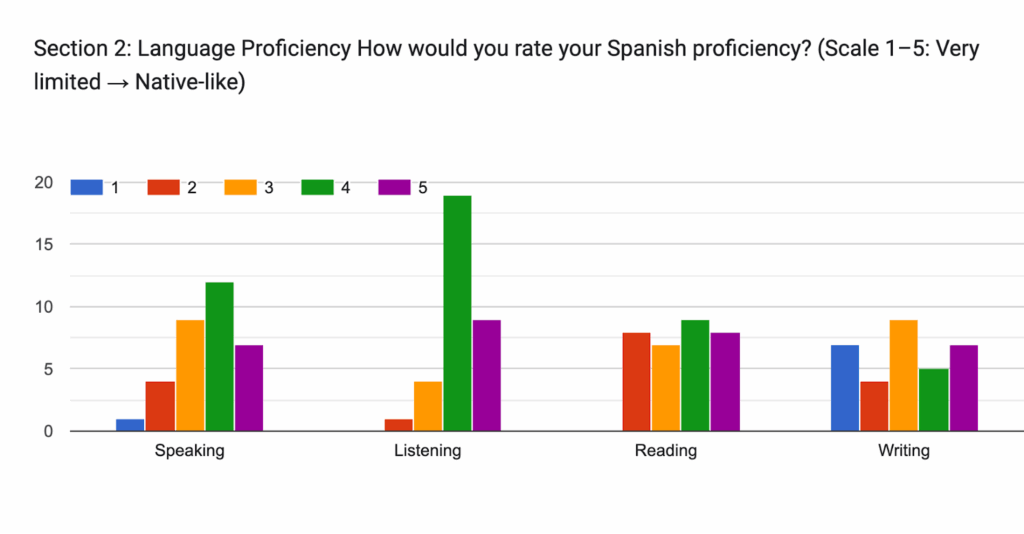
Figure 3 – Accent & Perception: English
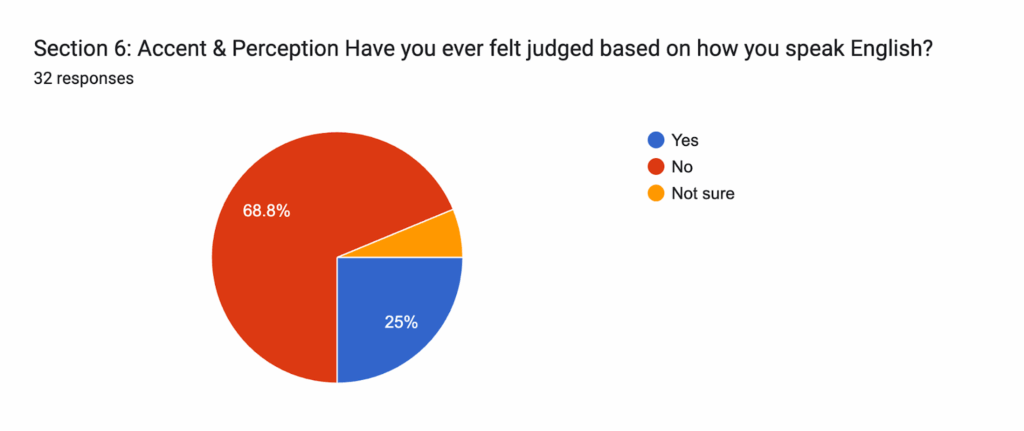
Figure 4 – Accent & Perception: Spanish
Along similar lines, we looked a bit further into the use of Spanglish, a linguistic hybrid of Spanish and English together. Survey responses suggest that Spanglish is widely understood as an important linguistic resource, although respondents remain cautious about its use in professional settings (Figure 5). Once again, this demonstrates the difference in linguistic approaches to “professional” settings and official situations, which introduce society’s hierarchical pressures.
Figure 5 – Spanglish
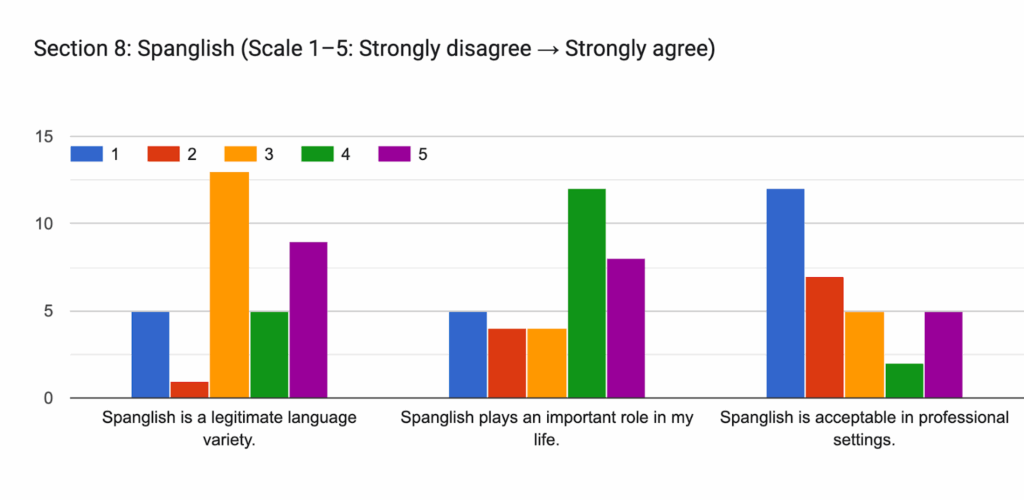
Survey responses suggest that many participants view Spanglish as meaningful in everyday communication, particularly for identity, emotional expression, and belonging, even while remaining cautious about its use in professional settings. The initial survey responses showed strong but context-dependent attitudes toward Spanglish; we developed a second survey to examine how speakers assess its legitimacy, usefulness, and social perception.
To move beyond individual survey responses, we created two simple indices using Likert-scale items. The first, a Spanglish Legitimacy Index, combined five questions measuring whether respondents viewed mixed speech as culturally meaningful, socially useful, legitimate, emotionally expressive, and connected to belonging. Each response was coded on a scale of 1 to 5, with higher scores indicating more positive attitudes toward Spanglish. The average score across responses was 3.66 out of 5, suggesting that respondents generally viewed Spanglish positively.
Figure 6 – Spanglish – Data A
| Legitimacy Component | Mean |
| Cultural Identity | 4.00 |
| Social usefulness | 3.57 |
| Legitimacy | 3.64 |
| Emotional Expression | 3.57 |
| Belonging | 3.50 |
| Overall Index | 3.66 |
Note. Means calculated from five Likert-scale survey items (1 = strongly disagree, 5 = strongly
agree). Higher scores indicate more positive attitudes toward Spanglish. For interpretation,
mean scores closer to 1 indicate low agreement, scores near 3 indicate mixed or neutral
attitudes, and scores closer to 5 indicate strong agreement. Following this scale, values above
roughly 3.5 suggest generally positive attitudes, while values between 2 and 3.4 indicate more
moderate or mixed responses.
The strongest agreement appeared in the area of cultural identity, suggesting that
respondents understand Spanglish less as random linguistic mixing and more as a meaningful
marker of lived bilingual experience. Slightly lower scores in belonging and usefulness suggest
that while respondents generally value Spanglish, its acceptance remains shaped by context,
especially where social expectations or institutional norms influence language choice.
To examine whether this positive valuation coexists with linguistic pressure, we also
created a second index focused on stigma and normative expectations surrounding language use.
This Spanglish Stigma Index combined items measuring whether speaking Spanglish can make
someone seem less educated, whether proper Spanish is seen as important within the community,
and whether respondents had experienced criticism from Spanish speakers
Figure 7 – Spanglish – Data B
| Stigma Component | Mean |
| Speaking Spanglish can seem less educated | 2.86 |
| Proper Spanish matters in the community | 3.29 |
| Criticism from Spanish speakers | 2.00 |
| Overall Stigma Index | 2.72 |
The overall stigma score of 2.72 falls within the moderate range, suggesting that although
strong stigma was not dominant across responses, respondents still reported noticeable pressure
around language correction and ideas of proper Spanish. In particular, the relatively higher score
for “proper Spanish matters” indicates that ideas of linguistic legitimacy continue to circulate
within the community itself, not only through outside institutions. Taken together, these two
indices show that positive identification with Spanglish coexists with lingering expectations
about when and how mixed speech is socially acceptable.
Discussion & Conclusion
The findings of our study show notable patterns and correlations that support our hypothesis. Overall, we found evidence that English indexes professionality, as it is the preferred language used in more institutional and professional settings. This shows how power hierarchies, particularly those in the United States that show preference to English speakers, maintain influence and control over which language is deemed socially acceptable to use in particular settings. Although English is the official language of the US, and therefore Los Angeles, this evidence still suggests that there is a general lack of support and acceptance of multilingualism.
In the context of our collected data (Fig. 1-4) and associated research, we suggest that a lack of institutional support for multilingualism and the Spanish language denies speakers opportunities to build proficiency, leading them to learn informally in private spaces, often through family and friends. This is perhaps the reason that many speakers feel more judged for their Spanish speaking abilities than English (Fig. 3-4), as they have not been formally taught Spanish as they were with English in school.
At the same time, the Spanglish survey shows that legitimacy is not absolute. Although respondents scored positively overall on the Spanglish Legitimacy Index (3.66), the Spanglish Stigma Index (2.72) indicates that moderate pressure on language norms remains. This suggests that language legitimacy operates unevenly: speakers may personally value Spanglish while still recognizing that certain forms of mixed speech can be judged negatively, especially in contexts where professionalism, education, or ideas of proper Spanish are emphasized. The relatively higher stigma score around “proper Spanish matters” further suggests that these pressures do not come only from institutions, but also circulate within the community itself. In this way,
Spanglish does not simply resist power structures; it also reveals how speakers continuously negotiate them in everyday interaction.
Nevertheless, Spanish remains a very important part of people’s lives, as it can be used as a tool to strengthen family ties, friendships, and community membership. Language use now develops in the context of these multicultural communities, which is where Spanglish enters the discussion as a tool to fuse together identity and perspectives while also reflecting one’s identity and multicultural group membership.
References
Phuong, J., Cioè-Peña, M., & Chinchilla, A. (2024). Raciolinguistics. Oxford Research Encyclopedia of Linguistics. Oxford University Press. https://doi.org/10.1093/acrefore/9780199384655.013.1001
Michnowicz, J., Trawick, S., & Ronquest, R. (2023). Spanish language maintenance and shift in a newly-forming community in the Southeastern United States: Insights from a large-class survey: Hispanic Studies Review 7(2). https://hispanicstudiesreview.cofc.edu/article/77601-spanish-language-maintenance-and-shift-in-a-newly-forming-community-in-the-southeastern-united-states-insights-from-a-large-class-survey Links to an external site.
Los Angeles Almanac.(n.d.). The Spanish language in Los Angeles County, California. https://www.laalmanac.com/population/po48s.php
Koskinen, Jeanette, and Josefine Karlsson. “Teachers as Linguistic Role Models: Language Teaching in Multilingual ECEC Settings.” Journal of Early Childhood Education Research, vol. 14, no. 2, 2025, pp. 140–68, https://doi.org/10.58955/jecer.147607.
Cenoz, J. (2013). Defining Multilingualism. Annual Review of Applied Linguistics, 33(Mar), 3–18
Appendix
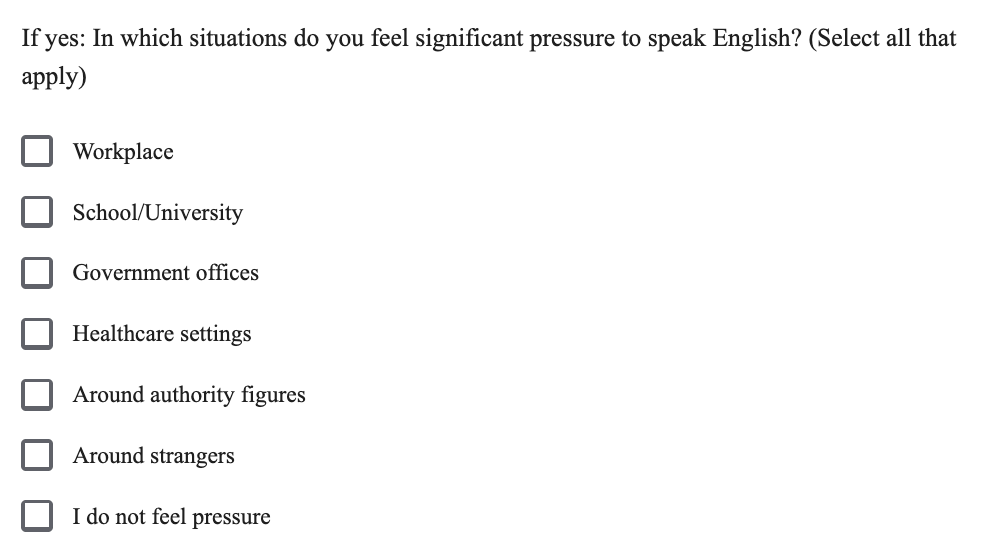
| Interviewer: Do you feel pressure to speak English in certain public spaces?Participant A:“Yes, especially at work. Even if everyone understands Spanish, English feels more official. Like it makes you look more educated.”Interviewer: What about at home?Participant A:“At home it’s the opposite. If I spoke only English with my parents it would feel distant.” | Observation Context: Informal family gathering. Conversation shifts fluidly between Spanish and English. Spanish is used for storytelling and emotional expression. English appears during references to work or academic topics. No visible hesitation in switching.Observation Context: Workplace interactionSpanish-speaking employees initially converse in Spanish. When a supervisor enters, conversation shifts entirely to English. The tone becomes more formal. Code-switching decreases. |
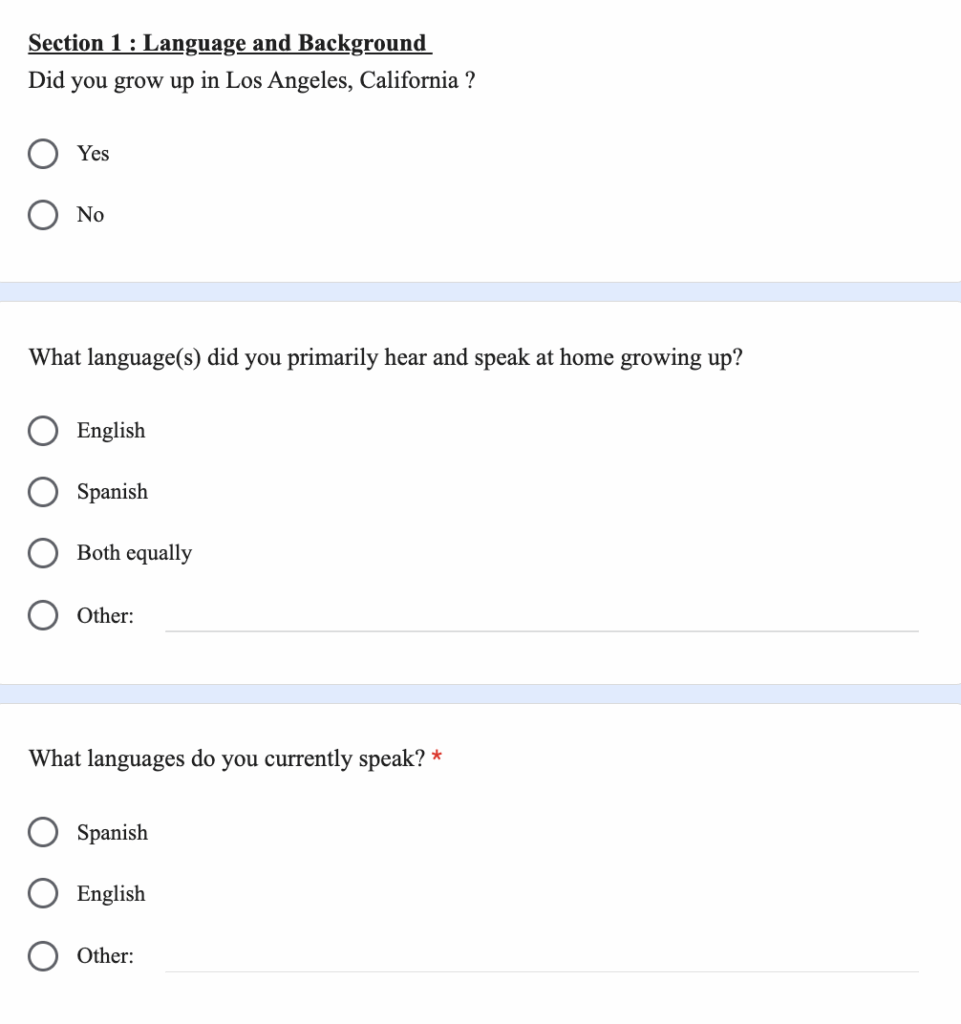
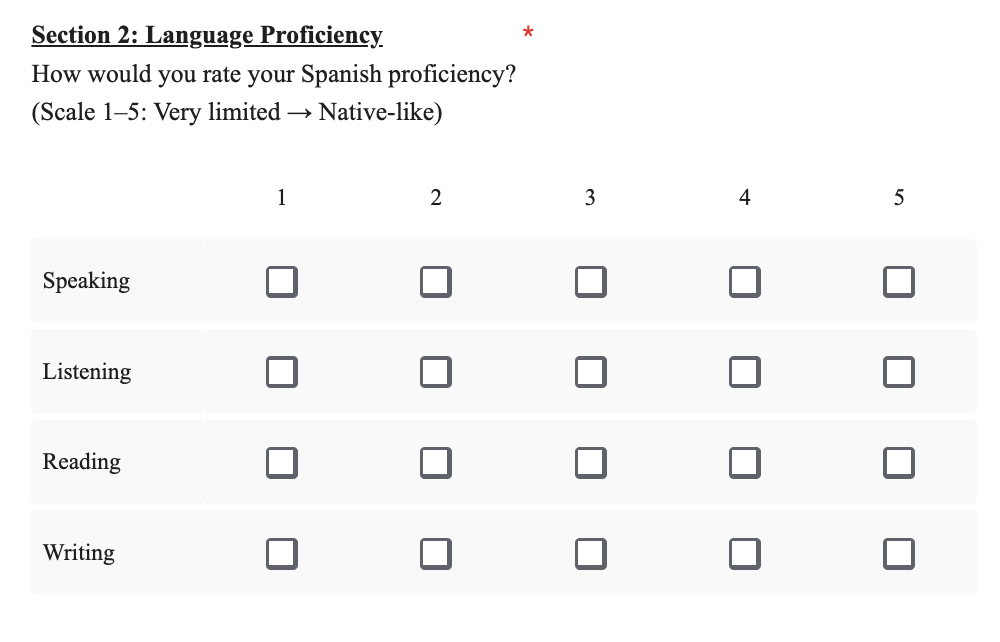
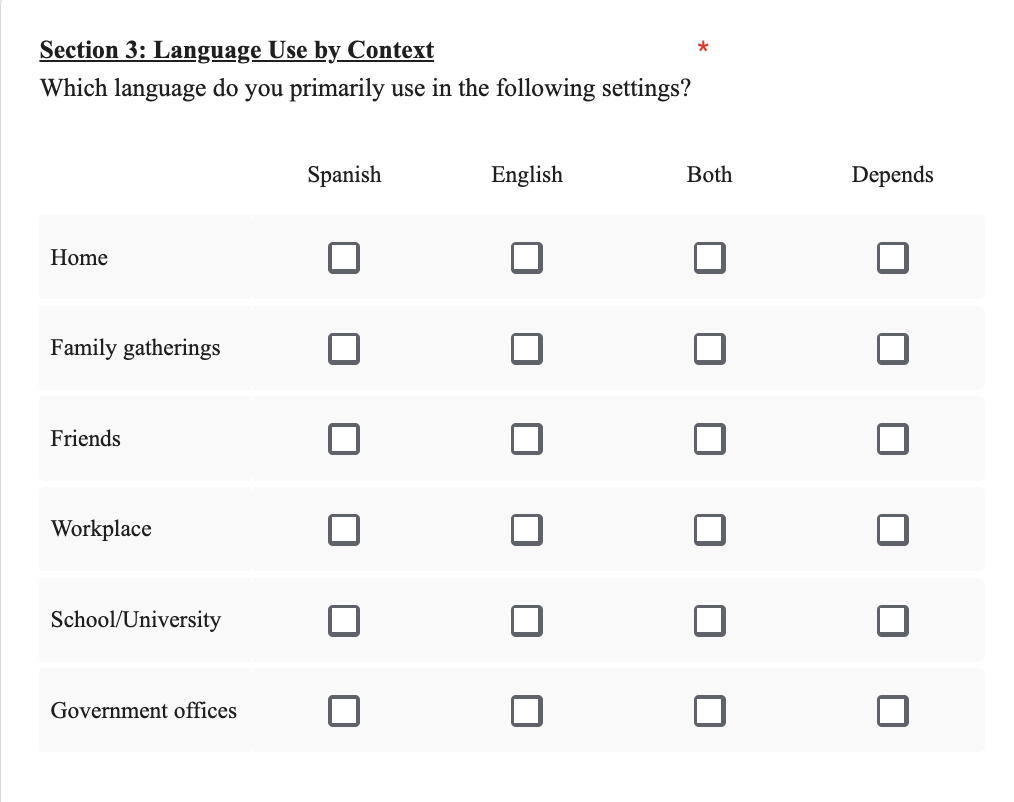
Sample Survey Questions
[/expander_maker]