The Generational Effects on Code-switching in Conversation Content and Word Choice
Isabelle Sandbank, Leonardo Diaz-Garcia, Huiyu Liu, Taehwan Kim
This study investigates the variations in code-switching behaviors between undergraduate students and faculty members at UCLA, with an emphasis on the generational impacts on word choice and conversation content. It utilizes a mixed-methods approach that incorporates surveys and text analysis, and it reveals that while both professors and students code-switch, there are clear disparities in their patterns of when they do it. In particular, younger students regularly code-switch with abbreviated phrases or words, whereas senior faculty members and professors typically tend to use formal language. Additionally, it also reveals that the word and phrase choices used while code-switching differ between generations, with younger students selecting more colloquial language when talking about day-to-day affairs and older faculty members favoring more modern language use and more serious topics. These results have significant repercussions for comprehending how generational disparities influence language practices and social identities.
Introduction
UCLA is known for being a very multicultural and diverse university, according to the school’s website. Through its population, it represents 118 countries and is home to over 5,000 international students (UCLA Facts & Figures, 2023). Within this body are multilingual students, professors, and faculty, some of which have the ability to switch between two languages, or varieties, at once, also known as code-switching (CS) (Washington-Harmon, 2022). Code-switching, a widely used technique, enables multilingual speakers to jump between languages without losing the syntax or structure of the prior language. People often code-switch from one language, such as English, to another, like their home language, in order to identify with a specific social group or convey specific information. Through the categorization of code-switched words in text messages, we were able to distinguish linguistic variations in word choice between bilingual UCLA undergraduates and the older professors and faculty members of the university to show that age affects the content of CS.
Background
Code-switching (CS) is a common phenomenon in multilingual communities (Bhatti, 2018). It is often a useful communicative tactic for bilingual communities as they believe code-switching helps them express what they want to communicate more clearly, directly, and efficiently (Bahous, 2013). It’s interesting to see that many who code-switch do not realize it- most students who speak in a bilingual environment do not realize that they are infusing English terminology when using a non-English language, and it seems that audience, context, identity and the effectiveness of information transmission will make multilingual people code-switch (Sichyova, 2005). This isn’t from unawareness due to a young age, as a recent study shows that even teachers do not realize that they code-switch (Bahous, 2013). Although we are aware of code-switching among both professors and students, there is still a lack of research that examines the linguistic disparities between these two cohorts.
Changes in CS patterns are also inseparably linked to personal experience. The speaker will tend to change languages according to the conversational style of the person whom they’re talking to; they will move between obvious CS and non-obvious CS, indicating their position in the group (Ellison, 2021). According to the findings of the Ellison study, which looked at the patterns of code-switching between languages such as Hindi and English, it was found that people of different ages often have distinctive and unique methods when it comes to changing between languages.
Does this mean that students and professors differ in their word choice of code-switching as well? Although previous research has looked at code-switching situations, this is currently a new idea and one we would like to explore.
Methodology
The population includes two distinct school cohorts, comprising of undergraduate students and faculty members at UCLA, with different age groups and unique school identities. Yet, each has something in common: they are all bilinguals. The experiment was conducted by sending out surveys to the UCLA community and asking them to share conversation logs screenshots. In the survey, participants would be asked about their demographic (i.e. gender, age, and school identity), their awareness of code-switching, and the frequency of code-switching in different scenarios. Furthermore, the participants were requested to share their email addresses voluntarily to facilitate follow-up communication, enabling us to collect the screenshots of their conversation logs at the end of the survey.
We used the judgmental sampling method, which uses our knowledge to select the individuals or cases to be included in the sample based on the research question addressed. Judgmental sampling method is a method that targets a population and maximizes the benefits of the analysis (Jagero, 2011). This provided a direction for data collection for our project.
After collecting surveys and participants’ conversation logs, researchers translated, transcribed, and categorized their code-switched sentences and words before analyzing possible patterns of code-switching between our established age parties (undergraduate students and faculty/professors).
Acknowledging the potential for bias in our study prior to presenting our findings is vital. The text samples are more susceptible to bias compared to our surveys. This is because there is a possibility that certain participants may have selectively shared specific segments of their text conversation with us, and the screenshots of the conversations shared by students and teachers may only represent a subset of the entire conversation.
While we may use alternate techniques of data gathering in future research, we must emphasize that for this specific study, we must consider the chance that it may not be composed of all possible data. Privacy issues are in fact a delicate subject that cannot be ignored, but something we would’ve hoped to get around.
Results and Analysis
Our research revealed that undergraduate students had a proclivity to employ abbreviated phrases or words via code-switching more often than faculty, who were more inclined to incorporate formal language while code-switching. By comparing two sets of conversational logs between undergraduate students and faculty, we observed that the former demonstrated a higher rate of code-switching within the logs as well.
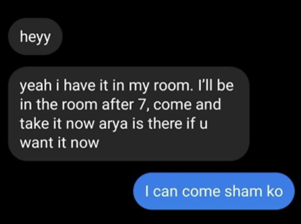
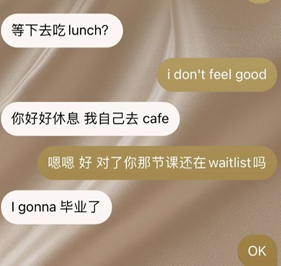
Our analysis revealed that undergraduate students were more apt to partake in code-switching during informal conversations with close friends. We observed this phenomenon primarily through the use of nouns pertaining to daily life (e.g., lunch, cafe, and waitlist, see Figure 2). Moreover, these students tended to initiate sentences with shorter verbal phrases such as “I gonna” and “I am”, while also utilizing code-switching at the conclusion of a sentence when they wished to express a particular time frame, specifically denoting in English for requests to happen “right now” or “today” (see Figure 1).
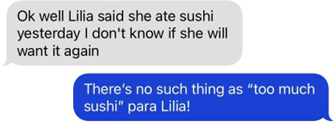
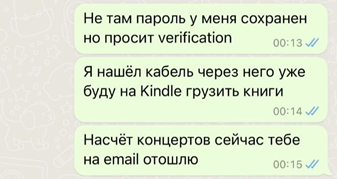
Faculty seem to talk most about modern issues such as technology or politics, but at times, even in simple conversations such as talking about what to eat for dinner, they may code-switch just to use the word “for” in their native language (see Figure 3). Prepositions were a common code-switched word in faculty conversations. Further screenshots provided by UCLA faculty revealed a preference for proper nouns and more formal terms, such as “Kindle,” “verification,” and “email” (see Figure 4). Our data demonstrated that undergraduate students code-switched more often than faculty members when communicating through text messaging, or at times, more common to professors, email.
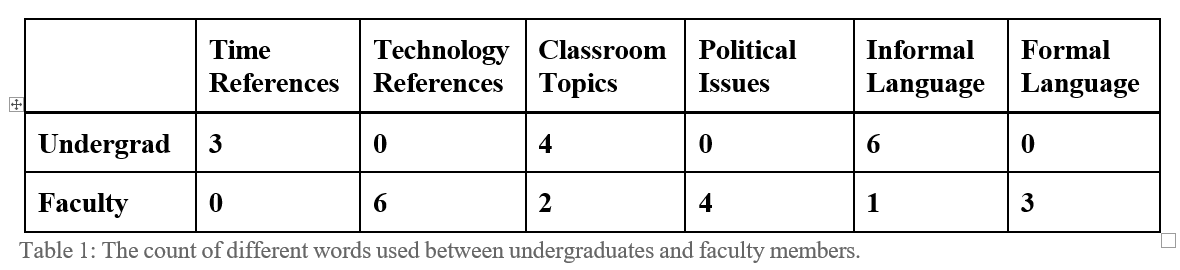
As stated so far, we’ve found code-switched words to fall into similar categories, such as prepositions, technological terms, legal jargon, or classroom topics. Table 1 categorizes the words used between undergraduates and faculty in order to more easily display the differences between both groups. The last two categories are a little vague- informal language relates to any time in which the participants shortened their words (example: “u” for “you”). Formal language relates to any time in which participants used words often meant to be polite (example: Mr. or Mrs.).
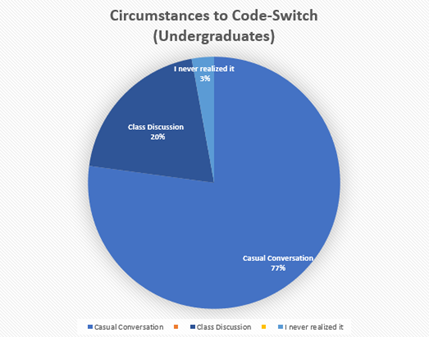
In our survey, we asked both parties under which circumstance they code-switched in more to see if it may provide an explanation for the texting outcomes we obtained. For example, perhaps faculty talked about citizenship and taxes because they were talking to employers, and maybe undergraduates spoke about getting waitlisted and class because they were codeswitching during class discussions. Yet our survey results show that most students code-switch in casual conversation with their friends, with only 20% of undergraduates code-switching during class-related activities.
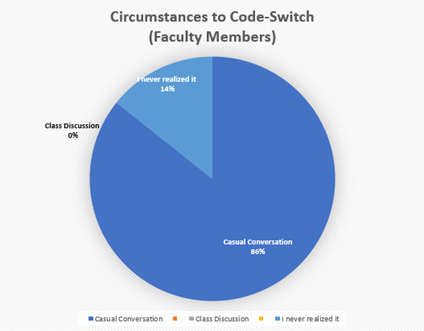
Here, our hypothesis is once again proven wrong, displaying that none of our older participants code-switched with employers but instead solely during casual conversation. There was an option to state where else they code-switch, but all other participants (except for those who couldn’t recall or stated they didn’t realize it) said that they only code-switch among friends and family during casual conversation.
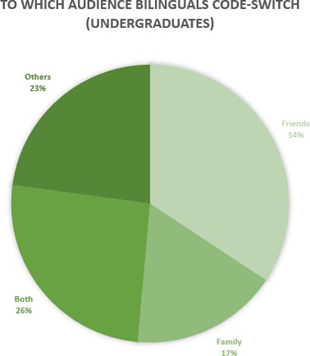
Using the same dataset, we made another distinction between undergraduate students and faculty members using one of the questionnaires from the survey: To which specific audience did you code-switch to more often? There are four variables that we chose to analyze, which are Friends, Family, Both, and others. The data of “others” include answers like, “teachers,” “people my age who look ethnically similar to me,” and “work environment.” The pie-chart above represents the data of undergraduate students. Based on the chart, we could tell how undergrads tend to CS with friends the most, followed by both friends and family (2nd), others (3rd), and family (4th). This corroborates the notion that bilingual undergraduate students are more likely to engage in code-switching during informal settings, such as chatting with friends, rather than in more intimate settings, like family discussions.
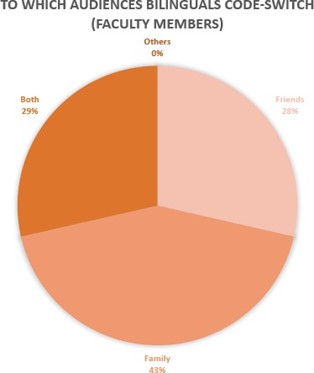
Next, this is another pie-chart that represents the data of faculty members and professors. Based on the chart, we could tell that UCLA faculty members and professors tend to CS with family members the most, followed by both (2nd), friends (2nd), and others (3rd). In contrast to the data regarding undergraduates, it is evident that faculty members tend to code-switch more frequently in personal settings, such as family conversations.
Conclusion
This research focused on the possibility of age affecting the way that bilinguals code-switch, both in content and environment. Through analysis of text messages and survey data, we were able to display some common bilingual texting patterns in UCLA undergraduates and faculty. Our research showed that bilingual people, regardless of age, do tend to transition between languages in casual conversations rather than in more formal, workplace or educational, situations. However, we saw some intriguing contrasts in the subjects that younger and older bilinguals code-switched about. It seems that when talking about less casual subjects, like political issues and business, older bilinguals are more inclined to switch languages. This could be the result of having more exposure to these kinds of interactions, while younger bilinguals may not code-switch in these certain situations because they have not yet encountered these themes as frequently. Our research also revealed that bilinguals’ code-switching behavior is influenced by the setting in which they are in. In casual situations, like conversations with friends, bilingual undergraduates tend to engage in code-switching more frequently than the faculty, who tend to reserve code-switching for more personal environments, such as with their families. The complexity of bilingualism and code-switching, as well as the ways that environment and age can affect these behaviors, are highlighted by our study. Understanding these subtleties is crucial for efficient communication and social integration in an increasingly linked society.
Although it seems as if most bilingual individuals, no matter the age, code-switch in casual conversations, older bilinguals tend to code-switch when talking about less casual topics, such as political issues and business, while younger bilinguals code-switch about daily life issues, like where to get lunch next.
References
Bahous, R. N., Nabhani, M. B., & Bacha, N. N. (2013, August 20). Code-switching in higher education in a multilingual environment: a Lebanese exploratory study. Language Awareness, 23(4), 353–368. https://doi.org/10.1080/09658416.2013.828735
Bhatti, A., Shamsudin, S., & Said, S. B. M. (2018, May 14). Code-Switching: A Useful Foreign Language Teaching Tool in EFL Classrooms. English Language Teaching, 11(6), 93. https://doi.org/10.5539/elt.v11n6p93
Ellison, T. M., & Si, A. (2021, June 28). A quantitative analysis of age-related differences in Hindi–English code-switching. International Journal of Bilingualism, 25(6), 1510–1528. https://doi.org/10.1177/13670069211028311
Jagero, N., & Odongo, E. K. (2011, March 30). Patterns and Motivations of Code Switching among Male and Female in Different Ranks and Age Groups in Nairobi Kenya. International Journal of Linguistics, 3(1). https://doi.org/10.5296/ijl.v3i1.1164
Mabule, D. R. (2015). What is this? Is It Code Switching, Code Mixing or Language Alternating? Journal of Educational and Social Research. https://doi.org/10.5901/jesr.2015.v5n1p339
Sichyova, O. N. (2005, November 22). A note on Russian-English code switching. World Englishes, 24(4), 487–494. https://doi.org/10.1111/j.0883-2919.2005.00432.x
Washington-Harmon, T. (2022, May 23). This survival tactic many BIPOC use could be harmful to their mental health. Health. Retrieved March 11, 2023, from https://www.health.com/mind-body/health-diversity-inclusion/code-switching