Profanity Amongst Undergraduate Students
Jesus Nocelotl, Fernanda Madrazo
For most people, college can be a difficult and exciting journey within one’s life. The new experience of living on your own, independence and responsibility of forming your own decisions, and for many, the chance to make and begin new meaningful friendships. Oftentimes, in communities that foster a sense of group identity and culture, such as college, and especially for young adults, the formation of friendships and relationships starts with interaction and language between individuals. Language is an essential aspect of our everyday lives, proven to be an effective way of communicating with others and a tool for forming relationships through shared experiences and identity.
The importance of social interactions in a college aged environment is of great significance, as many young adults see college as a new chapter within their life and an opportunity to form new bonds. Especially in the age of social media, college students often resort and feel the need for social and group identities to create friendships. One of the most commonly observed uses of language in college environments is the use of profanity to communicate between individuals. Profanity is commonly used in conversation as a measure to emphasize meaning, common slang, or a sense of group identity. For our group’s research project, undergraduate students and their prevalent use of expressing profanity in active conversation was used to analyze deeper meanings between language and social identity. Throughout our findings, we observed the most commonly used phrases and made relevant connections to age, group identity, and especially gender identity, to support and provide deeper meaning to the importance of language, young adult life, and college environment.
Introduction and Background
In observed profanity used in conversation, the choice and diction are influenced by the people engaging in conversation and present scenarios. For our research proposal, our group was interested in evaluating how prolific profanity is present in conversation by fellow undergraduate students at UCLA. When deciding on a target population, our group thought that fellow undergraduates would be a good target since we are more likely to relate to and understand undergraduates and their profane word usage. In addition to common relation, it is observed that college-aged students would be most likely to engage in active conversation using slang and profanity1, which would help gather more information and more culturally and generationally relevant profane words. Profane words are of special interest as they often carry more emphasis and meaning within American youth culture, and are especially observed when trying to “fit in” a certain group. Although much can be inferred on the significance of profanity to “fit in”, not much research is conducted on undergraduates’ frequency of profanity in relationship to observed gender groups. Since not much has been researched on the relationship between gender identity and profanity prevalence in college environments, our group decided to shift focus to explore this interesting topic. For our group’s initial hypothesis, we believed that through our findings, we would expect to see undergraduate males engaging in high volumes/cases of profanity within active conversation compared to their female counterparts. Our initial hypothesis was structured around gender roles and through our own shared experiences as young adult undergraduates, where males are often seen as casually expressing profanity and females are more likely to be reserved and professional in their profane word choices.
Methods
To gather information about this research topic, our group decided to conduct an online survey that would be accessible to the target population via social media. The survey was mostly focused on the topic of profanity, and asked what were the most common swear words individuals used and allowed them to elaborate on the scenario where they would be most comfortable using their selected word. Since the survey was already targeted to undergraduate students and required general information such as gender and undergraduate grade level, we included the opportunity for individuals to provide more information if they felt comfortable. Further elaboration included but was not limited to: gender identity, group membership, and race. This elaboration was important to the research project, as it allowed us to understand where profanity and relation sentiment could be applied to, such as Sororities, Fraternities, and group and social identity.
Results and Analysis
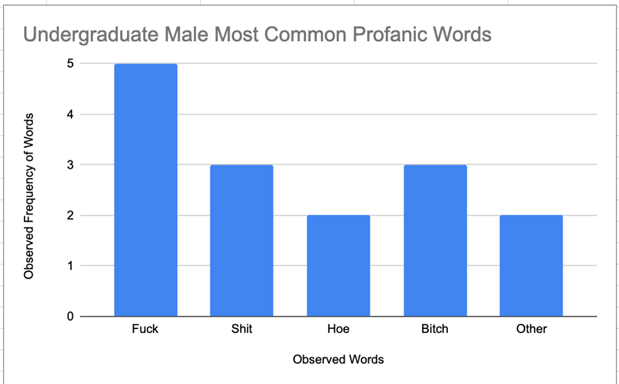
The results of our survey yielded a varied spread of words that students self-identified as their most commonly used. As indicated in Figure 1, “fuck” was the most frequently used word, but “bitch” and “hoe” were not too far behind, with 5 and 3 people identifying it, respectively. However, the most surprising aspect of the survey came in the results of the questions where students explained what each word meant to them. Male respondents most commonly ranked “fuck” as their most used word, and said they used it with friends as a catch-all to mean many different things. However, male-identifying respondents also explained that they believed that the words “bitch” and “hoe” were related to and connotated women. For example, “A female” or “a rude person, usually a woman tbh. like when my boss is being a pain, “shes such a bitch”’ were two responses given by men who completed the survey. The majority of men who completed the survey answered in similar ways, saying that the meaning they gave to these words align with the original view which centered around patriarchal and misogynistic views on gender roles.
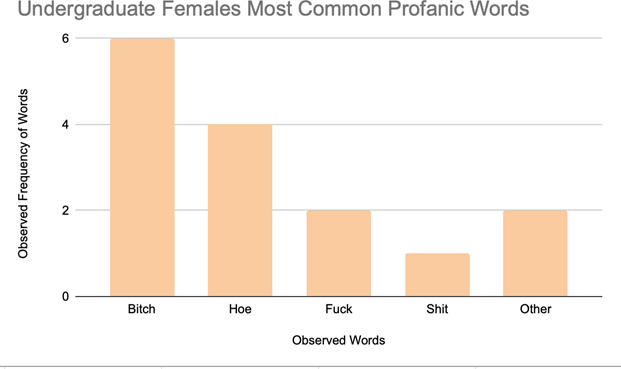
On the other hand, Figure 2 demonstrates that female-identifying respondents use the words “bitch” and “hoe” more frequently than other swear words. Overwhelmingly, the meaning ascribed to these words is positive. For example, respondents said, “just means like “girlll”, or “bitch is either a positive or a negative thing. my best friend is my bitch (positive)… i rarely use it in the negative context. it can also be a positive general exclamation of support, like if a friend does something they’re proud of or wears a nice outfit and i want to show encouragement.” Women use these words in the context of friendship, endearment, or as a way to show sisterhood. They have redefined what the words mean and reframed them in a positive way that uplifts and supports other women, instead of denigrating them as men might intend the words for.
Discussion
The results of the research we conducted were fairly surprising to us. We expected there to be a difference in usage of profanity between genders, but the questions that we asked as follow-up in the survey were very enlightening. We discussed the results in a comparison to racial slurs that have been reclaimed throughout history. Racial minorities used slurs that were originally demeaning to them, and now use them in a context that expresses solidarity, unity, respect, and understanding within their own communities. The results that we obtained from our research could point toward a similar trend in college students when it comes to words which typically denote negative attitudes toward women. The female culture in college and in young people is reclaiming the meanings of these words in a similar fashion in order to empower women and reframe traditionally gendered views. We would like to see this research continued on a much broader scale, encompassing students in different regions of the United States, and also expanding toward different age groups. Further research can be done to expand understanding on how changing gender roles can be reflected in individual meaning given to the words in common vocabularies.
References
Güvendir, E. (2015, March 16). Why are males inclined to use strong swear words more than females? an evolutionary explanation based on male intergroup aggressiveness. Language Sciences. https://www.sciencedirect.com/science/article/abs/pii/S0388000115000194
Howard University News Service, Haynes, A., NewsVision, H. U., Miles, P., Thomas, V., Steib, A., Alabi, N., Pierre, A., & Harris, T. (2010, January 31). Profanity among college students. Howard University News Service. https://hunewsservice.com/news/profanity-among-college-students/
National University of Ukraine on Physical Education and Sport, Babushko, S., Solovei, L. (2019). What Makes University Students Swear. Borys Grinchenko Kyiv University of Ukraine. https://files.eric.ed.gov/fulltext/EJ1305437.pdf
The University of Mississippi Undergraduate Research Journal, Knirnschild, J. (2019) “The Gender Differences in Perceived Obscenity of Vulgar, Profane, and Derogatory – Language Usage among U.S. University Students,” The University of Mississippi Undergraduate Research Journal: Vol 3, Article 4 /https://egrove.olemiss.edu/cgi/v iewcontent.cgiarticle=1050&context=umurjournal#:~:text=Men%20have%20been%20found%20to,with%20women%20being%20scrutinized%20more
Wong, S. C., Teh, P. L., & Cheng, C.-B. (2020). How Different Genders Use Profanity on Twitter? International Conference on Compute and Data Analysis. https://doi.org/10.1145/3388142.3388145