Spanglish – The Art of Code-Switching
Devan, Jessica Jary, Malia Salgado, Mao Mao, Valeria Carreon
In Hispanic neighborhoods, “Spanglish”— a linguistic practice that combines Spanish and English—has gained popularity as a way to communicate, even if some people do not realize that it involves code-switching. While the Chicanx and Latinx community is made up of people from a wide range of backgrounds, most of them are Spanish-English bilingual. In this research project, our group sought to investigate that when they are being interviewed, whether the Spanglish bilingual individuals would tend to code-switch, or rely heavily on one specific language while still understanding the other. We chose this research focus because we believe that studying the connection between the mixing of languages and the topic of conversation, as well as finding how often speakers code-switch, can help other Spanish-English bilingual speakers learn the semantics behind each individual code switch, thus breaking language barriers. We hypothesized that because of the participants’ daily reliance on both English and Spanish, code-switching via Spanglish would be prevalent in the interviews we conducted.
Methods
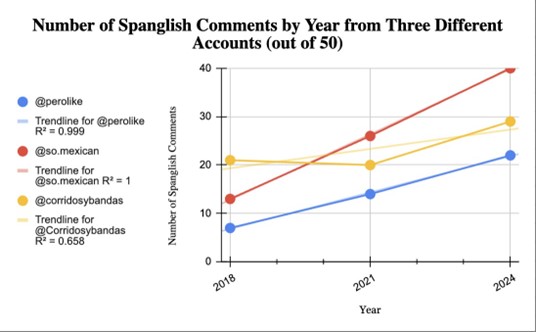
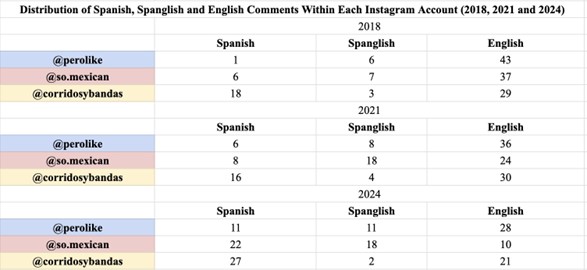
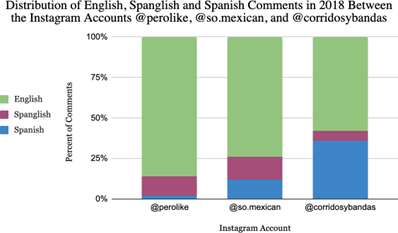
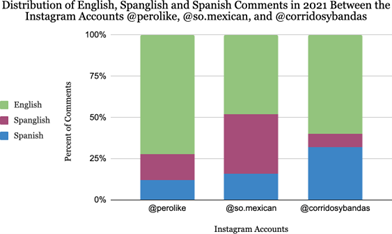
In order to test our hypothesis, we decided to interview five to ten individuals who are able to understand English and Spanish and speak both languages to varying degrees of fluency. Our interviews consisted of ten questions, five were asked in English and the other five were asked in Spanish. The participants were interviewed individually in various environments and locations, and through various methods including questionnaires, phone interviews, recorded disputes, and gossip interviews. The age range of our participants is from 18 to 55. All of them come from Mexican households and are either first or second-generation immigrants, but all described themselves as bilinguals and having spent the majority of their lives in the United States. Our younger interviewees have all lived in the United States for their entire lives and have learned Spanish from the older generations, whereas the older interviewees all immigrated to the United States in search of a better future, and they picked up English after their immigration. Nevertheless, our research is able to determine that members of this community code-switch and employ Spanish in their everyday lives, despite the fact that these participants come from very diverse origins. For the interviews that were specifically on ages 18-25, we noticed a more noticeable code-switching when answering the question. For our tables below we witness that younger interviewees felt more comfortable jumping in between languages. They use more words like “pues” “ósea” “si” “no”. Another example we can look at is this dialogue that was said during the interview by a 19-year-old.
Question: “What do you wanna be when you grow up?”
Answer : “ Social media marketing, algo asi”
Question: “What was your favorite childhood meal?”
Answer: “Rice and beans, revueltos?”
Question: “Cual es tu vacación ideal?”
Answer: “ Tropical area in a small town and like an ocean front house, view”
Question: “La mejor fiesta que haz tenido?”
Answer: “When I was eighteen”
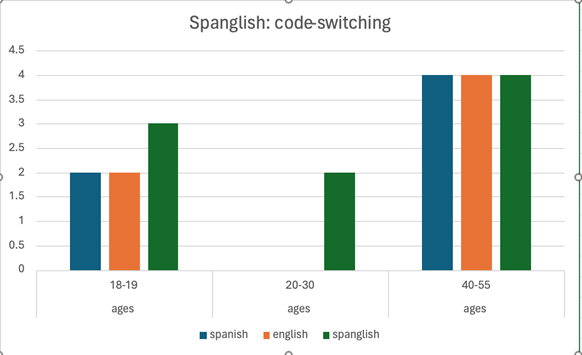
Whilst interviewing our older interviewees between the ages of 35-55, we noticed that these individuals tended to try to stick to speaking one language whilst answering the questions. 3 out of 4 of the interviewees in this category that we interviewed chose to answer all questions in English even though their native language is Spanish. As a result of Spanish being their dominant language whilst answering the 10 questions, these interviewees struggled quite a bit while trying to come up with English responses. Even though they were struggling, these 3 individuals stuck to answering in English even though they understood they could answer questions in Spanish, which we can see in the example below.
(During the beginning of an interview, she started speaking English and stated “My name is” before proceeding to tell me she would much rather speak en Español/ in Spanish. Additionally, she usually answered the questions I asked in English in the same language) :
First question
Question: What did you want to be when you grew up?
Answer: “Nurse”
Question: “Why did you want to be a nurse?”
Answer: “Because I like it. Take care of the kids.”
Second question
Answer: “Chile rellenos, rice, and beans”
Question: “Why do you like rice and beans? What do you like about them?”
Answer: “Because my mother show me how to make it when I was little kid.”
Third question
Answer: “My plan for tomorrow. Work. I have to work.”
Fourth question
Answer: “Aliens– That’s not real. I don’t believe in that.”
Fifth question
Answer: “Sunday– When i’m not working I go to the church with my sister sometime.”
Question: “Do you like going to church?”
Answer: “Yea”
With this, we concluded, and observed distinct dynamics in the nature of conversation for interviewees, which prompted us to make adjustments throughout the process. Notably, individuals aged 30 and above, primarily parents or older adults, approached the interviews with a more formal tone. They consistently responded in the language the question was initially posed, even if English presented some challenges for them. However, the interactions with friends and close family members, ranging from 18 to 25 years old, established a more relaxed atmosphere. This rise in comfort level led to much more frequent code-switching for the older adults, as they seamlessly shifted between the two languages. Recognizing that a strict question-and-answer format might yield more formal responses, we decided to incorporate recorded conversations on various topics. Subsequently, our findings indicated that the frequency of code-switching was less influenced by the relationship dynamics and more by the nature of the conversation topic. This discovery led us to uncover numerous instances of code-switching in these recorded discussions.
Discussion and Conclusions
Overall, our research successfully validated our hypothesis through multiple avenues of investigation. Notably, we demonstrated that Spanish-English bilingual speakers transition between codes more often than they may think. Moreover, a pattern surfaced during our research: participants tended to match the language used in the responses in formal interviews that were organized around predetermined questions. Nevertheless, in more relaxed conversational contexts, this pattern did not continue. Instead, participants were able to switch between languages with ease in familiar settings, even mixing vocabulary from both linguistic domains. This highlights the profound interacting influence of Hispanic culture and American culture on the Spanglish bilingual speakers, and showcases the intricate dynamics of living with two languages daily. It further underscores the evolution of Spanglish as a unique linguistic bridge, allowing us to forge a connection between both languages. Moreover, it emphasizes the significant presence of the Spanglish-speaking community, providing a touching connection to their ancestral roots while fostering a sense of closeness to the newly found home.