Do actions really speak louder than words? Exploring Nonverbal Communication at UCLA Through a Lens of Internationality, Identity Formation, and Socialization
Fanny Berger, Alyssa Cole, Helena Hu, Hunter Sarmiento, Makayla Smith
This article focuses on channels of nonverbal communication across different cultures; primarily, the study conducted aims to better understand differences in including, but not limited to, gestures, facial expressions, eye contact, touch, space, and posture across different cultures. A secondary focus was also shifted to understanding how people of different cultures interpret and perceive each other’s body language in a conversational context, and to the extent to which they feel comfortable understanding others’ nonverbal communication styles. The study was conducted in two rounds: preliminary data collection was performed across UCLA students of different cultural backgrounds, with a deeper dive into select respondents from different cultural backgrounds through extensive interviewing. Respondent data reflected that most nonverbal communication is influenced by cultural upbringing and interpreting body language from someone of a different culture proves to be a challenge for most, demonstrating the impact of culture, identity, and community on how one interacts with the world.
Introduction and Background
In America’s melting pot, communication transcends cultures as people of different cultural backgrounds are in constant contact with one another, whether that be through school, work, or day-to-day living. However, beneath the surface of words lies a complex web of nonverbal cues that often serve as the silent language of our interactions. These cues, ranging from facial expressions and gestures to physical positioning and body language, play a crucial role in conveying meaning and go hand-in-hand with verbal communication in socialization and acts of interaction (Phutela, 2015). Within this realm of nonverbal communication, culture plays an essential part. According to what a culture determines, there can be several meanings attached to one form of nonverbal communication, thus making cross-cultural communication all the more necessary to understand (Jabber & Mahmood, 2020).
Today, nonverbal communication is more important than ever—advanced video technology has enabled computer-mediated communication to expand the benefits of face-to-face communication, now making non-verbal communication available in multiple formats. Here at UCLA, over 106 countries are represented within the 2023-24 school year student body, meaning that people from all over the world can connect face-to-face in both academic and non-academic settings. We became interested in understanding the meaning of nonverbal communication across different cultures, specifically how these gestures and behaviors relate to having a sense of social belonging in a culturally diverse community like UCLA.
Methods
We employed a two-step process to conduct our research and answer our primary research question: How does nonverbal communication across cultural groups contribute to one’s identity and ability to participate in various social settings, such as forming friendships and interacting with peers and professors?
The first phase involved a preliminary Google Form meant to collect data on undergraduate students at UCLA and their understanding of the relationship between body language and their culture, as well as their perception of body language within other cultures. The survey was spread through social media and word of mouth, with additional outreach to cultural clubs on campus to recruit respondents. Via the survey, we were able to collect demographic information such as one’s year at UCLA, gender identity, and cultural identity. Respondents were then asked to rate themselves on a scale regarding how comfortable they felt in nonverbally communicating or interacting with other students and faculty on campus. Similarly, they were asked to detail any instances in which nonverbal communication was misinterpreted as a result of their sociocultural differences. The collected data was then transformed into visual illustrations, such as graphs and spreadsheets, which provide indications for how people of different cultural backgrounds both understand and participate in nonverbal communication.
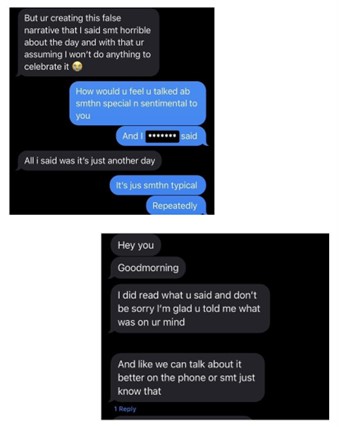
In the second phase, we reached out to individuals who had engaged with our survey and collected a total of five interviews from individuals from China, South Korea, Hungary, Spain, and Taiwan. Through our interviews, we were able to gain a deeper understanding of nonverbal communication and its impacts concerning cultural identity and one’s lived experience on campus. Additionally, we learned about personal experiences in which miscommunication or misinterpretations have occurred after using nonverbal communication with someone from a culture different than their own. Our respondents were able to elaborate in more detail than on their prior responses on the Google Form and explain their understanding of nonverbal communication across sociocultural contexts and interactions on campus and beyond.
Results and Analysis
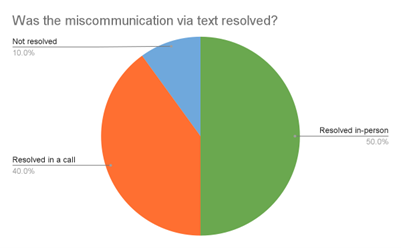
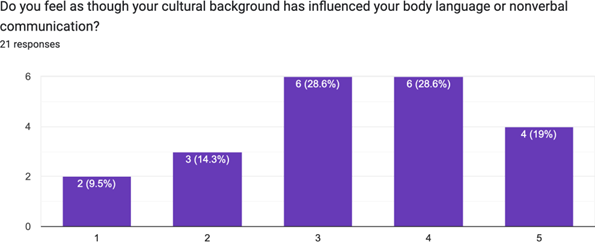
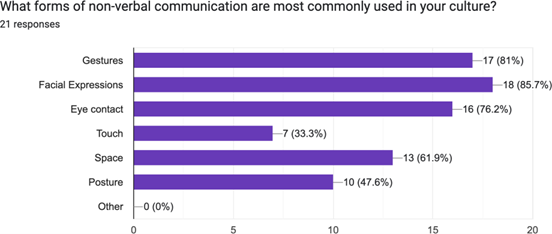
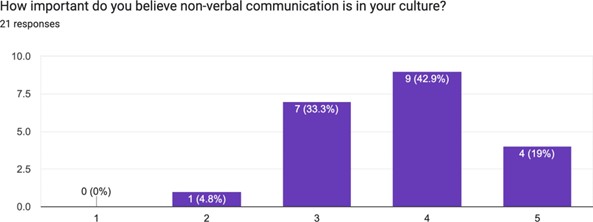
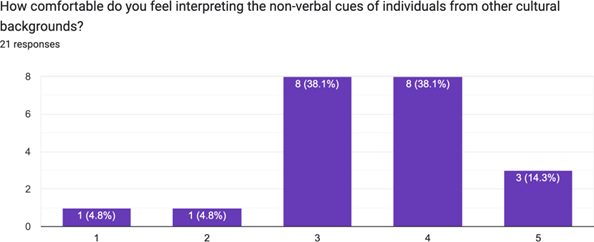
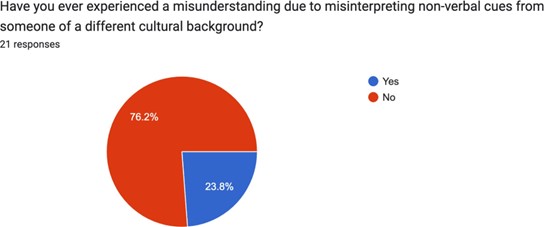
Our research project on nonverbal communication between various cultural groups provides some important insights into how cultural background affects the interpretation of nonverbal cues in a variety of social contexts. The project’s survey and interview data revealed that a substantial majority of participants (76.2%) agreed that their cultural backgrounds—which included people from Chinese, South Korean, British, Taiwanese, Spanish, Hungarian, and Indian backgrounds—have an impact on their nonverbal communication, which includes gestures, facial expressions, eye contact, touch, space, and posture (Figure 1). The study also found that the three most common nonverbal communication techniques used by people with these cultural identities are facial expressions, gestures, and eye contact (Figure 2). However, 47% of the respondents reported that they felt uneasy interpreting nonverbal cues from other cultures (Figure 4), and another 24% said that they had experienced a misunderstanding of nonverbal cues from someone of a different cultural background (Figure 5). These results demonstrate the nuanced function that nonverbal cues play in cross-cultural relationships, showing that these cues can both help and hinder connection between people of different cultural backgrounds in their attempts to understand each other.
Furthermore, our results yielded information regarding socialization and identity formation on campus. Through our survey and interviews, we were able to understand that students form in and out-groups according to feelings of acceptance or isolation associated with their nonverbal communication style. The students we interviewed explained that perceived cultural influences in their nonverbal communication caused them to feel a sense of social “othering” by American students who positioned themselves above these varying cultural identities due to their variation from the American, hegemonic standard at UCLA. With this, students embodied feelings of anxiety and disconnection that enabled them to develop in-groups with other international students, while feeling like a collective out-group from American students and faculty. Similarly, our research further supports the elimination of universal forms of nonverbal communication as both the expression and interpretation of nonverbal communication differ widely according to culture. This is additionally evidenced by students’ use of code-switching in nonverbal communication on campus. Many students expressed that they picked up on more Americanized forms of nonverbal communication, such as being more forward with their gestures and body language, and adapted their own forms of nonverbal communication to conform with this standard. For example, in our interview with a South Korean student, she expressed that she has a nonverbal linguistic repertoire of both South Korean and American influence and can “tap into” each form of nonverbal communication depending on who she is talking to. Through our research, we were able to gather data on the importance of nonverbal communication in identity expression, social and scholastic inclusion, and sociocultural power dynamics.
Discussion and Conclusion
Our results illuminate that a multitude of misunderstandings within nonverbal communication arise from a difference in sociocultural upbringing. Although our results were specific to UCLA students, our research on nonverbal communication and its cultural ties serves as a model for further understanding and analyzing the implications of nonverbal communication on socialization and identity formation. College campuses are known to be extremely diverse communities, bringing in students from all around the world, thus replicating a larger world context through a social and scholastic lens. In this context, we were able to understand that cultural background largely influences how people both express and interpret nonverbal communication. Misinterpretations, as well as feelings of social isolation, were directly tied to cultural differences in nonverbal communication, with students expressing their need to code-switch and conform to American standards of nonverbal communication to feel fully comfortable interacting on campus. It is these nonverbal misunderstandings that play into the larger phenomenon of miscommunication due to cultural differences, thus pointing to the need to study this subject further.
The main point of our study was to provide awareness of a struggle that many students experience at UCLA, but, similarly, what many people face on a day-to-day basis around the world. We want to provide empathy regarding differences in communication and how cultural influence should be recognized and accepted instead of stigmatized. It is essential to understand how cultural identities influence nonverbal communication to not only ensure ease in interaction and information sharing, but to also ensure that all individuals, no matter their cultural background, feel included and understood. We hope our project further sparks discussions about nonverbal communication and its sociocultural influences in order to increase cross-cultural competence, enhance empathy, and educate others on the importance of communication.
References
Akkilinc, F. (2019, August). The Body Language of Culture. International Journal for Innovation Education and Research, 7(8), 32-39. https://www.researchgate.net/publication/335689301_The_Body_Language_of_Culture
Jabber, K. W., & Mahmood, A. A. (2020). Non-verbal communication between two non-native English speakers: Iraqi and Chinese. Theory and Practice in Language Studies, 10(2), 189-196.
Kirch, M. S. (1979). Non-Verbal Communication across Cultures. The Modern Language Journal, 63(8), 416-423. https://www.jstor.org/stable/326027
Phutela, D. (2015). The importance of non-verbal communication. IUP Journal of Soft Skills, 9(4), 43.
Ren, Z. (2014). Body Language in Different Cultures. US-China Foreign Language, 12(12). https://doi.org/10.17265/1539-8080/2014.12.008
Rugsaken, K. (2006). Body Speaks: Body Language Around the World. NACADA. https://nacada.ksu.edu/Resources/Clearinghouse/View-Articles/Body-Language-Around-the-World.aspx
Thompson, J. (2023, May 15). How Much of Communication is Nonverbal?. The University of Texas Permian Basin. https://online.utpb.edu/about-us/articles/communication/how-much-of-communication-is-nonverbal/