Culture and Language: How Stigma Can Impact Students’ Mental Health Conversations
College students in America have had a rise in mental health concerns, finding themselves facing internal and external troubles when seeking support and open dialogue. Although past studies discuss the external factors that impact the rise in mental health concerns in college students, few discuss the cultural factors that affect these college students’ ability to seek and maintain support– particularly in the Chinese community, which has been found to carry a stigma for mental health. This study looks at the cultural influences that impact the conversation surrounding the mental health of Chinese college students. Using data from semi-structured interviews, this study frames the cultural reasons for how Chinese college students view mental health and support for mental health. Chinese UCLA undergraduate students discuss their mental health experience in three different contexts: with themselves, their family, and their friends. These students emphasize the difficulties of growing up in a community that stigmatizes mental health and lacks an open dialogue about it. Conversations growing up had impacted their own perceptions. These students needed to learn how to approach mental health conversations. The experiences and perceptions of mental health discussion of these students suggest that stigma perpetuated through communication can cause Chinese students and others from stigmatizing cultures to face various cultural challenges that hinder them from feeling confident in seeking resources.
Introduction
In recent years, there has been an increase in conversation about the mental health crisis, specifically in the student population. More than half of college students have at least one mental health problem. As mental health becomes a more significant crisis, there is a need to understand how different communities perceive and discuss the topic of mental health, as communication plays an essential role in perpetuating stigma (Rusch et al., 2005). A crucial aspect of understanding people’s perceptions of mental health would be their background.
Past studies have shown that in Chinese and other Asian communities, there is a great deal of mental health stigma, followed by a lack of knowledge and discussion on mental health. Understanding the perspective of one community of college students provides a significant opportunity to see how culture and its stigma could impact how people discuss mental health and, in turn, address it.
Background
In the Chinese community and other Asian communities, there is a mental health stigma and a lack of mental health knowledge (Yin et al., 2020; Shu et al., 2022). In recent years, there have been increased conversations about the mental health crisis, specifically in the student population. Past studies have found that more than 60% of college students have at least one mental health problem, with there being an increased rate of anxiety, depression, and suicidal ideation on college campuses (Lipson et al., 2022; Pedrelli et al., 2014).
As mental health becomes a bigger crisis, there is a need to understand how different communities perceive and discuss the topic of mental health. An important aspect of understanding people’s perception of mental health would be to consider their background.
Chinese undergraduate students may face mental health complications but struggle to address them because of their cultural stigma. In particular, perceptions of mental health by their parents may play a role in how they manage their mental health. Disconnects between immigrant parents and their children have been reported in previous studies. The variation in how people interpret language has significantly changed, and one is more likely to find a disconnect between how individuals interpret words, phrases, and expressions (Sharma & Dodsworth, 2020). Such differences may play a role in how Chinese undergraduate students perceive stigmatized topics and discuss them within their community and their parents. It is essential that we understand how culture and relationships may impact perceptions of mental health and language (Toppelberg & Collins, 2010). Understanding these variations, even if just in the Chinese undergraduate community, will allow for a better understanding of how to address stigma around critical health topics like mental health.
Methods
This research was conducted with UCLA Chinese undergraduate students. Interviewees were recruited through word-of-mouth. They participated in an in-person, 15-to-30-minute, semi-structured interview to answer open-ended questions (see Appendix). This structure allowed a natural conversation flow when discussing a heavy topic like mental health to understand how language and culture are intertwined.
Five Chinese undergraduate students participated in the interviews. Two are international students from China, and three are domestic students from America. To analyze our data, we used grounded theory to categorize and frame the prominent ideas expressed by our participants.
Positionality
Four undergraduate students conducted this study for a linguistic anthropology project. Each researcher is of a different ethnicity and background, and only one researcher is a member of the Chinese community. As college students, we recognize the significance of mental health and hope to understand the cultural and linguistic nuances of how students like us perceive mental health.
Findings and Analysis
Our five interviewees shared three main experiences, established through grounded theory to understand our interviewees’ beliefs about mental health dialogue.
Lack of Conversation
Growing up, Chinese undergraduate students did not have conversations about mental health with their parents. If these topics did come up, they were stigmatized, broad, and swept under the rug. Our participants emphasized how they have tried talking to their parents about mental health, only for the topic to be highly frowned upon and ignored. The only conversations about mental health that our participants had were stigmatizing, creating a negative perception of mental health and the lack of ability to discuss mental health.
Learning About Mental Health and its Dialogue
After coming to college, students had to grapple with mental health and how to really talk about it, especially to their peers. Starting conversations and looking for support was difficult because they felt they lacked a foundation due to their culture and how they were raised. These conversations were only sought after they started college and were away from home.
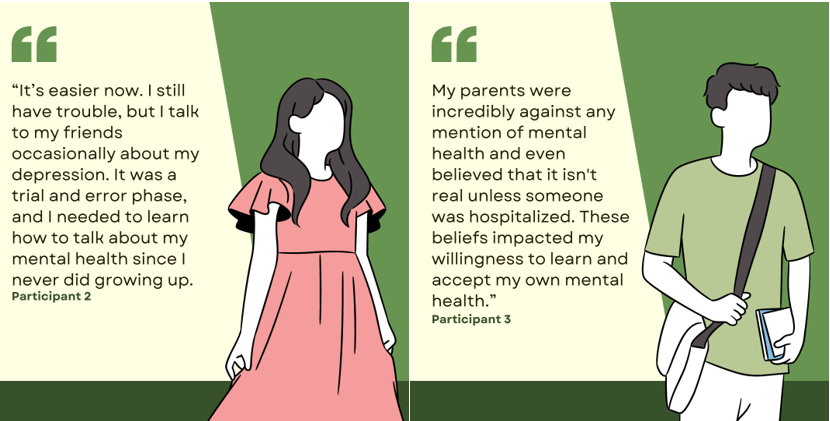
Chinese students who grew up in a family that stigmatized mental health, primarily through conversation or a lack of conversation, came into college feeling uncomfortable with starting conversations about mental health. Even when they sought out support from friends, it was a slow process. One student stated that it was a “trial and error phase,” they were uncomfortable talking to their friends or therapist but knew it was necessary for “healing.” In the same conversation, they said they slowly learned how to “properly” tell their friends as they never learned how to. Participants implied that they feel like there is a right way to talk about mental health, but they lacked the toolkit to do so due to their cultural upbringing.
Differences Between Conversations and Language with Parents and Peers
Students meticulously choose words when talking to their parents because they recognize the culture and barriers they were raised with. When they brought mental health up as an undergraduate student, they used terms they believed would be better accepted by their parents.
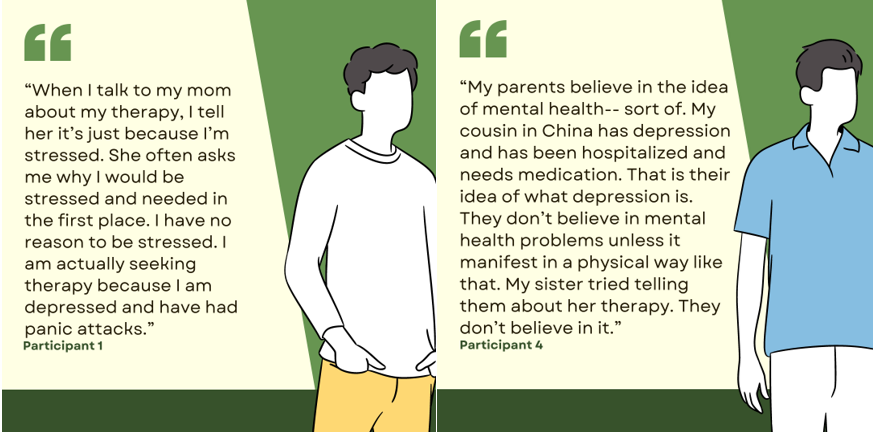
Quotes from two Chinese undergraduate students talking about how and why there are differences in how they talk about mental health to their parents versus their peers. Participant 1 (left box) reveals how he has to think about the right words to use to talk about his mental health with his parents. Participant 4 (right box) believed that because their parents have a specific view of what mental health is, they have to be careful with how they talk about mental health, especially if it does not fit their parents’ perception.
When speaking with peers, participants believed they had a space to be accepted, compared to speaking with their parents. During these conversations with their peers, they openly use terms like “depression,” “anxiety,” and “panic attacks.” When speaking with their parents, they use euphemisms. One participant uses “stress” instead of “depressed” because their parents better understand it, though it is still brushed over in conversations. The identity that was being used in each conversation was different. Students were less afraid of being identified as “mentally struggling” when with their friends. Participants expressed that they felt it was something they were all going through. However, using these linguistic labels with parents or elders felt much too far. Three participants indicated that the words “depressed” or “anxious” held more negative weight if said in Chinese in contrast to their English-speaking friends.
Discussion and Conclusions
The beliefs and experiences of these Chinese undergraduate students imply that culture plays a role in the language people use to discuss mental health. Cultural stigma can be perpetuated through the use of communication. Our Chinese participants grew up with a lack of positive mental health dialogue. Mental health dialogues were negative and filled with stigmatizing language. This led to our participants feeling unsure about seeking conversations about mental health with their parents at home.
The lack of opportunities to learn how to discuss mental health created difficulties when it came time for them to have these conversations. When mental health became an important topic in college, where their peers and themselves faced mental health experiences, these Chinese students felt ill-prepared to conversationally start and address the topic. Because of their upbringing, they needed to learn how to reframe their and others’ potential perception of mental health to feel comfortable doing so. Recognizing their parents’ and their peers’ opposing perceptions of mental health impacts the way they choose to talk about mental health, code-switching for the comfort of their parents.
Communities with stigmatizing cultural beliefs about mental health could lead to individuals having trouble accessing the support that they need because they lack the language to have and start conversations about their mental health. It is then essential to increase access to resources for parents and younger generations. Parents should become knowledgeable about mental health and normalize its dialogue to reduce stigmatization and be open to their children. These resources could provide younger generations with an avenue to recognize and learn about mental health and address it when necessary. Knowing the role of culture also allows professionals to be more culturally aware and adaptive.
Culture can affect how and if people communicate about topics, eventually impacting whether or not people are confident in seeking the right resources. As the mental health crisis among students rises, it is critical to consider all of the factors that could be mitigated to allow students to seek the support they need.
References
Babchuk, Wayne A. and Hitchcock, Robert K. (2013). “Grounded Theory Ethnography: Merging Methodologies for Advancing Naturalistic Inquiry,” Adult Education Research Conference. https://newprairiepress.org/aerc/2013/papers/5
Lipson, S. K., Zhou, S., Abelson, S., Heinze, J., Jirsa, M., Morigney, J., Patterson, A., Singh, M., & Eisenberg, D. (2022). Trends in college student mental health and help-seeking by race/ethnicity: Findings from the National Healthy Minds study, 2013–2021. Journal of Affective Disorders, 306, 138-147. https://doi.org/10.1016/j.jad.2022.03.038
Lu, Xing and Guo-Ming Chen. (2011)”Language change and value orientations in Chinese culture”. China Media Research, vol. 7, no. 3, pp. 56- 63. http://www.wwdw.chinamediaresearch.net/index.php/backissues?id=51
Pedrelli, P., Nyer, M., Yeung, A., Zulauf, C., & Wilens, T. (2015). College Students: Mental Health Problems and Treatment Considerations. Academic Psychiatry: The Journal of the American Association of Directors of Psychiatric Residency Training and the Association for Academic Psychiatry, 39(5), 503. https://doi.org/10.1007/s40596-014-0205-9
Toppelberg, C., & Colins, B. A. (2010). Language, culture, and adaptation in immigrant children. PubMed Central (PMC). https://www.ncbi.nlm.nih.gov/pmc/articles/PMC3526379/
Rüsch, N., Angermeyer, M. C., & Corrigan, P. W. (2005). Mental illness stigma: concepts, consequences, and initiatives to reduce stigma. European psychiatry : the journal of the Association of European Psychiatrists, 20(8), 529–539. https://doi.org/10.1016/j.eurpsy.2005.04.004
Sharma, D., & Dodsworth, R. (2020). Language variation and social networks. https://www.annualreviews.org/doi/10.1146/annurev-linguistics-011619-030524
Shu, J. L., Alleva, J. M., & Stutterheim, S. E. (2022). Perspectives on mental health difficulties amongst second-generation Chinese individuals in Germany: Stigma, acculturation, and help seeking. Journal of Community & Applied Social Psychology, 32(6), 1099-1114. https://doi.org/10.1002/casp.2620
Yin, H., Wardenaar, K.J., Xu, G. et al. Mental health stigma and mental health knowledge in Chinese population: a cross-sectional study. BMC Psychiatry 20, 323 (2020). https://doi.org/10.1186/s12888-020-02705-x
Additional Resources
https://embed.podcasts.apple.com/us/podcast/the-impact-of-mental-health-stigma-on-chinese-americans/id539018756?i=1000326453174
https://embed.podcasts.apple.com/us/podcast/mental-illness-and-its-cultural-stigma/id1273577192?i=1000420737041
Appendix
Guiding Interview Questions
Defining Mental Health and General Questions
- Have you heard of mental health diagnoses? What do you consider as mental health conditions?
- How did you learn about the topic of mental health?
- Do you know anyone with mental health concerns?
- What causes mental health concerns?
- How prevalent do you think mental health concerns are within the student population?
- What do you think about your own/people’s mental health diagnoses/state?
Family
- Do you talk to your family about mental health concerns? Why/why not?
- How do you talk to your family about mental health concerns?
- Does anyone in your family talk to you about mental health?
Community
- Do you talk to your peers about your mental health? Why/why not?
- Do your peers talk to you about their mental health? Why/why not?
- When talking to your peers/when your peers talk to you about mental health, how do they describe and talk about it?