Dialogues of Fame: Unveiling Gender Dynamics in Celebrity Interviews
Elizabeth Escamilla, Penelope Hernandez, Kenzie MacDougal, Jason Ye
Human interaction is complex and, at a sociolinguistic level, can be challenging to parse. With that in mind, we chose to analyze celebrity interviews — definite and structured slices of conversation whose participants were conscious of the invisible future viewer. Informed and inspired by studies such as Julia T. Wood’s “Gendered Media: The Influence of Media on View of Gender,” Rossi and Stiver’s “Category-Sensitive Actions in Interaction,” and Tavitz and Perez’s “Language influences mass opinion toward gender and LGBT equality,” we investigate patterns of interaction and indexical shifts as they may be affected by the genders of the involved parties. Taking two-minute segments from each interview, we classified questions as personal or professional and invasive or appropriate. Anything deviating from expected interview etiquette was noted, whether that be word choice or tone of voice, as well as the reactions of any third parties. Most importantly, we classified the ways in which interviewees responded to invasive lines of questioning, specifically as one of the following: retaliatory questioning, a passive aggressive remark, a humorous deflection, a partial answer, or a direct answer. A significant trend of women receiving more invasive and personal questions quickly appeared, though our investigation suffers from a possible selection bias. Therefore, future investigations should pull from a much larger and more varied sample of interviews.
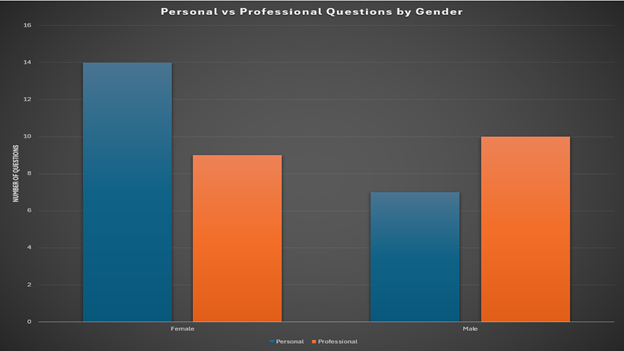
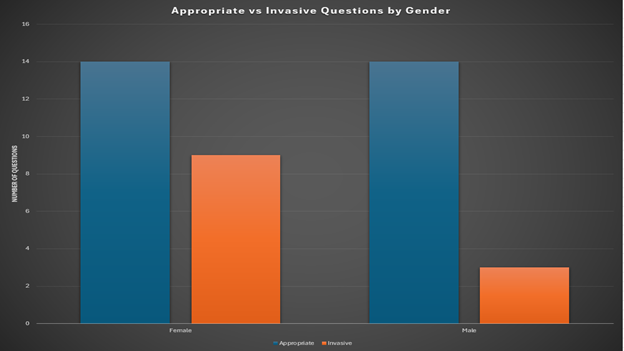
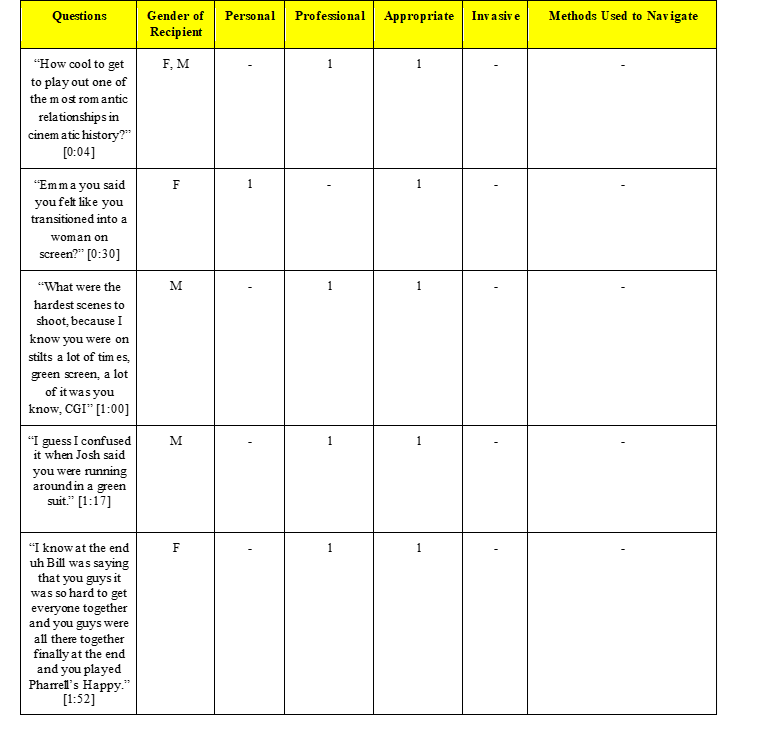
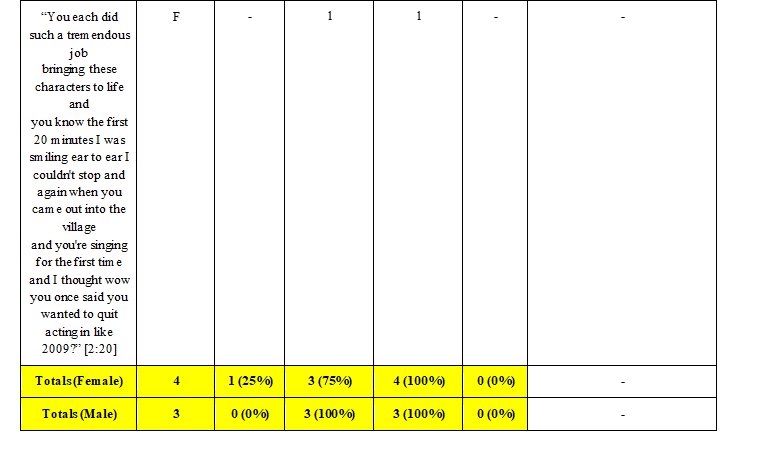
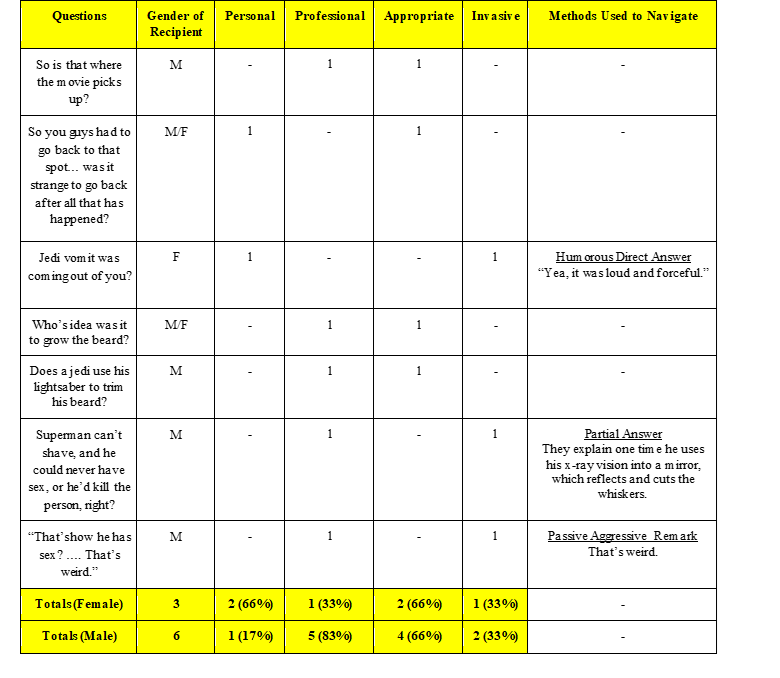
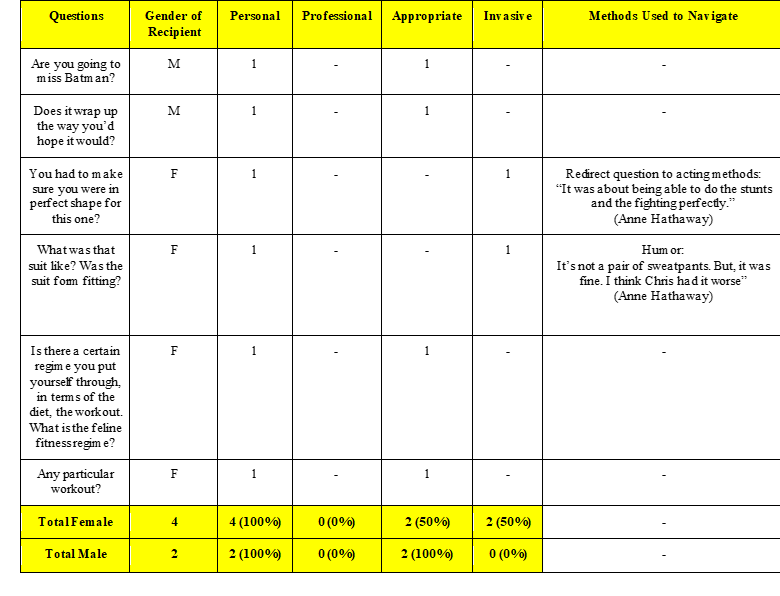
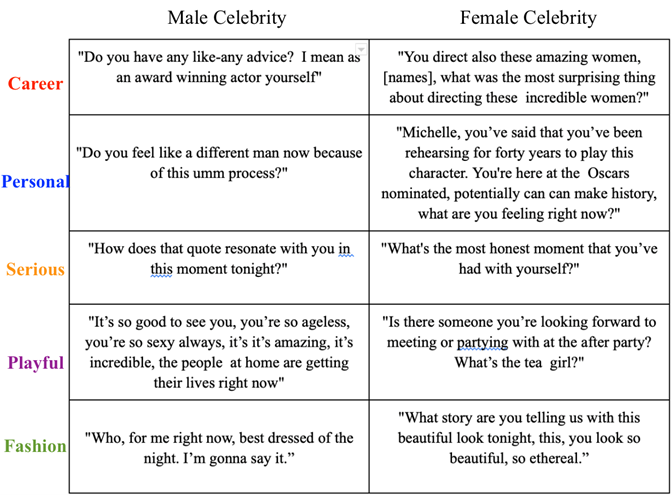
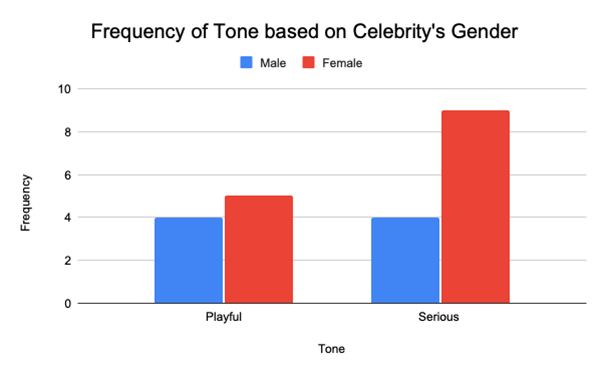
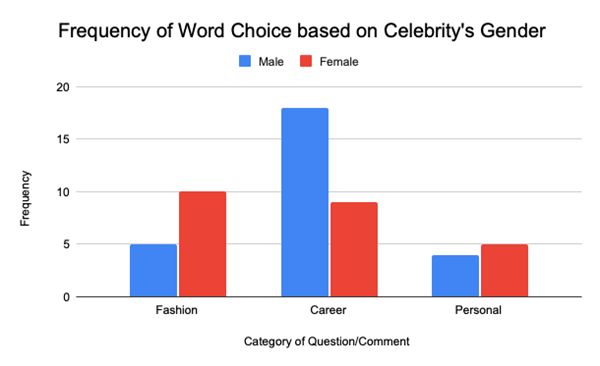
Introduction and Background Celebrity interviews aren’t conversations that take place in a vacuum; they may be viewed by hundreds, if not thousands, of people. Additionally, the predefined question-answer format of an interview makes it easier to parse for sociolinguistic analysis. Needless to say, we found celebrity interviews to be generous data points for analyzing patterns informed by the gender identities of the involved parties. Studies like Julia T. Wood’s “Gendered Media: The Influence of Media on View of Gender” show us how the media’s representation of men, women, and queer people may affect a viewer’s understanding of gender roles. Problematic patterns are uncovered: “men and women are portrayed in stereotypical ways that reflect and sustain socially endorsed views of gender… depictions of relationships between men and women emphasize traditional roles and normalize violence against women” (Wood, 2013). Unlike fictional movies and television shows, the interactions recorded in celebrity interviews involve real people, or at least believable personas designed with the public eye in mind. It follows that interviews with respected, famous individuals play a greater role in influencing what people deem socially acceptable behavior. Thus, when audiences watch mistreatment of women play out with little to no consequence, they may feel validated in their own experiences with misogyny, as either a perpetrator or victim. Media is both what its creator produces and what the viewer brings to their experience with it. The manners in which interviewers and interviewees carry themselves both reflects and defines current standards for human sociolinguistic communication. Inspired by “Category-Sensitive Actions in Interaction,” we hope to identify patterns in lines of questioning and the manner in which these questions are handled. That study outlines how boundaries of social membership are exposed in ordinary interactions — “the distribution of rights and constraints to perform certain actions creates boundaries in people’s activity space, which are typically respected but sometimes exposed or even crossed” (Rossi and Stivers, 2020). As it pertains to our investigation, when an interviewee is asked an invasive question, this may be classified as a transgression of these silent boundaries. So, we aim to contribute to a growing body of work suggesting that different behaviors and patterns of interaction vary based on the gender of the interviewee, unfortunately often at the expense of women and queer individuals. Methodology We chose to study a variety of variables for this project, including the frequency of personal versus professional questions, word choice and tone of voice used by the interviewer, and the methods interviewees used to navigate controversial questioning. Upon examining an interview, we followed a set of steps to extract and prepare the data for analysis moving forward. First, it’s important to classify any questions as being professional, personal, appropriate, or invasive. Professional questions relate strictly to the interviewee’s work, while personal questions deviate from this. Similarly, appropriate questions are given to those that are deemed socially acceptable, such as topics commonly discussed with acquaintances, while invasive questions are not. Next, we take note of any speech or tone used by either interviewer or interviewee that may deviate from the expected etiquette of interviews. From here, we classify methods used by interviewees to ease out of or address uncomfortable questioning. We chose to classify these among the following: direct answer, partial answer, humorous deflection, passive aggressive remark, or retaliatory questioning. Humorous deflection involves the use of humor in an effort to avoid responding to the question. A passive aggressive remark includes any form of snarky or sarcastic response, including those done purposefully to attack the interviewer. Retaliatory questioning is the act of answering the original question with a question of one’s own. Finally, if the selected interview happens to involve more than one interviewee, it is important to also take note of any third party reactions or interactions to awkward questioning. To demonstrate our methodology, we will examine an interview with Scarlett Johansson and Jeremy Renner for their film The Avengers (2012). The first question, directed at Johansson, was: “Were you able to wear undergarments [with your costume]?” This question was labeled personal and invasive. Johansson responded with a passive aggressive remark and retaliatory questioning: “I’ll leave it up to your imagination, okay, whatever you feel like I should be wearing or not wearing under that costume” (Passive Aggressive Remark) and “What is going on? What? Since when did people start asking each other about- in interviews about their underwear?” (Retaliatory Questioning). Later on in the interview, Jeremy Renner is asked a question about an injury: “I understand you got hurt pretty badly though. How’d you do that?” This was labeled as professional and appropriate, and no other notes were taken as there was no unique use of tone, word choice, or navigation methods. Results & Analysis In this section, we will break down the details of our results and perform analysis on each individual dataset table (interviews); let’s start with some visuals demonstrating the overall statistics. Just from these few charts, we can already gauge a sense of skewedness, one that seems to confirm our hypothesis: female interviewees, regardless of the gender of the interviewer, are likely to encounter more personal questions compared to male interviewees. Indeed, we can see that 61% of the questions asked to female interviewees were personal, as opposed to 41% of the questions posed to their male counterparts (49% increase). On top of that, we found 39% of the questions asked to female interviewees were also invasive in nature, while only 17% were invasive for male interviewees, which is a 129% increase, more than twice as many invasive questions. This disparity in question types based on the interviewees’ gender is alarming. To navigate these invasive lines of questioning, we found that male and female celebrities tend to employ different methods. Female celebrities mostly used retaliatory questioning, humorous deflection, and direct answers — the first two methods being more indirect ways of signaling to the interviewer that the line of questioning was inappropriate. Male celebrities, on the other hand, mostly used direct answers and passive-aggressive remarks, which we speculate is due to men feeling more comfortable asserting themselves in these socially invasive situations. Now, having discussed the key points of our results, we will provide additional analysis on each individual dataset (interview) separately. This first dataset/interview was already touched on in the previous section on methodology, it suggested the same disparity in question types between the female and male interviewees. Scarlet Johansson received a disproportionate amount of personal and invasive questions and had to defend herself using mainly retaliatory questioning, while Jeremy Renner received only appropriate or professional questions. This dataset/interview is an outlier amongst all the other datasets. First thing we noticed is the empty “Methods Used to Navigate” column; we didn’t need to fill in any. All the questions were appropriate and professional with only one personal (but appropriate still) question directed at Emma Watson. Interestingly, this is also the only interview in our entire dataset pool with a female interviewer; more evidence and data would be needed to come to any meaningful conclusions about whether the gender of the interviewer correlated with the fact there were no invasive questions. There are two invasive questions, and both were directed at Zendaya. The note-worthy takeaway here is the fact that both her co-stars Josh and Mike came to her support/rescue with direct answers trying to further alleviate the awkward situation after Zendaya responded initially with a retaliatory question. Out of the three invasive questions in this dataset/interview, two were directed at a male interviewee (certainly an outlier too in and of itself). Here, we see the use of a passive aggressive remark employed by the male celebrity and a partial answer instead of a more direct one, though the tone does not detract too much from a direct one. The female interviewee employed a humorous direct answer; though a direct answer, the tone is more of just a humorous answer without the impact of a completely direct response. Both invasive questions were directed at Anne Hathaway, and humor and deflection were used to navigate the situation. All four of the questions directed at her were personal. While the male interviewee also received only personal questions, none of them were invasive. Circling back to our hypothesis one more time after the more detailed look into each dataset, we can establish the clear gender bias in type and appropriateness of questions posed to celebrities in interviews, with female celebrities disproportionately subjected to more personal and invasive questions — confirming our suspicions and reflecting societal attitudes and expectations around gender. Discussion and Conclusions Based on our findings, we can conclude that there needs to be more discussions about indexicality and societal attitudes towards celebrity culture. Our study found that female interviewees are more likely to receive personal and invasive questions compared to their male coworkers. We observed that interviewees have various strategies to navigate these invasive questions, such as using humor or redirecting the conversation. This finding aligns with our hypothesis and suggests that gender does play a significant role in the nature of questions asked in celebrity interviews. When comparing our own study with previous research, we can view consistent results with Rossi and Stivers, Tavits and Perez, and Wood. They show that female celebrities often face questions that cross personal boundaries, contributing to the systemic stereotyping and underrepresentation of women in the media. Interestingly, in the Tavits and Perez article, they found that “the effects of feminine pronouns parallel those of gender-neutral pronouns: both heighten the salience of non-males in memory, which is then associated with people expressing more liberal opinions toward women and LGBT groups in politics” (Tavits and Perez, 2019). This article informs us of variables that affect how a viewer might perceive the interactions captured in celebrity interviews. To continue, Wood’s article on gendered media can help us to better see the media’s representation of men, women, and queer people and how that may affect a viewer’s understanding of gender roles (Julia T. Woods, 2013). Interviews play a greater role in what is acceptable and what is normalized amongst gender groups. Our study suggests that the media continues to reinforce traditional gender roles by subjecting female celebs to more personal scrutiny. Wood did a great job at explaining this. She stated how “depictions of relationships between men and women emphasize roles and normalize violence against women” (Wood, 2013). This not only affects the celebrities themselves but also influences public perceptions of acceptable behavior towards different genders. Everything we do in the media gets translated and put into practice outside of the media. So, whatever we allow to happen online will be manifested in real life interactions. We focused on American celebrities, but if we were to dive into other environments, we would have more evidence to contribute and offer more indications to analyze gender dynamics in media interactions. For the future, we could expand on our study by examining a more diverse range of celebrities, locations, and interview formats. When we look at our findings holistically, we can understand how the media plays a huge role in shaping public discourse around gender. When we examine the patterns within celebrity interviews, we can see there is a large need for more equitable and respectful media strategies. In our findings, we want to emphasize and analyze these dynamics because they are crucial for social change. It is important to challenge changing media practices so they can better promote gender equality and respect for all individuals in any field of work. In conclusion, our study not only contributes to understanding media and gender but also calls for a more conscientious and equitable approach to media representation. The media we consume online does not exist in isolation. It shapes our perceptions and behaviors in several tangible ways. Gender biases and stereotypes reinforced in digital content can manifest in real-life interactions. By promoting respectful and equitable interactions online and through interviews, we can adopt more inclusive and respectful behavior towards all genders in our everyday lives, professional or not. References Montiel, A. V. (2014). Media and gender a scholarly agenda for the Global Alliance on Media and gender. United Nations Educational, Scientific, and Cultural Organization. Pewsey, G. (2021, July 13). The world owes Megan Fox an apology. Grazia. https://graziadaily.co.uk/celebrity/news/megan-fox-michael-bay/. Rossi, G., & Stivers, T. (2020). Category-sensitive actions in interaction. Social Psychology Quarterly, 84(1), 49–74. https://doi.org/10.1177/0190272520944595. Tavits, M., & Pérez, E. O. (2019). Language influences mass opinion toward gender and LGBT equality. Proceedings of the National Academy of Sciences, 116(34), 16781–16786. https://doi.org/10.1073/pnas.1908156116. Wood, J. T. (2013). Gendered Media: The Influence of Media on Views of Gender. Chapel Hill, NC; Department of Communication, University of North Carolina at Chapel Hill.