Gendered Language Word Perception: On the Primary Language Acquisition in Los Angeles Adolescents
Lily Eun, Maya Gibson-Ott, Desirae Barrios, Katherine Sandoval
The Theory of Language Relativity suggests that an individual’s primary language shapes their perceptions and worldviews. Our research dives into how a gendered language like Spanish can affect object perception. The research focused on Spanish-speaking university students in Southern California; through surveys and interviews, the research illustrates how native Spanish speakers will assign gender to English words. Our research also included monolingual English-speaking participants as ‘control’ participants and native English speakers who were also bilingual in Spanish; this allowed our researchers to examine the patterns between bilingual and monolingual participants. Our findings illustrate that native Spanish speakers will assign genders to English words based on their Spanish equivalents; these findings indicate that primary languages have a strong linguistic influence on an individual’s perception regardless of their environment’s language. Our results highlight the importance bilingual assessments could have in the educational field. Accurately gauging students’ true intellect and advocating for inclusive language practices in fundamental education will be beneficial for educators to better provide the necessary resources to aid in a bilingual child’s learning. Our study highlights the implications of cross-cultural communication and the necessity of a change of assessment to be more linguistically sensitive for bilingual students.
Background
The Theory of Language Relativity is crucial to better understand human behaviors and the impacts of these behaviors in the educational world. This theory, also known as the Sapir-Whorf hypothesis, claims that the structure of an individual’s primary language changes their worldview and shapes their perceptions. This hypothesis indicates that language is not just a tool of communication but has a deeper connection to an individual’s cognitive processor. And because many individuals residing in Southern California spoke Spanish before they spoke English (Los Angeles Almanac), our research team wanted to explore how a gendered language, such as Spanish, could impact individuals’ perception of gender regarding ‘genderless’ objects. Would our participants inadvertently allot gender connotations even while speaking a genderless language—English? Our field of research has been explored by Meria Sera, a University of Minnesota professor, who found that Spanish—being a gendered language—does influence a Spanish-speaking individual’s perception (Sera 1994). Building on this, we sought to investigate whether Spanish speakers, when questioned in English about the gender of objects, would replicate Sera’s findings regardless that the questions would be in their secondary language. In the educational world, students, whose primary language is Spanish, are required to participate in all placement exams in English only. Our research aims to provide proof as to why having bilingual evaluations in fundamental grade levels is crucial to better evaluating a child’s perception of the world.
Methods
Our research observed and analyzed word choice and gender narratives. In order to expand on the implications of the process of gendering words, we surveyed over a hundred people, the majority of them being undergraduate college students. This survey showed the participants various words, for example, “dress” and asked them to determine if the word was feminine, masculine, or neither. We categorized our participants into different sections, group A who only spoke English, group B who spoke English and learned Spanish as a second language, and group C who spoke Spanish as their first language and English as their second language. Once our initial results were collected, any students interested in additional interviews were contacted a week later and they were asked to repeat the word categorization process. Our team identified any changes in answers and attempted to determine patterns in responses among Native Spanish speakers and English speakers. Furthermore, interviewees were asked to list synonyms or adjectives of a particular word, and we then had the participants categorize those words as being feminine, masculine, or neither. Our goal was to analyze whether or not the perceived gender of words consistently agreed with each other.
Results
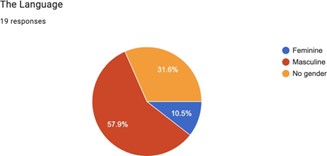
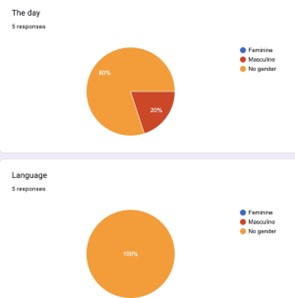
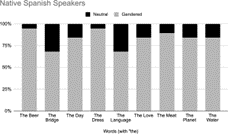
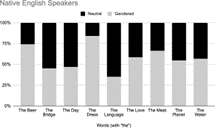
Our results show that native Spanish speakers will indeed gender English words to match the gender of the Spanish counterparts. In our 19 responses from participants who were Native Spanish Speakers, 50% of the responses to the English words were perceived to be the same gender as the gender of the word translated into Spanish. For example, when we asked our participants to identify the gender of the English word “language,” 57.9% of native Spanish speakers identified the word as Masculine. The word “language” in Spanish translates to “el idioma,” which is masculine in gender. During our post-survey interviews, a participant discussed that it felt “more natural” to choose the respective genders, and it had not registered to them that their choices aligned with the gender of the Spanish counterpart until our follow-up interview. When we analyzed the Native English speakers who only spoke English, we found that the participants were comparatively more likely to neutralize the gender of the English words. However, Native English speakers who were conversationally fluent in Spanish showed the greatest percentage of neutralizing the gender of English words. When analyzing Native Spanish speakers and Native English speakers, our results concluded that the more fluent and culturally connected the speaker was to Spanish culture, the more likely they would be to gender English words that do not explicitly show natural gender. Additionally, in explaining why speakers both fluent in Spanish and English chose to neutralize the words, we predicted that someone’s linguistic patterns would be subconsciously integrated to match the American culture that they live and are exposed to on a daily basis.
Discussion
The findings in our research show evidence as to why schools should offer bilingual evaluations to youth in the LA area instead of English. Our findings indicate that our native language affects how we think about and perceive the world. Because language alters our reality, we cannot accurately evaluate one’s intelligence level in a language separate from their native tongue. To do so is unfair and a poor representation of intellect. Such evaluations lack the ability to understand the students’ nuances of the world, and, as a result, often serve as an obstacle preventing students from pursuing a higher education. By offering bilingual evaluations to youth in the Los Angeles area we gain a more holistic view of the student’s true intelligence level; by offering these bilingual evaluations fundamental education will better provide educators with the resources they need to work alongside their bilingual students.
The implementation of our research on the gendering of words across English and Spanish may most notably have a distinguishable impact on educators and curriculum developers. Understanding how grammatical gender can influence perception and interpretation—in languages such as Spanish—can provide valuable perspective on cross-cultural communication and can foster greater empathy and inclusivity throughout foundational education discourses.
Language learners may also benefit from recognizing that the way they gender an object or word can be perceived as relating to an opposite gender when speaking in another language. Because language has a fundamental impact on perception, culture, and community, organizations may benefit from incorporating inclusive language and receiving input from individuals of different backgrounds.
References
Geeslin, K. L. (2018). The Handbook of Spanish Second Language Acquisition. Hoboken, Nj: Wiley Blackwell.
Hispanics/Latinos in Los Angeles County – By the Numbers. (n.d.). Retrieved February 16, 2024, from www.laalmanac.com website: https://www.laalmanac.com/population/po722.php#:~:text=3.6%20million
Montrul, S., Foote, R., & Perpiñán, S. (2008). Gender Agreement in Adult Second Language Learners and Spanish Heritage Speakers: The Effects of Age and Context of Acquisition. Language Learning, 58(3), 503–553. https://doi.org/10.1111/j.1467-9922.2008.00449.x
Nissen, U. K. (2002, June). Aspects of translating gender. ResearchGate. https://www.researchgate.net/publication/26402383_Aspects_of_translating_gender
Pérez-Pereira, M. (1991). The acquisition of gender: what Spanish children tell us. Journal of Child Language, 18(3), 571–590. doi:10.1017/S0305000900011259
Sera, M. D., Berge, C. A., & del Castillo Pintado, J. (1994). Grammatical and conceptual forces in the attribution of gender by English and Spanish speakers. Cognitive development, 9(3), 261-292.