Words Matter: How Language Shapes Career Aspirations
Corona Smith, Fehma Zahid, Tadeh Amirkhanian, and Taleen Amirkhanian
In today’s rapidly changing society, the language we choose to use not only reflects our future aspirations but also has the ability to guide and change them. This study delves into the nuanced interplay between language and gender. Also, it examines how linguistic differences in word choice, tone, and body language shape career aspirations among a wide range of UCLA undergraduate students with diverse backgrounds. Key takeaways from the study indicate that men are indeed more likely to use, ‘stronger,’ language when discussing their futures as compared to their female counterparts. In doing so, the study aims to understand these linguistic patterns to promote an inclusive environment that empowers individuals in pursuing their aspirations – with confidence and determination – regardless of their gender.
Introduction and Background
Boss or bossy? Assertive or aggressive? These seemingly innocent adjectives are often thrown around the workplace to describe one’s peers and colleagues. However, within the realm of communication, the choice of words carries immense weight, reflecting and perpetuating societal norms and expectations. The dichotomy between being perceived as assertive versus aggressive, or bosslike versus bossy, highlights the distinct linguistic double standards that often characterize interactions between genders.
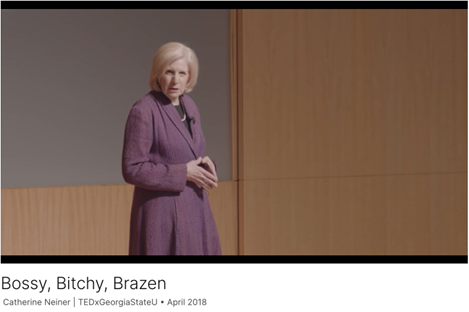
Thus, for our research project, we wanted to delve a little deeper into how men and women think about their careers. Our official research question was: Do college-aged women and men use different word choices and tones when speaking about their future career paths? In order to understand this question, let’s explore some past literature.
In previous studies of speech patterns among men and women, researchers found some evidence that women more often made use of cooperative feedback, supportive interruption, questions, accommodating behaviors, compliments, and hedging (Plug et al. 2021). They also found that, when gender identity was made salient to women in the experiment, these women used more tentative language (Plug et al. 2021).
Not only that, but further research also suggests that gender-based differences in language patterns are very common in the workplace. Kristen M. Getchell and Lauren Skinner Beitelspacher conducted research on language that was used to describe male and female CMOs through a Forbes article published in 2020.

They found that female leaders are often described in highly gendered ways that play up their nurturing or communal skills and downplay their agentic or leadership skills (Getchell & Beitelspacher 2020). Women were more commonly described as, “emotional,” “humanizing,” and “compassionate,” while men were more often described with words like, “powerful,” “confident,” and, “bold” (Getchell & Beitelspacher 2020). Because women are spoken about so differently from men in professional settings, we hypothesized that bringing up their careers would make this gendered difference more salient to female participants, which might cause them to speak about their future in a more traditionally “female” way. We hypothesized that these differences would emerge in our research as women use more fillers, hand gestures, and adjectives emphasizing interpersonal skills as compared to their male counterparts.
Methods
In order to investigate this hypothesis, we conducted semi-structured interviews with sixteen college students at UCLA (eight male and eight female). Our participants were selected using convenience sampling. It is important to note that this sampling method could make our results less generalizable. However, since each group member found participants from their own community at UCLA, we feel that we were still able to get a relatively diverse sample, ranging across many different majors and social backgrounds. Since these interviews were semi-structured, we went in with a set of questions but also allowed participants to talk about what they found interesting or important to them. Our questions related to what our interviewees hope to do after college, how confident they are in that path, why they’ve chosen that route, and more (see appendix for a full list of questions). We recorded the interviews so that we could truly analyze the body language and tone after all of the data was collected.
In order to analyze the interview data, we created a spreadsheet that listed different patterns and elements of speech that we expected to see, such as filler words or hedging. We then counted up each time we saw or heard one of these things in order to see if men or women would differ. We also paid special attention to which verbs and adjectives we heard the most from each group. We then looked at all of this data together and came up with our results.
Results and Discussion
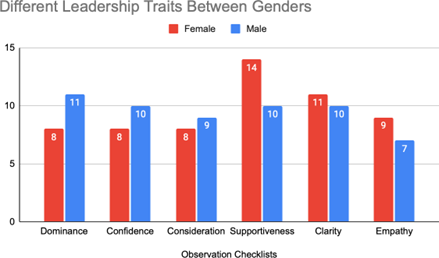
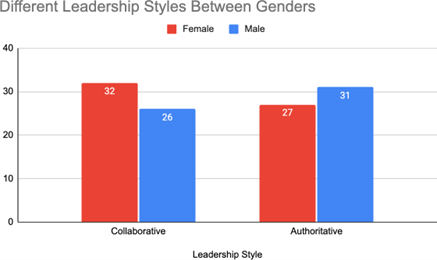
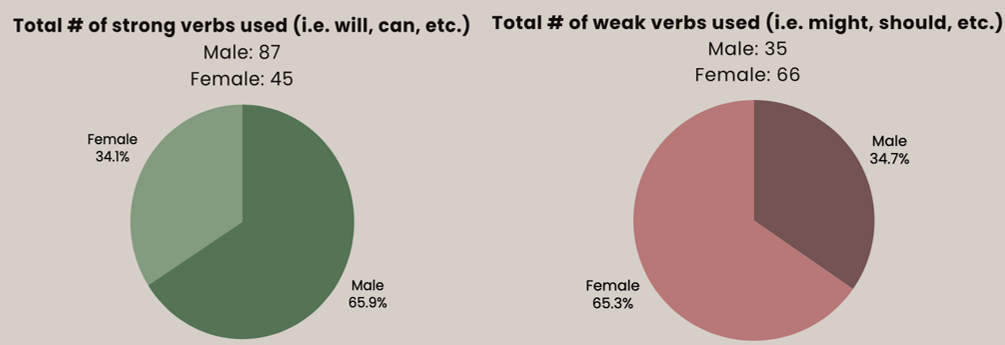
Based on our preliminary research, we hypothesized that college-aged women would speak with less certainty and use fewer words that emphasize power and more words that relate to compassion and emotion. And our findings showed just that. Our research showed that males were almost twice as likely to use ‘assertive’ verbs when speaking about their futures, with almost 66% making statements like: “I will be a doctor in five years”, as compared to only 34% of our female participants. Female participants generally used more modal verbs with approximately 66% of sentences using verbs like might, should, and could (i.e. “I might try to become a lawyer once I graduate”).
Our research also took note of participants’ body language as they were being interviewed. Most notably, female participants were on average almost 2x more likely to use filler words (i.e. um, like, uh) when speaking about their futures, with approximately 70 instances recorded across eight participants (as compared to 37 in males). Our researchers also qualitatively noted that their female participants used more hand gestures, facial expressions, and movements when speaking and that male participants made more continuous eye contact across interviews.
Further, our analysis extended beyond verb usage to explore the skills participants took pride in, revealing further disparities based on gender. While male participants often listed tangible, technical workplace skills such as proficiency in Python and Microsoft, females were more inclined to highlight intrapersonal competencies like creativity, organization, and communication.
Among other things, these findings suggest that gendered socialization processes may influence individuals’ perceptions of their strengths, with males more likely to prioritize technical skills and females valuing interpersonal abilities. These findings offer valuable insights into the underlying societal expectations that shape individuals’ career aspirations. The use of assertive language among males and tentative language among females highlights the existence of linguistic double standards, which may contribute to disparities in career advancement and achievement.
These findings offer valuable insights into the complex interplay between language, gender, and societal expectations, illuminating the subtle ways in which linguistic cues perpetuate gender disparities in career advancement and achievement. By addressing these biases at an early stage, we can foster an inclusive environment that empowers individuals to pursue their aspirations with confidence and determination, regardless of gender.
References
Getchell, K. M., & Beitelspacher, L. S. (2020). Better marketing for female marketers: Gendered language in the Forbes CMO list. Business horizons, 63(5), 607–617.
Plug, I., Radboud University, NL, Stommel, W., Radboud University, NL, Lucassen, P. L. B. J., Radboud Univ. Medical Centre, NL, olde Hartman, T. C., et al. (2021). Do women and men use language differently in spoken face-to-face interaction? A scoping review. Review of Communication Research, 9, 43–79.