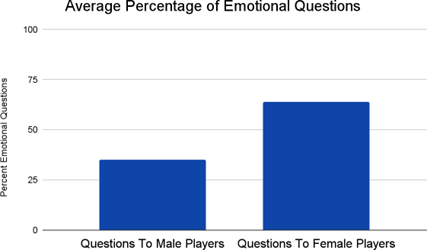
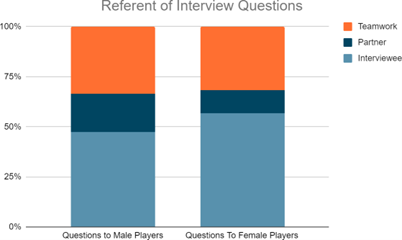
Gender Bias in Celebrity Interview Questions: Topic Study at the Oscars 2023
Sofia Duffy, Lauren Nemeh, Audrey Tseng, Venus Vu
Red carpet interviews at award shows are often a hot topic that circulates on the internet and are viewed by millions of people. This being said, the quality and nature of what is said in the interviews can wildly influence the viewers. Previous research and social movements have shown that female celebrities who participate in these interviews are more likely to receive questions and comments related to their appearance compared to their male counterparts. With this in mind, we aimed to investigate gender bias in celebrity interviews through analyzing interview clips of the 2023 Oscars red carpet interviews. Specifically, we examined if there were differences in the theme of questions asked (word choice) and the quality of interviewers’ voice (tone) when interviewing male celebrities versus female celebrities.
Introduction
Celebrity interviews on the red carpet hold a prominent position within the fabric of award shows, captivating global audiences as they eagerly seek glimpses into the lives of their beloved stars. However, within this realm, a disconcerting disparity often emerges in the nature of questions posed to male and female celebrities, serving as a reflection of deep-seated gender biases and the perpetuation of societal expectations. In our study, we set our sights on the precise queries directed at celebrities during the 2023 Oscars, embarking on an investigation to unravel the discrepancies in how interviewers engage with male and female celebrity interviewees. Through a meticulous analysis of interviewers’ word choice and tone, our objective is to cultivate a comprehensive understanding of the pervasive gender biases that permeate these high-profile interactions. In doing so, we aim to unearth patterns that mirror societal gender biases and shed light on the implicit biases harbored by the interviewers themselves. By undertaking this critical exploration of language use in celebrity interviews, we contribute to the ongoing discourse surrounding gender equality in the realm of entertainment and challenge the perpetuation of gender stereotypes on the illustrious red carpet.
Background
Celebrities hold a unique position in society due to their high-profile status and influence. The media coverage they receive significantly shapes public perceptions, particularly among impressionable children and teenagers who often look up to their favorite stars. Red carpet events are particularly important because they are televised occasions with substantial social significance. Among these events, the red carpet at the Oscars stands out as the most prestigious. Celebrities are asked a series of questions, and these interactions are recorded and broadcasted worldwide.
A study from 1956, “Age and Sex in the Interview” by Benny et al., offers valuable insights into the intersectional relationship between age and sex. Their analysis focuses on responses and utilizes post-interview surveys to gauge participants’ perspectives. Their research reveals a consistent pattern of communication inhibitions between individuals of the same age but different sexes, particularly among young men and young women. These findings underscore the complexity of interview interactions and the influence of societal expectations.
The Oscars red-carpet pre-show in question, with its apparent glamor and spontaneity, hides a reality that is heavily scripted and choreographed, where questions and reporters are carefully selected to meet industry demands and viewer expectations. Beneath the glamor of red-carpet lies a troubling tradition of objectifying the female body as a spectacle. Over the years, women have been typecast as the sole consumers of topics involving beauty and fashion, influenced by the rise of the beauty industry and photography (Lundén, 2021, p. 212). This has perpetuated a questionable tradition of objectification, reinforcing societal beliefs about gender roles. The red carpet has become a platform where women’s appearances are harshly criticized, focusing on mean-spirited evaluations of their bodies rather than celebrating their talent and accomplishments. Additionally, while women often bear the brunt of fashion-related questions, this does not exempt men from scrutiny. Fashion discourse has expanded to include men, but the discernible imbalance in how men and women are judged persists.
However, the emergence of the #askhermore movement in 2015 reflects a growing resistance to the recurring practice of asking women the superficial “what are you wearing” question on the red carpet. The movement encourages reporters to delve deeper and ask female celebrities more substantial questions beyond their clothing choices. In our research, we will concentrate on the questions asked to both male and female celebrities, shedding light on patterns that mirror societal gender biases and expected gender performance.
In the context of award shows, red carpet celebrity interviews hold great significance as they attract thousands of viewers seeking insights into the inner lives of these celebrities. However, the quality of questions posed to male and female celebrities differs significantly, with women often subjected to shallower inquiries about their appearance rather than their careers. The central focus of our research is to investigate the disparities in the treatment of male and female celebrity interviewees during the 2023 Oscars. Specifically, we aim to analyze the word choice and tone utilized by interviewers in their interactions with these individuals. By examining these linguistic aspects, we seek to gain a deeper understanding of the gender biases that manifest in celebrity interviews. Our research question revolves around whether interviewers hold implicit gender biases, leading to a tendency to ask female celebrities more superficial questions compared to their male counterparts. Through this inquiry, we aim to contribute to the broader conversation on gender equality within the entertainment industry and challenge the perpetuation of gender stereotypes on the red carpet.
Project Design
For our data sample, we selected 16 video clips from the 2023 Oscars red carpet. Since we are focusing on the gender difference of the celebrity, we selected 8 interview clips where the interviewee is a male celebrity and 8 interview clips where the interviewee is a female celebrity. To reach our sample size, we gathered video clips from three media sources: Extra TV, Vanity Fair, and E! News. In total, we analyzed 49 minutes and 53 seconds of interviews. The time varied from interview to interview, from an interview that was 41 seconds long to one that was 4 minutes and 49 seconds. We aimed to analyze whether there are differences in the interviewer’s tone and word choice based on the gender of the celebrities being interviewed. To do so, we first transcribed everything that was said by the interviewers. We omitted what the celebrities said to better focus on the style of the questions and comments and color coded the content according to these following categories:
- Word Choice (categorizing questions/comments according to theme)
- Red: career related questions/comments (e.g. film projects, experience working with co-stars)
- Blue: personal related questions/comments (e.g. family, love life)
- Green: fashion related questions/comments (e.g. outfit, makeup)
- Tone (categorizing questions/comments according to quality of interviewer’s speech)
- Yellow: serious tone
- Purple: playful tone
For the purpose of our study, we treated each categorization as mutually exclusive. Next, we counted how many instances each category was used in each interview and added them up according to the gender of the celebrity. We compared the number of instances between the two genders to see if there was any relationship between them. We also placed our transcripts into a word counter in an attempt to see if any significant words were used more or less in one gender over the other. In our collection and analysis of the data, we disregarded the gender of the interviewer as we solely wanted to focus on the gender of the celebrity in relation to the type of question asked.
Based on previous knowledge, we hypothesized that:
- Female celebrities will be asked more questions related to their personal life and fashion.
- Male celebrities will be asked more questions related to their career.
- Interviewers will use a more playful tone when interviewing female celebrities.
- Interviewers will use a more serious tone when interviewing male celebrities.
Data and Results
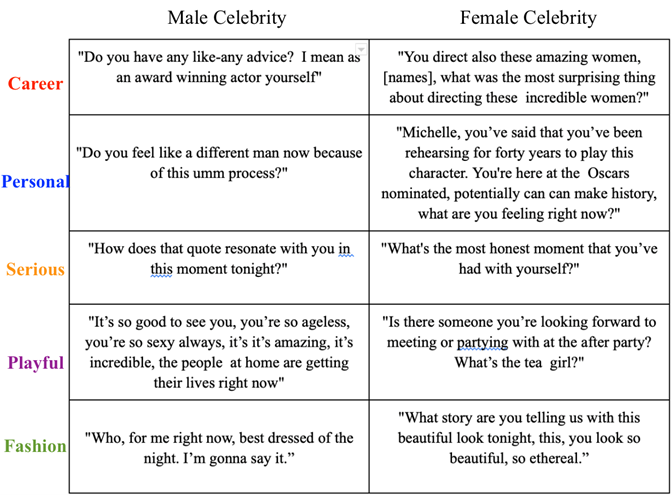
Before discussing the findings of our study, here are some examples of the types of questions/comments interviewers asked and how we categorized them. Each example is pulled from a different celebrity interview.
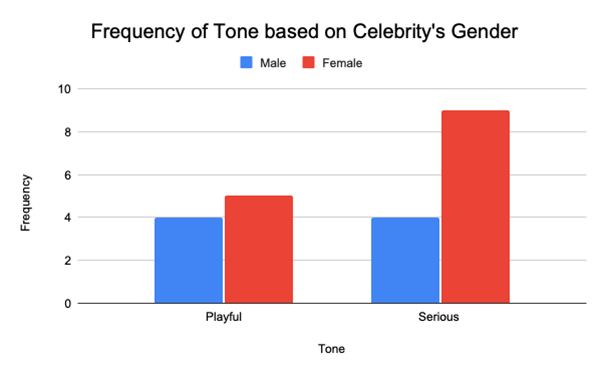
Here are our findings, separated into two bar charts. One chart is organized based on questions/comments that were categorized for tone, and the other is organized based on questions/comments that were categorized for word choice.
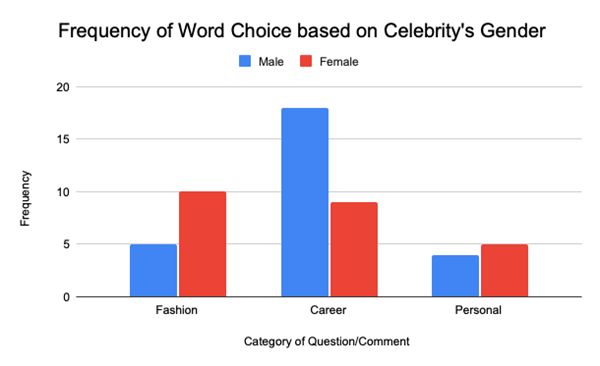
In terms of word choice categorization, female celebrities were asked twice as much about fashion compared to men, as we recorded 10 instances for women compared to 5 for men. Male celebrities were asked career related questions twice as much as women, as we recorded 18 instances for men compared to 9 for women. We originally predicted that female celebrities would be asked more questions related to their personal life, which was proven to be incorrect as the results were roughly equivalent. Women were asked five personal questions compared to four for men.
In terms of tone, we found that women were asked twice as many questions in a serious tone compared to men (9 vs 4). However, we originally predicted that interviewers would use a more serious tone when interviewing male celebrities. We also found that male and female celebrities were spoken to in a playful tone at roughly the same frequency, with 20 instances for men compared to 18 for women.
When we put the data into a word counter, which we separated by the gender of the celebrity, we did not find any significance in the density of words used for male versus female celebrities.
Discussion and Conclusion
As we previously discussed, while we did find slight differences in the types of questions that were asked to the male versus female celebrities in our data recording, our data was not all-revealing nor conclusive. While we did find that men were asked more career-related questions whereas women were asked more fashion-related questions, we are not able to use our data to conclude that this is true for red carpet interview events in general. Our data consisted of 8 male celebrity interviews and 8 female celebrity interviews, which is not a complete representative of red carpet interviews as a whole. Further research could be done looking at a variety of different events. It would be interesting to see how/ if the results change depending on if it is a music awards event, premiere event, awards event, small event, etc. Each red carpet could be researched as an independent study, to then later compare the data. This comparison would offer insight into how the different events influence the types of questions being asked to male versus female celebrities. Alternatively, a study could be done by taking a set amount of interviews from each red carpet in order to have an accurate data sample of red carpets as a whole. This would offer insight into the trends of the questions male celebrities versus female celebrities are being asked on red carpets as a whole. Moreover, in our study we only analyzed the questions that were asked to the celebrities and did not take into account their responses. Future studies could benefit from also analyzing the responses.
It is also important to note that for the purpose of our study, we approached gender in a binary way through only analyzing the interviews of female and male celebrities. However, gender is not binary, and there is plentiful research that could be done on how transgender, non-binary, and other identifying celebrities are approached by interviewers on red carpets. In particular, we believe that it would be insightful to research and analyze the red-carpet interviews of transgender celebrities before and after transitioning to see if there are any differences in the questions that the same individual is asked. One of our male celebrities, Austin Butler had an interesting response to being asked a fashion question about his tuxedo. He responded with “What story am I telling you? I mean this Saint Laurent and I don’t know what story I’m telling you,” (Butler, 2023). This response, and others, offer insight into the history and the “why” matters of the questions that are asked on red carpets and therefore would be a useful data addition to a project like ours.
In addition to what we have already mentioned, in reflecting back on our project we have identified some factors that could improve our research. First, we did not account for the length of the interviews we were analyzing. Therefore, if there are three career-related questions in a 2 minute video, and none in a 30 second interview, it would be an inaccurate comparison. In future studies, we would better control the interview lengths. Additionally, we did not control who the interviewer was. Reflecting back, we realize that the motive and employer of the interviewer could play a large role in the types of questions that are asked. In future studies, we would definitely control who the interviewer is. Doing so would also open up an opportunity for more research through analyzing and comparing the types of questions that interviewers from different companies and magazines ask. It is evident that our research serves as a good starting point and reference for future studies.
References
Benney, M., Riesman, D., & Star, S. A. (1956). Age and Sex in the Interview. American Journal of Sociology, 62(2), 143–152. http://www.jstor.org/stable/2773344
Brownlow, S., Rosamond, J.A. & Parker, J.A. (2003). Gender-Linked Linguistic Behavior in Television Interviews. Sex Roles, 49, 121-132. https://doi.org/10.1023/A:1024404812972
ExtraTV. (2023, March 12). Angela Bassett’s Kids Say Mom DESERVES Oscar Win (Exclusive). Youtube [Video]. https://www.youtube.com/watch?v=iM_bBHk-1HM
ExtraTV. (2023, March 12) Oscars 2023: Brendan Fraser Brings His Sons to the Red Carpet (Exclusive). Youtube [Video]. https://www.youtube.com/watch?v=dad48BVyR2A&ab_channel=extratv
ExtraTV. (2023, March 12) Oscars 2023: Colin Farrell’s Son Henry Says He’s a NICE Dad (Exclusive). Youtube [Video]. https://www.youtube.com/watch?v=WZRN4i0mIoo&ab_channel=extratv
ExtraTV. (2023, March 12) Oscars 2023: Miles Teller on Possibility of MORE ‘Top Gun’ Movies (Exclusive). Youtube [Video]. https://www.youtube.com/watch?v=BJMNzyb5Jtk&ab_channel=extratv
E! News. (2023, March 12). Oscars 2023: MUST-SEE Read Carpet Moments | E! News. Youtube [Video]. https://www.youtube.com/watch?v=-bu4OPD1PCM
Lawson, C. E., & Draper, J. (2021). Working the red carpet: a framework for analysing celebrities’ red carpet labour. Celebrity Studies, 12(4), 635-648. https://doi.org/10.1080/19392397.2020.1750969
Lundén, E. C. (2021). Twilight of the Idols. In Fashion on the Red Carpet: A History of the Oscars, Fashion and Globalization, 207–226. Edinburgh University Press. http://www.jstor.org/stable/10.3366/j.ctv1vtz84g.15
Mohammed, M. M., & Kadum, S. A. (2016). A Discoursal Analysis of Gender Differences in Selected English TV Interviews. Journal of the College of Languages (JCL), (34), 1-14. https://jcolang.uobaghdad.edu.iq/index.php/JCL/article/view/19
Nathanson, E. (2021). Aging on and off the red carpet: Joan Rivers, celebrity culture and postfeminist television. Celebrity Studies, 12(1), 51-66. https://doi.org/10.1080/19392397.2019.1608839
Vanity Fair. (2023, March 12). After the Awards with Vanity Fair. Youtube [Video]. https://www.youtube.com/watch?v=ncn7h59Ko-U
Wang, H. C. (2009). Language and ideology: gender stereotypes of female and male artists in Taiwanese tabloids. Discourse & Society 20 (6), 747-774. https://www.jstor.org/stable/42889296