Love Across Cultures: A Comparative Study of Verbal and Nonverbal Communication of Affection in Text Messages Among American and East Asian College Students
Yoonhye Kim, Yuka Tanaka, Asaka Minami, Eugene Jo, Zivana Ongko
Have you ever wondered why a simple text message can be interpreted differently by people from different cultures? We were curious about how cultural differences affect communication in romantic relationships and identify the causes of miscommunication among people from different cultural backgrounds. This study compares how college students from East Asian and American cultures express love through text messages and explores the cultural factors that contribute to these differences. The study surveyed 30 college students between 18-24 years old, consisting of 15 American students and 15 East Asian international students from China, Japan, and South Korea. Participants provided demographic information, self-reported love languages, and text message screenshots, and their language was analyzed as direct or indirect speech. Results showed that American students tend to express love through more direct language, using terms of endearment and direct declarations of love, whereas East Asian students use more indirect and implicit expressions of affection. The study highlights the cultural differences in the understanding of love and expressions of affection, shaped by norms, values, individualism, and collectivism. The findings suggest that cultural factors play a significant role in shaping linguistic expressions of love and the use of nonverbal cues in text messages.
Introduction
Love comes in many forms, and the means of communicating love vary across countries and cultures. This study aims to compare how college students from East Asian and American cultures express love through linguistic expression, specifically in text messages. The focus is on the directness of verbal expressions of affection and the contextual meaning of indirective expressions. Our research question is: “What are the differences in verbal (text) and nonverbal (emoji) communication in expressing love through text messages between college students in America and East Asian countries who have been in a romantic relationship for more than one month, and what cultural factors contribute to these differences?” We hypothesize that American students tend to express love through a more romantic language characterized by directness and expressiveness in their verbal expressions of love, whereas East Asian students may also be more hesitant to express their feelings directly (e.g., these students tend to respect cultural norms that value modesty and reserve in emotional expression). The use of nonverbal cues like emojis in text messages may be more prevalent in East Asian cultures due to their tendency to utilize an indirect style of language.
Background
Cultural differences in the understanding of love are shaped by norms, values, and expressions of love are influenced by individualism and collectivism (Kline and Zhang, 2008). American cultures are more passionate and erotic, while East Asian cultures tend to be more pragmatic. Individualistic cultures, like those found in America, tend to place a higher value on individual autonomy and self-expression, leading to a more open and expressive approach to love and relationships (Seki et al., 2002). In America, college students often use terms of endearment, pet names (e.g., sweetie, baby, babe, honey), and direct declarations of love in their text messages (e.g., “I love you,” “I miss you,” “Thinking of you,” “Can’t wait to see you,” “You mean everything to me”). In contrast, the collectivist cultures of many Asian countries prioritize interdependence and social harmony, leading to a more reserved and indirect approach. Students from East Asian countries tend to express love through a pragmatic love language, using more indirect and implicit expressions, such as indirect compliments or expressions of concern (e.g., “Did you eat,” “I will pick you up,” “How’s your day”).
East Asians tend to use emojis more frequently as a subtle way to express affection or interest, rather than relying on explicit statements. (Togans et al., 2021). Additionally, East Asians were “more careful in which emojis they used in situations, being more sensitive to show their concerns for others” (Johnson, 2021). Love is represented more directly in Western cultures which emphasize sexual communication and passion, while Eastern Asian cultures emphasize care and pragmatism. Gesselman et al. ‘s (2019) study found that emojis express complex feelings with a single symbol, enhancing successful intimate relationships. Frequent use of emojis is linked to stronger interpersonal connections and facilitates emotional expression in romantic relationships (Gesselman et al., 2019).
Methods
We aim to conduct a study on 30 college students between the ages of 18 and 24, comprising 15 American students and 15 East Asian international students from China, Japan, and South Korea. Our research will examine how these two groups differ in their use of verbal language, with regard to directness, as well as the use of emojis, in expressing affection through text messages. American students tend to express their emotions using direct language like “I love you” or “I miss you,” whereas East Asian students tend to use implicit expressions of affection like “Did you eat?” or “You must be tired today” and more emojis to convey their concern for their partner. Participants will complete a Google Form, providing demographic information and self-reported love languages used in text messages with their partners. They will have the option to submit text message screenshots and participate in a follow-up interview to give more context about their mood and situation when sending specific messages. We will inform participants that their responses will remain anonymous, and they can select the text message segments they wish to share, as well as delete or hide particular segments of their screenshots. For analysis purposes, we’ll sort the Google Form responses into two groups: American and East Asian students, then analyze their language to categorize it as direct or indirect speech. We had difficulty finding previous studies that offer clear-cut criteria for distinguishing between direct and indirect expressions of affection in verbal communication, so we developed our own. We define direct expressions of affection as those that convey affection even when the words are taken as they are, such as “I love you” or “I care about you,” while indirective expressions of affection are those that are less explicit in their phrasing yet manage to convey feelings of love through their tone or context, such as “Are you eating and sleeping well?”
Results and Analysis
Utilizing the data from our survey, we were able to generate the following figures that summarize results to key questions.
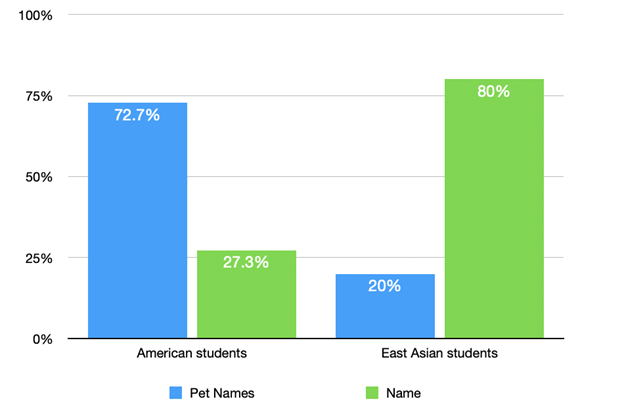
As seen in Figure 1, about 72.7 % of American students tend to use direct language and terms of endearment like “baby” or “sweetie,” while 80% of East Asian students use names to refer to their partners rather than pet names. Cultural differences can be observed in the way people refer to their partners, as evident from the varying practices between American and East Asian students.
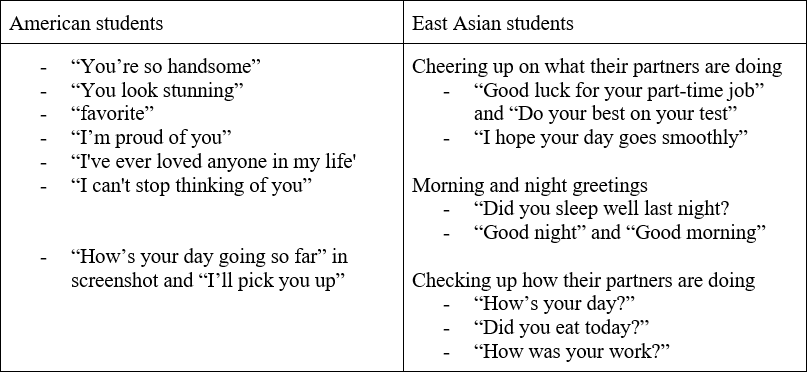
Using Figure 2’s data, we analyzed direct and indirect expressions of love in caring for one’s partner, and found that both groups show care and concern, albeit with different approaches. While Americans tend to use more explicit direct language, as we anticipated, such as expressing their love and thoughts toward their partners through direct compliments, Asians tend to use more indirect language, such as offering encouragement, sending morning and night greetings, and checking on their partners’ well-being daily. Interestingly, however, the expressions “I love you” and “I miss you” are frequently present in both American and Asian cultures. Additionally, Americans tend to employ more direct language, such as “looking forward to meeting you soon,” while Asians tend to use more indirect language, such as “I want the weekend to come already.” The use of different subjects in their messages also accentuates the contrast in directness.
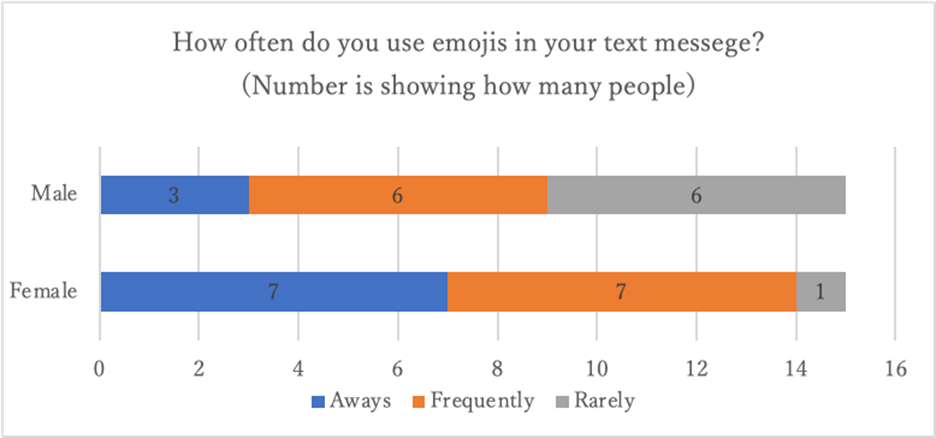
Lastly, we examined the differences in emoji usage between East Asian and American students, and the results were unexpected. Contrary to our initial hypothesis, cultural background had little effect on emoji usage, while gender and personality traits had more dominant factors. Additionally, we analyzed the use of emojis by gender, and Figure 3 illustrates that females used emojis more frequently and explicitly, often with a literal heart, while males used heart emojis combined with other images, such as 😍 and 😘. Interestingly, despite their tendency to use indirect verbal language, Asian students were not hesitant to use direct emojis like ❤️or 🫶to express love.
Discussion and Conclusions
The present study sheds light on the cultural differences in the expression of romantic love between American and East Asian students. Our results confirm that American students tend to use more direct language and pet names when referring to their partners, reflecting the culture’s emphasis on individualism and direct communication. These expressions allow individuals to convey their personal feelings and affection directly. Interestingly, both groups frequently use the expressions “I love you” and “I miss you,” indicating that these phrases hold universal significance in expressing romantic love. We also found that American students tend to employ more explicit direct language, while East Asian students use more indirect language, such as offering encouragement and checking on their partners’ well-being daily. In contrast to our initial hypothesis, we found that cultural background had little effect on emoji usage, while gender and personality traits had a bigger impact on the use of emoji.
Moreover, our study highlights the seeming balance of indirectness with words and more direct emojis used by East Asian students, challenging the common stereotype of East Asians as being overly indirect in communication. While it is challenging to draw a definitive conclusion, we have proposed several possible explanations for this phenomenon based on cultural and linguistic factors. Indirectness is often considered polite in East Asian cultures, while emojis can effectively convey emotions and meanings that are difficult to express in words. Even shy individuals may use emojis to express their affection and maintain a balance of love in text conversations. Understanding the nuances of both direct and indirect expressions of affection can help bridge communication gaps in these situations. The practical implications of this research extend to education and counseling, providing strategies to support students from diverse cultural backgrounds in their relationships.
References
Caldwell-Harris, Kronrod, A., & Yang, J. (2013). Do More, Say Less: Saying “I Love You” in Chinese and American Cultures. Intercultural Pragmatics, 10(1), 41–69. https://doi.org/10.1515/ip-2013-0002
Gesselman, Ta, V. P., & Garcia, J. R. (2019). Worth a thousand interpersonal words: Emoji as affective signals for relationship-oriented digital communication. PLoS ONE, 14(8), e0221297–e0221297. https://doi.org/10.1371/journal.pone.0221297
Johnson, C. (2021, November 2). New research shows that where we come from can influence our use of Emojis. Miami University. Retrieved February 16, 2023, from https://miamioh.edu/news/2021/11/new-research-shows-that-where-we-come-from-can-influence-our-use-of-emojis.html
Kline, Horton, B., & Zhang, S. (2008). Communicating love: Comparisons between American and East Asian university students. International Journal of Intercultural Relations, 32(3), 200–214. https://doi.org/10.1016/j.ijintrel.2008.01.006
Laursen, Furman, W., & Mooney, K. S. (2006). Predicting Interpersonal Competence and Self-Worth From Adolescent Relationships and Relationship Networks: Variable-Centered and Person-Centered Perspectives. Merrill-Palmer Quarterly, 52(3), 572–600. https://doi.org/10.1353/mpq.2006.0030
SEDIKIDES, OLIVER, M. B., & CAMPBELL, W. K. (1994). Perceived benefits and costs of romantic relationships for women and men: Implications for exchange theory. Personal Relationships, 1(1), 5–21. https://doi.org/10.1111/j.1475-6811.1994.tb00052.x
Seki, Matsumoto, D., & Imahori, T. T. (2002). The Conceptualization and Expression of Intimacy in Japan and the United States. Journal of Cross-Cultural Psychology, 33(3), 303–319. https://doi.org/10.1177/0022022102033003006
SPRECHER, & TORO-MORN, M. (2002). A study of men and women from different sides of Earth to determine if men are from Mars and women are from Venus in their beliefs about love and romantic relationships. Sex Roles, 46(5-6), 131–147. https://doi.org/10.1023/A:1019780801500
Togans, Holtgraves, T., Kwon, G., & Morales Zelaya, T. E. (2021). Digitally saving face: An experimental investigation of cross-cultural differences in the use of emoticons and emoji. Journal of Pragmatics, 186, 277–288. https://doi.org/10.1016/j.pragma.2021.09.016
Wilkins, & Gareis, E. (2006). Emotion expression and the locution “I love you”: A cross-cultural study. International Journal of Intercultural Relations, 30(1), 51–75. https://doi.org/10.1016/j.ijintrel.2005.07.003