Professor-Student Register Differences
Something students are conditioned to do is change the way they speak to people in power, specifically their professors. They want to sound knowledgeable and inquisitive, refraining from using slang, meme speaks, and overuse of filler words. One difference we were intrigued by was register changes in lectures. Register is defined as the style of speaking and writing distinguished by its formality, purpose, or audience. Key aspects include vocabulary/jargon, tone, or grammar complexity. This research explored how university students linguistically interact with their professors and classmates in upper and lower-division courses, focusing on register changes. Previous research in this field of study found that students who are fluent in two languages (English and French) use control processes to produce speech registers that are either formal or informal (Declerck et al., 2020). Our null hypothesis was that no difference in the register formality occurred between upper and lower-division courses. Our alternative hypothesis was that register changes were more significant, including the formality in upper-division courses through primarily observational methods and a supplemental survey. This research is important to analyze the way register changes can be impacted by a student’s conditioning and how professors can use this impact to reframe their lecture approach.
Background
Linguistic registers are characteristics of speaking or writing that can change situationally. These registers can reflect the speaker’s identity and the relationship between the speaker and the person they are speaking to (Agha, 2005). The observations made in upper and lower-division courses will let us know how students change their register formality and if this change is dependent on whether the class encourages a more formal register when responding to questions or communicating with one another.
Methods
Using Biber and Conrad’s guide on register analysis in Register, Genre, and Style as a reference, we approached analyzing linguistic register changes in university classrooms with the following steps:
- Note the environment and situation of the research setting and how these can affect the characteristics of observed registers.
- Record any register features that can be considered ‘normal.’
- Compare and contrast the average features of the register with features of the register that were observed to be situational.
To distinguish between formal and informal register in the courses we observed, we classified formal language as any language that had proper grammar, included references to some sort of study or concept, utilized terms that are appropriate to the subject matter, and language that demonstrates respect and formality through the use of a professional tone. An informal register was classified as any language that seemed more conversational or less structured, personal or subjective, did not include terms indicative of the class material, explained certain concepts in simple language, and used a more relaxed tone when participating in discussions.
Considering this method and understanding of registers, researchers attended in-person and recorded lectures at the University of California, Los Angeles, and office hours for select courses, accumulating data from twenty lectures. The lectures were chosen based on their lower or upper division status, two lower and two upper courses. In these settings, we expected to observe a difference in the linguistic register, with the hypothesis that students in upper-division courses had a more formal register because they were experienced and ready to enter the workforce.
The classrooms of the lectures we researched were situated with the speaker at the front, usually on a stage or near some podium with many seats facing forward. This arrangement establishes a sense of hierarchy, control, and power. However, the practice and enforcement of this hierarchy depended on how the professors taught and carried themselves along with the room. Some professors encouraged students to speak and contribute to the discussion, while others preferred to control the conversations to remain on schedule. Student-to-student conversations were minimal but still observed.
Our goal was to observe intently during lectures how students interacted with the professor and how that differed from the conversations amongst fellow students. Also, why was this difference significant, and what factors could influence this conditioned shift in speech behavior? To supplement our observational research, we asked students and professors a 5-question multiple choice survey to gauge how they felt about their register or how aware they were of it. The questions and choices were as follows:
- Do you know what a linguistic register is? (Yes/Somewhat/No)
- Do you notice differences in speaking in upper and lower-division courses? (Yes/Somewhat/No)
- Do you notice how your speech changes when discussing or conversing with your peers and professors? (Yes/Somewhat/No)
- Do you think factors like professor approachability, classroom size, and course subject influence how you adjust your language in an academic setting? (Yes/Somewhat/No)
- Are there words or phrases you use more frequently in an academic setting that you would not use elsewhere or vice versa? (Yes/Somewhat/No)
Results
Through careful observation, we noticed a significant change in the linguistic register in ten lower and ten upper-division lectures. This is in addition to the results of our supplemental survey, which revealed that students did notice a difference in their registers in their upper—and lower-division courses, noting that they indeed use a more formal register within their upper-division courses.
In upper-division courses, we noticed that students had more formal vocabularies and tended to express their ideas more structured and logically by referencing past concepts and citing where they got their answers or supporting evidence. As for lower-division courses, students used a more informal register, which led to students just trying to get their point across and ending their sentences in a way that made it seem as if they were unsure about their response. Students in lower-division courses also appeared to use words such as “um,” “uhh,” and “I think” more often than students in upper-division courses.
In a particular upper division course, the professor began every lecture by yelling “GOOD AFTERNOON” and expected a loud response, often requesting a redo if it was unsatisfactory. In an informal interview with this professor, she said it was to encourage students to have a voice in a large classroom. She stated that she would prefer a smaller classroom where they could be sitting in a circle. She often ended her lecture 30 minutes before class ended because she saw great importance in students discussing with each other and listening to different perspectives. This engagement was an attempt at breaking the hierarchical barrier of the class setting.
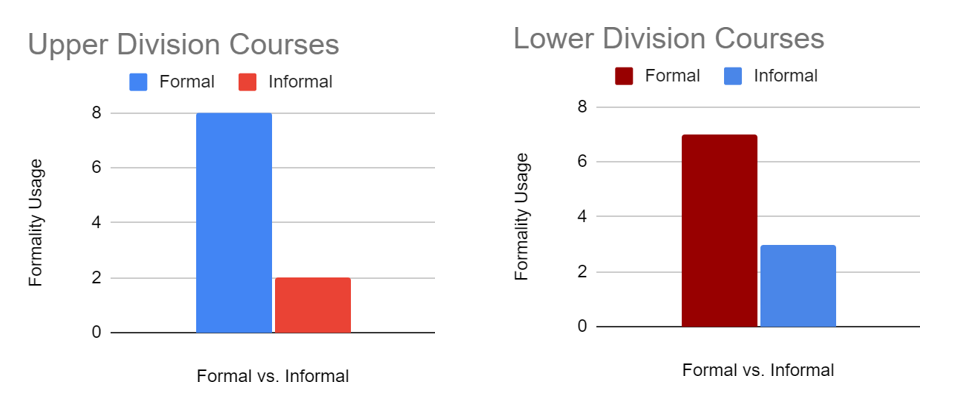
lower-division courses throughout ten lectures.
The graphs provided show the difference in formality between the upper- and lower-division courses we observed. Upper-division courses, for the most part, had formal register/language, while lower-division courses mostly had informal register/language.
Another interesting observation we noticed in both upper- and lower-division courses is that students who speak two languages and have a particular accent when talking to another student who may or may not share similar cultures seem to turn their accent off whenever they talk to an individual in a position of power, such as a professor or teacher assistant.
Analysis
These conclusions rejected our null hypothesis and supported the alternative hypothesis that there is a significant difference in the register used in upper-division courses versus those used in lower-division courses. Worth noting is that the reason for a more formal register in upper-division courses is the fact that upper-division courses necessitate the development of critical thinking, which requires students to express their ideas and responses in a more structured and logical manner, which further goes to show the complexity within the concepts seen in these courses. As shown in the graphs within the results, upper-division courses mainly used formal language, while lower-division courses used informal language. The bars on the graph that showed minimal informal or formal language in each respective course resulted from some days in the upper-division courses being relatively easygoing and not necessitating much discussion, while the formal register occurrences in lower-division courses happened as a result of professors making the student think critically about their answer and add to the discussion of the class on a specific complex concept.
Through this research, the discussion opens about how professors can facilitate change that empowers students to speak in their classrooms. With this knowledge, an improvement will likely create a better learning space while maintaining a professional register. The power dynamics do not have to be so stark that they intimidate students to not participate in lectures. However, professors should teach in a way that their course will introduce students to a more formal register early on in the course and gradually increase the emphasis on formal language as the course progresses. Especially in lower-division courses where informal linguistic register is standard, these changes will benefit students (more than likely first- and second-year students) in the long run, where future professional and academic environments will necessitate the use of formal language to express their critical thinking.
References
Agha, A., Duranti, A. (2005). Registers of Language. In A Companion to Linguistic Anthropology (pp. 23–45). https://cpb-us-w2.wpmucdn.com/web.sas.upenn.edu/dist/1/494/files/2018/08/19Agha2004RegistersOfLang-13dji2r.pdf
Biber, D., & Conrad, S. (2019). Register, genre, and style / Douglas Biber, Susan Conrad. (Second edition.). Cambridge University Press.
Declerck, M., Ivanova, I., Grainger, J., & Duñabeitia, J. A. (2020). Are similar control processes Implemented during single and dual-language production? Evidence from switching between speech registers and languages. Bilingualism (Cambridge, England), 23(3), 694–701. https://doi.org/10.1017/S1366728919000695
Goulart, L., Gray, B., Staples, S., Black, A., Shelton, A., Biber, D., … & Wizner, S. (2020). Linguistic perspectives on register. Annual Review of Linguistics, 6, 435-455.
Washington-Harmon, T. (2024, January 5). Code-switching has benefits and risks-but why do we do it? Health. https://www.health.com/mind-body/health-diversity-inclusion/code-switching