Makenna Grewal, Maryam Zakar, Genesis Maciel, Lauren Sadighpour, Ivelisse Castro
You’re standing in the crowded corner of Roccos, celebrating the end of this stressful quarter. A girl you just met smiles at you and says, “Wait, you are literally so pretty.” You immediately thank her, and your heart warms with appreciation…but you’re left wondering. Did she really mean it, or was she just being nice? Was it just a part of the social norm? Why do these moments feel so flattering yet strangely loaded? This exact confusion that most of us have experienced sparked our research. We set out to explore how compliments are used by undergraduate women at UCLA, comparing those involved in Panhellenic sororities and those who aren’t affiliated with Greek life. Our curiosity drove us to understand how something as simple as a compliment can carry layers of meaning, friendship, expectation, and even social power. Through surveys, we found that compliments aren’t just about being nice. They are tools that can sometimes be sincere, sometimes strategic, and sometimes expected to help women navigate identity, group belonging, and unspoken social hierarchies. (Figure 1: Regina George, played by Amy Adams, in movie Mean Girls)

Introduction and Background
At UCLA, Panhellenic sororities serve as hubs of social life, where language plays a significant role in shaping connections, identity, and a sense of belonging. The subtle yet powerful tool of compliments is crucial in shaping these interactions. But the common question is what exactly happens in these exchanges, and how distinct are they compared to women outside of the Greek Life bubble? This intriguing question led to a deeper exploration into the complexities of everyday communication among younger women. Frequently, sororities make headlines for their perceived social image, sisterhood, and extravagant events, but the nuanced day-to-day interactions that truly define these relationships often go unnoticed. Compliments are perceived as simple affirmations of admiration and are categorized as casual speech, yet they hold intricate layers of significance. They reinforce group cohesion, used as a tactic to navigate social hierarchies, and influence personal identities. After recognizing this unexplored realm, our study aims to compare these interactions between sorority-affiliated women and their peers outside the Greek community. This research is essential to identify the mechanics of social belonging while uncovering how power dynamics and identity negotiations occur in everyday conversations. To accomplish this, we have designed surveys and quantitative research methods focused on dyadic, or one-on-one, interactions among women aged 18-23. By analyzing their experiences, we strive to uncover whether sorority life uniquely shapes communication or if broader cultural factors influence all women’s interactions similarly. Ultimately, this research aims to gain a deeper understanding of how undergraduate women navigate their daily lives within various social structures.
Methods
To examine the use of gendered communication through the use of compliments among college women, our research employed a comparative study of undergraduate women at UCLA, focusing on two groups: women that belonged to sororities and those unaffiliated with greek life. Our goal was to explore how compliments, both verbal and nonverbal, function in how young women build relationships, reinforce identity, and negotiate social dynamics between these groups.
Our research utilized two separate surveys that asked the same questions, though distributed separately among sorority members and non-sorority members. The survey included both quantitative questions, such as frequency and context of compliment use and qualitative questions, for example, descriptions of specific instances in which compliments were given, exchanged, or received. The questions we included in the survey was designed to capture patterns among and between the groups, in addition to their individual perspectives of their lived experiences in this context. Participants were asked about their communication habits in everyday social settings, such as hanging out casually with other girls, social events, and through digital platforms, and how they perceive compliments to be used and received in those interactions.
Our analysis placed an emphasis on the observable elements of communication such as linguistic style, nonverbal behavior, and contextual cues. We applied thematic analysis to qualitative responses to identity recurring patterns in how compliments were used between the groups. The use of discourse analysis in our research enabled us to analyze the functioning of language and communication in reinforcing group norms or upholding social hierarchies. Lastly, comparative analysis was employed in our study to highlight the differences and similarities in the strategies of communication and the function of compliments used by both sorority and non-sorority women. By examining self-reported survey responses, we hoped to gain a thorough knowledge of how young women at UCLA manage social belonging and identity through gendered communication
Results and Analysis
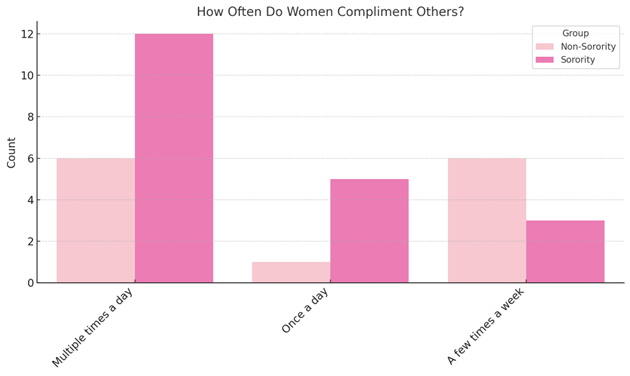
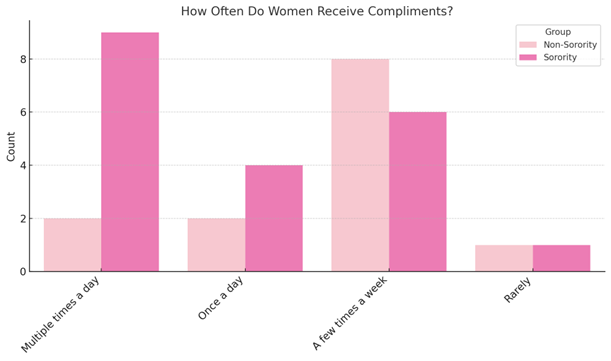
Sorority women report both giving and receiving compliments more frequently than their non-affiliated peers, with many engaging in this exchange multiple times a day. This elevated volume supports the idea that sorority life involves more frequent social interactions where compliments function as everyday tools for communication and cohesion. The constant flow of affirmations may reflect not only a culture of positivity but also an underlying strategy—compliments can be used to reinforce group identity, affirm social standing, or ease interpersonal dynamics. These patterns align with the project’s hypothesis that Greek life intensifies both the frequency and function of compliments, making them a central part of navigating relationships and maintaining one’s place within a tightly knit social hierarchy.
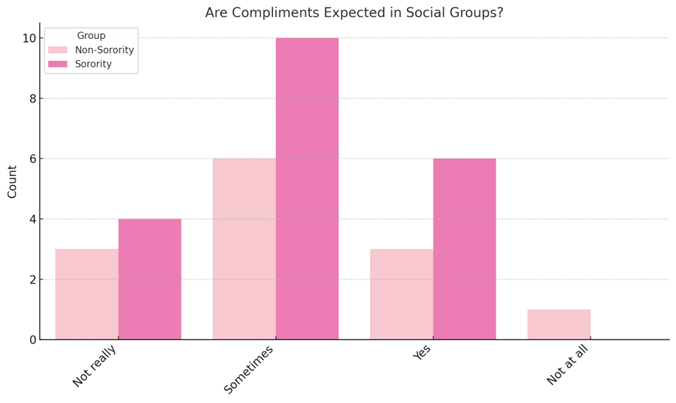
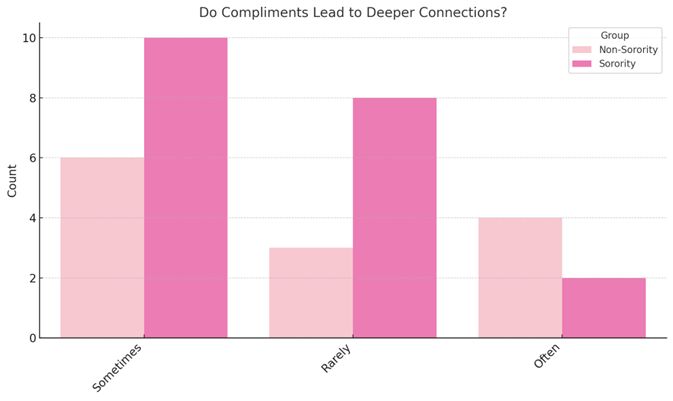
Sorority women more frequently perceive compliments as a social expectation, which suggests that these exchanges are not just spontaneous acts of kindness but part of a broader communication norm within their community. This expectation may foster a culture where compliments serve as a kind of social currency—used to maintain group harmony, affirm alliances, or smooth over tensions. Additionally, the finding that compliments more often lead to deeper conversations or bonding among sorority members reveals their higher social utility. Compliments in these settings appear to function as gateways to relationship-building and group integration, helping women establish rapport and navigate the layered dynamics of Greek life. In contrast, for non-sorority women, compliments may remain more surface-level, serving as gestures of kindness without necessarily opening the door to a closer connection.
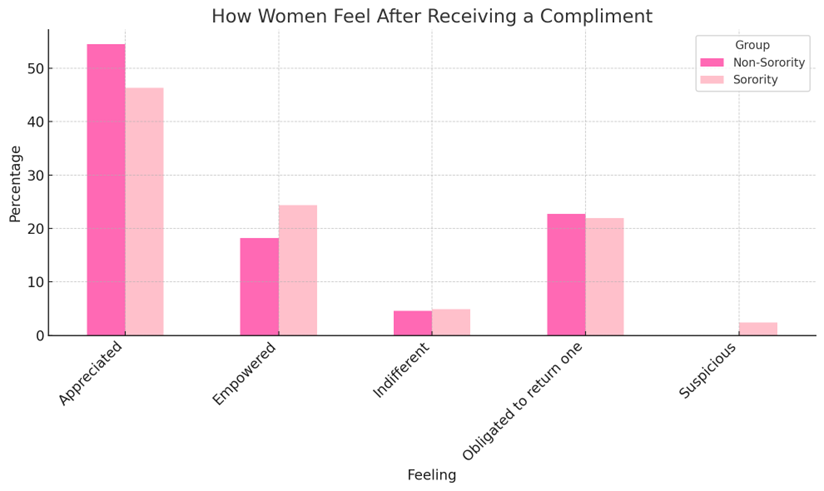
Both sorority and non-sorority women overwhelmingly report feeling appreciated after receiving a compliment, suggesting that affirmations are generally well-received across groups. However, sorority women are also more likely to feel empowered (50% vs. 30.8%), indicating that compliments may play a stronger role in reinforcing identity and confidence within Greek life. They also report feeling obligated to return the compliment more frequently (45% vs. 38.5%), hinting at social expectations or pressure to reciprocate. Notably, only sorority women reported feeling suspicious, which may reflect an awareness of strategic communication or unspoken power dynamics in their social circles.
Discussion and Conclusion
By examining the role of compliments among sorority and non-sorority girls at UCLA, this study contributes to a broader understanding of how compliments serve as mechanisms of social bonding and power negotiations in female social networks. It offers valuable insight into how gendered communication influences the way young women connect with one another. Popular media and television often depict female interaction as superficial or ingenuine, reinforcing dismissive stereotypes for comedic or dramatic effects. In contrast, our findings illustrate that language not only reflects social norms but also shapes relational dynamics within our social network.
This observation is supported by Ayers (2012), who discusses how compliments and seemingly kind remarks can also function as tools of relational aggression or competition, particularly among young women navigating subtle forms of power. Compliments, in this sense, are not always innocent; they can act as veiled strategies to assert dominance or reinforce group boundaries. Bryan’s (2013) research on sorority women reinforces this dynamic, illustrating how identity control theory plays out in Greek life through continual feedback—where compliments help regulate behavior and self-presentation within tight-knit groups. These findings align with our participants’ reports of both empowerment and pressure, especially among sorority members, who often experience compliments as part of a broader system of expectation, social maintenance, and inclusion.
Although the sample of young women is limited to UCLA specifically, the patterns observed in our findings support the phenomenon of power dynamics shaping female relationships across various social contexts and in fact challenge traditional assumptions about stereotypes embedded in sorority and non-sorority discourse. By recognizing the power compliments hold in day-to-day communication, the study helps highlight the significance female dynamics play in shaping social hierarchies and networks-demonstrating how language can elevate, encourage, include, and ultimately empower the bonds women create over time. Moreover, understanding these nuanced communication patterns encourages more mindful interactions that can foster genuine connection and challenge superficial stereotypes within female social networks.
(Figure 2: Chanel Oberlin, played by Emma Roberts, in TV series Scream Queens)

References
Ayers, Danielle, “Queen Bees: An Examination of the Mean Girl Phenomenon” (2012). Honors Theses. 767.
Bryan, H. (2013). The Sorority Priority: The Role of Interactional Feedback Mechanisms in Shaping Body Image in Sororities.
Frankenberger, W. R. (2024). Relational Conflicts Experienced Through Digital Platforms Among Generation Z Sorority Women (Order No. 31146923). Available from ProQuest Dissertations & Theses A&I; ProQuest Dissertations & Theses Global. (3068910761). www.proquest.com/dissertations-theses/relational-conflicts-experienced-through-digital/docview/3068910761/se-2
Rees-Miller, Janie. “Compliments Revisited: Contemporary Compliments and Gender.” Journal of Pragmatics, vol. 43, no. 11, Sept. 2011, pp. 2673–88. DOI.org (Crossref), doi.org/10.1016/j.pragma.2011.04.014.
Sasso, P., Manning-Ouellette, A., Bullington, K., & Price-Williams, S. (2024). White Girl Wasted: Gender Performativity of Sexuality with Alcohol in National Panhellenic Conference Sorority Women. Georgia Journal of College Student Affairs, 40(1), 32–61.