Hayden Hansel, Paige Runyan, Carla Bueno, Tallulah Blinn, Erin Marshall
The universally understood verbal pause, “uh” can be implemented across hundreds of languages. As a constant aspect in communication, discourse markers, also known as filler words, (these two terms will be used interchangeably) are words such as uh, umm, and like which act as pauses in speech to process thoughts. With the rise of casual and conversational styled online media, “uh” (and other markers) are heard now more than ever. We looked at five different Generation Z Influencers to see if different contexts of videos have different frequencies of discourse markers. This posed the question: which type of discourse marker has the highest frequency of use, and is there an association with the number of cuts in a Tik Tok video and the frequency of filler words? We found that there is an association between more informal videos and a higher number of discourse markers in our data set. The most frequent filler word used was the word ‘like,’ and in advertisement videos, we observed a trend of more frequent edits and a lower use of filler words[1].
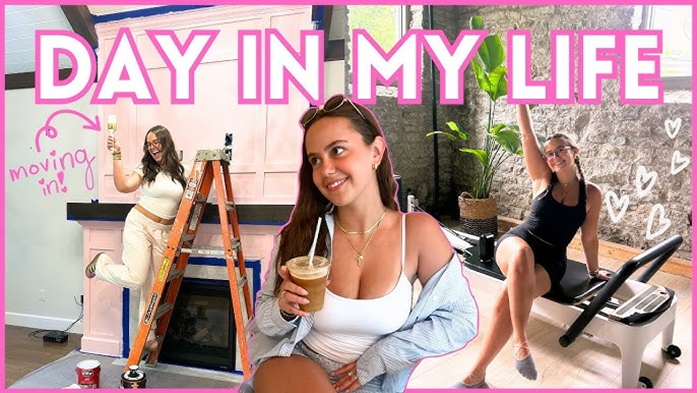
Image 1. Spencer Barbosa’s most recent vlog thumbnail showcases her approachable and relatable lifestyle content, reflecting the personal branding style typical of her online presence.
Image 2: TikTok app listing on the Apple App store with logo.
Introduction and Background
TikTok is a social media platform launched in 2016, becoming a globally popular app where users create and watch 5-second to 10-minute-long videos. TikTok uses an algorithm to curate a personalized feed of videos for each user on a “For You Page,” which distributes content. The algorithm prioritizes content of popular creators, leading to a rise in influencers who contribute to trends on the app. The video content varies greatly with marketing, influencing, political activism, comedy, and much more, attracting a wide range of audiences. In the U.S., TikTok has over 30.8 million active users daily, with kids averaging 75 minutes on the app daily (D’Souza, 2025). Demographically, 36.7% of its users are aged 18 to 24, and 52% are female. Notably, 60% of the influencers on TikTok are Gen Z age (Magnet, 2025). With Gen Z having a dominant influencer presence on the platform and females being the primary gender, we wanted to specifically observe Gen Z female influencers, looking at their language use.
Our study focuses on discourse markers, also known as filler words such as ‘um,’ ‘uh,’ and ‘like.’ ‘Um’ was added to the Oxford English Dictionary in 1672, but people used these pauses in speech long before by people of all ages, races, and backgrounds. (Thompson, 2021) (Keyes, 2017). Filler words originated as a pause for speakers to collect their thoughts but have evolved into a common habit in everyday speech. Psychologist Robert Ecklund estimates that up to six percent of our words act as “verbal punctuation” rather than conveying meaning, suggesting seemingly meaningless filler words serve great purpose in communication. With the rise of casual online conversations, like on TikTok, discourse markers can be more prevalently observed in our mainstream media.
Curious about the overall evolving use of filler words and Generation Z influencer’s dominance on TikTok, we examined the frequency at which Gen Z influencers on TikTok use filler words, specifically within different contexts of videos. We targeted Gen Z female TikTok influencers, ages 13-28, with over two million followers. We produced the following hypotheses:
- Influencers who produce “informal” content like “get ready with me” and “storytime” videos will have a higher frequency of filler words as opposed to advertisements, which are often formally scripted or influenced by a brand that sponsors the video.
- There will be a negative correlation between the number of cuts and the number of filler words used in a video, suggesting that editing in videos reduces the number of filler words[2].
Methods
The methodological approach to this project accounted for the TikTok algorithm and stylistic differences. We started a new Tiktok account for the five of us to view the specific content we were observing in order to avoid our own individually curated algorithms. Each member of our group selected an influencer with over two million followers to research. The five we focused on were: Britany Broski, Spencer Barbosa, Alix Earle, Katie Fang, and Lexi Hidalgo. We recorded data for one vlog video, one get ready with me video, one advertisement video, one beauty or makeup related video, and one storytime video for each influencer. We logged the influencer’s general description such as their name, username, age, and follower count. For each video we recorded the title, the view count, the length, the number of cuts and a count for each of the following discourse markers: like, um, uh, well, you know, I mean, basically, actually, literally, and “other”. We recorded the total number of discourse markers used per video, and the corresponding rate of discourse markers per minute. We analyzed 25 Tik Tok videos comprising 45 minutes of content. From here, we created graphs to further interpret and compare our collected data.
Results and Analysis
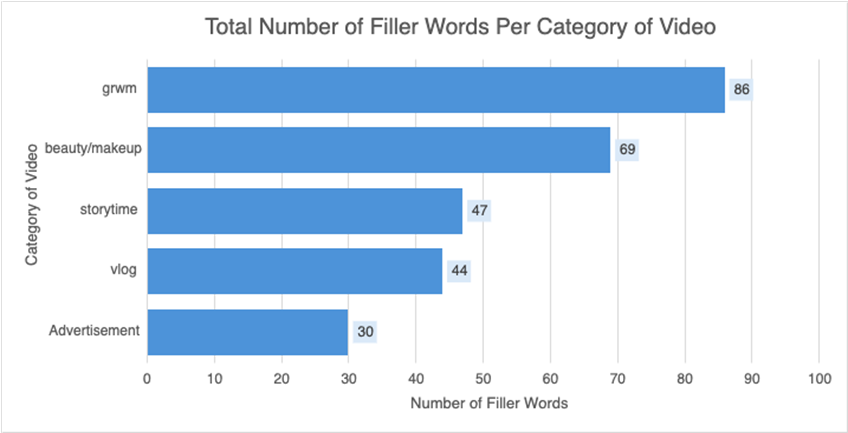
We observed the highest counts of filler words in the casual conversational videos. Get Ready With Me (grwm) videos had the highest average of filler words (15.8/video) and beauty/makeup videos had the second highest average (12.6/video). The category with the lowest average number of filler words across all influencers was the advertisement category (5.2/video).
Figure 1- Total Number of Filler Words Per Influencer in Each Category of Video. The graph shows the total number of filler words recorded for each individual influencerin each Tik Tok video category with beauty/makeup and get ready with me being the highest
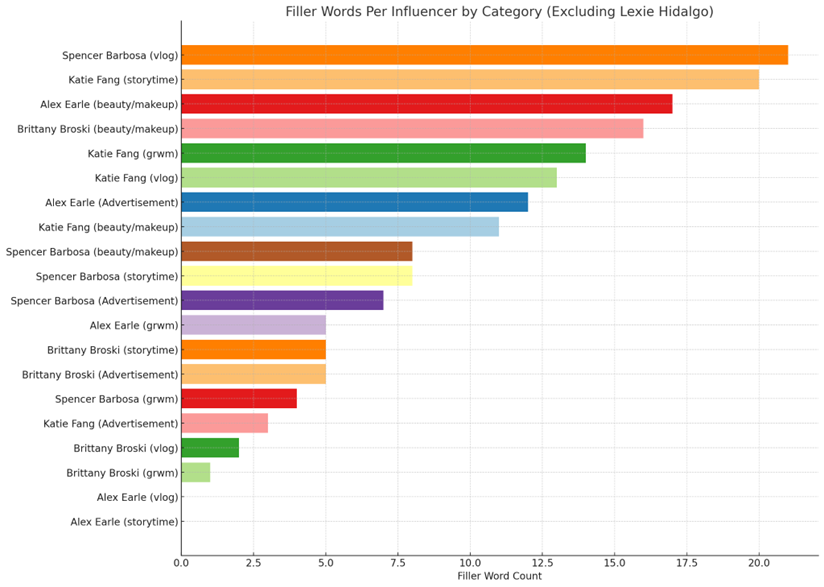
We noticed that Lexi Hidalgo had significantly more filler words than the other influencers in the dataset. To account for this, we looked at the results without her data and saw that the get ready with me still had the highest average number of filler words (17.25/video), meaning this type of video likely lends itself to more filler words in general. Without Lexi Hidalgo’s data, the lowest average number of filler words was also the advertisement category. We still see a pattern with beauty/makeup videos having the highest frequency of filler words and advertisements having the lowest frequency, even after accounting for our outlier.
Figure 2- Total Number of Filler Words Per Influencer in Each Category of Video (Without Lexi Hidalgo). This figure shows the total number of filler words for each category without Lexi Hidalgo’s data. The grwm category still has the highest average number of filler words.
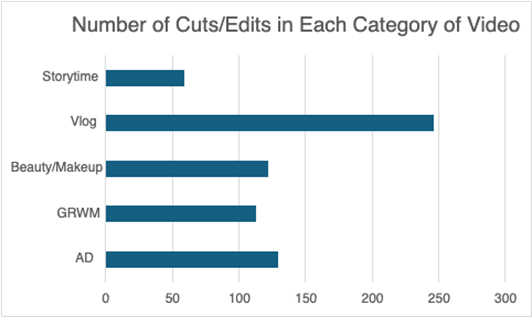
In addition, we observed the number of edits in each Tik Tok category. We hypothesized that more formal video contexts, such as advertisement videos, will have less filler words and more edits, because advertisements can be edited to communicate a branded message. We found that vlogs had the most edits, with a sum of 247 edits, and ads had the second highest with 130 edits. The category with the lowest number of edits was the storytime category, with 59 edits. This data supports our claim that videos can be intentionally edited to present an individual in a certain way. We see a trend with advertisement videos having the lowest average filler words recorded and the highest number of total edits in our data set.
Figure 3- Number of Cuts/Edits in Each Category of Video. The figure shows the total number of cuts/edits in the TikTok videos per category. We see that Vlogs had the highest total number of edits and ADs had the second highest.
While we see an association that influencers can edit videos to present themselves in a certain way, it is important to note the stylistic choices online creators can make. Despite the trend that advertisements have fewer filler words, influencers may intentionally choose to leave fillers as part of a stylistic package or preference. Also, we see that certain influencers have preferences in the words they use. For example, Brittany Broski had the highest recorded number of ‘uh/uhh’ across all of her videos in comparison to the other influencers[3].
Figure 4- Total Number of Cuts/Edits in Each Video by Influencer. The figure shows the total number of cuts/edits in the TikTok videos per influencer. We see that Lexi Hidalgo had the highest total number of edits
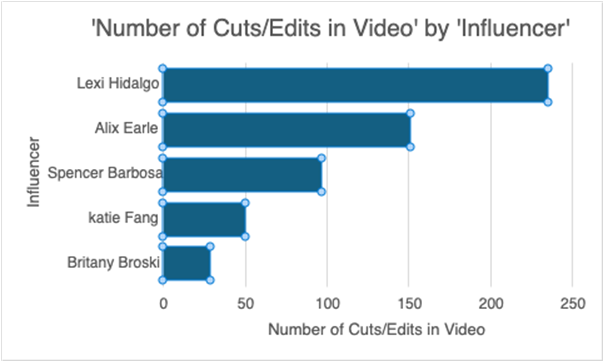
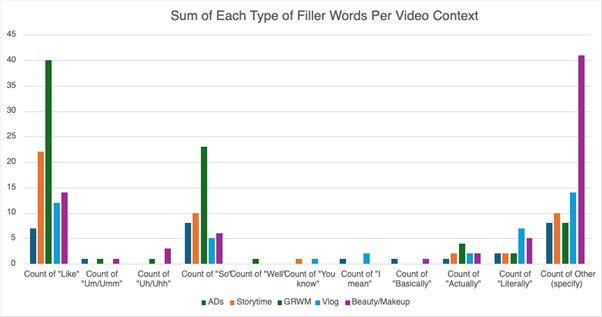
Figure 5- Sum of Each Type of Filler Words Per Video Context. The figure shows the frequency of each type of filler word in each category of video. We see that ‘like’ and ‘so’ had the highest counts in our data.
Discussion and Conclusion
One of the main patterns we saw in our data was that filler words were used much more in informal video types, especially in beauty and makeup videos and vlogs. These are the kinds of videos where influencers are speaking casually, often unscripted, and trying to connect with their audience in a more personal way. The most commonly used filler words were “like” and “so,” which help speakers sound more relaxed and relatable. Although we can’t say that informal video formats directly cause more filler word usage, we did see a strong association between the two. It’s also clear that each influencer brings their own style to the table. For example, Lexi Hidalgo had both the highest number of filler words and the highest number of video cuts; 235 in total. This suggests her fast, edited format and casual speech are part of a “stylistic package” that makes her content feel personable and conversational. On the other hand, Britany Broski didn’t edit her videos as heavily but used the filler “uh” more than any of the other influencers we studied. This shows that filler word use also varies by individual speaking style, not just the video type. Some influencers rely more on certain speech habits, and editing choices also shape how many fillers we hear. Factors like editing, video length, or whether the video is a voiceover versus real-time can all affect filler word counts. Just because an ad has fewer fillers doesn’t mean it’s because it’s an ad, it may also be more scripted or professionally edited. For future research, we could analyze how video length or editing impacts filler word use, and look at whether these words influence audience engagement; do more fillers make someone seem more relatable, and does that boost likes or comments?
References
Abrahams, M. (2021, April 23). “um, like, so”: How filler words can be effective in communication. Stanford Graduate School of Business. https://www.gsb.stanford.edu/insights/um-so-how-filler-words-can-be-effective-commucation
Barbosa, Spencer. (2024). “DAY IN MY LIFE (getting my new house & pilates)” [YouTube thumbnail photo]. Youtube. https://youtu.be/8KelCzKvt3w?feature=shared.
Bestvater, S. (2024a, February 22). How U.S. adults use TikTok. Pew Research Center. https://www.pewresearch.org/internet/2024/02/22/how-u-s-adults-use-tiktok/
Bosker, H. R., Badaya, E., & Corley, M. (2021). Discourse Markers Activate Their, Like, Cohort Competitors. Discourse Processes, 58(9), 837–851. https://doi.org/10.1080/0163853X.2021.1924000.
D’Souza, D. (2022, June 22). What is TikTok? Investopedia. https://www.investopedia.com/what-is-tiktok-4588933
Duvall , E., Robbins, A., Graham, T., & Divett, S. (n.d.). Exploring Filler Words and Their Impact- BYU. https://schwa.byu.edu/. https://schwa.byu.edu/files/2014/12/F2014-Front.pdf.
Erard, M. (2015, September 1). Pause fillers. The American Scholar. https://theamericanscholar.org/pause-fillers/The American Scholar
Lanzarotti, V. (2017, October). What does saying “like” say about you. YouTube. https://youtu.be/IstIqrAyS2I
Magnet ABA. (2024, December 31). TikTok statistics, facts & user demographics. https://www.magnetaba.com/blog/tiktok-statistics-facts-user-demographics
Muliadi, B. (2024, August 12). What the rise of TikTok says about generation Z. Forbes. https://www.forbes.com/councils/forbestechcouncil/2020/07/07/what-the-rise-of-tiktok-says-about-generation-z/.
Munaro, A., Barcelos, R., Maffezzolli, E., Rodrigues, J., & Paraiso, E. (2024, March 28). Does your style engage? Linguistic styles of influencers and digital consumer engagement on YouTube. Does your style engage? Linguistic styles of influencers and digital consumer engagement on Youtube. https://www.sciencedirect.com/science/article/pii/S0747563224000852.
musical.ly Inc. (n.d.). TikTok [Mobile app]. Amazon. Retrieved June 6, 2025, from https://www.amazon.com/musical-ly-Inc-TikTok/dp/B0117U0G3M
The Daily Free Press. (2011, April 13). Historically, the speech hesitation. https://dailyfreepress.com/04/13/11/177892/
Zhu, G., Caceres, J.P., & Salamon, J. (2022). Filler Word Detection and Classification: A Dataset and Benchmark. (arXiv:2203.15135v2 [cs.CL]).