Kayla Rezazadh, Elina Ghaem Maghami, Chloe Zhao, and Lina Muller
Parting ways is rarely ever easy, but how we decide to terminate a romantic relationship can speak volumes about who we are, how we process our emotions, and the ways in which gender norms have influenced us. In times of heartbreak, some people might pick up the phone and dial their number, or even write out a lengthy text message. Others may keep it brief, or even vanish without a word. In this project, we wished to investigate how men and women initiate and navigate romantic endings both in person and in the digital world. We sent out a survey that asked participants ages 18-25 about their past experiences breaking up and being broken up with, as well as hypothetical scenarios on how they would handle the termination of short-term and long-term relationships. By analyzing the method of communication, followed by body language, tone, and level of directness, we were able to uncover differences in the extent of emotional expression between young men and women.
Introduction and background
Breakups are rarely easy conversations, and how we communicate during them can profoundly shape the emotional outcome for both partners. Yet while much attention has been given to how relationships form, less is known about how they end and the role that communication plays in that process. In particular, gendered patterns in communication may shape how people express emotions, manage conflict, and seek closure when ending a relationship. Are women more likely to communicate openly and directly during a breakup, perhaps choosing a thoughtful conversation or in-person dialogue? And are men more likely to lean on indirect methods like ghosting or a quick text to avoid confrontations? Based on prior research and our observations, we hypothesized that these gendered tendencies would still appear among young adults today, even in casual dating and digital contexts. Prior research suggests that gendered socialization continues to shape how people manage difficult conversations. Women tend to report higher emotional expressivity and are more likely to value open communication (Ubando, 2026), while men often internalize norms that discourage emotional vulnerability (Cinardo, 2011; Drury, 1999). However, much of this work has focused on conflict within relationships rather than the moment of actually ending it. Our project seeks to fill this gap by exploring how gender influences the communication strategies on how adults choose when ending romantic relationships, especially in today’s digital landscape. Through this research, we hope to shape modern parting practices and how greater awareness of these patterns could foster healthier, more empathetic endings to relationships.
Methods
For our method, we created a Google form survey with 35 individuals between the ages of 18 and 25, and we presented our participants with four different hypothetical break-up scenarios, where each one varied by the length of the relationship. We proposed two hypothetical questions where participants would answer based on their preferred communication style if they were in a short-term relationship. Furthermore, we asked two hypothetical scenarios based on long-term relationships and what their communication style would be. The modes of communication we provided for the answers were digital versus in-person. According to “Gender and Conflict in Long-Term Romantic Relationship,” Hamlin conveys that “…another interesting component to improve future research includes examining how length of relationship impacts relational conflict and the type of conflict style exhibited in couples” (Hamlin, 2018). His assertion aligned with our method and findings that our goal in providing hypothetical scenarios was to elicit the modes of communication our participants would prefer when they were faced with relationship termination, whether it was short-term or long-term. Through this, we analyzed the observable elements of communication, whether that directness versus indirectness (ghosting, short messages, long messages, or phone calls) and their tone, whether they were more likely to be sympathetic with their partner or more apathetic. Through analyzing Ogolsky’s research he conducted on the the progression of college student romantic relationship, he found that “young adult relationships in the 21st century are deemed as overwhelmingly casual, with the termination of the relationship typically appearing at the 4th stage of dating labeled where conflict or obstacles either end or strengthen the relationship” (Ogolsky et al., 2025). This was useful for my group and me to examine more closely self-behavior and whether it was more common for a certain gender to be more indirect and less open in their communication style. Before presenting our hypothetical scenarios, we also asked our participants to reflect on their most recent relationship, specifically how it ended, who ended the relationship, and the form of communication used for the termination. We were able to compare whether their communication styles in their most recent relationship were similar or different from their responses in the hypothetical scenarios. Through using this method, we were able to analyze the observable elements of communication styles and analyze the differences and patterns across genders when it came to preferred communication styles in the modern dating world.
Results and Analysis
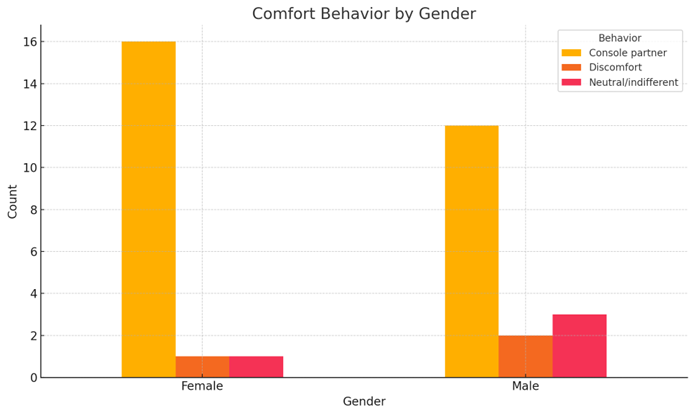
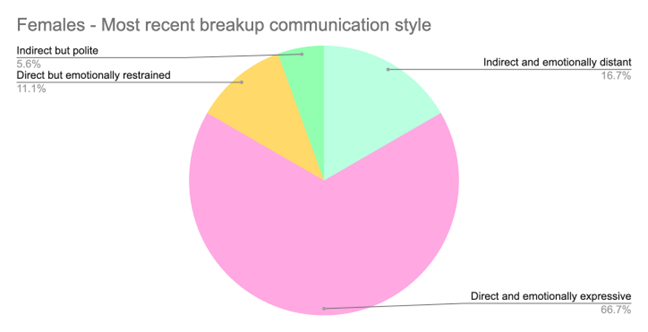
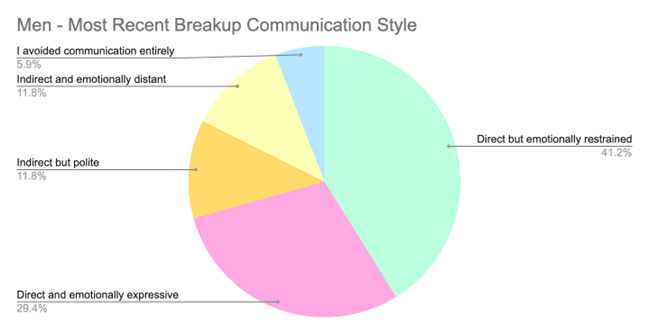
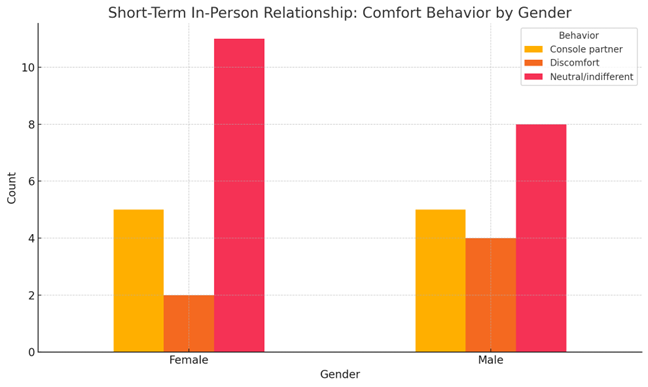
After conducting our survey, we found that our results were consistent with our predictions. It is a matter of fact – women are typically more emotional and expressive when it comes to relationship termination than men are. In our survey, one of the first questions participants answered was: How would you describe your communication style during the breakup? (In regards to their most recent breakup). Interestingly, 66% of women said they were direct and emotionally expressive, and only 11% reported being direct in their communication but emotionally restrained. Contrastingly, only 29% of men reported being direct and emotionally expressive, reporting much higher levels of emotional restraint at 41%. This fascinating difference truly illustrates a contrast in not only real-life communication but in personal approaches to termination. Further into our survey, we presented our participants with several example scenarios, two regarding in-person breakups and two regarding digital breakups. We asked them how they would react in that situation. Our short-term, in-person breakup scenario interestingly presented data contradicting our overarching argument. Here, we found that 29% (5 men) of male respondents would console their partner while 47% (8 men) would present neutral and indifferent body language. On the other hand, only 5 women also reported that they would console their partner, while an overwhelming 11 women said they would be neutral and indifferent. This goes against what we believed – illustrating that the men are more emotionally comforting when it comes to short term relationship termination. It is notable, however, that more men (4) reported showing discomfort in the scenario while only 2 women reported the same. When it comes to long term relationship termination in person, results differ as we had expected. Females showed the highest amount of consoling body language (16 women), while only 12 men reported the same. Men reported being neutral and different more frequently at 3 individuals, yet only 1 woman said the same. Such results are consistent with the findings of an article titled Language and Power in Politics. The article presents a graph which illustrates gender communicative structures – where women are typically empathetic, use emotional references, and use softened statements (Thomas et al., 2019). Men, on the other hand, tend to display solutions, use accusatory speech, and be angry (Thomas et al., 2019). Our results are consistent with these findings – and we can see that, overall, women tend to be more emotionally expressive on the basis of empathy and care than men.
Discussion and conclusions
Exposing levels of emotional expressivity and styles of communication when parting ways can reveal a lot about the way society has influenced us, especially in the way we succumb to traditional gender norms and stereotypes. A higher percentage of women self-reported that they would have open body language and console their partner regardless of relationship length, correlating to the higher levels of males self-reporting emotional restraint in past breakups. Displaying these patterns in extent of closure and vulnerability, both in real-life experiences from prior relationships and predicting behavior in future ones, can reveal how connected gender is to the degree of emotion presented in time of conflict. In connection to a larger phenomenon, particularly gender norms, men are stereotypically perceived as more indirect, cold, and distant in conflict. In contrast, women are often classified as more elaborate, empathetic, and detailed. After analyzing the data, it appears to mirror underlying notions of masculinity among men as they demonstrated much higher levels of emotional restraint. This not only influences the nature of the relationship itself, but also the ways in which women and men begin to reinforce distinct emotional languages as a result of gendered expectations. After investigating the impact of social conditioning in conforming to gender stereotypes when parting ways, it is important to encourage healthier methods of termination that speak more closely to the identity and desire of the individual rather than to obey the norms that police them.
Cross-References: Watch this to uncover hear about 5 differences in communication between men and women: https://www.youtube.com/watch?v=udAah5Lgx6o
This clip can provide guidance on closure after a breakup:
References
Cinardo, J. (2011). Male and Female differences in communicating conflict (Honors thesis, Coastal Carolina University). Digital Commons at Coastal Carolina University.
Hamlin, E. (2018). Gender and Conflict in Long-Term Romantic Relationships. Stars, 23-35. https://stars.library.ucf.edu/cgi/viewcontent.cgi?article=7045&context=etd
Ogolsky, B. G., Dobson, K., Rivas‐Koehl, M., Kawas, G., & Hardesty, J. L. (2025). The progression of college student romantic relationship development: Stability and change over 10 years. Personal Relationships: Journal of the International Association for Relationship Research. https://doi.org/10.1111/pere.12590
Thomas, S., Greene, E., Brewer, C., Dela Cruz, J. (2019). Language and Power in Politics: A Gender Stereotype Game. Languaged Life. https://languagedlife.ucla.edu/language-and-identity/language-and-power-in-politics-a-gender-stereotype-game/
Ubando, M. (2016). Gender differences in intimacy, emotional expressivity, and relationship satisfaction. Pepperdine Journal of Communication Research, 4(1), Article 13. https://digitalcommons.pepperdine.edu/pjcr/vol4/iss1/13