Cydney Jover, Daelyn R Johnson, Mia Dibono, Yexalen Casas, Ashanti Bracamontes
Over time, as a society, we have seen a general increase in online and digital communication. Since online communication has become more mainstream and a key format of expression that is universally common among society is the expression of laughter, the main focus here is the study of digital laughter in the form of specific expression, including “lol”, “LOL”, “haha”, “HAHA”, “hehe”, “LMAO”, or “😭”- to name a few. Typically, these phrases are used in social encounters digitally to convey laughter or humor. What we aim to acknowledge in this research project is how these specific phrases are used both similarly and differently as forms of digital laughter among Gen Z and Gen A communities. We wanted to dive deeper into how digital laughter slang can fluctuate in meaning depending on the social context, as well as the speaker’s generation or age. This research project focused on studying the sociolinguistic aspects of digital laughter and humor, as well as how specific phrases and emojis could indicate differing social meanings depending on specific factors, including generation, age, social context, and scenario.
Research Question: LOL vs 😂: How Digital Laughter Varies Across Generations
Introduction and Background
For this project, the target population will be Generation Z and Generation Alpha. Generation Z refers to those born in 1997 up until those born in 2012. Generation Alpha refers to those born in 2010 up until those born in 2024. With digital communication being one of the main sources of communication in today’s world, we want to explore how the two most recent generations, more specifically the younger generations, have become linguistic innovators. In these more recent generations, it has become evident that people now create their own rules for punctuation and have normalized not using punctuation (Guo, 2016). Both Generation Z and Generation Alpha have grown up using technology. From smartphones to social media to messaging platforms, both generations have been surrounded by technology as a main source of communication. In typical face-to-face communication, people physically show their emotions, whether they are happy, sad, excited, shocked, angry, humorous, etc. However, in today’s digital world, those non-verbal cues like facial expressions and vocal intonation are replaced by the use of emojis and expressions of amusement. The specific expressions we are going to focus on for this project are “LOL, LMAO, and HAHA,” and when they are being used by Gen Z and Gen Alpha, as well as certain emojis that pertain to humor. It is made clear that age is something that significantly impacts how emojis are classified (Chen et al., 2024). It is well established that textese are commonly used (Sánchez-Moya & Cruz-Moya, 2015). Both generations tend to use these phrases digitally quite often. “LOL” is an acronym that means laugh out loud, and over time, it has been used as a tone marker instead of an actual sign of laughter. “LMAO” is a more bold and exaggerated phrase to signal laughter, and “HAHA” is also used to express genuine laughter. Understanding the reasoning behind these linguistic patterns will allow for more expansive knowledge on how digital communication norms evolve and continue to grow amongst the new generations and today’s youth.
Methods
Our approach was to collect data using our two population groups. These participants were chosen due to their generational ages and the majority of individuals had relationships to the researchers. These relationships consisted of group members and included siblings, roommates, friends, classmates and cousins.
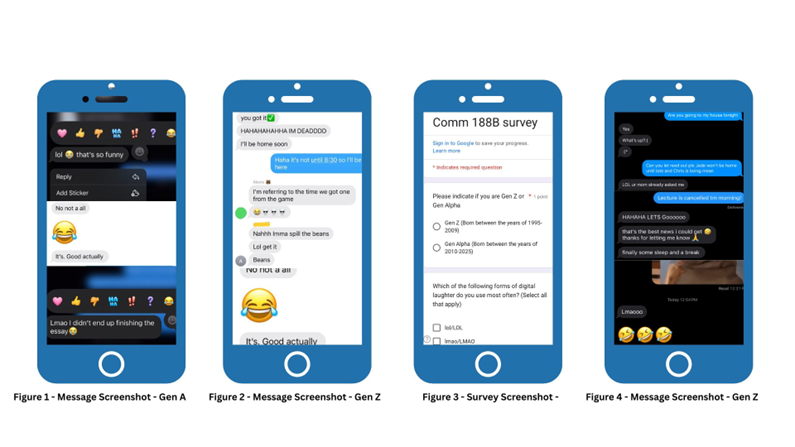
Next, the materials used throughout our research were observable data through screenshots of text messages and google form surveys to collect individual data. We first collected the observable data using real life conversations within text messages and organized these into the two generational groups. After collecting observable data we created google form surveys to either discredit or prove our origin hypothesis. The survey used the same questions for both generations and included 10 responses from Gen Z and 10 responses from Gen A participants. This survey began by asking those engaging in the study to indicate whether they are Gen Z or Gen A. Then, the succeeding question followed with a “Select All That Apply” to indicate which styles (i.e. lol/LOL, haha/HAHA, lmao/LMAO, 😭, 😂, 💀) of digital laughter they use. Additionally, the next questions after those included Likert scales ranging from (1) Not at All to, (5) Frequently. This scale determined the likelihood and frequency of each form of digital laughter and allowed us to measure the different forms of usage between each generation. The survey questions are specific to ensure detailed conclusions of responses, which changes in polarity to see visible opposing viewpoints. Although, due to using the survey method, the participants must have personal accountability to respond truthfully. All responses collected were anonymous and included all participants to agree on responses being used publicly.
Furthermore, the data collected within this methodological procedure was coded using all participants’ responses to understand the opposition among generations. Using the survey responses we divided each individual reply into Gen Z and Gen A categories. We then analyzed each form, marking down each response from all 13 questions. This is how we gathered the differences between frequency and style of digital laughter used in online communication styles between Gen Z and Gen A. This procedure allowed us to determine statistical data in which we could affirm or negate the hypothesis from our observable data.
Results and Analysis
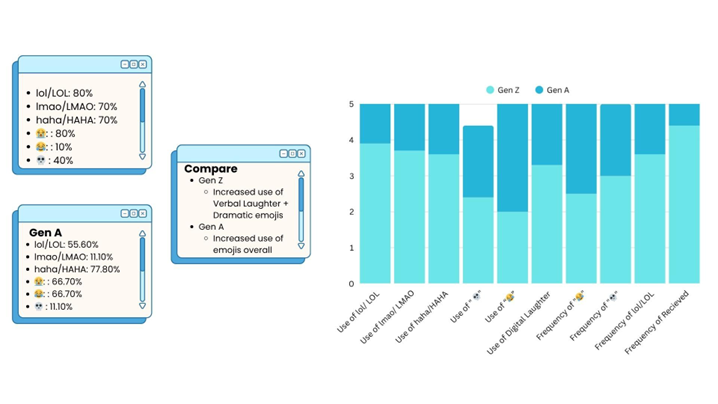
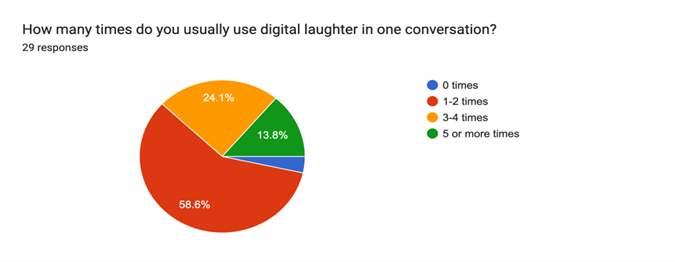
Through the collection of our data, we were able to confirm details within our hypothesis as well as gather new information that supported our research study. Our results suggested that while both generations profusely engage in online laughter, there is a difference in how they use it and in what forms. For example, results from our survey collection indicated higher use of overall online laughter particularly verbal laughter amongst Gen Z with phrases such as “lol/LOL” and “lmao/LMAO” receiving 70-80% usage compared to that of Gen A’s (55% and 11%). Gen A on the other hand relied on emoji usage more so than Gen Z. However as per survey data, Gen A participants were less likely to use digital laughter than their counterparts. These results were portrayed through our bar graph which compared digital laughter use among the generations with Gen Z represented in teal color and Gen A through blue. When comparing verbal laughter and emoji usage, our graph depicted patterns of Gen Z participants selecting verbal responses with ranging levels of 2-4 while Gen A participants selected fewer verbal responses and drifted to emoji usage at higher levels. As stated previously, these results aided in identifying patterns between the generations and noting the differences in expression through online laughter.
Based on the results, we see that while there are some differences between the two generations, there are no big differences. Usually when comparing 2 different generations, there are clear and distinct differences, often big ones. However, we found that the differences are hardly any and relatively small. The small differences can show how similar and closely related these 2 generations are in regards to digital communication and emoji usage. The gap between generations is not large, they have some nuances but it doesn’t stop them from effectively communicating with each other. Our findings show that both Gen Z and Gen Alpha frequently use digital laughter, but slightly differ in how and with what tone they express it. Emojis allow us to speak in ‘gestures’ through digital platforms and let conversation flow more freely (McCulloch, 2019). It is almost as if texting is the new speaking in-person in today’s day and age. While texting using digital laughter, in a study done on Whatsapp, researchers found that this turn-taking was similar to face-to-face conversations (Petitjean & Morel, 2017).
Discussion and Conclusion
Based on the results, we see that while there are some differences between the two generations, there are no big differences. Usually when comparing 2 different generations, there are clear and distinct differences, often big ones. However, we found that the differences are hardly any and relatively small. The small differences can show how similar and closely related these 2 generations are in regards to digital communication and emoji usage. The gap between generations is not large, they have some nuances but it doesn’t stop them from effectively communicating with each other. Our findings show that both Gen Z and Gen Alpha frequently use digital laughter, but slightly differ in how and with what tone they express it. Emojis allow us to speak in ‘gestures’ through digital platforms and let conversation flow more freely (McCulloch, 2019). It is almost as if texting is the new speaking in-person in today’s day and age. While texting using digital laughter, in a study done on WhatsApp, researchers found that this turn-taking was similar to face-to-face conversations (Petitjean & Morel, 2017).
As Gen Z college students ourselves, we are aware that the majority of Gen Z had a childhood without texting, but as we grew older, we started to text more using emojis and digital laughter as those evolved. While Gen Alpha grew up with texting, we wanted to explore if that dynamic made a difference in the use of digital laughter between the two generations. Early Gen Z are digital natives but vividly remember analog life. They’re the last generation who remembers what it was like to have a flip phone as their first device, use physical CDs or DVDs, write handwritten letters or notes, and live without constant access to everything online. Yet, they adapted to technology so quickly that they can navigate both analog and digital worlds fluidly. Gen Alpha however, cannot relate to that since emojis and digital laughter have been around since the beginning of that generation. For example, the “tears of joy” emoji, or the first laughing emoji was created in 2010, which is the beginning of Gen Alpha. Digital laughter amongst both generations is a crucial part of online communication and a way of expression.
References:
Chen, Y., Yang, X., Howman, H., & Filik, R. (2024). Individual differences in emoji comprehension: Gender, age, and culture. PLOS ONE. https://journals.plos.org/plosone/article?id=10.1371%2Fjournal.pone.0297379
Guo, J. (2016). Stop. Using. Periods. Period. – The Washington Post. The Washington Post. https://www.washingtonpost.com/news/wonk/wp/2016/06/13/stop-using-periods-period-2
McCulloch, G. (2019, June 1). Because the internet: Understanding the new rules of language. Explorations in Media Ecology. https://doi.org/10.1386/eme_00039_5
Petitjean, C., & Morel, E. (2017, January 25). “hahaha”: Laughter as a resource to manage WhatsApp conversations. Journal of Pragmatics. https://www.sciencedirect.com/science/article/pii/S0378216616302594
Sánchez-Moya, A., & Cruz-Moya , O. (2015, April 21). WhatsApp, Textese, and moral panics: Discourse features and habits across two generations. Procedia – Social and Behavioral Sciences. https://www.sciencedirect.com/science/article/pii/S1877042815013786