Ever watched a YouTuber cry and thought “This feels fake”? You’re not alone. As public figures rush to apologize online, audiences are becoming expert lie detectors — decoding every tremble, tear, expression, and “I’m sorry” for signs of sincerity. Our project explores how language, tone, and visual presentation influence audience perceptions of sincerity in these moments of crisis. Focusing on apology videos from Logan Paul, Laura Lee, and Colleen Ballinger, we will analyze how public figures use rhetorical strategies to rebuild trust. We will gather qualitative as well as quantitative insights on what makes an apology feel genuine or performative. Using frameworks such as interpersonal apology theory and image repair discourse, we will evaluate how verbal repetition, emotional expression, and appearance affect judgments of credibility and accountability. Our goal is to better understand how audiences interpret public apologies and what these reactions reveal about trust, vulnerability, and reputation in digital spaces. The problem(s) we intend to address are the following: How do public figures (Colleen Ballinger, Logan Paul, Laura Lee) use language, tone, and image (with both verbal and nonverbal methods) to influence audience perceptions of their sincerity in public apologies?
Introduction and Background
When deciding which videos to use for our analysis, there was an initial limitation to our study related to cropping longer videos for brevity and how that would affect audience perceptions of the apologies. With Colleen’s video, for example, we cropped her 10-minute video into a 4-minute video and decided that the middle of the video was a good way to gauge the overall language use. This decision aligns with Ambady and Rosenthal’s concept of thin slices, which suggests that people can accurately judge complex traits such as sincerity or emotional state from brief snippets of behavior. By focusing on a representative portion of the video, we aimed to preserve the essence of the apology while still enabling meaningful analysis grounded in the reliability of these short behavioral samples. (Ambady & Rosenthal, 1992)
Our contribution lies in bridging rhetorical analysis with audience perception, using YouTube apology videos as a case study to explore how sincerity is communicated and interpreted in digital spaces. By analyzing apology videos from these “influencers,” we aim to investigate not only what these public figures say, but how they say it (visually, emotionally, and linguistically). Our thesis is that public apologies are performative acts in which specific communicative choices (like a tearful tone, minimal makeup, or carefully crafted phrasing/scripting) shape whether an audience sees the apology as genuine or manipulative. This project sheds light on how the intersection of image, tone, and language affects credibility in the age of viral accountability and offers a nuanced perspective on the performance of remorse in online culture.
Methods
To examine how public figures convey sincerity in their apology videos, we selected three widely circulated YouTube apologies from the previously mentioned figures. We then distributed these clips to 30+ college students via an open-ended and multiple-choice Google form survey. Participants were asked to reflect on their impressions of the apologies’ sincerity, whether they believed the public figure should be forgiven, and what verbal or nonverbal elements shaped those judgments. Our analysis was guided by two core theoretical frameworks: interpersonal apology theory and Benoit’s image repair discourse (Sandlin, J. K. et al., 2018). Interpersonal apology theory, rooted in communication studies, outlines five key components of a sincere apology: Admitting fault – clearly acknowledging responsibility for the offense, Acknowledging harm – recognizing the damage done to others, Expressing remorse – showing emotional regret and guilt, Asking for forgiveness – signaling a desire to make amends, and Offering compensation or corrective action – providing a tangible or verbal commitment to change.
These components emphasize the relational and emotional dynamics between the offender and the audience, underscoring that sincerity is not just about what is said, but how it’s expressed. To evaluate rhetorical strategies, we applied Benoit’s image repair discourse theory(Sandlin, J. K. et al., 2018). This framework categorizes how individuals and organizations respond to crises through specific strategies, including: Denial (refusing responsibility or shifting blame), Evasion of responsibility (claiming lack of intent or knowledge), Reducing offensiveness (minimizing the severity or attacking accusers), Corrective action (promising to fix the issue), and Mortification (openly admitting guilt and asking for forgiveness).
These strategies are often used in combination and serve to repair the speaker’s public image. By identifying which of these strategies were present in the videos, we could compare them with how participants responded in terms of perceived sincerity and forgiveness.
We also paid attention to nonverbal and contextual cues, such as facial expressions, vocal tone, emotional displays (e.g., crying), clothing, setting, and even the presence or absence of makeup. These elements were analyzed to understand how visual and tonal choices contributed to the perception of sincerity, whether, for instance, a more casual appearance or a somber tone enhanced credibility. We used a dual-method approach to analyze how public figures use specific linguistic and visual strategies in their public apology videos on YouTube to influence the audience’s perception of sincerity, accountability, and forgiveness.
Results and Analysis
Drawing on Benoit’s image repair discourse theory and interpersonal apology theory, we performed a content analysis of the three YouTube videos, focusing on four specific aspects: the influencers repetition of performative verbs (“sorry” or “apologize”), their emotional appearance, denial, and personal presentation to help us better visualize and interpret the survey results (Sandlin, J. K. et al., 2018). We then used a Likert-type scale of 1-10 to measure our perceived perceptions of these four variables (see Table 1), rating 10 as the highest level perceived and 1 as the lowest level perceived. For example, in Table 1, Laura Lee received a 10 for Repetition Level of performative verbs, meaning she repeated the verbs “sorry” and/or “apologize” over ten times.
Table 1
Perceived level of linguistic and visual features in influencer apology videos (1 = low,10 = high). Levels rated are based on content analysis of all three apology videos.
| Logan Paul | Colleen Ballinger | Laura Lee | |
| Repetition Level of Performative Verbs | 6 | 1 | 10 |
| Visually Emotional Level | 5 | 2 | 9 |
| Denial Level | 1 | 8 | 1 |
| Personal Presentation Level | 1 | 3 | 1 |
Survey Results
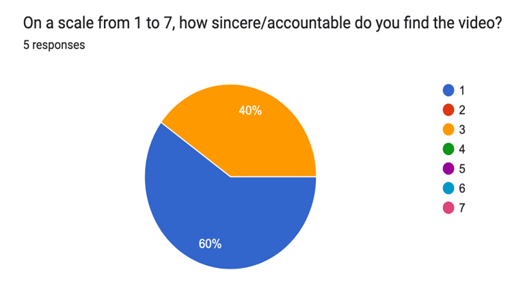
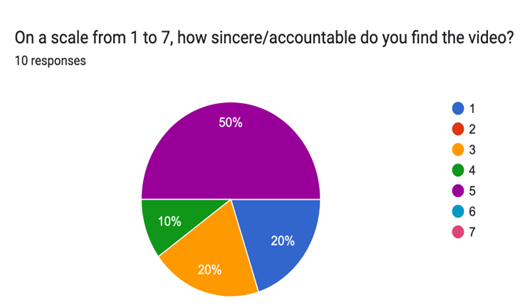
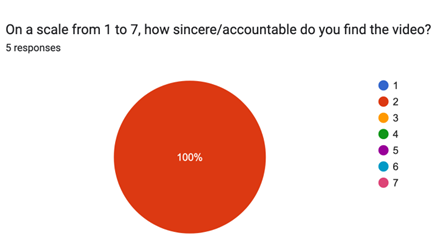
The other method that we used in our dual method approach was an open-ended online survey. To better visualize how the audience rated the sincerity/accountability of the video, we included one of the responses to our question asking the audience “On a scale from 1 to 7, how sincere/accountable do you find the video?” (1 = not sincere at all, 7 = took full accountability). Highlighting the most significant findings from this question, we found that 60% of surveyors did not find Colleen Ballinger to be sincere/accountable (see Pie Chart 1). We then found that 50% of surveyors found that Logan Paul was somewhat sincere/accountable (see Pie Chart 2). Finally finding that 100% of surveyors did not find Laura Lee sincere/accountable (see Pie Chart 3).
Pie Chart 1
Measuring audiences’ perception of the sincerity of Colleen Ballinger’s apology video (respondents either choose 1 or 3).
Pie Chart 2
Measuring audiences’ perception of the sincerity of Logan Paul’s apology video (here we see a bit more variation in responses).
Pie Chart 3
Measuring audiences’ perception of the sincerity of Laura Lee’s apology video (here we see a unanimous decision).
Measures of Audience Perception:
To better understand the significance of the survey responses and to have clear numerical data, we then used a Likert-type scale of 1-10 to quantify the audience’s free response answers (see Table 2).
Table 2
Audiences’ perceived level of sincerity, forgiveness, accountability, and their changed perception (1 = low, 10 = high). Levels rated are based on free-response answers from open-ended surveys.
| Logan Pual | Colleen Ballinger | Laura Lee | |
| Perceived Sincerity Level | 5 | 2 | 3 |
| Changed Perception Level | 2 | 1 | 1 |
| Forgiveness Level | 3 | 1 | 2 |
| Perceived Accountability level | 7 | 5 | 2 |
We, from quantifying audiences free-response questions into a Likert-type scale, were able to see a clear trend. In the videos where the influencers received higher numbers on our content analysis scale, audience members were more likely to rate sincerity levels lower. Meaning, influencers who were visually more emotional, used more repetition of words such as “sorry”, and who expressed more denial of wrongdoing, were found by the audience to have less sincere apologies. The audience was also likely to rate the accountability level lower (see Table 2). For Logan Paul, responses were more mixed, though they mostly leaned negative or unchanged. For Laura Lee, the majority of participants reacted very negatively, describing the apology as overly emotional, manipulative, or performative. Finally, for Colleen Ballinger, we found that the apology reinforced or worsened existing negative opinions, even if they had already stopped watching her (likely due to the use of a guitar and breaking out into song, which can come off as dismissive and playful during a serious situation). Overall, we were able to see that Logan and Laura took more of an interpersonal route of apology (5/5 components of IAT), whereas Collen was geared more towards image repair (4/5 components of IRDT), which heavily affected audience perception of sincerity.
Some things to note when looking at such apologies are that “The medium is the message”. This reminds us that how an apology is delivered (through a platform like YouTube) shapes audience perception just as much as the content of the apology itself. (McLuhan, 1964)
Discussion and Conclusion
In conclusion, we considered audience commentary on YouTube as part of the broader discursive context. Comment sections often revealed whether viewers thought the apology was believable or performative, and frequently referenced the public figure’s prior reputation. This ties into the two-step flow model, which suggests that public opinion is shaped not just by media content but by influential opinion leaders (for example; top commenters or media coverage) who interpret and amplify messages for others. We also acknowledged the mass-personal nature of YouTube apologies (where personal disclosures are made in mass communication formats) and how this shapes expectations of authenticity and vulnerability. (Lazarsfeld, Berelson, & Gaudet, 1944)
References
Choi, G. Y., & Mitchell, A. M. (2022). So sorry, now please watch: Identifying image repair strategies, sincerity and forgiveness in YouTubers’ apology videos. Public Relations Review, 48(4), 102226. https://doi.org/10.1016/j.pubrev.2022.102226.
Holmbom, M. (2015). The YouTuber : A Qualitative Study of Popular Content Creators (Dissertation). https://urn.kb.se/resolve?urn=urn:nbn:se:umu:diva-105388.
Ohbuchi, K.-I., Watanabe, N., & Narisawa, K. (2013). Effects of timing and sincerity of an apology on satisfaction and changes in negative feelings during conflicts. Communication Reports, 26(1), 2–11. https://doi.org/10.1080/10570314.2013.770160.
Uoti, K. (2022). Apology as a Speech Act Set: Apology strategies of social media influencers in the context of the Covid-19 Pandemic (Doctoral dissertation, Master’s Thesis, University of Turku]. UTUPub. https://urn.fi/URN:NBN: fi-fe2022042530307).
Matheson, B. (2023). Fame and redemption: On the moral dangers of celebrity apologies. Social Philosophy. https://epub.ub.uni-muenchen.de/108820/1/Journal_of_Social_Philosophy_-_2023_-_Matheson_-_Fame_and_redemption__On_the_moral_dangers_of_celebrity_apologies.pdf
Sandlin, J. K., & Gracyalny, M. L. (2018). Seeking sincerity, finding forgiveness: YouTube apologies as image repair. Public Relations Review, 44(3), 393–406. https://doi.org/10.1016/j.pubrev.2018.04.007.