Mariam Arafa, Bianca Richmond, Olivia Rubin, Sydney Steinger
In the workplace, a new female intern might wonder, Why does my male boss communicate with me so differently compared to my male coworkers? Our research explores this question. Communication in the workplace is not just exchanging information; rather, it reveals social hierarchies, implicit bias, and power and gender dynamics. This study focuses on how gender and professional experience influence communication in the workplace. Working off existing literature, we examine how men often use “report talk”, assertive and task-oriented communication, and women use “rapport talk”, communication based on connection and emotions. While we were able to find research on gendered communication patterns, studies were limited in addressing how age and experience alter these patterns. To bridge this gap, we conducted a survey and interviews targeting professionals of various genders, industries, and levels of experience. Our results defend three patterns: (1) same gender communication is usually more relaxed and informal; (2) supervisors speak more formally and respectfully when addressing more experienced employees; and (3) long-term employees that have an established relationship with their boss are addressed with continued respectful but less formal communication over time. Our study provides evidence that it is not just gender that shapes workplace communication, but also experience, which subtly impacts hierarchies and norms in professional interactions within the workplace.
Introduction and Background
Communication serves as a powerful tool to observe and interpret hidden messages. In the workplace, communication depending on various parts of one’s identity may affect roles, actions, or speaking styles in professional settings; specifically gender and level of experience influence how individuals speak and are addressed. Discourse plays a large role in language and gender studies “because many masculine and feminine aspects of speech emerge during communication” (Kizi, 2024). Social hierarchies and biases can be shown through something as simple as a different tone of voice or body movement. Our research dives into these different forms of communication by gender and level of experience of the employee being addressed.
Before conducting our own research, we searched for information that could be beneficial for us to evaluate to help make conclusions. Past research showed that women and men often use different communication styles; men use report talk, which is assertive and goal-oriented, while women use rapport talk, which places importance on connection and collaboration (Mohindra and Azhar, 2012). Relating back to the workplace, these differences can lead to how workers are valued and judged in professional settings. For example, rapport talk, typically used by women, is seen as less skilled than report talk, often used by men. Additionally, communication that stereotypically aligns with feminine traits is often overlooked in performance evaluations and leadership assessments (Chai, 2022). While we were able to find plenty of research examining communication by gender in the workplace, we were unable to find research that studied age and level of experience that influence communication in the workplace. We were curious to examine the intersection between experience and gender in the workplace. Do older, more experienced women get spoken to with more respect? Do newer female employees experience more condescending tones than their male counterparts? These are questions we were hoping to answer in our own research methods.
Methods
When conducting this study, we first formulated our hypothesis: “How do both gender and professional experience influence tone, word choice, and body language used by supervisors when addressing employees in the workplace?” We wanted to come to a conclusion regarding communication for those of different genders and different positions (hierarchy-wise) in workplaces. Our method consisted of conducting a poll via Google Form, asking our respondents the same set of occupation-based questions. Our questions began with basic intro topics: age, gender, and career experience. We then dove into more personal subjects, creating a list of yes or no questions surrounding communication within the workplace. The questions focused on how each participant is treated and addressed based on their gender. We chose to make each question very straightforward (not open-ended) to avoid any biases in the study. We chose to send this survey to four people each, two of each gender. We wanted to have an equal number of males and females in the study to make our outcome as accurate and honest as possible. We chose participants of all different ages and employment levels. Some were interns, some were in the service industry, some worked high-paying corporate jobs, and some even worked for themselves. The variation amongst every participant provided us with the most transparent results. By focusing on all different backgrounds and levels of experience, we could make a consensus about gender and many different workplaces in 21st-century America. Although our questions required a yes or no response, we focused our topics around rapport and report, displaying differences amongst age, sex, and gender.
Results and Analysis
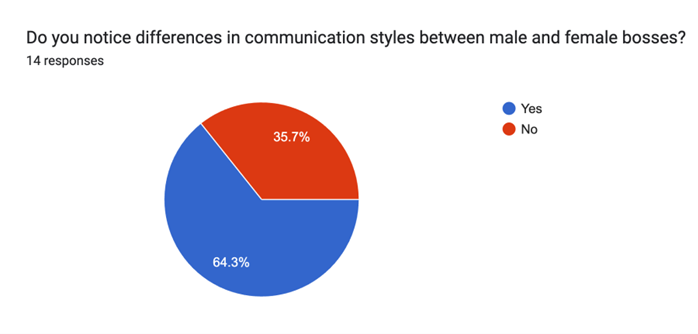
When our participants were asked if they notice differences in communication styles between their male and female bosses, 64.3% of participants replied “YES,” while 35.7% replied “NO.” One of our participants even shared that their female bosses tend to be more sincere and considerate, while their male bosses take a condescending approach in their workplace. (Johnson, 2017) This manifests itself in the specific tone used by one’s boss. We chose to ask questions about bosses of both genders to come to a consensus with report versus rapport talk. Report and rapport contribute to how each gender takes on an authoritative position, especially in an intense work environment. The results in this pie chart were supported by one of our participants, a young female intern. At the end of our survey, she wrote, “I feel like I get spoken to too harshly by my male bosses and that they give the guys that I work with much more leeway.”
Pie chart displays responses of different experiences between bosses of each gender
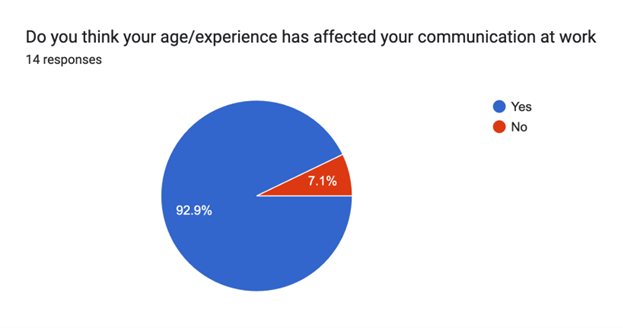
In addition to communication between employees and their bosses, we also factored in age to our questionnaire (as stated above). In gender-based studies, age often gets overlooked. Incorporating age as a question in our Google Form allowed us to connect the outcome to our predominantly gender-focused study. Age and gender are without a doubt connected, especially when it comes to male and female interactions on a professional level. When asking about age, 92.9% of our participants said that their age has affected their communication at work. That is almost our entire population, leaving out 7.1%. Age has a direct correlation with work experience, so it is bound to impact communication, how one is addressed by both their peers and authoritative figures, and even how they are perceived by others.
Pie chart displays correlation between age and communication in the workplaces
Younger employees are more likely to be recipients of condescending or belittling behavior. This connects to realistic factors such as lack of experience or deeper ones such as gender. Whatever the motives may be, it is inevitable that age has a direct connection to how one communicates and is communicated with in their workplace.
Discussion and Conclusion
Based on the results of our research, we found three main patterns in communication in the workplace between males and females. The first main finding is same-gender communication leads to relaxed and informal conversation. Our evidence illustrates how females engage in rapport talk over text and this is consistent with our survey findings because about 64.3% of our respondents reported differences in communication styles between male and female bosses. In an interview, we found that female bosses were perceived as less condescending and more considerate, male bosses were described as “more self-centered.” The second main finding is that Supervisors use more formal and respectful language when addressing experienced employees. We noticed patterns of tone shifts within text conversations. This aligns with our literature review where experience and age shapes the formality in the workplace, and a polite tone may emerge toward more seasoned women. This also connects with our survey findings because 53.8% rated a 4 or 5 (on a 5-point scale) in agreement that they were addressed differently based on age or experience. The third and final theme is long-term experienced employees are spoken to with continued respect, but less formality. We found that texts between male bosses and experienced male employees are more relaxed. This aligns with Holmes and Marra (2004), relational practice evolves over time and becomes less formal with workplace bonds, and Mohindra & Azhar (2012), men adopt direct talk (report) once relationship is established. This connects to our survey results because 92.9% said their age/experience affected communication. Qualitative responses such as “I tend to feel less comfortable with male bosses” reflect same-gender or familiar dynamics. Ultimately, with our research we focused on the differences of language, tone, and communication between men and women in the workforce. Our research highlights gender roles through a lens of language. We aimed to examine the differences in language use amongst themselves, their bosses, clients, colleagues, and especially how they are addressed by their peers. We emphasized tone, word choice, and body language as a whole. Our research question was: Are women addressed with different tones, word choices, and body language than men in the workplace? We hypothesized that gender would influence workplace communication and that women are more likely to be spoken to with different linguistic and behavioral communication when compared to their male counterparts. Our hypotheses were found to be all true as our survey results demonstrated same gender communication leading to more relaxed and information conversations, supervisors being more formal with older more experienced employees, and finally, experienced employees having less formal but still respectful conversations. Our findings imply that there is only a small amount of discrimination in the workplace through communication styles or behaviors among colleagues or bosses based on one’s gender or experience. Further, when one stays longer in one job, they attain more respect and are more lenient with their formality/conversation styles. Gender can cause more formal, serious tones and closed off body language between male bosses and female workers. This is because of gender perceptions of female competence and ability to get work done. Women have to work harder to prove their capabilities and this causes women to engage in rapport talk whereas men engage in report talk. Furthermore, our findings are important because it illustrates why men and women generally use different communication styles and how it can boost their status or job performance.
References
Mohindra, V., & Azhar, S. (2012). Gender Communication: A Comparative Analysis of Communicational Approaches of Men and Women at Workplaces. IOSR Journal of Humanities and Social Science, 2, 18-27.
Chai, Y. (2022). Implicit gender-biased speeches in workplace: Embedded stereotypes and effects on women’s Career Development.
Johnson, Stefanie K. “What the Science Actually Says about Gender Gaps in the Workplace.” Harvard Business Review, 17 Aug. 2017, br.org/2017/08/what-the-science-actually-says-about-gender-gaps-in-the-workplace. Accessed 05 June 2025.
Holmes, J., & Marra, M. (2004). Relational practice in the workplace: Women’s talk or gendered discourse? Language in Society, 33(3), 377–398. https://doi.org/10.1017/S0047404504043039
Ergasheva Nozima Khasan Kizi (2024). GENDER DIFFERENCES IN COMMUNICATION IN THE WORKPLACE. Eurasian Journal of Social Sciences, Philosophy and Culture, 4 (6-1), 171-175. doi: 10.5281/zenodo.12176621