Monique Tunnell, Lori Garavartanian, Marlene Ortiz, Melina Darlas
In the world of TikTok, where creativity knows no bounds, young Latinx creators are redefining what it means to connect through language. Spanglish skits on TikTok combine Spanish and English, making a perfect mix of hilarity and relatability. But these skits do more than just make us laugh, they create a sense of belonging for bilingual audiences navigating their cultural identities in a digital space.
Our study dives into the art of Spanglish code-mixing in TikTok skits to uncover how these creators build community through humor. By analyzing videos tagged with hashtags like #Spanglish and #Humor, we explore the linguistic features behind these skits—inter-sentential alternations and intra-sentential alternations. Focusing on Mexican and Puerto Rican dialects, we explain how these tools aren’t just random word choices; they’re powerful markers of identity and in-group solidarity. We see how viewers react to these humorous takes on bilingual life by looking at comments, likes, and shares and find that these skits are sparking conversations and fostering connections that stretch across the digital Latinx diaspora.
This research sheds light on why certain Spanglish patterns hit harder, gain more traction, and resonate deeper with audiences. Whether it’s through a hilarious Chicano slang twist or a clever Puerto Rican phrase, Spanglish on TikTok proves that humor isn’t just entertainment—it’s a bridge connecting identities, cultures, and people one laugh at a time.
Introduction and Background
Code-switching is a linguistic phenomenon that has consistently signaled community and group membership, in diasporas or otherwise. It is a feature of language that has often been used to show solidarity with other members of a marginalized group or to signal generational comradery. Persistent usages of code-switching have given rise not only to unique means of language usage, but to what some would consider entirely new languages. This can be seen not only through academic observations of bilingual speakers, but also through the lived experiences of those speakers. One particular space where both academic and personal reflections are abundant is regarding the usage of “Spanglish,” a unique combination of Spanish and English used by many in the Latinx community.
Previous research on Spanglish has found that in cities like New York City, Spanish-English bilingual youth have consistently reflected their cultural belonging and showcased their understanding of bilingual cultural norms through code-switching (Montes-Alcalá, 2024). These findings have helped build an understanding of how Spanglish is evoked as a cultural and social tool, rather than simply a linguistic phenomenon.
Personal narratives have also reinforced this perception of Spanglish as a cultural device. In speaking about her Spanglish usage during a Ted Talk, high school student Alondra Posada (2018) states that Spanglish helps people communicate, especially when they are struggling to learn both Spanish and English at the same time. She also states that Spanglish is a strong representation of both her American and Latinx communities, indicating that it helps her connect and feel comfortable within both elements of her identity. Spanish professor Dra Meduri Soto (2021) reinforces this concept when speaking about the U.S. Latinx community’s usage of Spanglish. She states that her relatives in Mexico usually admired Spanglish when they heard it spoken. She emphasizes that it was hard, if not impossible, to teach them Spanglish because she had acquired it organically as part of her American Latina identity. Generally, Spanglish speakers’ own conceptions and accounts of their Spanglish use reinforces its usefulness as a communication device that brokers understanding and a sense of cultural belonging.
Other studies have added onto this conversation by exemplifying how Spanish-English bilinguals have adapted their usage of Spanglish to other spheres, for example by using online content like memes to resonate with each other and with a broader Latinx audience (Dickinson, 2023). In the digital age, this usage of online resources has become increasingly significant, prompting one to wonder how community building via code-switching and Spanglish has been altered by social media apps and forums, as well as how digital connectedness has molded and shaped code-switching as a whole. These questions and qualms come at a time where content posted on Tik Tok specifically has taken the world by storm, allowing young people a new platform on which to gain popularity and connect with others. Existing research (Daulay et al, 2024) has already shown that code switching in Tik Tok and Instagram comments can shift subjects and showcase bilingualism between app users. Therefore, there is some basis to assume that platforms such as Tik Tok are already being used to create community and solidarity. However, not much is known, at present, about how specific linguistic strategies, such as intra-sentential switches or inter-sentential switches, function in TikTok’s humor-driven environment to build and sustain community connections. These key terms, as well as code switching as we use it in our research, have been defined in the following index:
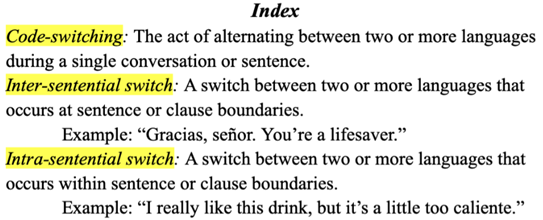
This study seeks to fill the gap in knowledge regarding social media code-switching tools by analyzing Spanglish TikTok skits, focusing on Mexican and Puerto Rican dialects, to uncover how creators use language to entertain, unite, and resonate with bilingual audiences. By examining linguistic patterns and audience engagement, this research sheds light on how humor and language intersect to strengthen cultural identity in a rapidly evolving digital landscape. Ultimately, the research poses the question of exactly how Spanglish in Tik Tok skits is building humor and community in the Mexican and Puerto Rican online communities and how engagement metrics are reflective of this.
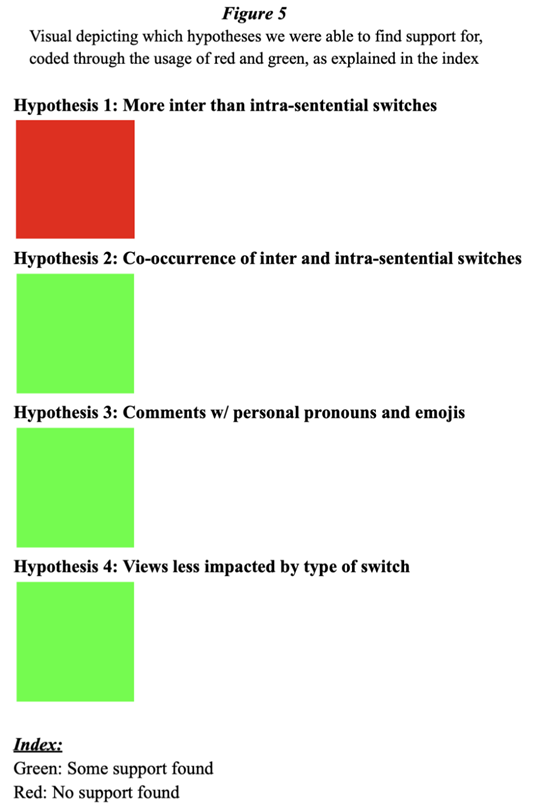
Before formally addressing this question, we had four personal hypotheses. For one, we believed inter-sentential switching would occur more often than intra-sentential switching. Next, we believed many videos would have both intra and inter-sentential switching. Third, we anticipated seeing many comments with personal pronouns and “humorous” emojis. Finally, we hypothesized that comments, likes, and shares would differ more than views when inter versus intra-sentential switching was used. These hypotheses were supported at varying degrees throughout our data collection process, as we will address.
Methods
To understand how bilingual people use Spanish and English in humorous TikTok videos, we picked eight content creators aged 18 and above who use skits and hashtags such as #Spanglish and #comedy. We watched eight videos where these creators mix languages, a practice we’ve already defined as code-switching. We counted how often they switched between languages and looked at two types of code-switches, both of which have also been defined above: intra-sentential switching and inter-sentential switching.
We studied how people responded to these particular videos by checking how many likes, comments, and shares each got. For example, we looked at what kinds of jokes people found funny, how many people saved the videos, and if they shared their own, often extremely similar, experiences in the comments. This helped us see which type of code-switching typically works best to make people laugh and relate to creators. We also noticed how creators used their language background, like “Spanish de rancho” and Puerto Rican Spanish, to connect with their audiences. By studying these videos, we aimed to learn how language blending can be a tool for creativity and connection.
Data Collected: Figure 1 showcases video analytics for a subset of the eight TikTok videos we analyzed for our results analysis. Figure 2 highlights types of code switching and examples of code switches utilized within the same videos. The five videos selected were the first five observed. Additionally, they included the videos with the highest numbers of code-switching, serving as valuable data to showcase.

| Video Number | Dialects | Views | Likes | Comments | Top Comment Themes |
| 1 | “Spanish de Rancho” & American English | 511.9k | 68.5K | 1283 | 1) Shared experience 2) Comedic effect, including mentions of laughter |
| 2 | Puerto Rican Spanish & American English | 263.5k | 67.3k | 205 | 1) Shared experience |
| 3 | Puerto Rican Spanish & American English | 92.4k | 7626 | 101 | 1) Comedic effect, including usage of “cry” and “laugh” emojis |
| 4 | Mexican Spanish & American English | 7.8M | 1M | 4599 | 1) Shared experience, particularly in familial settings |
| 5 | Mexican Spanish & American English | 1.1M | 156.5k | 857 | 1) Shared experience 2) Comedic effect, including usage of “cry” and “laugh” emojis |

| Video Number | Dialects | Number & Types of Code-switches | Example of code-switch |
| 1 | “Spanish de Rancho” & American English | Total: 28 22 intra-sentential 6 inter-sentential | “I told my patient ‘encuerate’” |
| 2 | Puerto Rican Spanish & American English | Total: 5 3 intra-sentential 2 inter-sentential | “Estamos buscando una pillow” |
| 3 | Puerto Rican Spanish & American English | Total: 8 6 intra-sentential 2 inter-sentential | “I cannot live in a caliente place” |
| 4 | Mexican Spanish & American English | Total: 3 2 intra-sentential 1 inter-sentential | “How to say ‘to tag’ in spanish” |
| 5 | Mexican Spanish & American English | Total: 15 15 intra-sentential | “I speak spanglish of course cuando se me olvida..” |
Tik Tok Analytics:
Tik Tok analytics were collected for various reasons. We wanted to see, more generally, how many views, likes, and comments Spanish-English creators were getting for their “Spanglish” centered skits and videos. More specifically, we wanted to be able to compare analytics between videos that used intra-sentential and inter-sentential switching to see if any one of them helped creators gain more popularity than the other. Within the eight total TikTok videos we observed, some words and ways of talking did seem to make videos more popular, garnering more likes and comments. It seemed as though solely using intra-sentential switching was less successful in pulling in likes, relative to the amount of views videos garnered. Figure 3, seen below, exemplifies this. As a note, the average ratios were calculated by taking the ratio of likes to views for each of the eight videos assessed and subsequently taking the mean amongst videos
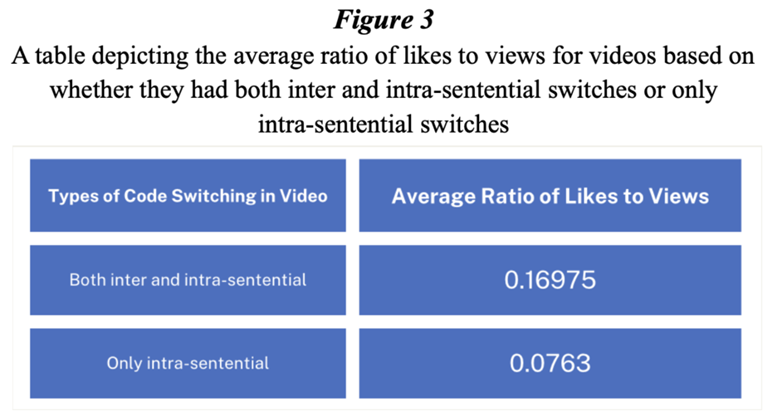
As can be observed within the figure, videos with both types of switches were over two times as successful at gaining likes when compared to their counterparts with only intra-sentential switches. The videos with both inter and intra-sentential switching often used both types of switches to mirror instances between Spanish speaking parents and bilingual children, occasions which likely evoke relatability. On the other hand, the TikTok videos where people mix Spanish and English in the same sentence didn’t get as many likes or saves, perhaps because they were harder for the audience to follow.
A more qualitative analysis of the video comments also revealed that the Tik Tok audience often uses words in the comments like “I”, “myself”, and “me”, because they are relating to experiences showcased in the videos. They additionally use emojis like “😂” and “😭” to show laughter or emotion. Sometimes, the audience even mixes Spanish and English themselves.
Other Results: After assessing our eight selected Tik Tok videos, we found the following, displayed in Figure 4:
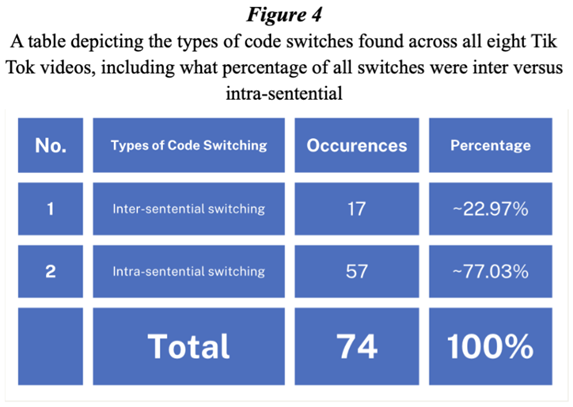
We borrowed methodology previously used in an analysis of code-switching in Instagram videos (Wiraputi et al, 2021). This method looks at not only the number of code switches, but also what percentage of code switches are of a certain type. The methodology we copied had “tag-switching” as well, an extra-sentential type of switching where a speaker inserts phrases from one language into another, but we did not notice the occurrence of tag-switching within our videos and omitted it as a result. The results that we did find showed a few interesting phenomena:
- When Spanglish Tik Tok creators code switch in videos, they typically do so more than once. In fact, the average across eight videos was 9.25 code switches per video.
- Intra-sentential switching dominates code switching occurrences, taking up over 77% of the code switching we witnessed.
- Co-occurrence was in fact common. Only two of eight videos or 25% of content observed did not have both inter and intra-sentential switching.
Having analyzed all our quantitative and qualitative data on video analytics, comments, and occurrence of code-switches, our results yielded the following consequences as far as our hypotheses are concerned:
Discussion and Conclusion
This study of Spanglish humor on TikTok revealed that young adult creators frequently use intra-sentential code-switching, particularly in Mexican and Puerto Rican dialects, to enhance the comedic and relatable quality of their content. Contrary to our initial hypothesis, intra-sentential switching was more prevalent than inter-sentential switching, indicating that the integration of Spanish and English within sentences may occur more commonly with bilingual audiences. Another key insight we came across was the ways in which community and identity building proceeds amongst the Latinx community in the United States. Prior to our studies, we had understood that Spanish varieties, such as that spoken in Los Angeles, are often characterized by convergence, borrowings, and switches (Sánchez-Muñoz, 2017). We had been curious about the role that convergence played on social media and on Tik Tok specifically and whether the blends we witness in real life translate to online spheres. Our analysis pointed us towards the observation that Spanglish serves as a vital tool for expressing cultural identity and fostering community solidarity online, making humor a bridge between bicultural experiences. We also noticed while studying engagement patterns that videos that incorporate both intra and inter-sentential switching see higher engagement, pointing to the idea that utilizing many different linguistic patterns within the same video boosts performance.
Some considerations we have for future research into this field is the generalizability of our findings. Since our findings are specific to TikTok and its user demographics, they may not apply universally across all digital platforms or linguistic communities. Comparative studies across different digital platforms and research completed over a longer period of time could explain how digital code-switching presents itself in other contexts. In essence, the study underscores the importance of linguistic flexibility in digital content, which not only entertains but also strengthens community ties among bilingual Latinx viewers.
References
Dickinson, K. V. (2023). What Does It Meme? English–Spanish Codeswitching and Enregisterment in Virtual Social Space. Languages, 8. https://www.researchgate.net/publication/374657133_What_Does_It_Meme_English-Spanish_Codeswitching_and_Enregisterment_in_Virtual_Social_Space
Hamidah Daulay, S., Husein Nst, A., Randia Ningsih, F., & Berutu, H. (2024). Code Switching in the Social Media Era: A Linguistic Analysis of Instagram and TikTok Users. Humanitatis Journal of Language and Literature, 10. https://www.researchgate.net/publication/383171193_Code_Switching_in_the_Social_Media_Era_A_Linguistic_Analysis_of_Instagram_and_TikTok_Users
Montes-Alcalá, C. (2024, April 15). Bilingual texting in the age of emoji: Spanish–English code-switching in SMS. MDPI. https://www.mdpi.com/2226-471X/9/4/144
Sanchez-Munoz, A. (2017). Tempted by the Words of Another: Linguistic Choices of Chicanas/os and Other Latinas/os in Los Angeles. https://www.researchgate.net/publication/345124311_Tempted_by_the_Words_of_Another_Linguistic_Choices_of_Chicanasos_and_Other_Latinasos_in_Los_Angeles
Soto, Dra. M. (2021, September 15). We Speak Spanglish ¿Y qué? World Outspoken. https://www.worldoutspoken.com/articles-blog/spanglish-its-who-we-are
Sanchez-Munoz, A. (2017). Tempted by the Words of Another:: Linguistic Choices of Chicanas/os and Other Latinas/os in Los Angeles. https://www.researchgate.net/publication/345124311_Tempted_by_the_Words_of_Another_Linguistic_Choices_of_Chicanasos_and_Other_Latinasos_in_Los_Angeles
TEDx Talks. (2018). Spanglish is a Language Too! | Alondra Posada | TEDxYouth@UrsulineAcademy. In YouTube. https://www.youtube.com/watch?v=6N8Zk_EY6G8
Wiraputri, D., & Sultara, K. (2021). Code switching found in cinta laura’s video on her instagram tv. Journal of Language and Applied Linguistics.