Ashlyn Howell, Caitlyn Nguyen, Elizabeth Williams
If you’ve never played water polo, watching a game can feel a little like listening to people speak another language, except they’re yelling it across a pool. Players often shout quick words like “set,” “drop,” or “press,” and somehow everyone in the water immediately understands what to do. But for outsiders, these terms usually don’t make much sense. This project explores how the language of water polo works and what it reveals about the sport as a community of practice, which is a group of people who develop shared ways of speaking through participating in the same activity.
Check out this video to get a better understanding on what a community of practice is: https://www.youtube.com/watch?v=XS1OhxXhOEM
To investigate this, we conducted surveys and interviews with people who had and had not played water polo, asking them to interpret common terms used during games. The results show a clear divide. Most participants without experience in the sport struggled to define the terms, while players recognized them instantly and connected them to specific strategies in the pool. These findings suggest that water polo language is more than just sports jargon, but it is part of the shared knowledge that helps players coordinate quickly during games while also signaling membership within the water polo community.
The main research question guiding this project is: How does sport-specific jargon in water polo function to facilitate efficient communication while simultaneously reinforcing group membership and excluding outsiders who lack contextual knowledge?
Keywords: UCLA water polo players, sports jargon, surveys and interviews, communities of practice
[expander_maker id=”1″ more=”Read more” less=”Read less”]
Why did we study this?
For our research project, we specifically focused on water polo players and non-water polo players at and around UCLA. We identified specific language choices among the community of water polo players, and then sought to determine if non-water polo members could understand and participate in this language exchange to test our hypothesis of group specific lexical choices.
Prior research by Eckert and McConnell‑Ginet (1992) describes a similar kind of setting as a community of practice and found that people build local norms and identities through what they regularly do together, including how they talk. Bucholtz (2002) adds that youth and young adults actively shape who they are through everyday cultural practices. Given this past research, we treated water polo slang as one of the tools players use to signal who belongs and how they see themselves in relation to their teammates and non‑athletes. Ishak’s (2017) review of sports communication supports the idea that clear verbal and nonverbal signals are crucial for coordination, cohesion, and role performance on teams. This relates to our idea that having a shared vocabulary is foundational to how players successfully organize themselves in games and practices. Heath’s (2024) study of a UK swimming club shows that banter and shared jokes can help athletes cope with boring or intense training while also drawing boundaries around who is identified as an insider. Schei et al. (2023) finds that when athletes strongly identify with their team and coaches practice identity leadership, intra team communication becomes more effective and supports task cohesion, suggesting that feeling like part of a “we” is tied to how people talk to each other and how information moves through the group.
Commonly used terms in waterpolo help create efficiency for players who share the same background, but these terms can sound insulting, confusing, or even nonsensical to non water polo people who are only interpreting the words based upon their literal definition. This was the basis for our hypothesis of what we would see in our group interviews, and in our surveys from non‑water polo players.
How did we do it?
For this project, we combined an online survey with interviews to compare how water polo players and non‑players interpret commonly used terms in the game. We recruited participants through UCLA networks and personal connections and asked them whether they had ever played organized water polo before answering any questions about language. This allowed us to sort responses into two broad groups: experienced players and people with no playing background.
The survey presented short prompts with de‑contextualized terms that players frequently yell during games, such as “set,” “press,” “drop,” “driver,” and “5‑meter,” and asked participants to define what each word meant in their own words. We deliberately did not give additional context, like describing a specific play, to see whether people could still access the sport’s specific meaning rather than the everyday one.
To complement the survey, we conducted interviews with five current or former water polo players, focusing on how they actually use this vocabulary in the pool. The interviews also included reflections on how long it took them to learn this terminology and how newcomers respond when they first encounter it in practices or games. Taken together, the survey and interview data gave us a way to see both sides of the same terms: how insiders rely on them for quick coordination and how outsiders struggle to interpret them without shared experience.
What did we find?
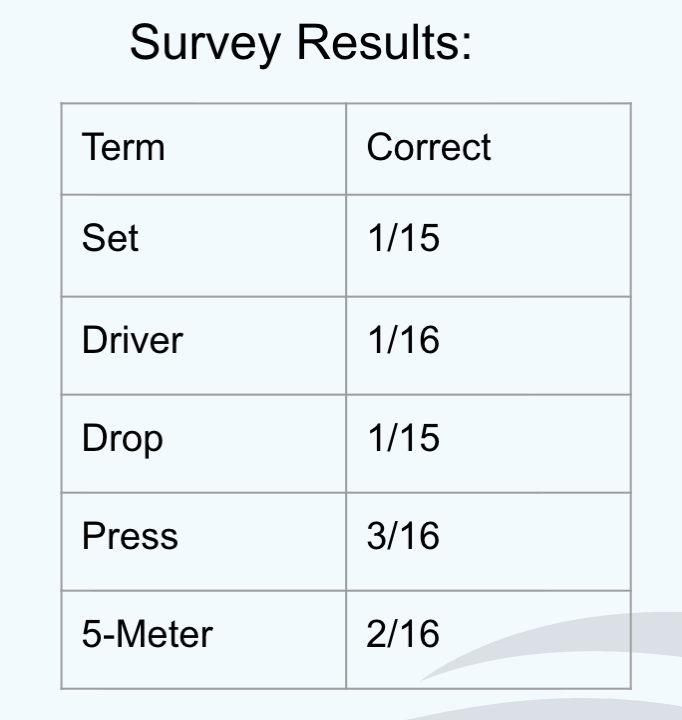
Survey: The results we found suggest that water polo language works as insider vocabulary that players learn through participating in the sport. In the survey, most participants who had never played water polo struggled to correctly identify the meanings of common terms used during games. For example, only 1 out of 15 respondents correctly identified the meaning of “set,” and only 3 out of 16 understood the meaning of “press.” Similar patterns appeared with other terms such as “drop,” “driver,” and “5-meter.” For non-players, these words often sounded familiar but lacked the specific strategic meaning they carry in the context of a water polo game. In the questions where only one participant correctly defined a term, that response came from the only respondent who had prior experience playing water polo.

Interview: The interviews with water polo players showed that these terms are used constantly during gameplay and are understood immediately by teammates to create efficient gameplay. Players also described regularly shouting short commands to coordinate positioning and defensive strategy in real time. Because water polo games move quickly and players are spread out across the pool, they said how this kind of condensed language allows them to communicate complex instructions almost instantly which you will hear in the audio below. The players we interviewed also shared that this vocabulary is not something beginners understand right away. All five of those who were interviewed explained that learning the terminology takes time and usually happens gradually through practice and gameplay, instead of being something that is learned immediately. New players often feel confused by the language at first, but over time they begin to understand how these terms have a function within different game situations.
Check out these audio clips from our interviews:
https://drive.google.com/file/d/1MUnLg9FRJwZIqCuBfIZjgdC1ykzH9Gnz/view?usp=drive_link
https://drive.google.com/file/d/1bzoqAP-eYeIs5lTCKzVnSeWQKjwxoX8y/view?usp=drive_link
https://drive.google.com/file/d/1NO0KYyT7nSGmVvF7oLhDHlBmTycINlME/view?usp=drive_link
https://drive.google.com/file/d/1vj2k2X93bKg-Rv5iyW7wb-xupo0JexoY/view?usp=drive_link
This pattern reflects what linguistic anthropologists Eckert and McConnell-Ginet (1992) described as a community of practice. The language used in water polo is not just random sports jargon, but it is part of the shared knowledge that players build together. Knowing how to interpret and use these terms signals that someone belongs to the group. The data from the interviews also supported Ishak’s (2017) idea that clear verbal and nonverbal signals are crucial for coordination and cohesion on teams because the participants shared that when plays or specific terms are called out they all typically know what to do and it makes for more efficient game play.
In linguistic anthropology, communities of practice are important because they show how language and identity develop together through shared activities. Over time, shared vocabulary becomes part of what defines someone as a member of the water polo community. This helps explain why outsiders in the survey struggled to interpret many of the terms. Understanding water polo language requires not just knowing the words themselves, but also participating in the social and physical environment where those words are used. The survey results and player interviews together show how language in sports can function as both a practical communication tool and a marker of social belonging.
So what?
While our project is limited to a relatively small sample from around UCLA, it points to a broader pattern in sports where specialized jargon helps teams function smoothly while reinforcing group boundaries. Looking ahead, similar methods could be used to compare how jargon works in other sports or to explore how players translate this insider language when they talk to coaches, parents, or fans who are not part of their immediate community of practice. The results we have found from this project remind us that many communities, from workplaces to friend groups, develop their own shared language that strengthens coordination and belonging.
Bibliography
Bucholtz, M. (2002). Youth and cultural practice. Annual review of anthropology, 31(1), 525-552. https://doi.org/10.1146/annurev.anthro.31.040402.085443
Eckert, P., & McConnell-Ginet, S. (1992). Think practically and look locally: Language and gender as community-based practice. Annual Review of Anthropology, 21, 461-490. https://www.jstor.org/stable/2155996
Heath, S. (2024). Banter as transformative practice: linguistic play and joking relationships in a UK swimming club. Humor, 37(4), 529-549. https://doi.org/10.1515/humor-2024-0005
Ishak, A. W. (2017). Communication in sports teams: A review. Communication Research Trends, 36(4), Article 1. https://scholarcommons.scu.edu/crt/vol36/iss4/1
Schei, G. S., Høigaard, R., Erikstad, M. K., Ivarsson, A., & Haugen, T. (2023). Identity leadership and cohesion in elite sport: The mediating role of intra-team communication. Heliyon, 9(7). https://doi.org/10.1016/j.heliyon.2023.e17853
[/expander_maker]