Maegan Abutin, Nicole Li, Melani Matian, Dev Patel
“It helps me understand and relate to people and situations better” and “provides a sense of community and support, especially in spaces we’re underrepresented,” one participant explained when describing their use of code-switching. Our research focuses on bilingual students at the University of California, Los Angeles (UCLA), examining how they use code-switching across public and private campus settings. Many of these students come from immigrant communities and culturally diverse familial networks, where language is closely tied to identity and relationships. This study asks for and why bilingual students choose to switch between languages in different contexts. Drawing on qualitative data from surveys and interviews, we analyze how language use reflects identity, social identity, and institutional expectations. Our findings suggest that code-switching is not random, but rather a strategic practice shaped by setting and audience. While English is often used in academic and professional spaces, other languages are more common in social and cultural interactions with friends and roommates. Code-switching occurs most frequently in casual conversations with other bilingual peers, where crossing languages express emotion, humor, and connection. This study highlights how bilingual students navigate identity and structural power through everyday language practice.
Keywords: Bilingual, code-switching, identity, UCLA students
[expander_maker id=”1″ more=”Read more” less=”Read less”]
Introduction & Background
Universities across the U.S. are linguistically diverse spaces, but on a campus as diverse as UCLA, students regularly navigate between multiple languages in their everyday interactions. English often functions as the dominant institutional language in academic and public settings, leading our group to pose the question: how do bilingual students decide when to switch between languages? The motivation for this study comes from the idea that language choice is not random. While previous research shows that code-switching expresses identity, our group seeks to highlight how bilingual students regulate their language use in response to social and institutional expectations. This study explores this gap, showing how these students adjust their language choices to navigate identity and structural power in everyday campus settings. We argue that multilingual speakers strategically regulate code-switching across private and public settings in response to audience comprehension and institutional language norms, revealing how language choice negotiates identity, accessibility, and structural power.
Methods
This study examines code-switching among bilingual undergraduates at UCLA across diverse social contexts. The study focuses on 14 undergraduate students at UCLA who speak two or more languages and report having used them for a long time. These languages included Armenian, Farsi, Spanish, Mandarin, Korean, and Arabic. Participants were selected through convenience sampling from the researchers’ personal networks, consisting of a close-knit group of friends. Thereby facilitating access to individuals familiar with the campus environment and daily student interactions, both in private and public settings. The research examines both public settings (such as classrooms, campus areas, and academic interactions at UCLA) and private or informal contexts (including conversations with family and close friends, within friend groups, and dorm rooms). This method aligns with the principles of linguistic anthropology, which examines daily interactions as a fundamental site for constructing social meaning, in which language use reflects broader cultural and social dynamics (Dingemanse & Floyd, 2014).
Short questionnaires and casual interviews are used to get participants to talk about their own language use. The analysis does not focus on formal linguistic structure; instead, it examines observable elements in communication, such as code-switching, participants’ identities, and motivations for switching, including the expression of identity, humor, emotion, or clarification. This method is based on conversation-based techniques that examine how to design an audience, how to take turns, and what people mean when they talk to each other in real life (Bahtina, 2026A).
Patterns are identified in all participants’ responses by categorizing analogous behaviors and interpretations. This is a common way to link participants’ social contexts to their interactions (Bahtina, 2026B). Close attention is paid to how language use changes across different settings, such as family, friends, and school, and how these changes reflect societal and institutional expectations for how people should act (Bahtina, 2026C).
The objective of this methodology is not to produce results that could be generalized at a statistical level; rather, it is to uncover significant patterns in the manner in which UCLA bilingual students govern language usage in everyday campus life, as well as the ways in which these choices reflect identity, social connections, and structural factors. Therefore, the goal of this methodology is to produce generalizable results.
Results/Analysis
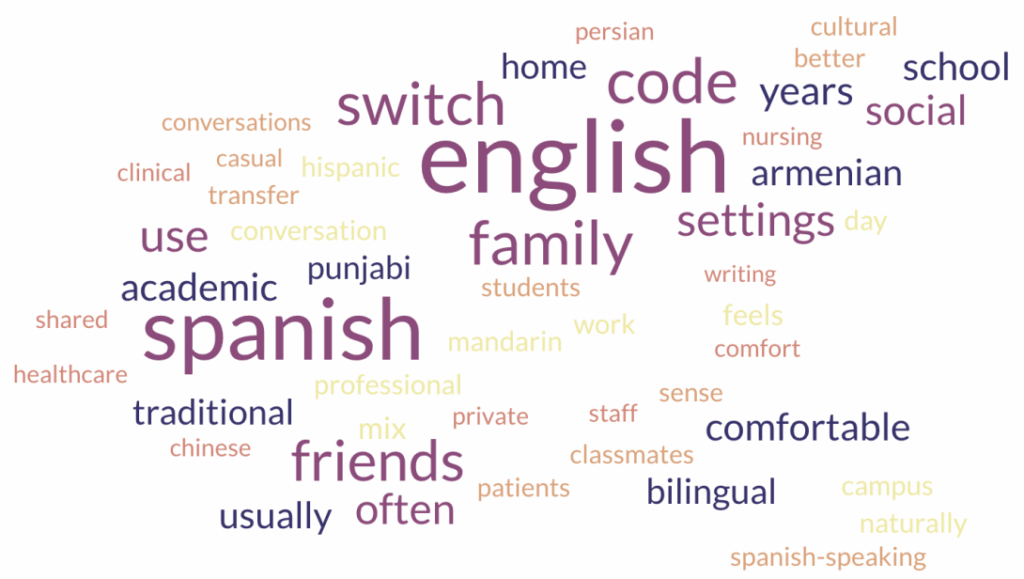
Figure 1. What comes to mind when students talk about code-switching. This word cloud is based on responses from 14 UCLA bilingual students, with larger words reflecting ideas that came up most often.
The following quotes are drawn from our data and grouped by recurring themes in students’
code-switching experiences.
- Identity
“Switching between languages is just part of who I am.”
“It reflects both sides of my identity.”
“I feel like I’m a different version of myself depending on the language I use.” - Community & Belonging
“When I hear other people switching, it makes me feel like it’s okay for me to do it too.”
“It creates a shared understanding between us.”
“It makes conversations feel more natural and comfortable.” - Humor & Expression
“Some jokes only work in one language, so I switch.”
“It’s the only way to make it sound right.”
“Certain phrases just hit better in another language.” - Emotion
“There are things I can say in one language that don’t feel the same in another.”
“I feel more comfortable expressing emotions in one language.”
“Some emotions are easier to express in my other language.” - Institutional Pressure
“In class, I usually stick to English—it just feels expected.”
“It feels more appropriate to use English in academic settings.”
“I don’t want people to think I’m unprofessional.” - Naturalness
“It just happens naturally—I don’t really think about it.”
“Switching languages feels automatic.”
“It’s just how I talk.” - Audience Awareness
“It depends on who I’m talking to.”
“I switch based on whether the other person understands.”
“I adjust my language depending on the situation.” - Family vs Campus
“At home, we usually stick to one language.”
“On campus, I switch more because people are bilingual.”
Code-switching socially during in-person communication is frequent in conversations with bilingual friends, casual conversations, joking or storytelling, and emotional conversations. This was connected to people hearing others code-switching, which encourages them to do so as well; it creates a shared understanding, feels more natural, and signals that both languages are acceptable, per participants’ answers.
More code-switching occurs on campus because students come from diverse linguistic backgrounds and many are bilingual. Shared spaces including dorms, restrooms, and study rooms help students be comfortable switching between languages. As one participant explained, “Some academic terms feel more natural in English, while certain emotions or cultural references feel more authentic in Chinese,” providing more information behind when and why students code-switch. At home, families often speak one main language, so there is less switching and more focus on that language. This contrast suggests that code-switching is shaped by one’s linguistic environment and audience (Zentella, 1997; Duranti, 1997).
English is used primarily in academic and professional settings, while other languages are mainly used in family and cultural environments (Gumperz, 1982; Zentella, 1997). Code-switching, however, occurs more often in casual social situations, especially with bilingual friends who speak the same language. Hearing others code-switch often makes people more comfortable doing it themselves. A participant in our study wrote, “At work and during clinical, I also code switch when helping translate for staff who don’t speak Spanish and patients who do. Being able to move between languages is important because it helps with communication and makes patients feel more understood and supported. It’s not just social, it’s something that has a
real impact in healthcare settings.” This shows the power of language and the role that codeswitching plays in and out of social communities, crossing institutional barriers and structural power. It also conveys how code-switching functions not only as a social practice, but as a communicative resource, allowing speakers to build trust and navigate systems where language differences might otherwise create misunderstanding.
Discussion & Conclusion
In healthcare and legal settings, our findings suggest the possibility to prevent “linguistic profiling,” ensuring that patients and defendants are understood based on their meaning rather than judged by their accent or dialect. Our data also portrays when bilingual students utilize code-switching it provides a further sense of support and cultural connection, especially in academic spaces where students may feel underrepresented. Future studies can sample a larger population in different locations to further study language choice and narrow the study to specific locations such as, restaurants, office workplaces etc.
By recognizing that every word we use has power, we can move beyond stereotypes towards a deeper shared understanding. We show that our words are never just about grammar; rather, they are primary sites of identity construction and a form of cultural contestation. We move beyond simple definitions to reveal that alternating between languages and combining languages, using dialects and different registers, are not barriers or signs of deficiency; they are high-level communicative competencies used to navigate the social world. We validate performative identity as we recognize that we don’t just “have” an identity, we perform it into existence through our daily linguistic choices and interactions. Furthermore, we build community by demonstrating how code-switching functions as a “we-code,” allowing us to establish solidarity to create a safe, inclusive environment for bilingual speakers.
Works Cited
Bahtina, D. (2026A). 6A: Conversation. UCLA Anthropology M150 Course Lectures.
Bahtina, D. (2026B). 8A: Practical work. UCLA Anthropology M150 Course Lectures.
Bahtina, D. (2026C). 7B: Multilingualism. UCLA Anthropology M150 Course Lectures.
Dingemanse, M., & Floyd, S. (2014). Conversation across cultures. In N. J. Enfield,
P.Kockelman, & J. Sidnell (Eds.), The Cambridge handbook of linguistic anthropology.
Cambridge University Press. https://doi.org/10.1017/CBO9781139342872.021
Duranti, A. (1997). Linguistic Anthropology. Cambridge University Press.
Gumperz, J. J. (1982). Discourse strategies. Cambridge University Press.
Auer, P. (2013). Code-switching in conversation: Language, interaction and identity. Routledge.
Zentella, A. C. (1997). Growing up bilingual: Puerto Rican children in New York. Blackwell.
[/expander_maker]