Ahmani Guichard, Presley Liu, Isabella Rivera, Dru Stinson
“Hi! Welcome back to my channel,” the YouTuber begins, waving to the camera. She leans back and starts to talk about her day. Ten minutes pass. “Don’t forget to give this video a big thumbs up!” she grins, flashing raised thumbs. The vlog ends. In the polished, highly edited world of YouTube, each movement counts. Like aesthetically pleasing thumbnails and attention-grabbing titles, gestures can be intentional signals online. Whether taking viewers through “A Day in the Life” or “Landing an Internship,” these creators adjust their hands, faces, and posture due to context. This research highlights gestures across casual and serious content while exploring their influence on digital identity. Analyzing clips from publicly available videos/vlogs, the study examines seven categories of gestures: illustrators, emblems, adaptors, posture, hand openness, and head movement. The research dissects how undergraduate female YouTubers convey expressiveness through their nonverbal behavior. The results indicate that casual videos tend to feature more animated, spontaneous gestures. In contrast, those same creators are more composed, employing fewer gestures overall in formal content. By focusing on gestures, this research adds a new dimension to the sociolinguistic understanding of impression management and gendered norms in the digital realm.
[expander_maker id=”1″ more=”Read more” less=”Read less”]
Introduction and Background
Across digital spaces, content creators strive to present themselves effectively in various contexts. Over the past decade, the rise of young female vloggers has transformed YouTube from a video-sharing platform into a complex stage for influencer culture. These creators document life. Yet, they also navigate the pressures of visibility and social norms in a highly curated world. As the YouTuber phenomenon continues to grow, the importance of understanding how people perform their online identity is ever essential.
Previous research by Abdul Razak (2025) has focused on influencers’ linguistic patterns, such as the use of the word “like.” Other studies have concentrated on influencer actions (e.g., taking selfies) (Adidin, 2016). However, there is a limited understanding of how gestures overall may change based on context for female-identifying content creators. Drawing on Goffman’s (1959) concept of impression management, this project considers how vloggers may act as performers on a digital stage. Abidin’s (2016) theory of subversive frivolity reframes seemingly lighthearted content as sites of resistance, where femininity becomes a tool for navigating digital labor. Hence, this existing literature further legitimizes the inherent merits of our research focused on shifts across content by this group of young, female YouTubers who are often dismissed.
This study examines how undergraduate female YouTubers utilize nonverbal cues in their casual versus serious videos. This examination seeks to contradict the perception of this group as one-dimensional and hypothesizes that our sample changes their gestures to fit the situation — more expressiveness (a higher amount of hand gestures and more relaxed posture, head movements, and hand openness) in casual videos and less in serious ones.
Methods
We began our study by observing five female YouTubers based on their popularity, as we were interested in analyzing videos with high admiration. We noted creators who had verified statuses, a strong following, and a high number of views. We focused mainly on those with over ten thousand subscribers, which then led to a high viewer count on the videos we chose. Our selection included twenty videos total, with two casual and two serious videos per creator. This came out to four videos for each of the five creators. Each one was determined as casual if it involved low social or personal stakes, like “a day in the life,” while serious videos included high social or academic stakes, such as career planning. We randomly selected a five-minute clip to observe from each one with an online number generator (numbergenerator.org), to remove any sort of bias. We recorded data when the YouTuber had their face visible on the screen and spoke to the audience. With each clip, we examined multiple gesture categories due to their associations with expressiveness. These gestures were adaptors, illustrators, emblems, posture, hand openness, and head movements.
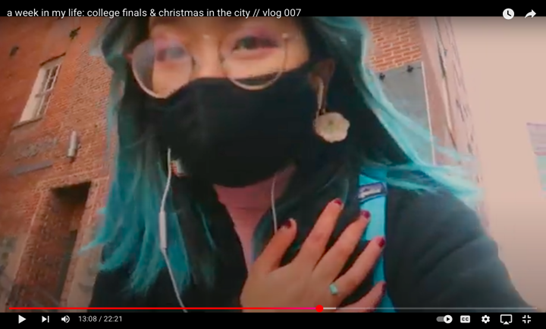
We then coded each clip by counting the raw numbers of illustrators, adaptors, and emblems we observed per clip. Illustrators are gestures that send a message, like pointing or placing a hand on your chest, as shown in Figure 1.
Figure 1: Example of Illustrator from Lihn Troung’s “A week in my life: college finals & christmas in the city // vlog 007”
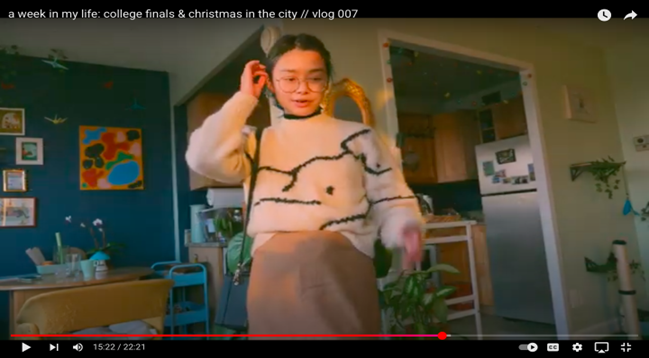
Adaptors, on the other hand, involve self-touching behaviors like scratching or rubbing and are typically unconscious responses to adapt to one’s environment (Kelmaganbetova et al., 2023). Figure 2 shows an example of an adaptor from Lihn Troung’s videos where she tucks her hair behind her ear.
Figure 2: Example of Adaptor from Lihn Troung’s “A week in my life: college finals & christmas in the city // vlog 007”
Emblems are substitutes for words or phrases in communication, like the peace sign shown in Figure 3.
Figure 3: Example of Emblem from Lihn Troung’s “A week in my life: college finals & christmas in the city // vlog 007”

Our next step was to further observe and calculate each video’s expressiveness. We did this in terms of the creators’ posture, hand openness, and head movements throughout the videos. To code this step, we utilized a Likert scale to determine the levels of each gesture displayed by the creator. For instance, a video with relaxed posture would have a rating of 1 on the Likert scale, while a rating of 5 would indicate formal levels of posture throughout the video. The same was for hand openness where a 1 meant closed hand positions, and a 5 meant open. High levels of head movement received a rating of 5, while still head movements received a 1. We performed interrater testing as well, in order to ensure overall consistent results. This testing measured consistency by having more than one group member collect the data.
Results and Analysis
The data set partially lined up with our prediction. Our group’s hypothesis was that young women in undergraduate programs would have a significant difference in gestures between serious and casual content. Our data demonstrated some differences between serious and casual contents’ data. However, there seemed to be more variance between the person that had uploaded the videos themselves versus their actual content type. Something we noticed was that postures would be more “correct” or upright in serious videos in general. Meanwhile, casual videos often had slouchier or relaxed posture. The frames were another factor that typically depended on the type of video that was being seen. For example, shoulders up was the frame that was seen in serious videos. On the other hand, videos that were more casual typically had a less consistent frame. Throughout the videos there was also a difference between different creators. Lihn Truong was the only creator that we viewed that fit the prediction that nine or more illustrators would be visible in casual content. Helaine Zhao and Studyquill had less gestures when filming serious content. Some of the creators kept many of their video styles pretty consistently. Mikayla Mags would be an example of a creator that had high illustrators across video types. Mags also kept a similar posture throughout her videos. Other things that we noticed among videos were that some creators had lower gestures on the Likert scale despite a difference in content type. Lillian Zhang kept a formal style of video content and personality throughout. The patterns observed demonstrate how tone and individual creators overall have more variety rather than their content type. It can be connected to sociological themes such as gender and women trying to be perceived as likable by other people due to societal expectations to be kind and nurturing. This can potentially come across differently depending on the content creator and what they perceive to be according to standard. It is also important to note that this may be a subconscious decision to do so.
Figure 4 shows the gesture counts calculated for Lihn Troung’s videos, along with the Likert scale data for each one. As shown in her casual holiday vlog, she used 10 illustrators, 5 adaptors, and 4 emblems. We can see that her serious content showed more restrained posture, fewer gestures, and closed body language. For more detailed counts and results, see the data table linked at the bottom of this post.
Figure 4: Results from Lihn Troung’s Videos (Raw Counts and Likert Scale)
| Video Title | YouTuber | Vlog type | Illustrators | Adaptors | Emblems | Posture | Hand Openness | Head Movements |
| A week in my life: college finals & christmas in the city // vlog 007 | Lihn Troung | Casual | 10 | 5 | 4 | 5 | 5 | 5 |
| another productive day in my life studying, coffee omakase, dance practice, & senior year memories | Lihn Troung | Casual | 8 | 1 | 3 | 4 | 4 | 4 |
| why you need hobbies in 2024 // rediscovering my hobbies as a burned out college student | Lihn Troung | Serious | 6 | 1 | 3 | 2 | 4 | 5 |
| study with me for college finals (pomodoro method) | Lihn Troung | Serious | 6 | 4 | 7 | 2 | 2 | 1 |
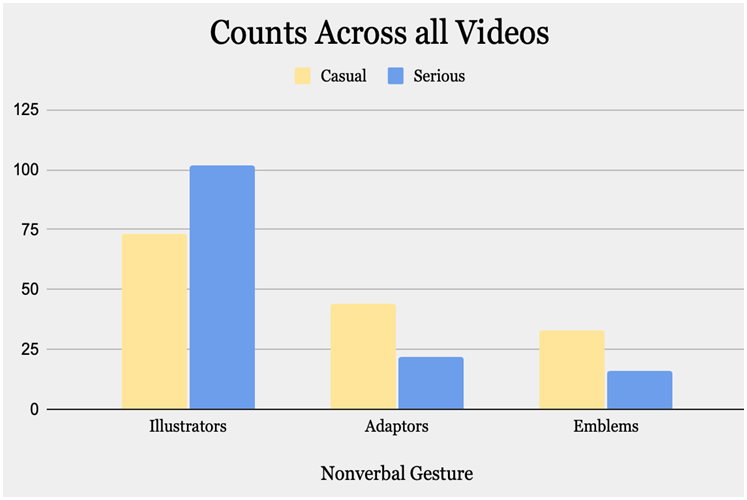
Regarding other overall trends, illustrators were the most frequently counted gesture. Casual vlogs showed higher amounts of adaptors and emblems; however illustrators actually appeared more frequently in serious videos. Yet, serious vlogs showed fewer hand gestures as depicted in Figure 5.
Figure 5: Relationship between Gesture Counts of Casual vs. Serious Videos
X-axis: Nonverbal Gesture
Y-axis: Number of Counts
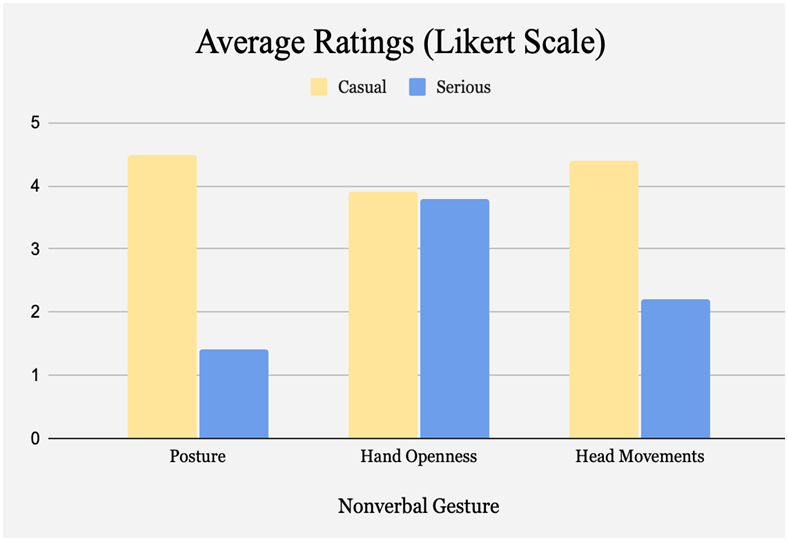
Examining the data from the Likert scale included in Figure 6, casual videos had an average score of 4.4 for head movements while serious videos scored an average of 4.8, depicted variation in relaxed and expressive behavior. However, hand openness remained consistent across topics, contradicting part of our original hypothesis which predicted that hand openness would be more prevalent in casual content.
Figure 6: Average Ratings of Expressiveness using Likert Scale (1-5)
X-axis: Expressive Gesture
Y-axis: Rating
Thus, while variation occurred between YouTubers, with some like Linh Troung adhering to our hypothesis closely while others like Makayla Mags presented some contrasting data, overall, a distinction in gestures between causal versus serious content is visible.
Discussion and Conclusion
Overall, YouTubers in casual vlogs displayed more expressive behaviors — more adaptors and emblems, relaxed posture, and head movements. In contrast, serious vlogs tended to feature more restrained gestures yet a higher number of illustrators. Although these patterns largely supported our hypothesis and the results from previous literature, individual variation between vloggers and the counts for illustrators suggests the benefits of a further study.
Our sample size of five female undergraduate YouTubers is one limitation of our study. While this small group allowed for detailed coding, it curbs the generalizability of our results. Furthermore, although the structured coding scheme and interrater testing helped mitigate bias, gesture analysis inherently involves some degree of interpretation. Distinguishing between an illustrator and an adaptor can be context-dependent. Without direct input from the creators themselves, interpretations largely remain speculative — especially regarding intentionality. It is also uncertain how gender specifically shapes these behaviors. Future research could compare how gestures differ between a sample of male versus female YouTubers.
Although additional research may help us derive more concrete overall conclusions about our population, our study offers several benefits to the study of interpersonal communication and societal understanding of internet culture. Our research challenges stereotypes about female influencers by showcasing their context-sensitive nonverbal use. The shift in physical behavior depending on the topic can suggest acute awareness of audience expectations. These patterns contribute to our broader understanding of impression management as gestures take on a layered meaning. The openness adopted in casual vlogs reflects a negotiation of credibility. In serious videos, reducing gesturing and maintaining an upright posture aligns with traditional markers of authority, while in casual contexts, animated movement may serve to build rapport and relatability (Smith, 2017). Gestures become a coded method of exploring platform visibility, societal norms, and professional aspirations.
The findings point to a broader takeaway — nonverbal communication is a vital aspect of digital self-presentation. Although these gestures may be subtle, they wield significant implications for how we understand identity, labor, and gender in the age of influencers.
EXTENDED DATA TABLE + COUNTS
- https://docs.google.com/spreadsheets/d/1RnSxkMVnGdnex0hzXd5Kp_PWCNb36AltPVLHQpakhfs/edit?usp=sharing
RECOMMENDED READING/VIEWING (RELEVANT INFO)
- https://youtu.be/ZzEOs9bVpZQ?si=g0jPMMVomBFOFCV6
- https://languagedlife.ucla.edu/sociolinguistics/the-linguistic-switcheroo-navigating-style-shifts-in-college-discourse/
- https://www.frontiersin.org/journals/psychology/articles/10.3389/fpsyg.2025.1568341/full
- https://www.talkabouttalk.com/gender-differences-in-communication-ep-141/
REFERENCES
Abdul Razak, N. (2025). The use of slang by Gen Z female influencers on Instagram and Twitter (X). International Journal of Research and Innovation in Social Science, 9(4), 1910–1917. https://rsisinternational.org/journals/ijriss/articles/the-use-of-slang-by-gen-z-female-influencers-on-instagram-and-twitter-x/
Abidin, C. (2016). “Aren’t these just young, rich women doing vain things online?”: Influencer selfies as subversive frivolity. Social Media + Society, 2(2), 1–17. https://doi.org/10.1177/2056305116641342
Goffman, E. (1959). The presentation of self in everyday life. Anchor Books. Retrieved from https://archive.org/details/presentationofs00goff
Kelmaganbetova, A., Mazhitayeva, S., Ayazbayeva, B., Khamzina, G., Ramazanova, Z., Rahymberlina, S., & Kadyrov, Z. (2023). The role of gestures in communication. Theory and Practice in Language Studies, 13(10), 2506–2513. https://doi.org/10.17507/tpls.1310.09
Number Generator. (n.d.). NumberGenerator.org. Retrieved June 10, 2025, from https://numbergenerator.org (https://numbergenerator.org/)
Smith, H. J., & Neff, M. (2017). Understanding the impact of animated gesture performance on personality perceptions. ACM Transactions on Graphics, 36(4), Article 128. https://doi.org/10.1145/3072959.3073697
[/expander_maker]