Going Greek?
Jasmin Lopez, Samantha Solowitz, Max Orroth, Esther Lin, anonymous author
Collegiate Greek life has been around for centuries, fraternities first being established in 1775 followed by sororities in 1851, giving both men and women the opportunity to become a member of an exclusive association promising brotherhood and sisterhood to all who join. The mysterious and vague identity of these fraternities and sororities became a tradition, with members specifically using terms and/or slang that make sense only to those involved. The purpose of our blog is to recognize the meaning behind Greek life slang, and how this particular lexicon represents a departure from formal language. We delve into the nuances of Greek life, from its rich history and recruitment process to understanding its cultural shift in linguistic trends and social dynamics. Through the use of online videos and fieldwork, we explored how Greek life slang terms develop a strong sense of social acquisition for those directly involved while simultaneously maintaining a form of mystery for those who are not.
Background
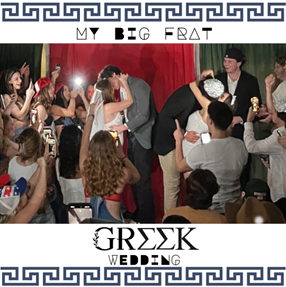
As I (Max) walked into the Phi Kappa Psi house on a Tuesday night for a frat wedding (a faux wedding, two fraternities/sororities come together to host their chosen couple), a brother greeted me: “Hey welcome bro, tonights gonna be so ferda.” I didn’t understand what he meant by this at all, specifically ferda, and when I asked what the word meant I never got a straight answer. It was clear at this moment, to me and the brothers of Phi Psi, that I was an outsider. I did not understand their secret slang, and for the rest of the night, I felt like a toddler asking what words everyone seemed to know meant.
The example above showcases an ingroup outgroup dynamic. Through this experience, we sought to understand the slang evoked in the Greek life college setting, towards a cultural shift in linguistic and social status. Through the use of online videos and fieldwork, we explored how Greek life slang acquisition is used to communicate valuable insight into fraternities and sororities. This project draws on two main questions; How does Greek slang separate members of Greek life from the broader collegiate community? And, How do Greek organizations undergo a socialization process through linguistic genres?
Introduction to Greek Life
The origins of Greek culture can be identified in the late 18th century when the initial Greek-letter societies were founded (Harding, 1972). Greek life is a conduit for lifelong friendships, countless parties to attend, and the opportunity to live in a mansion with 20-50 peers (Jones, 1976). However, the daily lives of some “brothers” and “sisters” are widely known to be exclusionary, insular, and with roots in the secretive masonic lodges (Dymchuk, 2020). The groups are segmented into fraternities for men and sororities for women. Like most groups, Greek life holds its own set of slang terms, and priori language is only understood within the community. Slang is not an official language, but is characterized by familiar coloring (Izmaylova et al., 2017). Familiar coloring refers to certain words being associated with a specific group, used to linguistically signal identity and ingroup status. More specific to the linguistic environment we studied, college slang amongst undergraduates pulls from both broad lexicons as well as university and context-specific slang (Hummon, 1994). We hypothesize that at its core, greek life slang represents a departure from formal language, often characterized by its genre. This departure of informality is developed through sociocultural language acquisition (Ochs & Schieffelin, 1984). The social functions of slang are manifold. Firstly, it serves as a marker of group identity, fostering a sense of camaraderie among those who share a common slang lexicon (Bucholtz, 2012). The slang lexicons used by sorority members and fraternities alike use phrases, symbols, and handshakes only known to collegiate Greek members, differing from the common use of slang found by nonmembers.
Ready to embark on a Greek life journey?
We were not! This is why our methods are participant observation and visual anthropology. We examined how the words and phrases are used in context and how they deviate from mainstream slang through visual anthropology (Abasi & Taylor, 2007).
Methods
For our methods, we used TikTok and YouTube videos; which involve heavy use of acronyms, Greek letter symbols, and code language.

Some popular accounts on TikTok were @makeupbymckenna and @emmaortiz24.
@makeupbymckenna’s TikTok videos titled “GRWM” (get ready with me) displayed a full day of the “Last rush week ever.” While @emmaortiz24 showcases a “GRWM” with Penn State recruitment trips. “Day in the Life” were mostly made by women in sororities representing “PNM”, “PIE PIE”, “DLAM”, “Olemiss”, etc. In the introduction to one of the TikTok videos, a girl is doing her makeup to get ready for sorority recruitment as a “TriDelt” and talking about the amount of “PNMs” that are going to be at their “house.” She advises those who will be participating in the recruitment process to make intentional relationships with other “PNMs” from their “pledge class” or “active number.” In a similar video, a girl advises her audience to let their “Pie Pie” know if they are going to be late to an event.
The YouTube videos we looked at were videos about “rushing” which is the recruitment process for joining a sorority. The picture above is Lauren Norris, talking extensively about her experience of being “dropped” from sorority Pi Beta Phi. This was a contrast from the TikTok videos which seem to be an audience for sisters “in” the sorority. Whereas, Lauren talks about her experience of being “out” of the organization.
Although the videos were meant to be informative, the slang used in the videos made it difficult to understand the symbolic meaning of words such as rush, dropped, sisters, and acronyms. Our research results in a complex web of terminology that defines, unites, and separates members of Greek life from the broader collegiate community.
Results
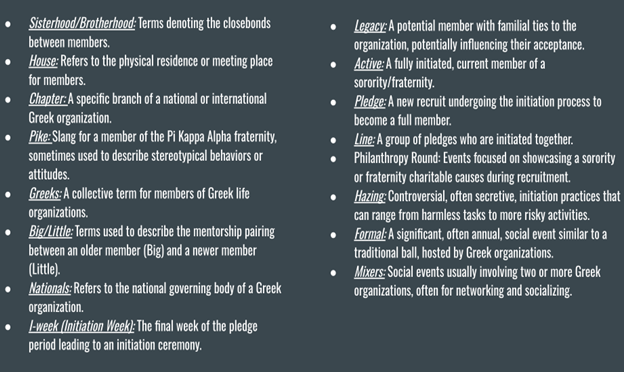
Here is a compiled list of the common slang terms used in Greek culture:
Analysis
New members of Greek organizations seem to undergo a rapid socialization process to become competent members of their respective communities. In videos such as “GRMW(Get Ready with me)” or “Day in the life,” the general public may recognize the language used within the videos but certain keywords would not be understood unless one had previous knowledge of them. These videos demonstrate that a majority of the slang used are English words or acronyms that may seem out of context to those unfamiliar with Greek life and possibly even completely change their meaning (Nardyuzhev et al, 2017), solidifying the barrier between those within the community and those outside it. Our analysis of Greek life slang reveals a rich and complex language system that serves multiple functions: it cements the bonds between members, upholds traditions, and sets the community apart from the broader campus, and society.
Conclusion
Throughout this study, we analyzed Greek life culture through their unique sociolinguistic and cultural acquisition. This research has provided a comprehensive exploration of the multifaceted dynamics within Greek life, encompassing indexical slang, language social acquisition, online communities, and symbolic vocabulary. Through an interdisciplinary approach, the group was able to integrate sociolinguistics, visual anthropology, and analysis, to uncover the intricate interplay between language, identity, and rituals within Greek organizations. Through research into archetypes and codes that generate sense, our findings determine that symbols did not hold the ultimate meaning, but rather offered a vast array of interpretation possibilities; they served as a gnoseological key, a means of self-learning and learning about “philosophical knowledge,” and a medium for the development of the adept’s gnoseological qualities. To an outgroup member, this translates into a form of social acquisition during the initiation process, a crest or secret message is revealed as a rite of passage, only to be mentioned among the membership for exclusive purposes. Greek organizations separate ideology from each other by ascribing symbolic meaning to their group organization. Hence the various phrases, symbols, and handshakes are showcased in varied TikToks, YouTube, and the Greek wedding ritual. This socialization process is enacted by active members, who are assigned the task of formal recruitment. This process entails acts of initiation that signal the acquisition of the group’s values, pledges, and ultimately the group’s acceptance.
References
Bucholtz, M. (2012). Word Up: Social Meanings of Slang in California Youth Culture. eScholarship, University of California.
Dymchuk, A. (2020). Masonic symbolism in the context of philosophical anthropology searches. Skhid, 1(165), 60–66. https://doi.org/10.21847/1728-9343.2020.1(165).197068
Harding, Thomas S. (1972), College Literary Societies: Their Contribution to Higher Education in the United States, 1815–1876, New York, New York: privately published
Hummon, D. M. (1994). College Slang Revisited: Language, Culture, and Undergraduate Life. The Journal of Higher Education, 65(1), 75–98. https://doi.org/10.2307/2943878doi.org/10.2307/2943878
Izmaylova, G.R., Zamaletdinova, G.R., & Zholshayeva, M.S. (2017). Linguistic and social features of slang. International Journal of Scientific Study, 5(6), 75-78.
Jones, B. M. (1976). The American fraternity. In Paper presented at the meeting of the National Interfraternity Conference, Williamsburg, VA.
Ochs, E., & Schieffelin, B. B. (1984). Language acquisition and socialization: Three developmental stories and their implications. In R. A. Shweder & R.A. LeVine (Eds.), Culture Theory: Essays on Mind, Self, and Emotion. CUP, pp. 276-320.
Nardyuzhev, V. I., Nardyuzhev, I. V., Marfina, V. E., & Kurinin, I. N. (2017). AMERICAN SLANG: DIACHRONIC ANALYSIS. RUDN Journal Of Informatization In Education, 14(4), 399-405. doi: 10.22363/2312-8631-2017-14-4-399-405