Click, Swipe, Connect: Flirting Directly and Indirectly through Online Mediums and In-Person Interactions
Natasha Motamed, Sasha Bok, Angelica Limoanco, Ashley Lopez
Does the medium in which you flirt with someone change your flirting style? Are you more likely to use direct language such as complimenting when trying to flirt online versus in-person, or are you more likely to use a pick-up line? The following research project will investigate how individuals flirt online via private messaging on dating apps such as Hinge, Bumble, and Tinder, and text messages versus in-person interactions and whether they use direct or indirect language in their flirting practices. Based on previous findings, we hypothesized that flirting on various online mediums will employ greater directness, whereas in-person flirting would consist of more indirect language. To test these hypotheses, we compared screenshots of online flirting interactions with flirting scenes between contestants on The Bachelor and Bachelor in Paradise.
Our main finding was that flirting on online mediums consisted of both direct and indirect communication through the usage of compliments and pick-up lines, respectively. Therefore, our hypothesis was partly true in predicting that online mediums would at least employ direct communication. On the other hand, we were surprised to discover that in-person flirting employed direct communication rather than indirect communication, which was what we had initially predicted.
Introduction and Background
How exactly do you interpret what flirting is? According to Wade (2018), flirting refers to words or nonverbal actions that include any semblance of romantic and sexual relations between individuals. Moreover, when communicating face-to-face, flirtatious speech is also often used with laughter and animated speech (Whitty, 2016). With flirting, it is prevalent within our society today both in-person as well as on online mediums. Regardless of whether someone uses pick-up lines or compliments to flirt, people tend to communicate differently depending on the modality they are using, i.e. online or in-person.
For our research, we investigated how people flirt differently depending if it is in-person or online. We researched and observed the similarities and differences of flirting indirectly or directly between in-person interactions of The Bachelor and Bachelor in Paradise contestants and online private messages on various dating mediums, direct messages, and texts, which were obtained from 18-29-year-old UCLA students. When looking at the linguistics of flirting, indirect communication can be defined as nonverbal choices such as pauses and bouts of silence, where the recipient must contextualize the situation in order to more accurately discern the speaker’s implied message (Joyce, 2012). Pick-up lines are a perfect example when it comes to indirect flirting since there might be hidden messages beyond what is actually being said. A popular example of this would be the infamous saying “Netflix and Chill,” which requires contextual clues in order to decipher the sexual innuendo being implied.
On the other hand, direct communication means there is no hidden meaning in what is being said, so the speaker will use exact words for their intended meaning (Joyce, 2012). An example of direct communication while flirting is a compliment, such as “I think you are gorgeous.” We had hypothesized that flirting on various online mediums will utilize greater directness, whereas in-person flirting will use more indirect language and word choice. Whether it was a Bachelor franchise contestant flirting in-person or a UCLA student flirting online, they had all found different methods of flirting depending on where they communicated from (see below in Results).
Methods
To investigate these hypotheses, we observed two target populations –– the first consisted of male, female, and non-binary/non-conforming UCLA students, ages 18 to 29, from any ethnic or socioeconomic background. While people of all ages and demographics use the internet, according to Smith (2014), the majority of internet users are actually between the ages of 18 to 29. Additionally, it has also been noted that they utilize technology to start romantic relationships (Meenagh, 2015). Therefore, we analyzed their online communication through various online platforms such as dating apps (Hinge, Bumble, and Tinder) and private text messaging. Our second target population included cisgender male and female contestants, ages 21-35 years old, from any ethnic background and socioeconomic status, on the television shows The Bachelor and Bachelor in Paradise. We observed their in-person communication through their methods of flirting shown on-screen.
The communicative/language aspects our project looked at included directness versus indirectness which is observed through word choice and specifically manifested through pick-up lines versus straightforward phrases and complimenting. These practices are used as a means to flirt in both in-person and online contexts.
We recruited the participants for our first target population and collected their screenshots by posting a Google Form on various platforms that UCLA students use such as GroupMe chats from various classes, Instagram stories, and Slack groups. Participants were asked to submit one or more screenshots where they used flirting on the following platforms: Hinge, Bumble, Tinder, or private messaging.
Our total data set included 33 screenshots of conversations on various online platforms as well as 21 in-person interactions observed from The Bachelor franchise shows. Throughout the analysis process, we highlighted and noted which interactions utilized indirect and direct communication by analyzing word choice in addition to the use of compliments and pick-up lines.
Results and Analysis
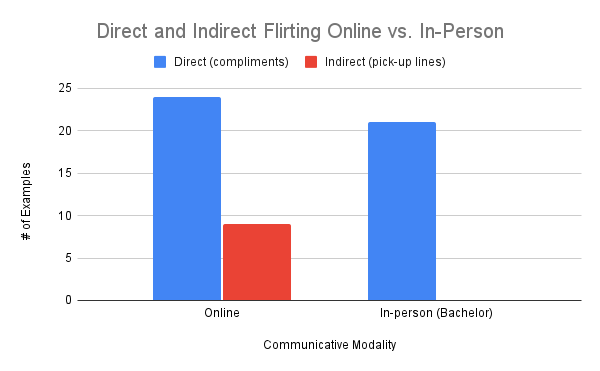
As a result, in Figure 1 we see a comparison of direct and indirect communication within in-person and online interactions. Direct communication like compliments were seen the most in online mediums as well as in in-person interactions. Indirect communication such as pick-up lines were only seen in online interactions.
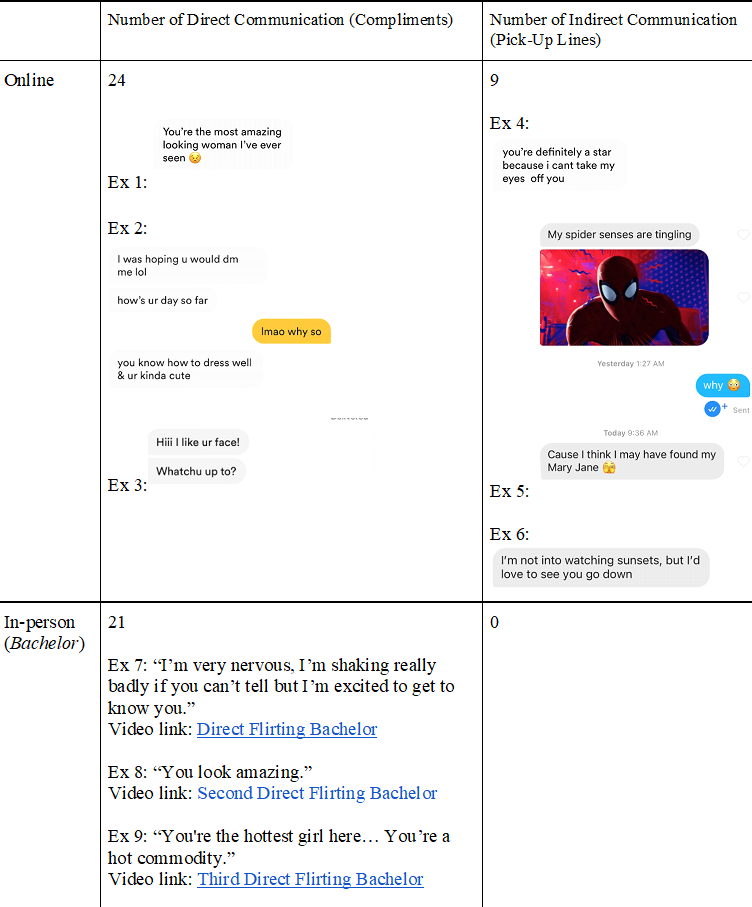
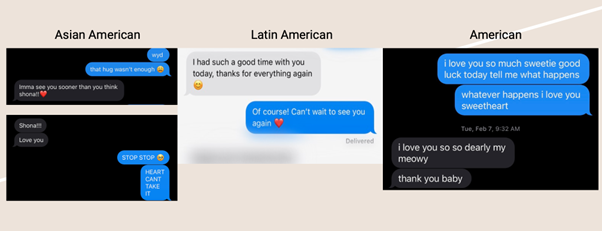
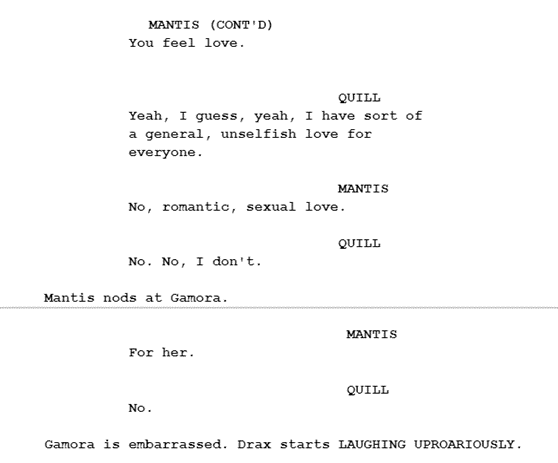
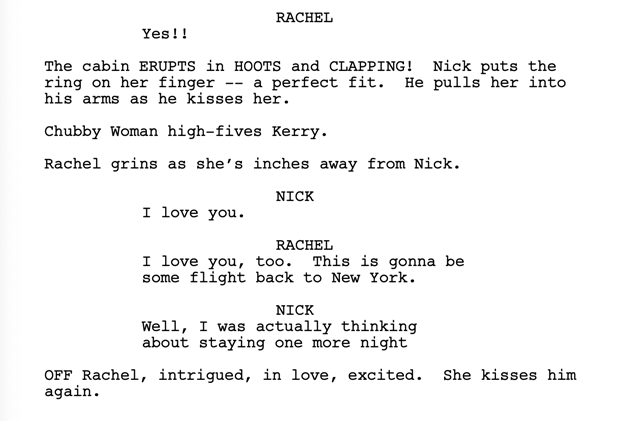
After collecting our empirical evidence, we observed that out of 33 online flirting interactions, 24 of them contained direct communication manifested through compliments whereas only 9 interactions contained indirect communication through the use of pick-up lines. Examples of direct and indirect communication observed are shown in Figure 2 above. This shows that although both direct and indirect communication are utilized on online platforms, the majority of online interactions use direct communication. In contrast, out of a total of 21 in-person flirting interactions, all of them contained direct communication and none of them contained any indirect communication or the usage of pick-up lines. Examples of direct communication in in-person interactions are linked in Figure 2 above.
After observing 33 screenshots and 21 in-person interactions, we found that pickup lines were very prominent in online mediums and were used indirectly compared to in-person interactions. Participants in The Bachelor franchise were more direct in their conversations while pursuing a romantic relationship. They did not utilize any indirect communication such as through pick-up lines in person. But in both mediums, compliments were utilized. For example, the following compliments were used on online mediums: “you know how to dress well and ur kinda cute”, “I like ur face”, “I think you’re gorgeous”, “you really fine”, and “that smile won me over”. The following compliments were used in in-person interactions: “I’m very nervous, I’m shaking really badly if you can’t tell but I’m excited to get to know you,” “you look amazing,” “you’re the hottest girl here,” and “you’re a hot commodity.” In online mediums, it is much more common to see someone use direct language when they ask if someone is free when compared to in-person interactions. Individuals will use direct language such as “Are you free this Tuesday” or “U free later tn tho?” We found that people online were more indirect through their usage of pickup lines and it was rare to see pickup lines like “you’re definitely a star because I can’t take my eyes off you” used in person. Both online and in-person interactions used direct and explicit word choices in the form of compliments in order to get their meanings across. However, in the in-person interactions, our observations found that the flirting did not result in any individual asking out another person. Overall, we found that flirting online utilizes both direct and indirect communication through the use of complimenting and pick-up lines, respectively, whereas in-person interactions solely use direct communication as a means to show romantic interest.
Discussion and Conclusion
For our Post Data Collection Analysis, we concluded that word choice can result in either direct or indirect communication, for example through compliments or pick-up lines, respectively. We observed both the screenshots and Bachelor scenes through the lens of explicit and implicit word choice, and ultimately placed them into their respective categories, as seen in the chart and graph above.
Based on these findings alone, we could predict that flirting on online mediums could potentially lead to higher or more frequent usage of direct and indirect communication through the employment of pick-up lines and compliments. We attribute this trend possibly to people feeling more confident or comfortable when there is a physical distance between the parties involved and also due to the anonymity veil provided by device screens.
In regards to the validity of our observations and findings, we do acknowledge that there are limitations in having The Bachelor represent in-person flirting practices due to the possibility of it being scripted. Therefore, it’s important to note potential differences between our samples from the reality show and what actually happens within everyday life.
That being said, we believe that our observational results can benefit anyone who communicates online or would like to explore the benefits of talking to and meeting new people online, especially in the romance department. As daily users of technology and online communication yourselves, you can definitely utilize our findings to improve your methods of obtaining the best romantic partner ever! We want you to succeed romantically as much as possible, so take our results into consideration when looking for your future partner in crime!
For future purposes, it’s also important that we research and examine any new and upcoming trends and patterns that arise from our behaviors within these online modalities, especially since we live in this technological age where the majority of society is now heavily reliant on social media as a primary means of communication.
References
Joyce, C. (2012). The impact of direct and indirect communication. Journal of the International Ombudsman Association.
Meenagh, J. (2015). Flirting, dating, and breaking up within new media environments. Sex Education, 15(5), 458–471. https://doi.org/10.1080/14681811.2015.1033516
Smith, J. (2014). The Perceived Impact of Online Versus Offline Flirting on Romantic Relationships [Master’s thesis, University of Dayton]. OhioLINK Electronic Theses and Dissertations Center.
Wade J. A. (2018). (I Think) You Are Pretty: a Behavior Analytic Conceptualization of Flirtation. Perspectives on behavior science, 41(2), 615–636. https://doi.org/10.1007/s40614-018-0136-y
Whitty, M. T. (2004). Cyber-flirting: An examination of men’s and women’s flirting behaviour both offline and on the Internet. Behaviour Change, 21(2), 115-126. https://doi.org/10.1375/bech.21.2.115.55423